Anastasia Krupnik Summary, Characters and Themes
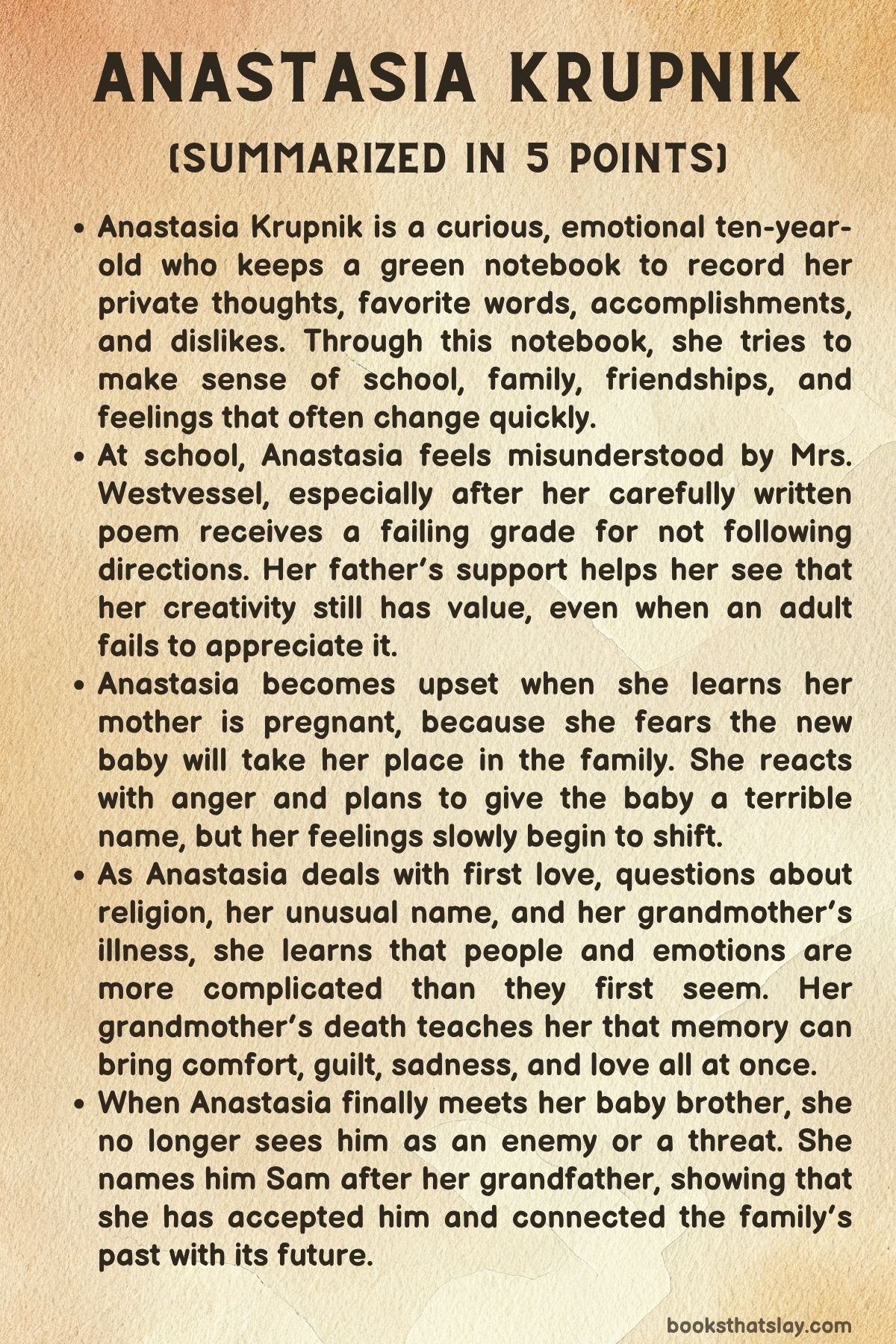
Anastasia Krupnik by Lois Lowry is a funny and thoughtful children’s novel about a sharp, emotional, and opinionated ten-year-old girl learning how complicated growing up can be. Anastasia lives with her professor father and artist mother, keeps a private green notebook, and tries to make sense of school, family, love, memory, death, and the arrival of a baby brother.
Her thoughts are often dramatic, but they are also honest and curious. Through Anastasia’s lists, mistakes, changing opinions, and sudden realizations, the book captures the awkwardness and wonder of childhood in a warm, intelligent way.
Summary
Anastasia Krupnik follows ten-year-old Anastasia Krupnik, a bright, sensitive, and stubborn girl who is trying to understand herself and the world around her. She lives with her parents in a home filled with books, art, poetry, and conversation.
Her father is a literature professor and poet, while her mother is an artist. Anastasia admires her father’s writing, especially because one of his poetry books is dedicated to her.
This makes her feel special, and it also shapes the way she thinks about words, ideas, and her own importance.
Anastasia keeps a green notebook where she writes private thoughts, special words, lists, facts about herself, and early attempts at poetry. The notebook becomes her way of sorting through feelings that are often too big or confusing to handle all at once.
She writes about her age, her wart, her teacher, her likes and dislikes, and the important events in her life. She also keeps a list of people and things she hates, though her feelings often change as she learns more.
At school, Anastasia struggles with her teacher, Mrs. Westvessel. Anastasia dislikes her because the teacher makes her feel foolish, especially when Anastasia sees things differently from her classmates.
When the class is assigned to write poems, Anastasia is excited. She works hard for several nights, throwing away many failed attempts before finally writing a poem she believes is good.
Her poem is thoughtful and full of imagery, but it does not rhyme like the teacher expects. Mrs. Westvessel gives it a failing grade because Anastasia did not follow directions.
Anastasia is hurt and angry, but her father reads the poem and praises it. He changes the “F” on the paper so it stands for “fabulous,” helping Anastasia believe in her own voice even when an adult misunderstands it.
Anastasia’s sense of stability is shaken when her mother announces she is pregnant. Anastasia is furious at the idea of a baby joining the family.
She feels that her parents already have her and should not need another child. In protest, she threatens to move out and begins packing.
Her father gently persuades her to stay by reminding her about Christmas and by offering her the chance to name the baby if she remains. Anastasia agrees, but she secretly chooses a terrible name as revenge.
Anastasia also experiments with identity. She decides she might become Catholic because many of her classmates are Catholic and because she wants to choose “Perpetua” as a middle name.
Her friend Jennifer takes her to church, where Anastasia learns about confession. When Jennifer explains that Anastasia would have to confess her sins and be truly sorry, Anastasia realizes this religion may not suit her.
She does not want to say she is sorry unless she actually means it. This moment shows Anastasia’s strong honesty, even when her honesty makes things harder.
Her emotional life becomes even more dramatic when she decides she is in love with Washburn Cummings, an older boy at school. She bases this conclusion on a magazine article about love and begins to believe her feelings are serious.
Her parents respond calmly, which frustrates her because she wants them to understand how important this feels. Hoping to impress Washburn, she changes her hair to look more like his.
Instead of admiring her, he laughs and asks if she has electrocuted herself. Anastasia is crushed.
She goes home sick with embarrassment and writes that she hates him many times in her notebook.
Anastasia also worries about her name. Some girls at school form a club with cute nicknames ending in “i,” and Anastasia feels left out because her name does not easily fit the pattern.
Her father tells her she shares a name with Anastasia Romanov, daughter of the Russian czar. This makes Anastasia wonder about history, identity, and whether names carry special meaning.
Her father suggests she ask her grandmother, who was alive during that time, but Anastasia feels uneasy because her grandmother is old, ill, and forgetful.
Her grandmother’s condition brings Anastasia face to face with aging and sadness. At Thanksgiving, her grandmother visits the family.
Anastasia is uncomfortable because her grandmother forgets things and sometimes thinks Anastasia’s father is still a child. Anastasia dislikes her own discomfort, especially because her grandmother’s eyes are kind.
When her grandmother watches for her late husband, Sam, as if he might return, Anastasia is deeply affected. She begins to understand that love and memory can remain powerful even when the present becomes confusing.
During a school break, Anastasia goes with her father to one of his college classes. She is surprised that grown college students have trouble understanding a poem.
After class, she and her father discuss a line about memory and solitude. Anastasia does not fully understand it at first because she thinks she does not have many memories yet.
But she begins to see that her grandmother has a lifetime of memories, and those memories may still bring comfort.
Anastasia then becomes interested in collecting memories of her own. She asks her mother about meaningful experiences, and her mother tells her about an old romance from before her marriage.
The story makes Anastasia realize that adults had full lives before becoming parents. At Christmas, Anastasia asks her grandmother about her grandfather Sam.
Her grandmother happily remembers making him a shirt for his birthday. The memory lights her up for a moment, but then she wants to go home to Sam, forgetting that he is dead.
Anastasia feels a new kind of sadness as Christmas becomes connected with loss and longing.
As the baby’s birth gets closer, Anastasia’s feelings continue to shift. She learns the word “mercurial,” meaning changeable, and decides it describes her perfectly.
Sometimes she likes her name, sometimes she hates it; sometimes she is almost ready to accept the baby, and sometimes she is angry again. Her mother prepares a small room for the baby, and her father handles household tasks awkwardly.
Anastasia wants to be present when the baby is born, but hospital rules do not allow it. Feeling excluded, she returns to the awful name she has chosen for her brother.
Then the family receives news that Anastasia’s grandmother has died. Anastasia cries and remembers moments with her grandmother, including times when she felt annoyed or embarrassed.
She feels guilty and suddenly understands that memories can hurt as well as comfort. She writes the death in her notebook as an important event and recognizes that she is gaining memories, but not all of them are happy.
Anastasia goes with her father to clean out her grandmother’s room at the nursing home. The room contains only a small number of belongings, including keepsakes and pictures of Anastasia.
Seeing how little her grandmother owned makes Anastasia think about time, age, and what people leave behind. In the middle of this sad task, they learn that Anastasia’s mother has gone into labor.
While her parents are at the hospital, Mrs. Westvessel calls Anastasia to express sympathy for her grandmother’s death. Anastasia is surprised by the teacher’s kindness.
This changes how she sees Mrs. Westvessel, and she removes her from the list of things she hates. It is one of several moments when Anastasia learns that people are more complicated than her first judgments.
Later, Anastasia’s father takes her to the hospital to meet the baby. He tells her the birth went well and that the baby looks like her.
When Anastasia sees her brother, she is amazed by how tiny and alive he is. Her anger softens.
Instead of giving him the cruel joke name she had planned, she chooses the name Sam, after her grandfather. The choice honors the family’s past while welcoming its future.
By the end of Anastasia Krupnik, Anastasia has not become a completely different person, but she has grown. She understands more about love, loss, memory, change, and the way feelings can shift when life becomes real.
Characters
Anastasia Krupnik
Anastasia is the emotional and intellectual center of Anastasia Krupnik. She is ten years old, but her mind is already crowded with opinions, doubts, ambitions, disappointments, and questions that feel much larger than childhood.
Her green notebook is one of the clearest windows into her personality. Through it, she tries to organize life into lists of accomplishments, hated things, special words, and important events.
This shows her need to control feelings that often change quickly. She can be dramatic, especially when she threatens to move out after learning about the new baby or when she decides she hates Washburn after he laughs at her.
Yet her drama is not shallow. It comes from a real struggle to understand why people act as they do and why her own feelings shift so fast.
Anastasia is also deeply honest. When she tries to list why she hates Mrs. Westvessel, she crosses out reasons that are not true because she does not want to lie, even privately.
This honesty appears again when she considers becoming Catholic but decides against it because she cannot say she is sorry if she does not truly feel sorry. She wants to belong, but not at the cost of pretending.
Her growth comes through many small realizations. She learns that a teacher she disliked can show kindness, that a baby brother may not be a threat, that memory can be painful, and that people are rarely as simple as her notebook lists make them seem.
By the end, Anastasia remains witty, intense, and changeable, but she has gained a more generous understanding of others.
Myron Krupnik
Myron Krupnik, Anastasia’s father, is a literature professor and poet whose presence gives the family home its intellectual warmth. He is not presented as a distant academic figure but as a playful, loving, and thoughtful parent.
He understands Anastasia’s unusual mind better than most adults do. When her teacher fails her poem for not following the assignment, he recognizes the poem’s quality and changes the grade from “F” to “fabulous.” This moment shows his belief in creative expression and his desire to protect Anastasia’s confidence without dismissing her hurt.
He encourages her to value her own voice, even when authority figures misunderstand it.
Myron’s parenting style is gentle and clever. When Anastasia announces that she is moving out because her mother is pregnant, he does not scold her.
Instead, he gives her space to feel angry, then offers reasons to stay, including Christmas and the chance to name the baby. He often meets Anastasia’s intensity with humor, which helps soften difficult moments.
At the same time, he does not avoid serious subjects. His conversation with Anastasia about poetry and memory helps her begin to understand her grandmother’s inner life.
Myron is also shown as imperfect. He grumbles about cooking and household roles, suggesting he still carries ordinary flaws.
These imperfections make him believable. He is loving, intelligent, occasionally old-fashioned, and deeply connected to his daughter.
Katherine Krupnik
Katherine Krupnik, Anastasia’s mother, is an artist, a wife, a mother, and a woman with her own history beyond the family. She is warm but not overly sentimental, and she often treats Anastasia’s questions with respect.
When Anastasia says she is in love with Washburn, Katherine does not dismiss the feeling as meaningless. Instead, she remembers having been in love at the same age, which gives Anastasia’s emotions a kind of legitimacy.
Katherine’s response shows that she understands childhood feelings can be real, even if they do not last.
Her pregnancy places her in a complicated position. She is bringing a new child into the family while managing Anastasia’s jealousy, anger, and fear of being replaced.
Katherine does not always respond perfectly. When she is frustrated while preparing the baby’s room, she snaps at Anastasia.
This moment shows the pressure she is under and prevents her from becoming an unrealistically patient parent. Katherine’s story about a former romance also adds depth to her character.
Anastasia begins to see that her mother had experiences, heartbreak, and choices before marriage and motherhood. Katherine represents adulthood as something layered: creative, practical, emotional, tired, loving, and sometimes impatient.
She helps Anastasia understand that adults are not fixed roles but full people with memories of their own.
Mrs. Westvessel
Mrs. Westvessel first appears through Anastasia’s dislike, so the reader initially sees her as rigid, unfair, and unable to understand creative work. Her handling of Anastasia’s poem makes her seem narrow-minded because she values rule-following over imagination.
To Anastasia, this is not simply a bad grade; it feels like proof that her way of seeing the world is wrong. Mrs. Westvessel therefore becomes a symbol of the adult world’s power to make a child feel unintelligent or out of place.
Yet the story later complicates this view. When Mrs. Westvessel calls Anastasia after her grandmother’s death, she shows sensitivity and compassion.
This act does not erase the earlier unfairness, but it changes Anastasia’s understanding of her. The teacher is not only the person who failed her poem.
She is also someone capable of kindness. This shift is important because it teaches Anastasia that her first judgments may be incomplete.
Mrs. Westvessel’s role is not to become a perfect teacher but to show how people can be disappointing in one situation and caring in another. Through her, Anastasia learns that hatred is often easier than understanding, but understanding is more truthful.
Jennifer
Jennifer is Anastasia’s friend and an important part of her school life. She represents the social world Anastasia both wants to join and questions.
When Anastasia becomes interested in Catholicism, Jennifer serves as the person who explains how certain rituals and expectations work. Her explanations are practical and direct.
She tells Anastasia about confession and the need to be truly sorry, which leads Anastasia to realize that joining a religion for a name and a sense of belonging is not the same as believing in it.
Jennifer is also skeptical of Anastasia’s claim that she is in love with Washburn. This skepticism makes her a useful contrast to Anastasia’s dramatic self-certainty.
Jennifer is not unkind, but she is less romantic and less theatrical. She tries to talk Anastasia out of conclusions that seem sudden or exaggerated.
In this way, Jennifer helps reveal Anastasia’s impulsive side. She also reflects the ordinary pressures of childhood friendship: wanting to fit in, wanting to be taken seriously, and wanting to understand rules that seem obvious to others.
Jennifer’s role is quieter than Anastasia’s, but she helps push Anastasia toward self-examination.
Washburn Cummings
Washburn Cummings is less developed as an individual than as the focus of Anastasia’s first romantic fantasy. Anastasia decides she is in love with him after reading about love in a magazine, and her feelings are based more on imagination than real intimacy.
Washburn is older, confident, and socially visible enough to become the object of Anastasia’s attention. To her, he represents glamour, excitement, and the seriousness of first love.
His reaction to Anastasia’s changed hairstyle is cruel in a casual way. When he laughs at her and makes a joke, he destroys the romantic story she has built in her mind.
For Anastasia, the humiliation is intense because she has risked changing herself to be noticed. Washburn’s function in the story is to teach her that fantasy and reality do not always match.
He also shows how easily children can hurt one another without fully understanding the damage. He is not treated as a villain, but his carelessness becomes a painful lesson for Anastasia.
Through him, she learns that admiration can quickly turn into anger when the person admired fails to live up to the imagined version.
Anastasia’s Grandmother
Anastasia’s grandmother is one of the most emotionally important characters in Anastasia Krupnik. She is elderly, ill, forgetful, and living in a nursing home, which makes Anastasia feel frightened and sad.
Anastasia is uncomfortable around her because she does not know how to respond to age, memory loss, and physical decline. At the same time, she feels guilty about this discomfort because her grandmother is kind and loving.
This conflict is central to Anastasia’s emotional growth.
The grandmother’s love for her late husband, Sam, remains vivid even when other parts of her memory are unreliable. She watches for him, remembers him, and wants to go home to him.
Her memories give her moments of happiness, especially when she recalls making him a birthday shirt. Through her, Anastasia begins to understand that memory is not just a record of the past.
It can comfort, confuse, and hurt. After her grandmother dies, Anastasia suddenly sees the weight of memory more clearly.
She remembers times when she was impatient or embarrassed and feels grief mixed with guilt. The grandmother’s character helps move Anastasia from childish discomfort toward compassion.
Sam, Anastasia’s Grandfather
Sam, Anastasia’s grandfather, is dead before the main events of the story, but his presence is strongly felt through memory. He exists through the grandmother’s longing, the family’s stories, and finally through the name Anastasia gives her baby brother.
He represents the lasting power of love after death. The grandmother’s attachment to him shows Anastasia that a person can remain central in someone’s emotional life even when physically absent.
Sam also helps Anastasia understand family history. Before she begins asking questions, the past feels distant and abstract to her.
Through memories of Sam, the past becomes personal. He is not just a relative she never knew well; he becomes someone loved, missed, and remembered.
When Anastasia chooses his name for her brother, she connects the old generation to the new one. This decision marks a major change in her attitude.
Instead of using the baby’s name as revenge, she uses it as an act of love and remembrance. Sam’s character is therefore quiet but meaningful, shaping the story through absence rather than action.
Sam, Anastasia’s Baby Brother
Anastasia’s baby brother begins as an idea she rejects. Before he is born, she sees him as a threat to her place in the family.
She worries that her parents will no longer need her in the same way, and she reacts with anger by planning to give him a ridiculous name. The unborn baby becomes a screen for Anastasia’s fears about replacement, change, and loss of attention.
Once he is born, however, he becomes real to her. Seeing him in the hospital changes her feelings.
His smallness, breathing, and resemblance to her make him impossible to hate. He is no longer an abstract invader but a living member of the family.
Anastasia’s decision to name him Sam shows that she has moved beyond jealousy. The name links him to her grandfather and turns the baby’s arrival into part of a larger family story.
His role is important because he forces Anastasia to confront change. Through him, she learns that love does not have to be divided when a family grows.
It can expand.
Themes
Growing Up Through Emotional Change
Anastasia’s growth is not shown through one dramatic transformation but through many emotional reversals. She loves and hates quickly, changes her mind often, and tries to give these changes meaning by calling herself mercurial.
This word matters because it gives her a way to understand her shifting inner life. She can hate her teacher and later recognize her kindness.
She can reject her unborn brother and later name him with tenderness. She can think love means magazine-style romance, then discover humiliation and disappointment.
These changes are not treated as childish foolishness alone. They are part of how Anastasia learns to live with feelings that do not stay neat or predictable.
Growing up, in this story, means learning that emotions can be sincere even when they are temporary. Anastasia’s notebook shows her desire to make firm categories, but experience keeps challenging those categories.
The movement from certainty to reconsideration becomes one of the main signs of maturity. By the end, she has not stopped being dramatic or opinionated, but she has become more willing to revise her judgments.
The Meaning and Pain of Memory
Memory begins as an idea Anastasia only partly understands. She thinks of herself as someone without many memories because she is young and believes that nothing especially important has happened to her.
Her grandmother changes this understanding. The grandmother’s memories of Sam show Anastasia that the past can remain emotionally alive, even when the present becomes uncertain.
At first, memory seems almost comforting, something that might keep a lonely person company. But after her grandmother dies, Anastasia learns that memory can also hurt.
She remembers moments of impatience, discomfort, and guilt, and those memories do not feel happy. This is one of the story’s clearest movements from innocence toward emotional knowledge.
Anastasia begins to see that memories are not collected only from exciting adventures or romantic events. They are also formed through ordinary family moments, regrets, losses, and acts of love.
The grandmother’s small box of keepsakes reinforces this idea. A life may leave behind only a few objects, but memory gives those objects weight.
In Anastasia Krupnik, memory becomes a sign of connection, grief, and growing awareness.
Identity, Belonging, and Self-Expression
Anastasia often wants to belong, but she also wants to remain herself. This tension appears in her feelings about her name, her interest in becoming Catholic, her wish to fit in with girls who have matching nicknames, and her attempt to impress Washburn.
She wants to be accepted by classmates, admired by others, and included in social patterns that seem to leave her outside. At the same time, she resists anything that feels false.
She cannot fully accept a religious identity just because it gives her a middle name she likes. She cannot pretend to be sorry when she is not.
She cannot easily reshape her unusual name into something cute and fashionable. Her poem also becomes part of this theme.
It does not match the expected form, but it expresses her own imagination. The failing grade wounds her because it suggests that her way of expressing herself is wrong.
Her father’s support gives her confidence that originality has value even when it is misunderstood. The story treats identity as something formed through both resistance and experiment.
Anastasia tries on roles, rejects some, keeps others, and gradually learns that being different can be lonely but also meaningful.
Family, Love, and Acceptance
Family love in the story is warm but not simple. Anastasia’s family members love one another deeply, yet they still become irritated, jealous, impatient, and sad.
Her parents are affectionate and intelligent, but they are not perfect. Her mother snaps when overwhelmed, and her father sometimes falls into old-fashioned complaints.
These flaws make the family feel real. Anastasia’s anger about the baby comes from fear that love is limited.
She imagines that a new child will reduce her own importance. Her parents do not erase this fear with easy reassurance; instead, Anastasia has to experience the baby’s arrival before her feelings truly change.
The death of her grandmother also reshapes her understanding of family. She sees that love extends backward into memory and forward into the next generation.
Naming the baby Sam becomes a powerful act because it accepts the new child while honoring someone lost. This choice shows that family is not only made of people currently present in the home.
It is also made of stories, names, grief, forgiveness, and remembered love. Anastasia’s final acceptance of her brother suggests that love can grow without removing what came before.