Annie John Summary, Characters and Themes
Annie John by Jamaica Kincaid is a coming-of-age novel about a girl growing up in Antigua and struggling to separate from the mother she once worshiped. The book follows Annie from childhood into late adolescence, tracing her shifting feelings about death, friendship, desire, school, colonial history, illness, and family.
At its center is the painful change in Annie’s bond with her mother: a relationship that begins in closeness and wonder, then turns into conflict, secrecy, and emotional distance. Kincaid writes Annie’s inner life with sharp clarity, showing how growing up can feel like both freedom and loss.
Summary
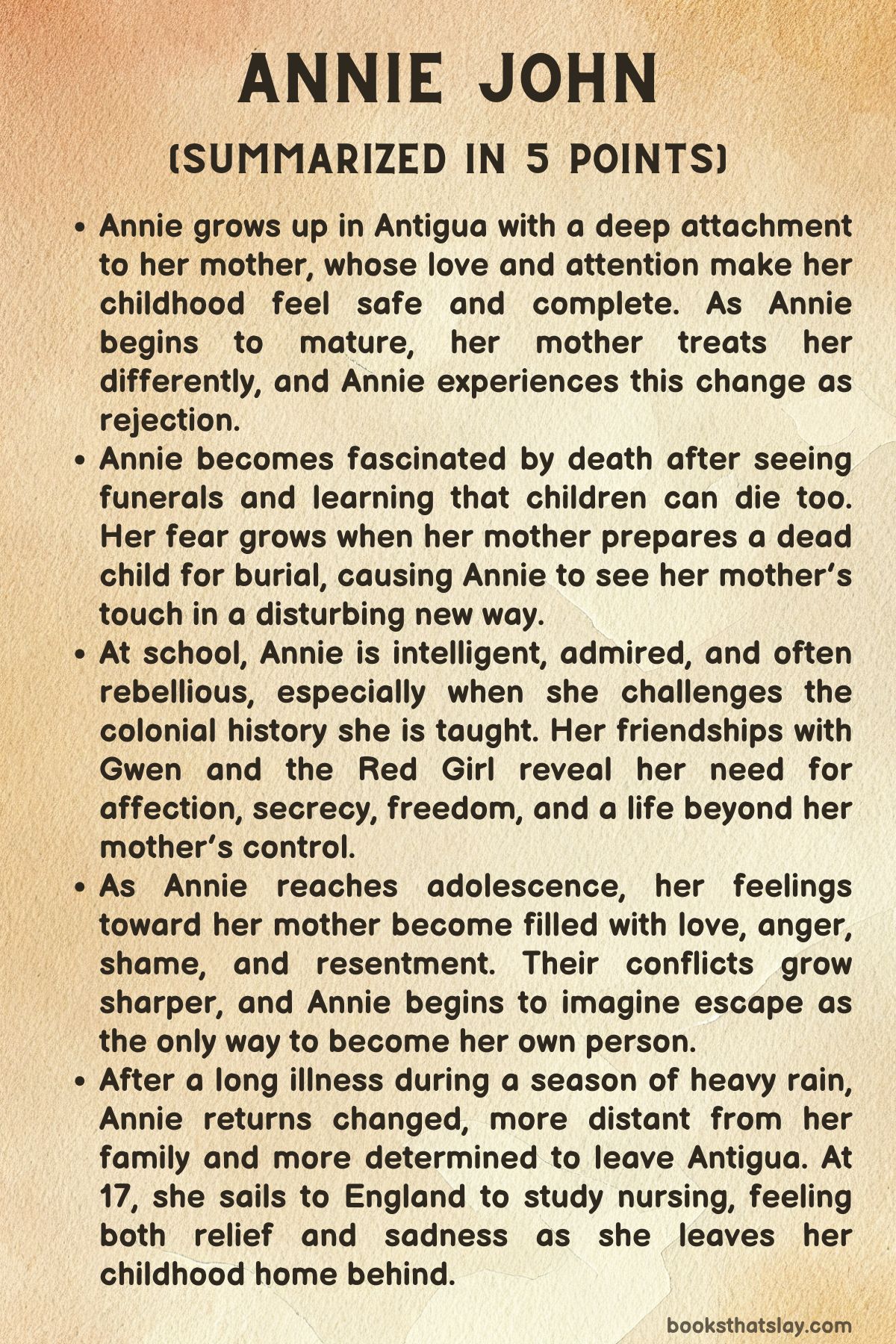
Annie John begins with Annie as a 10-year-old girl in Antigua who is fascinated and frightened by death. At first, she believes that death happens only to people she does not know.
From her yard, she watches funerals at the nearby cemetery and imagines the dead as powerful beings who might return to trouble the living. Her view changes when a young girl named Nalda dies of fever in Annie’s mother’s arms.
Annie does not know Nalda well, but she is shaken by the fact that a child can die. She is even more disturbed because her mother prepares Nalda’s body for burial.
After that, Annie cannot stop thinking about her mother’s hands touching the dead girl, and she begins to pull away from those hands, refusing their touch and even the food they prepare.
Annie’s feelings are often intense and confusing. She says she loves a schoolmate named Sonia, yet she shows this love through cruelty.
She steals money to buy Sonia treats, then pinches and hurts her while Sonia eats. When Sonia’s mother dies, Annie avoids her, feeling that there is something shameful about a mother leaving her child alone.
Annie also begins secretly attending funerals, drawn by curiosity. When a girl her own age dies, Annie goes to see the body and realizes that the dead girl looks almost the same, though not simply asleep as adults claim.
This secret visit causes trouble at home because Annie forgets to collect fish for dinner and lies about it. Her mother discovers the lie and punishes her by making her eat alone outside, though she still kisses Annie good night.
At this stage of life, Annie’s bond with her mother is the center of her world. On days without school, Annie listens as her mother prepares her father’s bath and breakfast.
Her mother includes Annie in errands, cooking, shopping, and household routines. Annie feels important because her mother explains everything and shares stories from the past.
Her mother’s old trunk contains baby clothes and keepsakes from Annie’s childhood, and Annie loves hearing the stories attached to each object. These stories make her feel treasured and known.
Annie also learns about her father’s childhood: his parents left him when he was young, and he was raised by his grandmother, who died when he was 18. Annie pities him because he lost the kind of motherly care she cannot imagine living without.
But as Annie reaches puberty, this paradise begins to change. Her body changes, her clothes no longer fit, and her mother starts treating her differently.
They used to wear matching dresses, but now her mother insists Annie must stop looking like a smaller version of her. Annie feels rejected.
She is sent to learn manners and music, but she behaves badly and is dismissed from both lessons. She becomes used to her mother’s disapproval, though it hurts her deeply.
One day, after winning a Bible class prize, Annie rushes home hoping to win back her mother’s affection. Instead, she sees her parents together in bed, her mother’s hand moving on her father’s back.
The sight disgusts and wounds Annie. Soon after, she speaks rudely to her mother for the first time.
At her new school, Annie quickly becomes known as smart and capable. She meets Gweneth Joseph, and the two girls become inseparable.
Annie believes they fall in love. They share secrets, walk home together, and declare their devotion.
Gwen becomes a replacement for the closeness Annie feels she is losing with her mother. Annie sometimes kisses Gwen on the neck, as her mother once kissed her.
At school, Annie wins praise for an autobiographical essay about losing sight of her mother at the beach. In the real memory, Annie felt abandoned and terrified; in the essay, she invents a comforting ending in which her mother promises never to leave her.
Annie changes the truth because she does not want others to know how distant her mother has become.
Annie’s first period deepens the divide between her and her mother. She is frightened and in pain, but her mother responds with practical calm rather than the tenderness Annie wants.
Although her mother eventually tells Annie about her own first menstruation, Annie feels resentment instead of comfort. Her body is changing, and so is her place in the family.
The mother who once seemed to exist wholly for her now appears separate, mysterious, and sometimes cruel.
Annie begins to build a secret life. She steals books because she cannot bear to return them, and she hides them under the house.
She tricks her mother by slamming the gate to make it seem as though she has left or returned. One day, she meets a rough, free-spirited girl she calls the Red Girl.
The Red Girl climbs trees, plays marbles with boys, stays dirty, and seems to live without the rules that govern Annie’s life. Annie is fascinated by her.
Compared with Gwen’s neatness and obedience, the Red Girl seems exciting and free. Annie starts meeting her secretly near an abandoned lighthouse and learns to play marbles.
Her mother disapproves of girls who play marbles, which only makes Annie more determined.
The relationship with the Red Girl becomes one of rebellion and secret pleasure. Annie steals small gifts and money to give her.
The two girls develop a ritual in which the Red Girl pinches Annie hard and then kisses the places she has hurt. Annie finds this thrilling.
When Annie’s mother discovers one marble, she suspects Annie has more and searches under the house, but she does not find Annie’s hidden collection. Annie nearly confesses after her mother tells a story from her own girlhood, but when her mother asks for the marbles in a soft voice, Annie senses manipulation and lies again.
Later, the Red Girl is sent away to live with her grandparents. Annie dreams that she saves the Red Girl from a sinking boat and that they live alone together on an island, causing ships to crash and laughing as joy turns to sorrow.
At school, Annie continues to excel. She receives academic prizes and studies colonial history.
When her class discusses Columbus and the West Indies, Annie reflects on the violence of colonization and slavery. She feels sympathy for Ruth, an English girl who struggles in class, because Ruth is constantly reminded of what her ancestors did to people like Annie’s ancestors.
Annie is especially drawn to a picture of Columbus in chains. Instead of pitying him, she enjoys seeing him humbled.
She writes a mocking caption under the image, using words her mother once spoke about Annie’s grandfather. Her teacher sees the note as disrespectful and punishes her harshly.
Annie’s intelligence gives her power, but it also marks her as unruly and defiant.
By age 15, Annie is deeply unhappy. She feels that everything she once loved has turned sour.
She and her mother now seem to have two faces: one for public life and one for each other. In front of others, they may appear affectionate, but when alone, Annie feels both love and hatred toward her mother.
She dreams that her mother might kill her and that she might kill her mother if she had the courage. These thoughts frighten her because she knows she cannot live without her mother, even while she feels trapped by her.
Annie grows apart from Gwen, who now seems dull and limited. Annie daydreams about living alone in Belgium, a place she knows mostly from reading.
She imagines her mother having to write to her formally, as if Annie were a distant adult rather than a child under her control. One day, after school, Annie walks downtown alone and looks at herself in shop windows.
She sees herself as strange, ugly, black, and miserable. A group of boys laughs nearby, including Mineu, a boy from her childhood who once humiliated and hurt her during their games.
When Annie comes home late, her mother accuses her of behaving shamefully with boys and calls her a slur. Annie strikes back by saying she is like her mother.
The words hurt them both. Annie wants to apologize but cannot.
She asks her father to make her a trunk of her own, a sign that she wants a life separate from her mother’s trunk and her mother’s stories.
Soon Annie becomes seriously ill during a period of endless rain. She is weak, feverish, and mentally foggy.
Doctors cannot find a clear cause, and her mother also seeks help from an obeah woman. Annie lies in bed as her parents worry over her, and she feels something dark and heavy inside her head.
Her illness blurs memory, dream, and reality. She thinks about school rituals, family photographs, and the strange mixture of medical and spiritual remedies surrounding her.
At one point, when left alone, she washes the family photographs because they seem swollen, dirty, and foul-smelling to her. The pictures are ruined, and her mother makes sure Annie is never left alone again.
Annie’s grandmother, Ma Chess, arrives and tends to her with deep knowledge and authority. She sleeps near Annie and comforts her through frightening visions.
The rain continues for more than 100 days, and Annie remains in bed. When the illness finally lifts and the rain stops, the landscape has changed: the sea has risen, the garden is ruined, and the foundation of a house her father was building is damaged.
Annie has also changed. She is taller than her mother, tired of her home, and eager to be somewhere else.
She returns to school wearing longer clothes and a large hat, walking with a stoop and speaking strangely. She distances herself from most people and takes pleasure in the envy her academic success creates.
At 17, Annie prepares to leave Antigua for England, where she is expected to train as a nurse. She does not want to be a nurse, and she does not especially want England, but she wants to leave Antigua more than anything.
She looks around her room and hopes never to see its objects again. Her father is older and sickly, and her mother now cares for him.
Watching this confirms Annie’s determination never to marry. She sees her parents as joined together while she stands apart from them.
She believes her mother has always claimed to love her while quietly preparing for their separation. What her parents do not know is that Annie plans never to return.
On the day she leaves, her parents treat the occasion like a celebration. They eat a large breakfast, receive visitors, and act proud of her future.
Gwen comes to say goodbye, now engaged and no longer the girl Annie once loved. Annie feels embarrassed by her old attachment to her.
As the family walks to the jetty, Annie passes places tied to her childhood: church, school, shops, friends’ houses, the doctor’s office, and the library. Each place belongs to the life she is leaving behind.
At the ship, Annie feels both pleasure and pain at the thought of never seeing Antigua again. Her father kisses her goodbye silently.
Her mother cries and tells Annie that she will always be her mother and that Antigua will always be her home. Annie watches until she can no longer see her mother waving.
Then she goes to her cabin and lies down, listening to the waves against the ship, as if something inside her is being emptied out.
Characters
Annie
Annie is the central consciousness of Annie John, and the entire book is shaped by the intensity of her inner life. She begins as a child who feels protected by her mother’s love and by the routines of home, yet she is also drawn to things that frighten her, especially death.
Her early fascination with funerals shows that she is curious, imaginative, and emotionally alert, but also secretive and willing to disobey when something captures her attention. As she grows older, Annie becomes more divided within herself.
She wants closeness, but she also resents dependence. She wants her mother’s approval, but she refuses to submit fully to her mother’s expectations.
Her lies, thefts, secret friendships, and acts of defiance are not simply signs of bad behavior; they show a girl trying to build a private self in a world where her mother once seemed to know and control everything about her. Annie’s intelligence makes her powerful at school, but it does not save her from loneliness.
She often sees herself sharply, even cruelly, and her reflections on her appearance, her body, and her emotions reveal a painful awareness of change. By the end of the book, Annie’s departure from Antigua is not a simple victory.
She leaves because staying feels impossible, yet leaving also empties her. Her character is defined by this conflict between love and rejection, memory and escape, dependence and selfhood.
Annie’s Mother
Annie’s mother is the most powerful emotional presence in the book. In Annie’s childhood, she appears almost perfect: beautiful, capable, protective, and endlessly attentive.
She teaches Annie how to shop, cook, dress, behave, and understand the world, and she preserves Annie’s childhood objects as if every moment of Annie’s life has sacred value. To young Annie, this care makes life feel whole and meaningful.
Yet as Annie matures, the mother’s love becomes more complicated. She begins to separate herself from Annie, insisting that Annie dress differently, behave like a young lady, and stop existing as her smaller copy.
From the mother’s perspective, this may be a natural part of raising a daughter, but Annie experiences it as betrayal. Annie’s mother is not cruel in a simple way; she still cares for Annie during illness, seeks both medical and spiritual help, and grieves when Annie leaves.
However, her authority can feel controlling, especially when she judges Annie’s behavior, searches for her secrets, or uses softness as a way to gain obedience. She represents both comfort and confinement.
Annie’s pain comes from realizing that her mother is not only “Mother” but also a woman with her own desires, marriage, history, and limits. That discovery changes love into something mixed with anger, suspicion, and grief.
Annie’s Father
Annie’s father is quieter than Annie’s mother, but he has an important place in the story. He is a skilled carpenter, a steady worker, and a man whose past carries its own sadness.
His parents left him when he was young, and he was raised by his grandmother until she died, leaving him alone at 18. This history makes Annie pity him, and it also helps her understand, for a time, how precious a mother’s care can be.
Yet Annie’s father is also distant from her emotional struggles. He remains largely unchanged while Annie and her mother move through conflict.
His presence often reminds Annie that her mother has a life beyond motherhood. The scene in which Annie sees her mother touching his back deeply disturbs her because it forces her to recognize her parents’ intimacy and her own exclusion from it.
He is not presented as harsh or openly oppressive, but his existence changes the shape of Annie’s relationship with her mother. Later, his age and sickness make Annie see marriage as a burden, especially for women.
His character adds quiet pressure to the book’s family structure: he is loved and cared for, but he also occupies a place that separates mother and daughter.
Gwen
Gwen is Annie’s first close school friend and one of the figures through whom Annie tries to replace the closeness she has lost with her mother. Their friendship is intense, affectionate, and private.
Annie believes they fall in love almost immediately, and Gwen becomes a person to whom Annie can confess secrets and offer devotion. At first, Gwen gives Annie emotional security.
Walking home together, sharing confidences, and being known as inseparable make Annie feel less abandoned. Yet Gwen also reveals Annie’s changing nature.
What once feels like deep love eventually becomes boring and insufficient to Annie. Gwen’s neatness, obedience, and conventional future begin to irritate her, especially after Annie meets the Red Girl.
By the end, Gwen is engaged and giggling, and Annie feels embarrassed by the strength of her former attachment. Gwen is not a weak character; rather, she represents a form of girlhood that Annie outgrows.
She belongs to a more socially acceptable path of friendship, romance, and marriage, while Annie increasingly wants a life that is harder to define and less easily controlled.
The Red Girl
The Red Girl is one of the strongest symbols of freedom in the book. She lives in a way that seems almost impossible to Annie: she climbs trees, plays marbles with boys, stays dirty, ignores strict rules of feminine behavior, and appears untouched by the constant discipline that shapes Annie’s daily life.
Annie is fascinated by her because she represents everything Annie is not allowed to be. Their secret meetings near the lighthouse give Annie a space outside home, school, and respectability.
The Red Girl awakens Annie’s desire for risk, secrecy, bodily freedom, and rebellion. Their relationship is charged with both affection and danger, especially in the ritual of pinching and kissing.
This mixture reflects Annie’s own emotional confusion, since love, pain, pleasure, and defiance are often linked in her mind. The Red Girl’s departure leaves Annie with a fantasy of escape: an island where the two girls live apart from the world and disturb passing ships.
That dream shows how much Annie associates the Red Girl with refusal. She does not simply admire the Red Girl; she imagines a whole life built around rejecting the rules that have trapped her.
Sonia
Sonia appears briefly, but she reveals much about Annie’s early understanding of love, cruelty, and loss. Annie says she loves Sonia, yet she expresses that love through torment, buying her frozen treats and then pinching and hurting her.
This contradiction is important because it shows that Annie’s feelings are powerful before they are morally clear. She does not always know how to separate affection from control.
Sonia also becomes linked with death when her mother dies. Instead of comforting Sonia, Annie avoids her because she feels ashamed on Sonia’s behalf.
To Annie, a mother’s death is not only a loss but a kind of exposure, as if the child has been abandoned in a way too terrible to face. Sonia’s role in the story is small, but she helps show Annie’s childish fear that love can vanish suddenly and leave someone marked by humiliation.
Nalda
Nalda’s death changes Annie’s understanding of the world. Before Nalda dies, Annie thinks of death as something that belongs to strangers and distant adults.
Nalda’s body, prepared by Annie’s mother, makes death intimate and close. The fact that Annie’s mother touches and bathes the dead child disturbs Annie deeply, and it alters the way she sees her mother’s hands.
Nalda is less a developed character than a turning point in Annie’s emotional life. Through her, Annie learns that children can die and that her mother can belong to experiences Annie cannot control or fully understand.
This realization begins one of the book’s repeated patterns: Annie sees something frightening, connects it to her mother, and then feels both drawn to and repelled by her.
Ma Chess
Ma Chess, Annie’s maternal grandmother, represents older female knowledge, family history, and spiritual authority. When Annie becomes ill, Ma Chess arrives and seems to understand what others cannot.
She is connected to forms of healing and perception that exist outside English medicine, and she carries the weight of past grief, especially the death of her son Johnnie and her long silence toward Pa Chess. Her presence during Annie’s illness is protective but also mysterious.
She comforts Annie through frightening visions and stays close to her when Annie feels trapped inside the dark confusion of sickness. Ma Chess also strengthens the female line of the book: Annie, her mother, and grandmother are tied through care, conflict, memory, and inherited pain.
Unlike Annie’s mother, Ma Chess does not seem invested in shaping Annie into a proper young lady. Her authority is different, older, and less domestic.
She enters during crisis and leaves without ceremony, suggesting a kind of power that does not need explanation.
Miss Nelson
Miss Nelson is Annie’s admired teacher and one of the few adults at school who recognizes Annie’s talent without immediately trying to crush her spirit. When she assigns autobiographical writing, Annie responds strongly because the task allows her to transform private pain into language.
Miss Nelson’s praise matters because Annie is beginning to realize that her world is larger than her home and that she can be seen by people other than her mother. However, Annie’s essay also shows her need to control how others see her.
She changes the ending of the memory about her mother at the beach, making it more comforting than the truth. Miss Nelson therefore becomes part of Annie’s discovery that writing can both reveal and hide emotional reality.
She supports Annie’s intelligence, but she also unknowingly gives Annie a space to reshape her own hurt.
Miss Moore
Miss Moore, the English headmistress, represents colonial authority in the school environment. Annie views her with dislike and ridicule, describing her in harsh physical terms and associating her with unpleasant smells and watchful judgment.
Through Miss Moore, the book shows Annie’s instinctive resistance to English standards of respectability and control. Annie is expected to accept the school’s hierarchy, but her private thoughts mock it.
Miss Moore’s presence helps frame the classroom as more than a place of education. It is also a place where colonial habits, manners, and values are enforced.
Annie’s dislike of her is personal, but it is also connected to a larger rejection of foreign authority.
Miss Edward
Miss Edward is a strict teacher who punishes Annie for her disrespectful note about Columbus. She represents the kind of education that demands obedience to colonial history.
To Miss Edward, Columbus must be honored as a heroic discoverer, but Annie sees him as a violent and arrogant figure who deserves humiliation. The conflict between them reveals Annie’s sharp political awareness, even when she expresses it through schoolgirl defiance.
Miss Edward’s punishment is severe, but it also proves that Annie has touched something dangerous. She has refused to accept the official version of history.
In Annie John, Miss Edward’s role is important because she shows how school can become a place where historical memory is controlled, and how Annie’s intelligence turns into resistance when the lesson itself feels false.
Ruth
Ruth is the English girl in Annie’s class, and Annie’s reaction to her is shaped by colonial history. Ruth struggles with lessons about the Caribbean, and Annie imagines that Ruth must feel ashamed because her ancestors colonized and enslaved people like Annie’s ancestors.
Annie’s sympathy for Ruth is complicated. She likes Ruth in part because Ruth is foreign, blond, and physically different from the other girls, but she also sees Ruth as connected to a history of violence.
Ruth’s character helps reveal how Annie thinks about race, empire, and belonging. Annie does not simply memorize history; she places herself and her classmates inside it.
Ruth becomes a living reminder that the past is still present in the classroom, even when teachers try to make it seem settled and orderly.
Mineu
Mineu is a figure from Annie’s childhood who returns in her memory as a source of humiliation and fear. As a boy, he controlled their games and gave Annie inferior roles, making himself the conqueror or hero while she became the servant or monster.
His cruelty becomes more serious in the memory of the fire ants, when he tricks Annie into sitting naked on an ants’ nest and laughs as she suffers. When Annie sees him years later among a group of boys, she feels exposed and mocked, even though she greets him politely.
Mineu represents the early lessons Annie receives about gender, power, and shame. His character shows how boys can claim authority over girls’ bodies and how childhood games can carry real violence.
He also helps trigger the confrontation between Annie and her mother, since Annie’s mother sees her speaking with boys and interprets it as sexual misconduct.
Dr. Stephens
Dr. Stephens, the English doctor, appears during Annie’s long illness. He examines her but cannot find a clear physical cause for her condition.
His role is important because his medical knowledge has limits. Annie’s sickness is not presented as something that can be easily diagnosed or cured through ordinary medicine.
It is emotional, physical, spiritual, and symbolic all at once. Dr. Stephens represents official, Western authority, but his failure to explain Annie’s illness opens space for the obeah woman and Ma Chess.
The contrast does not simply reject medicine; instead, it shows that Annie’s suffering belongs to a world of family conflict, fear, growth, and psychic strain that a doctor cannot fully name.
The Obeah Woman
The obeah woman represents spiritual protection and the survival of African diasporic belief in Antiguan life. Annie’s mother consults her more than once, first because she fears that women from Annie’s father’s past may harm Annie and later during Annie’s illness.
The obeah woman’s oils, herbs, candles, symbols, and rituals exist alongside ordinary domestic life and medical treatment. Her character shows that Annie’s world is shaped by multiple systems of belief at the same time.
English medicine, Christian schooling, colonial education, family memory, and obeah all coexist, sometimes uneasily. The obeah woman also reflects Annie’s mother’s fear and care.
When ordinary explanations are not enough, Annie’s mother turns to spiritual protection, proving that her love for Annie remains active even when their relationship is damaged.
Annie’s Classmates
Annie’s classmates function as a social world against which Annie measures herself. Some admire her, some compete with her, and some become objects of her cruelty or protection.
Hilarene, the sexton’s daughter, irritates Annie because she seems too good, while other girls challenge Annie academically and fail. The classroom gives Annie a place to shine, but it also increases her sense of separation.
She is popular at times, yet she never truly belongs in a simple way. Her classmates reveal her contradictions: she wants recognition but often despises those who offer it; she wants friendship but outgrows or rejects it; she defends girls in whom she sees herself but may also mistreat them for the same reason.
Through them, the book shows Annie becoming more isolated as her self-awareness grows.
Annie’s Parents as a Pair
Annie’s parents together represent the adult world from which Annie feels excluded. As a child, she sees her mother almost as her own possession, but gradually she realizes that her mother and father share a bond that does not include her.
Their marriage becomes one of the forces pushing Annie toward separation. At times, they appear cheerful, ordinary, and loving; at other times, Annie sees them with disgust, focusing on their bodies, sounds, and habits.
This shift reveals less about them changing and more about Annie’s changed vision. They remain largely themselves, but Annie can no longer live inside the old family arrangement.
By the end of Annie John, her parents stand together on the shore while Annie leaves by ship, making visible the emotional distance that has been growing for years.
Themes
Motherhood, Separation, and the Pain of Growing Up
Annie’s relationship with her mother begins as the emotional foundation of her life. Her mother is not only a parent but also a guide, protector, storyteller, and model of womanhood.
Annie feels that her existence matters because her mother remembers every detail of her childhood and preserves her belongings with care. The crisis begins when Annie reaches puberty and her mother starts treating her as a separate person.
What might be ordinary growth feels to Annie like abandonment. Matching dresses disappear, private routines change, and the mother who once seemed entirely available becomes a woman with her own marriage, body, and authority.
This theme is powerful because the book does not present separation as clean or easy. Annie needs distance in order to become herself, but she experiences that distance as betrayal.
Her anger is tied to love, and her rebellion is tied to grief. The mother is not simply oppressive, and Annie is not simply ungrateful.
Their bond becomes painful because it was once so complete. Growing up means Annie must lose the childhood version of her mother, and that loss shapes nearly every act of secrecy, defiance, illness, and departure in the story.
Female Friendship, Desire, and Secret Freedom
Annie’s friendships with Gwen and the Red Girl show her search for intimacy outside the mother-daughter bond. Gwen first appears as a solution to Annie’s loneliness.
Their closeness gives Annie a new person to love, confess to, and walk beside. The relationship is tender, possessive, and emotionally intense, suggesting that Annie is trying to recreate the safety she once felt with her mother.
Yet Gwen eventually becomes too neat, too familiar, and too tied to ordinary expectations. The Red Girl offers something different: danger, dirt, rule-breaking, physical daring, and a life beyond respectable femininity.
Annie’s attraction to her is also an attraction to a self she has not been allowed to become. Playing marbles, meeting secretly, stealing gifts, and visiting forbidden places allow Annie to imagine freedom through another girl.
These relationships are not minor episodes of childhood friendship; they reveal Annie’s developing desires and her hunger for a world not arranged by adults. In Annie John, female friendship becomes a space where Annie can test rebellion, affection, secrecy, power, and escape before she is able to leave home physically.
Colonial Education and Resistance to Official History
School is a place of achievement for Annie, but it is also a place where colonial authority is repeated. The classroom teaches English manners, English history, and reverence for figures like Columbus, while expecting Antiguan girls to accept these lessons as truth.
Annie’s intelligence makes her successful in this system, yet it also allows her to see its contradictions. Her reaction to Columbus is especially important.
While her teacher expects pity and respect for him, Annie feels satisfaction at seeing him reduced and punished. She understands that the official story of discovery hides conquest, slavery, and humiliation.
Ruth, the English girl, becomes part of this theme because Annie imagines her as burdened by the crimes of her ancestors. The school tries to make history orderly, but Annie experiences it as personal and unfinished.
Her defiance in the classroom is not only childish misbehavior; it is a refusal to honor the people and symbols that colonial education asks her to admire. At the same time, Annie remains shaped by the very system she resists.
She excels in its exams, earns its prizes, and reads its books. This tension makes her resistance complex rather than simple.
Illness, Identity, and the Desire to Escape
Annie’s long illness is one of the clearest signs that her inner conflict has become impossible to contain. Her sickness arrives after years of emotional strain, secrecy, anger, and separation from her mother.
The doctor cannot explain it, which suggests that the illness is not only physical. It is connected to Annie’s changing identity, her fear of her mother, her hatred of home, her developing body, and her inability to return to childhood.
The endless rain outside mirrors her condition: heavy, isolating, and seemingly without end. During the illness, family photographs become unbearable to her, and she tries to wash them clean, damaging the images.
This act shows her desire to erase or remake the family story that has defined her. The presence of medicine, obeah, and Ma Chess also shows that Annie’s suffering cannot be understood through one system alone.
When she recovers, she is not restored to her old self. She is taller, stranger, more distant, and more determined to leave.
Illness becomes a passage between childhood and departure. Annie’s eventual journey to England is not presented as pure hope, but as the only escape she can imagine from a life that has become too small for her.