Antony and Cleopatra Summary, Characters and Themes
Antony and Cleopatra is William Shakespeare’s tragedy about love, power, pride, and political collapse. It follows the Roman leader Mark Antony as his bond with Egypt’s queen, Cleopatra, draws him away from the discipline and ambition expected of a Roman statesman.
Around them, Rome shifts under the cold strategy of Octavius Caesar, whose patience and calculation make him Antony’s most dangerous rival. The play moves between Egypt’s sensual world and Rome’s hard public order, showing how private desire can change the fate of empires. At its center is a pair of lovers whose greatness cannot save them from themselves.
Summary
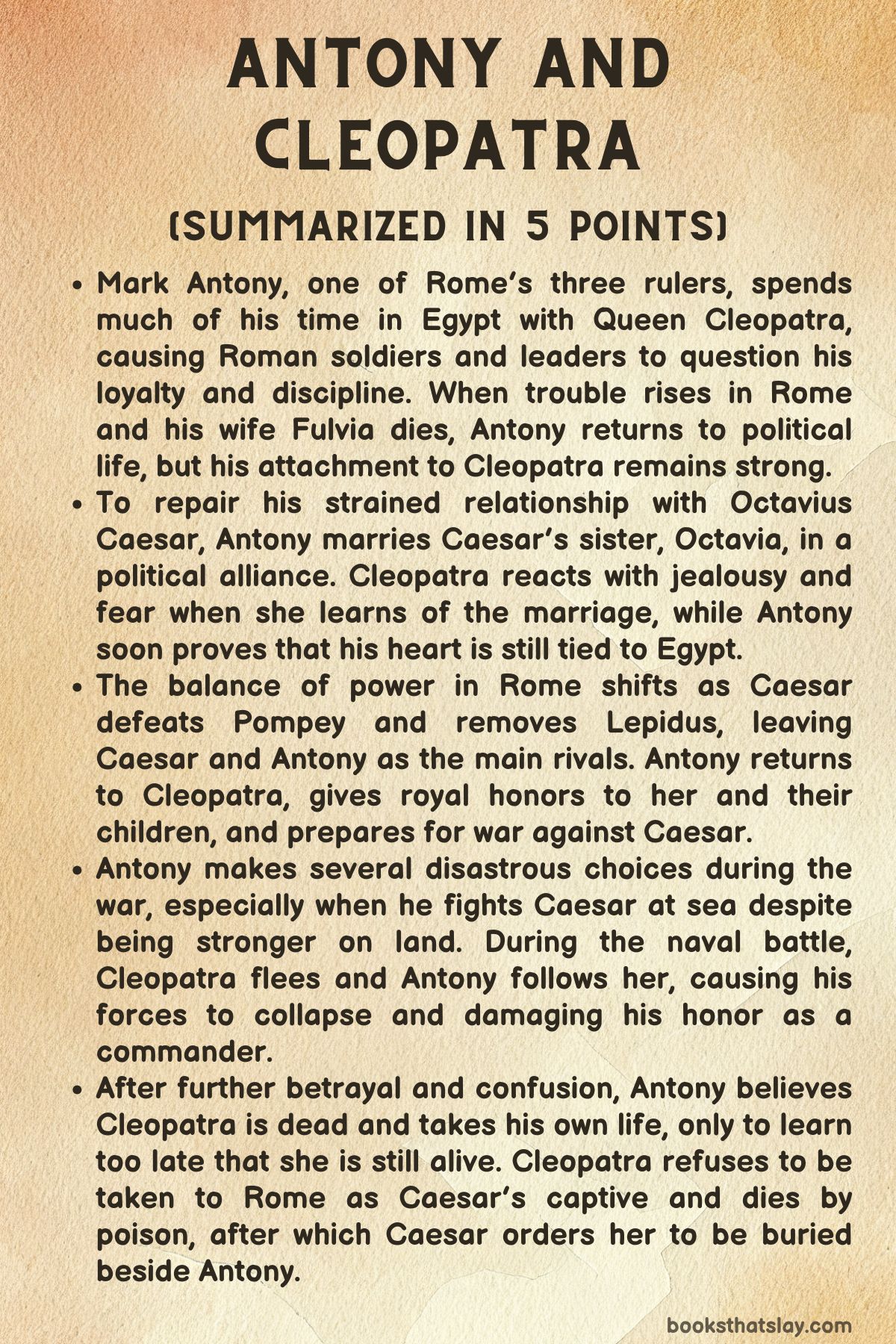
Antony and Cleopatra begins in Egypt, where Roman soldiers are disturbed by the change they see in Mark Antony. Once admired as one of Rome’s strongest generals, Antony now spends his days with Cleopatra, queen of Egypt, enjoying feasts, flirtation, and pleasure while political problems grow in Rome.
His followers fear that love has weakened him and made him forget his duty as one of Rome’s three rulers, alongside Octavius Caesar and Lepidus. Cleopatra teases Antony about messages from Rome, including news from his wife, Fulvia, and from Caesar, but Antony refuses to listen.
He insists that the world can wait while he remains with her.
Yet Rome cannot be ignored for long. Antony receives reports that Fulvia and his brother-in-law Lucius have rebelled against Caesar.
He also learns that Fulvia has died. Her death stirs mixed feelings in him.
On one hand, it frees him from marriage and makes his love for Cleopatra less openly adulterous. On the other, it reminds him of the ambition, discipline, and Roman identity he has allowed to fade.
His soldier Enobarbus advises him with practical bluntness, and Antony decides he must return to Rome. Sextus Pompey, son of Pompey the Great, is gaining strength against the triumvirs, and Antony knows his absence has made him look irresponsible.
Cleopatra reacts badly to Antony’s decision to leave. She tries to make him feel guilty, accusing him of false promises and suggesting that if he can leave Fulvia behind so quickly in death, he may one day treat Cleopatra the same way.
Antony explains the political emergency, but Cleopatra’s jealousy and fear make her unwilling to accept his reasons. He leaves while assuring her that his love remains unchanged.
In Rome, Caesar criticizes Antony’s life in Egypt. He sees Antony as reckless, indulgent, and unreliable, especially while the state faces threats.
Lepidus tries to defend Antony, saying his greatness outweighs his flaws, but Caesar remains skeptical. Still, Caesar remembers Antony’s past bravery and endurance as a soldier, which makes his present behavior seem even more disappointing.
With Pompey’s forces rising, Caesar and Lepidus prepare for war.
Back in Egypt, Cleopatra misses Antony intensely. She imagines what he might be doing and asks messengers for news.
Antony sends her a pearl as a gift, and Cleopatra studies every detail of the report about his mood. She decides that if he seemed neither happy nor sad, it must mean he was hiding sadness for the sake of his troops while his heart stayed in Egypt.
She plans to send him letters every day, showing how fully her thoughts remain fixed on him.
Meanwhile, Pompey hopes Antony will stay in Egypt, because he believes Rome is weaker without him. He knows Caesar is politically sharp but not loved, and he sees Lepidus as weak.
When Pompey learns that Antony is returning to Rome, he becomes uneasy. Antony’s military reputation is too strong to dismiss.
Still, Pompey hopes Antony and Caesar will quarrel, since Fulvia’s rebellion has given Caesar reason to mistrust him.
Antony and Caesar meet in Rome, with Lepidus trying to keep peace between them. Caesar accuses Antony of neglecting his promises and possibly supporting Fulvia’s rebellion.
Antony denies betrayal, admitting only that he failed to give Roman affairs proper attention. The tension remains, so Agrippa proposes a political marriage: Antony should marry Caesar’s sister, Octavia.
The marriage would make Antony and Caesar family and help repair their alliance. Caesar doubts Antony can forget Cleopatra, but Antony agrees.
He marries Octavia, who is gentle, loyal, and dutiful.
Even after the marriage, Antony’s mind is not settled. A soothsayer warns him to stay away from Caesar because Caesar’s luck always defeats his.
Antony recognizes that even in games, chance favors Caesar over him. Although he has married Octavia, Antony decides he will return to Egypt because it gives him more joy.
The political marriage cannot erase Cleopatra’s hold over him.
When Cleopatra hears that Antony has married Octavia, she explodes in anger. She strikes the messenger who brings the news, even though he is innocent.
Her jealousy overwhelms her, and she cannot bear the thought of Antony belonging to another woman. Later, she questions the messenger about Octavia’s appearance.
When she hears that Octavia is shorter, quiet, and modest, Cleopatra feels reassured. She convinces herself that Antony will not truly love such a woman.
The triumvirs meet with Pompey and reach a treaty. Pompey is given control of Sicily and Sardinia in exchange for clearing pirates from the sea and sending wheat tribute to Rome.
The men celebrate with a drunken feast on Pompey’s ship. During the banquet, Pompey’s follower Menas suggests killing the triumvirs while they are vulnerable.
Pompey refuses, saying that although he might have welcomed the result if he had not known beforehand, honor now requires him to reject the plan. This moment shows how political opportunity and personal honor clash throughout the play.
The peace does not last. Caesar later defeats Pompey and removes Lepidus from power, using past letters to condemn him.
With Pompey gone and Lepidus imprisoned, the Roman world is left mainly to Caesar and Antony. Their rivalry becomes impossible to contain.
Antony returns to Egypt and publicly gives kingdoms and titles to Cleopatra and their children, angering Caesar, who sees this as an insult to Rome. Octavia travels to Caesar hoping to reconcile him with her husband, but Caesar tells her Antony has dishonored her by returning to Cleopatra.
Antony prepares for war against Caesar. Cleopatra insists on joining the campaign, despite objections from Enobarbus, who believes her presence will distract the soldiers.
Antony chooses to fight Caesar at sea, even though his strength lies in land warfare and his sailors are less skilled. His soldiers beg him to use the army where he has the advantage, but Antony refuses.
Caesar, understanding the importance of this choice, orders his own forces to avoid land battle and fight at sea.
The naval battle becomes a disaster for Antony. Cleopatra’s ships suddenly flee, and Antony follows her instead of staying to command the fight.
His soldiers are horrified, seeing that he has abandoned military judgment for love. Canidius surrenders Antony’s land forces to Caesar.
Antony is crushed by shame. He gives treasure to his remaining followers and tells them they may leave and surrender.
Cleopatra tries to comfort him, saying she did not know he would follow her, but Antony knows his honor has been badly damaged.
Antony sends a messenger to Caesar asking either to remain in Egypt or retire privately in Athens. He also asks that Cleopatra’s heirs be allowed to rule Egypt.
Caesar rejects Antony’s request but offers Cleopatra mercy if she kills or banishes Antony. He sends Thidias to flatter her and encourage betrayal.
Cleopatra listens, but Antony catches Thidias kissing her hand and orders him whipped. Antony’s anger briefly restores his fighting spirit.
He vows to rebuild his army and challenge Caesar again. Enobarbus, however, loses faith and defects to Caesar, believing Antony is no longer guided by reason.
When Antony learns of Enobarbus’s betrayal, he does not punish him. Instead, he sends Enobarbus his possessions with a kind message.
This generosity breaks Enobarbus emotionally. He is overwhelmed by guilt and condemns himself for betraying such a noble master.
Soon afterward, he dies in shame, unable to live with his disloyalty.
Antony wins a small victory against Caesar’s forces, and for a moment hope returns. Cleopatra rejoices, and Antony rewards his brave soldiers.
But the advantage does not last. Antony’s Egyptian fleet defects to Caesar, and Antony believes Cleopatra has betrayed him.
In a furious rage, he curses her and threatens to kill her. Terrified, Cleopatra hides in her monument and sends word that she has died by suicide, hoping to see how Antony reacts.
The false report destroys Antony. Believing Cleopatra dead, he decides he cannot live.
He asks his servant Eros to kill him, but Eros kills himself instead. Antony then falls on his own sword, but the wound does not kill him immediately.
He learns that Cleopatra is still alive and asks to be taken to her. He is carried to her monument, where they share a final meeting.
Antony tells her not to mourn him as a man defeated by Caesar, but as one who defeated himself. He urges her to save her life if she can and remember him in his greatness.
Then he dies in her arms.
Caesar is deeply affected by Antony’s death. Though they were enemies, he recognizes Antony as a man equal to him in greatness, divided from him by fate and ambition.
Caesar wants Cleopatra alive so he can take her to Rome and display her in his triumph. He sends messengers promising mercy, but Cleopatra doubts him.
Cleopatra is captured before she can stab herself. Dolabella, moved by her, admits that Caesar does intend to parade her in Rome.
Cleopatra cannot accept such humiliation. She imagines being mocked on a Roman stage and reduced from queen to spectacle.
Determined to keep control over her own end, she arranges for a poisonous asp to be brought to her in a basket of figs.
Dressed in royal clothing, Cleopatra prepares for death with her attendants, Charmian and Iras. Iras dies first, and Cleopatra applies the snake to her breast, welcoming death as a release and as a way to rejoin Antony.
Charmian also dies from the poison. When Caesar’s men arrive, they find Cleopatra dead.
Caesar recognizes her courage and royal dignity. He orders that she be buried beside Antony, uniting them in death after politics, war, jealousy, and pride have destroyed them in life.
Characters
Mark Antony
Mark Antony is one of the central figures in Antony and Cleopatra, and his character is shaped by the conflict between public duty and private desire. He is introduced as a Roman general whose earlier reputation rests on courage, endurance, and military brilliance.
Other Roman characters remember him as a man who could survive hunger, hardship, and the demands of war with almost legendary strength. Yet when the play begins, Antony is in Egypt, absorbed in his relationship with Cleopatra and increasingly distant from the duties that once defined him.
His love does not make him weak in a simple sense, but it divides him. He wants Rome’s honor and Egypt’s pleasure, political greatness and emotional surrender, public admiration and personal freedom.
Antony’s tragedy lies in his inability to rule himself. He can inspire deep loyalty, as seen in the devotion of soldiers such as Enobarbus and Eros, and he can still act with nobility, especially when he sends Enobarbus’s belongings after the man has betrayed him.
That gesture shows the generous side of Antony’s nature: even when wounded, he can rise above revenge. However, his judgment repeatedly fails when emotion overtakes reason.
His decision to fight Caesar at sea, against military advice, reveals pride and impulsiveness. His abandonment of the battle to follow Cleopatra becomes the turning point in his collapse, damaging both his army and his self-respect.
Antony is also deeply theatrical in the way he experiences love, shame, anger, and death. He sees himself in grand terms, and when he falls, he measures that fall against the heroic image he once held.
His final moments with Cleopatra show a man who understands that Caesar did not defeat him as completely as his own choices did. Antony remains magnificent, flawed, passionate, and self-destructive.
He is not simply ruined by Cleopatra or Caesar; he is undone by the divided nature of his own desires.
Cleopatra
Cleopatra is the queen of Egypt and one of the most powerful personalities in the play. She is intelligent, emotionally intense, politically aware, and skilled at shaping how others see her.
Her presence dominates Egypt, and her relationship with Antony is marked by passion, performance, insecurity, and command. She often tests Antony’s love, changes moods quickly, and uses wit, anger, teasing, and vulnerability to hold his attention.
At times, she seems playful and theatrical; at other times, she is fiercely serious about her dignity as a queen and lover.
Cleopatra’s emotional nature should not be mistaken for simplicity. She understands power and knows that survival often depends on reading people carefully.
Her reaction to Antony’s marriage to Octavia shows jealousy, but it also reveals fear: Octavia represents Rome’s attempt to replace Cleopatra not only as Antony’s beloved but as a political influence. Cleopatra’s interrogation of the messenger about Octavia’s appearance shows how personal rivalry and political anxiety become one in her mind.
She wants to know whether Octavia is a real threat to her hold over Antony.
Her greatest weakness is that she often acts out of impulse. Her flight during the naval battle has disastrous consequences, and Antony’s decision to follow her destroys his military position.
Later, when Antony believes she has betrayed him, Cleopatra’s false report of her death leads directly to his suicide. Yet Cleopatra’s final actions restore much of her grandeur.
Refusing to be paraded in Rome as Caesar’s trophy, she chooses death on her own terms. Her suicide is not only an act of love for Antony but also an assertion of royal identity.
She will not allow Caesar to turn her into an object of public humiliation. In the end, Cleopatra becomes a figure of pride, passion, and political resistance, preserving control over herself when all worldly power has been lost.
Octavius Caesar
Octavius Caesar stands as Antony’s opposite in Antony and Cleopatra. Where Antony is passionate, expansive, and emotionally driven, Caesar is controlled, strategic, and disciplined.
He is not presented as warm or generous, but he is extremely effective. He understands politics as a contest of patience, image, calculation, and timing.
While Antony acts according to feeling and pride, Caesar watches, waits, judges, and takes advantage of weakness.
Caesar’s criticism of Antony is partly political and partly personal. He sees Antony’s life in Egypt as a disgrace to Roman seriousness and believes that Antony has neglected his responsibilities.
Yet Caesar also recognizes Antony’s former greatness. This makes his disapproval sharper, because he is not dismissing a weak man but condemning a great man who has allowed desire to damage his authority.
Caesar uses Antony’s failures to strengthen his own position. He imprisons Lepidus after Pompey is defeated, turns Octavia’s humiliation into political evidence against Antony, and presents himself as the stable defender of Rome.
His treatment of Cleopatra after Antony’s death reveals his ambition clearly. He speaks of mercy, but he wants her alive so she can be displayed in his triumph.
To Caesar, Cleopatra is valuable as a symbol. Her capture would complete his victory and show Rome that Egypt, Antony, and the old world of divided power have been brought under his control.
Still, Caesar is not a crude villain. His response to Antony’s death shows real respect for his rival, and his final praise of Cleopatra’s courage suggests that he can recognize greatness even in those he defeats.
Caesar’s power comes from emotional restraint, but that restraint also makes him colder and less human than the lovers he conquers.
Enobarbus
Enobarbus is Antony’s loyal follower, observer, critic, and eventual betrayer. He is one of the most perceptive characters in the story because he sees Antony clearly without either worshipping or hating him.
He understands Antony’s greatness, but he also sees the danger of Antony’s attachment to Cleopatra and the damage caused by emotional decision-making. His comments often carry practical wisdom, and he frequently acts as a voice of realism in a world ruled by ambition, desire, and pride.
Enobarbus is drawn to Antony because Antony inspires loyalty. He knows his master’s flaws, but he also recognizes his generosity, courage, and charisma.
His betrayal does not come from hatred; it comes from despair. After Antony’s disastrous choices and unstable behavior, Enobarbus concludes that Caesar will win and that Antony’s cause is lost.
His decision to defect is practical, but it violates his deeper sense of honor.
The most revealing moment in Enobarbus’s arc comes after his betrayal, when Antony sends him his possessions with kindness instead of anger. This mercy destroys Enobarbus emotionally.
He realizes that he has betrayed a man who, even in decline, remains capable of nobility. His guilt becomes unbearable, and he dies consumed by shame.
Enobarbus’s story shows that loyalty is not only a political bond but a moral one. His fall is quieter than Antony’s, but it is deeply significant because it shows how betrayal can wound the betrayer more severely than the betrayed.
Octavia
Octavia is Caesar’s sister and Antony’s political wife. She represents duty, restraint, modesty, and Roman virtue.
Her marriage to Antony is arranged as a political solution, meant to repair the relationship between Antony and Caesar. Unlike Cleopatra, Octavia does not command attention through dramatic emotion or royal performance.
She is quiet, obedient, and sincere, and she hopes to serve as a bridge between two powerful men.
Octavia’s tragedy is that she is used by others without being truly valued by them. Caesar offers her as a means of political peace, and Antony accepts her while his heart remains tied to Cleopatra.
She enters the marriage with loyalty and seriousness, but she cannot compete with Cleopatra’s emotional force or Antony’s longing for Egypt. Her goodness becomes almost powerless in a world shaped by ambition and passion.
Her position becomes painful when Antony and Caesar move toward war. As Caesar’s sister and Antony’s wife, she is caught between two duties that cannot be reconciled.
She hopes to heal the division, but her efforts fail because the conflict has already moved beyond family bonds. Caesar uses Antony’s treatment of Octavia as evidence of insult and betrayal, turning her personal humiliation into a political weapon.
Octavia’s character highlights the limits of virtue in a ruthless political world. She is honorable, but honor alone cannot stop men determined to seek power.
Lepidus
Lepidus is the third member of the Roman triumvirate, but he lacks the force and authority of Antony and Caesar. He often acts as a mediator, trying to soften conflict and maintain unity among the rulers.
His instinct is toward peace, but he does not have the strength to control the ambitions of the men around him. He admires Antony and tries to excuse his faults, yet his judgment often seems weak because he wants harmony more than truth.
Lepidus’s role shows the instability of shared power. A government divided among three rulers can survive only if each is strong enough to command respect.
Lepidus is not. Caesar eventually removes him after the defeat of Pompey, using political evidence to imprison him and take away his authority.
This act reveals Caesar’s ruthlessness and also proves that Lepidus was never an equal partner in practice. He was useful while balance was needed, but once Caesar no longer required him, he was discarded.
In the larger structure of the story, Lepidus represents the fading middle ground. He stands between Antony’s passion and Caesar’s calculation, but he cannot restrain either.
His fall clears the path for the final struggle between Antony and Caesar, turning political rivalry into a direct contest for control of the Roman world.
Sextus Pompey
Sextus Pompey is the son of Pompey the Great and a rebel against the triumvirs. His political role comes from inheritance, memory, and revenge.
He opposes Caesar, Antony, and Lepidus partly because of his father’s legacy and partly because he sees opportunity in Rome’s instability. With strong naval forces and control over important territories, he becomes a serious threat, especially while Antony is absent in Egypt.
Pompey is ambitious, but he also has a code of honor. This becomes clear when Menas suggests killing the triumvirs during the drunken banquet.
Pompey admits that he might have welcomed the result if it had happened without his knowledge, but once the plan is spoken to him, he cannot approve it. This response reveals a divided morality.
He wants power and revenge, but he also wants to see himself as honorable. He is willing to fight Rome’s rulers, yet he rejects murder under the cover of hospitality.
Pompey’s importance fades after the treaty and Caesar’s later war against him, but his presence helps expose the unstable alliances among the Roman leaders. His rebellion forces Antony back into Roman politics, creates pressure for Antony’s marriage to Octavia, and briefly unites the triumvirs.
Once Pompey is defeated, the temporary unity disappears, leaving Caesar and Antony to face each other directly.
Charmian
Charmian is one of Cleopatra’s closest attendants and shares in the queen’s private emotional world. She is playful, loyal, observant, and often bold enough to speak with a degree of familiarity that few others could use with Cleopatra.
Through Charmian, the reader sees Cleopatra away from public politics, in moments of jealousy, longing, humor, and fear. Charmian’s presence helps reveal the intimate atmosphere of the Egyptian court.
Her loyalty is not passive. She understands Cleopatra’s moods and sometimes teases or challenges her, as when she reminds her of earlier love affairs.
She serves Cleopatra not only as an attendant but as a companion who has witnessed her history and knows her habits. Her closeness to Cleopatra gives her a special place in the story’s emotional structure.
Charmian’s final act confirms her devotion. When Cleopatra chooses death rather than humiliation in Rome, Charmian stays with her and follows her into death.
Even when Caesar’s guards arrive, Charmian protects Cleopatra’s dignity, presenting her death as noble and fitting for a queen. Charmian’s loyalty gives the ending a sense of shared royal defiance.
She is not merely a servant; she is part of Cleopatra’s final assertion of identity.
Iras
Iras is another of Cleopatra’s attendants, and like Charmian, she belongs to the queen’s private circle. She appears most often in scenes that show Cleopatra’s emotional life, especially her longing for Antony and her jealousy of Octavia.
Iras’s role is quieter than Charmian’s, but she contributes to the sense of intimacy around Cleopatra. She helps create the world of Egypt as a place of personal expression, wit, luxury, and emotional immediacy.
Iras is loyal to Cleopatra until the end. When Cleopatra decides that death is better than being displayed in Caesar’s triumph, Iras accepts the queen’s decision and joins her.
Her death before Cleopatra’s own passing has symbolic force. Cleopatra sees Iras die and imagines that Antony may be greeting her first in the afterlife.
This moment intensifies Cleopatra’s desire to follow and suggests how closely love, rivalry, pride, and imagination remain bound in her final thoughts.
Iras may not shape the political action of the story, but her presence matters because she reflects Cleopatra’s personal world. Through her and Charmian, Cleopatra is not isolated as a queen; she is surrounded by women who share her fears, rituals, and final choices.
Eros
Eros is Antony’s devoted servant, and his character is defined by loyalty, honor, and love for his master. His most important moment comes near the end, when Antony believes Cleopatra is dead and decides to take his own life.
Antony asks Eros to kill him so that he will not be captured and humiliated by Caesar. Eros cannot bring himself to strike Antony, but he also cannot disobey the spirit of his master’s desire for an honorable death.
Instead, he kills himself.
Eros’s suicide is an act of devotion and refusal. He refuses to harm Antony directly, yet he chooses death as a way of showing absolute loyalty.
His action also reflects the Roman ideal of dying with honor rather than living in shame. For Antony, Eros’s death becomes both an example and a wound.
It pushes Antony toward his own suicide while also showing how deeply his followers love him.
Though Eros appears only in a limited role, he represents the personal loyalty Antony inspires. Even after Antony’s political and military failures, men close to him remain willing to die for him.
Eros’s death reminds the reader that Antony’s greatness is not only public reputation; it lives in the devotion he awakens in others.
Fulvia
Fulvia, Antony’s wife, is dead early in the story, but her influence remains important. She is described as ambitious and politically active, having taken part in rebellion against Caesar with Lucius.
Her actions force Antony to confront the Roman responsibilities he has neglected while staying in Egypt. Her death also creates a turning point in Antony’s emotional and political life.
Antony’s reaction to Fulvia’s death is complex. He does not respond as a deeply grieving husband, but he does respect her strength.
Her death frees him in one sense, because it removes the marriage bond that made his relationship with Cleopatra more openly dishonorable. Yet it also reminds him of Rome, politics, and the kind of ambition he once shared.
Fulvia becomes a symbol of the Roman world calling Antony back from Egypt.
She also affects the conflict between Antony and Caesar. Her rebellion gives Caesar reason to suspect Antony’s loyalty, even though Antony denies supporting her.
In this way, Fulvia continues to shape events after her death. She is absent, but not insignificant; her political boldness and death help move Antony back toward Rome and toward the uneasy alliance that later fails.
Agrippa
Agrippa is one of Caesar’s important followers and advisers. He is practical, politically intelligent, and alert to solutions that preserve Roman stability.
His most important contribution is suggesting the marriage between Antony and Octavia. This proposal shows his understanding of how personal relationships can serve political purposes.
He recognizes that Antony and Caesar’s conflict threatens Rome, and he offers a family bond as a way to repair public trust.
Agrippa is not as emotionally prominent as Antony’s followers, but he represents the orderly, strategic side of Caesar’s world. He speaks and acts in ways that support Caesar’s larger political goals.
His suggestion of the marriage is clever, but it also reveals the limits of political planning. A marriage can create appearances of unity, but it cannot change Antony’s attachment to Cleopatra or Caesar’s ambition.
Through Agrippa, the play shows how Roman politics often treats people as instruments of statecraft. Octavia’s marriage is not primarily about love; it is about alliance.
Agrippa’s intelligence is useful, but the failure of his plan proves that political arrangements cannot always master desire, resentment, and pride.
Menas
Menas is a follower of Sextus Pompey and one of the sharper minor characters in the Roman political world. He is bold, opportunistic, and willing to use violence to secure power.
During the banquet on Pompey’s ship, he recognizes a rare chance: the triumvirs are drunk and vulnerable, and killing them could make Pompey the most powerful man in Rome. His plan is ruthless but politically effective.
Menas’s proposal reveals the brutal reality beneath the surface of treaties and feasts. Publicly, the leaders celebrate peace; privately, power remains available to whoever is willing to seize it.
Menas has fewer moral restraints than Pompey and is frustrated when Pompey refuses the plan. From Menas’s point of view, Pompey loses a once-in-a-lifetime opportunity because he is too concerned with honor.
His role is brief but important because he exposes the difference between ambition and principle. Menas sees politics as action, advantage, and results.
Pompey wants power but also wants moral legitimacy. This contrast makes Menas a useful figure in the play’s wider examination of political conduct.
Dolabella
Dolabella is one of Caesar’s men, but he shows sympathy toward Cleopatra near the end of the story. After Antony dies and Cleopatra is captured, Dolabella becomes an important source of truth for her.
While Caesar’s official message suggests mercy and respect, Dolabella quietly admits that Caesar intends to take her to Rome and display her in his triumph.
This honesty changes Cleopatra’s final decision. Dolabella’s compassion does not save her life, but it gives her the knowledge she needs to act freely.
He is caught between loyalty to Caesar and pity for Cleopatra, and in that tension he becomes more humane than many of the political figures around him. He does not openly rebel against Caesar, but he allows Cleopatra to see through Caesar’s promises.
Dolabella’s role shows that even within Caesar’s disciplined world, individual sympathy can still exist. He is not a major power in the story, but his truthfulness helps Cleopatra preserve her dignity.
Without his admission, she might not fully understand the humiliation Caesar has planned for her.
Proculeius
Proculeius is Caesar’s messenger to Cleopatra after Antony’s death. His task is to reassure her and prevent her from killing herself, because Caesar wants her alive for his triumph in Rome.
He speaks gently and offers promises of kindness, but his mission is not truly about Cleopatra’s welfare. It is about Caesar’s political image and victory.
Proculeius represents the polished surface of Caesar’s power. He uses calm language and diplomacy, but behind that language is control.
His men capture Cleopatra before she can stab herself, turning words of mercy into an act of force. This moment reveals the gap between Caesar’s public generosity and his private ambition.
As a character, Proculeius is important because he helps show why Cleopatra distrusts Caesar. The Romans may speak of protection, but their goal is possession.
Proculeius’s behavior confirms Cleopatra’s fear that surrender will not mean safety in any meaningful sense; it will mean the loss of her freedom and royal identity.
Thidias
Thidias is Caesar’s envoy sent to Cleopatra with a calculated message. Caesar instructs him to flatter her and suggest that she can receive mercy if she abandons Antony.
Thidias approaches Cleopatra by appealing to her self-interest and implying that Caesar understands her situation. His mission is designed to separate Cleopatra from Antony emotionally and politically.
Thidias’s encounter with Antony reveals Antony’s insecurity and rage. When Antony sees Thidias behaving with familiarity toward Cleopatra, especially kissing her hand, he feels humiliated and betrayed.
He orders Thidias to be whipped, turning the envoy into a target for his anger at Caesar, Cleopatra, and himself. Thidias does not have much personal depth, but his role is important because he becomes the spark for one of Antony’s emotional reversals.
Through Thidias, Caesar’s style of warfare becomes clear. Caesar does not rely only on armies; he also uses persuasion, flattery, and psychological pressure.
Thidias is a tool of that strategy, sent to weaken Antony by testing Cleopatra’s loyalty.
Soothsayer
The soothsayer adds a sense of fate and warning to Antony and Cleopatra. Early in the story, he gives cryptic fortunes to Cleopatra’s attendants, telling Charmian and Iras that they will outlive their queen.
They misunderstand this as a promise of long life, but the ending proves that the prediction is technically true in a darker way. His words suggest that fate may be clear only after events unfold.
His most important warning is given to Antony. He tells Antony to stay away from Caesar because Caesar’s fortune is stronger.
Antony may be nobler, braver, and more impressive in spirit, but Caesar’s luck will defeat him. Antony recognizes the truth in this because he notices that Caesar beats him even in games of chance.
The soothsayer therefore gives voice to one of the play’s central tensions: personal greatness does not guarantee victory.
The soothsayer does not control events, but his warnings create an atmosphere in which destiny and choice exist side by side. Antony is warned, but he still makes the decisions that lead to his fall.
Fate may favor Caesar, but Antony’s pride and desire help bring that fate into reality.
Philo and Demetrius
Philo and Demetrius are Roman soldiers who appear at the beginning and help frame the reader’s first impression of Antony. They are not central actors in the plot, but their concern is important.
Through their conversation, Antony is introduced as a man whose reputation has changed. They remember him as a great Roman general, but they now see him as a man distracted by Cleopatra and softened by luxury.
Their judgment reflects the Roman view of Egypt and of Antony’s love. To them, Antony’s devotion to Cleopatra is not romantic freedom but political and masculine decline.
They measure him by Roman standards of duty, discipline, and military service, and by those standards he appears to have fallen. Their comments prepare the reader to see the central conflict before Antony even fully explains himself.
Although they do not shape later events, Philo and Demetrius serve as a kind of public conscience. They show how Antony’s private life has become a public problem.
His love is not hidden; it is being watched, discussed, and judged by the men who once admired him.
Alexas
Alexas is one of Cleopatra’s attendants and belongs to the Egyptian court’s atmosphere of luxury, wit, and ceremony. He brings in the soothsayer and helps introduce the world around Cleopatra as one filled with entertainment, prophecy, flirtation, and emotional display.
His presence supports the contrast between Egypt and Rome. Rome is shown through politics, war councils, and arguments over duty, while Egypt is shown through performance, pleasure, and personal feeling.
Alexas is not a major decision-maker, but he helps reveal Cleopatra’s environment. The queen is surrounded by people who serve not only political needs but also emotional and theatrical ones.
Alexas contributes to the sense that Cleopatra’s court is alive with talk, ritual, and spectacle.
His role also helps show why Antony is drawn to Egypt. It is not only Cleopatra herself but the entire world around her that offers a release from Roman severity.
Alexas is part of that world, where prophecy, amusement, and personal service blend into royal life.
Mardian
Mardian is Cleopatra’s servant and messenger during one of the most tragic turns in the story. When Antony, enraged by the surrender of the Egyptian fleet, believes Cleopatra has betrayed him, Cleopatra hides and sends Mardian to report that she has died by suicide.
The message is false, intended to test Antony’s reaction and perhaps soften his anger, but it has fatal consequences.
Mardian’s role is significant because he carries the lie that pushes Antony toward death. He does not create the plan, but as messenger he becomes part of its destructive power.
His report convinces Antony that Cleopatra loved him enough to die for him, and Antony decides to follow her into death. The tragedy of this moment lies in the gap between intention and result.
Cleopatra hopes to manage Antony’s feelings; instead, the message destroys him.
Mardian represents the danger of performance when real lives are at stake. In Cleopatra’s world, emotional gestures are often used to test love or regain control.
Here, such a gesture cannot be undone. A false death produces a real one.
Scarius
Scarius is one of Antony’s soldiers and represents the martial loyalty that remains around Antony even after his larger failures. He appears during the later battles, especially when Antony briefly wins a victory against Caesar’s forces.
Scarius urges aggressive pursuit and is rewarded by Antony for his bravery. Cleopatra also honors him, allowing him to kiss her hand and giving him golden armor.
Scarius matters because he shows that Antony’s army is not entirely broken in spirit. Even after the disastrous naval defeat and the loss of many followers, Antony still has brave men willing to fight for him.
Scarius’s courage briefly restores the image of Antony as a commander who can inspire valor.
His presence also makes Antony’s decline more painful. The problem is not that Antony lacks loyal soldiers or brave supporters; the problem is that his own judgment has become unstable.
Scarius and men like him could serve a strong commander well, but Antony’s personal turmoil prevents him from fully using their loyalty.
Ventidius
Ventidius is Antony’s soldier who wins a major victory in Parthia. His success shows that Antony’s military network remains capable and that Antony’s name still commands talented leaders.
However, Ventidius deliberately chooses not to push his victory too far because he understands the danger of outshining his superior. He knows that commanders may not reward subordinates whose glory grows too large.
Ventidius reveals the politics within military honor. Victory is not enough; it must be managed carefully.
His restraint suggests intelligence and survival instinct. He serves Antony, but he also understands the insecurity that can exist among powerful men.
A soldier who becomes too celebrated may become a threat.
His brief role expands the play’s view of Roman power. The empire is not held together only by famous leaders such as Antony and Caesar.
It also depends on skilled officers who must balance courage with caution. Ventidius is successful because he knows how to win without making himself dangerous to the man above him.
Themes
Love as Power and Weakness
Love in Antony and Cleopatra is never only private emotion. It changes political decisions, damages alliances, redirects armies, and reshapes public identity.
Antony’s love for Cleopatra gives him a sense of freedom from Roman discipline, but it also pulls him away from the duties that sustain his reputation. With Cleopatra, he can imagine a life ruled by pleasure and feeling rather than law, rank, and expectation.
Yet that same attachment repeatedly clouds his judgment. His choice to follow Cleopatra during the naval battle becomes the clearest example of love overpowering military responsibility.
Cleopatra’s love is equally complex. She desires Antony, but she also tests, performs, doubts, and commands.
Her love includes jealousy, pride, fear of abandonment, and concern for her royal position. She does not simply adore Antony; she wants assurance that she remains central to his life and superior to rivals such as Octavia.
Their relationship is powerful because both lovers are larger-than-life figures, but it is dangerous because neither can separate affection from ego. Love gives them grandeur, but it also exposes their deepest weaknesses.
In the end, their devotion becomes most stable only in death, when political pressure can no longer divide them.
Rome and Egypt as Opposing Worlds
Rome and Egypt represent two very different ways of living. Rome is associated with discipline, public duty, military order, political calculation, and masculine restraint.
Caesar embodies these values most completely. He judges Antony not merely because Antony loves Cleopatra, but because Antony seems to have abandoned the Roman code that once made him great.
In Rome, a leader must master desire, protect reputation, and place the state above personal pleasure. Antony’s failure is therefore seen as both political and moral.
Egypt, by contrast, is associated with luxury, emotional expression, sensuality, performance, and royal display. Cleopatra’s court is full of messengers, attendants, teasing conversations, music, prophecy, and dramatic gestures.
It offers Antony a world where he can escape the hardness of Roman expectation. Yet Egypt is not simply a place of weakness.
It has its own form of power, centered on charisma, beauty, emotional intelligence, and spectacle. Cleopatra rules through presence as much as policy.
The conflict between Rome and Egypt is not a simple contest between virtue and corruption. Rome may be disciplined, but it is also cold and ruthless.
Egypt may be indulgent, but it also allows emotional richness and personal freedom. Antony is torn because both worlds answer different parts of his nature.
His tragedy comes from trying to belong fully to both.
Honor, Reputation, and Public Identity
Reputation governs nearly every major decision in the story. Antony’s fall begins not only when he neglects Roman affairs, but when others begin speaking of him as a changed man.
Philo, Demetrius, Caesar, and Pompey all measure Antony against his former image as a great soldier. The gap between what Antony was and what he appears to have become creates shame, pressure, and conflict.
Antony himself feels this loss deeply. After the naval defeat, his pain comes not only from losing the battle but from knowing that he has damaged his honor.
Caesar understands reputation as a political weapon. He uses Antony’s behavior in Egypt, his treatment of Octavia, and his alliance with Cleopatra to present him as unfit for Roman trust.
Caesar’s strength lies in controlling the public story. Antony, by contrast, often acts first and worries about reputation afterward.
This makes him vulnerable to Caesar’s colder intelligence.
Cleopatra also thinks in terms of public identity. Her fear of being displayed in Rome is not fear of death but fear of humiliation.
To be paraded as Caesar’s captive would destroy the royal image she has spent her life creating. Her suicide preserves the version of herself she wants history to remember: queen, lover, and ruler of her own final act.
Fate, Choice, and Self-Destruction
The story often suggests that fate favors Caesar. The soothsayer warns Antony that Caesar’s fortune is stronger, and Antony himself notices that he loses to Caesar even in games of chance.
This creates the sense that Caesar’s rise may be unavoidable. Yet the play does not present Antony and Cleopatra as helpless victims of destiny.
Their own choices repeatedly move them toward ruin. Antony chooses to remain too long in Egypt, accepts a political marriage he cannot honor, fights at sea against better advice, follows Cleopatra from battle, and reacts to despair with self-destruction.
Cleopatra also makes choices that worsen events. Her flight during battle, her emotional testing of Antony, and her false report of death all have terrible consequences.
These actions come from fear and passion rather than careful thought. Fate may surround the lovers, but their temperaments help fulfill it.
This theme is powerful because it avoids making tragedy feel accidental. Antony and Cleopatra are great figures, but their greatness does not protect them from their own flaws.
Their end feels shaped by fortune, politics, and personality together. Caesar may have luck on his side, but Antony and Cleopatra give that luck room to work.
Their deaths are not only defeats imposed from outside; they are also the final results of pride, passion, fear, and the desire to control how they are remembered.