An Unsuitable Job for a Woman Summary, Characters and Themes
An Unsuitable Job for a Woman by P. D. James is a detective novel centered on Cordelia Gray, a young private investigator trying to survive professionally and emotionally after the death of her mentor and business partner. The book begins with personal loss, then turns into a murder investigation that tests Cordelia’s intelligence, courage, and moral limits.
Set largely around Cambridge and the English countryside, the story combines mystery with questions about class, parenthood, secrecy, and power. Cordelia’s youth makes others underestimate her, but her persistence allows her to uncover a truth many people would rather leave buried. The book is the first book in the Cordelia Gray series.
Summary
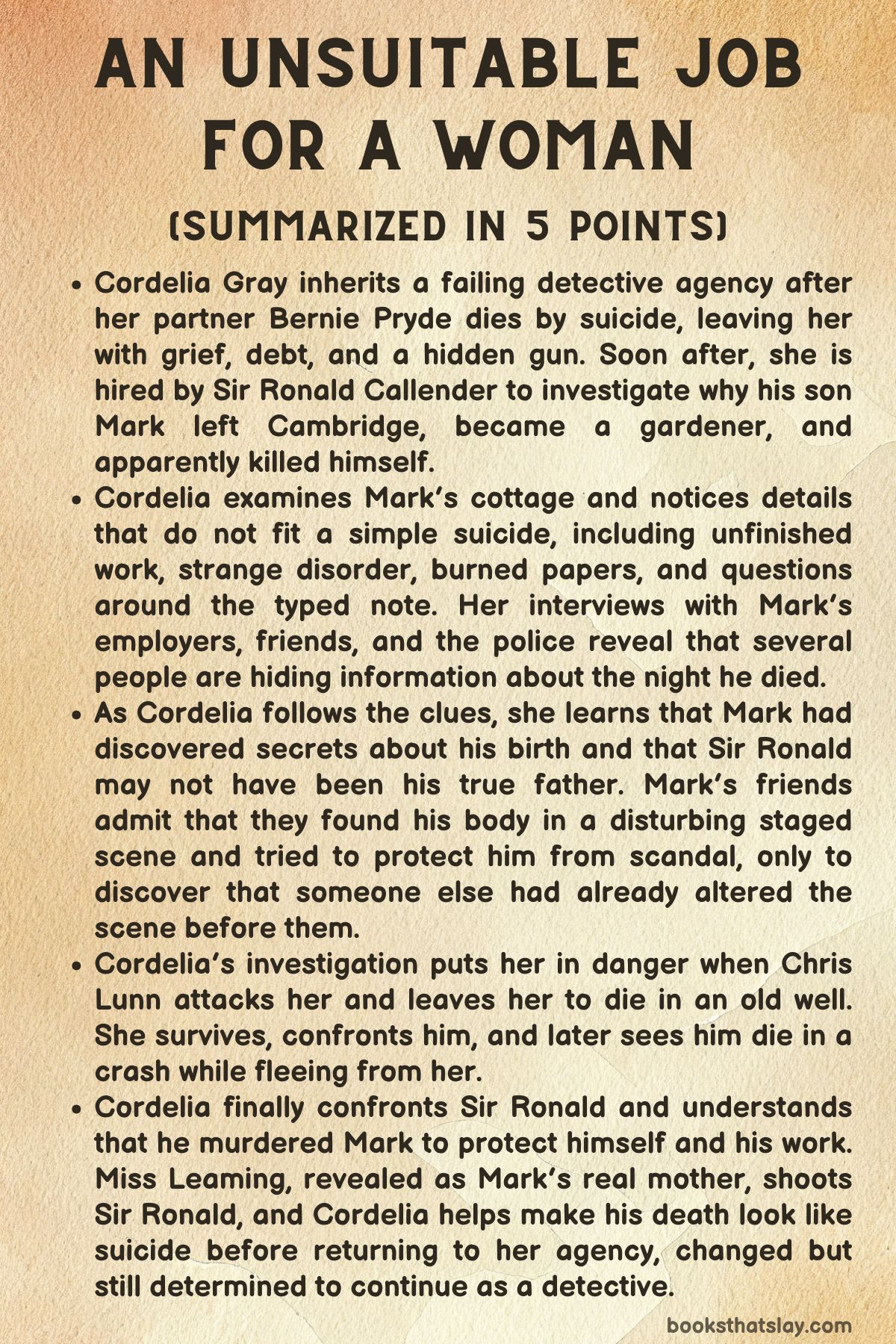
An Unsuitable Job for a Woman begins with Cordelia Gray arriving at the small detective agency she runs with Bernie Pryde, a former police officer who has served as her mentor and partner. She finds that Bernie has killed himself after learning he has cancer.
His farewell note leaves her the agency and hints that she should take possession of the illegal gun and bullets hidden among their equipment. Cordelia understands the message, hides the weapon, and contacts the police.
Bernie’s death leaves Cordelia alone in every practical sense. He had no close family, and neither does she.
As she clears out his office and room, she sees the poor state of his life and the agency’s finances. The business is nearly bankrupt, and she is close to being homeless.
Still, she decides to keep the detective agency open for as long as possible, partly out of loyalty to Bernie and partly because she has nowhere else to go.
Her first major chance arrives when Elizabeth Leaming comes to the office on behalf of Sir Ronald Callender, a respected microbiologist. Miss Leaming had expected to hire Bernie, but Cordelia persuades her to consider her instead.
Cordelia travels to Cambridge and meets Sir Ronald, who wants her to investigate the death of his twenty-one-year-old son, Mark Callender. Mark had left Cambridge University, taken a job as a gardener, and soon afterward was found hanged in a cottage on the estate where he worked.
A note was found, but it consisted only of a passage from William Blake. Sir Ronald says he wants to understand why Mark died, even if the truth implicates him.
Miss Leaming strongly objects to the inquiry, arguing that Mark’s privacy should be respected.
Cordelia begins by visiting the estate where Mark had lived and worked. The Markland family, who employed him, describe him as quiet, disciplined, and hardworking.
His choice to leave Cambridge and become a gardener seemed strange, especially because he had come from a privileged background and was due to inherit a large fortune. Cordelia examines the cottage and sees that Mark had made it neat and orderly.
Several details disturb her. A pitchfork had been left in the ground before a row of digging was finished, which seems unlike Mark’s tidy habits.
His shoes had been removed carelessly. Food had been cooked but not eaten.
There were ashes in the fireplace, suggesting that papers had been burned before his death. Cordelia also learns that a rich foreign woman had visited Mark on the evening he died.
These small inconsistencies make Cordelia question whether Mark truly killed himself. She stays in the cottage to continue her inquiry, keeping Bernie’s gun hidden nearby.
She checks the official inquest record and visits the police officer who handled the case. Sergeant Maskell admits that some details troubled him too, especially the knot used with the leather strap that killed Mark.
Yet he lacked proof of murder. He lets Cordelia keep the strap and suicide note, since no one else wants them.
Cordelia notices that the note appears to have been typed by an experienced typist. Maskell also tells her that the pathologist found a faint trace of lipstick on Mark’s upper lip.
Cordelia then turns to Mark’s friends: Hugo and Sophie Tilling, Isabelle de Lasterie, and Davie Stevens. They are uneasy when she questions them and seem to be hiding something.
Hugo says Mark was private and should be left alone. The group claims they were all at a play on the night Mark died, but Cordelia catches Isabelle in a lie when she asks about a scene that does not exist.
Sophie later speaks to Cordelia privately and reveals that she and Mark had been lovers. She also tells Cordelia that Mark had cared for a severely disabled boy named Gary Webber and had argued that Gary’s life still had worth, even when others thought the family might be better off if he died.
Sophie admits that she thought she knew Mark but now realizes she did not.
Cordelia attends a party at Isabelle’s house, hoping to learn more. Isabelle admits that she visited Mark shortly before his death and recalls that he had earlier stopped at a doctor’s house while they were on a trip.
Cordelia also meets Mark’s former tutor, Edward Horsfall, who says Sir Ronald could not have killed Mark because they were at dinner together on the night of the death. During that dinner, Sir Ronald received a phone call that seemed to be from Mark.
Later, Cordelia learns that Sir Ronald told the porter the call had actually been from Chris Lunn, his assistant. This contradiction deepens her suspicion.
When Cordelia returns to Mark’s cottage, she finds that someone has hung a pillow from the same hook where Mark died, clearly intending to frighten her. The knot is different from the one used on Mark, which suggests that the person trying to scare her may not be the original killer.
Cordelia continues searching for the truth and tracks down Mrs. Goddard, the woman who had once served as nanny to Mark’s mother, Evelyn. Mrs. Goddard explains that Evelyn came from wealth, while Sir Ronald had been the gardener’s son.
This helps Cordelia understand how painful it may have been for Sir Ronald to see Mark choose work as a gardener.
Mrs. Goddard also reveals that Evelyn gave her a prayer book and asked her to pass it to Mark on his twenty-first birthday. Mark later asked Mrs. Goddard for the name of the doctor who had treated Evelyn when she was dying.
Cordelia finds the prayer book and eventually notices a faint mark on the page for St. Mark’s Day. She interprets the mark as a clue to Evelyn’s blood type.
Mark’s donor card shows he had type B blood, while Cordelia learns that Sir Ronald has type A. After checking the biological facts, she concludes that Sir Ronald and Evelyn could not both have been Mark’s parents. Mark must have discovered that Sir Ronald was not his father, or that the story of his birth was false.
Cordelia confronts Hugo and Isabelle after catching them entering the cottage to retrieve a painting Isabelle had lent Mark. They finally admit part of what happened on the night Mark died.
Isabelle had gone to see Mark and found him dead, dressed in women’s underwear, with lipstick smeared on his mouth and pornographic images nearby. Terrified of scandal, she ran to Hugo and the others.
They planned to clean the body and make the death look less shameful, but when they returned, someone else had already done so and had staged the hanging as suicide. This confirms Cordelia’s belief that Mark was murdered and that another person had reached the cottage before the friends came back.
Cordelia goes to London to examine the will of Mark’s grandfather, thinking there may be a financial motive. She discovers that no individual benefits from Mark’s death; the money goes to charities.
When she returns to the cottage, she is attacked. Her assailant covers her head, drags her to an old well, drops her inside, and seals the cover above her.
Cordelia fights to stay alive, slowly climbing the narrow shaft by bracing her body against the sides. Miss Markland finds and rescues her after noticing that the well cover has been disturbed.
Cordelia sends Miss Markland away, knowing her attacker may return to make the scene look like an accident.
Cordelia waits near the well with her gun and soon sees Chris Lunn arrive with her handbag, clearly intending to leave it as evidence that she fell in by accident. She confronts him, but he runs.
Cordelia chases him in her car until he drives into a truck and dies when his van crashes and explodes. Shaken and exhausted, Cordelia drives to Sir Ronald’s house.
There she confronts Sir Ronald with the truth. She believes he killed Mark and arranged the scene to look like a shameful accidental death, but someone else changed it into a suicide before the body was found.
Sir Ronald denies responsibility, yet he speaks in a way that makes his guilt plain. He suggests Mark’s death served a purpose and shows no remorse.
Cordelia understands that, even with the truth in front of her, she lacks the evidence to prove it.
Miss Leaming then enters and shoots Sir Ronald with Cordelia’s pistol. She reveals that Mark was her son by Sir Ronald.
She had allowed Evelyn to be presented as Mark’s mother, partly to protect the child and partly because of the family’s social and financial situation. She knows Sir Ronald killed Mark because she found the lipstick he used in the pocket of his suit.
Cordelia decides to help her. Drawing on Bernie’s lessons, she stages Sir Ronald’s death to look like suicide.
The two women agree on a story and repeat it to the police. At the inquest, they lie successfully, and Sir Ronald’s death is ruled suicide.
Afterward, Miss Leaming meets Cordelia one last time and explains the full story of Mark’s birth. She had loved Mark from a distance, expressing what she could not say by knitting him sweaters.
She gives Cordelia a written confession to protect her if the truth ever comes out, but Cordelia burns it and insists that they remember only their agreed version of events.
Cordelia returns to London, but Chief Superintendent Adam Dalgliesh questions her. He suspects she has lied about the gun and has uncovered evidence that weakens her story.
Just as Cordelia is close to confessing, news arrives that Miss Leaming has died in a car accident. Dalgliesh lets Cordelia go, recognizing that there is no longer much purpose in pursuing the case.
The official inquiry ends without exposing the full truth.
The novel closes with Cordelia back at the detective agency. She receives payment from Sir Ronald’s estate and considers her uncertain future.
Then the telephone rings and a prospective client appears, suggesting that despite loss, danger, and moral compromise, Cordelia Gray’s career as a private detective is only beginning.
Characters
Cordelia Gray
Cordelia Gray is the central figure of An Unsuitable Job for a Woman, and her character is built around loneliness, intelligence, discipline, and a quiet need to prove herself. She begins the book in a position of almost complete vulnerability: her partner Bernie Pryde is dead, the agency is failing, and she has little money or security.
Yet she does not collapse under these pressures. Instead, she treats Bernie’s death, the agency’s future, and the Callender case with a steadiness that shows both emotional restraint and inner toughness.
Cordelia is young, and many people underestimate her because of her age, gender, and appearance, but these very qualities help her move through spaces where a more conventional detective might be resisted. She listens carefully, observes small contradictions, and allows people to reveal themselves.
Cordelia is not simply a clever investigator; she is also morally complex. Her sympathy for Mark grows as she inhabits his cottage, handles his belongings, and recognizes the neglect surrounding his death.
She does not know him directly, yet she becomes one of the few people willing to treat his life as worth understanding. Her investigation is personal as well as professional because Mark’s isolation resembles her own.
Both have been shaped by absent or failed parents, and both seem to have lived on the edges of other people’s arrangements. By the end, Cordelia crosses a serious ethical line when she helps Miss Leaming conceal Sir Ronald’s murder.
This decision shows that her sense of justice is not identical to the law. She sees Sir Ronald as guilty and Miss Leaming as a grieving mother acting after years of suppression and loss.
Cordelia’s final survival as a detective suggests that she has gained experience, but not innocence.
Mark Callender
Mark Callender is dead before the investigation begins, yet he is one of the most important presences in the book. He is reconstructed through objects, memories, witness accounts, and the emotional reactions of those who knew him.
At first he appears to be a privileged young man who inexplicably abandoned Cambridge and chose a harsh, solitary life as a gardener. As Cordelia learns more, Mark becomes a figure of moral seriousness and private pain.
His neatness, discipline, and care in arranging the cottage suggest a young man trying to create order in a life built on secrecy. His decision to leave university and work with his hands is not merely eccentric; it seems to be a response to what he has discovered about his birth, his father, and the false structure of his family.
Mark’s tragedy lies in the fact that he seeks truth in a family that survives by hiding it. He is not portrayed as dramatic or rebellious in a simple way.
He is thoughtful, gentle, and capable of compassion, as shown through his concern for Gary Webber and his refusal to reduce a difficult life to convenience. His relationship with Sophie suggests tenderness but also distance, because even those closest to him do not fully understand what he is carrying.
Mark’s death exposes the selfishness and fear of the adults around him. Sir Ronald sees him as a threat, Miss Leaming loves him but cannot claim him, and his friends try to protect appearances after finding his body.
Mark is therefore both victim and moral test: the way others respond to his death reveals who they really are.
Bernie Pryde
Bernie Pryde appears only briefly in person, but his influence remains strong throughout An Unsuitable Job for a Woman. He is Cordelia’s former partner, mentor, and the person who gives her the practical foundations of detective work.
His suicide is a bleak opening event, but it is not treated as a simple act of weakness. Bernie is ill, isolated, financially unsuccessful, and aware that his life has not become what he hoped.
His final note to Cordelia is apologetic and coded, showing both affection and a detective’s habit of practical thinking. Even in death, he tries to equip her for survival by leaving her the agency and reminding her about the gun.
Bernie represents failure, but also inheritance. Professionally, he was never the great detective he wanted to be, and his admiration for Dalgliesh suggests a man who measured himself against a higher standard.
Yet his lessons matter. Cordelia repeatedly uses techniques and stories she learned from him, including how to examine scenes, interpret clues, and understand staged deaths.
His presence also gives Cordelia a form of emotional ancestry. She has no strong family structure, so Bernie’s training becomes a substitute legacy.
Dalgliesh’s later recognition that Bernie indirectly affected the case gives Bernie a posthumous dignity. He may have failed in life, but through Cordelia he leaves behind a real detective.
Sir Ronald Callender
Sir Ronald Callender is one of the coldest and most dangerous figures in the novel. Publicly, he is a respected microbiologist, a man of intellect, status, and scientific achievement.
Privately, he is controlling, proud, and capable of treating human beings as instruments. His decision to hire Cordelia appears at first to show a desire for truth, but it is more likely an attempt to manage danger and measure how much can be discovered.
His personality is shaped by ambition and resentment. Having risen from a poor background, he has built an identity around success, authority, and social elevation.
Mark’s choice to become a gardener wounds him because it recalls the class position he escaped and threatens the story he has built about himself.
Sir Ronald’s evil is especially disturbing because it is rationalized. He does not behave like a man overcome by passion or panic; he thinks in terms of necessity, usefulness, and control.
Once Mark discovers the truth about his parentage and possibly threatens Sir Ronald’s reputation or work, Sir Ronald decides that his son can be removed. His lack of remorse reveals the full emptiness of his moral world.
He can discuss murder almost as an intellectual problem, reducing Mark’s life to an obstacle. His final confrontation with Cordelia shows his confidence in social power.
He believes he can destroy her because he has status and she has little. His death at Miss Leaming’s hands is therefore not only revenge but the collapse of the authority he used to dominate others.
Elizabeth Leaming
Elizabeth Leaming is one of the most tragic and controlled characters in the book. At first, she appears to be Sir Ronald’s efficient assistant and housekeeper-like companion, a woman whose loyalty to him seems stern and unquestioning.
Her opposition to the investigation initially makes her look evasive or hostile, but the truth reveals that her resistance comes from grief, fear, and a lifetime of denied motherhood. She is Mark’s biological mother, yet she has never been allowed to claim him openly.
Her love has been forced into indirect forms, such as knitting sweaters for him and remaining near the household without being recognized for what she truly is.
Miss Leaming’s character is shaped by repression. She has lived inside a lie that benefits Sir Ronald and preserves social appearances, while costing her the ordinary rights of a mother.
Her emotional severity is the result of years spent controlling what she knows, feels, and cannot say. When she discovers that Sir Ronald murdered Mark, her response is decisive and fatal.
Shooting him is an act of vengeance, but also an assertion of identity: the hidden mother finally acts for her son. Her later cooperation with Cordelia shows intelligence and composure, but also exhaustion.
She does not beg to be saved. Her confession, which Cordelia burns, shows that she is willing to protect the younger woman even after committing murder.
Miss Leaming’s death soon afterward leaves her story unresolved in legal terms, but emotionally complete in a dark and sorrowful way.
Adam Dalgliesh
Adam Dalgliesh enters late in the novel, but his presence carries authority because of his connection to Bernie and his role as a professional investigator. He represents the official detective world that Cordelia stands outside.
Unlike many others, he does not underestimate her, though he questions her sharply and recognizes that she is lying. His intelligence is shown not through dramatic action but through patient reconstruction.
He traces Cordelia’s movements, notices contradictions, and understands that the official account of Sir Ronald’s death is false or incomplete.
Dalgliesh also serves as a moral contrast to Cordelia. He belongs to the law, while Cordelia has acted according to a personal sense of justice.
Their interview becomes a test of whether truth, proof, and justice can be made to align. Dalgliesh suspects much but cannot prove enough, and Miss Leaming’s death removes the practical point of further pursuit.
His comments about Bernie reveal both criticism and respect. He sees Bernie as flawed, but he also recognizes that Bernie’s influence on Cordelia has shaped the outcome of the case.
Dalgliesh’s final restraint is important. He does not expose Cordelia, partly because the evidence is insufficient and partly because he seems to understand the human reality behind the lies.
Sophie Tilling
Sophie Tilling is Mark’s former lover and one of the young Cambridge circle who knew him before his death. She is intelligent, emotionally unsettled, and more deeply affected by Mark than she first allows Cordelia to see.
Her relationship with him gives her a privileged position in the investigation, but it also reveals how little intimacy guarantees understanding. Sophie thought she knew Mark, yet his final choices and hidden discoveries make her feel that she had never truly reached him.
This realization wounds her pride and her emotions.
Sophie also reflects the moral uncertainty of youth in the book. Her conversation about Gary Webber shows that she can be unsentimental, even harsh, in her reasoning about suffering and usefulness.
Mark’s disagreement with her marks him as someone with a deeper reverence for life, even difficult life. Sophie is not cruel, but she is intellectually restless and emotionally evasive.
She wants to talk and not talk, to remember Mark and protect herself from what remembering demands. Her invitation to Cordelia and her partial openness suggest that she is not actively malicious, but she is part of a group that hides truth when scandal threatens.
Through Sophie, the story examines the limits of love when honesty is missing.
Hugo Tilling
Hugo Tilling is clever, socially confident, and protective of his circle. He often speaks with irony and detachment, using wit as a shield against discomfort.
When Cordelia questions him, he tries to discourage her by appealing to Mark’s privacy. His attitude suggests both loyalty and evasion.
Hugo does not want Mark’s life exposed, but he also does not want his own actions or the group’s deception uncovered. He is not the murderer, yet he participates in the concealment that delays the truth.
Hugo’s role becomes especially important when he admits what happened after Isabelle found Mark’s body. His decision to help alter or manage the scene is morally questionable, but it arises from panic, class instincts, and fear of scandal rather than calculated evil.
He is the kind of person who assumes that certain ugly facts can be cleaned away if handled discreetly. His later remarks about death suggest a fashionable philosophical detachment, but the book does not entirely endorse this pose.
Hugo may be intelligent, but he lacks Cordelia’s commitment to seeing a difficult matter through. He represents a social world that can admire sensitivity while avoiding responsibility.
Isabelle de Lasterie
Isabelle de Lasterie is glamorous, wealthy, foreign, and somewhat removed from the emotional codes of the English characters around her. She is important because she is one of the last people to see Mark alive and the first among the young group to find his body.
At first she lies about her whereabouts, pretending to have attended the play with the others. Her failure to answer Cordelia’s test question exposes the weakness of that lie.
Yet Isabelle is not shown as deeply devious; she is frightened, self-protective, and dependent on others to manage the situation.
Isabelle’s reaction to Mark’s body is crucial because it reveals the original staging of the murder. She finds him dressed in a humiliating sexualized manner, with lipstick and pornographic images used to create a false impression.
Her shock leads her to seek Hugo’s help, and their group’s attempt to cover things up creates another layer of confusion. Isabelle’s inability to remember seeing lipstick becomes a major clue for Cordelia, because it suggests that the object used to smear Mark’s mouth was removed before the others returned.
Isabelle is not a central moral thinker in the novel, but her fear and honesty under pressure help Cordelia move closer to the truth.
Davie Stevens
Davie Stevens is part of Mark’s Cambridge circle and functions as a quieter, more observant presence among the younger characters. He does not dominate scenes in the way Hugo does, nor does he carry Sophie’s emotional connection or Isabelle’s direct involvement, but he helps Cordelia understand the social and intellectual environment Mark left behind.
His remarks about Sir Ronald and Chris Lunn are useful because they reveal how others viewed the Callender household. Davie suggests that Sir Ronald cared more for Lunn than for Mark, which sharpens Cordelia’s sense of emotional distortion within the family.
Davie also contributes to the atmosphere of Cambridge life that Cordelia briefly imagines she might have had. Through him and the others, she sees a world of education, leisure, conversation, and youthful privilege.
Yet this world is not innocent. Its members lie, hide, and protect themselves when faced with death.
Davie is not presented as wicked, but he is part of a group whose loyalty is selective. He helps show that charm and intelligence do not necessarily produce courage.
In the structure of the story, he is a supporting character who adds social context and helps reveal how Mark moved among people who liked him but did not fully know him.
Chris Lunn
Chris Lunn is Sir Ronald’s assistant and one of the more sinister figures around the Callender household. He is physically present at key moments and seems to occupy an ambiguous position between employee, favored subordinate, and possible surrogate son.
Others notice Sir Ronald’s attachment to him, and this attachment contrasts sharply with Sir Ronald’s coldness toward Mark. Lunn’s role suggests dependence on power.
He benefits from Sir Ronald’s trust and appears willing to act in his interests, even when those interests become dangerous.
His attempt to murder Cordelia by leaving her in the well marks him as more than a passive servant. Whether he acts under direct orders or out of loyalty, fear, or self-preservation, he becomes an agent of violence.
His plan is practical and cruel: Cordelia’s death is meant to look accidental, removing a threat without exposing Sir Ronald. His return to plant her handbag shows calculation, but his panic when confronted reveals weakness.
Lunn’s death in the crash prevents full legal clarity, leaving uncertainty about exactly how much he knew and did. Still, his actions prove that Sir Ronald’s household is protected by more than silence; it is protected by people willing to destroy others.
Miss Markland
Miss Markland is one of the most unusual secondary characters in An Unsuitable Job for a Woman. She is severe, bitter, and openly hostile toward younger generations.
Her speeches about youth, violence, selfishness, and moral decline reveal a woman trapped in old grief and disappointed ideals. The loss of her fiancé in the Spanish Civil War shaped her emotional life, but the later revelation that her young son died in the well gives even greater depth to her bitterness.
She is not merely a judgmental older woman; she is someone whose life has been marked by private devastation.
Her connection to the well makes her rescue of Cordelia deeply significant. She notices the disturbed cover because the place already carries terrible meaning for her.
In saving Cordelia, she briefly moves beyond bitterness into urgent human action. Afterward, her emotional confession makes Cordelia uncomfortable because it exposes raw grief at a moment when Cordelia needs practical safety.
Miss Markland’s later planting of flowers around the well suggests an attempt to transform a place of death into a place of remembrance. She is harsh and sometimes unpleasant, but the book gives her enough pain to make her more than a caricature.
Major Markland
Major Markland is Mark’s employer at Summertrees and represents a conventional, restrained, upper-class approach to responsibility. He hires Mark after checking that there was no scandal behind his departure from Cambridge, but he does not inquire deeply into Mark’s motives.
His attitude is formal and practical: Mark applied for a job, seemed suitable enough, and did the work. He is not uncaring in an active sense, but his lack of curiosity shows how easily a troubled person can remain unseen when others decide that deeper questions are not their business.
Major Markland’s function in the story is to establish the setting of Mark’s final days and to show the limits of respectable observation. He notices oddness but does not interpret it.
He allows Mark to live in the cottage and work on the estate, but he does not form a meaningful bond with him. Through him, the novel shows that neglect does not always look cruel.
Sometimes it appears as politeness, distance, and respect for privacy. His household gives Cordelia access to the physical facts of the case, but emotionally it remains detached from the dead young man.
Mrs. Markland
Mrs. Markland has a smaller role, but she helps form the atmosphere of Summertrees and the social world in which Mark spends his final days. Like her husband, she is part of a household that observes Mark from a distance.
Her skepticism toward Cordelia reflects the assumptions that many characters make about youth and female competence. She does not seem vicious, but she belongs to the polite social order that fails to recognize danger until after it has passed.
Her importance lies less in individual action and more in what she represents. Around Mark are people who behave properly, speak cautiously, and maintain appearances, yet none of this protects him.
Mrs. Markland’s limited understanding of Mark reinforces his isolation. She sees a young employee, perhaps a strange one, but not a person at the center of a hidden family crisis.
In a detective story concerned with missed signs, she is one of several characters whose ordinary blindness allows the crime to remain concealed for a time.
Mrs. Goddard
Mrs. Goddard is a key witness to the older family history behind Mark’s death. As the former nanny connected to Evelyn’s family, she carries memories that others have buried or distorted.
Her conversation with Cordelia opens the past and reveals the emotional and class tensions that shaped the Callender household. She remembers Evelyn, Sir Ronald’s rise from humble origins, and the strange circumstances surrounding Mark’s birth.
Her promise to deliver the prayer book gives Mark the clue that leads him toward the truth.
Mrs. Goddard is also important because she represents loyalty across time. She does not understand everything, but she honors Evelyn’s request long after the events themselves.
Her actions are quiet, domestic, and easily overlooked, yet they become central to the mystery. Through her, Cordelia learns that the truth was not erased completely; it survived in small gestures, old memories, and a faint mark in a prayer book.
Mrs. Goddard’s decency contrasts with Sir Ronald’s manipulation. She has no power, but her faithfulness helps expose a powerful man’s crime.
Evelyn Callender
Evelyn Callender is absent from the present action, but her life shapes the entire mystery. She is remembered as a woman controlled by family expectations, illness, and Sir Ronald’s dominance.
Born into wealth but deprived of maternal love, she becomes vulnerable to the arrangement that presents Mark as her child. Her participation in the deception is morally complicated.
She benefits from the appearance of motherhood because it restores her standing in her father’s eyes and affects inheritance, but she also seems to convince herself that the lie serves the child’s welfare.
Evelyn is not portrayed as a mastermind. She is more a fragile participant in a scheme designed and controlled by stronger personalities.
Her prayer book suggests guilt, faith, and a desire for eventual revelation. By leaving a clue for Mark, she creates the possibility that truth may one day reach him.
Yet this delayed truth also contributes to his danger. Evelyn’s character shows how lies created to solve immediate social problems can become destructive legacies.
Her absence is therefore active: she is gone, but the choices made around her body, marriage, illness, and supposed motherhood determine the fate of the next generation.
Gary Webber
Gary Webber is a minor character in terms of action, but he has thematic importance. He is a severely disabled boy whom Mark befriends and occasionally cares for.
His presence allows the book to explore how characters think about human worth. Sophie views Gary’s life through the pain and burden experienced by his family, while Mark resists the idea that death can be treated as a practical solution to difficult existence.
This disagreement reveals something essential about Mark’s moral nature.
Gary also helps distinguish Mark from the more detached intellectualism of his Cambridge friends. Mark’s compassion is not abstract; he gives time and care to someone many people might avoid.
In a story full of people who rationalize harm, Gary becomes a measure of ethical seriousness. Mark’s defense of his life shows that he values existence even when it is inconvenient, painful, or socially hidden.
This makes Sir Ronald’s later justification of Mark’s murder even more horrifying, because father and son stand on opposite sides of the question of whether a human life can be dismissed for someone else’s convenience.
Edward Horsfall
Edward Horsfall, Mark’s former tutor, is a figure of academic detachment and social observation. He gives Cordelia useful information, especially about Sir Ronald’s alibi and the phone call during dinner.
His view of Mark is cool and dismissive; he describes him as a negligible personality and does not imagine that anyone would have a strong reason to murder him. This misjudgment is important because it shows how badly Mark was underestimated by people who should have known him better.
Horsfall’s role also exposes the limitations of intelligence without emotional insight. He is educated and observant, but he does not grasp the hidden pressures around Mark’s identity and family.
His confidence in the unlikelihood of murder rests on social logic rather than moral imagination. Yet the detail he provides about the dinner becomes valuable because it helps Cordelia question Sir Ronald’s version of events.
Like several characters in the book, Horsfall does not solve the mystery, but he accidentally hands Cordelia a piece of the truth.
Themes
Truth, Secrecy, and the Cost of Concealment
Truth in An Unsuitable Job for a Woman is never presented as simple information waiting to be found. It is buried under family arrangements, social shame, false appearances, and deliberate staging.
Mark’s death is surrounded by several layers of concealment: Sir Ronald’s original crime, Miss Leaming’s alteration of the scene, the friends’ attempted cover-up, and the official willingness to accept suicide because murder cannot easily be proved. Each secret begins as an attempt to control damage, yet every act of concealment creates more danger.
The greatest secret is Mark’s parentage, a lie created years earlier to preserve reputation, inheritance, and domestic order. That lie does not stay safely in the past.
It shapes Mark’s identity, threatens Sir Ronald’s authority, and leads directly to violence. Cordelia’s work as a detective is therefore not only about solving a crime; it is about testing whether truth can survive in a world where powerful people are skilled at burying it.
The book also questions whether all truth should be legally exposed. Cordelia uncovers the reality of Mark’s murder, yet she helps hide Miss Leaming’s revenge.
The result is morally uneasy: truth is known, but not publicly settled.
Gender, Power, and Professional Respect
Cordelia’s position as a young woman in detective work shapes nearly every encounter she has. People doubt her competence before she speaks, judge her by her appearance, and assume that investigation is not proper work for someone like her.
The title itself reflects the social prejudice she faces, but the story repeatedly shows that Cordelia’s supposed unsuitability is one of her strengths. Because she is underestimated, people speak carelessly around her.
Because she is not an official police detective, she can ask questions in unexpected ways. Because she knows what it means to be insecure and alone, she notices forms of neglect that others overlook.
Gender also affects Miss Leaming’s life in a harsher and more tragic way. She is denied the public role of mother and remains trapped in a subordinate position beside Sir Ronald, despite being essential to his household and history.
The alliance between Cordelia and Miss Leaming near the end is built on shared recognition: both women have been dismissed by male authority, and both understand how power protects itself. Their cover-up of Sir Ronald’s death is morally troubling, but it also exposes their refusal to remain passive within a system that has already failed Mark.
Class, Status, and Social Performance
Class pressure runs beneath the mystery from the beginning. Sir Ronald’s rise from the gardener’s son to respected scientist is central to his identity, and this explains why Mark’s decision to become a gardener feels like more than youthful rebellion.
It threatens the story Sir Ronald has built about escape, achievement, and superiority. Mark’s work at Summertrees becomes symbolic: he returns to the kind of labor his father wanted to leave behind, and in doing so he unknowingly touches Sir Ronald’s deepest shame.
The contrast between Cambridge privilege, country-house manners, inherited wealth, and professional ambition creates a world where appearances matter intensely. Characters often respond to scandal before they respond to suffering.
Isabelle and Hugo’s first instinct after finding Mark is not to call for help or truth but to manage the disgrace of how the body looks. Evelyn’s false motherhood is also tied to inheritance and social approval.
Even the official handling of death is shaped by respectability; a suicide can be absorbed into social order more easily than a murder involving family secrets. The novel suggests that class is not only about money.
It is about performance, memory, shame, and the fear of being seen as what one once was.
Justice, Law, and Moral Compromise
The book separates justice from legal procedure in uncomfortable ways. The police require proof, and Sergeant Maskell’s position makes practical sense: suspicion is not enough.
Cordelia, however, operates in the space between what can be proved and what can be known. She gathers clues that point to murder, but the evidence is repeatedly destroyed, altered, or made ambiguous.
By the time she confronts Sir Ronald, she understands the truth but lacks the means to secure legal justice. Sir Ronald counts on that gap.
His confidence comes from knowing that status, intelligence, and missing evidence can protect him. Miss Leaming’s act of killing him closes one moral account while opening another.
She punishes a murderer, but she also commits murder herself. Cordelia’s decision to help stage the death as suicide forces readers to judge whether compassion can justify deception.
The novel does not offer an easy answer. Sir Ronald escapes trial, Miss Leaming escapes public judgment through death, and Cordelia escapes punishment despite lying.
Yet none of these outcomes feels clean. Justice occurs only in a damaged, unofficial form, leaving the law intact on the surface while the deeper moral truth remains hidden.