Anything But Typical Summary, Characters and Themes
Anything But Typical by Nora Raleigh Baskin is a middle-grade novel about Jason Blake, a twelve-year-old autistic boy who understands the world most clearly through words, stories, and patterns. Speaking aloud is often difficult for him, and people around him frequently mistake his silence or movements for indifference, strangeness, or rudeness.
Online, however, Jason can express himself with precision and confidence. Through his writing on a story website, he forms a friendship with a girl named Rebecca, forcing him to face his fear of being seen beyond the safety of the screen. The book is about identity, acceptance, family, and the need to be understood as one truly is.
Summary
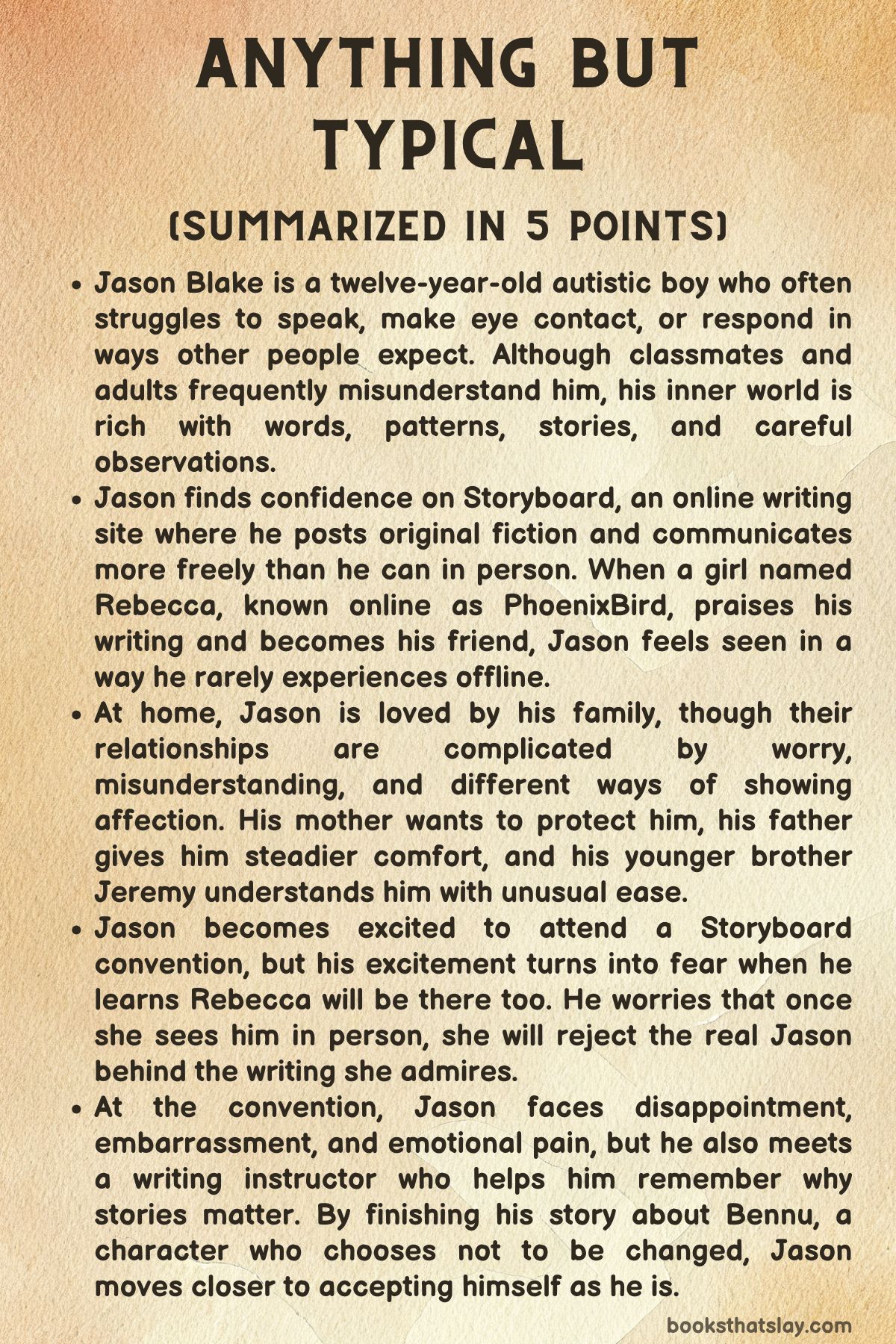
Jason Blake is twelve years old, autistic, and deeply aware that most people do not understand him. He knows that others see him as strange because he flaps his hands, rocks, avoids eye contact, and struggles to speak when he is anxious or overwhelmed.
Yet Jason’s inner life is rich, sharp, observant, and full of language. He loves words, letters, stories, and the hidden patterns behind them.
He wants to explain himself in a way that neurotypical people can understand, but speaking aloud rarely lets him do that. Writing does.
School is difficult for Jason because it constantly demands responses he cannot easily give. In the library, he becomes distressed when another student sits at his favorite computer.
For Jason, that particular computer is not a small preference but part of the order he needs to feel steady. The librarian tries to help, but her touching him makes everything worse.
Jason cannot explain his discomfort in the moment, and other students judge him for the way he moves, breathes, and reacts. His friend Aaron helps by getting the girl to move, but Jason cannot show gratitude in the expected way.
Adults assume that because he does not display emotion normally, he does not feel it. Jason knows this is untrue.
At home, Jason’s family loves him, though they do not always understand him. His mother wants to help, but her help often carries grief and worry.
She wants Jason’s life to be easier and sometimes seems to wish she could make him more like other children. His father is quieter and steadier, and Jason often feels safer with him.
His younger brother Jeremy is neurotypical but has quirks of his own, such as not wanting foods to touch. Jason understands Jeremy in ways adults do not.
Their relationship is one of the most comfortable in Jason’s life because they do not always need words to communicate.
Jason’s greatest freedom comes through Storyboard, an online writing site where he posts original fiction. There, he is not the odd boy in class or the child adults are trying to manage.
He is a writer. When a user named PhoenixBird comments kindly on one of his stories, Jason is stunned.
PhoenixBird praises his work, and Jason soon learns that she is a girl. Her real name is Rebecca.
Their messages become important to him, and he begins to think of her as a true friend, perhaps even more than that. Through the computer, Jason can be thoughtful, funny, intelligent, and emotionally open in a way he cannot manage face-to-face.
As his friendship with Rebecca grows, Jason also writes a story about Bennu, a dwarf who is offered a medical procedure that could make him the same size as other people. Bennu’s situation reflects Jason’s own questions about difference, identity, and what it means to be “fixed.” Jason understands that the world often treats difference as a defect.
He has felt this at school, in public, and even among relatives. When his cousin Seth insults him and calls him defective, Jason reacts physically by kicking him.
Jason knows hurting someone is wrong, but he also knows that Seth’s cruelty hurt him first. His family’s reactions leave him ashamed and frightened about what will happen when he grows older and cannot rely on his parents in the same way.
Jason’s school life continues to be full of small disasters that other people do not fully understand. In art class, noise, unclear instructions, and teasing push him beyond what he can manage.
In math, while thinking about Rebecca, he shreds his book without realizing it. In the cafeteria, he tries to navigate friendship with Aaron and the social world of other boys, but their teasing about his supposed girlfriend makes him feel exposed.
Jason’s mind often moves toward words and images to cope: snowflakes, letters, leaves, sounds, and story structures. These thoughts are not distractions to him; they are part of how he survives.
Rebecca becomes a source of comfort because she knows him first through his writing. She likes his stories and trusts his comments on her own work.
Jason tells her about his dog Lester, who died, and Rebecca responds with kindness. For Jason, this matters deeply.
Online, he can be known without being stared at. He can be valued before being judged by his body, his movements, or his voice.
This friendship helps him manage school better, and his parents notice that he seems to be doing well. As a reward, they offer to take him to a Storyboard convention in Dallas, where he can attend writing workshops and meet other writers.
At first Jason is thrilled. The convention is something he has wanted for a long time.
But everything changes when Rebecca tells him she will also be there. Jason is terrified.
He believes that once Rebecca sees him in person, she will no longer like him. He imagines her recognizing his name tag, seeing his movements, hearing his silence, and realizing that he is not the person she thought he was.
His online world and real world are about to meet, and he feels trapped. His parents assume his anxiety is about flying and try to help him practice sitting still for the plane ride, but Jason cannot tell them the truth.
The fear is not the plane. The fear is being seen.
For a brief moment, bad weather and illness seem to cancel the trip, and Jason is relieved. Believing he will not see Rebecca after all, he writes to her that he had hoped to attend the convention but cannot.
He signs the message with love, exposing more feeling than he intended. Then his father finds another flight, and Jason must go after all, this time with his mother.
The situation becomes even more frightening because Rebecca now has both his name and his confession.
Traveling with his mother is stressful. Airports, noise, crowds, and unfamiliar places are hard for Jason, and his mother becomes anxious when she gets lost.
Jason remembers the day he was diagnosed with autism, when his mother came out from speaking with doctors in tears. He understood that the diagnosis explained him, but he also understood that it would not make life suddenly simple.
In Dallas, the hotel room gives him some relief because it is plain and calm, but the convention itself is overwhelming, filled with costumes, noise, and strangers.
Then Rebecca appears. She introduces herself to Jason and his mother.
Jason cannot look at her or speak to her. His mother makes polite conversation, but Jason feels the relationship slipping away.
Later, at breakfast, Rebecca sees him and turns away, pretending to tie her shoe so she can leave. Jason understands what she is doing.
His mother understands too, and Jason hears her pain. For Jason, it feels like confirmation of his worst fear: Rebecca liked the writer she knew online, but not the boy standing in front of her.
This rejection makes Jason want to stop writing. He thinks about another painful memory, when he played baseball on a team coached by his father.
Other boys mocked and physically hurt him, and after that he never played again. Now he feels the same way about writing.
If writing led him to Rebecca and then to this humiliation, he wants to give it up. His mother gently gives him the option to skip the workshop and stay in the hotel room, but Jason decides to attend because he wants to make her happy.
At the writing workshop, Jason faces the wall, planning not to participate. Then the instructor arrives, and Jason sees that he is a dwarf, like Bennu.
The instructor, Hamilton, asks the class what the most important part of a writer is. Jason blurts out the answer: the bottom, because writers must sit down and write.
Instead of mocking him, Hamilton says he is right. He explains that writers preserve their own truth by writing it down.
This moment reaches Jason. Hamilton’s presence and words show him that difference does not erase authority, talent, or purpose.
A person can be visibly different and still stand before a room as a writer.
At the convention party, Rebecca approaches Jason again. This time she tells him that she likes his stories and hopes they can keep writing to each other.
She also admits that his help improved her language arts grade. The moment is not the romance Jason imagined, but it is not complete rejection either.
Rebecca is imperfect, young, and unsure, but she still values his words. Jason cannot say all he wants to say, yet the conversation leaves space for something to continue.
On the flight home, Jason sits beside an uncomfortable stranger but manages the experience using the coping skills he has developed. He looks forward to seeing his father and Jeremy.
His mother tells him that the trip has been one of the best experiences of her life because she has learned from him, especially about bravery. Jason wishes she would not cry or talk so much, but he also recognizes that everyone has things they cannot help doing.
This recognition becomes a quiet form of acceptance between them.
By the end of Anything But Typical, Jason returns to Bennu’s story. Bennu wakes up on the morning of the surgery that is supposed to make him normal.
He goes to the doctor but decides not to change. He tells the doctor that he has changed his mind because this is who he is.
Through Bennu, Jason says what he has been learning about himself. He does not need to be cured into someone else to have worth.
He is autistic, a brother, a son, a friend, and a writer. He is not typical, but he is fully himself.
Characters
Jason Blake
Jason Blake is the central character of Anything But Typical, and the book presents his inner life with unusual closeness and honesty. He is a twelve-year-old autistic boy who often cannot express himself through speech, especially when he is anxious, overstimulated, or expected to respond in a socially accepted way.
What makes Jason so compelling is the difference between how people see him from the outside and how full, intelligent, and observant his mind is on the inside. Others may notice his hand flapping, rocking, silence, or discomfort with touch, but the reader sees his precise awareness of language, emotion, patterns, and human behavior.
Jason is not unaware of the world around him; in many ways, he notices more than the people who judge him.
Jason’s relationship with words is one of the clearest ways the book shows his identity. Letters, sounds, meanings, and names matter deeply to him.
Writing gives him a form of freedom that ordinary conversation rarely provides. On Storyboard, he can be thoughtful, funny, sensitive, and exact.
This online space allows him to be known first through his imagination rather than through the physical behaviors that often make people misunderstand him. His friendship with Rebecca becomes so important because it offers him the possibility of being accepted as a writer and person before being labeled as different.
At the same time, Jason is painfully aware of how others react to him. He knows when people call him weird, gross, defective, or dangerous, and he carries those judgments with him.
He does not always respond in ways that others consider appropriate, but the book makes clear that his emotions are strong even when they are not expressed conventionally. His fear of meeting Rebecca comes from a lifetime of being rejected after people see his body, movements, and silence.
His growth does not come from becoming more typical. It comes from reaching a clearer acceptance that he is already complete, even if the world often fails to understand him.
Rebecca
Rebecca, known online as PhoenixBird, is one of the most important figures in Jason’s emotional journey. At first, she exists for Jason almost entirely through words.
She reads his stories, praises his writing, shares her own work, and gradually becomes a friend. Because their relationship begins online, Rebecca sees Jason’s intelligence and creativity before she sees his autism.
This gives Jason a rare experience: being appreciated without first being examined, corrected, pitied, or avoided. Her kindness makes him feel hopeful, and her messages become a source of comfort during difficult school days.
Rebecca is also significant because she represents Jason’s longing for ordinary connection. He wants a friend who is a girl, and he begins to imagine her as a possible romantic figure.
This does not mean Rebecca is cruel or false; rather, she is a young person who likes Jason’s writing but is not fully prepared for the reality of meeting him face-to-face. When she sees Jason in person and avoids him, the moment hurts because it confirms the fear he has been carrying.
She is not presented as a villain, but her reaction shows how even people who admire someone from a distance can struggle when confronted with difference in real life.
Her later conversation with Jason at the convention adds complexity to her character. She approaches him, tells him she likes his stories, and says she hopes they can continue writing to each other.
This does not erase the pain of her earlier avoidance, but it suggests that Rebecca is also learning. She is awkward, imperfect, and limited by her own expectations, yet she is not entirely dismissive.
In Anything But Typical, Rebecca becomes a mirror for Jason’s fear of being seen and a reminder that human connection can be uneven, painful, and still meaningful.
Elizabeth Blake
Elizabeth Blake, Jason’s mother, is loving, anxious, protective, and often overwhelmed by the demands of parenting a child whom the world does not easily accept. She wants Jason to be safe, happy, and understood, but she also carries grief over the difficulties he faces.
Her love is real, yet it sometimes feels to Jason like a wish to fix him. She worries about his behavior, his future, his social life, his school experiences, and the ways other people judge him.
This worry makes her both deeply devoted and emotionally fragile.
Elizabeth’s sadness often comes from misunderstanding Jason’s silence. When he cannot respond to her affection or explain his distress, she sometimes reads his behavior as rejection.
Jason, however, is often aware of her pain and feels guilty for causing it, even when he cannot say so. Their relationship is tender but complicated because both of them are trying to protect the other from sadness.
Elizabeth wants to reduce Jason’s suffering, while Jason often hides his feelings because he does not want to hurt her.
Her journey becomes especially important during the trip to the Storyboard convention. Away from the stabilizing presence of her husband, she appears more vulnerable.
She gets anxious, becomes lost, struggles with unfamiliar places, and at moments seems to mirror Jason’s own distress. This allows Jason to see her not only as a parent but as a person with her own limits.
By the end of the trip, Elizabeth recognizes Jason’s bravery and admits that she is learning from him. Her growth lies in moving closer to acceptance, not because she stops worrying, but because she begins to see Jason’s strength more clearly.
Jason’s Father
Jason’s father is a quieter and steadier presence than Elizabeth. He does not always understand Jason perfectly, but his calmness gives Jason a sense of safety.
Jason often finds him easier to be around because he talks less and seems to demand fewer emotional performances. When Jason is upset, his father’s physical presence can help him feel grounded.
Being held by his father allows Jason to breathe and feel supported in a way that words cannot always accomplish.
His father’s love is practical and patient. He paints the alphabet on Jason’s ceiling when Jason is young, recognizing that letters have meaning and beauty for him even when others dismiss them as useless.
This act shows that he is capable of honoring Jason’s interests without needing to translate them into typical achievement. He also tries to prepare Jason for the airplane trip by creating practice situations at home.
Although he misunderstands the real cause of Jason’s anxiety, his effort comes from care.
At the same time, Jason’s father is not flawless. His reaction to the baseball incident, when he describes cruelty as part of the world, shows a more resigned view of human behavior.
He wants Jason to survive in a harsh world, but he may sometimes underestimate how deeply cruelty wounds him. Still, his bond with Jason remains one of the book’s most stabilizing relationships.
He represents a form of love that is less verbal, more physical, and often easier for Jason to trust.
Jeremy Blake
Jeremy is Jason’s younger brother, and his role in the story is quietly powerful. Although he is neurotypical, Jeremy has habits and sensitivities of his own, such as wanting food to stay separated on his plate.
Through Jeremy, the book challenges the idea that only autistic people have unusual needs or behaviors. Everyone has preferences, fears, and patterns; Jason simply lives in a world that judges his more harshly.
Jeremy understands Jason in ways many adults do not. Their communication is often direct, gentle, and free of unnecessary pressure.
Jeremy can sense when Jason is upset about Rebecca, and he knows how to approach him without forcing him to explain everything. He is one of the few characters who accepts Jason’s inner emotional life without demanding that it appear in a typical form.
His loyalty is especially clear after Jason kicks Seth. Jeremy understands that Seth was cruel and does not rush to condemn Jason.
Jeremy also gives Jason a chance to act as an older brother. When Jeremy struggles with the regular plate at dinner, Jason speaks to comfort him.
This moment matters because Jason is often treated as the child who needs help, but here he becomes the one who gives it. Jeremy’s presence brings warmth to the story and shows that love between siblings does not always require perfect communication.
Sometimes it rests on trust, shared space, and a willingness to understand what others miss.
Aaron Miller
Aaron Miller is Jason’s main friend at school, although their friendship is not simple or deeply intimate in the usual sense. Aaron helps Jason in practical ways, such as getting another student to leave Jason’s preferred computer.
He calls Jason “Jay-man,” includes him at lunch, and shows a casual loyalty that matters in a school environment where many students are quick to mock or avoid Jason. Aaron’s friendship is valuable because it gives Jason at least one peer who does not treat him only as a problem.
Aaron is not presented as a perfect friend. He does not always know what Jason needs, and their relationship has limits.
They no longer spend time together outside school as they once may have, and Jason often cannot tell Aaron the things he wants to say, especially about Rebecca. Still, Aaron’s presence gives Jason a small but real connection to the social world of school.
He is one of the few classmates who sees Jason as more than his autistic behaviors.
His response to Jason’s Bennu story is especially important. When Jason explains Bennu’s dilemma, Aaron listens and offers a thoughtful idea about what it would mean for Bennu not to recognize himself after changing.
This shows that Aaron is capable of engaging with Jason’s imagination rather than dismissing it. In a book where many people talk around Jason or about him, Aaron’s willingness to listen makes him meaningful.
Suzy
Suzy, the babysitter, is a minor but warm presence in Jason’s life. Jason likes her because she communicates in a way that feels easier for him to read.
Her hand movements help him understand her, and her manner does not seem as demanding or judgmental as that of many adults. She has known the family for a long time, which gives Jason some comfort, even though he still becomes anxious when his parents leave.
Suzy’s importance lies partly in how Jason responds to her. He feels affection for her, but he cannot express it directly.
When he looks at the alphabet on his ceiling and wishes the letters could speak for him, the reader sees how much feeling exists behind his silence. Suzy does not occupy a large part of the plot, but she helps reveal Jason’s emotional depth.
His inability to speak in a typical way does not mean he lacks tenderness, attachment, or gratitude.
Miss Leno
Miss Leno, the librarian, represents the well-meaning adult who still misunderstands Jason’s needs. She tries to guide him and calm him when he is distressed, but her physical touch makes the situation worse.
She does not intend to hurt him, yet she assumes that her way of helping is the right one. For Jason, being touched when he is already overwhelmed is painful, and Miss Leno’s failure to recognize this shows how easily good intentions can become harmful when adults do not listen to autistic experience.
Her frustration with Jason after Aaron helps him also reveals a common misunderstanding. She expects Jason to show appreciation visibly, in the way she considers proper.
When he does not, she assumes he is ungrateful. Jason understands gratitude as an internal feeling, not as a performance.
Miss Leno’s character highlights one of the book’s central conflicts: neurotypical people often mistake expression for emotion. If Jason does not express something in their language, they assume it is not there.
Mrs. Hawthorne
Mrs. Hawthorne, Jason’s art teacher, is connected to some of Jason’s most stressful school experiences. Art class is difficult for him because of noise, unclear expectations, and the behavior of other students.
Mrs. Hawthorne seems unable to fully understand how her classroom affects Jason. Her assignments do not always make sense to him, and her reactions to his distress make him feel even more alienated.
She is not simply cruel, but she is not equipped to support Jason well. After the incident with the potter’s wheel, she tries to be nicer, yet the damage has already been done.
Jason enters her class expecting conflict and discomfort. Mrs. Hawthorne’s character shows how a school environment can fail a student even when accommodations exist on paper.
A teacher may know that a child has needs without truly understanding how to teach that child in a humane and flexible way.
Eric Doyle
Eric Doyle is one of the students who openly torments Jason. His teasing after the art class incident shows the casual cruelty that Jason faces from peers.
Eric turns Jason’s involuntary barking sound into a weapon, using it to embarrass and dehumanize him. He does not try to understand why Jason reacted as he did; he only sees an opportunity to mock him.
Eric’s role in the book is to represent the social danger of school for Jason. The problem is not only sensory overload or academic challenge.
The problem is also the constant threat of humiliation. Eric and students like him make Jason’s body feel unsafe in public because any movement or sound can become a joke.
Through Eric, the story shows how bullying can attach itself to disability and difference, making ordinary school days emotionally exhausting.
Seth
Seth, Jason’s cousin, is rude, dismissive, and openly hostile. He does not want Jason in his room, lies to avoid spending time with him, and speaks to both Jason and Jeremy with contempt.
His use of the word “defective” is especially cruel because it strikes directly at one of Jason’s deepest fears: that others see him not as different, but as broken. Seth’s insult has more force because it comes from family, a space where Jason might reasonably hope for more acceptance.
Jason’s reaction to Seth is physical. He kicks him, and although the action is wrong, the book allows the reader to understand the emotional pressure behind it.
Seth’s cruelty pushes Jason past what he can process. This scene also reveals how quickly adults may focus on Jason’s behavior while missing what was done to him first.
Seth functions as a reminder that not all harm is loud or visible. Sometimes the most damaging act is a word said with contempt.
Aunt Carol
Aunt Carol is Jason’s aunt and Seth’s mother. She appears as a competitive and status-conscious adult who likes to praise her own children.
Her conversations contribute to the pressure Jason’s mother feels during family visits. Aunt Carol’s pride in Seth sharpens Elizabeth’s insecurity, making family gatherings uncomfortable and emotionally loaded.
Aunt Carol also helps show how families can become places of comparison rather than comfort. Her view of children seems tied to achievement, normalcy, and appearances.
When conflict happens, she reacts to Jason’s visible behavior, not necessarily to the full situation. Her character is important because she reflects the social judgment Elizabeth fears.
Through Aunt Carol, the book shows that parents of children with disabilities often face not only their own worries but also the silent or open criticism of relatives.
Uncle Bobby
Uncle Bobby has a smaller role, but he helps define the family environment Jason enters during the dinner visit. He is described as financially successful despite being less educated than Jason’s father, and this detail contributes to the tension Jason’s mother feels around her side of the family.
His household becomes a place where comparison, bragging, and discomfort gather.
Although Uncle Bobby is not developed as deeply as Aunt Carol or Seth, his presence helps establish the social world that Elizabeth finds stressful. The visit is not just a meal; it is a test of appearances.
Jason senses these tensions even if the adults do not explain them directly. Uncle Bobby’s role supports the book’s larger picture of family life as a place where love, pride, judgment, and discomfort can exist together.
Jason’s Grandmother
Jason’s grandmother is one of the clearest examples of an adult who does not understand him. She speaks loudly to him as if he cannot hear, showing that she confuses autism with other kinds of impairment.
She also fails to appreciate the value Jason finds in letters and words, dismissing them as meaningless if they do not lead to ordinary speech. Her attitude reveals a narrow idea of intelligence and communication.
Her reaction when Jason honestly says he does not love baby Jeremy also shows how uncomfortable she is with literal truth. Jason is not trying to be cruel; he is stating what he feels at that time.
His grandmother expects a socially acceptable lie and becomes displeased when he does not provide it. Through her, the book explores how neurotypical social rules often reward false politeness over honesty, while punishing Jason for being direct.
Jane
Jane, Jason’s former one-on-one aide, is important even though she is mostly remembered rather than actively present. Jason recalls how she helped him manage school situations, including moments when he needed guidance to avoid trouble.
Her absence marks a turning point in his life. As a sixth grader, Jason is expected to manage more independently, but the school environment remains difficult.
Jane represents support that was structured, familiar, and useful. Jason misses her not because he wants to be treated as helpless, but because she helped translate confusing expectations into something he could handle.
Her role points to a major issue in Jason’s life: independence is valuable, but removing support too quickly can leave a child exposed. Jane’s memory shows that accommodation is not a weakness.
For Jason, the right support can make participation possible.
Mr. Shupack
Mr. Shupack, Jason’s language arts teacher, is one of the more positive adults in the school setting. Jason likes language arts because it allows creativity, and Mr. Shupack’s class gives him a space where his strengths are visible.
In this classroom, Jason is not only the student who struggles socially; he is also the student who writes well and helps others. That matters greatly to his sense of self.
Jason does have difficulty looking at Mr. Shupack’s birthmark, which reveals the honesty of Jason’s sensory and visual responses. The book does not present Jason as saintly or perfectly sensitive; instead, it shows his mind as specific and sometimes uncomfortable in ways he cannot easily control.
Mr. Shupack’s importance comes from the fact that he is connected to Jason’s identity as a writer. He is part of the world where Jason’s talent is recognized.
Hamilton
Hamilton, the writing instructor at the convention, has a brief but decisive role in Anything But Typical. He is a dwarf, which immediately connects him to Jason’s fictional character Bennu.
For Jason, seeing Hamilton as a published writer and teacher challenges the assumptions behind Bennu’s imagined cure. Hamilton is visibly different, yet he commands the room through knowledge, humor, and authority.
He is not presented as someone who needs to be fixed.
His lesson about writing is simple but powerful: writers must sit down and write. This idea reaches Jason at a time when he is ready to give up writing because of his painful encounter with Rebecca.
Hamilton gives Jason a reason to continue. He frames writing as a way to preserve truth and individual voice.
For Jason, who often cannot speak his truth aloud, this lesson is life-giving. Hamilton helps Jason understand that a writer’s value does not depend on appearing typical.
Bennu
Bennu is Jason’s fictional character, but he is also one of the most revealing figures in the story. As a dwarf offered a procedure that could make him physically typical, Bennu becomes Jason’s way of exploring his own fears about autism, acceptance, and cure.
Jason gives Bennu a body that the world sees as different, then places him in a situation where others are excited by the possibility of changing him. Through Bennu, Jason can ask questions he cannot easily ask about himself.
Bennu’s final decision not to undergo the surgery is one of the strongest symbolic moments in the book. He chooses himself as he is.
This ending reflects Jason’s movement toward self-acceptance. Bennu is not merely a fictional project; he is Jason’s emotional language.
When Jason cannot explain his fear of Rebecca, his shame, or his anger at being treated as defective, Bennu’s story carries those feelings. Bennu shows that Jason’s writing is not an escape from reality.
It is one of the truest ways he understands reality.
Lester
Lester, Jason’s former dog, represents comfort, loyalty, and grief. Jason chooses Lester at the shelter because the dog is trembling rather than jumping around like the others.
This choice reveals Jason’s sensitivity to fear and vulnerability. He recognizes something in Lester that others might overlook.
Their bond is quiet and physical, based on presence rather than complicated social expectations.
Lester’s death is one of Jason’s painful memories, but it also becomes a point of connection with Rebecca. When Jason tells her about Lester and she responds kindly, he feels understood.
Lester’s role is not large in terms of action, but emotionally he matters. He shows Jason’s capacity for attachment and care.
He also reminds the reader that Jason’s grief may not always look typical, but it is real and deep.
Themes
Being Seen Versus Being Understood
Jason is seen constantly, but he is rarely understood. People notice his movements, his silence, his hand flapping, his discomfort with touch, and his difficulty responding in expected ways.
They see the outside and quickly decide what it means. The book challenges that habit by giving full access to Jason’s thoughts, where his intelligence, humor, sensitivity, and emotional awareness become unmistakable.
This contrast creates one of the strongest tensions in the story. Jason’s body communicates distress in ways others misread, while his mind is often processing far more than anyone realizes.
The online friendship with Rebecca sharpens this theme. Through writing, Jason can be understood before he is seen.
Rebecca first knows his imagination, not his diagnosis. That gives him hope, but it also creates fear.
When they meet in person, Jason worries that being seen will destroy being understood. Her initial avoidance hurts because it suggests that the visible version of Jason has replaced the written version she admired.
Yet the book does not leave the issue there. Jason’s journey suggests that true understanding requires more than looking and more than reading.
It requires patience, humility, and the willingness to believe that a person’s inner life may be larger than their outward behavior suggests.
Language, Writing, and the Self
Words are not just a skill for Jason; they are the place where he is most himself. Spoken language often fails him because it depends on timing, eye contact, tone, and immediate social response.
Written language gives him space. It allows him to choose, arrange, revise, and express what his body and voice cannot always manage in the moment.
In Anything But Typical, writing becomes Jason’s clearest form of agency. It is how he builds friendship, processes pain, explores identity, and claims a voice in a world that often speaks for him.
Jason’s fascination with letters shows that language is physical and emotional to him. Letters have shapes, personalities, and relationships.
Words can comfort, but they can also wound. Terms like “defective” hurt because they carry judgment beyond their dictionary meaning.
Through Bennu’s story, Jason uses fiction to examine questions he cannot directly ask: Would being changed make life easier? Would it still be him?
Does difference need correction? Writing gives Jason a way to test these fears safely.
Hamilton’s lesson at the convention reinforces this theme by reminding him that writers preserve their truth. For Jason, writing is not a hobby.
It is his most reliable bridge between his inner world and everyone else.
Family, Protection, and Acceptance
Jason’s family loves him deeply, but love does not automatically create understanding. His mother wants to protect him from pain, yet her protection is mixed with fear, sadness, and a desire to make his life easier by making him seem more typical.
His father offers a calmer form of support, though he also misreads some situations. Jeremy, meanwhile, often understands Jason with a natural ease that adults lack.
The family is not perfect, but it is one of the book’s most important spaces for showing how care can be complicated.
Elizabeth’s relationship with Jason is especially layered. She hurts when he hurts, but she also sometimes interprets his silence as emotional distance.
Jason, in turn, often tries to protect her by hiding his own pain. This reversal is moving because it shows that Jason is not only cared for; he also cares deeply for others.
He notices his mother’s sadness, his father’s disappointment, and Jeremy’s distress. The convention trip changes Elizabeth because she begins to see Jason’s courage more clearly.
Acceptance in the family does not mean all worry disappears. It means learning to stop treating Jason’s difference only as a problem and beginning to recognize the strength, perception, and love already present in him.
Difference, Normalcy, and the Idea of Being Fixed
The book repeatedly questions what it means to be normal and who gets to decide. Jason is surrounded by people who have their own habits, fears, and limitations, yet his differences are the ones most often labeled as problems.
Jeremy dislikes food touching. Elizabeth struggles with directions and anxiety.
Other children lie, tease, and hurt people. Adults misread situations and pretend not to notice uncomfortable truths.
The story quietly asks why some differences are tolerated while others are treated as defects.
Bennu’s storyline brings this theme into sharp focus. Offered the chance to become physically typical, Bennu must decide whether changing his body would solve his life or erase part of who he is.
This fictional dilemma reflects Jason’s own experience as an autistic boy whose mother sometimes seems to wish his difficulties could be removed. The book does not deny that Jason’s life can be hard.
Sensory overload, bullying, social confusion, and communication barriers cause real pain. But it separates hardship from defectiveness.
Jason does not need to become someone else to deserve friendship, respect, or love. The final choice Bennu makes affirms the central idea that acceptance is not resignation.
It is the recognition that a person’s worth is not measured by how closely they match the world’s preferred version of normal.