Arc of Justice Summary and Analysis
Arc of Justice: A Saga of Race, Civil Rights, and Murder in the Jazz Age by Kevin Boyle is a historical nonfiction account of race, housing, law, and resistance in 1920s America. At its center is Dr. Ossian Sweet, a Black physician who moves with his family into a white Detroit neighborhood and faces a violent mob determined to drive him out.
Boyle uses Sweet’s life to show the wider story of the Great Migration, Jim Crow, northern segregation, Black ambition, white backlash, and the rise of civil rights legal activism. The book is both a courtroom drama and a social history of a nation struggling over who had the right to safety, property, and citizenship.
Summary
Arc of Justice opens against the background of the Great Migration, when millions of Black Americans left the South for northern and midwestern cities in search of work, safety, and dignity. They traveled by train from towns shaped by cotton fields, tobacco plantations, racial terror, and Jim Crow laws.
The North promised jobs, better schools, political rights, and a chance to live beyond the constant threat of southern violence. Yet the migrants soon learned that northern cities had their own color lines.
Detroit, Chicago, New York, and other urban centers offered opportunity, but also crowded housing, racist employers, hostile police, and white neighborhoods determined to keep Black families out.
Detroit becomes the central stage of the book. By the 1920s, the city is booming because of the automobile industry.
Factories owned by men like Henry Ford and the Dodge brothers attract workers from across the United States and abroad. The city grows rapidly, and housing becomes expensive and scarce.
Black migrants are largely confined to overcrowded districts such as Black Bottom, where landlords divide buildings into small units and charge high rents because tenants have few alternatives. White residents, meanwhile, form neighborhood associations to protect what they call racial purity.
They use intimidation, restrictive agreements, and mob violence to prevent Black families from moving into white areas.
Dr. Ossian Sweet is one of the Black professionals who tries to move beyond these limits. Born in Florida, he grows up under Jim Crow and learns early that success cannot protect Black people from white violence.
His family values religion, education, thrift, and respectability. His father works hard to build a life for the family, and his mother helps raise their children within the moral discipline of the African Methodist Episcopal Church.
But Sweet’s childhood is marked by racial cruelty, including lynchings and burnings that leave him with a lasting fear of mobs.
As a teenager, Sweet leaves Florida to attend Wilberforce University in Ohio, a historically Black institution connected to the AME Church. He works to pay his way and absorbs the ideals of discipline, achievement, and racial uplift.
Later, he studies medicine at Howard University in Washington, D.C. His time there coincides with World War I and a period of racial violence across the country. In Washington, Black residents arm themselves to defend their neighborhoods against white attacks.
Sweet sees that Black advancement does not end white hostility. It often provokes it.
After earning his medical degree, Sweet moves to Detroit. He starts his practice in Black Bottom, first using the back room of a pharmacy as his office.
He treats Black workers and families who have limited access to medical care because white hospitals and doctors often refuse them. His practice grows, and he joins Dunbar Memorial, Detroit’s Black hospital.
Through his profession and social connections, Sweet enters the city’s Black middle class. He meets Gladys Mitchell, a poised and educated young woman from a respectable Detroit family, and they marry.
The couple later travels to Europe, where Sweet studies in Vienna and Paris. In France, they experience a degree of public freedom denied to them in the United States, though even there an American hospital refuses to admit Gladys because she is Black.
Their daughter Iva is born in France.
When the Sweets return to Detroit, Sweet wants a home that reflects his success and gives his family stability. But the city’s housing market is shaped by racism.
Real estate agents charge Black buyers more, banks refuse loans, and white neighborhoods organize against integration. Sweet eventually buys a bungalow on Garland Avenue, a white working-class street.
The purchase is financially burdensome, but it represents more than comfort. It is a claim to citizenship, dignity, and the right to live where his work and money allow.
Sweet knows the danger. Other Black Detroiters have been attacked after moving into white neighborhoods.
Dr. Alexander Turner, another respected Black physician, was driven from his home by a mob and forced to sign away his deed. Vollington Bristol, a friend of Sweet’s, also faced violence when he tried to occupy property in a white area.
Around Garland Avenue, white residents form the Waterworks Park Improvement Association to stop the Sweets from moving in. Its members spread rumors, hold meetings, and prepare the neighborhood for confrontation.
Sweet decides he will not be driven out. He gathers guns and asks relatives and friends to stay with him and Gladys during the first nights in the house.
Among those present are his brothers Otis and Henry, friends, insurance agents, a chauffeur, and a handyman. Police are assigned to watch the house, but Sweet cannot trust them fully.
On the first night, a crowd gathers but the situation does not turn deadly. On the second night, the threat grows.
Neighbors and onlookers gather outside, rocks are thrown, windows break, and fear rises inside the house. Shots are fired from the bungalow.
Leon Breiner, a white man in the crowd, is killed, and another man is wounded.
The police arrest everyone inside the Sweet home, including Gladys. The defendants are taken to jail and questioned.
Prosecutors try to shape the case as murder rather than self-defense. Their argument depends on denying that a mob existed.
Police officers and neighbors claim the crowd was small and peaceful, even though the defense later shows that the gathering was large, hostile, and connected to organized attempts to drive the Sweets away. The prosecution charges all eleven people with murder and assault with intent to kill.
The case quickly becomes larger than one shooting. Detroit’s Black leaders, lawyers, churches, and NAACP branch rally behind the defendants.
The national NAACP, led by James Weldon Johnson and Walter White, recognizes the case as a test of whether Black Americans have the legal right to defend their homes against racial violence. Johnson also sees it as a chance to build support for a broader legal campaign against segregation.
The NAACP eventually brings in Clarence Darrow, one of the most famous defense lawyers in the country, along with Arthur Garfield Hays. Their presence turns the trial into a national event.
The first trial places all eleven defendants before an all-white jury. Prosecutors call police officers and Garland Avenue residents who insist that the Sweets were not under real threat.
Darrow and the defense team work to expose contradictions. They show that rocks were thrown, windows were broken, and the neighborhood association had organized to keep Black people out.
They also present Sweet’s life story, not as a distraction, but as the key to understanding his fear. His memories of southern violence, Washington riots, lynchings, and recent attacks on Black homeowners explain why he believed his life and family were in danger.
Darrow’s courtroom strategy is moral as well as legal. He argues that the law cannot be separated from the long history of racial violence in America.
Sweet is not portrayed as a criminal looking for trouble, but as a man who had done everything America claimed to reward: he studied, worked, married, bought a home, and tried to protect his family. The prosecution asks the jury to focus on the dead man.
The defense asks the jury to consider the mob, the broken windows, the history of terror, and the right of a homeowner to defend himself. The jury cannot agree, and the judge declares a mistrial.
The NAACP then prepares for separate trials. Henry Sweet, Ossian’s younger brother, is tried first.
This time Darrow sharpens the case. He attacks the Waterworks Park Improvement Association more directly and shows that its purpose was to keep Black residents out through intimidation.
Witnesses admit that the association wanted to protect the neighborhood from Black people. The defense again brings forward evidence of the crowd, the rocks, and the danger surrounding the bungalow.
Ossian testifies and admits he armed the men in the house because he was afraid.
In closing, Darrow turns Henry’s trial into a statement about American democracy. He argues that Black citizens cannot be expected to submit quietly to violence and still believe in equal justice.
Judge Frank Murphy instructs the jury that all men are equal before the law. The jury returns a verdict of not guilty.
The decision ends the prosecution’s case against the others. For the NAACP, the victory becomes a symbol of organized legal resistance and helps strengthen the movement that would later challenge segregation in courts across the country.
The book’s ending is more sorrowful. The legal victory does not bring peace to the Sweet family.
Gladys contracts tuberculosis during her time in jail and passes it to Iva. Their daughter dies in 1926, and Gladys dies two years later.
Ossian returns to Garland Avenue and continues practicing medicine, but his life becomes increasingly lonely and troubled. He runs hospitals, buys property, seeks political office, and remains involved in public life, but he never fully recovers from the losses that follow the trial.
He eventually sells the Garland Avenue house. In 1960, after years of decline, he dies by suicide.
Arc of Justice ends by showing that the case mattered even though it did not save Ossian Sweet from personal tragedy. It helped establish that Black Americans had the right to defend their homes and forced the nation to confront northern racism as part of the same system that sustained Jim Crow.
The story is therefore both a victory and a warning: the law can be used to challenge injustice, but legal triumph does not erase the human cost of hatred.
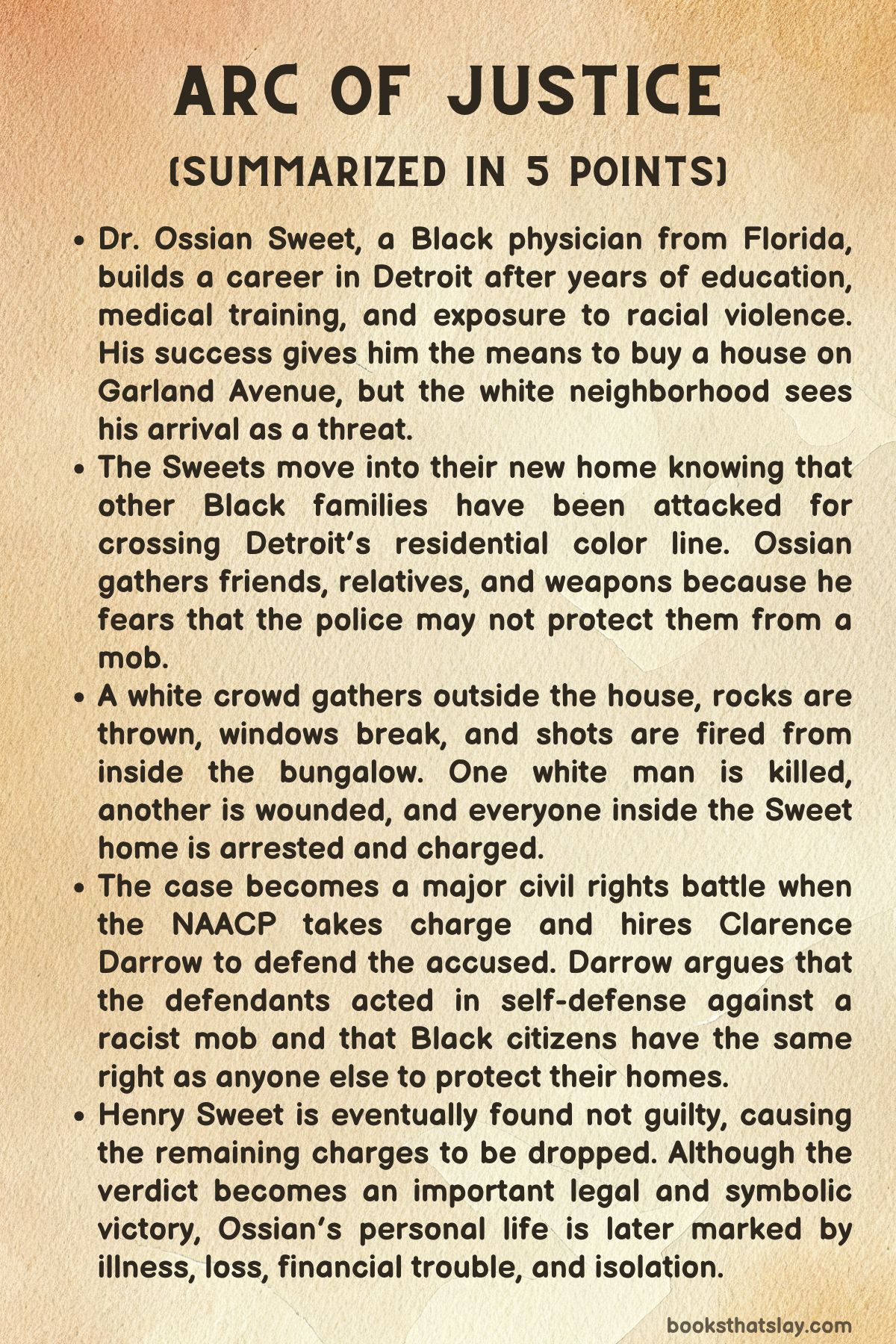
Key Figures
Dr. Ossian Sweet
Dr. Ossian Sweet is the central figure of Arc of Justice, and the book presents him as both a product of American racial violence and a man determined not to be defeated by it. His life begins in the Jim Crow South, where he grows up seeing how easily white power can turn into public terror.
The burning and lynching of Black men in Florida shape his imagination long before he becomes a doctor, teaching him that respectability, education, and moral discipline may improve a Black person’s life, but they do not guarantee safety. His journey through Wilberforce University, Howard University, medical training, and Europe gives him confidence and ambition, yet it also sharpens his awareness of the unfair limits placed on Black achievement.
When he buys the Garland Avenue house, he is not simply buying property; he is claiming the ordinary American right to live where his labor and money allow him to live. His decision to arm the house shows both courage and fear.
He knows the danger is real because he has lived under its shadow since childhood. In the book, Sweet is neither a simple hero nor a flawless victim.
He can be proud, anxious, defensive, and later difficult in his personal relationships. His legal victory does not save him from grief, illness in his family, isolation, or decline.
That complexity makes him a deeply human figure: a man who wins a public battle for justice but loses much of his private world.
Gladys Sweet
Gladys Sweet is one of the most quietly powerful figures in the book. She comes from a respectable working-class Black family in Detroit and carries herself with poise, dignity, and social confidence.
Her marriage to Ossian connects her to his ambitions, but she is never only an extension of him. She shares in the risks of the Garland Avenue move, helps prepare the home, hosts guests even in a tense atmosphere, and faces police questioning with remarkable control.
Her refusal to be intimidated after the arrest shows a kind of discipline that contrasts with Ossian’s more visible anxiety. Gladys also represents the cost borne by Black women in struggles that are often publicly remembered through male leaders and courtroom speeches.
She is jailed, exposed to disease, separated from security, and later suffers the devastating consequences of tuberculosis. Her death after Iva’s death turns the legal victory into something painfully incomplete.
Through Gladys, the book shows that racial violence attacks not only public rights but also domestic life, motherhood, marriage, health, and hope. She stands for the fragile dream of a safe Black home in a society determined to make that dream dangerous.
Henry Sweet
Henry Sweet, Ossian’s younger brother, becomes crucial because his separate trial determines the fate of all the defendants. In the house on Garland Avenue, Henry is young, loyal, and frightened, yet he is also willing to stand beside his brother when the mob gathers.
His admission that he fired a weapon makes him legally vulnerable, but it also makes him the clearest test case for the question at the heart of the book: whether a Black man has the right to defend himself and his family against a white mob. Henry’s trial allows the defense to focus the story more sharply than in the first group trial.
He becomes, in effect, the person through whom the court must judge the entire situation. Henry does not dominate the book the way Ossian does, but his role is vital because his acquittal ends the threat of further trials.
His character also reflects the family pattern of education, ambition, and upward movement. Like Ossian, he has left the South and seeks a professional future, but the violence of Garland Avenue interrupts that path and turns him into a symbol of self-defense.
Otis Sweet
Otis Sweet is another important member of the Sweet family, and he brings a different energy from Ossian and Henry. He is sociable, lively, and less severe than Ossian, with interests that include baseball and nightlife.
Yet his lighter personality does not mean he lacks seriousness. He moves north, establishes himself professionally as a dentist, and supports Ossian during the Garland Avenue crisis.
Otis also plays an active role in pushing the legal defense toward the NAACP, helping the defendants move beyond local legal confusion and toward a national strategy. His presence in the book helps show that the Sweet family’s migration north was not only Ossian’s individual success story.
It was part of a larger family effort to escape the South’s restrictions and enter professional life. Otis’s loyalty matters because the defense of the house is also a defense of family advancement.
He represents the younger generation of Black professionals who want not merely survival, but social freedom, dignity, and space to live fully.
Clarence Darrow
Clarence Darrow enters the book as a nationally famous lawyer whose reputation changes the scale of the case. He is not presented as a saintly rescuer, but as a brilliant, theatrical, ambitious, and deeply skilled advocate.
Darrow understands that the case cannot be won through narrow legal argument alone. He must make the jury understand fear, history, prejudice, and the meaning of home.
His courtroom method depends on exposing contradiction without sounding mechanical. He questions witnesses in a way that makes police officers seem indifferent, neighbors seem evasive, and the neighborhood association seem openly racist.
His closing arguments are powerful because he connects Henry and Ossian Sweet to the broader history of slavery, lynching, segregation, and Black striving. Darrow’s role in Arc of Justice also shows the complicated politics of interracial legal work.
The NAACP hires him partly because a famous white attorney may influence white jurors in a way Black attorneys are not allowed to do by the racial assumptions of the time. Darrow’s success is therefore both inspiring and revealing: the defense needs his genius, but it also needs his whiteness to be heard.
Walter White
Walter White is one of the book’s most important organizers. As a national NAACP figure, he recognizes that the Garland Avenue case is not simply a Detroit criminal trial but a major test of civil rights strategy.
White is practical, energetic, and politically alert. He understands public opinion, fundraising, press coverage, legal talent, and the racial psychology of the courtroom.
His ability to pass as white has already allowed him to investigate racial violence, and in this case his skill lies in negotiation and coordination. He must manage local Black attorneys, national NAACP leaders, famous lawyers, donors, judges, and anxious defendants.
He sometimes offends people, and his decisions reveal tensions between local Black leadership and national civil rights strategy. Yet without White’s intervention, the defense might not have gained the organization, money, and prestige it needed.
In the book, he represents the emerging professional civil rights movement: disciplined, media-conscious, legally ambitious, and willing to turn one person’s crisis into a national campaign.
James Weldon Johnson
James Weldon Johnson appears as a strategist who sees the Sweet case in relation to the NAACP’s larger mission. He is not only reacting to one injustice; he is looking for a case that can help challenge the spread of residential segregation and raise money for sustained legal work.
Johnson understands that racial violence is not random. It is connected to housing, law, politics, and the refusal of white America to accept Black citizenship.
His press campaign turns the case into a national symbol and helps frame the defendants not as criminals but as citizens defending constitutional rights. Johnson’s leadership shows the importance of narrative in civil rights activism.
He knows that facts alone are not enough; the public must be made to see why the case matters. His role in building the Legal Defense Fund points toward later civil rights victories, even though the immediate world of the book remains full of setbacks.
Johnson is a figure of vision, discipline, and institutional power.
Judge Frank Murphy
Judge Frank Murphy is one of the more complex white public figures in the book. He is a progressive judge who wants to be seen as fair, humane, and sympathetic to ordinary people, yet he is also a political actor working within a racially tense city.
His courtroom becomes the place where the meaning of equal justice is tested. Murphy does not simply dismiss the case when the defense asks him to, which may reflect legal caution, political calculation, or a belief that a jury verdict would carry more public force.
At the same time, his conduct during the trials allows the defense to make its arguments fully, and his instruction that all men are equal before the law gives moral weight to Henry Sweet’s acquittal. Murphy’s character matters because he shows both the promise and limits of liberal institutions.
He is not free from ambition or pressure, but he is capable of making space for justice in a system built on inequality.
Robert Toms
Robert Toms, the Wayne County prosecutor, represents the power of the state when it chooses to treat Black self-defense as criminal violence. His case depends on minimizing or denying the mob outside the Sweet home.
By presenting the shooting as murder rather than as a response to racial attack, he tries to separate the death of Leon Breiner from the larger context that produced it. Toms is not portrayed as a wild demagogue; his danger lies in his formal respectability.
He uses legal procedure, witness selection, and courtroom order to support a version of events that protects white neighborhood aggression from full accountability. His role in the book shows how injustice can operate through polished arguments and official authority.
Yet his later movement toward civil rights also complicates him. The book does not freeze him as a one-note villain, but during the Sweet case he stands on the side of a legal system unwilling to recognize Black fear as reasonable.
Inspector Norton Schuknecht
Inspector Norton Schuknecht is a key figure because his conduct reveals the failure of police protection. He knows the situation on Garland Avenue is dangerous, but the police response is shaped by hesitation, bias, and sympathy for the white crowd.
His later testimony attempts to reduce the size and threat of the gathering, which helps the prosecution argue that no mob existed. Darrow’s cross-examination weakens that image and exposes the gap between police authority and actual justice.
Schuknecht represents a familiar problem in the book: institutions that claim neutrality while allowing racial intimidation to proceed. His presence outside the house should have meant safety for the Sweets.
Instead, the police become part of the reason Sweet believes he must rely on armed defense. Schuknecht is important not because he is unusually monstrous, but because he is ordinary within a system where white disorder is excused and Black resistance is punished.
James Conley
James Conley, the real estate agent who leads the Waterworks Park Improvement Association, represents organized white resistance to Black mobility. His motives are tied to property values, racial fear, and the belief that a white neighborhood must remain white by force if necessary.
Conley’s association gives structure to the hostility around Garland Avenue. It transforms private prejudice into meetings, posters, public pressure, and intimidation.
In that sense, Conley is not merely an angry neighbor; he is an organizer of exclusion. Through him, the book shows how segregation in the North often worked without formal Jim Crow laws.
It relied on real estate interests, neighborhood associations, police tolerance, and the threat of mob action. Conley’s importance lies in how ordinary his goals appear to his supporters.
He speaks the language of neighborhood protection, but what he protects is racial domination.
Leon Breiner
Leon Breiner is the man killed during the Garland Avenue shooting, and his death gives the prosecution its emotional center. He is not developed as fully as Ossian or the legal figures, but his role is essential because the case turns on how the jury understands his death.
To the prosecution, Breiner is the innocent victim of reckless Black violence. To the defense, his death is tragic but inseparable from the mob action surrounding the Sweet home.
Breiner’s character therefore functions less as a psychological portrait and more as a moral and legal test. The book does not ask readers to ignore his death.
Instead, it asks them to place it within the chain of events that brought armed men, frightened homeowners, police inaction, and a hostile white crowd onto Garland Avenue. His death shows how racist intimidation creates conditions in which tragedy becomes likely.
Dr. Alexander Turner
Dr. Alexander Turner is an important parallel to Ossian Sweet. Like Sweet, he is a successful Black physician who tries to move into a white neighborhood.
Unlike Sweet, he is overwhelmed by mob violence and forced to surrender his home. His experience haunts Sweet because it proves that professional status cannot shield a Black homeowner from racial attack.
Turner’s defeat helps explain Sweet’s determination not to be driven out. He functions in the book as a warning and a comparison: one respected doctor is broken by the mob, while another prepares to resist it.
Turner’s story also shows the cruelty of white neighborhood associations. They do not merely protest; they invade, threaten, and force legal surrender.
Through Turner, the book makes clear that Garland Avenue was not an isolated accident. It was part of a pattern.
Vollington Bristol
Vollington Bristol is connected to Ossian’s early ambitions and later to the housing conflicts that shape the case. As a young Caribbean-born man, he encourages the idea that northern ambition can lead to success.
He builds a funeral business and becomes another example of Black professional striving in Detroit. Yet his own conflict with white neighbors shows that success does not allow Black people to escape the color line.
When Bristol and his family try to occupy property they own, they face intimidation and violence. His experience strengthens the book’s argument that northern racism is not softer simply because it is less formally written into law.
Bristol’s role also expands the story beyond the Sweet family, showing that many Black Detroiters were fighting the same battle over housing, dignity, and safety.
The NAACP
The NAACP functions almost like a collective figure in the book. Its local and national branches bring money, lawyers, publicity, and strategic direction to the Sweet case.
The organization understands that a criminal defense can become a civil rights campaign if handled carefully. Through fundraising, press releases, legal planning, and public meetings, the NAACP turns a local prosecution into a national argument about citizenship.
Yet the organization is not shown as perfectly unified. There are tensions between local Black attorneys and national leaders, between practical needs and pride, and between public symbolism and private suffering.
The NAACP’s role in Arc of Justice is essential because it marks a shift from spontaneous defense toward organized legal activism. The case helps prepare the ground for later courtroom challenges to segregation.
The White Mob and Neighborhood Associations
The white mob and neighborhood associations are not single individuals, but they are among the most important forces in the book. They represent collective racial power at street level.
Their members include homeowners, real estate agents, local residents, and political sympathizers who believe Black presence in a white neighborhood is an invasion. Their violence is often disguised as defense of property, order, or community standards.
The mob outside the Sweet home matters because it turns abstract racism into immediate danger: shouted threats, thrown rocks, broken glass, and the possibility of death. The associations matter because they show that mob violence is not always spontaneous.
It is often prepared through meetings, speeches, rumors, and shared assumptions. Together, they reveal how segregation survives through ordinary people who see cruelty as neighborhood loyalty.
Themes
The Right to Home and Belonging
The house on Garland Avenue stands at the center of the conflict because it represents more than shelter. For Ossian and Gladys Sweet, homeownership is proof of labor, education, family stability, and social arrival.
Ossian has studied, built a medical practice, married, traveled, saved money, and paid far more than a white buyer would likely have paid. Yet the moment he claims a home outside the imposed Black district, white neighbors treat his presence as a provocation.
The book shows that racism does not only deny people public rights; it also invades the private dream of domestic peace. A home should be a place of rest, but for the Sweets it becomes a guarded position under siege.
This theme exposes the false promise of northern opportunity. Black citizens may earn money and credentials, but white society still tries to decide where they can live.
The struggle over Garland Avenue is therefore a struggle over belonging itself: who is allowed to occupy space, raise a family, and feel safe behind a front door.
Fear as Historical Memory
Ossian Sweet’s fear is not sudden, irrational, or personal in a narrow sense. It is built from a lifetime of racial knowledge.
He has grown up hearing about and witnessing violence against Black people in the South, lived through an era of riots and lynchings, and watched other Black homeowners in Detroit face mobs when they crossed residential color lines. When rocks strike the Garland Avenue house, he does not hear only breaking glass.
He hears the return of a history that has followed him from Florida to Washington to Detroit. This makes fear one of the book’s deepest subjects.
The prosecution tries to treat the shooting as a single event, detached from the past. The defense insists that the past matters because it shapes what a reasonable person understands danger to mean.
For Black Americans in the book, memory is a form of survival. It teaches caution, preparation, and the painful knowledge that official protection may fail.
Fear becomes evidence of experience, not weakness.
Law, Justice, and the Limits of Neutrality
The courtroom scenes show that law is never simply a set of rules floating above society. It is shaped by judges, lawyers, juries, police, public pressure, and racial assumptions.
The prosecution uses the law to charge the Sweets and their companions with murder, but the defense uses the same legal system to argue for the right to self-defense. This tension gives the trials their power.
On paper, the law promises equality. In practice, police testimony, coached witnesses, all-white juries, and public prejudice threaten to make equality meaningless.
Judge Murphy’s courtroom becomes a place where the legal system’s contradictions are exposed. Clarence Darrow and the NAACP do not reject the law; they force it to confront its own claims.
The book suggests that justice requires more than procedure. It requires historical awareness, moral courage, and a willingness to see Black defendants as full human beings.
Legal neutrality can become injustice when it ignores the unequal conditions under which people act.
The Cost of Black Advancement
Ambition in Arc of Justice is both necessary and dangerous. Ossian Sweet’s education, medical career, marriage, and home purchase should mark a triumphant rise from the poverty and terror of Jim Crow Florida.
Instead, each step upward brings him into sharper conflict with the racial order. The book shows how Black advancement threatens white supremacy because it disproves the assumptions on which segregation depends.
A Black doctor in a white neighborhood unsettles those who want status, space, and citizenship reserved for whites. This theme is especially painful because the Sweets do nearly everything American culture claims to admire.
They work hard, save money, value education, build a family, and seek property. Yet success makes them targets.
The later tragedies deepen this idea. The acquittal is a public victory, but Gladys and Iva die, Ossian’s life darkens, and the home he fought for does not become the sanctuary he imagined.
The cost of advancement is not only social resistance; it is emotional exhaustion, bodily harm, and lasting grief.