Argonauts of the Western Pacific Summary and Analysis
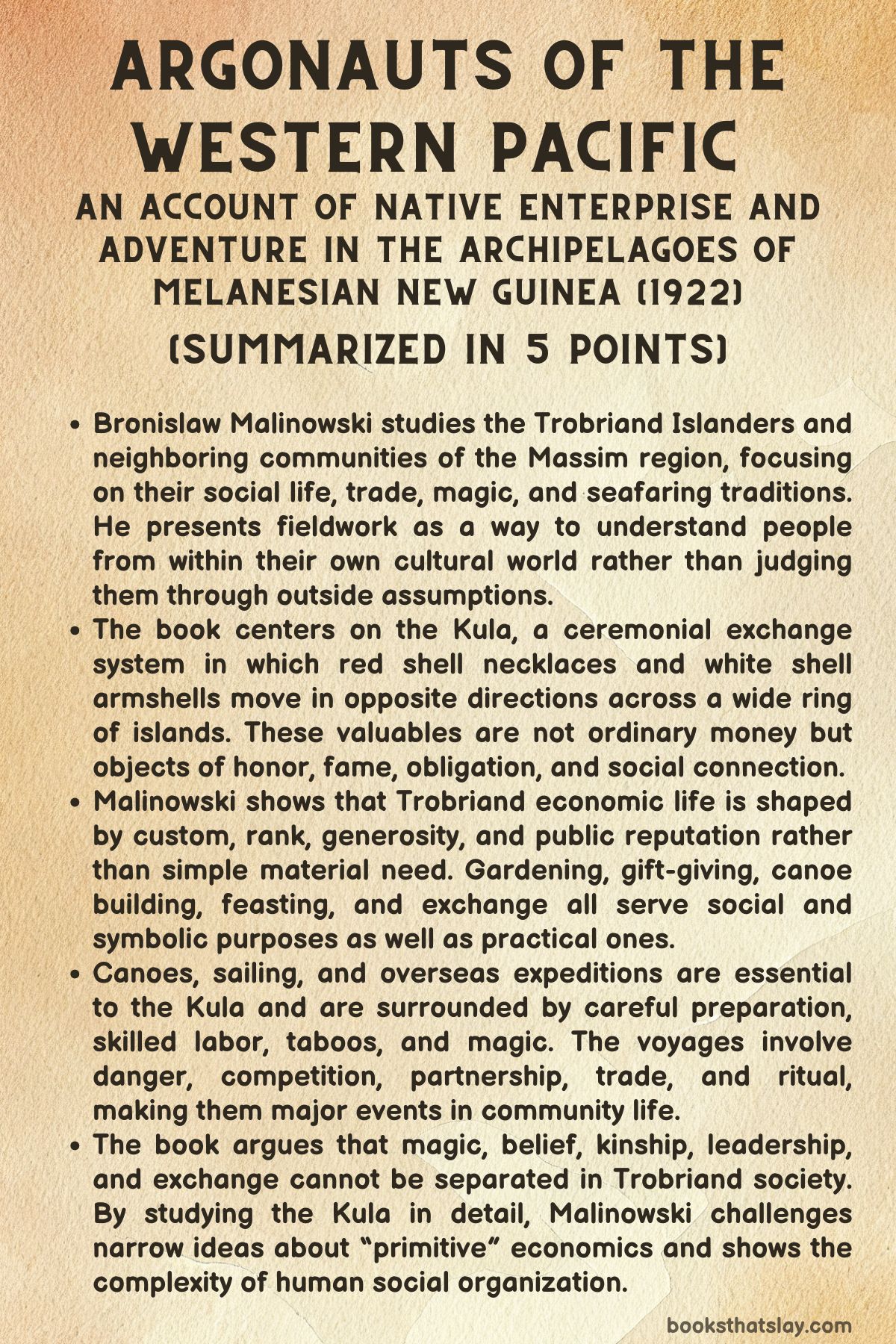
Argonauts of the Western Pacific is Bronislaw Malinowski’s landmark ethnographic study of the Trobriand Islanders and the wider Massim region near New Guinea. Rather than presenting culture as a collection of odd customs, Malinowski studies social life from within, focusing on daily routines, work, ritual, exchange, and belief.
At the center of the book is the Kula, a ceremonial exchange system in which shell necklaces and armshells travel across islands through lifelong partnerships. The book is both a record of Trobriand society and a major statement about how fieldwork should be done: by living among people and trying to understand their world on its own terms.
Summary
Argonauts of the Western Pacific begins by explaining how Malinowski approaches the study of the Trobriand Islanders and the wider Kula region. He argues that an ethnographer cannot understand a society from a distance or through scattered facts.
Lists of tools, trade goods, kinship terms, and customs are useful, but they remain lifeless unless the researcher lives among the people, observes ordinary conduct, learns the language, and tries to see how institutions feel from the inside. For him, good fieldwork requires three things: living apart from other Europeans among the community being studied, having clear scientific aims, and recording evidence carefully through concrete examples, tables, and detailed observation.
The goal is not simply to describe strange practices, but to understand the native point of view, the logic of social relations, and the emotional meaning behind action.
The book then introduces the islands and peoples involved in the Kula. The Massim region includes parts of eastern New Guinea and many surrounding islands.
The people who take part in the Kula do not all speak the same language or follow the same customs, yet they are joined by shared routes of exchange, travel, ritual, and obligation. Malinowski moves from the southern coastal communities to Dobu, the Amphletts, and finally the Trobriand Islands, where he spent most of his time.
Each area has its own character: some communities are known for pottery, others for canoe construction, shell production, or trade. Dobu is especially important as a cultural and trading center, and its people are often feared for their reputation in sorcery as well as respected for their role in the wider exchange network.
In the Trobriand Islands, also called Boyowa, village life is central. The village acts as a social, political, ceremonial, and economic unit.
Decisions are usually made by elders, though rank and chiefly authority matter greatly. Trobriand society follows matrilineal descent: a child belongs to the mother’s clan, and inheritance passes through the mother’s line, especially from maternal uncle to nephew.
Chiefs hold high status, but their power depends on rank, wealth, kinship obligations, and their ability to redistribute goods. Their authority is displayed through tribute, feasts, wives from subject villages, and strict rules of respect.
Gardening is one of the main activities of Trobriand life. Yams, taro, and sugarcane are grown not only for food but also for prestige, display, and social duty.
A man’s garden work reflects his status and reputation. The garden magician plays an important role, performing rites at each stage and directing both human labor and supernatural influence.
Malinowski uses gardening to challenge the idea that people in so-called primitive societies act only from material self-interest. Trobrianders often produce more than they need because production serves social honor, obligation, beauty, and competition.
Magic runs through nearly every important activity. It is connected with gardening, canoe building, sailing, love, beauty, sickness, death, weather, fishing, and exchange.
Trobrianders recognize practical skill and natural conditions, but they also believe success depends on spells, rites, taboos, and inherited magical knowledge. Disease and death are often attributed to sorcery, witches, spirits, or other invisible forces.
Flying witches, male sorcerers, wood sprites, and dangerous non-human beings form part of the feared supernatural world. Yet these beliefs are not treated as abstract doctrine.
They are part of daily feeling, caution, hope, and action.
The central institution of the book is the Kula. It is a ceremonial exchange of two kinds of shell valuables: red shell necklaces and white shell armshells.
The necklaces move in one direction around the ring of islands, while the armshells move in the opposite direction. A necklace must eventually be exchanged for an armshell, and an armshell for a necklace.
These objects are not ordinary money and are not used to buy food or tools. They are valued because of their history, beauty, fame, and the prestige attached to possessing and passing them on.
Only certain men participate in the Kula, and each exchange takes place between recognized partners. These partnerships last for life.
A commoner may have only one or a few partners, while a chief may have many. No man keeps a valuable permanently; he holds it for a time, speaks proudly about it, displays it, and later sends it onward.
The honor lies not in hoarding the object but in receiving, possessing, and giving it properly. A gift must be answered by a counter-gift, though not always immediately.
The value of the return gift is governed by trust, reputation, and shame rather than bargaining. Direct haggling is improper.
If a return is poor, the disappointed partner may complain, but he cannot enforce equivalence like a market price.
The Kula is surrounded by many other activities. Expeditions require canoes, crew organization, food supplies, trade goods, gifts, spells, taboos, and ceremonies.
Canoes are not treated as mere tools. A large sea canoe is a valued social object, built by skilled workers under the direction of an owner who carries both privileges and responsibilities.
The owner organizes labor, pays workers in food, performs magical rites, chooses crew members, and receives a major share of the expedition’s gains. Canoe building combines technical craftsmanship with magic.
Trees are selected, ritually treated, cut, hollowed, fitted with outriggers, lashed together, carved, painted, and launched with repeated spells intended to give speed, lightness, safety, and success.
The launching of a canoe is a public event marked by display, food, pride, and ceremony. Trial runs, visits to nearby villages, and preliminary exchanges form early stages of major Kula activity.
Malinowski uses these moments to discuss Trobriand economics more broadly. Exchange is not limited to practical barter.
Gifts, payments, ceremonial offerings, tribute, rewards for services, and displays of wealth structure social life. Food, especially yams, carries symbolic importance.
To give, display, and redistribute goods is to create rank, obligation, and social connection.
A major Kula expedition from Sinaketa to Dobu shows how carefully organized the system is. Before departure, canoe owners and crews observe taboos, prepare food, arrange trade bundles, decorate canoes, and perform spells to persuade partners, ensure safety, and make supplies last.
Women prepare provisions and are expected to remain sexually faithful while their husbands are away, because misconduct is believed to endanger the voyage. The fleet makes halts along the route, receives food distributions, performs rites for speed and protection, and waits for suitable winds.
Sailing is dangerous, and the sea is filled with practical risks as well as mythical threats. Storms, reefs, tides, sharks, hostile beings, and witches all shape the sailors’ fears.
The book gives special attention to beliefs about shipwreck. Sailors rely on protective magic against flying witches and dangers from above and below.
Stories of shipwreck combine practical sailing knowledge with supernatural fear. In one account, a storm destroys a canoe, witches scream in the wind, and the crew survives by using magic, breaking away part of the canoe, and being carried to safety by a summoned fish.
Such stories reveal not only belief but also the emotional world of sailors: courage, panic, ritual control, and dependence on inherited spells.
When the Sinaketan fleet reaches Dobu, the men stop at a beach to prepare themselves. They apply magical substances, paint their bodies, sound conch shells, and perform beauty and persuasion rites meant to make their partners generous.
The arrival is tense. Dobuans may appear fierce at first, but ritual actions transform hostility into hospitality.
The actual exchange follows strict etiquette. Gifts are often given abruptly and received with controlled indifference, even when they are deeply desired.
Opening gifts, return gifts, intermediary gifts, and soliciting gifts all have specific meanings. Alongside the Kula, ordinary trade takes place, but usually not between Kula partners themselves.
The visitors return home with valuables, trade goods, and stories of success.
On the journey back, the fleet collects materials such as obsidian, ochre, pumice, sand, and shells. The making of red shell ornaments is described in detail, from diving for shells to cutting, sanding, drilling, polishing, and stringing beads.
Production depends on labor, skill, gendered tasks, and systems of payment, often linked to kinship obligations. When the fleet nears home, conch blasts announce the number of valuables gained, and the community gathers to welcome the men.
The return visit of the Dobuans to Sinaketa shows the reciprocal nature of the system. Months later, the Dobuan fleet prepares its own expedition with food, cargo, ceremonies, and magic.
Malinowski follows the movement of canoes and crowds, stressing that large events can seem chaotic unless the observer understands the rules beneath them. The Dobuans arrive, receive and give valuables according to custom, stay briefly, trade, and depart without elaborate farewell.
Their journey also ends with displays of what has been obtained.
Later sections broaden the analysis. Malinowski explains magic as a force that organizes effort, expresses desire, handles uncertainty, and gives people a sense of control where skill alone cannot guarantee success.
Spells are the core of magic, supported by rites, taboos, ownership rules, and inherited rights. Magical words are powerful not because they communicate ordinary information, but because they are believed to act upon the world.
Their rhythm, repetition, archaic language, names, and references to myth all help give them force.
The book also examines inland and offshoot forms of the Kula. Not every exchange requires an overseas voyage.
Some exchanges occur between neighboring communities or within a single Kula area, often with fewer ceremonies and less trade. Rank becomes especially important in these cases, as lower-status men may initiate exchange with higher-status men.
Other routes carry valuables beyond the main ring, while certain islands serve as sources of armshells, necklaces, canoes, or other goods.
In the end, Malinowski presents the Kula as a large social mechanism that joins economics, ceremony, magic, ambition, rank, travel, and friendship. It is not simple barter, not market trade, and not useless ornament exchange.
It is a system through which people gain honor, form alliances, maintain obligations, and imagine themselves as part of a wider world. Argonauts of the Western Pacific therefore becomes more than a study of one exchange network.
It is an argument that human behavior cannot be understood through material need alone. To understand any society, one must study how work, belief, emotion, status, and tradition give meaning to ordinary acts.
Key Figures
Bronislaw Malinowski
Bronislaw Malinowski is the central observing figure in Argonauts of the Western Pacific. He stands inside the book as the investigator, interpreter, and organizing intelligence behind the study.
His presence matters because the work is not only about the Trobriand Islanders but also about how an outsider should study another culture. Malinowski rejects detached observation and argues that true understanding comes from living among the people, watching ordinary actions, learning native categories, and separating fact from inference.
He is methodical, ambitious, and often self-conscious about the limits of his own perspective. At the same time, his language sometimes reflects the colonial attitudes of his era, especially when he speaks about “native” life through European scientific categories.
His most important role is to shift attention away from exotic surface details and toward social logic. Through him, the book becomes a study of exchange, belief, labor, rank, and human motivation.
The Trobriand Islanders
The Trobriand Islanders are the main social figures in the book, especially the people of Boyowa, where Malinowski carried out much of his fieldwork. They appear as skilled gardeners, sailors, traders, ritual specialists, relatives, spouses, chiefs, workers, and partners in exchange.
Malinowski presents them as people governed by custom, ambition, beauty, obligation, and reputation rather than by simple economic need. Their society is matrilineal, so descent and inheritance move through the mother’s line, and the maternal uncle holds a crucial place in family and property relations.
They are also deeply shaped by rank, magic, and public display. Their gardens, yam houses, canoes, ceremonies, and exchanges all reveal a culture in which social honor is produced through action.
In Argonauts of the Western Pacific, they challenge Western assumptions about “primitive” life by showing a complex society where economic behavior is inseparable from ritual, prestige, kinship, and moral expectation.
The Kula Participants
The Kula participants are among the most important figures in the book because they carry the central institution of exchange across islands and communities. They are not random traders but men bound by lifelong partnerships, rules of conduct, and obligations of return.
Their behavior is marked by restraint, calculation, pride, and concern for reputation. A man who receives a valuable shell object gains fame only temporarily, because the object must eventually move on.
This makes generosity and circulation more important than permanent possession. The Kula participant must know when to give, when to wait, when to solicit, and how to preserve dignity while desiring a valuable object.
He lives within a moral economy where public honor depends on proper exchange. These figures reveal that trade can be ceremonial, emotional, political, and symbolic at the same time.
They also show how relationships across distance are maintained not by written contracts but by custom, trust, memory, and reputation.
The Toliwaga
The toliwaga, or canoe owner, is one of the strongest social figures in the book. He is not merely the owner of a physical craft; he is the person responsible for organizing labor, financing preparations, directing key stages of canoe construction, choosing the crew, and performing important magical rites.
His authority comes from a combination of wealth, kinship position, ritual knowledge, and practical responsibility. The toliwaga receives prestige and a larger share of benefits, but these privileges are balanced by obligations.
He must provide food, manage cooperation, uphold taboos, and ensure that the canoe is ritually prepared for the dangers of the sea and the demands of the Kula. His position shows how ownership in Trobriand society is not simply private possession.
It is a social relationship involving duties, rights, rank, and public recognition. The toliwaga embodies the connection between technology, magic, leadership, and economic ambition.
The Chiefs
The chiefs represent rank, symbolic power, redistribution, and social order. Their authority is not always absolute, yet it carries visible weight in public life.
A chief’s status is displayed through deference, food tribute, wives from subject villages, ceremonial privilege, and the ability to gather people for collective work or exchange. High-ranking chiefs can have many Kula partners, and their influence reaches beyond their own villages.
Still, Malinowski shows that chiefly power is affected by social change, especially through European presence, wage labor, pearling, and altered wealth patterns. A chief may command respect, but his authority depends on whether the community continues to support the customs that sustain him.
The chiefs are therefore not only powerful individuals; they are signs of a larger structure under pressure. Their role in the book helps explain how rank is maintained through giving, receiving, feasting, obligation, and controlled public display.
To’uluwa
To’uluwa, the chief of Omarakana, is one of the named figures who gives the book a more personal view of rank and decline. He appears as a chief whose traditional importance remains real but whose power has been weakened by changing conditions.
His visit to Sinaketa reveals the strain placed on older authority by new sources of wealth. The Sinaketans, enriched through pearling and contact with white traders, treat him with less ceremony than he expects.
His disappointment shows that chiefly dignity depends not only on inherited status but also on the willingness of others to honor that status through gifts and ritual behavior. To’uluwa’s position is especially important because he stands between an older social order and a changing world.
He is not portrayed as powerless, but his reduced influence suggests how fragile traditional authority can become when economic life shifts around it.
The Dobuans
The Dobuans are presented as powerful, feared, and necessary partners in the Kula network. They are associated with strict customs, strong magical reputations, and a fierce manner toward visitors.
Their role is especially important because Sinaketan expeditions often travel to Dobu, where the most dramatic moments of reception and exchange occur. The Dobuans may appear hostile at first, but their behavior follows recognizable ceremonial patterns.
After the proper rites are performed, tension gives way to exchange, hospitality, and partnership. They are also linked with sorcery and with beliefs about dangerous magic, which adds emotional intensity to voyages toward their region.
In the book, the Dobuans show how fear and friendship can exist within the same social relationship. They are rivals, hosts, exchange partners, and ritual counterparts.
Their presence gives the Kula its sense of risk, prestige, and inter-island importance.
The Amphlett Islanders
The Amphlett Islanders appear as smaller but important figures within the regional system. Their communities are known for pottery, trade, and strategic participation in the Kula.
Although their population is relatively limited, they hold an influential place because of their specialized production and location. Malinowski describes them as important intermediaries, especially because their islands lie along significant routes of movement.
Their role reminds the reader that the Kula is not controlled by one society alone. It depends on many communities, each with its own goods, customs, reputation, and bargaining position.
The Amphlett Islanders also show how specialization creates influence. A group does not need to be large to matter; it can become essential through control of a craft, a route, or a valued product.
Their presence helps widen the book beyond the Trobriands and makes the exchange network feel regional rather than local.
Garden Magicians
The garden magician is a key ritual and managerial figure in Trobriand life. His role goes far beyond reciting spells.
He organizes the sequence of agricultural work, performs rites for each stage of gardening, and helps coordinate communal labor. In practical terms, he acts as a supervisor; in ritual terms, he directs the unseen forces believed to affect growth and harvest.
This double role is central to Malinowski’s interpretation of magic. The garden magician does not replace hard work, skill, or planning.
Instead, his magic gives order, confidence, and social form to labor. He shows how religious or magical authority can be deeply practical in a society’s daily life.
Through him, gardening becomes more than food production. It becomes a field of rank, beauty, competition, obligation, and belief.
His figure proves that work and ritual are not separate domains in the Trobriand world.
Canoe Builders and Sailing Experts
Canoe builders and sailing experts represent technical intelligence in Argonauts of the Western Pacific. They understand wood, balance, wind, lashing, carving, repair, and navigation.
Malinowski is careful to show that Trobriand seamanship is not accidental or crude. Canoes require skilled design, expert construction, and disciplined use.
These figures are important because they correct any false idea that magic replaces practical knowledge. A canoe must be well built, and the people who build and sail it must know what they are doing.
At the same time, their work is surrounded by spells and taboos, showing that technical competence and magical belief operate together. The canoe builder gives physical form to a social project, while the sailing expert protects the crew through judgment and experience.
Together, they reveal the intelligence behind long-distance exchange and the courage required for sea travel.
Crew Members
Crew members, including usagelu, younger assistants, and boys who sometimes help on voyages, form the working body of a Kula expedition. They do not all hold equal status, and not all of them take part in the Kula itself, but the voyage depends on their labor.
They prepare the canoe, carry goods, manage sails, paddle when necessary, watch the sea, and endure taboos and danger. Their role shows that great ceremonial systems are supported by many people whose labor may receive less prestige than that of chiefs or canoe owners.
The crew members also create the emotional life of the expedition. They camp, talk, fear storms, discuss dangers, and participate in the collective anticipation of arrival and return.
Through them, the book shows the Kula not as an abstract institution but as a lived experience of work, movement, hunger, risk, discipline, and expectation.
Women
Women occupy a crucial position in the book even though men dominate the public Kula expeditions. Trobriand society is matrilineal, and this gives women great structural importance.
Descent, inheritance, clan identity, and many property relations depend on the mother’s line. Women also contribute to gardening, food preparation, household organization, pottery in some regions, and shell polishing.
Their labor supports the visible achievements of men, especially in expeditions and ceremonial exchange. Women are also central to sexual customs, marriage relations, and the obligations between a husband and his wife’s brothers.
During voyages, their expected fidelity is believed to influence the success and speed of the canoe, showing how domestic conduct is connected to public male enterprise. Malinowski’s account sometimes reflects the gender assumptions of his time, but the material he presents makes clear that women are not marginal.
They are essential to kinship, production, ritual meaning, and social continuity.
Maternal Uncles and Matrilineal Kin
Maternal uncles and matrilineal relatives form one of the deepest social foundations in the book. Since identity and inheritance pass through the mother’s line, the relationship between a man and his sister’s children is especially important.
A boy’s future wealth, rank, and rights are tied not primarily to his father but to his mother’s kin. This arrangement changes the meaning of family authority.
The biological father is part of the household, but the maternal uncle carries formal importance in descent and property. Matrilineal kin also shape exchanges involving food, yams, labor, and social obligation.
Their role explains why Trobriand society cannot be understood through a simple Western model of father-centered inheritance. These figures reveal a social world in which family bonds, wealth, rank, and duty follow a different logic, one that structures both everyday life and ceremonial action.
Kula Partners
Kula partners are central relational figures rather than isolated individuals. A Kula partner is someone with whom a man maintains a lifelong exchange bond, often across distance and sometimes across cultural difference.
The relationship is marked by trust, rivalry, expectation, and strategic generosity. Partners may desire valuables intensely, but they must act within rules of dignity and restraint.
A poor return gift can damage reputation, while a generous gift can raise status and place pressure on the receiver. These partnerships are not casual friendships.
They are formal social ties that help create a network across islands. Through Kula partners, the book shows how objects can carry relationships with them.
A shell valuable is never just a thing; it arrives with memory, obligation, fame, and future expectation. The partner relationship turns exchange into a long-term social bond.
Sorcerers and Flying Witches
Sorcerers and flying witches are not “characters” in the ordinary realist sense, but they are powerful figures in the mental and emotional world of the book. Male sorcerers are associated with sickness, death, and feared magical attack, while flying witches are linked with night travel, danger, and shipwreck.
Sailors fear them intensely, especially during storms and difficult voyages. These figures reveal how danger is understood in Trobriand thought.
Misfortune is rarely only accidental; it is often connected to hidden agency. Sorcerers and witches also show why protective magic is so important.
The sailor does not face only wind and water but also invisible hostility. Malinowski treats these beliefs as part of lived reality rather than as simple superstition to be dismissed.
Their presence helps explain the emotional force of ritual and the deep need for spells of protection.
Mythic Beings and Spirits
Mythic beings, spirits, wood sprites, ancestral figures, and dangerous non-human forces shape the symbolic world of the book. They appear in spells, stories, taboos, explanations of disease, canoe magic, garden rites, and sailing beliefs.
Some are feared as causes of illness or danger, while others belong to the mythic background that gives authority to ritual action. Their importance lies in the way they connect present practice with ancestral time.
When a spell names a mythic figure or recalls an old story, it gives current action a deeper source of power. These figures also reveal that Trobriand religion and magic are practical rather than separate from daily life.
Spirits and mythical beings are present in gardening, sailing, illness, weather, and exchange. They make the world feel charged with agency, memory, and consequence.
Themes
Exchange as Social Power
Exchange in Argonauts of the Western Pacific is never limited to practical trade. The Kula proves that giving can be a way of making reputation, building alliances, expressing rank, and creating moral pressure.
The shell valuables that move through the Kula are not money, because they do not function as a general measure of price or an ordinary tool of purchase. Their importance comes from circulation, history, fame, and the status they give to temporary possessors.
A man gains honor by receiving a valuable, but he must eventually pass it on. This turns ownership into performance rather than accumulation.
Gift-giving also creates obligation. A generous gift can elevate the giver and embarrass the receiver if he cannot answer properly.
The system depends on trust because equivalence is not settled through bargaining. This makes reputation a kind of social currency.
Through the Kula, the book shows that economic life can be ceremonial, emotional, and political. It challenges the idea that people act only from material self-interest and shows how exchange can organize an entire regional world.
Magic, Work, and Uncertainty
Magic appears wherever effort meets uncertainty. Trobrianders know that gardens require labor, canoes require skill, and sailing requires practical judgment, yet they also believe that success depends on spells, rites, taboos, and inherited magical knowledge.
Magic does not erase work; it gives work sequence, authority, confidence, and emotional force. In canoe building, craftsmanship is essential, but a canoe without proper magic is considered unsafe and unlucky.
In gardening, the garden magician helps organize labor while also addressing the unseen forces believed to affect growth. At sea, protective spells respond to storms, witches, sharks, dangerous depths, and the fear of shipwreck.
This theme is important because it shows magic as a social and psychological system, not merely a set of strange beliefs. Magic gives people a way to act when outcomes cannot be fully controlled.
It also binds communities to tradition, since many spells are inherited, owned, purchased, or restricted by kinship. The book presents magic as one of the main forces that organizes labor and gives meaning to risk.
Rank, Obligation, and Public Display
Rank in the Trobriand world is constantly made visible. Chiefs receive deference, food tribute, ceremonial recognition, and access to many exchange partners.
Yam houses, feasts, canoe decoration, shell valuables, and public distributions all help display status. Yet rank is not only a matter of privilege.
It also creates obligation. A chief must redistribute, entertain, sponsor ceremonies, and maintain relationships.
A wealthy or high-ranking person is expected to give more, not simply possess more. This creates a social order in which power depends on public generosity.
The same pattern appears in the Kula, where a man’s reputation grows through visible participation and proper giving. Public display is not vanity alone; it is a language through which society reads honor, competence, and authority.
The decline of chiefly influence under European contact shows how fragile this system can be. When new forms of wealth appear, older signs of rank lose some of their force.
The book uses these changes to show that social hierarchy must be continually supported by custom, belief, and material exchange.
Seeing a Culture from Within
Malinowski’s method rests on the belief that a society cannot be understood through isolated facts. Tools, rituals, objects, and customs only become meaningful when placed within the larger pattern of life.
This theme shapes the entire book. The ethnographer must live among the people, observe ordinary routines, learn how institutions function, and try to understand how people themselves experience their world.
This does not mean abandoning analysis; Malinowski insists on careful evidence, clear methods, and distinction between observation and interpretation. But he also argues that statistics and descriptions are incomplete unless they help reveal the native point of view.
The Kula is the clearest example. From outside, it may look like decorative objects moving from hand to hand.
From within, it is a system of ambition, honor, danger, partnership, magic, and memory. This theme remains one of the book’s major contributions to anthropology.
It asks readers to move beyond surface judgment and recognize that human practices often have meanings that are invisible until the observer understands the social world that sustains them.