Arsenic and Adobo Summary, Characters and Themes
Arsenic and Adobo by Mia P. Manansala is a cozy mystery centered on Lila Macapagal, a young Filipino American woman who returns to her hometown of Shady Palms, Illinois, after a painful breakup. Back with her family, she helps at Tita Rosie’s restaurant, where food, gossip, family loyalty, and local rivalries shape daily life.
When her ex-boyfriend dies after eating at the restaurant, Lila becomes a suspect and must clear her name. The book mixes murder investigation, family drama, romance, friendship, and Filipino food culture with a sharp sense of humor. It is the first novel of the Tita Rosie’s Kitchen Mystery series.
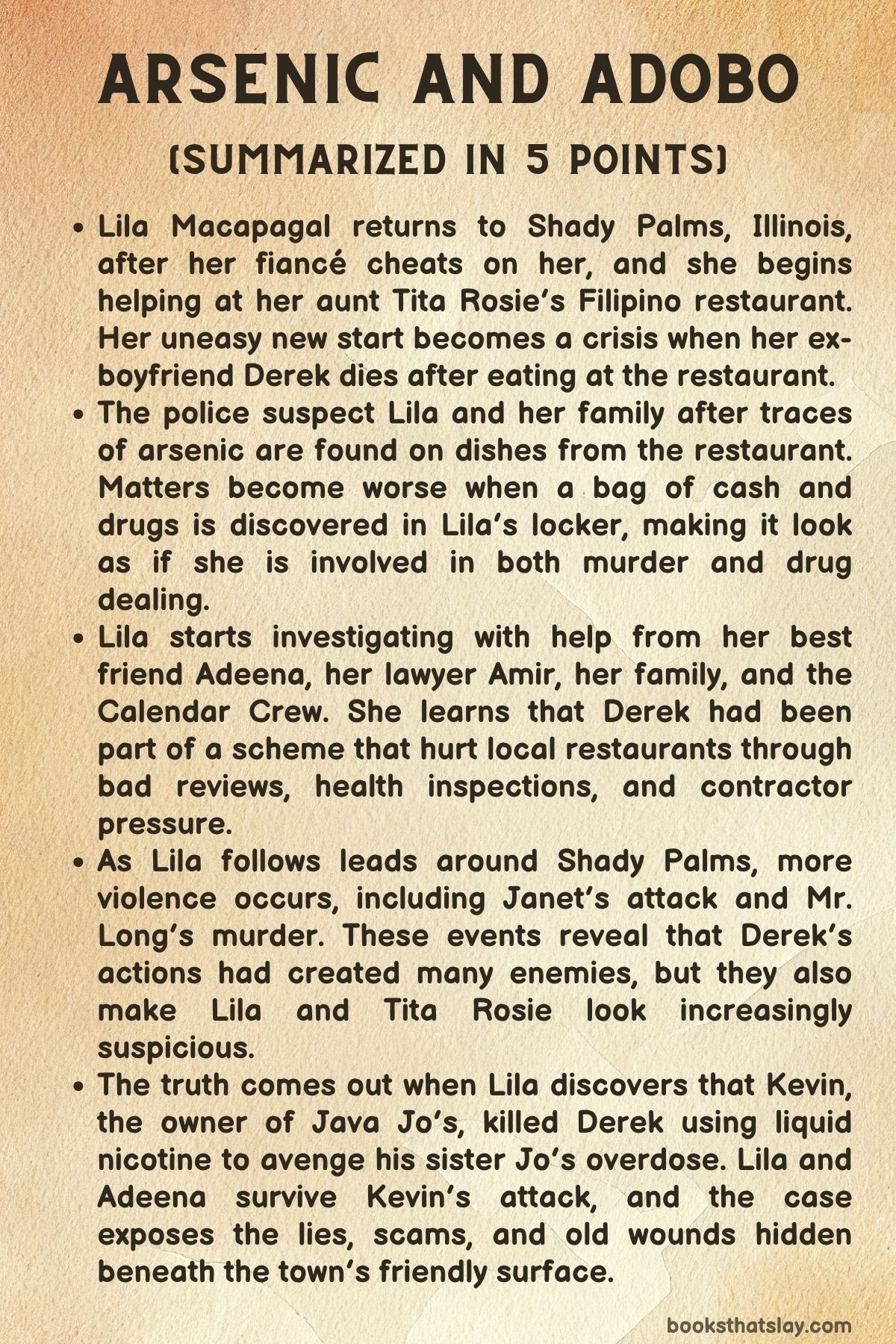
Summary
Lila Macapagal has come back to Shady Palms after her fiancé, Sam, betrayed her. Her return is not triumphant.
She is living with her family again and working at Tita Rosie’s restaurant, trying to recover from the collapse of her life in Chicago. Her family is loving but intense, especially her grandmother, Lola Flor, her aunt Tita Rosie, and the Calendar Crew, a group of older women who are her mother’s best friends and her godmothers.
They care about Lila but often criticize her looks, choices, and future, leaving her both comforted and frustrated.
The ordinary rhythm of the restaurant changes when Derek Winter, Lila’s ex-boyfriend, arrives with his stepfather, Mr. Long. Derek has been writing cruel reviews about Tita Rosie’s restaurant, even though he still eats there.
His presence brings up old wounds for Lila, and his connection to Mr. Long is alarming because Mr. Long is also the family’s landlord. The restaurant is already behind on rent, so every comment from Derek feels like a threat.
During the meal, Derek behaves rudely and insults the food. He drinks several glasses of honey calamansi iced tea, criticizes Lila’s ube cookies, and mocks her for being too sensitive.
Then, while eating ginataang bilo-bilo, he suddenly convulses and collapses into his bowl. At first, Lila thinks he is playing a cruel joke, but the situation quickly becomes serious.
Emergency services arrive, and Derek is taken away. Later, the family learns that he has died.
Derek’s death turns Tita Rosie’s restaurant into a crime scene. Mr. Long accuses the family of killing him, and Detective Jonathan Park begins questioning everyone.
The fact that the staff cleaned the table after Derek was taken away makes the detective suspicious, though Lila defends it as normal restaurant hygiene. When the police find that the dishes connected to Derek’s meal test positive for arsenic, the restaurant is closed, putting Tita Rosie in serious financial danger.
Lila soon becomes the focus of the investigation. A duffle bag filled with cash and pills is found in her locker, and she is taken to the police station.
She insists the bag is not hers, but Detective Park believes the evidence links her to drugs as well as Derek’s death. Lila is arrested, processed, and placed in a jail cell.
While there, she meets Yuki Sato, co-owner of Sushi-ya, another local restaurant that had problems with Derek and the health inspector. From Yuki, Lila begins to suspect that Derek was part of a larger scam targeting restaurants.
After Lila is released on bail, she learns that her family had to put up the house and restaurant to secure her freedom. This deepens her guilt and binds her to Shady Palms, even though she longs to escape.
She begins investigating Derek’s death with help from her best friend Adeena, a barista at Java Jo’s. Adeena is smart, loyal, and practical, though tension grows between the two friends when Adeena keeps suggesting they open a cafe together in town.
Lila is not sure she wants to stay in Shady Palms, and she avoids the conversation.
Lila’s investigation leads her through the town’s restaurants and social circles. She learns that Derek had a pattern: he wrote damaging reviews, then the health inspector would appear and cite restaurants for violations.
A contractor would then be recommended, suggesting that Derek, the inspector, and Mr. Long were working together to extort local businesses. Stan’s Diner, Sushi-ya, El Gato Negro, and Big Bishop’s BBQ had all been affected in different ways.
As Lila follows these leads, her personal life becomes more complicated. She reconnects with people from her past, including Janet, a former high school bully who is now engaged to Terrence, one of Derek’s old friends.
Janet hints that she has information about Derek, but before Lila can learn more, Janet is attacked and left badly injured in her hospital office. Detective Park tries to connect Lila to the assault, especially after discovering that she has a criminal record from Chicago.
Lila explains that Sam used her in an illegal restaurant supply scheme without her knowing, and she took the blame out of misplaced loyalty.
The pressure on Lila’s family grows. The restaurant is vandalized just when the health inspector and Mr. Long arrive, making it even harder for Tita Rosie to recover financially.
Food is ruined, the kitchen is damaged, and the family faces the possibility of losing everything. Yet the community also shows up.
Adeena, Amir, Bernadette, Marcus, the Calendar Crew, and others help clean the restaurant. Their support reminds Lila that Shady Palms is not only a place of gossip and judgment but also a place where people protect their own.
Lila also develops a connection with Dr. Jae Park, a dentist who turns out to be Detective Park’s brother. Jae is kind, charming, and interested in Lila, while Amir, Adeena’s lawyer brother, also seems to care about her.
The possible romance creates teasing from Lila’s family and godmothers, but it also distracts her from the danger around her. At the same time, Adeena becomes upset with Lila for not listening to her dreams and for refusing to seriously consider their cafe idea.
The case becomes more dangerous when Lila visits Mrs. Long, Derek’s mother. Lila brings ube cookies and tries to understand whether Mrs. Long knows more about her husband’s business with Derek.
During the visit, Mr. Long is found dead on the kitchen floor. Once again, Lila is present at a crime scene, and Detective Park notices the pattern.
Suspicion shifts in new directions when the knife used to kill Mr. Long is identified as belonging to Tita Rosie. Tita Rosie admits she had gone to see Mr. Long because he wanted her to meet with the health inspector, likely as part of the same scam that hurt other restaurants.
Mrs. Long later reveals important information. She knows Lila and Tita Rosie did not kill Derek.
She also knows Mr. Long planted the drug-filled bag in Lila’s locker after Mrs. Long found it among Derek’s belongings and gave it to him. This confirms that Lila was framed, but it still does not identify Derek’s killer.
The real breakthrough comes through Adeena. She learns from the lab that Derek was killed by nicotine poisoning, not arsenic, though he had also been exposed to low levels of arsenic over time.
Before Adeena can explain her new suspicion, Lila hears her scream over the phone. Lila rushes to Java Jo’s and finds the cafe locked.
Adeena’s bracelet is on the floor, and Kevin, the owner, acts strangely.
Lila realizes Kevin is the killer when she sees him refilling his vape pen. Kevin admits that he used liquid nicotine to kill Derek.
His motive was revenge. Derek had supplied drugs to Jo, Kevin’s sister and the original owner of Java Jo’s, after she had become sober.
Jo died of an overdose, and Kevin blamed Derek for pulling her back into addiction. When Kevin learned that Derek planned to leave town with Yuki, he poisoned him before he could escape.
Kevin also attacked Janet because she had discovered the truth. Janet had helped Derek get prescription drugs, and she knew enough to threaten Kevin’s secret.
Kevin used the dachshund statue Janet had made for Lila as a weapon against her, then hid it at Java Jo’s. Adeena figured out too much, so Kevin tied her up and planned to flee.
Lila fights back. She throws hot coffee at Kevin and reaches Adeena, who is tied up in the back room.
Together they try to escape. Kevin attacks Lila, but she and Adeena resist.
Lila uses her keys as a weapon, and later throws the dog statue at Kevin, knocking him unconscious. Detective Park arrives with emergency help, and Kevin survives.
With Kevin exposed, Lila finally has the answers needed to clear herself and protect her family.
By the end, Lila has faced more than a murder case. She has confronted her past with Sam, her guilt over leaving home, her fear of being trapped in Shady Palms, and the strain in her friendship with Adeena.
She has also seen the strength of her family and community. Arsenic and Adobo closes its central mystery by revealing how Derek’s greed and cruelty damaged many lives, while Lila’s determination, food knowledge, and loyalty help bring the truth into the open.
Characters
Lila Macapagal
Lila Macapagal is the central character of Arsenic and Adobo, and much of the book’s energy comes from her mixture of fear, anger, humor, guilt, and stubborn loyalty. She returns to Shady Palms after a painful breakup and carries the embarrassment of feeling as though she has failed in Chicago.
Her life at the start of the story is shaped by emotional bruises: Sam’s betrayal, her past with Derek, her criminal record, her family’s expectations, and her uncertainty about whether she belongs in her hometown. Lila is not presented as a flawless amateur detective.
She is impulsive, defensive, and often driven by emotion before strategy. Yet these traits also make her believable.
She investigates because she has no choice: her freedom, her aunt’s restaurant, and her family’s future are all at risk. Her love for food is one of her strongest forms of self-expression, especially through baking, and her ability to read people often works alongside her knowledge of the restaurant world.
Lila’s growth comes from learning that returning home does not have to mean defeat. By the end of the book, she has faced the damage caused by both Derek and Sam, repaired parts of her friendship with Adeena, and gained a clearer understanding of how much her family and community matter to her.
Tita Rosie
Tita Rosie is the emotional and cultural center of the family restaurant. She represents generosity, tradition, resilience, and the burden of keeping a small family business alive.
Her cooking is not just work; it is her way of caring for people, maintaining family memory, and preserving Filipino identity in Shady Palms. When Derek dies after eating at the restaurant, Tita Rosie is devastated not only because she becomes a suspect but also because her food, the thing she gives most lovingly, is treated as a possible weapon.
This accusation wounds her deeply. Her financial struggles make her more vulnerable, especially because Mr. Long’s pressure over rent threatens everything she has built.
Tita Rosie is gentle in many ways, but she is not weak. She opens her home to Mrs. Long even after Mr. Long’s hostility, feeds people in moments of crisis, and keeps working despite fear and humiliation.
In Arsenic and Adobo, she shows how family matriarchs often carry private anxiety while still appearing steady for everyone else. Her character gives the book warmth, but also shows the real cost of community judgment and economic pressure.
Lola Flor
Lola Flor is sharp, commanding, funny, and deeply protective. She often appears strict, especially with Lila, but her criticism usually comes from a desire to keep the family strong and respectable.
She belongs to an older generation that values family duty, food, faith, and reputation, and she expects Lila to understand these values even when Lila feels trapped by them. Lola Flor is practical in a crisis.
When Derek collapses, she guides others toward action and later helps keep the family moving when panic could easily take over. Her gambling habit and secretive errands add humor and complexity, preventing her from becoming only a wise grandmother figure.
She is also one of the people who best understands the social rules of Shady Palms. She knows when to feed people, when to withhold information, and when to challenge authority.
Her relationship with Lila is sometimes tense because both women are stubborn, but their bond is strong. Lola Flor helps ground the story in family history and cultural expectation, reminding Lila that independence and family responsibility are not always easy to separate.
Adeena Awan
Adeena is Lila’s best friend and one of the most important emotional anchors in the novel. She works at Java Jo’s and helps Lila investigate Derek’s death, but her role goes far beyond sidekick.
Adeena is intelligent, direct, and loyal, yet she also has her own wounds and desires. She is a lesbian in a town and family environment that does not fully understand or accept her, and this shapes her longing for a space where she can build a life on her own terms.
Her dream of opening a cafe with Lila is not just a business idea; it is a vision of belonging, independence, and partnership. The tension between Adeena and Lila grows because Lila does not fully recognize how serious this dream is.
Adeena’s frustration reveals that friendship can suffer when one person assumes the other will always be available. Her discovery of key information about the nicotine poisoning proves her intelligence and courage, but it also places her in danger.
Adeena’s character adds emotional depth to the story by showing that loyalty must include listening, not only showing up during emergencies.
Derek Winter
Derek Winter is dead for much of the book, but his influence remains everywhere. He is the victim, yet the story gradually reveals that he caused harm to many people while alive.
He is cruel to Lila, rude to Tita Rosie, dismissive of Filipino food, and involved in schemes that damage local restaurants. His role as a food critic gives him power in Shady Palms, and he abuses that power by writing harmful reviews and helping create pressure on restaurant owners.
Derek’s drug dealing, manipulation, and connection to the health inspector show a pattern of selfishness. Still, the book does not make him a simple villain.
His addiction, his dependence on his mother, and his failed relationships suggest a person whose weakness and resentment turned destructive. His death exposes the harm he left behind.
Derek’s character is important because almost every suspect has a reason to hate him, which makes the mystery work. He also forces Lila to face her past choices and the kind of men she once trusted.
Detective Jonathan Park
Detective Jonathan Park is a frustrating figure because he often seems more interested in proving Lila guilty than in fully understanding the case. His suspicion of her family, his focus on the planted drugs, and his use of Lila’s past against her make him appear rigid and unfair.
At the same time, he is not portrayed as completely incompetent or cruel. He is under pressure, he has experience with drug cases, and he begins to notice larger patterns as the investigation continues.
His warnings to Mr. Long and the health inspector suggest that he is not blind to corruption. His relationship to Dr. Jae also gives him a more personal dimension, since it shows him outside the narrow role of detective.
Park’s main function in the book is to represent institutional suspicion. He shows how quickly an investigation can turn against someone when prejudice, prior records, and circumstantial evidence combine.
His gradual shift toward the truth helps release some of the tension, but the harm caused by his early assumptions remains significant.
Dr. Jae Park
Dr. Jae Park brings warmth, humor, and romantic possibility into Lila’s life. As a dentist, he first enters the story through one of its comic incidents, when Lila breaks a tooth on Kevin’s stale biscotti.
Jae is attractive and kind, but his importance is not limited to romance. He represents the possibility that Lila can be seen without being judged by her worst circumstances.
Even though his brother is the detective investigating her, Jae does not treat her as a criminal. He is attentive, thoughtful, and willing to enter Lila’s chaotic family world with respect.
His mixed Korean and white background also allows the story to touch on identity, family expectations, and belonging from another angle. Jae’s interest in Lila gives her a future-facing emotional thread at a time when much of her life is tied to old mistakes.
He is not the central force in solving the case, but he helps soften the story and gives Lila a chance to imagine trust after betrayal.
Amir Awan
Amir is Adeena’s brother and the lawyer who helps Lila and her family during the investigation. He is competent, composed, and protective, but he can also seem controlling from Lila’s point of view.
As a lawyer, he understands the seriousness of the situation better than Lila does at first, and he repeatedly tries to stop her from making reckless choices. This creates tension because Lila wants to be active in clearing her name, while Amir wants her to avoid worsening her legal position.
His dynamic with Lila carries hints of romantic interest, which the family and Calendar Crew quickly notice. Amir also serves as a bridge between Lila and Adeena, especially when their friendship becomes strained.
His role in the book shows the importance of practical support during crisis. While Lila’s investigation depends on instinct and personal relationships, Amir brings structure, caution, and legal knowledge.
He is one of the people who keeps the family from being completely overwhelmed by the police and by public suspicion.
Kevin
Kevin, the owner of Java Jo’s, is one of the book’s most deceptive characters. For much of the story, he seems like a somewhat unpleasant but ordinary cafe owner whose stale food and poor customer care are almost comic.
This makes the reveal of his guilt more effective. Kevin’s motive is rooted in grief and rage over the death of his sister Jo, the original owner of Java Jo’s.
Derek supplied Jo with drugs after she had become sober, and she died of an overdose. Kevin’s pain is understandable, but his response turns him into a murderer.
He poisons Derek with liquid nicotine, attacks Janet when she discovers the truth, and kidnaps Adeena when she figures out too much. Kevin’s character shows how grief can become monstrous when it is joined with secrecy, obsession, and a desire for revenge.
He is frightening because he hides in plain sight. His cafe is a familiar community space, but behind that ordinary setting he commits acts of violence to protect himself.
Janet Spinelli
Janet is introduced through her history as Lila’s high school bully, which immediately colors how readers understand her. She is sharp, competitive, and eager to remind Lila of old social wounds.
Yet Janet becomes more than a mean-girl figure. Her engagement to Terrence, her connection to Derek, and her access to medical information place her close to the center of the mystery.
She had helped Derek obtain prescription drugs, which makes her morally compromised, but she is not the killer. Her attack shows that she became dangerous to Kevin because she knew too much.
Janet’s presence also forces Lila to confront the lingering effects of teenage rivalry. Their interactions are tense, but they are not meaningless; Janet’s attempt to meet Lila suggests that she may have been ready to reveal something important.
In this way, Janet functions as both a reminder of Lila’s painful past and a victim of the same network of secrets that surrounds Derek.
Mr. Long
Mr. Long is a landlord, stepfather, and corrupt local operator whose actions place heavy pressure on Lila’s family. He uses rent and property ownership as weapons, making him a threatening figure even before his deeper connection to Derek’s schemes becomes clearer.
His relationship with Derek is not warm, but they are linked through financial and criminal interests. Mr. Long helps frame Lila by planting the bag connected to Derek, showing that he is willing to destroy an innocent person to protect himself or control the situation.
His death complicates the investigation and temporarily places Tita Rosie in danger because one of her knives is used in the crime. Mr. Long represents a form of power that is quieter than violence but deeply damaging: the ability to pressure small business owners who are already vulnerable.
He is not charismatic or sympathetic; he is useful to the book because he shows how corruption can operate through everyday systems such as rent, inspections, and local influence.
Mrs. Long
Mrs. Long is a grieving mother caught between her dead son, her corrupt husband, and the truth. At first, she appears mostly as Derek’s mother and Mr. Long’s wife, but her later conversations with Lila reveal more complexity.
She knows more than she initially says, including the fact that Mr. Long planted the drugs in Lila’s locker. Her grief does not make her blind to Derek’s flaws, but it does place her in an emotionally difficult position.
She loved her son, yet she also has to face the harm he caused and the crimes surrounding him. Her willingness to accept kindness from Tita Rosie’s family, even after public suspicion and hostility, adds softness to her character.
Mrs. Long helps move the truth forward, but she also shows how families can become trapped by the actions of the people they love. In Arsenic and Adobo, her character reflects the pain of knowing that justice may require admitting ugly truths about one’s own household.
Yuki Sato
Yuki Sato is one of the restaurant owners harmed by Derek and the health inspector’s scheme. She is proud, defensive, and quick to anger, as seen when she slaps Lila after being questioned about Derek.
Her anger comes from fear, humiliation, and the pressure placed on her restaurant. Yuki’s affair with Derek gives her a personal connection to the victim and makes her suspicious, but her confession later reveals a more complicated emotional situation.
Derek wanted her to leave with him, while she did not want to abandon her family. Yuki’s character adds depth to the town’s restaurant community because she shows how Derek’s behavior harmed people professionally and personally.
She is not simply a suspect; she is another person caught in his manipulation. Her pride makes her difficult to read, but her fear is understandable.
Through Yuki, the book explores how small-town secrets can spread across business, romance, and reputation.
Elena
Elena works at El Gato Negro and becomes an important source of information for Lila. She is open, observant, and more willing than many characters to speak honestly about Derek’s damage.
Her family’s restaurant suffered because of Derek’s reviews and the related inspection pressure, giving her a believable motive in the eyes of the investigation. Yet Elena is not presented as dangerous.
She is practical, warm, and protective of her family. Her conversations with Lila help confirm the wider pattern of Derek’s scams and also show how many people in town were affected by him.
Elena’s connection with Adeena adds a gentle romantic possibility to the story and gives Adeena more personal space beyond her friendship with Lila. Elena also warns Lila about investigating alone, which proves sensible as the danger increases.
Her role is smaller than Lila’s or Adeena’s, but she helps widen the book’s world by showing how the restaurant community has its own bonds and wounds.
Marcus
Marcus is the son of Ninang Mae and works as a corrections officer. His position gives Lila occasional access to information she would not otherwise have, though he must balance loyalty to family friends with professional limits.
Marcus is friendly, helpful, and quietly supportive, especially when Lila is jailed and later when the case becomes more complicated. His affection for Lila’s baking, especially her ube cookies, gives him an approachable quality.
He also has connections to Elena and the wider town, which helps tie together different parts of the community. Marcus is not a major driver of the mystery, but he plays an important supporting role.
He represents the way Shady Palms operates through relationships: everyone knows someone, and personal history often shapes how information moves. His character adds warmth and local texture to the story.
Bernadette
Bernadette, Ninang June’s daughter, works at the hospital and initially resists giving Lila information. Her reluctance makes sense because she has professional responsibilities and a complicated relationship with Lila.
There is a sense of old competition between them, and Bernadette does not immediately become an easy ally. Still, she eventually provides important information about Derek’s medical condition, helping Lila understand that the case is more complex than it first appears.
Bernadette’s character is useful because she shows that not every helper in the story is instantly warm or enthusiastic. She has her own pride and boundaries.
Her later support during the restaurant cleanup and her reminder that Tita Rosie needs Lila show that she cares, even if she expresses it bluntly. Bernadette adds realism to the community because she is neither enemy nor close friend; she is someone tied to Lila by family networks, history, and obligation.
Terrence
Terrence is connected to both Derek and Janet, which makes him important to Lila’s understanding of the past. He is more gentle and emotionally open than Derek, and he gives Lila information about Derek’s scams, drug use, and the death of Jo, the original owner of Java Jo’s.
His loyalty to Janet and his grief over her attack make him sympathetic. Terrence also helps Lila see that Derek’s damage reached farther back than she knew.
He once hoped Derek might change or reconnect, but Derek’s choices pushed people away. Terrence’s conversations with Lila reveal how much she did not know during her relationship with Derek.
He also encourages her to think more carefully about Adeena’s reasons for staying in Shady Palms. His role is partly informational, but he also serves as a reminder that many people are trying to make sense of damaged relationships and unfinished histories.
Sam
Sam does not appear as actively as many other characters, but his influence over Lila is significant. He is the cheating fiancé whose betrayal sends her back to Shady Palms, and he is also tied to her criminal record in Chicago.
Sam used Lila in an illegal supply scheme, and Lila took the blame, revealing how deeply she once confused loyalty with self-sacrifice. His character matters because he explains why Lila begins the book with such damaged trust.
Her past with Sam makes her vulnerable to shame and defensive when Detective Park brings up her record. Sam is a contrast to the healthier relationships Lila begins rebuilding with Adeena, her family, and possibly Jae.
He represents the life Lila thought she wanted but now must reassess. Though he is mostly absent, the consequences of his actions shape Lila’s emotional arc.
Themes
Food as Memory, Identity, and Power
Food carries emotional, cultural, and investigative weight throughout Arsenic and Adobo. Tita Rosie’s cooking represents family history, Filipino identity, and care, while Lila’s baking becomes a form of self-expression and a way to reconnect with people.
Meals are rarely just meals in the novel. They reveal relationships, tensions, prejudice, and trust.
Derek’s insults about Filipino food are not simple food criticism; they carry disrespect toward the family and their culture. The accusation that Tita Rosie’s food killed Derek is especially painful because it turns an act of care into something suspicious.
At the same time, food becomes a tool of survival. Lila uses baked goods to comfort people, persuade them, thank them, and gather information.
The restaurant community also reveals how food businesses depend on reputation, inspection systems, and customer trust. A bad review can damage a livelihood.
A poisoned meal can destroy a family’s name. Through food, the book shows how culture is preserved, how love is communicated, and how power can be abused when someone controls public opinion about what others create.
Family Duty and Personal Independence
Lila’s return to Shady Palms places her between two competing desires: the need to protect her family and the wish to build an independent life. Her family’s love is strong, but it comes with pressure.
Lola Flor, Tita Rosie, and the Calendar Crew expect loyalty, presence, respect, and participation in family life. Lila often feels judged by these expectations, especially after her failed engagement and her return from Chicago.
Yet when she is accused of murder, that same family becomes her strongest defense. They risk their home and restaurant for her bail, feed her, defend her, and refuse to abandon her.
The theme becomes complicated because the book does not suggest that family duty is only noble or only oppressive. It is both.
Lila feels trapped by obligation, but she also realizes that her family has carried burdens for her. Adeena’s dream of opening a cafe sharpens this tension because it asks Lila whether staying in Shady Palms could be a choice rather than a defeat.
The story treats adulthood as a process of deciding which responsibilities are loving and which ones must be questioned.
Reputation, Gossip, and Small-Town Judgment
Shady Palms is a place where everyone watches, talks, remembers, and judges. Reputation becomes a kind of currency, especially for small businesses and families.
Lila’s past with Derek, her criminal record, her breakup, and her return home all become part of how people view her. Tita Rosie’s restaurant suffers not only because of the police investigation but also because customers begin to doubt the family.
Church scenes, restaurant visits, news crews, and local gossip all show how quickly suspicion spreads. The Calendar Crew uses gossip as a weapon and a tool; they can damage reputations, but they can also defend the people they love.
Derek understands this social system and exploits it through his food reviews. His criticism harms restaurants because people believe him, and his partnership with the health inspector turns reputation into a business threat.
The novel shows that public judgment is often careless. People accept stories before knowing facts, especially when the accused are already vulnerable.
Lila’s struggle is not only to solve a murder but also to survive the town’s assumptions long enough for the truth to emerge.
Corruption, Exploitation, and Justice
The murder mystery exposes a broader system of corruption in Shady Palms. Derek’s death first appears to be an isolated poisoning, but Lila’s investigation reveals a pattern involving restaurant reviews, health inspections, contractor referrals, rent pressure, drugs, and planted evidence.
Small restaurant owners are easy targets because they depend on public trust and often lack the money to fight official-looking accusations. Derek, Mr. Long, and the health inspector exploit this vulnerability.
Their scheme shows how corruption can hide behind ordinary systems: a review, an inspection, a repair bill, a rent demand. The justice system also comes under scrutiny through Detective Park’s early focus on Lila.
Once the planted drugs appear, her past record makes her an easy suspect, even though the evidence is misleading. The book separates legal process from true justice, showing that official suspicion can be wrong while community investigation can uncover hidden motives.
Kevin’s crime adds another layer because his motive comes from grief over Jo’s overdose. His pain is real, but the story does not excuse his violence.
Justice requires exposing both Derek’s harm and Kevin’s choices.