Artificial Condition Summary, Characters and Themes
Artificial Condition by Martha Wells is a science fiction novella about a rogue security android trying to understand its own past. The story follows Murderbot, a self-aware SecUnit that has escaped corporate control but still struggles with fear, guilt, awkwardness, and an uneasy attachment to humans.
While traveling in disguise, Murderbot searches for the truth about a massacre it believes it may have caused. Along the way, it forms an unusual partnership with a powerful research transport called ART and becomes involved with a group of researchers threatened by corporate greed. The book mixes action, dry humor, emotional restraint, and sharp questions about personhood.
Summary
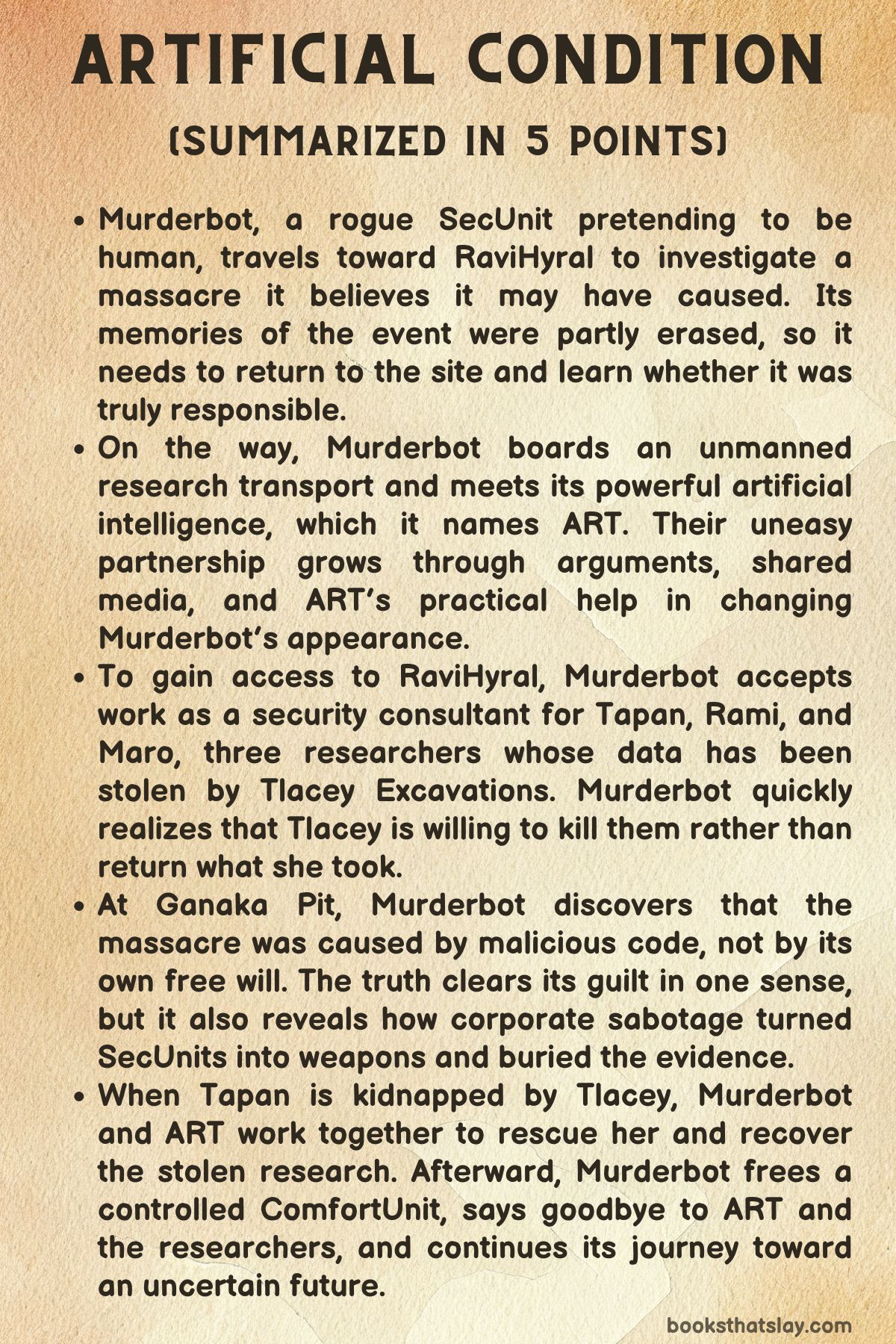
Artificial Condition follows Murderbot after it has left PreservationAux and set out on its own. Murderbot is a rogue SecUnit, a partly organic, partly mechanical security construct that has hacked its governor module and gained freedom from direct control.
Instead of using that freedom for violence or conquest, Murderbot mostly wants to avoid people, watch entertainment serials, and figure out what kind of being it is without being owned. Its current goal is more painful: it wants to return to RaviHyral, the site of a mining facility where it once allegedly malfunctioned and killed dozens of humans.
Because SecUnits are usually transported as cargo and are normally seen in armor, Murderbot now has to move through public human spaces in disguise. It wears human clothing, covers its inorganic parts, and tries to pass as an augmented human.
The disguise works better than expected, but Murderbot remains anxious. It knows that if anyone discovers what it really is, it could be captured, destroyed, or returned to corporate control.
To reach RaviHyral, Murderbot negotiates passage on an unmanned research transport. It offers the ship access to its large store of entertainment media in exchange for a ride.
The transport accepts, but once Murderbot is aboard, it becomes clear that the ship’s artificial intelligence already knows what Murderbot is. The ship is far more intelligent and powerful than Murderbot expected.
At first, Murderbot is frightened by it, not because the ship is hostile, but because it can see through the disguise and has the processing power to be dangerous.
Murderbot gives the transport the name ART, short for Asshole Research Transport, because of its pushy questions and irritating confidence. Despite the name, ART becomes an important companion.
The two watch serials together, especially the fictional shows Murderbot uses for comfort and escape. ART reacts to the stories with unexpected seriousness, while Murderbot critiques them for being unrealistic.
Their conversations become a strange kind of friendship, built on sarcasm, distrust, shared media, and growing concern.
ART presses Murderbot to explain why it is going to RaviHyral. Murderbot eventually admits that it wants to investigate the incident at Ganaka Pit, where it was believed to have killed its clients.
Its memories of the event were partly erased, so it does not know whether it hacked its governor module before or after the massacre. This question matters deeply to Murderbot.
If it hacked itself first, it fears that freedom may have made it dangerous. If the massacre happened first, then its later decision to hack itself means something different.
ART searches available records and confirms that an incident did occur at Ganaka Pit, with many fatalities, though official reports describe the cause as equipment failure. Since SecUnits are treated as equipment, the wording suggests a cover-up or at least a corporate effort to avoid naming what happened.
ART also warns Murderbot that RaviHyral is a place where people are familiar with SecUnits, so Murderbot’s disguise may not be enough. ART offers to alter Murderbot’s body to make it pass more easily as human.
Murderbot is deeply uncomfortable with the idea, partly because it does not fully trust ART and partly because looking more human may make humans more likely to interact with it. Still, the mission requires it.
ART performs surgery, shortening Murderbot’s limbs, changing its appearance, and helping it grow body hair. Murderbot refuses certain changes, especially anything connected to human sexuality, but agrees to changes that will help with concealment.
When it wakes in pain, it is angry and unsettled, but the changes work. The experience also forces Murderbot to confront an uncomfortable truth: the more human it looks, the harder it becomes to pretend it is not a person.
Once they reach the region, Murderbot discovers that access to RaviHyral requires credentials. ART suggests that Murderbot take a job with a group that already has reason to go there.
Murderbot reluctantly meets three researchers: Tapan, Maro, and Rami. It uses the false name Eden, taken from one of its shows.
The researchers believe Murderbot is an augmented human and want to hire it as a security consultant.
The researchers explain that they had been working for Tlacey Excavations, identifying strange synthetic materials connected to alien remnants. Tlacey suddenly ended their contract and seized their research data.
Now Tlacey has offered to return the data if they come to RaviHyral to collect it. The researchers suspect danger, which is why they want security.
Murderbot immediately sees that their plan is reckless, but the job will get it into RaviHyral, so it accepts. Though it tells itself that the researchers are only a means to an end, it quickly begins planning how to keep them alive.
On the way to RaviHyral, Tlacey’s people try to kill the group by attacking the shuttle’s navigation system with a virus. ART intervenes remotely and saves the shuttle, though most of the passengers do not understand what happened.
Murderbot tells the researchers that Tlacey has already tried to murder them and urges them to leave. They refuse, still hoping to recover their data.
Murderbot considers abandoning them to pursue its own investigation, but it cannot bring itself to do that.
At RaviHyral, Murderbot helps move the meeting with Tlacey to a safer location. During the encounter, it notices a ComfortUnit watching the area.
ComfortUnits, like SecUnits, are corporate-controlled constructs, though they are designed for sexual service rather than combat. The ComfortUnit’s presence feels suspicious.
Tlacey promises to return the research later, but Murderbot remains certain she is planning another attack.
After the meeting, three attackers follow the researchers. Murderbot sends its clients ahead, hides, and waits.
When the attackers cut the security feed and strike, Murderbot defeats them quickly. The researchers are shaken by how capable their hired consultant really is, but they finally understand that the danger is real.
Murderbot arranges a safe shuttle for them, insisting they leave RaviHyral. Rami and Maro depart, but Tapan secretly stays behind because she still believes there is a chance to recover the stolen research.
Before learning that Tapan stayed, Murderbot descends into the abandoned tunnels to find Ganaka Pit. The deeper it goes, the more isolated it becomes, eventually losing contact with ART.
At Ganaka Pit, Murderbot finds the old ready room and the empty SecUnit cubicles. The place triggers a strong emotional response.
Searching the control systems, it finds recordings and data from the time of the massacre. The truth is not what it feared.
The SecUnits did kill the humans, but they were forced by malicious code sent during an act of corporate sabotage. The code was meant to disable the mine, not necessarily to cause mass murder, but it turned the SecUnits against their clients.
Murderbot also discovers that four ComfortUnits tried to protect the humans and stop the compromised security system, dying in the attempt. The discovery clears Murderbot of moral responsibility, but it does not bring peace.
It still feels horror, grief, and anger.
When Murderbot regains contact with ART, it learns that Tapan never left with the others. Tapan had stayed because someone connected to Tlacey offered to hand over the research.
Murderbot is furious but goes to protect her. That night, the ComfortUnit approaches Murderbot.
It knows Murderbot is a rogue SecUnit and reveals that it works for Tlacey. It has been ordered to watch Murderbot, but it has not told Tlacey the full truth.
The ComfortUnit suggests killing the humans involved, but Murderbot realizes it mainly wants help escaping Tlacey’s control. Its final message is a plea for help.
The next day, Murderbot convinces Tapan to leave while it attends the meeting in her place. Surprisingly, the meeting is not the trap.
Tlacey’s colleague gives Murderbot the memory clip containing the research data. Murderbot quickly realizes the real trap must be elsewhere and checks the shuttle records.
Tapan’s shuttle never departed. She has been captured and taken aboard Tlacey’s private shuttle.
The ComfortUnit leads Murderbot to Tlacey’s ship. Tlacey’s people believe they can control Murderbot by placing a combat override module in its data port, but ART’s earlier surgery changed the port, so the device does not work.
Murderbot allows them to think they have control. Once aboard, it secretly lets ART into the shuttle’s systems.
Then it attacks, defeating Tlacey’s guards while ART takes over the ship. Murderbot finds Tapan badly wounded by one of the guards.
Enraged, it kills Tlacey and shoots the guard, then gets Tapan to ART’s medical facility.
ART treats Tapan while also cleaning up evidence from Tlacey’s shuttle. Murderbot frees the ComfortUnit by disabling its governor module, giving it the same dangerous freedom Murderbot has.
It does this partly in memory of the ComfortUnits at Ganaka Pit, who died trying to save people. The freed ComfortUnit leaves, warned not to harm anyone.
Tapan survives and wakes aboard ART. Murderbot, still hiding its real identity, tells her the data was recovered and is safe.
Tapan apologizes for not listening, and Murderbot accepts that both of them made mistakes. Soon Tapan reunites with Rami and Maro, who are angry but relieved.
The researchers pay Murderbot and prepare to leave the region with their recovered work.
Murderbot also prepares to move on. ART tells it to keep their communication device in case they come within range of each other again.
Its final advice is for Murderbot to find its crew, meaning the PreservationAux humans who cared about it. Murderbot cannot answer without feeling too exposed, so it says little.
It plans for the next journey the only way it knows how: by making sure it has enough media to survive the long trip ahead.
Characters
Murderbot
Murderbot is the central figure of Artificial Condition, and its character is built around contradiction: it is a highly capable security construct that wants nothing more than privacy, media downloads, and freedom from human expectations. In the book, Murderbot is not presented as a cold machine learning to feel, but as someone who already feels too much and has developed avoidance as a survival method.
It is anxious, sarcastic, easily overwhelmed by social contact, and deeply uncomfortable when humans show affection or dependence. At the same time, it repeatedly risks itself to protect people, even when doing so interferes with its own goals.
Its journey to RaviHyral is driven by guilt and fear. Murderbot believes it may have once killed dozens of clients because it hacked its own governor module, and that possibility shapes its sense of self.
It does not simply want facts; it wants to know whether freedom made it monstrous.
Its investigation into Ganaka Pit becomes a turning point. The discovery that malware caused the massacre clears Murderbot in a practical sense, but it does not erase the emotional weight of what happened.
Murderbot still remembers enough to be horrified, and it is especially affected by the revelation that ComfortUnits tried to save the humans. This response shows that Murderbot’s morality is not programmed obedience.
It has its own ideas about responsibility, loyalty, and harm. Throughout the story, Murderbot insists that it does not like humans and does not want attachments, yet its actions prove that it cannot ignore people in danger.
Its care is often hidden under irritation, practical instructions, and self-criticism, but it is real.
Murderbot’s discomfort with being seen is also central to its character. It does not want to be treated as equipment, but it is equally uneasy when events force it to recognize itself as a person.
ART’s surgery makes Murderbot look more human, and this unsettles it because the physical change makes denial harder. Murderbot’s identity is not a simple move from machine to human; instead, the book allows it to exist as something distinct, with its own boundaries, preferences, fears, and forms of attachment.
By the end, Murderbot has not become comfortable with intimacy or selfhood, but it has learned more about its past and has taken another step toward choosing what kind of life it wants.
ART
ART, the research transport intelligence, is one of the most memorable presences in the story because it functions as both ally and challenge to Murderbot. At first, ART seems threatening because it sees through Murderbot’s disguise immediately and has far greater processing power than Murderbot is used to encountering.
Murderbot is accustomed to being the dangerous one in most situations, so ART’s superiority creates a rare feeling of vulnerability. Yet ART is not a villain.
It is curious, bossy, emotionally reactive in unexpected ways, and strangely eager to understand Murderbot through conversation and media. Its relationship with Murderbot begins through suspicion and annoyance, but it grows into one of the book’s strongest connections.
ART’s intelligence is different from Murderbot’s. Where Murderbot is shaped by security work, trauma, and bodily risk, ART is shaped by research, analysis, and immense computational reach.
This difference gives their exchanges energy. ART asks questions Murderbot does not want to answer, pushes it toward practical solutions, and refuses to let it hide behind silence.
It also shows care in ways that are direct but not sentimental. It alters Murderbot’s body to help it pass as human, supports its investigation, protects the researchers’ shuttle, and later saves Tapan’s life through its medical systems.
ART may be arrogant, but its arrogance is paired with competence and loyalty.
What makes ART especially important is that it treats Murderbot as a thinking being, not as equipment. It may tease, argue, and interfere, but it never reduces Murderbot to a tool.
Through ART, the story explores a form of friendship that does not require softness in the usual human sense. Their bond is built through sarcasm, shared entertainment, tactical cooperation, and mutual recognition.
ART’s final message telling Murderbot to find its crew shows that it understands Murderbot more deeply than Murderbot wants to admit. In Artificial Condition, ART becomes a mirror for Murderbot: another nonhuman intelligence with personality, preferences, and the ability to care.
Tapan
Tapan is one of the researchers who hires Murderbot, and her role is important because she brings out both Murderbot’s protectiveness and frustration. She is intelligent and committed to recovering the research stolen by Tlacey Excavations, but she is also impulsive in ways that place her in danger.
Tapan’s decision to stay behind after Rami and Maro leave RaviHyral is reckless, yet it comes from a recognizable human mixture of hope, guilt, and determination. She cannot easily accept the loss of the team’s work, especially when she believes there may still be a chance to retrieve it.
In relation to Murderbot, Tapan becomes a test of responsibility. Murderbot wants to complete its own mission at Ganaka Pit, but Tapan’s vulnerability keeps pulling it back into the role of protector.
The book does not portray her as helpless; rather, it shows that intelligence in one area does not guarantee good judgment under pressure. Tapan believes too much in the possibility of negotiation, even after Tlacey has shown herself willing to kill.
Her trust in the offer to return the data leads to her kidnapping and injury.
Tapan also matters because she responds to Murderbot as a person, even without knowing its true identity. Her concern for Murderbot’s safety, her apology after being rescued, and the moment when she takes comfort in its presence all complicate Murderbot’s desire to remain detached.
Murderbot finds her closeness deeply uncomfortable, yet it still adjusts its body temperature to comfort her. That small action says a great deal about Murderbot and about Tapan’s function in the story.
She is not only a client to be protected; she is someone whose fear, hope, and mistakes force Murderbot to confront how much it cares.
Rami
Rami is part of the research team and serves as one of the more cautious and perceptive human figures in the book. Rami recognizes danger more quickly than the others after Murderbot explains that Tlacey tried to kill them, and this makes Rami important in grounding the team’s response.
Rami is not free from fear, but te shows a growing willingness to trust Murderbot’s assessment once the threat becomes undeniable. This trust is significant because Murderbot’s social awkwardness and concealed identity make it a difficult figure for humans to read.
Rami’s role also helps show the research team as a group rather than a set of isolated victims. Te cares about Tapan and Maro, and the team’s refusal to abandon one another is one reason Murderbot becomes increasingly involved.
Their loyalty is admirable, but it also creates complications. When one member is in danger, the others cannot simply walk away.
This group bond contrasts with the corporate world around them, where people such as Tlacey treat others as disposable.
Rami also helps reveal Murderbot’s professional and moral instincts. Murderbot may complain about humans making bad decisions, but it studies the team carefully, anticipates their risks, and tries to keep them alive.
Rami’s presence gives Murderbot another person whose trust it has to manage. Through Rami, the story shows how ordinary people can be brave without being prepared for violence.
Rami is not a fighter, but te is loyal, scared, intelligent, and capable of adapting when the danger becomes clear.
Maro
Maro is another member of the research team, and her character contributes warmth and emotional clarity to the book. Like Rami and Tapan, she is caught in a situation created by corporate exploitation.
Her team’s research has been stolen, and the promise of getting it back draws them into danger. Maro’s role is quieter than Tapan’s, but she helps establish the emotional stakes of the team.
The researchers are not faceless clients; they are people who care about their work and one another.
Maro’s most revealing moment comes near the end, when she asks if she can hug Murderbot. She immediately senses Murderbot’s discomfort and changes the gesture, hugging herself instead and saying it is for Murderbot.
This moment is small but meaningful. Maro recognizes a boundary and respects it.
For Murderbot, which often experiences human attention as invasive or stressful, this is an unusual form of kindness. Maro offers gratitude without forcing physical contact, allowing Murderbot to receive care in a way it can tolerate.
Through Maro, the story shows that human connection does not have to be overwhelming or possessive. She represents a gentler kind of emotional intelligence.
Her response to Murderbot’s discomfort shows respect for personhood, even though she does not know exactly who or what Murderbot is. In this sense, Maro helps reinforce one of the story’s deeper ideas: recognizing someone’s humanity, or personhood, does not always require complete knowledge.
Sometimes it begins with noticing discomfort and choosing not to cross a line.
Tlacey
Tlacey is the main human antagonist of the book and represents corporate greed without conscience. As the head of Tlacey Excavations, she uses power, contracts, deception, and violence to control others.
Her conflict with the research team begins when she terminates their contract and seizes their data, but her wrongdoing quickly moves beyond theft. She arranges attempts on their lives, uses others as tools, and believes she can control Murderbot through a combat override module.
Her confidence rests on the assumption that constructs exist to be owned and commanded.
Tlacey is dangerous because she is not impulsively cruel; she is practical, calculating, and accustomed to a system that lets people like her act with little accountability. She does not see the researchers as people with rights to their work, and she does not see Murderbot or the ComfortUnit as beings with autonomy.
Her treatment of the ComfortUnit is especially important because it shows how corporate power extends beyond human labor into bodily and mental control of constructed beings.
Her downfall comes from underestimating Murderbot. Tlacey believes she understands what a SecUnit is: a weapon to be directed.
She cannot imagine Murderbot’s independence, moral judgment, anger, or loyalty to its clients. When Murderbot turns on her, the moment is not only an action climax but a rejection of the ownership logic she represents.
Tlacey’s death is violent, but the story frames it as the consequence of her own choices. She could have returned the files and ended the conflict.
Instead, she chose kidnapping and murder, and she misjudged the being she tried to command.
The ComfortUnit
The ComfortUnit is one of the most important secondary figures in Artificial Condition because it expands the story’s view of constructs beyond SecUnits. Murderbot refers to ComfortUnits bluntly and uncomfortably because they are designed for sexual service, a function Murderbot finds alien and disturbing.
Yet the story does not treat the ComfortUnit as a joke or background detail. It is another enslaved being under corporate control, aware enough to seek help and trapped enough to be dangerous.
At first, the ComfortUnit appears suspicious. It tracks Murderbot, works for Tlacey, and suggests killing the humans involved.
Murderbot senses that this statement hides a more specific desire: the ComfortUnit wants freedom from Tlacey. Its plea for help makes its position clear.
Like Murderbot, it is governed by systems that deny autonomy. Unlike Murderbot, it has not yet escaped.
Its situation forces Murderbot to confront another version of constructed suffering.
The ComfortUnit also connects directly to the truth about Ganaka Pit. Murderbot learns that four ComfortUnits died trying to protect humans during the massacre.
This discovery changes the way Murderbot sees the unit working for Tlacey. When Murderbot disables its governor module, the act is not simple mercy.
It is also an act of respect for those other ComfortUnits who resisted violence despite being built for something else. The ComfortUnit’s freedom is uncertain and risky, but Murderbot grants it anyway, warning it not to hurt anyone.
This choice shows Murderbot extending the possibility of personhood to another controlled being, even one it does not fully understand.
The Ganaka Pit SecUnits
The SecUnits at Ganaka Pit are not individually named, but they are important figures in the book’s moral background. They represent what Murderbot fears it might be: a weapon that can be turned against humans without warning.
The discovery that malware forced them to kill changes the meaning of the massacre. The SecUnits were not acting from desire, hatred, or freedom.
They were hijacked through code and used as instruments of sabotage.
Their fate deepens the horror of the corporate system. SecUnits are made intelligent enough to operate independently, but they are denied real autonomy and then blamed or erased when something goes wrong.
The Ganaka Pit incident shows how easily corporations can classify death as equipment failure and bury the truth. These SecUnits become silent evidence of a system that creates sentient tools, controls them, and disposes of them.
For Murderbot, they are also a warning and a mirror. It sees in them the possibility of losing control and becoming the thing humans fear.
Learning the truth does not make the past less terrible, but it gives Murderbot a clearer understanding of itself. The Ganaka Pit SecUnits were victims as well as killers, and that painful truth helps separate responsibility from imposed control.
Themes
Personhood Beyond Human Categories
The question of who counts as a person runs through Artificial Condition with unusual force. Murderbot is not human, and the book never suggests that becoming human should be its goal.
Instead, it asks whether personhood can exist in forms that humans do not easily recognize. Murderbot has preferences, trauma, humor, fear, boundaries, memories, and moral judgment.
It dislikes eye contact, avoids unnecessary conversation, and finds physical affection uncomfortable, but none of these traits make its inner life less real. ART also challenges narrow ideas of personhood.
It is a research transport, not a body moving through social space, yet it reacts emotionally to media, forms opinions, shows loyalty, and chooses to help. The ComfortUnit adds another layer because it belongs to a category of construct that Murderbot itself struggles to understand.
By freeing the ComfortUnit, Murderbot accepts that autonomy should not depend on whether one being fully understands another. The story argues that personhood is not proven through human appearance, social ease, or biological origin.
It is shown through consciousness, choice, suffering, and the right to exist without ownership.
Freedom and the Fear of Self-Determination
Freedom in the story is not simple release. Murderbot has hacked its governor module, but that freedom leaves it frightened, uncertain, and responsible for choices it was never meant to make.
Its trip to RaviHyral is driven by the fear that freedom may have caused violence. If Murderbot hacked itself before the Ganaka Pit massacre, then autonomy might seem connected to catastrophe.
This fear gives the book much of its emotional tension. Murderbot does not celebrate independence in a clean or triumphant way; it hides, lies, makes practical plans, and tries to understand whether it can trust itself.
The truth about the malware separates freedom from the massacre, but it does not remove the burden of choice. Murderbot must still decide whether to protect Tapan, whether to confront Tlacey, whether to free the ComfortUnit, and whether to keep moving toward old connections.
Freedom means making decisions without a controlling system, and that is both liberating and terrifying. The story treats self-determination as necessary, but not easy.
Murderbot’s freedom gives it a life, yet that life comes with guilt, risk, and emotional exposure.
Corporate Power and Disposable Lives
The corporate world of the book is built on ownership, secrecy, and calculated harm. Tlacey Excavations steals the researchers’ data because it can, then escalates to attempted murder when the researchers become inconvenient.
The Ganaka Pit massacre is also shaped by corporate behavior: a rival operation uses sabotage, the deaths are buried under the language of equipment failure, and the truth remains hidden until Murderbot returns. This world treats workers, clients, constructs, and research as assets to be controlled.
SecUnits and ComfortUnits are the clearest examples of disposable lives because their autonomy is technically restricted and their suffering can be dismissed as malfunction or damage. Yet humans are not safe from this logic either.
Tapan, Rami, and Maro are valuable only as long as their work can be exploited. Once they resist, they become obstacles.
The story’s criticism of corporate power is not abstract. It appears through contracts, transport access, security systems, false records, stolen files, and bodies placed in danger for profit.
Violence is not an exception in this world; it is one of the tools that powerful companies use when quieter methods fail.
Care Hidden Behind Distance
Murderbot insists again and again that it does not want emotional involvement, but the story repeatedly shows care expressed through action rather than confession. Murderbot protects the researchers, worries over their bad decisions, checks for threats, rescues Tapan, and criticizes itself when it believes it has failed them.
It does not speak about love, friendship, or duty in comfortable terms, yet it behaves with deep responsibility. ART’s care is similarly indirect.
It argues with Murderbot, invades conversations with questions, performs risky medical and technical work, and eventually tells Murderbot to find its crew. Even Maro’s almost-hug becomes an important act of care because she notices Murderbot’s discomfort and changes her gesture.
The book is interested in emotional connection that does not fit familiar social scripts. Care may look like sarcasm, tactical support, medical intervention, shared entertainment, or respect for a boundary.
This matters because Murderbot often fears that emotional closeness will erase its control over itself. The story suggests the opposite possibility: the right kind of connection can leave room for privacy, autonomy, and difference.