After The Fall Summary, Characters and Themes
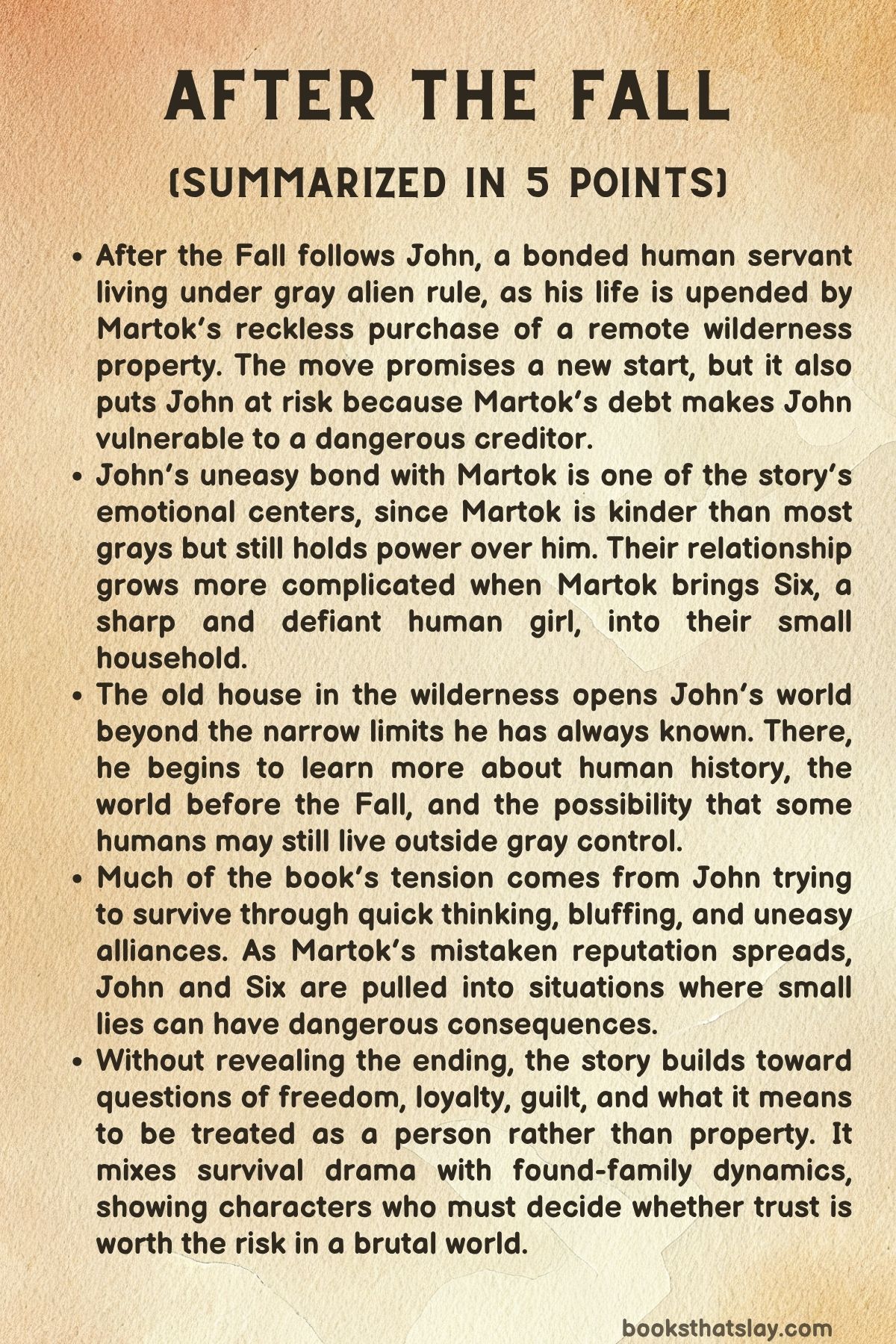
After The Fall by Edward Ashton is a science fiction story about survival, loyalty, and the uneasy line between ownership and friendship. Set in a future where gray aliens rule over altered, smaller humans called bondsmen, the book follows John, a bonded servant whose life depends on the choices of his well-meaning but reckless gray master, Martok.
What begins as a strange attempt to build a wilderness retreat becomes a dangerous chain of lies, hidden communities, political violence, and moral tests. The story uses sharp tension and dry character work to ask what freedom means when kindness still exists inside a system built on captivity.
Summary
John is a bonded human servant living under Martok, a poor gray alien who owns him. Martok is not cruel in the way many grays are, and he often treats John with a kind of rough affection, but he is foolish with money and acts before thinking.
Their life in Farhome is bleak, cramped, and uncertain. When Martok announces that he has bought a home in the wilderness beyond Lake Town, John immediately senses danger.
Martok has not truly improved their situation. He has taken credit from Daro Lia née Greatfoot, a powerful and frightening creditor.
Worse, John’s bond has been used as pressure. If Martok does not make his first payment within sixty days, Daro will take John.
John knows that probably means death.
Martok and John leave Farhome by train. On the journey, a Greatfoot passenger abuses John, and Martok defends him.
The moment is important because it shows both Martok’s loyalty and his frightening capacity for rage. He nearly loses control, then pulls himself back.
At another stop, Martok visits a crèche, one of the places where bonded humans are raised. He brings out a girl named Six, an older child close to the age when unbonded humans are usually killed.
Six is sharp, suspicious, and openly hostile. She calls John a pet and doubts Martok’s claim that John is his friend.
John helps her when she is freezing, though she refuses to show gratitude. He also understands that Martok may have taken Six because John might soon be lost to Daro.
At Lake Town, Martok and Six leave John with the baggage. Two Ice River laborers try to rob him.
John survives by inventing a dangerous lie. He suggests that Martok is an enforcer, one of the rare grays able to commit violence against other grays without going mad.
The thieves retreat. But the lie spreads quickly.
When Martok returns with supplies, new clothes for Six, and a broken-down trundlecar supposedly given by Chairman Sinta of Ice River, John realizes that Sinta has heard the rumor and believes Martok may be useful as a violent agent.
The property Martok has bought is an enormous old house near a lake, built before the grays conquered Earth. Martok dreams of turning it into a wilderness resort for wealthy grays.
John and Six soon understand how unrealistic this plan is, but Martok is full of confidence. Six explains that the house was made by true humans before The Fall, not by the smaller humans bred in crèches.
This makes John think about a powerful boy named Dee from his childhood, who had once fought back and been killed. The memory suggests that other kinds of humans may still exist.
While exploring the woods, John gets lost and meets Dana and Tanner, two large feral humans living outside gray control. They suspect him because Daro once occupied the house and had sent bondsmen after them.
John survives again through bluffing. He claims Martok is an enforcer with access to deadly spider machines.
Dana and Tanner let him go, but the encounter reveals that the wilderness is not empty. There is a hidden human life beyond the grays’ system.
Sinta soon sends Martok a “client,” an old gray named Min Hara. Martok thinks the visit supports his resort plan, but John understands the truth.
Sinta wants Martok to punish Min. John is trapped by his own lie, and the household must make the false reputation real.
John pressures Dana into helping by threatening to reveal the feral community. That night, after Martok and Min drink heavily, John, Six, Dana, and Tanner attack Min in his room.
Tanner holds him down, John speaks as if Martok has ordered the punishment, and Dana beats Min’s feet. They warn him to stay silent.
The deception works. Sinta pays far more than expected and says the service was satisfactory.
Martok is thrilled because he believes his retreat is succeeding. John and Six know the opposite.
Sinta now wants to send another guest for “the full treatment,” which likely means murder. John and Six discuss what it would take to kill a gray and admit they cannot do it alone.
They may need Dana and Tanner again.
During the second winter at the house, John remembers once freezing in fear before a wolf in Farhome’s park and surviving only because the animal left. In the present, Dana confronts him in the snow.
He had stolen antibiotics for Miri, a sick member of the feral community, but the medicine is not helping quickly enough. Dana decides they need a real doctor.
To force Martok to summon one, she breaks John’s arm, leaving a compound fracture. John struggles back through the snow in terrible pain until Martok finds him and carries him inside, terrified for him.
Martok calls Alph, a high-status bondsman doctor. Before Alph arrives, John tells Six the truth: Dana injured him so they can get medical help for Miri.
Six agrees to lure Alph into the woods after he treats John. Alph quickly sees that John’s injury was not caused by an accident.
He treats him and reveals that he knows John helped punish Min. Alph explains that Min was not a criminal but a political enemy of Sinta.
Min opposes Sinta’s cruelty and believes bondsmen deserve rights. Six later leads Alph to Dana, and he treats Miri.
He returns alive, and Dana sends word that John has earned a credit with her.
The household begins to collapse under the weight of secrets. John and Six worry that Martok may know about the ferals.
At breakfast, Martok asks them not to kill the next guest. This forces the truth into the open.
John admits that Sinta thinks Martok is an enforcer because of his lie. Six then reveals everything else: the ferals, Min’s beating, the fake illness, and the plan to murder the next visitor.
Martok is shaken. He explains that bondsmen exist because the grays altered surviving humans after The Fall rather than killing them all.
Yet his deepest anger is not about the lie itself. To him, John and Six attacked a gray who was under his protection.
He cannot bring himself to kill them, so he orders them to leave.
John and Six flee into the winter woods. They argue, and Six realizes that Martok probably took them from the crèche to save their lives.
Dana finds them and at first refuses to shelter them. When she learns that Martok knows about the ferals, she panics and brings them to the hidden underground community.
The settlement is technologically advanced, built before or around The Fall. There John meets Walter, an elderly bondsman who leads the group.
Walter explains that bondsmen are essentially domesticated humans, bred and shaped by the grays.
Martok later searches for John and Six in the woods. He asks them to come home, but John refuses.
For the first time, he tells Martok plainly that Martok’s own choices caused their disaster. Martok seems to accept the accusation, but soon sends Alph with a message: Sinta has agreed to help, and John should be ready in two days.
John, Six, Dana, Walter, and Alph understand what this probably means. Sinta may be sending spiders to hunt the ferals.
Dana decides to sacrifice herself. She gives John a rifle and tells him to kill her near the house so he can claim he destroyed the only feral threat.
John cannot do it. Instead, he runs to the house, where Sinta and Martok are eating.
John shoots Sinta and wounds him. Sinta seizes John and is about to kill him, but Martok attacks Sinta and kills him.
The truth is finally revealed: Martok really was once an enforcer.
Martok explains that he left that violent life because it damaged him. He rescued John, and later Six, from the crèche as a way to make amends for what he had done.
Since Sinta had already transferred money meant for the spider attack, Martok can use it to clear John’s bond and strengthen the retreat. With Sinta dead, Min Hara’s faction may gain power and create safer conditions for bondsmen and ferals.
Martok accepts that John must be his partner, not his property.
Months later, the wilderness retreat has become a real success. Martok, John, Six, and the ferals trade and cooperate.
Miri recovers. Other rescued bondsmen come to work there, and some may eventually join the hidden human community.
John knows their freedom is fragile, but for the moment they have safety, food, purpose, and one another. In winter, while hunting, he sees a wolf.
Remembering the wolf that once spared him, he lowers his rifle and lets it live. Then he goes home.
Characters
John
John is the central human character in the book, and his journey is built around the painful movement from obedience toward selfhood. At the beginning, he lives as Martok’s bonded servant, which means his life is legally and socially treated as property rather than as fully his own.
Yet John is not passive. He is cautious, observant, and skilled at surviving by reading danger quickly.
His repeated use of bluffing shows both intelligence and desperation. He lies about Martok being an enforcer, threatens Dana with exposure, and later performs a staged punishment on Min Hara because these are the only tools available to someone with almost no formal power.
John’s complexity comes from the fact that he is morally aware even when he is forced into ugly actions. He knows that beating Min is wrong, but he also understands that refusing Sinta’s demand may lead to greater danger.
He is often trapped between protecting himself, protecting Six, protecting Martok’s fragile situation, and protecting the hidden feral humans. This makes him a character defined by compromise, guilt, and quick thinking rather than simple bravery.
His bond with Six also reveals his gentler side. Though Six insults him and challenges him, John repeatedly protects her, helps her, and eventually accepts her as someone whose life is tied to his own.
By the end of the story, John’s greatest change is that he begins to reject the idea that gratitude requires submission. He recognizes that Martok saved him, but he also finally tells Martok that his reckless choices caused much of their suffering.
This is one of John’s most important moments because he stops seeing himself only as someone who must endure the decisions of others. His refusal to kill Dana also proves that he has developed a moral line he will not cross, even under extreme pressure.
John’s final act of sparing the wolf reflects his transformation: he is no longer ruled only by fear, and he chooses mercy where once he could only freeze or survive.
Martok
Martok is one of the most morally layered figures in the book. He is a gray alien and legally John’s master, yet he does not fit neatly into the role of cruel owner.
Compared with many grays, he treats John with affection, respect, and emotional dependence. He calls John his friend, defends him from abuse, rescues Six from the crèche, and ultimately cannot bring himself to kill or abandon John permanently.
These qualities make Martok sympathetic, but the book never allows his kindness to erase the reality that he still participates in a system of ownership.
Martok’s main flaw is that he mistakes good intentions for good judgment. His decision to buy the wilderness house is reckless, and his debt to Daro Lia places John’s life in direct danger.
Even when he imagines building a resort, he fails to understand the political and violent expectations surrounding him. He wants to reinvent himself as a harmless host, but his past and reputation follow him.
This makes Martok tragic because he is trying to escape violence without fully understanding how much harm his irresponsibility still causes.
The revelation that Martok was once an enforcer gives new meaning to his behavior. His fear of losing control, his violent reaction when Sinta threatens John, and his grief over past harm all suggest a character carrying deep guilt.
He rescued John and Six partly as an act of atonement, but atonement alone is not enough while he still treats them as dependents rather than equals. His growth comes when he finally accepts that John must be a partner, not a possession.
By the end of After The Fall, Martok becomes a figure of partial redemption: not innocent, not fully healed, but willing to change the structure of his relationships.
Six
Six is a fierce, defensive, and deeply wounded child whose personality has been shaped by the brutal logic of the crèche. When she first appears, she is sharp-tongued and hostile, calling John a pet and refusing to accept Martok’s claim that John is his friend.
Her aggression is not simple cruelty; it is a survival mechanism. She has grown up in a world where unbonded children can be killed when they are no longer useful, so she has learned to distrust softness, gratitude, and dependence.
Six serves as a powerful contrast to John. John has survived by adapting to bondage, reading social cues, and avoiding direct confrontation when possible.
Six, however, survives through defiance. She challenges John’s acceptance of Martok’s kindness, forces uncomfortable truths into the open, and eventually blurts out the secrets that John tries to manage carefully.
Her honesty is dangerous, but it also breaks the false peace that has been holding the household together. She exposes what everyone is trying not to say: that Martok’s home is built on lies, fear, and unequal power.
Six’s emotional development is subtle but important. She begins as someone who appears almost purely combative, but she gradually shows loyalty, courage, and insight.
She helps with the plan involving Alph, flees with John, understands that Martok may have saved them both from death, and becomes part of the new community at the retreat. Her relationship with John changes from mockery to partnership.
Six represents the generation that has not yet been fully trained into obedience, which makes her dangerous to the old order and vital to the possibility of freedom.
Dana
Dana is one of the strongest symbols of free humanity in the story. Unlike John and Six, she has not been bred into the same small, bonded condition as crèche humans.
She belongs to a hidden feral community that preserves physical strength, old knowledge, and a connection to pre-Fall human independence. Her presence forces John to confront the difference between survival inside bondage and survival outside it.
Dana is brave and fiercely protective, but she is not idealized. She can be threatening, ruthless, and manipulative.
She considers killing John when she believes he may endanger her people, breaks John’s arm to force access to a doctor for Miri, and later decides that sacrificing herself may be the only way to protect the hidden community from the spiders. These actions show that Dana has been shaped by a world where mercy can expose everyone she loves to destruction.
Her morality is communal rather than personal: she is willing to harm one person, or even die herself, if it protects her people.
Her relationship with John is tense because they need each other before they fully trust each other. John uses threats to gain her help, while Dana uses force to achieve her goals.
Yet over time, they develop a rough respect. Dana recognizes John’s usefulness and courage, while John comes to see that the ferals are not monsters or legends but living people with their own fragile society.
Dana’s willingness to meet Martok peacefully near the end suggests that she, too, can move beyond pure suspicion when survival no longer demands constant hostility.
Tanner
Tanner is less developed than Dana, but he plays an important role as a physical reminder of what humans were before gray domination changed them. He is large, strong, and dangerous in ways that John is not.
When John first meets Dana and Tanner, Tanner’s presence intensifies the threat. He helps make clear that the feral humans are not helpless victims; they are capable of defending themselves and punishing those who threaten them.
In the staged attack on Min Hara, Tanner becomes the force that makes the plan possible. He pins Min down while John performs the role of Martok’s speaker and Dana carries out the beating.
Tanner’s role in this scene is mostly physical, but that physicality matters because it reverses the usual power structure. A gray, normally protected by status and fear, is suddenly vulnerable beneath human strength.
Through Tanner, the book shows the hidden power that the bonded system tries to suppress.
Tanner also helps define the feral community as practical and suspicious. He does not sentimentalize John, and he does not immediately see bonded humans as allies.
His caution reflects the danger his people face. Although he is not as emotionally central as John, Martok, Six, or Dana, Tanner adds weight to the idea that free humans have survived by becoming disciplined, secretive, and ready for violence when necessary.
Alph
Alph is one of the most important secondary characters because he reveals that resistance exists even within the bonded world. As a high-status bondsman doctor, he occupies a complicated position.
He has more education, authority, and mobility than John, but he is still part of the oppressed human class. His profession gives him access to knowledge and social spaces that most bondsmen do not have, and he uses that access carefully.
When Alph treats John’s broken arm, he immediately understands that the injury was not caused by an accident. His intelligence and calmness make him different from the more impulsive characters around him.
He does not expose John, Six, or Dana, and he later helps Miri, showing that his loyalties are not simply with gray authority. He also gives John crucial political context by explaining Min Hara’s punishment and Sinta’s cruelty.
Through Alph, John begins to understand that the conflict is bigger than his own household.
Alph represents quiet resistance rather than open rebellion. He survives by knowing when to speak, when to act, and when to conceal the truth.
His connection to Min Hara’s faction suggests that change may come not only through violence but through organized political shifts among those who believe bondsmen deserve rights. In that sense, Alph bridges the domestic story of John and Martok with the wider struggle for human dignity.
Miri
Miri is not present in many direct scenes, but she is still important because her illness drives several major decisions. Dana’s desperation to save Miri leads to John’s arm being broken and to Alph being brought into contact with the feral community.
This makes Miri a character whose vulnerability exposes the limits of isolation. The hidden humans may be free, but they are not safe from sickness, injury, or the need for outside knowledge.
Miri represents the ordinary lives at stake behind the story’s larger conflicts. The ferals are not just warriors or symbols of old humanity; they are a community with sick people, children, elders, and fragile needs.
Her recovery near the end helps confirm that cooperation between Martok’s retreat, John, Alph, and the ferals can create something better than either isolation or bondage.
Through Miri, the book also shows that survival is not only about defeating enemies. It is about medicine, trust, shared resources, and the willingness to risk contact with outsiders.
Her illness forces Dana and John into a dangerous alliance, but that alliance eventually becomes part of the foundation for a freer future.
Walter
Walter is the elderly bondsman who leads the hidden underground community, and he brings historical understanding to the story. Unlike Dana, whose role is often immediate and physical, Walter’s importance lies in knowledge, memory, and interpretation.
He explains that bondsmen are like domesticated humans, bred down and reshaped by the grays. This gives John a broader understanding of what has happened to his people.
Walter’s leadership suggests that the feral community is not merely a group of fugitives hiding in the woods. It is organized, thoughtful, and connected to knowledge from before or around The Fall.
His presence gives the underground shelter a sense of continuity with the human past. He helps transform John’s understanding of humanity from something private and shameful into something historical and collective.
Walter also serves as a cautious elder figure. He questions John carefully and thinks strategically about Martok, Sinta, and the danger of spiders.
He is not reckless, and his authority seems grounded in experience rather than force. In the structure of the book, Walter helps John move from personal survival toward political awareness.
Chairman Sinta
Chairman Sinta is one of the clearest antagonistic forces in the story. He is powerful, manipulative, and cruel, using his authority in Ice River to turn violence into entertainment and control.
His belief that Martok is an enforcer leads him to send “clients” for punishment, revealing a society where brutality can be disguised as service, discipline, or politics.
Sinta’s cruelty is especially disturbing because it is bureaucratic and casual. He does not need to be openly monstrous at every moment; his power lies in how easily he can arrange harm through others.
He pays Martok, sends Min Hara to be corrected, and later escalates toward what appears to be a request for murder. This makes him dangerous not only as an individual but as a representative of a larger system that treats humans and dissenting grays as disposable.
His death at Martok’s hands is a turning point because it reveals Martok’s true past and breaks Sinta’s immediate hold over the characters. Yet Sinta’s importance goes beyond his final confrontation.
He embodies the political violence that keeps both humans and sympathetic grays afraid. Removing him creates space for Min Hara’s faction and for the retreat’s new future, but the story makes clear that men like Sinta are symptoms of a broader order.
Daro Lia née Greatfoot
Daro Lia née Greatfoot is a threatening figure because she represents the financial and legal machinery of bondage. She does not need to appear constantly to shape the plot.
Her credit arrangement with Martok places John’s life at risk from the beginning, turning Martok’s dream of owning a wilderness home into a countdown toward disaster.
Daro’s use of John as “motivational” collateral shows the cruelty of the society in which the characters live. John is not merely attached to debt as property; he is used as a pressure point, someone whose likely death is meant to force Martok into repayment.
This makes Daro frightening because her violence is contractual. She turns murder into a business mechanism.
Although she is not as active in the later events as Sinta, Daro’s role is essential because she exposes how trapped John is even under a relatively kind master. Martok’s affection cannot fully protect John in a world where another gray can claim him through debt.
Daro therefore represents the cold economic side of oppression, where cruelty is normalized through credit, ownership, and obligation.
Min Hara
Min Hara is first introduced as a victim of the staged punishment, but the later revelation about his politics changes the reader’s understanding of him. At first, John sees Min mainly as a problem to be solved: a gray sent by Sinta whose treatment will determine whether Martok is paid and whether the household survives.
The beating of Min is one of the morally darkest acts John participates in, especially because Min is old and vulnerable in that moment.
Alph’s explanation reveals that Min was punished because he opposed Sinta and supported the idea that bondsmen deserve rights. This makes Min a tragic figure.
He is not an enemy of John’s people, but John helps harm him without knowing the truth. Through Min, the book complicates the idea that all grays are the same.
Some grays benefit from the system, some enforce it, and some may oppose parts of it, even at great personal risk.
Min’s faction becomes important near the end because Sinta’s death may allow them to gain power. This means Min is not only a victim but also a sign of possible reform.
His suffering shows the cost of dissent, while his political position suggests that change may require alliances across the boundaries that the ruling system tries to make absolute.
Dee
Dee appears through John’s memory, but his brief presence is deeply significant. He was a powerful boy in the crèche who fought back and was killed.
To John, Dee becomes evidence that other kinds of humans may exist or may once have existed. His strength and resistance disturb the controlled world John has been taught to accept.
Dee’s importance lies in what he awakens in John’s imagination. Before John meets Dana and Tanner, Dee is one of the only signs that humans might be more than the small, obedient bondsmen created by the grays.
His death also shows how the system responds to human strength: it destroys it before it can become a threat. In this way, Dee foreshadows the danger faced by the ferals and the violence used to maintain human weakness.
Though Dee is not present in the main action, he functions as a memory of suppressed possibility. He helps prepare John to recognize Dana and Tanner not as impossible anomalies, but as proof that the story of humanity is larger than what the crèches teach.
The Wolf
The wolf is not a conventional character, but it serves as an important living symbol in the book. John’s memory of freezing before a wolf in Farhome’s park captures his earlier condition: terrified, powerless, and alive only because danger passes him by.
At that point in his life, survival depends on stillness and luck.
When John sees a wolf again near the end, the meaning has changed. He now has a rifle and the ability to kill, but he chooses not to.
This moment reflects his emotional growth and the changed meaning of power. John has learned that being free does not have to mean destroying every possible threat.
He can choose restraint.
The wolf also mirrors the wildness that surrounds Martok’s retreat and the feral humans. It belongs to a world outside ownership, contracts, and crèches.
By lowering his rifle, John symbolically accepts that freedom includes risk, coexistence, and mercy. The final encounter closes After The Fall with a quiet image of survival that is no longer based only on fear.
Themes
Bondage, Freedom, and the Meaning of Personhood
John’s life begins under a system that treats humans as owned bodies rather than full people. His bond is not just a legal condition; it shapes how he sees danger, loyalty, choice, and survival.
Even Martok’s kindness cannot erase the fact that John can be transferred, punished, or killed because others consider him property. Six challenges this false comfort more directly than John does at first, forcing him to see that being treated gently is not the same as being free.
The feral humans deepen this theme because they show another version of humanity: hidden, threatened, but self-directed. Their existence proves that the grays’ version of human life is artificial and controlled.
By the end of After The Fall, freedom is not presented as a simple escape from one master. It means being recognized as a decision-maker, a partner, and a person whose life cannot be used as collateral.
Moral Compromise Under Oppression
John survives by lying, threatening, manipulating, and sometimes helping others commit violence. These actions are not shown as pure heroism, but they are also not treated as simple wrongdoing.
The world around him gives him very few clean choices. His bluff about Martok being an enforcer protects him in the moment, but it creates larger danger later.
The attack on Min Hara is especially morally complex because John believes he is protecting himself and his group, yet he is also harming someone who supports bondsman rights. The story shows how oppressive systems corrupt moral judgment by forcing the powerless to choose between cruelty and death.
John’s guilt matters because it proves he has not become numb to harm. His growth lies in learning that survival alone is not enough; he must also consider who pays the cost for his choices.
The Uneasy Nature of Kindness and Ownership
Martok is affectionate, protective, and often genuinely concerned for John and Six, yet he still participates in a structure where they belong to him. This contradiction makes his character important.
He is not a simple villain, because he rescues children from the crèche and refuses to treat John with the casual brutality common among grays. However, his kindness is limited by his belief that he has the right to decide their lives.
His anger after learning the truth shows that he cares deeply about the safety of a gray under his protection, but he does not immediately understand the fear that drove John and Six. The story asks whether kindness can be trusted when it exists inside ownership.
Martok’s final change matters because he does more than feel sorry; he accepts responsibility, admits John must be treated as a partner, and begins to act against the system that once gave him power.
Fear, Courage, and Choosing Mercy
Fear follows John through nearly every major decision. He fears Daro, Sinta, the woods, the ferals, Martok’s disappointment, and the possibility that every attempt to survive will make things worse.
Courage in After The Fall is not shown as fearlessness. John often acts while terrified, injured, or unsure.
His refusal to kill Dana is one of the clearest examples of courage because it rejects the easiest path to safety. Shooting Sinta is reckless, but it comes from John’s decision not to let another person die for him.
The wolf scenes frame this theme quietly. At first, the wolf represents helpless terror: John survives only because danger passes him by.
At the end, he holds power over a wolf and chooses mercy instead of violence. That choice shows how much he has changed.
He is still living in a dangerous world, but he no longer defines survival as killing whatever frightens him.