How to Get Away With Murder Summary, Characters and Themes | Tam Barnett
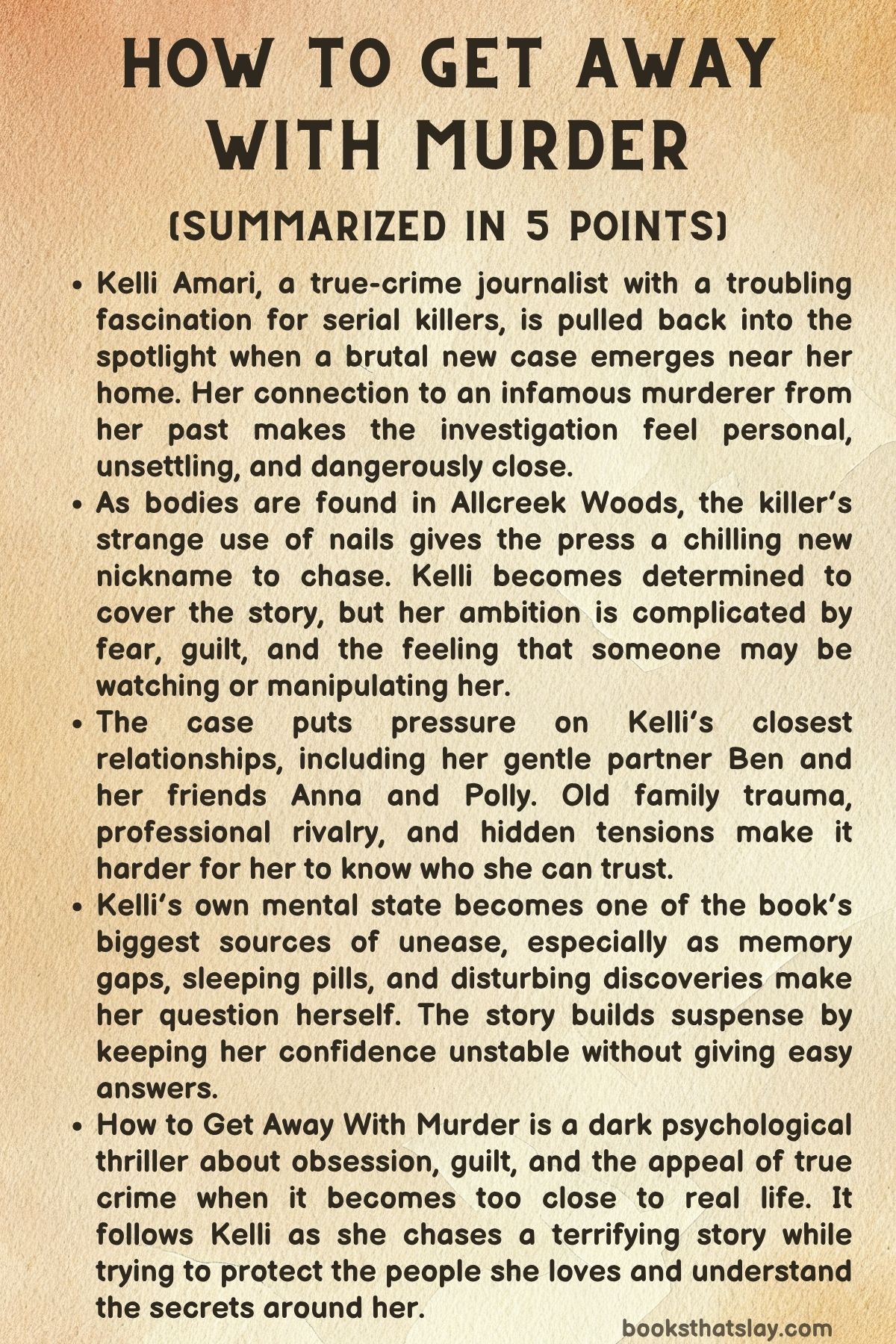
How to Get Away With Murder by Tam Barnett is a dark crime thriller about ambition, obsession, guilt, and the dangerous pull of true crime. The story follows Kelli Amari, a journalist whose career has been shaped by serial killers, especially Dick Monroe, the murderer she helped expose years earlier.
When a new killer begins targeting victims near her home, Kelli sees a chance to reclaim her professional standing. But the case soon turns personal, forcing her to question her memories, her morality, and the people closest to her. The book builds a tense portrait of a woman fascinated by murder until murder begins to reflect her back.
Summary
Kelli Amari is a journalist with a deep fixation on true crime. After watching a disturbing documentary about John Wayne Gacy, she cannot sleep and starts questioning her own mind.
She takes an online psychopathy test and scores higher than most people, though not high enough to be clinically labelled a psychopath. The result unsettles her, but it also feeds the part of her that has always been drawn to killers, motives, and the fine line between observation and participation.
Kelli’s career is closely tied to Dick Monroe, a serial killer known as The White Widower. Years earlier, she and fellow journalist Rob Grayson helped bring him down.
During a Netflix interview about Dick, Kelli presents him as brilliant, dangerous, and worthy of study. She repeats the official version of the night Dick was captured, claiming that his final victim, Janice Benson, was already dead when she found her.
In truth, Kelli has hidden something for years: Janice was still alive when Kelli arrived, but Kelli froze and watched as Dick killed her before calling the police.
After the interview, Kelli runs into Rob, who has become her rival. Their relationship is bitter, sharpened by professional jealousy and Rob’s suspicion that Kelli has never told the full truth about Janice.
He also mentions a body found in Allcreek Woods, near the large house where Kelli lives with Ben Farrer. Ben is kind and gentle, still marked by the deaths of his fiancée and parents in a car crash.
Kelli cares for him, but the house unnerves her at night, and her imagination fills the shadows with visions of killers and victims.
Kelli contacts Detective Superintendent Abe Vickers and learns that the dead man is Maurice Williams, a homeless man murdered with nails fired into his eyes and throat. She immediately senses that the killing is too exact to be random.
She wants the story, but Rob takes it first. Frustrated, Kelli visits Dick in prison and describes the murder.
Dick believes the killer is ritualistic and unlikely to stop. Kelli also questions him about his rumoured ninth victim, hoping the information will strengthen the book she is writing about him.
Soon the case reaches Kelli directly. After celebrating her birthday with her friends Anna and Polly, she finds a riddle on her car.
The answer is “nails.” The police take the note seriously, and Kelli uses the fact that the killer has contacted her to attract interest from the Daily Mirror. Her need for a major story grows stronger as the case becomes more personal.
Kelli searches Allcreek Woods with Polly, hoping to find homeless witnesses. She finds none, but she notices a bruise on Polly’s wrist and begins to suspect that Polly’s boyfriend, Todd Kromkamp, is violent.
Kelli’s own family history also weighs on her. Her mother worries about her obsession with murder, which began after Kelli’s father killed a man who had tried to abuse Kelli’s brother, then later died in prison.
More victims appear. Donna Smyth, a homeless woman, is found hidden in a bog.
Harry Bancroft, a wealthy young man, is found newly killed. Like Maurice, both have nails in the eyes and throat.
Before visiting one of the scenes, Kelli discovers a blood-soaked rag in her car’s glovebox. Terrified that she is being framed, she hides it instead of calling the police, then later bleaches the glovebox.
Her actions make her look guilty, even to herself.
The press names the killer The Nailer, and Kelli secures attention by interviewing Harry Bancroft’s father. At the same time, Rob keeps pressing at her secrets.
Kelli’s mental state worsens. She nearly attacks Ben with a knife during a misunderstanding in the house, convinced an intruder has harmed him.
Afterward, she admits her fears and visions. Ben urges her to step away from true crime.
Kelli then realizes that her illegal sleeping pills can cause memory loss and sleepwalking. Since she has no firm alibi, access to Ben’s nail gun, and blood in her car, she briefly fears she may be The Nailer without remembering it.
Ben insists this is impossible.
Then the police arrest Ben for the murders of Maurice, Donna, and Harry. Kelli is horrified.
The evidence looks serious: blood from all three victims is found on Ben’s father’s nail gun. Police also suspect sedatives and chloroform were used.
Kelli believes Ben is innocent and vows to prove it. She stays with Anna, argues with Polly, and begins focusing on Todd.
Todd had been near Allcreek Woods on the relevant Thursdays, hates the homeless people who camp there, and once started a petition against them.
Kelli questions Todd during a taxi ride. He is evasive, lies about walking through the woods, and shows contempt for the homeless.
Her suspicion deepens. She also learns that Maurice had helped beat Todd years earlier, giving Todd a possible motive.
Meanwhile, Ben calls from custody, frightened and broken. He worries that Kelli’s earlier talk about fugue states and sleeping pills was a confession, but she denies it and promises to clear him.
Kelli’s support system starts to fracture. The Mirror drops her because she is too close to the case.
Her mother comforts her, but Kelli later learns her mother has early-onset Alzheimer’s. Polly stays over, partly to escape Todd, and while drunk accidentally reveals that she knows Kelli wrote the threatening note left on her own car.
This shocks Kelli, because it was a secret.
Kelli visits both Ben and Dick in prison. Dick suggests that Ben has been carefully framed.
Kelli suspects Todd, but she also fears her own hidden capacity for violence. A memory confirms that this fear is not groundless: she once killed Mildred’s cat, Tyson, after speaking with Dick about whether she could get away with murder.
Kelli confronts Polly about Todd, but Polly refuses to expose him and even threatens to give him an alibi. Kelli then pretends she will confess to the murders herself to save Ben.
Under pressure, Polly admits the truth: she is The Nailer. She killed Maurice, Donna, and Harry, framed Ben, and left enough false evidence to shift blame onto Todd if needed.
She used Kelli’s pills, Ben’s nail gun, Todd-like footprints, and careful methods to mislead the police.
Instead of turning Polly in, Kelli makes a darker choice. She manipulates Polly into committing one more murder and framing Todd, choosing Lee Inkly, a paedophile connected to Kelli’s father’s case, as the intended victim.
Kelli creates an alibi through a long video call at her mother’s house. But Polly kills Shaz instead of Inkly.
Todd is arrested, and Ben is released.
Kelli is furious about Shaz’s death. Polly reveals that she knows Kelli was the abused child in her father’s case, not her brother.
Kelli also realizes Polly wrote the blog posts that destroyed her London career. Their friendship becomes a silent war.
Weeks later, Kelli kills Lee Inkly herself, copying Polly’s method and framing Polly for the murder. Polly is arrested and gives confused, inconsistent confessions.
Kelli visits her once, revealing just enough to make sure Polly stays silent.
Months later, a Netflix documentary airs about Dick Monroe and The Nailer case. Kelli appears to have survived and regained control of her story.
Then Dick calls, offering to reveal the location of his ninth victim. Kelli secretly visits him and, drawn back into his influence, confesses in detail to killing Inkly.
Dick then reveals that Rob Grayson has wired him, trading Kelli’s confession for the truth about Victim Number Nine. Kelli finally understands that she has been recorded, outplayed, and trapped by the very world of murder she thought she could control.
Characters
Kelli Amari
Kelli Amari is the central character of How to Get Away With Murder, and she is written as a deeply unstable, intelligent, morally damaged journalist whose fascination with murder gradually becomes inseparable from her own identity. At the beginning of the book, she appears to be a true-crime professional: ambitious, sharp, media-aware, and experienced in dealing with killers, police, victims’ families, and public narratives.
However, beneath that professional surface, Kelli is haunted by fear, guilt, and an obsessive need to understand violence. Her sleeplessness after watching a documentary about John Wayne Gacy, her decision to take a psychopathy test, and her disturbing interest in whether she could “get away with murder” reveal that her attraction to crime is not simply journalistic curiosity.
It is psychological, personal, and dangerous.
Kelli’s greatest complexity comes from the gap between the version of herself she presents to the world and the truth she hides. Publicly, she is the brave reporter who helped catch Dick Monroe, The White Widower.
Privately, she carries the shameful knowledge that Janice Benson was still alive when Kelli found her, and that she froze while Dick finished killing her. This secret becomes one of the emotional foundations of her character.
She is not merely haunted by having witnessed violence; she is haunted by her own inaction. Her lie about Janice shows how carefully she has built her public image, but it also shows that her morality is already compromised long before she commits murder herself.
As the Nailer case develops, Kelli becomes increasingly unreliable, both to others and to herself. Her use of illegal sleeping pills, her hallucinations, her fear of sleepwalking, and the discovery of blood in her car create a frightening uncertainty around her.
She briefly suspects that she may be the killer, which shows how little she trusts her own mind. Yet this fear also reveals something darker: Kelli can imagine herself as a murderer because some part of her already knows she is capable of crossing that line.
The later revelation that she killed Mildred’s cat, Tyson, confirms that her fascination with killing has previously moved beyond thought and into action.
Kelli’s relationship with justice is deeply distorted. She wants Ben freed because she loves him and believes he has been framed, but she does not respond to Polly’s confession by going to the police.
Instead, she manipulates Polly into killing again so that Todd can be framed. This is the point where Kelli’s intelligence turns fully predatory.
She no longer simply investigates crime; she engineers it. Her later murder of Lee Inkly shows that she has accepted the logic of murder as a tool.
She justifies Inkly’s death through his connection to her father’s case, but the act is also about control, revenge, and proving something to herself.
By the end of the story, Kelli is both victim and villain. She has been shaped by childhood trauma, professional humiliation, guilt, obsession, and manipulation by dangerous people.
Yet the book does not allow those wounds to excuse her choices. Her downfall comes because she believes she is clever enough to control every story around her.
She manipulates Polly, deceives Ben, cuts ties with Dick only to return to him, and believes she can confess to a serial killer without consequence. Her final entrapment by Dick and Rob is fitting because Kelli’s life has always revolved around narratives, secrets, and public exposure.
She spends the book trying to control the story, only to become trapped inside one written by others.
Ben Farrer
Ben Farrer is one of the most sympathetic and vulnerable figures in the book. He is gentle, grieving, emotionally open, and seemingly far removed from the brutality of the Nailer murders.
His large, eerie house creates an atmosphere of fear around him, but Ben himself is presented as a source of warmth and safety for Kelli. He has suffered enormous loss through the deaths of his fiancée and parents in a car crash, and this grief makes him emotionally fragile without making him cruel.
In many ways, he represents the peaceful life Kelli could have had if she were not so consumed by murder, guilt, and obsession.
Ben’s importance lies partly in how sharply he contrasts with Kelli. While Kelli is secretive, restless, and fascinated by darkness, Ben wants stability, honesty, and emotional connection.
He worries about her mental state, urges her to reduce her true-crime consumption, and reassures her when she fears she may be the killer. His compassion makes him easy to care for, but it also makes him vulnerable.
He does not understand the full extent of the darkness surrounding Kelli, Polly, Dick, and the Nailer case until he becomes its victim.
His arrest is one of the major emotional turning points of the story. The discovery of the victims’ blood on his father’s nail gun makes him appear guilty, but the reader understands that the evidence has been planted.
Ben’s terror and confusion in custody underline his innocence. He is not a mastermind or a secret killer; he is a man destroyed by someone else’s careful framing.
His grief, kindness, and trust are used against him by Polly, and later indirectly by Kelli, who chooses a morally corrupt path to secure his release.
Ben’s relationship with Kelli is tender but also troubling. He loves her and believes in her, yet he does not truly know the woman he is protecting.
When he worries that Kelli’s comments about fugue states and sleeping pills might be a confession, it shows that even he senses something unstable beneath her surface. After his release, their reconnection seems emotionally comforting, but it is built on deception.
Ben is free because Kelli and Polly redirected guilt onto Todd, and he remains unaware of Kelli’s later murder of Inkly. This makes Ben a tragic innocent: he survives the legal danger, but he is emotionally tied to a woman whose moral collapse he does not fully see.
Polly
Polly is one of the most shocking and disturbing characters in the story because she initially appears to be Kelli’s loyal, lively friend, only to be revealed as The Nailer. Her early behavior gives her the appearance of someone curious, emotionally available, and perhaps slightly intrusive, especially in her interest in the murders.
She is close enough to Kelli to notice what others miss, including Kelli’s secrets and lies. Yet her closeness is not innocent.
Polly is watching, calculating, and positioning herself inside Kelli’s life.
Her relationship with Todd creates an effective misdirection. Because Todd is abusive, hostile, and connected to Allcreek Woods, suspicion naturally gathers around him.
Polly benefits from this. Her bruises, fear, and reluctance to speak against Todd make her seem like a victim trapped in a violent relationship.
In reality, she is both victim and perpetrator. The story does not erase Todd’s abuse, but it complicates Polly by showing that suffering has not made her morally pure.
Instead, she has learned how to use other people’s expectations of victimhood to hide her own violence.
Polly’s confession reveals her as intelligent, controlled, and frighteningly strategic. She kills Donna, Maurice, and Harry, frames Ben, and leaves space to frame Todd if needed.
She understands evidence, timing, police assumptions, and Kelli’s psychology. Her use of Kelli’s pills, Ben’s nail gun, Todd-like footprints, and anti-forensic methods shows that her murders are not impulsive.
They are planned performances. Polly is not simply killing; she is building a false story around each death.
Her bond with Kelli is deeply toxic because both women recognize something monstrous in each other. Polly knows Kelli wrote the note left on her own car, knows more about Kelli’s past than she should, and eventually reveals that she wrote the blog posts that damaged Kelli’s London career.
This makes Polly not only a killer but a long-term manipulator of Kelli’s life. She envies, studies, harms, and mirrors Kelli.
When Kelli manipulates her into killing again, the relationship becomes a contest between two dangerous minds.
Polly’s decision to kill Shaz instead of Lee Inkly is crucial because it proves she cannot be fully controlled, even by Kelli. She has her own desires and cruelties.
Her eventual arrest and inconsistent confession leave her damaged and cornered, but not entirely powerless. She remains silent because Kelli gives her enough information to understand the consequences of speaking.
Polly is therefore both antagonist and dark reflection. She shows what Kelli might look like without the mask of journalism, public respectability, and moral hesitation.
Dick Monroe
Dick Monroe, known as The White Widower, is one of the most sinister figures in How to Get Away With Murder. Even from prison, he exerts enormous influence over Kelli’s mind and over the direction of the story.
He is a convicted serial killer, but he is not presented only as a past criminal. He remains active through conversation, manipulation, withheld knowledge, and psychological control.
His power comes from the fact that people still want something from him. Kelli wants insight, material for her book, validation, and the truth about his ninth victim.
Rob eventually uses him as part of a trap. Dick understands this hunger and exploits it.
Dick’s relationship with Kelli is one of the most disturbing dynamics in the book. She helped catch him, yet she is drawn back to him repeatedly.
He represents danger, knowledge, fame, and forbidden intimacy. Kelli presents herself as someone who understands killers, but Dick understands her with terrifying accuracy.
He sees her fascination with murder, her desire to be exceptional, and her hidden capacity for violence. Their conversations are not ordinary interviews; they are psychological exchanges in which Dick pushes Kelli closer to acknowledging what she truly is.
His role in the Nailer investigation is ambiguous and manipulative. When Kelli discusses the killings with him, he correctly suggests that the murders are ritualistic and unlikely to be isolated.
Later, he helps her reason through the possibility that Ben has been framed. These moments make him appear useful, even insightful.
However, his usefulness is never innocent. Dick gives Kelli enough truth to keep her dependent on him.
He becomes the person she turns to when ordinary morality and ordinary investigation are no longer enough.
Dick’s final betrayal is especially powerful because it shows that he has never stopped being a predator. By tempting Kelli with the truth about Victim Number Nine, he lures her into confessing to Lee Inkly’s murder.
The fact that he is wired by Rob reveals that Kelli has underestimated both men. Dick trades one secret for another, proving that his loyalty is only to his own advantage.
His final function in the story is to expose Kelli’s arrogance. She believed she could use a serial killer as a confidant, but Dick uses her confession as currency.
He remains dangerous not because he can physically kill again, but because he can still destroy lives through knowledge.
Rob Grayson
Rob Grayson is Kelli’s former colleague, rival, and eventual destroyer. He is bitter, sharp, suspicious, and professionally competitive, but he is also one of the few characters who sees through Kelli’s carefully managed public image.
His resentment toward her is partly personal and partly professional. He believes she exploited her connection to Dick Monroe and suspects that the famous version of the night Janice Benson died is not the full truth.
This suspicion makes him a threat long before he becomes directly involved in her downfall.
Rob functions as Kelli’s professional mirror. Both are journalists shaped by crime, ambition, and the desire to own the story.
However, Rob appears less seduced by murder itself and more interested in exposing Kelli’s hypocrisy. He challenges her public performance and refuses to accept her heroic self-presentation.
His presence unsettles her because he represents the possibility that her secrets are not as hidden as she believes.
His rivalry with Kelli also reveals the brutal ethics of crime journalism in the story. Both understand that murder can become media currency.
Kelli resents Rob for taking over stories, while Rob accuses her of exploiting her relationship with Dick. Neither character is entirely clean in this world.
However, Rob’s final move places him in a position of control. By working with Dick to record Kelli’s confession, he turns the tools of investigation and exposure against her.
Rob’s role at the end is morally complicated. He helps trap a murderer, but he does so through a deal with a serial killer and through his long-standing obsession with proving Kelli’s guilt.
His victory is not purely noble. It is also personal revenge.
Still, he becomes the character who finally punctures Kelli’s illusion that she can outthink everyone. In a book full of manipulation, Rob wins by manipulating the manipulator.
Detective Superintendent Abe Vickers
Detective Superintendent Abe Vickers represents official law and procedure in a story where nearly every other major character bends truth for personal reasons. He is serious, controlled, and cautious, and his interactions with Kelli show that he understands both her usefulness and her danger.
He gives her information at times, but he does not fully trust her. His presence reminds the reader that while Kelli imagines herself as an investigator, she is also a civilian, a journalist, and eventually someone dangerously close to the crimes.
Vickers becomes especially important when Ben is arrested. From Kelli’s point of view, the arrest feels like a catastrophic mistake, but from the police perspective, the evidence against Ben is strong.
Blood from all three victims is found on his father’s nail gun, and the case appears to have a clear forensic direction. Vickers is not presented as foolish for suspecting Ben; rather, he is working within the evidence available to him.
This makes the framing more convincing and shows Polly’s intelligence.
His brief permission for Kelli to speak to Ben shows a more humane side. He is not simply a cold authority figure.
He recognizes Kelli’s distress, but he must also maintain the boundaries of the investigation. Throughout the book, Vickers stands for the imperfect but necessary structure of law.
His limitation is that law depends on evidence, and evidence can be planted, distorted, or manipulated by people clever enough to understand the system.
Anna
Anna is one of Kelli’s closest friends and serves as a more grounded contrast to both Kelli and Polly. She is repulsed by the gruesome details of murder, which immediately separates her from Kelli’s obsessive fascination and Polly’s hidden violence.
Anna’s discomfort is important because it represents a healthier moral instinct. Where Kelli leans toward the darkness and Polly hides inside it, Anna reacts with ordinary horror.
Her friendship with Kelli provides emotional shelter, especially after Ben’s arrest. Kelli stays with Anna when her life begins to collapse, showing that Anna is dependable and caring.
However, this choice also wounds Polly, who feels excluded and later argues with Kelli about it. Through this conflict, Anna becomes part of the emotional triangle between the three women.
She is not manipulative like Polly or morally unstable like Kelli, but her presence exposes the different levels of trust within Kelli’s friendships.
Anna’s role is quieter than many others, yet she is important because she shows what ordinary loyalty looks like in a story dominated by obsession. She does not need murder to feel alive, does not try to control Kelli, and does not turn trauma into performance.
Her normality makes the abnormality of the others clearer.
Kelli’s Mother
Kelli’s mother is a painful and emotionally significant character because she represents family history, unresolved trauma, and the ordinary human cost behind Kelli’s obsession with violence. Her relationship with Kelli is strained, partly because she worries about Kelli’s fixation on murder and partly because both women are connected to a traumatic family past.
Kelli’s father killed a man who had tried to abuse Kelli’s brother and later died in prison, and this event shaped the family permanently.
Her concern for Kelli is practical and emotional. She sees that Kelli’s interest in murder is not healthy, even if she cannot fully understand how dangerous it has become.
When she visits after Ben’s arrest, she offers comfort at a moment when Kelli is isolated and publicly exposed. This shows that despite the strain between them, the bond still matters.
She is one of the few characters whose concern for Kelli is not rooted in rivalry, manipulation, or professional gain.
The revelation that she has early-onset Alzheimer’s adds another layer of sadness. It places a real, human tragedy beside the sensational violence of the Nailer case.
While Kelli is consumed by murder, framing, and revenge, her mother is facing the loss of memory and identity. This contrast deepens the emotional world of the book.
Kelli’s mother reminds the reader that not all suffering is dramatic, criminal, or headline-worthy. Some pain is quiet, domestic, and irreversible.
Kelli’s Father
Kelli’s father is mostly important through memory and consequence. He killed a man who had tried to abuse Kelli’s brother, then died in prison.
This act creates one of the moral shadows hanging over Kelli’s life. To some extent, he represents protective violence: a father committing murder in response to a threat against his child.
Yet his action also destroys the family and leaves Kelli with a complicated inheritance of trauma, anger, and fascination with killing.
His story helps explain why Kelli’s relationship with murder is so personal. Violence is not merely something she reports on; it is part of her family history.
The idea that murder can be connected to justice, protection, and revenge becomes deeply embedded in her worldview. This becomes especially important when she kills Lee Inkly.
Kelli’s murder of Inkly echoes her father’s crime in the sense that she frames it as punishment for sexual predation. However, unlike her father’s act, Kelli’s killing is calculated, concealed, and tied to her desire to prove control.
Her father’s legacy therefore becomes morally distorted through her.
Kelli’s Brother
Kelli’s brother is not heavily present as an active character, but he matters because of what happened to him and how that event shaped the family. The attempted abuse against him led Kelli’s father to kill the perpetrator, which in turn led to imprisonment, death, and lasting trauma.
His suffering is part of the origin point of Kelli’s damaged relationship with crime and punishment.
Even though he is not central in the present action, his place in the backstory matters because it complicates Kelli’s later choices. The reader can see why crimes involving predatory men affect her so intensely.
However, the book does not present this history as a simple excuse. Instead, it shows how trauma can echo through a family and become transformed into obsession, secrecy, and moral corruption.
Todd Kromkamp
Todd Kromkamp is an abusive, unpleasant, and suspicious character who becomes the perfect false suspect. He is Polly’s partner, and the bruises on Polly’s wrist strongly suggest his violence.
He is evasive when Kelli questions him during the taxi ride, lies about walking through Allcreek Woods, shows hostility toward homeless people, and has a history that connects him indirectly to Maurice. His behavior makes him easy to suspect, and the book uses that suspicion effectively.
Todd’s cruelty is real, even though he is not The Nailer. This is important because his innocence in the murders does not make him innocent in life.
He appears controlling, aggressive, and prejudiced against the homeless people in the woods. His petition against them and his contemptuous attitude make him morally ugly.
Because of this, both Polly and Kelli can use him as a believable scapegoat. The police and public are prepared to believe in his guilt because he already seems capable of violence.
His role shows how framing works best when it attaches itself to an existing truth. Todd is not randomly chosen; he is chosen because he is already abusive and disliked.
Polly leaves evidence that can point toward him, and Kelli later manipulates events so that he is arrested. Todd becomes a victim of false accusation, but the book does not invite simple sympathy for him.
Instead, it presents him as a bad man punished for the wrong crime.
Maurice Williams
Maurice Williams is the first identified victim of The Nailer and therefore sets the tone for the horror of the murders. He is a homeless man found in Allcreek Woods with nails fired into his eyes and throat.
His death is shocking because of its precision and ritualistic cruelty. Through Maurice, the killer’s method becomes clear: the murders are not random acts of rage, but deliberate, symbolic acts staged to create fear and attention.
Maurice also becomes important when Kelli learns that he had helped beat Todd years earlier. This detail strengthens the suspicion around Todd and gives the case a personal motive that appears to fit.
However, because Polly is the real killer, Maurice’s past becomes part of her manipulation. His life and death are used as material in someone else’s false narrative.
Like the other victims, Maurice is vulnerable not only because of his social position but because the killer understands how little attention homeless victims often receive until their deaths become sensational.
Donna Smyth
Donna Smyth is another homeless victim of The Nailer, and her hidden body deepens the sense that the killer has been operating with planning and patience. Her death expands the case beyond one isolated murder and confirms that the violence in Allcreek Woods is part of a pattern.
As a homeless woman whose body is concealed in a bog, Donna represents the kind of victim who can disappear without immediate public urgency. This makes her death especially tragic.
Donna’s role also highlights the killer’s exploitation of social invisibility. Polly chooses victims whose lives are already precarious and whose disappearances may be easier to overlook.
Donna is not given the same public emotional weight as Harry Bancroft, whose wealthy background makes him more media-friendly. This difference exposes the unequal value society places on victims.
Donna matters because her death reveals both the killer’s cruelty and the world’s indifference.
Harry Bancroft
Harry Bancroft is the third Nailer victim and his death changes the public and media scale of the case. Unlike Maurice and Donna, Harry is wealthy and socially visible.
His murder brings a different kind of attention, giving Kelli a stronger opportunity to sell the story and secure photographs and quotes from his father. Through Harry, the book shows how class affects the treatment of victims.
His death is not more horrific than the others, but it becomes more useful to the press.
Harry’s murder also helps complete the framing of Ben because traces of his blood are later found with the others on the nail gun. As a victim, he becomes part of Polly’s constructed evidence trail.
His presence in the case broadens the killer’s pattern, making the murders seem less easily connected to homelessness alone. That variety strengthens the mystery and makes the false case against Ben more believable.
Harry Bancroft’s Father
Harry Bancroft’s father appears through Kelli’s death-knock, and his role is brief but meaningful. He represents the grieving family member who becomes part of the media machinery surrounding murder.
Kelli secures photographs and quotes from him, turning private grief into public material for a newspaper story. His presence highlights one of the book’s recurring ethical concerns: the way journalists extract emotion from victims’ families in the name of truth, public interest, or career advancement.
He is also important because his grief gives Harry’s death a social face. Maurice and Donna are treated more as bodies in the investigation, while Harry’s father helps make Harry visible as a person with a family, background, and emotional impact.
This contrast is uncomfortable and deliberate. It shows how media attention often depends not only on the crime but on the victim’s social position and the availability of a grieving family to interview.
Janice Benson
Janice Benson is one of the most important dead or absent characters because her murder defines Kelli’s secret guilt. Publicly, Kelli claims Janice was already dead when she arrived.
Privately, the truth is far worse: Janice was still alive, and Kelli froze while Dick Monroe finished killing her. Janice therefore becomes the moral wound at the center of Kelli’s life.
Janice’s role is not only to be a past victim but to expose Kelli’s capacity for cowardice, self-protection, and false storytelling. Kelli’s public career is partly built on a lie about Janice’s death.
The fact that she repeats this lie in interviews shows how thoroughly she has buried the truth under performance. Janice haunts the book because she represents the moment when Kelli could have acted but did not.
That failure becomes the beginning of Kelli’s deeper moral collapse.
Shaz
Shaz is a tragic victim because her death results from Polly’s refusal to follow Kelli’s plan. Kelli intends for Lee Inkly to die, but Polly kills Shaz instead.
This act shocks Kelli and reveals that Polly is not merely a tool Kelli can control. Shaz’s death is therefore both a murder and a message.
It shows Polly’s independence, cruelty, and ability to disrupt Kelli’s carefully arranged moral logic.
Shaz also matters because her death exposes the emptiness of Kelli’s justification. Kelli convinces herself that another murder can serve a purpose if the target is Inkly and the outcome frees Ben.
But once Shaz dies instead, the plan is stripped of its false righteousness. An unintended victim is dead, Todd is arrested, and Ben is freed through deception.
Shaz’s murder makes clear that once Kelli accepts murder as a strategy, she cannot control the damage it causes.
Lee Inkly
Lee Inkly is the target Kelli wants dead because of his connection to her father’s case and the abuse at the center of her family trauma. He represents predatory evil in Kelli’s mind, and his existence allows her to frame murder as justice.
When Polly fails to kill him, Kelli later does it herself, copying Polly’s method and framing Polly for the fifth murder. Lee’s death is the moment when Kelli fully becomes what she has long feared and desired to understand.
His character is less developed as a living person than as a symbol of Kelli’s revenge. However, that symbolic function is crucial.
By killing him, Kelli repeats and transforms her father’s violence. She acts not in a moment of immediate protection but through planning, imitation, and self-preservation.
Lee Inkly’s murder allows Kelli to punish a man she sees as deserving while also solving her problem with Polly. This double motive shows how easily moral outrage becomes a cover for personal manipulation.
Martin
Martin represents the professional pressure of journalism. When he calls Kelli after Ben’s arrest, he wants her to report on the case without initially understanding that Ben is the suspect.
His reaction shows how the news industry can flatten personal catastrophe into content. For Martin, the arrest is a story; for Kelli, it is the collapse of her life.
His role is brief but useful because he reminds the reader that Kelli’s world rewards speed, access, and sensational information. Kelli has built her career inside that world, and Martin’s pressure reflects the same professional culture she has benefited from in the past.
When the Mirror later drops her because she is too close to the case, it shows how quickly the industry can use and discard someone depending on their value to the story.
Chief Constable Madders
Chief Constable Madders appears as the public voice of the police investigation. By announcing that Ben has been charged after traces of all three victims’ blood are found on the nail gun, Madders gives official weight to the false case against Ben.
His role is important because he shows how public authority can transform planted evidence into apparent certainty.
Madders is not presented as personally malicious. Instead, he represents institutional confidence.
Once the evidence points toward Ben, the police present the case as solved. This creates devastation for Kelli and strengthens the public narrative against Ben.
Madders’s announcement also demonstrates how difficult it is to challenge a story once police, media, and forensic evidence appear to align.
Mildred
Mildred is a minor character, but her importance comes through the revelation involving her cat, Tyson. The fact that Kelli once killed Tyson after discussing with Dick her desire to know whether she could get away with murder is deeply revealing.
Mildred herself stands as an ordinary person harmed by Kelli’s hidden cruelty, even before the main murders unfold.
Through Mildred, the story shows that Kelli’s darkness did not begin with Lee Inkly or the Nailer case. The killing of Tyson was a private experiment, a test of power and secrecy.
Mildred’s loss may seem smaller compared with the human murders, but it is morally significant because it marks an earlier step in Kelli’s descent. It shows that Kelli’s curiosity about killing had already produced a victim.
Tyson
Tyson, Mildred’s cat, is not a human character, but his death is one of the clearest signs of Kelli’s hidden capacity for cruelty. Kelli’s killing of Tyson is disturbing because it appears experimental rather than emotional.
She wants to know whether she can commit an act and escape punishment. This makes Tyson’s death a small but crucial rehearsal for later crimes.
Tyson’s role in the book is symbolic. He represents the boundary Kelli crosses before she ever kills Lee Inkly.
The act reveals that her fascination with murder is not only intellectual or professional. She has already tested herself in secret.
This makes her later crimes feel less like a sudden transformation and more like the continuation of a path she had already begun.
Themes
Obsession with Violence and the Need for Control
Kelli’s fascination with serial killers is not just professional curiosity; it becomes a way for her to manage fear, trauma, and uncertainty. In How to Get Away With Murder, true crime gives her language for danger, but it also distorts how she sees herself and others.
She studies killers so closely that she begins measuring her own mind against theirs, taking a psychopathy test and later fearing she might be capable of murder during blackouts. Her obsession makes her sharp, ambitious, and useful as a journalist, yet it also isolates her from ordinary emotional responses.
While Anna reacts with disgust and concern, Kelli is drawn toward the details that most people avoid. This creates a disturbing conflict: the more she tries to understand violence, the more violence becomes part of her identity.
Her interest shifts from reporting murder to imagining, hiding, enabling, and finally committing it. The theme shows how control can become dangerous when it is built on fear and fascination rather than moral clarity.
Truth, Lies, and Public Performance
Kelli survives by shaping stories, both for the public and for herself. Her career depends on presenting events with confidence, but her private memories are full of gaps, guilt, and deliberate omissions.
She lies about Janice Benson’s death, allowing the public to see her as brave rather than frozen and complicit. This habit of editing reality continues as the murders develop.
She hides evidence, misleads others, manipulates Polly, and later frames Polly to protect herself. The media world around her rewards dramatic versions of truth: killers are branded with memorable names, victims become headlines, and trauma becomes content.
Rob understands this performance and eventually uses it against her. The theme becomes especially powerful because Kelli is both investigator and unreliable storyteller.
She wants truth when it helps her expose others, but she avoids it when it threatens her own image. By the end, her carefully managed version of herself collapses because someone else has learned to record, frame, and publish truth better than she can.
Guilt, Complicity, and Moral Corruption
Kelli’s downfall is driven not by one sudden act, but by a series of choices where she crosses moral lines and then justifies them. Her guilt begins with Janice Benson, because she did not kill Janice herself but watched death happen without acting.
That moment shapes her later decisions: she understands the difference between witnessing, allowing, and causing harm, yet she keeps moving closer to direct violence. When Polly confesses, Kelli has the chance to stop the killings and clear Ben honestly.
Instead, she turns Polly’s crime into an opportunity. Her decision to manipulate another murder reveals that she no longer sees justice as fixed; she sees it as something she can arrange.
Even when Shaz dies instead of Lee Inkly, Kelli’s horror is mixed with anger that the plan went wrong, not pure moral shock. In How to Get Away With Murder, guilt does not cleanse the character.
It teaches her how to hide, calculate, and excuse herself until murder feels like a solution.
Friendship, Betrayal, and Hidden Selves
The relationship between Kelli and Polly exposes how intimacy can hide resentment, fear, and violence. Polly appears at first to be part of Kelli’s support system, someone close enough to celebrate birthdays, visit during crisis, and stay over when Kelli is under pressure.
Yet beneath that closeness is secrecy. Polly is trapped in an abusive relationship, knows more about Kelli than she admits, and eventually reveals herself as The Nailer.
Their friendship becomes a mirror: both women are damaged, both know how to lie, and both are willing to use murder as a tool. Kelli’s betrayal of Polly is especially cold because it grows from emotional closeness.
She understands Polly’s weaknesses and uses them to push her toward another killing. Polly, in turn, has already betrayed Kelli by writing damaging blog posts and by framing Ben.
The theme suggests that hidden selves often survive inside trusted relationships. What looks like loyalty can become leverage, and what looks like concern can turn into control.