The Anomaly Summary, Characters and Themes | Hervé Le Tellier
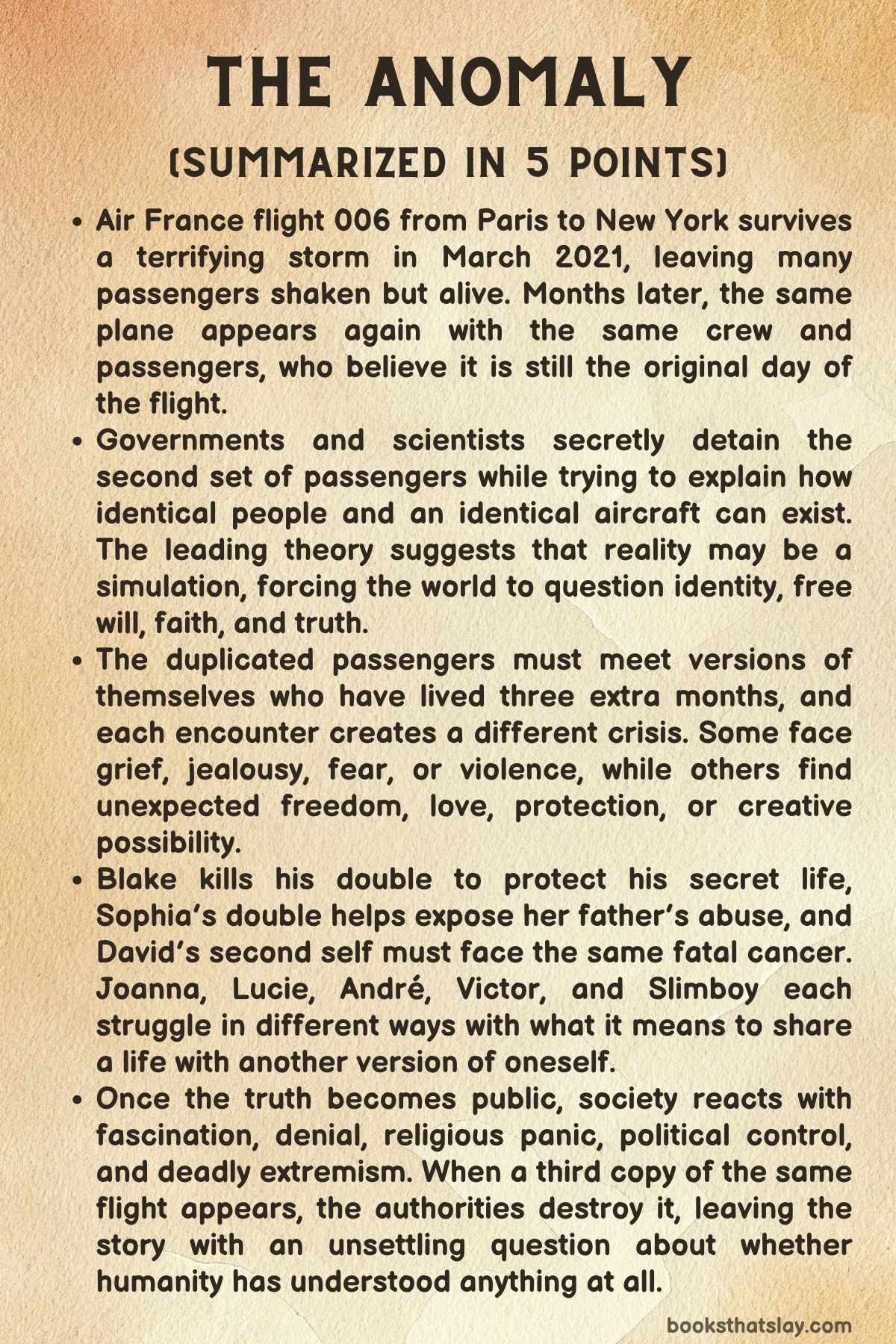
The Anomaly by Hervé Le Tellier is a speculative literary novel about identity, fate, free will, and the limits of human reason. It begins with an Air France flight from Paris to New York that survives terrifying turbulence, only for the same plane, with the same passengers and crew, to appear again months later.
The event forces governments, scientists, religious leaders, and ordinary people to confront a reality that may not be real at all. Through linked lives, sharp humor, and philosophical tension, the book asks what makes a person unique when an exact duplicate exists.
Summary
The Anomaly opens by introducing several passengers connected by Air France flight 006 from Paris to New York. Each has a separate life, private conflict, and moral burden before the strange event at the center of the story becomes clear.
Blake, a professional killer, lives under two identities. In one life, he is a cold, efficient hitman who has spent years murdering people for money while covering his tracks with care.
In another, he is Joe, a Paris-based caterer, husband, and father. He treats both lives as separate systems and believes he can control them through discipline and secrecy.
Victor Miesel is a French writer and translator whose literary career has brought him little fame. He is lonely, ironic, and haunted by missed chances, especially the memory of a woman he once met at a translation conference.
During the March flight, the violent turbulence leaves him shaken by a deep feeling that reality has become unstable. After returning to Paris, he writes a strange, philosophical book called The Anomaly and then dies by suicide.
His death changes the reception of the manuscript, and the book becomes a major posthumous success.
Lucie Bogaert, a film editor, is involved with André Vannier, a much older architect. Their relationship begins with attraction and intellectual charm, but it soon becomes strained by André’s neediness and Lucie’s discomfort with his control over her emotional life.
After they travel together on the same March flight, Lucie tries to imagine a new version of herself, even cutting her hair as a sign of change. Yet by June, she ends the relationship.
Her ordinary life with her son Louis is interrupted when the police come to see her.
David Markle, the pilot of the March flight, receives devastating news after returning home: he has stage four pancreatic cancer. His brother Paul, an oncologist, tells him that he is unlikely to survive the year.
David’s personal story becomes one of mortality and repetition, because the later event will force his family to experience his illness and death in a strange doubled form. Sophia Kleffman, a young girl who also traveled on the flight with her mother, lives in a frightening household ruled by her abusive father, Clark.
Her intelligence and love for her frog Betty contrast sharply with the danger she faces at home.
Joanna Wasserman is a brilliant lawyer defending a pharmaceutical company in a harmful insecticide case. She knows the moral cost of the work, especially because many victims are women of color, but she also needs money to help save her ill sister.
The turbulence on the March flight made her realize how short life can be, leading her to marry Aby and become pregnant. Slimboy, a Nigerian pop star whose real name is Femi Ahmed Kaduna, is also connected to the flight.
He has become famous through his song “Yaba Girls,” but he hides parts of himself because of homophobia in Nigeria and the memory of his murdered lover, Tom.
The key event begins when Air France 006 encounters an extreme storm on March 10, 2021. Captain David Markle struggles to keep the aircraft under control as the plane drops, hail batters the windows, and the passengers believe they may die.
The plane eventually emerges into clear sky and lands safely in New York. At first, this appears to be only a terrifying flight experience.
But on June 24, 2021, the same plane appears again, with the same crew, the same passengers, and no awareness that any time has passed. To them, it is still March 10.
The United States military intercepts the second plane and forces it to land at McGuire Air Force Base. The situation activates Protocol 42, an emergency plan designed years earlier by mathematicians Adrian Miller and Tina Wang.
The plan had originally been created as an almost absurd response to an impossible event. Now the impossible has happened.
The authorities discover that the June plane and its passengers are identical to the March versions, except that the March passengers have lived 106 more days. Two people from the first flight have already died, one woman has given birth, and many lives have changed.
The passengers from the June flight are detained in a hangar, interviewed, studied, and kept from contacting the outside world. Scientists examine the passengers’ DNA and the two aircraft.
Everything points to perfect duplication. Adrian, Tina, and other experts consider several explanations.
A wormhole might explain movement through time or space, but it does not explain duplication. A futuristic copying device might explain the second plane, but there is no evidence of such technology.
The most convincing explanation becomes the simulation hypothesis: reality may be a computer simulation, and the duplicated plane may be a flaw, experiment, or test within it.
As the authorities try to control the situation, Blake escapes from the hangar before his identity is known. He learns that another version of himself is living his Paris life.
Because his existence depends on secrecy, he sees no room for two versions of himself. He later captures and kills his double, taking back control of his accounts and identities.
Blake’s response is the darkest and most practical: duplication is not a philosophical problem for him, but a threat to be eliminated.
The public eventually learns about the duplicated plane. Governments make announcements, scientists explain the simulation theory, and religious leaders debate whether the duplicated passengers have souls.
The world reacts with fear, fascination, denial, humor, and violence. Some people accept the doubles as human beings; others view them as signs of the end times or as unnatural beings.
The duplicated passengers are forced to meet their earlier selves, and each encounter exposes a different kind of emotional crisis.
The two Andrés meet and respond with a mix of embarrassment, strategy, and self-criticism. André March has already lost Lucie and sees how pathetic his younger double looks when he watches her.
André June hopes to avoid the same mistakes. The two Lucies, however, clash over motherhood, property, identity, work, and private history.
Their son Louis handles the situation better than the adults, using a dice system to decide which mother he will spend time with so he does not carry the emotional weight of choosing.
Sophia’s meeting with her double brings hidden abuse into the open. The two girls recognize that both have been harmed by their father, and their conversation gives authorities the evidence needed to protect them.
For Sophia, duplication becomes a path to rescue, because one version of herself can say what the other has been forced to hide. Slimboy and his double react with joy rather than fear.
They recognize each other through shared memory and grief, then decide to use their doubled existence creatively by presenting themselves as twins and performing together as SlimMen.
David Markle’s situation is crueler. His June self learns that he has the same cancer as his March self, only at an earlier point.
His wife Jody must face the pain of losing him twice. Joanna’s meeting with her double creates emotional and legal confusion.
Joanna March is married to Aby and pregnant, while Joanna June has not lived those three months. Both women love the same man and share the same past, but only one has the marriage and child.
Joanna June eventually chooses to leave, take a new name, and build a separate life with the FBI.
Victor Miesel’s double has one of the most unusual positions. Victor March wrote the famous book and died, but Victor June is alive and does not feel connected to the work.
He attends a press conference, jokes with reporters, rejects the idea that he is the same person as the dead author in any simple way, and meets Anne Vasseur, the woman he had long remembered from the translation conference. This gives him a second chance at love and creative life.
The social reaction grows darker when Adriana Becker, a young actress from the flight, appears with her double on television. Their appearance is meant to humanize the duplicated passengers, but religious extremists protest outside.
One zealot, Jacob Evans, influenced by radical preaching, shoots and kills both Adrianas. Their deaths show that the greatest threat may not be the strange event itself, but the human inability to respond to it with compassion and reason.
In the final movement, the world tries to absorb the impossible. Some passengers enter witness protection.
Others build new lives. The Chinese government is revealed to have hidden a similar duplicated flight earlier, keeping its passengers captive.
Governments erase records and manage the crisis as best they can. Later, a third version of Air France 006 appears from the same storm.
This time, the authorities decide not to let it land. Fighter jets destroy the aircraft, killing everyone aboard before another set of duplicates can enter the world.
The ending follows the surviving characters into altered lives. Victor lives with Anne and writes a new novel based on the events.
David dies again. SlimMen performs in Lagos with Elton John.
Joanna March prepares for motherhood while Joanna June begins again. Sophia and her family live under new arrangements.
Blake remains free. André and Lucie’s doubled lives settle into different paths.
Adrian and Meredith are together. As the third plane is destroyed, reality itself seems to tremble.
Language breaks apart, leaving the reader with uncertainty about whether the world has passed a test, failed it, or merely revealed the fragility of everything people assume to be real.
Characters
Blake
Blake is one of the most unsettling figures in the book because he treats identity as a tool rather than a moral center. He is a murderer who has learned to divide himself into separate roles with frightening precision.
As Blake, he kills efficiently and without remorse; as Joe, he runs a vegetarian catering business, lives in Paris, and maintains the surface of a family life. His ability to move between these identities shows how little he depends on ordinary emotional ties.
The duplication crisis does not create his split self; it only exposes the logic he has always lived by. When he discovers that another version of himself exists, he reacts with the same cold practicality he brings to murder.
For him, two selves cannot share one life because his entire survival depends on secrecy, money, and control. His decision to kill his double is not presented as a breakdown but as a continuation of his nature.
In The Anomaly, Blake represents the person who responds to metaphysical terror by reducing it to a logistical problem.
Victor Miesel
Victor Miesel is a lonely, intelligent, self-mocking writer whose life is shaped by failure, longing, and a strange relationship with meaning. Before the duplication event becomes public, he is known mostly as a translator and unsuccessful novelist.
His red Lego brick reveals how deeply he holds onto memory, even when memory itself has become unstable or secondhand. The March version of Victor reacts to the turbulence by writing a philosophical work and then ending his life, turning him into a posthumous literary celebrity.
The June version, however, complicates that fame because he has not written the book and does not feel fully responsible for it. His return forces readers to question whether a person can own the acts of a self who is biologically identical but experientially different.
Victor’s humor protects him from despair, but it also lets him resist false seriousness. His eventual connection with Anne Vasseur gives him a second chance, not as a miracle in a sentimental sense, but as an accident he chooses to accept.
Lucie Bogaert
Lucie Bogaert is defined by independence, restlessness, and a guarded approach to intimacy. She is a film editor, which is important because her work involves cutting, arranging, and reshaping reality into emotional meaning.
In her personal life, however, she finds it harder to edit cleanly. Her relationship with André begins with attraction, admiration, and curiosity, but his intensity soon becomes oppressive.
Lucie wants freedom, yet she also wants to be seen and desired without being trapped. The existence of her double forces her into conflict not only with another person but with another version of her own habits, secrets, and flaws.
When the two Lucies fight over Louis, their home, their work, and their belongings, the conflict becomes a practical version of a philosophical question: what belongs to a person when two people have equal claim to the same life? Lucie is not made simpler by motherhood or romance.
She is complex, sharp, sometimes unfair, and deeply human in her resistance to being possessed by anyone.
André Vannier
André Vannier is a successful architect whose confidence in professional spaces hides emotional insecurity. He is older than Lucie, accomplished, socially connected, and accustomed to influence, but his relationship with her reveals a needy and anxious side.
He loves Lucie, yet his love often becomes pressure. He wants closeness so intensely that he damages the very desire he hopes to preserve.
The meeting between the two Andrés is one of the book’s most revealing mirrored encounters because André March can look at André June and see his own mistakes from the outside. Rather than simply competing, the two versions begin to negotiate a division of life and possibility.
André March imagines retirement and reinvention, while André June hopes to do better with Lucie. His character shows how duplication can become a cruel form of self-knowledge.
He is forced to witness his own behavior as another person would see it, and that vision gives him the chance, however limited, to change.
David Markle
David Markle brings mortality into the center of the story. As the pilot of Air France 006, he is responsible for carrying the passengers through the storm, but after the flight his own body becomes the site of disaster.
His pancreatic cancer gives the novel one of its harshest forms of duplication: the June David has not escaped death but has merely arrived earlier in the same fatal path. This makes his story different from characters who gain opportunity through doubling.
David’s second version does not get a clean second chance. Instead, he and his family must face the same grief again, with the added cruelty of knowing what is coming.
His wife Jody’s pain is especially important because it shows that duplication does not simply restore a loved one. A repeated person can also repeat loss.
David is steady, decent, and frightened, and his illness gives the book a grounded emotional weight amid its larger scientific and philosophical questions.
Sophia Kleffman
Sophia Kleffman is one of the most vulnerable and important characters in the book. She is intelligent, observant, and deeply attached to her frog Betty, a small creature whose survival becomes a quiet symbol of endurance.
Sophia lives under the control of her abusive father, Clark, whose violence and authority frighten the family into obedience. The duplication event becomes a form of rescue for her because the meeting between the two Sophias reveals the abuse that had been hidden.
Children in the story often understand the impossible with more flexibility than adults, but Sophia’s situation is not treated lightly or abstractly. Her double gives her a witness who knows exactly what happened, and that shared knowledge breaks the secrecy her father imposed on her.
In The Anomaly, Sophia’s character shows how a repeated self can become proof, support, and protection. Her story is painful, but it also gives one of the clearest examples of the duplicate event producing justice.
Joanna Wasserman
Joanna Wasserman is ambitious, brilliant, morally aware, and emotionally divided. As a Black lawyer in a powerful firm, she understands how race, class, and gender shape the professional world around her.
Her work defending Valdeo places her in an ethically compromised position, especially because the victims of the company’s harmful product are largely vulnerable workers. Yet Joanna is not simply greedy or careerist.
Her decision is tied to her sister Ellen’s medical needs, which makes her ambition inseparable from family duty. The turbulence on the March flight pushes Joanna March toward marriage, pregnancy, and a more urgent embrace of life with Aby.
Joanna June, who has not lived those three months, must face a future that another version of herself has already claimed. Her jealousy, grief, and eventual decision to leave make her one of the clearest examples of identity becoming a legal, emotional, and moral conflict.
She chooses separation not because she feels nothing, but because staying would destroy her.
Aby Wasserman
Aby Wasserman is central to Joanna’s doubled crisis because he becomes the person both versions love. As a cartoonist who has already faced public controversy, he understands conflict, but nothing prepares him for the arrival of two Joannas with equal emotional claim to him.
His tattoo, connected to his father’s Auschwitz number, gives his character a background shaped by inherited memory and survival. Aby’s pain comes from the impossibility of choosing without betraying someone.
When he says he loves one woman, the statement is both true and inadequate, because the world has produced two versions of that woman. His role in the book is not to solve the problem but to reveal its emotional impossibility.
He is loving, overwhelmed, and helpless before a situation in which ordinary ideas of marriage, loyalty, and partnership no longer function.
Slimboy
Slimboy, born Femi Ahmed Kaduna, is a Nigerian musician whose public success hides private grief and fear. His rise to fame through “Yaba Girls” gives him international recognition, but he lives within a social context where being openly gay is dangerous.
The memory of Tom, his teenage lover who was killed, shapes his guilt and his caution. Unlike many characters, Slimboy responds to his double with delight rather than horror.
The two versions recognize each other through shared memory, pain, and creativity, then quickly imagine a future together as performers. Their decision to become SlimMen turns duplication into artistic possibility.
Slimboy’s character connects fame, sexuality, survival, and performance. He has learned to manage public image, but the duplication gives him a strange form of freedom: he no longer has to stand alone.
Adrian Miller
Adrian Miller is a mathematician whose theoretical work becomes unexpectedly real. He once helped create emergency protocols for wildly unlikely events, including Protocol 42, without believing they would ever be used.
When the duplicated plane appears, Adrian is pulled from academic awkwardness into a global crisis. His expertise gives him authority, but he never becomes a simple heroic problem-solver.
He is anxious, funny, intellectually agile, and distracted by his attraction to Meredith. His role is to explain the impossible in terms governments can act on, even when the available explanations are deeply unsatisfying.
Adrian’s openness to probability makes him better suited than many others to face the event, but he is still shaken by the idea that reality might be simulated. In The Anomaly, Adrian represents the limits of rational systems when reality produces an event beyond normal categories.
Meredith Harper
Meredith Harper is a topologist whose intelligence, impatience, and skepticism make her a strong counterpart to Adrian. She dislikes easy answers and resists the simulation theory because of what it does to human dignity, history, and free will.
Her questions are not merely technical; they are emotional and existential. If reality is simulated, then love, memory, suffering, and choice all seem threatened, and Meredith refuses to accept that calmly.
Her developing relationship with Adrian gives warmth to the scientific sections of the story, but she is not included only as a romantic interest. She sharpens the intellectual debate and challenges the tendency to turn terror into neat theory.
Meredith’s anger is part of her clarity. She insists that an explanation is not the same thing as acceptance.
Jamy Pudlowski
Jamy Pudlowski is a PsyOps specialist who handles some of the most delicate social and religious consequences of the duplication event. She is practical, unsentimental, and skilled at managing belief systems she does not personally share.
Her meeting with religious leaders shows her ability to translate a bizarre emergency into terms that institutions can process. She understands that public reaction may be more dangerous than the event itself, especially if people decide the duplicated passengers are soulless or monstrous.
Jamy also plays an important role in Sophia’s case, where her professionalism helps expose abuse and protect the child. She is one of the book’s most effective administrators of crisis, not because she has all the answers, but because she understands human fear, group behavior, and the need for protective action.
Adriana Becker
Adriana Becker, the young actress duplicated by the flight, represents the way media turns disaster into performance. The two Adrianas appear on television and try to use the moment to build their careers, but they also become public symbols of the duplicated passengers’ humanity.
Their appearance is playful, awkward, strategic, and vulnerable. They understand that the world is watching them not just as people but as evidence of a terrifying new reality.
Their murder by Jacob Evans shows how quickly public fascination can turn into violence. Adriana’s role in the story is brief but significant because her death marks a turning point in the public response.
It proves that the duplicates need protection not from science, but from fear given ideological form.
Jacob Evans
Jacob Evans is a minor character in terms of page time, but his actions carry major consequences. He is shaped by religious extremism and the rhetoric of the Army of the Seventh Day, which teaches him to see the duplicated passengers as abominations.
His violence against the two Adrianas shows how dangerous certainty can become when it is joined to fear and dehumanization. Jacob does not understand the full event; he only understands the story he has been given about it.
That makes him frightening in a realistic way. He represents the people who cannot tolerate ambiguity and therefore turn mystery into a target.
Through him, the book shows that metaphysical uncertainty can create social violence when leaders exploit panic.
Themes
Identity Without Singularity
Identity in the story is no longer based on the comforting idea that each person is singular and unrepeatable. The duplicated passengers have the same memories, bodies, habits, and emotional histories up to the point of the storm, yet they become different people the moment their timelines separate.
This creates a crisis that is practical before it is philosophical. Who owns the apartment, the marriage, the job, the child, the bank account, the grief, or the guilt?
The book refuses to treat identity as only a soul, only a body, or only a set of memories. Instead, it shows that identity depends on continuity, recognition, legal status, relationships, and choices made after separation.
Victor June is not simply Victor March restored, because he did not write the famous book or choose death. Joanna June is not merely a spare Joanna, because her pain and desire are real.
The duplicates force everyone to see that personhood is not a fixed object but a claim made through time, memory, and social acknowledgment. The Anomaly makes identity feel fragile because it removes the one thing people assume can never be taken away: the fact of being the only version of oneself.
Free Will Under a Questioned Reality
The simulation theory threatens the characters because it attacks their belief that their choices belong to them. If the world is programmed, then every act of love, violence, ambition, regret, and sacrifice may be part of a design written elsewhere.
Yet the book does not allow this idea to erase responsibility. Blake still chooses murder.
Joanna June still chooses to leave. Slimboy still chooses to sing with his double.
André June still tries to avoid the mistakes of André March. The uncertainty about reality does not make action meaningless; it makes action more urgent because meaning can no longer be borrowed from certainty.
Characters continue to desire, fear, plan, and change even when they cannot prove that the universe is real in the way they once believed. This is one of the story’s strongest philosophical tensions.
If humans are simulated, they still suffer as humans. If their freedom is limited, they still experience decision as decision.
The book suggests that free will may not require absolute proof of metaphysical independence. It may exist in the space where people respond to what they know, what they fear, and what they choose to become after the impossible happens.
Public Fear and the Failure of Meaning
The duplicated plane creates a vacuum that society rushes to fill with explanations. Governments frame it as a security crisis.
Scientists frame it as a theoretical problem. Religious authorities debate souls.
Conspiracy theorists turn it into proof of their existing fears. Media outlets turn the passengers into spectacle.
The public response reveals that people often prefer a bad explanation to no explanation at all. The event is so large that it should humble everyone, yet many characters and institutions quickly reduce it to familiar categories: threat, miracle, hoax, punishment, opportunity, entertainment.
This theme becomes darkest in the murder of the two Adrianas. They try to present themselves as human, funny, frightened, and ordinary, but Jacob Evans sees only the label imposed on them by extremists.
The book shows that the need for meaning can become dangerous when it hardens too quickly. Instead of accepting uncertainty, people search for narratives that protect their old beliefs.
The real crisis is not only that reality may be artificial; it is that human beings may be unable to face reality without reshaping it into something smaller, simpler, and more violent.
Second Chances and Repeated Loss
Duplication looks at first like the ultimate second chance, but the book repeatedly shows that a second version of a person does not erase pain. David’s story is the clearest example: his June self arrives with more time than his March self, but not enough to escape death.
Jody does not receive her husband back in any simple sense; she is asked to mourn him twice. For Victor, the second chance is more generous because his June self survives and finds Anne, yet even this gift is complicated by the fame and death of the version who wrote the book.
Sophia’s doubled existence helps reveal abuse and opens a path to protection, while Joanna’s creates a painful separation from the man and future her other self has already claimed. The theme works because the book treats repetition as unstable.
A repeated life can heal, expose, mock, or injure. It can offer justice to one person and renewed grief to another.
The characters learn that a second chance is not a return to the past. It is a new branch of consequence, carrying the same memories but not the same future.