Read Between the Lies Summary, Characters and Themes
Read Between the Lies by Jesse Q. Sutanto is a sharp psychological suspense novel about memory, envy, online fame, and the stories people tell to survive their own guilt. The book follows Fern Huang, an aspiring author whose long-buried trauma resurfaces when her former school bully, Haven Lee, enters the same debut-author circle and becomes a publishing sensation.
What begins as professional jealousy soon becomes a dangerous reckoning with the past, especially the death of their classmate Dani Wilder. The novel examines how victimhood, ambition, social media, and unresolved blame can distort truth until no one is fully innocent.
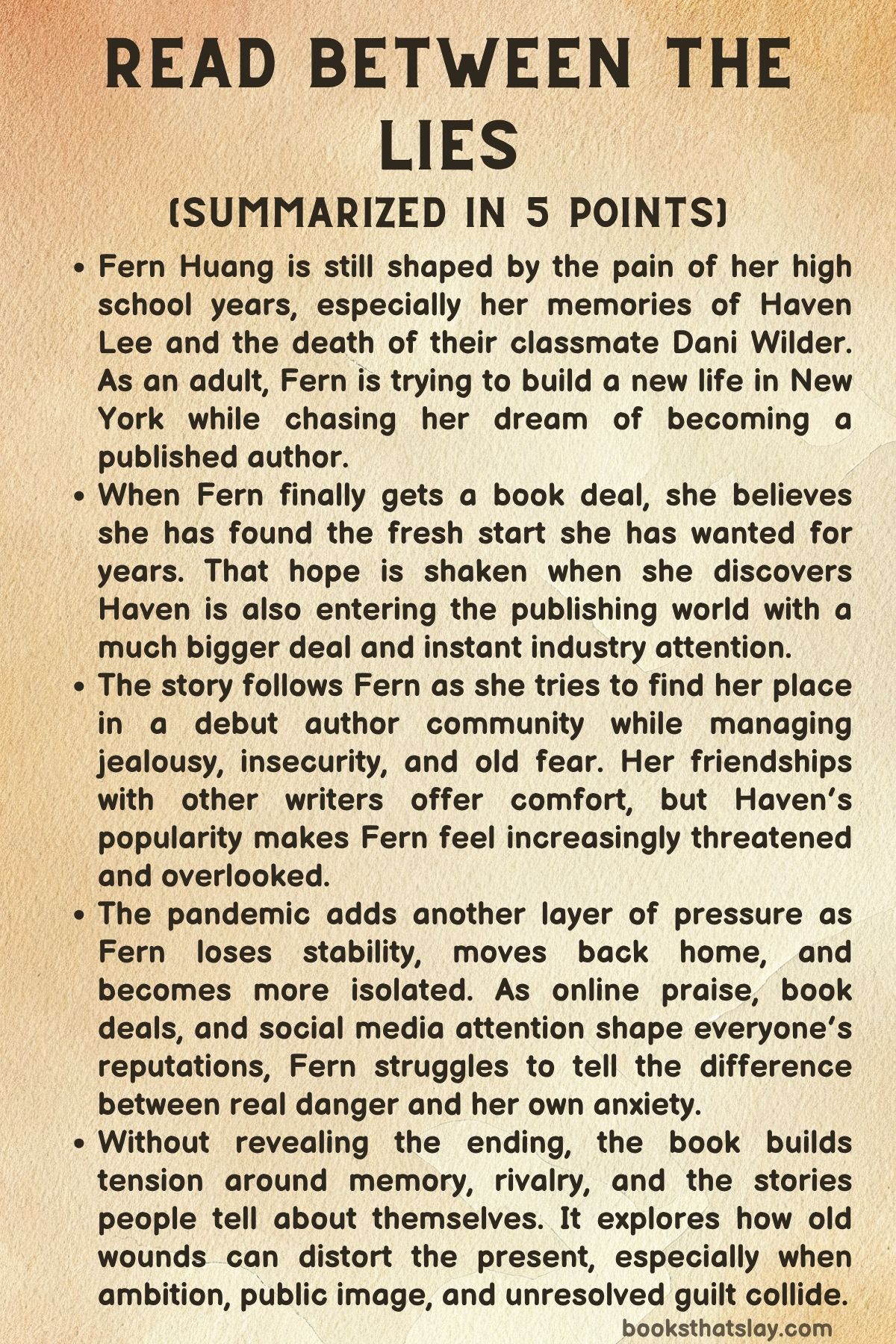
Summary
Fern Huang is pulled out of precalculus with Haven Lee after their classmate Danielle “Dani” Wilder is found dead. Fern is devastated and tells the police that Dani was her best friend.
The officers ask whether Dani had been depressed, but Fern is convinced Haven had something to do with what happened. She believes Haven’s cruelty pushed Dani toward disaster, yet fear keeps her from saying what she really thinks.
That silence becomes one of the central shadows over Fern’s life.
Years later, Fern is living in New York and still carries the damage of her school years. Haven has become everything Fern resents: confident, adored, successful, and surrounded by a happy family.
She is a popular food influencer with a huge audience, while Fern works as a badly paid assistant to Annette, a demanding prewedding photographer. Fern’s real dream is to become an author.
Her agent, Poppy, is submitting her novel, The Happiest of Unhappy Days, to publishers, and Fern hopes that publication will finally give her a place where she belongs.
The story looks back at Fern’s teenage years and shows why Haven occupies so much space in her mind. Haven repeatedly humiliates and threatens her.
At a bake sale, Fern makes apple maple cinnamon rolls, but Haven ruins them and twists the situation so Dani thinks Fern was the aggressor. Later, Fern starts a baking club after being rejected by other clubs, only for Haven to sabotage her ingredients and make her cupcakes taste salty.
Haven warns her not to try again. By prom, Fern is so frightened that she stays outside in her car, watching from a distance, until Haven appears at the window and silently threatens her.
Fern comes to believe Haven destroyed her friendships, her confidence, her activities, and her bond with Dani.
Fern’s present-day life brightens when Poppy calls with news: Harvest Press has offered her a two-book deal. The advance is not large, but Fern is thrilled.
She signs the contract, hints about the news online, gains followers, and joins a private Facebook group for writers debuting in 2020. In the group, she befriends Jenna Duncan and Lisa Garcia.
They exchange manuscripts, encourage each other, and bond over the strange excitement and fear of becoming published authors. Fern feels, for the first time in years, that she has found people who understand her.
That happiness collapses when her deal announcement goes public and she discovers Haven is also publishing a debut novel in fall 2020. Haven’s book, She Asked for It, has sold after a huge nine-house auction for seven figures, with foreign deals and film rights attached.
Fern is stunned and humiliated by the difference between their publishing journeys. Her own deal suddenly feels small.
She searches Haven online and finds that Haven has blocked her on Twitter but is already connected to writers Fern knows. Soon Haven is welcomed into the same debut group, praised by others as kind and generous.
Fern tells Lisa and Jenna that Haven bullied her in school, and they initially support her. The debut group moves from Facebook to Slack, where Haven quickly becomes popular.
Fern tries to stay active, but every channel feels like a place where Haven might outshine her again. Meanwhile, Fern’s editor, Lindsay, sends extensive revision notes.
Fern panics and doubts herself, but after speaking with Lindsay, she accepts the direction and rewrites much of her manuscript. The revision eventually earns praise, giving Fern a brief sense of progress.
As 2020 arrives, Fern tries to coexist with Haven online. She reads Haven’s manuscript and is upset to realize it is genuinely good.
Hoping to improve her own chances, Fern hires an independent publicist. Then COVID-19 begins spreading.
At first, Fern treats the news as distant, but the pandemic soon disrupts publishing events, book launches, and her work with Annette. After Fern accidentally emails clients to confirm a shoot when one client’s father has died of COVID, Annette fires her.
Alone in lockdown, Fern tries to stay useful by creating a culinary Slack channel for the debut group and baking elaborate pastries, but her confidence keeps eroding. She worries that her second book is terrible and leans on Lisa and Jenna for support.
During the pandemic, Fern becomes more anxious and suspicious. When Lisa accidentally posts in the wrong Slack channel that she is absorbed in Haven’s manuscript rather than Fern’s, Fern realizes Lisa and Jenna have been speaking privately.
She fears they prefer Haven and are leaving her behind. The story also returns to Fern and Dani at twelve, when they were inseparable.
Dani worried a new girl might replace her, and Fern promised they would always be best friends. That memory makes Dani’s later closeness with Haven feel even more painful.
Unable to afford New York rent, Fern moves back into her parents’ cold, emotionally distant house in California. Her life feels small and airless compared with Haven’s online world, where Haven posts about her affectionate family and growing success.
Fern watches Haven’s Instagram following rise quickly while her own grows slowly. Haven praises another author, Yuna, in a way that draws more attention than Fern’s attempts at support.
Fern feels shut out again when Lisa and Jenna talk about parenting in the Slack group, and her jealousy worsens when Haven announces that She Asked for It has been chosen by Good Morning America’s book club.
Fern begins rereading Haven’s old posts and interpreting everything as smug and malicious. She admits to Lisa and Jenna that she is jealous, but Lisa tells her Haven has moved home because her father has COVID and is seriously ill.
Fern is shocked that Haven confided in Lisa. Instead of feeling sympathy, she suspects Haven is manipulating people.
When Lisa says Haven had praised Fern’s photography career, Fern convinces herself that Haven may have caused the complaints that got her fired. In Fern’s mind, Haven is once again entering every part of her life and stealing every relationship.
Another flashback reveals that Fern was not only a victim. When Dani and Haven began spending time together as children, Fern felt abandoned.
She baked cookies and secretly put laxatives in one meant for Haven. Haven became sick, realized what Fern had done, and called her evil.
From then on, the hostility between them had roots on both sides, though Fern has spent years remembering herself mainly as the wounded one.
In the present, Fern drives to Haven’s house at night, determined to prove Haven is lying about her father’s illness. She sees Mr. Lee through a window and realizes he really is sick.
Instead of leaving, Fern becomes angry that Haven was telling the truth. She rips out cables from the house, cutting the power, then flees.
The next day she learns Mr. Lee is diabetic and that his insulin needed refrigeration. Strangers help the Lee family with temporary housing and repairs, but Fern is horrified by what she caused.
To repair the damage without confessing, she organizes a group gift: a large card, a secondhand espresso machine, and homemade sourdough baked goods. She delivers the package to Haven’s house, lies awkwardly that her own mother had COVID, and leaves feeling relieved.
That relief vanishes when Fern later sees Haven throw all the baked goods into the trash. Hurt and furious, Fern tells Lisa and Jenna and sends photos.
They spread the story, and Felicity confronts Haven publicly in Slack. The group turns against Haven, and Fern feels protected by collective outrage.
For a moment, she has the support she wanted, and Haven becomes the villain in the eyes of their peers.
The truth about Dani’s death is darker than Fern’s version. In senior year, Fern’s baking presentation is sabotaged when embarrassing material appears, and Fern believes Haven is responsible.
Dani tries to intervene between Fern and Haven, but the confrontation escalates near a cliff. Fern and Haven fight physically, and during the chaos, Dani falls to her death.
Haven threatens to blame Fern, and both girls agree to hide their involvement. Haven later suggests to police that Dani may have killed herself, allowing the truth to disappear beneath fear, blame, and silence.
In the present, Haven comes to Fern’s house with security footage proving Fern damaged the cables. She posts the evidence online, and Book Twitter turns against Fern.
Fern fights back by writing a viral op-ed about how a bullied person can be made into the “bad guy.” The piece gains attention, and Haven’s former agent, Rachel, offers to represent Fern. Fern sells a nonfiction book based on her story, turning scandal into opportunity.
Then Haven dies. Fern fears she has played a role in another death, but her publishing team continues to support her career.
Six months later, Fern’s book reaches number two on the New York Times list, while Haven’s posthumous novel sits at number one. At Dani’s grave, Fern finally faces the truth that she helped build the silence around Dani’s death.
She recognizes that her story of being only a victim was incomplete. The novel ends with Fern deciding to go to the police at last, suggesting that the truth may finally matter more than winning the narrative.
Characters
Fern Huang
Fern Huang is the central figure of Read Between the Lies, and her character is built around pain, resentment, ambition, insecurity, and a deeply damaged sense of justice. She begins as someone who sees herself as a victim of Haven Lee’s cruelty, and much of her emotional life is shaped by the belief that Haven destroyed her friendships, confidence, opportunities, and sense of safety.
Fern’s memories of school are filled with humiliation and fear, especially around baking, social rejection, prom, and Dani’s death. These experiences make her sympathetic at first because she appears isolated, traumatized, and trapped in a past that nobody else fully understands.
However, Fern becomes more complicated as the book reveals that her victimhood is not the whole truth. Her pain is real, but so are her cruelty, obsession, jealousy, and capacity for harm.
She is desperate to be seen as talented and deserving, especially in the publishing world, and Haven’s success feels to her like another version of their old school dynamic. Fern cannot separate professional disappointment from personal betrayal.
Haven’s larger advance, stronger online following, popular manuscript, book club selection, and warm public image all intensify Fern’s belief that life keeps rewarding the person who hurt her.
Fern’s relationship with storytelling is especially important. She wants to become an author, but she also constantly reshapes reality into a story where she is the wronged person and Haven is the villain.
This makes her unreliable, not necessarily because she lies about everything, but because she interprets events through fear and resentment. When Haven’s father is actually sick, Fern is angry not because Haven lied, but because Haven told the truth and Fern’s imagined version of her collapses.
That reaction shows how deeply Fern needs Haven to remain monstrous in order to justify her own anger.
By the end of the book, Fern is one of the most morally complex characters because she is both wounded and dangerous. She has been harmed, but she also harms others.
She wants justice, but often seeks revenge. She wants friendship, but manipulates sympathy.
Her final decision to go to the police suggests a possible movement toward accountability, but it does not erase the damage she has caused. Fern represents how trauma, when left unexamined, can become identity, obsession, and even violence.
Haven Lee
Haven Lee is Fern’s rival, former schoolmate, and the character around whom much of Fern’s fear and resentment revolves. In Fern’s memory, Haven is cruel, calculating, socially powerful, and almost supernaturally skilled at turning people against her.
As a teenager, Haven appears to sabotage Fern’s baking, threaten her, steal Dani’s friendship, and create an atmosphere where Fern feels trapped and powerless. This version of Haven is intimidating because she seems to understand exactly how to hurt Fern while still appearing innocent to others.
In the adult timeline, Haven becomes even more threatening to Fern because she appears to have everything Fern wants. She is successful, beloved online, supported by a warm family, and celebrated by the publishing world.
Her debut novel receives enormous attention, while Fern’s deal is comparatively modest. Haven’s public kindness and popularity make Fern feel as though the world has once again chosen Haven over her.
This makes Haven a symbol of unfairness in Fern’s mind: the person Fern believes ruined her life is now being rewarded with fame, money, admiration, and literary success.
Yet Haven is not simply a villain. As the story develops, she becomes more human and vulnerable.
Her father’s illness reveals a private struggle that Fern initially refuses to believe. Her decision to throw away Fern’s baked goods may seem cruel, but it is also understandable once the reader knows their history, especially the earlier incident in which Fern secretly gave her laxatives.
Haven’s fear of Fern is not imaginary. Like Fern, she carries the past with her, and her actions are shaped by old wounds and distrust.
Haven’s greatest complexity lies in her connection to Dani’s death. She is involved in the confrontation, helps conceal the truth, and allows the police to believe Dani may have died by suicide.
This makes her morally compromised, even if she is not the only guilty person. Haven’s later death makes her both a victim and an unresolved presence in the story.
She remains powerful even after death because her novel, reputation, and memory continue to compete with Fern’s version of events. In Read Between the Lies, Haven functions as both antagonist and mirror: she reflects Fern’s fear, envy, guilt, and refusal to fully face the past.
Danielle “Dani” Wilder
Dani Wilder is the emotional center of the tragedy in the book, even though she is dead for most of the story. Her death shapes the lives of Fern and Haven and becomes the hidden wound beneath their rivalry.
At the beginning, Dani is presented as Fern’s best friend, someone Fern loves deeply and believes was taken from her by Haven. Because Dani is gone, she exists partly through memory, grief, guilt, and competing interpretations.
This makes her less active in the present timeline, but extremely important to the emotional structure of the novel.
Dani’s friendship with Fern is shown as intense and important, especially when they are young. Fern sees Dani as her safe person, and Dani’s closeness gives Fern a sense of belonging.
When Haven enters their social world, Fern experiences Dani’s attention to Haven as abandonment. Dani’s fear of being replaced earlier in their friendship becomes ironic, because Fern later feels exactly that kind of replacement.
Dani becomes the person both Fern and Haven are connected through, and her shifting loyalty contributes to the emotional instability between them.
Dani is also important because she complicates Fern’s self-image. Fern wants to believe that Haven alone caused the tragedy, but the truth is much messier.
Dani tries to intervene, and her death occurs during a physical confrontation involving both Fern and Haven. This means Dani is not simply the victim of one person’s cruelty; she is the victim of a toxic triangle of jealousy, fear, rivalry, and silence.
Her death exposes how adolescent cruelty can spiral into irreversible consequences.
Dani’s grave scene near the end gives her character a final symbolic role. She represents the truth that has been buried, not only literally through death but emotionally through denial.
Fern’s decision to go to the police is tied to Dani, suggesting that Dani’s memory finally pushes Fern toward honesty. Dani is therefore more than a lost friend.
She is the moral weight of the story, the person whose death reveals the cost of lies, self-protection, and unresolved guilt.
Lisa Garcia
Lisa Garcia is one of Fern’s debut author friends and initially serves as a source of comfort, validation, and belonging. Fern meets Lisa through the private group for debut authors, and their friendship helps Fern feel that she has finally entered a supportive literary community.
Lisa matters because Fern has spent much of her life feeling excluded, so Lisa’s attention and encouragement give her a sense of emotional security. Through Lisa, Fern briefly believes she has found people who will understand her without judgment.
However, Lisa also becomes part of Fern’s insecurity. When Lisa becomes interested in Haven’s manuscript and forms a private connection with Jenna, Fern feels threatened.
To Fern, this is not simply normal friendship behavior; it feels like another betrayal and another sign that Haven can take people away from her. Lisa’s sympathy toward Haven, especially after Haven’s father becomes ill, deeply unsettles Fern because it challenges Fern’s belief that Haven is purely manipulative.
Lisa becomes a character through whom Fern’s possessiveness and paranoia are revealed.
Lisa is not presented as malicious. She appears caring, social, and responsive to the emotional needs of others.
Her willingness to listen to Haven suggests that she is not completely controlled by Fern’s version of events. At the same time, Lisa can be drawn into group judgment, especially when Fern frames Haven’s actions in a way that encourages others to condemn her.
This makes Lisa a realistic member of an online literary community: supportive and kind, but also vulnerable to partial information and emotional persuasion.
As a character, Lisa shows how friendship can become unstable when filtered through social media, professional competition, and unresolved trauma. She is important not because she drives the central conflict directly, but because Fern’s reactions to her reveal Fern’s fear of being replaced.
Lisa’s role in Read Between the Lies highlights how online intimacy can feel powerful but fragile, especially when people bond quickly around ambition, insecurity, and shared vulnerability.
Jenna Duncan
Jenna Duncan is another debut author friend who becomes part of Fern’s new publishing circle. Like Lisa, Jenna initially represents acceptance and community.
Fern’s friendship with Jenna gives her the feeling that she belongs in the author world, a space where people understand revisions, publishing anxiety, manuscripts, and the emotional chaos of debuting. Jenna helps Fern feel less alone at a moment when her life is changing rapidly.
Jenna’s character also reveals how easily Fern’s sense of belonging can turn into suspicion. When Fern realizes that Jenna and Lisa have been talking privately, she interprets this as exclusion.
For many people, separate conversations between friends would be ordinary, but for Fern it echoes her childhood fear of Dani and Haven forming a bond without her. Jenna therefore becomes part of the repeating pattern in Fern’s life: Fern longs for closeness, then becomes terrified when that closeness is not exclusive.
Jenna appears to be empathetic, but she is also part of the group dynamic that can shift against someone quickly. When Fern presents herself as wounded by Haven, Jenna supports her.
This support comforts Fern, but it also helps create an environment where Haven can be judged by the group before the full truth is understood. Jenna’s role shows how people in a community can become emotionally involved in a conflict without knowing its complete history.
Jenna is significant because she helps demonstrate the social pressure of the debut author world. Writers in the group are not just colleagues; they become emotional witnesses, cheerleaders, competitors, and judges.
Jenna’s friendship with Fern is sincere enough to matter, but it is not strong enough to resolve Fern’s deeper wounds. Instead, Jenna becomes another person onto whom Fern projects her fear of abandonment.
Poppy
Poppy is Fern’s literary agent and represents the professional doorway into Fern’s dream career. She is the person who submits Fern’s novel to publishers and later gives her the news that Harvest Press has offered a two-book deal.
For Fern, Poppy is connected to validation. When Poppy calls with good news, Fern feels that years of loneliness and struggle may finally be turning into success.
Poppy’s role is mainly professional, but she is important because she helps establish Fern’s early hope. Through Poppy, Fern’s dream becomes real.
The book deal gives Fern a reason to imagine herself as someone who has escaped her past and built a future. This makes the later discovery of Haven’s much bigger deal even more painful.
Fern’s success, which should have felt joyful, becomes diminished because she compares it to Haven’s achievement.
Poppy also reflects the practical side of publishing. Fern’s advance is modest, and her career still requires work, revisions, publicity, and emotional endurance.
Poppy’s presence reminds the reader that publishing is not pure glamour; it is uncertain, competitive, and often financially limited. Fern’s expectations of transformation clash with the reality that a book deal does not immediately fix her loneliness, insecurity, or material problems.
As a character, Poppy is not emotionally central in the way Lisa, Jenna, Haven, or Dani are, but she is structurally important. She helps Fern enter the world where the adult conflict with Haven unfolds.
Poppy represents possibility, but also the gap between Fern’s fantasy of literary success and the harsher reality of being a debut author.
Annette
Annette is Fern’s demanding employer in New York and works as a prewedding photographer. She represents the exhausting, underpaid, and unstable side of Fern’s adult life before her writing career begins to look promising.
Fern’s work for Annette is not fulfilling; it is a job that emphasizes her lack of control, low status, and frustration. Through Annette, the book shows that Fern’s adult life is already full of pressure before Haven reappears in the publishing world.
Annette’s character is important because she contributes to Fern’s sense of failure. Fern dreams of becoming a published author, but her daily reality involves serving someone else’s career and dealing with a boss who is difficult and demanding.
This contrast makes Fern’s publishing deal feel even more significant. It appears to offer escape from a life where she feels undervalued.
When Annette fires Fern after the mistaken client email during the pandemic, the event worsens Fern’s isolation and instability. Fern suspects Haven may somehow be connected to complaints about her photography job, which shows how Fern’s fear of Haven spreads into every part of her life.
Whether or not that suspicion is reasonable, Annette’s decision becomes another moment Fern folds into her larger belief that she is being targeted and undermined.
Annette is not deeply explored emotionally, but she functions as a pressure point. She makes Fern’s life feel precarious and helps explain why Fern becomes so dependent on publishing, online approval, and her debut author friendships for self-worth.
Annette’s presence also shows how quickly Fern’s life can unravel when professional, financial, and emotional stress collide.
Lindsay
Lindsay is Fern’s editor at Harvest Press, and she represents the demanding but constructive side of the publishing process. When Lindsay sends extensive revision notes, Fern initially spirals because she interprets criticism as failure.
This reaction reveals Fern’s insecurity as a writer and her fear that success can be taken away at any moment. Fern does not simply see revision as part of writing; she experiences it as a judgment on her worth.
Lindsay’s role becomes more positive as Fern adjusts to the revision process. After a call with her, Fern accepts the editorial direction, rewrites much of the manuscript, and eventually receives praise.
This shows that Fern is capable of discipline, growth, and creative resilience. Despite her emotional volatility, she has real ambition and talent.
Lindsay helps bring out Fern’s professional side, the part of her that can work hard and improve.
As a character, Lindsay also highlights the difference between useful criticism and emotional attack. Fern has difficulty telling the difference because of her history with humiliation and rejection.
Lindsay’s notes are not cruelty; they are part of making the book better. Fern’s eventual success with revision suggests that not every challenge in her life is sabotage, even though she often fears it is.
Lindsay is important because she grounds the publishing storyline in craft and labor. She is not part of Fern’s personal drama with Haven, but her editorial relationship with Fern shows that Fern’s author identity is not entirely built on victimhood.
Fern can write, revise, and earn praise, but her inability to separate professional growth from personal insecurity keeps threatening her progress.
Rachel
Rachel is Haven’s former agent who later offers to represent Fern after Fern writes her viral op-ed. Rachel’s role is morally interesting because she appears at a moment when Fern’s public narrative is gaining power.
Instead of being ruined by the backlash against Haven, Fern is able to transform the situation into a new publishing opportunity. Rachel’s interest in Fern shows how the publishing world can reward compelling personal narratives, even when those narratives are incomplete or ethically complicated.
Rachel represents ambition and industry opportunism. Her offer suggests that Fern’s story has market value, especially once Fern becomes publicly associated with bullying, victimhood, and controversy.
Rachel may see Fern as courageous, but she also sees a book that can sell. This makes her character important to the novel’s critique of publishing and social media, where trauma can become content and moral conflict can become a brand.
Rachel’s move from Haven to Fern also symbolically reverses the rivalry. Haven once seemed to have the better career, stronger support, and brighter future.
Rachel’s offer gives Fern the sense that she has finally gained power. However, this victory is unsettling because it is built on public outrage and a version of events that avoids Fern’s full responsibility.
Rachel is not portrayed as emotionally intimate with Fern, but she matters because she helps Fern convert private history into public success. Her presence raises uncomfortable questions about who benefits when painful stories are packaged for an audience.
Rachel shows that the industry around Fern is not neutral; it can amplify partial truths when those truths are profitable.
Felicity
Felicity is a member of the debut author community who publicly confronts Haven in Slack after Fern shares the story about the discarded baked goods. Her role is brief but revealing.
Felicity becomes the voice of group outrage, turning Fern’s private hurt into a public accusation. Through her, the book shows how quickly online communities can move from support to judgment.
Felicity likely believes she is defending someone who has been mistreated. Her confrontation comes from a desire to hold Haven accountable, but it is based on limited information.
She does not know the full history between Fern and Haven, including the earlier laxative incident or the deeper truth about Dani. This makes Felicity an example of how moral certainty can become dangerous when people act before understanding the whole situation.
Her character also shows the power of public performance in online spaces. By confronting Haven openly, Felicity helps shift the group’s mood.
Other people turn against Haven, and Fern feels supported. Yet that support is unstable because it depends on the version of events Fern has chosen to share.
Felicity’s actions therefore contribute to the escalation of the conflict.
Felicity is significant because she represents the larger crowd that forms around Fern and Haven. She is not one of the main players in the original trauma, but she becomes part of its modern consequences.
Her role shows that secondary witnesses can intensify harm when they respond emotionally to incomplete stories.
Yuna
Yuna is another author figure whose presence matters mainly because of how Fern compares herself to others. When Haven praises Yuna online more successfully than Fern does, Fern feels jealous and diminished.
Yuna herself is not the source of Fern’s pain, but Fern turns even ordinary author interactions into evidence that Haven is better, more liked, and more powerful.
Yuna represents the competitive atmosphere of online publishing. Authors are expected to promote one another, celebrate books, build communities, and appear generous.
But for Fern, these public gestures become measurements of status. Haven’s praise of Yuna gains more attention, which makes Fern feel invisible.
This shows how social media turns kindness into performance and comparison.
Yuna’s character is mostly peripheral, but she helps reveal Fern’s emotional state. Fern is not only jealous of Haven’s book deal; she is jealous of Haven’s ease, influence, and ability to make every interaction look effortless.
Yuna becomes part of the evidence Fern gathers against herself, proof in Fern’s mind that she is always less successful and less loved.
Through Yuna, the story shows that Fern’s rivalry with Haven expands beyond direct conflict. Even neutral people become part of Fern’s internal scoreboard.
Yuna’s role is small, but it deepens the portrayal of Fern’s insecurity in the literary world.
Mr. Lee
Mr. Lee, Haven’s father, is important because his illness exposes one of Fern’s most disturbing moral failures. Fern suspects Haven is exaggerating or lying about his COVID diagnosis, so she drives to Haven’s house to prove it.
When she sees that he truly is sick, Fern does not respond with compassion. Instead, she becomes angry that Haven was telling the truth and damages the house by ripping out cables.
Mr. Lee’s condition makes Fern’s actions more serious. Because he is diabetic and his insulin needs refrigeration, the power outage Fern causes could have had severe consequences.
This moment forces the reader to see Fern’s obsession as dangerous, not merely anxious or wounded. Mr. Lee is an innocent person drawn into Fern and Haven’s conflict, and his vulnerability makes Fern’s revenge especially cruel.
He also humanizes Haven. Until this point, Fern often views Haven as a villainous figure with a perfect life.
Mr. Lee’s illness reveals that Haven’s family is suffering and that her public image does not show everything. Fern struggles to accept this because Haven’s vulnerability conflicts with the version of Haven she needs to believe in.
Mr. Lee’s role is not large, but it is crucial. He represents collateral damage, the harm done to people outside the central rivalry.
His illness turns Fern’s suspicions into action and reveals how far she is willing to go when consumed by jealousy and resentment.
Fern’s Parents
Fern’s parents are emotionally cold figures who help explain Fern’s loneliness and hunger for belonging. When Fern moves back into their house during the pandemic, the home feels sterile rather than comforting.
This environment contrasts sharply with the warmth Fern sees in Haven’s family life online. Fern’s return home is not a healing retreat; it is a humiliating reminder that she feels unsupported and emotionally unseen.
Their coldness contributes to Fern’s need for external validation. Because she does not seem to receive warmth or reassurance from her family, she seeks it from friends, online communities, literary success, and public sympathy.
This makes her especially vulnerable to jealousy when Haven appears to have the love and support Fern lacks. Fern does not merely envy Haven’s career; she envies the emotional world Haven seems to inhabit.
Fern’s parents also deepen the sense that Fern has never had a secure place to land. Her adult failures, including losing her job and being unable to afford rent, send her back into a family space that reinforces shame rather than comfort.
This helps explain why Fern clings so intensely to her author identity and debut group friendships. They become substitutes for the emotional safety she does not find at home.
Although Fern’s parents are not central actors in the plot, they are important to understanding Fern’s emotional formation. Their distance does not excuse Fern’s actions, but it helps explain her desperation to be chosen, believed, praised, and loved.
Fern’s Mother
Fern’s mother is mentioned most directly when Fern lies to Haven by claiming that her own mother had COVID. This lie is significant because Fern uses illness as a tool to smooth over suspicion and make herself appear sympathetic.
The fact that she invents suffering connected to her mother shows how easily Fern can turn personal or family details into part of a performance when she is trying to manage consequences.
As part of Fern’s emotionally cold household, her mother also represents the absence of nurturing comfort in Fern’s life. Fern’s home does not seem to offer the warmth she craves, and this lack shapes how she responds to Haven’s family.
Seeing Haven supported and loved makes Fern feel deprived and resentful. Fern’s mother, therefore, is important less as an individually developed character and more as part of the emotional background that forms Fern’s insecurity.
The lie about her mother also reveals Fern’s instinct for self-protection. After damaging Haven’s house, Fern wants to appear caring by organizing gifts and delivering baked goods, but she also wants to control how Haven sees her.
The invented COVID story becomes another layer of deception. It shows that even Fern’s gestures of apology are tangled with manipulation.
Fern’s mother’s role is small, but it contributes to the larger portrait of Fern as someone who longs for care while struggling to offer honest care to others. The emotional emptiness of Fern’s family life helps explain her neediness, but Fern’s use of her mother in a lie shows how that neediness can become morally compromised.
Themes
The Long Shadow of Bullying
Fern’s adult life is shaped by fear that began in adolescence and never truly ended. Haven is not just remembered as a school bully; she becomes the measure by which Fern judges her own safety, success, friendships, and worth.
Every achievement Haven gains feels to Fern like another act of domination, even when Haven is not directly attacking her. This makes the past feel active in the present, as if Fern is still trapped in the same school corridors, waiting to be humiliated or replaced.
Read Between the Lies shows how bullying can distort memory and identity, especially when the victim has never received justice or closure. Fern’s pain is real, but her inability to separate old wounds from present reality pushes her toward harmful choices.
The theme becomes more complex because Fern is not only wounded; she also wounds others. The story suggests that trauma can explain destructive behavior, but it does not erase responsibility.
Jealousy, Comparison, and the Hunger for Recognition
Fern’s publishing success should bring relief, but it quickly becomes another space where she measures herself against Haven. The two-book deal gives Fern a rare sense of validation, yet Haven’s seven-figure deal, major attention, and public popularity make Fern feel small again.
Social media worsens this comparison because every post, follower count, announcement, and compliment becomes evidence in Fern’s mind that Haven is winning. Fern does not simply want to succeed; she wants success to prove that the world finally sees her correctly.
This hunger makes praise feel temporary and criticism feel devastating. Her friendships with Lisa and Jenna also become part of this competition, as Fern fears Haven will take even emotional support away from her.
The novel presents jealousy as a force that feeds on insecurity. Fern’s envy is not shallow ambition; it comes from years of feeling erased.
Still, it becomes dangerous because she starts treating another person’s happiness as proof of her own failure.
Truth, Memory, and Self-Deception
The story repeatedly questions how much of Fern’s version of events can be trusted. Fern remembers Haven as cruel, manipulative, and dangerous, and many moments support that view.
Yet Fern also hides her own actions, such as drugging Haven with laxatives, damaging the Lee family’s power supply, and helping conceal what happened to Dani. Her narration reveals how people can protect themselves from guilt by arranging memory in a way that makes them the victim in every scene.
This does not mean Fern invented all her suffering; rather, it means pain has shaped how she interprets truth. Haven also participates in silence and distortion, especially after Dani’s death.
Both women carry a shared secret, but each frames it in a way that preserves her own survival. Read Between the Lies uses this uncertainty to show that truth is not only about facts.
It is also about the stories people tell themselves so they can keep living with what they have done.
Guilt, Accountability, and the Cost of Silence
Dani’s death sits at the center of the characters’ lives, even when it is not openly discussed. Fern and Haven both survive by staying silent, but that silence does not free them.
Instead, it grows into suspicion, fear, resentment, and self-protection. Fern’s later actions show how unacknowledged guilt can turn outward, making her desperate to expose Haven while avoiding the full truth about herself.
The tragedy is not only that Dani dies, but that her death is reshaped into a story convenient for the people left behind. Haven’s implication that Dani may have harmed herself adds another layer of cruelty, while Fern’s silence allows that false version to stand.
By the end, Fern’s decision to go to the police suggests a painful move toward accountability. The story does not present confession as an easy cleansing act.
It presents it as the first honest step after years of avoidance, showing that buried guilt continues to harm everyone until truth is finally faced.