Royal Spin by Robin Benway Summary, Characters and Themes
Royal Spin by Omid Scobie and Robin Benway is a contemporary royal workplace romance about reinvention, public image, and private damage. The story follows Lauren Morgan, an American communications professional whose life in Washington, DC has collapsed after betrayal by her boyfriend and best friend.
When she is unexpectedly hired to manage royal communications at Buckingham Palace, she enters a world of old rules, hidden corridors, press battles, and carefully managed scandals. As Lauren tries to rebuild both the monarchy’s reputation and her own confidence, she is pulled into complicated relationships with a charming reporter and a troubled duke.
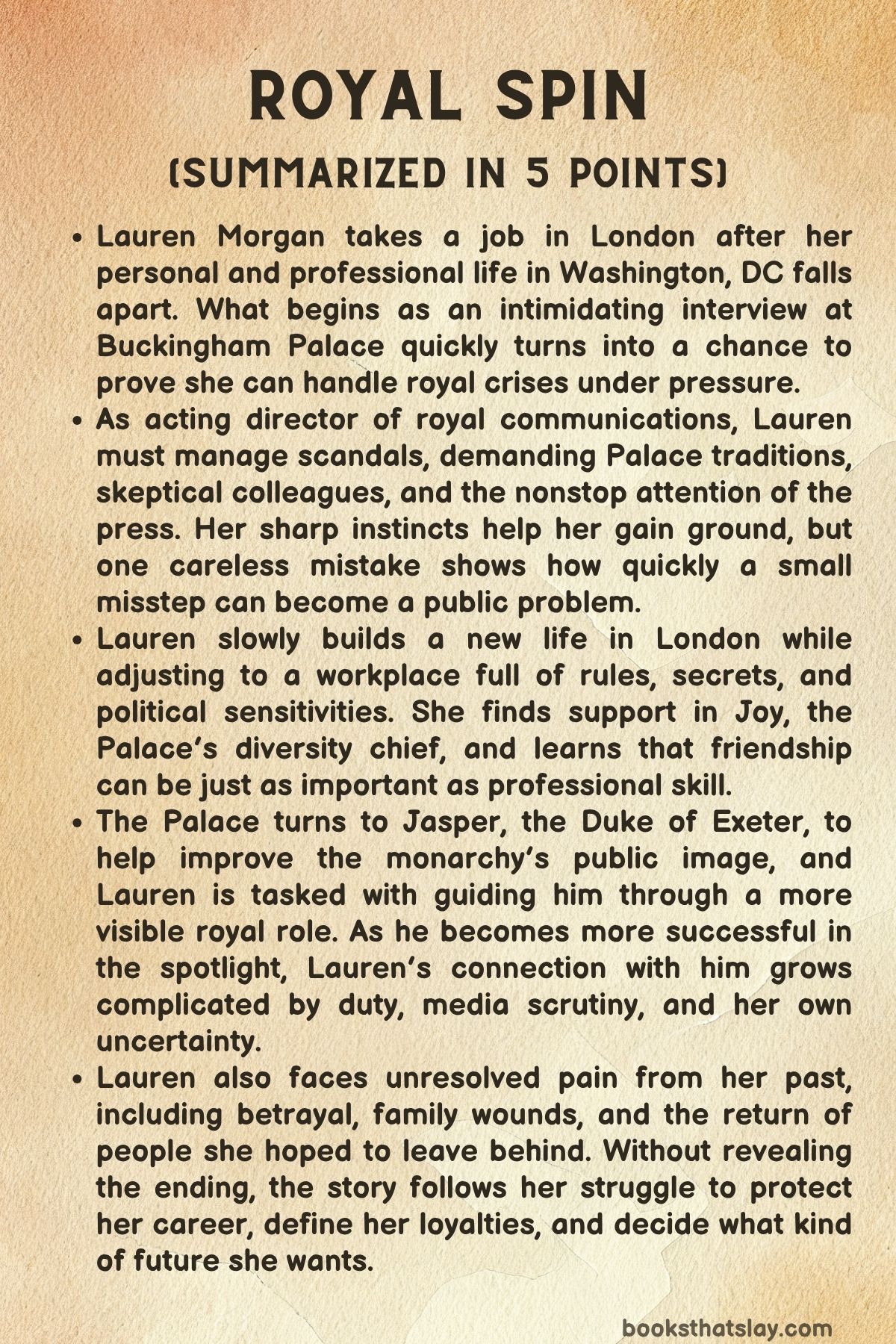
Summary
Lauren Morgan arrives in London exhausted, late, and emotionally bruised. Her career in Washington, DC has stalled after a humiliating personal and professional collapse: her boyfriend Brian has been having an affair with her best friend Brooke, and the fallout has left Lauren unable to continue in her White House role.
Her trip to Buckingham Palace is meant to be an interview for a deputy communications position, but nothing about it feels grand. Instead of a polished royal welcome, she gets a chaotic Uber ride, an awkward arrival through a side entrance, and a tour through the Palace’s practical back corridors.
Inside, Lauren meets James Colleran, chief of staff to the Queen’s principal private secretary, and is brought into the royal communications office. The interview quickly turns into a real crisis.
Amelia Adams, the current director of royal communications, storms in, furious and ready to quit. A scandal has erupted after the Countess of Lancaster displayed an offensive racist vase during a luncheon honoring Caribbean nurses and healthcare workers.
Photos are already headed for the press, and the Palace needs a response immediately.
Asked what she would do, Lauren gives a clear, fast plan. She recommends issuing a statement, removing the countess from public duties, arranging an educational appearance with a senior royal, managing the press directly, and keeping the scandal away from the Queen.
Amelia is impressed enough to declare that Lauren should be hired on the spot, not as deputy but as acting director of communications.
At first, Lauren thinks she cannot accept. London feels foreign, her life is a mess, and the job is far more intense than expected.
But during her ride away from the Palace, she reads a glowing article about Brian’s career that casually includes Brooke and reduces Lauren’s own future to vague “freelance opportunities.” The article makes clear that DC has moved on without her. The Palace crisis, by contrast, made her feel sharp, useful, and needed.
She calls James and accepts.
Lauren begins work almost immediately. She brings doughnuts to the office, tries to learn the Palace’s unwritten rules, and meets Joy Hamilton, the new diversity chief.
Joy’s hiring is partly connected to Lauren’s own criticism of the Palace’s earlier preference for an aristocratic candidate. Joy quickly becomes an ally, especially when Lauren proposes weekly Palace press briefings to regain control of royal coverage before an upcoming US state visit.
Eugene Ainsworth, the Queen’s principal private secretary, resists the idea, but James supports Lauren enough to secure her a one-month trial.
Outside work, London proves harder to manage. Lauren rents a pretty Hampstead studio, only to discover too late that it has a shared bathroom.
Her neighbor Una is eccentric but friendly, and their odd domestic arrangement becomes part of Lauren’s new life. At the Palace, Lauren clashes with Eugene, learns strange emergency customs such as keeping black clothes ready in case of tragedy, and encounters a wet, bearded cyclist who bursts through her office.
She later learns that he is Jasper, the Duke of Exeter, the Queen’s nephew, newly returned from New Zealand after a divorce and financial trouble.
Lauren’s first press briefing is tense but successful. Reporters try to provoke her about her White House exit, Brian, Brooke, the Countess, and Jasper’s finances, but she avoids giving them what they want.
Instead, she shifts attention to Joy, who speaks with authority about diversity and institutional change. Afterward, reporter Oscar Mason invites Lauren to lunch.
Their conversation is flirtatious, but he also makes it clear that he is good at uncovering private information. He knows Lauren’s full first name, Bearnas, and presses her about her past.
Lauren soon makes a serious mistake of her own. While trying to manage rumors about the Queen’s health, she texts a tabloid reporter that the Queen has allergies, “not pneumonia.” The phrasing creates exactly the headline she wanted to avoid, feeding fears that the Queen may have pneumonia.
Lauren is called before the intimidating Lord Chamberlain. She survives the meeting through quick thinking, careful flattery, and a lucky conversation about his dog, but the error reminds her how unforgiving royal communications can be.
As polls show younger people losing interest in the monarchy, the Palace decides to use Jasper more visibly as a working royal. Lauren suggests introducing him through a children’s hospital visit.
Jasper is reluctant and embarrassed by the idea of being managed, but the visit is a success. He is gentle with the children, reads to them, comforts them, and looks natural on camera.
Press coverage improves sharply, and Lauren sees that Jasper has real public appeal.
As winter deepens, Lauren’s loneliness grows. Her mother cancels a planned Thanksgiving visit, and Lauren misses the life she used to understand, even though that life betrayed her.
Joy becomes one of her closest friends, Oscar remains both appealing and professionally dangerous, and Jasper’s debts threaten to become a tabloid story. On Christmas Eve, Lauren travels with Palace staff to Balmoral.
Outside the estate, protesters have gathered. Among them, Lauren suddenly recognizes her long-absent father, Callum.
He calls her name, but she turns away and continues toward work.
At Balmoral, Lauren is shaken by Callum’s appearance but keeps doing her job. During the Christmas morning church appearance at Crathie Kirk, Jasper again performs beautifully in public.
He charms the crowd, especially a shy little girl holding flowers, and Lauren becomes even more convinced that he can help the Palace connect with people. Later, she secretly takes a taxi to Aberdeen to confront Callum.
He apologizes for leaving Lauren and her mother, saying he did not know how to return after abandoning them. He asks for a new beginning, but Lauren refuses.
When she later speaks to her mother, her mother explains that she chose not to let Callum’s choices control the rest of her life.
That night, unable to sleep because of Harriet’s loud whale-noise sleep app, Lauren walks around Balmoral and runs into Jasper. He apologizes for being difficult and admits that he is struggling with the royal role being built around him.
Later, Oscar calls because he noticed she seemed upset. Lauren does not tell him the truth about her father, but she enjoys the comfort of talking with him.
Back in London, Lauren pushes for Jasper to receive more important public work before stories about his financial trouble can break. Eugene agrees to add Jasper to a Singapore visit for the Queen’s Pearl Jubilee.
In Singapore, Lauren manages the press and helps Jasper through his nerves. He performs well, wins over the public, and earns positive headlines.
Oscar praises Lauren’s work, but later Lauren meets Jasper in his suite to review the next day’s schedule. Jasper is unsettled by the attention, and he and Lauren speak honestly about lives that have not gone according to plan.
Lauren tells him about Brian and Brooke’s betrayal, and Jasper understands the feeling of losing direction. Their connection turns romantic, and they kiss, but Norman interrupts before anything more happens.
After returning to London, Lauren admits a vague version of the kiss to Una, who correctly guesses that it involved the attractive duke. Lauren is conflicted because she is also drawn to Oscar.
At work, Joy pushes a community outreach project for the Strathearns and faces an offensive remark from Harold Cockburn about Lewisham. Joy challenges him, and Lauren supports her afterward.
When Oscar asks Lauren to dinner, she first teases him about giving proper notice, then later agrees.
Lauren and Oscar go to dinner in Shoreditch, kiss afterward, and end up at his apartment, where they sleep together. Their conversation afterward is unusually open.
Oscar tells her about growing up with dyslexia, and Lauren explains how her breakup and a serious work mistake led to her leaving the White House. The next morning, she tells Joy that the night with Oscar was good.
But Lauren’s unresolved feelings for Jasper become harder to hide. During a Palace event with the Queen and the president of Congo, Lauren and Jasper exchange charged looks.
Joy notices and warns Lauren that involvement with a royal could ruin her if the tabloids discovered it. Lauren admits she kissed Jasper but resents Joy’s warning and snaps at her.
Their friendship suffers.
Soon, Eugene assigns Jasper to a visit in Skipton with the Prince of Strathearn, placing Lauren, Jasper, and Oscar in the same professional space. Oscar brings Lauren coffee, the visit runs smoothly, and Jasper handles the crowd well while Oscar reports on the event.
Then Oscar reveals that the Tribune has video of Lauren’s father protesting at Balmoral and calling her name. Lauren tells James and Eugene, who are furious.
To protect her, Oscar tries to shift the story toward Jasper’s financial problems. Jasper accepts that damage as part of his public role, but Lauren is crushed and fears she has destroyed her career.
During the US state visit, Brian reappears as part of the American communications team and argues with Lauren inside Buckingham Palace. Eugene hears about the incident and summons her for a Monday meeting.
Certain she will be fired, Lauren spends the weekend miserable. She finally goes to Joy and apologizes.
Joy forgives her, reminds her that she belongs in the job, and urges her not to quit before the Palace makes its decision.
At the Monday meeting, Eugene surprises Lauren by apologizing for the way he handled the crisis. James tells her she will stay, though her probation will be extended.
Lauren breaks down with relief. She has not solved every problem, and her personal life remains complicated, but she has survived the first major test of her new life.
In Royal Spin, Lauren’s work at the Palace becomes more than a career rescue. It becomes the place where she begins to rebuild her judgment, her confidence, and her belief that she can still choose the direction of her own story.
Characters
Lauren Morgan
Lauren Morgan is the central character of Royal Spin, and her journey is shaped by professional pressure, public performance, private betrayal, and emotional reinvention. When she arrives in London, she is not entering royal service as a polished outsider with everything under control; she is exhausted, humiliated, displaced, and still wounded by Brian and Brooke’s betrayal.
Her White House career has stalled, her romantic life has collapsed, and her confidence has been badly shaken. This makes her arrival at Buckingham Palace feel less like a glamorous new beginning and more like a last-minute escape from personal failure.
Yet Lauren’s strength emerges precisely because she is at her lowest. When the Palace faces an immediate communications crisis, she responds with clarity, strategy, and instinct.
Her ability to think fast under pressure proves that she is not defined by the collapse of her old life.
Lauren’s character is especially compelling because she is both competent and messy. At work, she is sharp, politically alert, and unafraid to challenge outdated royal habits.
She understands media strategy, public optics, and the importance of controlling a narrative before others define it. Her handling of the Countess of Lancaster scandal shows that she has strong moral instincts as well as professional skill.
She does not treat the racist vase incident as a minor embarrassment to be buried; she recognizes the need for accountability, education, and institutional protection. At the same time, Lauren is not flawless.
Her accidental “pneumonia” text shows how easily one impulsive mistake can become a public-relations disaster. Her personal life is equally complicated, especially as she becomes emotionally drawn to both Oscar and Jasper.
These mistakes do not weaken her as a character; they make her feel human, vulnerable, and believable.
Lauren’s deepest conflict is between control and emotional exposure. Her job requires her to manage other people’s images, anticipate scandals, and protect the monarchy from embarrassment, but her own life keeps breaking through the controlled surface.
Her father’s sudden appearance among the protesters at Balmoral is one of the most revealing moments in the book because it forces Lauren to confront a wound she has tried to keep separate from her professional identity. Callum’s abandonment has shaped her fear of being unwanted, replaced, or left behind, which connects directly to the pain caused by Brian and Brooke.
Her refusal to give Callum an easy reconciliation shows growth. She is not cruel, but she is no longer willing to let someone else’s absence dictate her worth.
By the end of the given events, Lauren has not become perfectly settled, but she has begun to claim a new life. She learns to fight for her job, apologize when she has hurt Joy, accept support, and recognize that she does not have to run from every humiliation.
Her extended probation is significant because it does not give her a neat victory; instead, it gives her the chance to keep proving herself. Lauren’s development lies in her movement from escape to commitment.
London begins as a place to hide from failure, but gradually becomes a place where she can rebuild herself with more honesty, courage, and self-respect.
Jasper, Duke of Exeter
Jasper is one of the most emotionally layered characters in the book because he carries the public glamour of royalty while privately feeling trapped, embarrassed, and uncertain. His first appearance as a wet, bearded man bursting through Lauren’s office with a bicycle immediately undercuts the polished image usually associated with a duke.
He does not arrive as a distant fairytale figure; he arrives as someone chaotic, awkward, and resistant to being packaged for public consumption. His recent return from New Zealand, divorce, and financial trouble all suggest a man whose life has not gone according to plan.
Like Lauren, Jasper is trying to recover from personal disruption while being pushed into a role he did not fully choose.
Jasper’s reluctance to become a working royal makes him interesting because it is not simple arrogance. He is embarrassed by being managed, uncomfortable with sudden attention, and aware that his life is becoming a public tool for Palace survival.
The monarchy needs him because he has charm, youth appeal, and emotional warmth, but Jasper himself does not immediately know how to inhabit that usefulness. His children’s hospital visit reveals his natural gift for connection.
He is gentle with children, responsive to emotion, and far more appealing when he is not trying too hard. His success at the hospital and later at Crathie Kirk shows that his public value comes from sincerity rather than performance alone.
His bond with Lauren develops because both characters understand what it means to have life plans collapse. Their conversation in Singapore is important because it strips away the professional roles surrounding them.
Lauren is not just the communications expert managing him, and Jasper is not just the duke being promoted by the Palace. They are two people dealing with humiliation, loss, and unwanted reinvention.
Their kiss grows out of that mutual recognition. However, the attraction is also dangerous because Jasper’s royal status makes any relationship unequal in public terms.
What might be private for someone else would become scandalous and career-damaging for Lauren.
Jasper’s decision to accept negative coverage about his finances in order to protect Lauren marks a major development in his sense of duty. Earlier, he resents being used by the institution, but in this moment he willingly absorbs damage because the role requires sacrifice.
This does not make the Palace system morally simple, but it shows that Jasper is beginning to understand responsibility differently. He is not merely a reluctant royal or romantic possibility; he is a man learning that public duty can be painful, strategic, and personally costly.
Oscar Mason
Oscar Mason functions as both a romantic interest and a professional complication. As a reporter, he belongs to the world Lauren must manage, influence, and sometimes outmaneuver.
His attraction to her is therefore never simple, because every flirtatious conversation carries the possibility of professional risk. From the beginning, Oscar is charming, observant, and slightly dangerous.
He notices details, presses gently but persistently, and knows how to unsettle Lauren by revealing that he has learned her full first name, Bearnas. This makes him appealing, but it also reminds the reader that he gathers information for a living.
Oscar’s relationship with Lauren is built on wit, tension, and emotional curiosity. Their lunch and later dinner show that he is not only interested in her as a source.
He enjoys her intelligence, her guarded humor, and the way she refuses to be easily impressed. At the same time, his profession means he cannot be separated from the public world that threatens her.
This tension becomes sharper when the Tribune obtains the video of Callum protesting and calling Lauren’s name. Oscar’s choice to warn Lauren shows care, but the situation also exposes the limits of his position.
He may like Lauren, but he still operates inside a media system that profits from exposure.
Oscar’s vulnerability makes him more than a smooth romantic rival to Jasper. His conversation with Lauren after they sleep together, especially when he speaks about childhood dyslexia, reveals a private insecurity beneath his confident reporter persona.
He understands what it means to feel judged or underestimated, which helps explain why he is drawn to Lauren’s combination of competence and damage. Their intimacy is not merely physical; it is also rooted in confession.
Lauren tells him about the breakup and the mistake that helped push her out of the White House, allowing Oscar to see the person beneath her professional armor.
Oscar’s moral complexity lies in the fact that he tries to help Lauren without fully escaping the machinery of journalism. His attempt to redirect the damaging story toward Jasper’s finances is protective, but it also causes harm elsewhere.
He is not villainous, but neither is he neutral. He represents the blurred line between affection and access, truth and exploitation, public interest and private pain.
Through Oscar, the book explores how difficult it is for Lauren to separate desire from danger.
Joy Hamilton
Joy Hamilton is one of the most important stabilizing and challenging figures in Lauren’s new life. As the newly hired diversity chief, she enters the Palace as a sign that the institution may be trying to change, but her presence also reveals how resistant that institution remains.
Joy is professional, principled, and emotionally perceptive. She supports Lauren during her early meetings and becomes one of the first people in London to make Lauren feel less alone.
Their friendship develops through shared pressure: both women are outsiders in different ways, trying to work within an old system that does not always welcome directness or reform.
Joy’s role is especially significant because she brings moral clarity to a workplace often governed by tradition, hierarchy, and image management. During the press briefing, she speaks firmly about institutional diversity, helping Lauren shift the conversation away from defensive spin and toward accountability.
Her work is not decorative; it is necessary. The Palace’s response to the Countess scandal would be incomplete without someone like Joy, who understands that diversity cannot be treated as a public-relations accessory.
She pushes for outreach, inclusion, and meaningful change, even when others prefer polite avoidance.
Her confrontation with Harold Cockburn after his offensive remark about Lewisham shows her strength and the emotional burden she carries. Joy is forced not only to do her job but also to challenge prejudice inside the very institution that hired her to improve its culture.
Lauren’s support after that moment matters because it shows the beginnings of real solidarity between them. However, their friendship is tested when Joy warns Lauren about Jasper.
Joy’s warning is not jealousy or judgment; it comes from a clear understanding of how tabloids, class, race, gender, and royal power can combine to destroy someone like Lauren far more easily than someone like Jasper.
Joy’s forgiveness after Lauren apologizes demonstrates her generosity, but it also shows that their friendship has matured. She does not simply comfort Lauren; she pushes her to fight for her place.
Joy is both friend and truth-teller. She helps Lauren see that survival in London requires more than cleverness.
It requires humility, accountability, and the courage to accept help.
James Colleran
James Colleran is a calm, controlled, and quietly influential figure within the Palace. As chief of staff to the Queen’s principal private secretary, he operates close to power without making himself the center of attention.
His first interactions with Lauren are practical and understated, guiding her through the less glamorous side of Buckingham Palace and into the communications office. This introduction is important because James represents the real machinery behind royal spectacle.
He knows the corridors, routines, pressures, and personalities that keep the institution functioning.
James’s attitude toward Lauren is measured but supportive. He recognizes her talent quickly, especially during the Countess crisis, and later gives her room to prove herself through the weekly press briefings.
Unlike Eugene, who is more resistant and tradition-bound, James seems more willing to test new strategies when they serve the institution. His support is not sentimental; it is professional.
He backs Lauren because she is useful, sharp, and capable of solving problems that the Palace cannot afford to mishandle.
At the same time, James is not simply Lauren’s ally. He belongs to the Palace system, and his loyalty is ultimately to the institution.
This makes his support valuable but conditional. When Lauren’s father becomes a potential scandal, James reacts within the logic of Palace protection.
Yet at the Monday meeting, he confirms that Lauren will stay, which suggests that he sees both her mistake and her value clearly. James’s steadiness provides a contrast to the more volatile personalities around him.
He is not dramatic, but he is essential to the book’s portrayal of how power often works quietly through decisions, permissions, and controlled opportunities.
Eugene Ainsworth
Eugene Ainsworth, the Queen’s principal private secretary, represents the cautious, hierarchical, and tradition-protecting side of the Palace. He is not presented as foolish; in fact, his caution often comes from an understanding of how fragile royal reputation can be.
However, he is resistant to change, especially when Lauren proposes methods that challenge established habits. His discomfort with weekly press briefings shows how wary he is of giving the media regular access, even when Lauren argues that silence allows others to control the narrative.
Eugene’s relationship with Lauren is tense because he must decide whether she is a necessary risk or a liability. He sees her talent, but he also sees her mistakes, her emotional complications, and the potential scandal surrounding her father.
His anger when Oscar reveals the Tribune’s video is not only personal frustration; it is institutional panic. Eugene’s job is to protect the Crown from embarrassment, and Lauren suddenly becomes a possible source of that embarrassment.
This makes him harsh, but not entirely irrational.
What makes Eugene more complex is his eventual apology. After Lauren fears she will be fired, Eugene admits that he mishandled the situation.
This moment softens him without transforming him completely. He remains a Palace operator, but he is capable of recognizing unfairness.
His decision to keep Lauren under extended probation is very much in character: he offers mercy, but within strict limits. Eugene embodies the institution’s slow, guarded movement toward change.
He does not easily trust disruption, but he can be persuaded by competence and necessity.
Amelia Adams
Amelia Adams has a brief but important role because she creates the opening that changes Lauren’s life. As the outgoing director of royal communications, she enters in a state of fury, overwhelmed by the Countess of Lancaster crisis and ready to quit.
Her dramatic resignation shows the pressure of the role Lauren is about to inherit. Royal communications is not glamorous message-crafting; it is crisis management, emotional exhaustion, political sensitivity, and constant risk.
Amelia’s reaction to Lauren is decisive. When Lauren outlines a clear response to the racist vase scandal, Amelia recognizes her ability immediately and declares her hired.
This says something important about Amelia’s own professionalism. Even while angry and leaving the job, she can identify competence when she sees it.
She functions almost like a gatekeeper who, in one chaotic moment, passes responsibility to Lauren. Her exit also warns the reader that the position can consume people.
Lauren is not stepping into a dream job; she is stepping into a furnace.
Una
Una, Lauren’s eccentric neighbor, brings humor, warmth, and domestic texture to Lauren’s London life. Their first connection comes through the shared bathroom, an awkward discovery that punctures Lauren’s hope that her pretty Hampstead studio will be a perfect fresh start.
Una belongs to the everyday world outside Palace corridors, and that makes her important. She reminds the reader that Lauren’s life is not only royal crises, press briefings, and romantic tension.
It is also rent, neighbors, embarrassment, loneliness, and strange late-night conversations.
Una’s eccentricity makes her a source of comic relief, but she is not meaningless. She quickly becomes someone Lauren can speak to more freely than most of her colleagues.
When Lauren confesses a vague version of the kiss with Jasper, Una immediately guesses that it involved the “hot duke,” showing both humor and perception. Una’s presence helps Lauren begin to form a life in London that is not entirely defined by work.
In a story full of image management, Una represents a more informal kind of truth. She sees through Lauren’s evasions without making the moment heavy.
Callum
Callum, Lauren’s long-absent father, is one of the most painful figures in her emotional life. His sudden appearance among protesters outside Balmoral is shocking because it brings together Lauren’s public and private worlds in the worst possible way.
Until then, Callum belongs to the past: the father who left, the wound Lauren carries, the absence she has learned to live around. Seeing him at the edge of a royal event turns that private wound into a potential public scandal.
Callum’s apology in Aberdeen is important, but it does not erase the harm he caused. He explains that he did not know how to come back after leaving, which may be emotionally honest, but it is also inadequate.
Lauren’s refusal to give him an immediate fresh start shows that she has learned to protect herself. She does not deny the pain, but she also refuses to reward abandonment with instant forgiveness.
Callum’s role in the book is less about his own redemption and more about Lauren’s boundary-setting. He forces her to face the difference between apology and repair.
Lauren’s Mother
Lauren’s mother is a quieter but deeply important influence on Lauren’s emotional development. Although she is not physically present for much of the London action, her voice and perspective help explain how Lauren has survived abandonment.
When she tells Lauren that she chose not to let Callum’s actions control her life, she offers a model of resilience that is not based on denial. She acknowledges pain without making it the center of identity.
Her canceled Thanksgiving visit also contributes to Lauren’s loneliness, even if it is not presented as a betrayal on the same level as Brian, Brooke, or Callum. Lauren is trying to build a new life in a foreign city, and the absence of family support makes that harder.
Still, her mother’s emotional steadiness remains important. She gives Lauren a way to think about the past without being trapped by it.
Through her, the story suggests that healing is not always dramatic. Sometimes it is a long decision not to let someone else’s failure define the rest of one’s life.
Brian
Brian is the clearest symbol of Lauren’s old life and the betrayal that pushes her toward London. His affair with Brooke wounds Lauren not only romantically but socially and professionally.
He does not simply cheat; he continues to rise in the same Washington world from which Lauren has been displaced. The glowing article about his career, casually mentioning Brooke and reducing Lauren to someone pursuing “freelance opportunities,” captures the cruelty of public narratives.
Brian gets momentum, polish, and legitimacy, while Lauren is treated like a footnote.
When Brian reappears during the U.S. state visit, he brings Lauren’s past directly into her new workplace. Their argument at Buckingham Palace matters because it threatens the professional identity she has fought to rebuild.
Brian’s presence shows that the past does not vanish just because Lauren changes countries. He represents humiliation that has been publicly smoothed over in his favor.
His role in Royal Spin is not to be deeply sympathetic, but to reveal how much Lauren has had to recover from and how determined she is not to remain the discarded person in someone else’s success story.
Brooke
Brooke’s importance comes from the intimacy of her betrayal. As Lauren’s best friend, her affair with Brian cuts deeper than a typical romantic breakup.
Brooke is not just the other woman; she is someone who should have been loyal to Lauren, someone who knew her vulnerabilities and still participated in hurting her. This makes the betrayal feel like a collapse of Lauren’s entire support system.
Although Brooke does not dominate the present action, her shadow follows Lauren. Every time Lauren questions her judgment, fears being replaced, or struggles to trust intimacy, Brooke’s betrayal is part of the emotional background.
Brooke also helps explain why Lauren is so sensitive to public embarrassment. The Washington article’s casual treatment of Lauren suggests that Brooke has stepped into Lauren’s old world without suffering the same consequences.
In that sense, Brooke represents the unfairness of betrayal: the people who cause damage sometimes get to continue smoothly while the wounded person has to rebuild from nothing.
The Queen
The Queen is more of an institutional presence than an intimate character, but that presence shapes nearly every decision in the story. The Palace staff constantly works to protect her reputation, shield her from scandal, and preserve public confidence in the monarchy.
Even when she is not directly involved in a crisis, her image determines the stakes. Lauren’s communications plans repeatedly focus on preventing controversy from touching the Queen, which shows how central she is to the royal machine.
As a character, the Queen represents continuity, tradition, and symbolic authority. The upcoming state visits, Jubilee events, church appearances, and royal engagements all orbit around her role.
Yet the polling about young people losing interest in the monarchy shows that her symbolic power is not automatically secure. The institution must adapt around her, using figures like Jasper and staff members like Lauren and Joy to refresh its public meaning.
The Queen’s importance therefore lies not in personal drama but in what she represents: the crown that everyone is trying to preserve, modernize, and protect.
Countess of Lancaster
The Countess of Lancaster is a catalyst for the first major crisis Lauren handles. Her display of an offensive, racist vase during a luncheon honoring Caribbean nurses and healthcare workers exposes the ugliness that can exist beneath polished aristocratic surfaces.
The incident is not merely a social mistake. It reveals ignorance, entitlement, and the danger of treating tradition as an excuse for harm.
Her role is important because it forces the Palace to decide whether it will respond with empty damage control or meaningful accountability. Lauren’s plan to remove the countess from duties and arrange an educational public engagement shows that the scandal requires more than a carefully worded apology.
The Countess represents the old order at its most damaging: insulated, careless, and unaware of how offensive symbolism affects the people being supposedly honored. Through her, the book introduces the larger question of whether royal institutions can genuinely change or merely manage appearances.
Harold Cockburn
Harold Cockburn represents the casual prejudice and class arrogance that persist inside elite institutions. His offensive remark about Lewisham is not treated as an isolated joke; it reveals a worldview.
He looks down on communities outside his social comfort zone and does so with enough confidence to speak carelessly in a professional setting. His comment becomes especially significant because Joy is trying to push a community outreach project, and Harold’s reaction shows exactly why such outreach is needed.
Harold’s function in the story is to expose the resistance that reformers face from within. He does not need to be a central villain to cause harm.
His dismissiveness creates emotional labor for Joy and forces Lauren to decide what kind of colleague and ally she will be. By supporting Joy afterward, Lauren shows growth in her understanding of institutional culture.
Harold helps reveal that modernizing the Palace is not only about media strategy; it is also about confronting the assumptions of the people who work inside it.
Lord Chamberlain
The Lord Chamberlain appears as an intimidating figure of authority after Lauren’s mistaken text about the Queen’s health creates a tabloid problem. His presence shows the seriousness of Palace hierarchy and the consequences of communications errors.
Lauren’s summons to face him feels almost like a trial, emphasizing that her role leaves little room for carelessness.
Yet the scene also reveals Lauren’s adaptability. She survives the encounter by flattering him about his dog, which is both funny and strategically revealing.
The Lord Chamberlain is frightening because of his office, but he is still human enough to be softened by personal pride and affection. His role adds humor while reinforcing the high stakes of Lauren’s job.
In the Palace, even a small message can become a national story, and even a terrifying authority figure may have an unexpected weakness.
Harriet
Harriet is a minor but memorable staff figure whose loud whale-noise sleep app at Balmoral pushes Lauren into a nighttime walk. Though comic on the surface, this detail plays a useful structural role because it leads Lauren into a more honest conversation with Jasper.
Harriet helps show the strange intimacy of working royal events, where staff members are thrown together in shared spaces under high pressure.
As a character, Harriet adds texture to the Palace staff world. Not everyone around Lauren is a major power player or romantic possibility.
Some characters exist to make the working environment feel lived-in, inconvenient, and occasionally absurd. Harriet’s presence reminds the reader that behind royal ceremony is a group of tired people managing logistics, sleep, stress, and one another’s habits.
Norman
Norman is a small but important presence because he interrupts Lauren and Jasper after their kiss in Singapore. His timing prevents the moment from going further and restores the reality that Jasper is surrounded by staff, schedules, and public obligations.
In a private romance, interruption might be merely comic; in this context, it is a reminder that privacy around a royal is fragile.
Norman’s role emphasizes that Jasper’s life is never fully his own. There are always aides, plans, expectations, and people nearby.
His interruption also protects the story from letting Lauren and Jasper’s attraction become too simple too quickly. The moment remains charged, unfinished, and risky.
Norman therefore functions as part of the royal machinery that makes intimacy difficult.
Prince of Strathearn
The Prince of Strathearn represents the established working royal model that Jasper is being pushed toward. His appearance in connection with the Skipton visit places Jasper inside a more formal pattern of public duty.
The visit allows Jasper to be seen alongside a more experienced royal figure while Lauren, Oscar, and the press observe his performance.
Although the Prince is not as emotionally developed as Lauren or Jasper, his role helps define the institutional path Jasper may have to follow. He belongs to the existing structure of royal engagements, public appearances, and managed visibility.
By pairing Jasper with him, the Palace signals that Jasper is being moved from troubled nephew to usable royal asset. In Royal Spin, the Prince helps frame Jasper’s transformation from reluctant outsider to public representative.
Themes
Reinvention After Personal Collapse
Lauren’s move to London begins as an escape from humiliation, betrayal, and professional uncertainty, but it slowly becomes a test of whether a person can rebuild without pretending the past did not happen. Her old life in Washington has been defined by public embarrassment: Brian’s affair with Brooke damages her trust, her career stalls, and even the press reduces her future to a vague “freelance” footnote.
In London, however, the Palace crisis gives her something she has lost: proof that she is still capable under pressure. Her quick response to the Countess scandal shows that competence can survive emotional wreckage.
Yet reinvention is not shown as instant glamour. Lauren is lonely, jet-lagged, underprepared, and often out of place.
Her awkward flat, tense workplace, and mistakes with the press keep her new life grounded in difficulty. Royal Spin presents reinvention as a process of acting before confidence fully returns.
Lauren does not become new by forgetting Washington; she becomes stronger by proving, repeatedly, that the worst thing that happened to her does not have to define the rest of her life.
Public Image Versus Private Reality
The Palace depends on polished appearances, but nearly every major event reveals the gap between the image shown to the public and the messy reality behind it. Lauren enters Buckingham Palace expecting grandeur, only to be taken through service corridors and thrown into a communications emergency.
That contrast sets the tone for a world where tradition, dignity, and ceremony are constantly protected by exhausted staff, fast decisions, and strategic silence. Jasper’s public transformation is especially important to this theme.
On camera, he becomes the charming duke who comforts children, handles crowds, and gives the monarchy a younger, warmer face. Privately, he is anxious, financially troubled, divorced, and unsure of his place.
Lauren’s job is to shape stories without letting them become lies, which places her in a morally difficult position. The Palace must appear steady even when it is reacting to scandal, bad polling, racism, debt, and family conflict.
The novel shows that public image is powerful, but also fragile. A single vase, text message, protest video, or headline can expose how much effort is required to maintain royal control.
Loyalty, Duty, and Self-Protection
Characters are repeatedly forced to decide whom they owe loyalty to and how much of themselves they can sacrifice for duty. Lauren’s professional loyalty to the Palace often conflicts with her personal need for privacy and emotional safety.
When her father appears among the protesters, the situation is not only painful but dangerous for her career because private trauma can become public material. Oscar’s decision to redirect attention toward Jasper’s finances complicates the idea of loyalty further.
He cares for Lauren, but his solution depends on another person accepting public damage. Jasper’s willingness to take that hit shows his growing understanding of royal duty: he may dislike being used as a symbol, but he recognizes that the role sometimes requires personal cost.
Joy also represents a different kind of loyalty, one rooted in honesty. She warns Lauren about Jasper not to control her, but to protect her from a system that would likely punish Lauren more harshly than him.
Royal Spin treats loyalty as difficult rather than sentimental. True support sometimes means defending someone, sometimes warning them, and sometimes asking them not to give up on themselves.
Belonging in Institutions That Resist Change
Lauren and Joy both enter Palace life as outsiders, and their presence exposes how resistant old institutions can be to new voices. Lauren is American, emotionally bruised, professionally bold, and unfamiliar with many Palace traditions.
Joy is hired to address diversity but quickly faces condescension and prejudice from people who are comfortable with the old order. Their work shows that belonging is not just about being invited into a room; it is about being heard once inside it.
Lauren’s proposal for regular press briefings challenges the Palace’s habit of controlled distance, while Joy’s push for outreach challenges narrow assumptions about which communities matter. The offensive vase scandal reveals that symbolic change is not enough if the institution still protects ignorance, class arrogance, or racial insensitivity.
At the same time, the novel does not make change look easy. Eugene resists, Harold offends, reporters bait, and even Lauren makes mistakes.
Belonging becomes something earned through persistence, friendship, and the courage to speak up. The Palace may value tradition, but Lauren and Joy show that survival also depends on adaptation.