One of Us Summary, Characters and Themes | Elizabeth Day
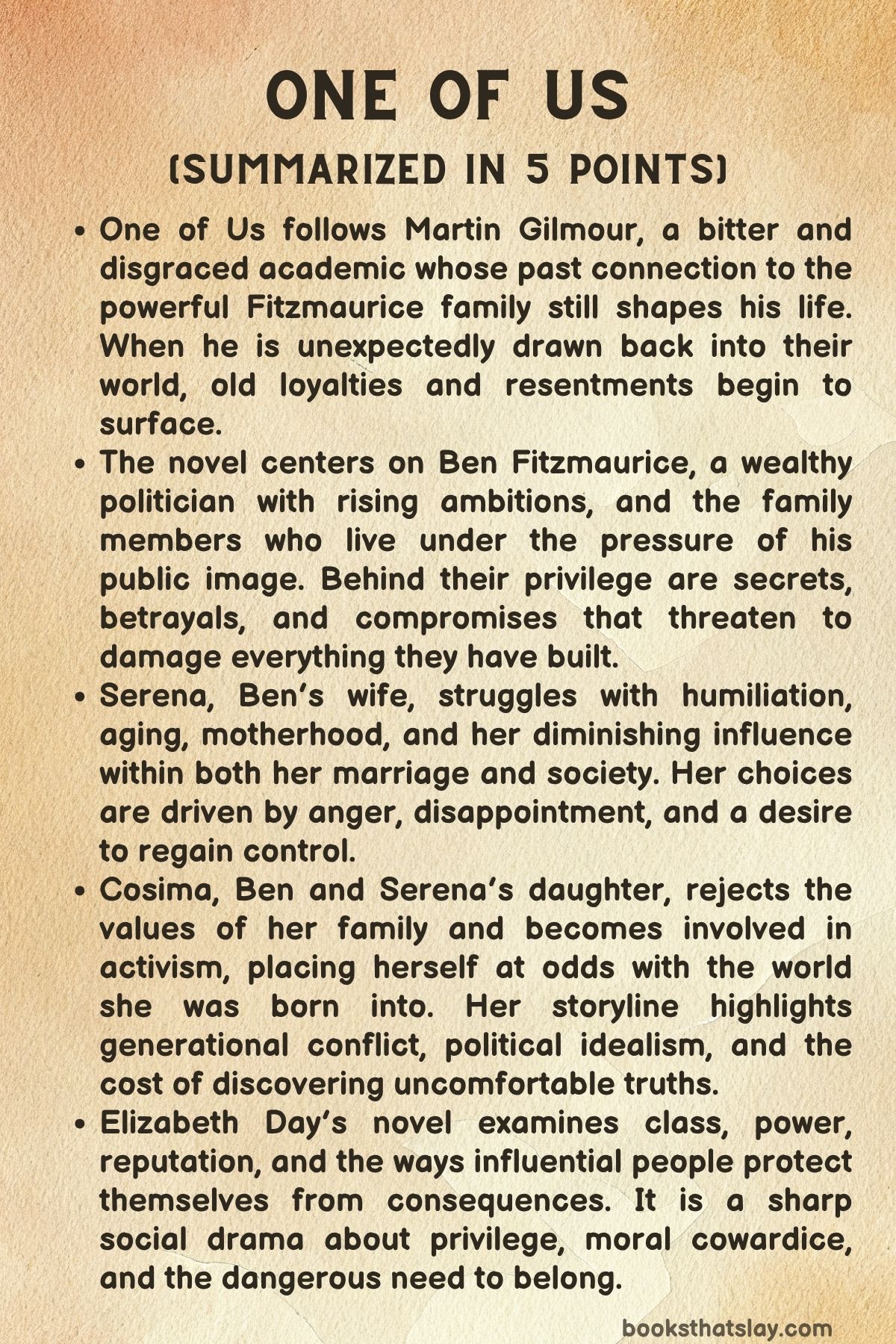
One of Us by Elizabeth Day is a sharp social and political novel about privilege, loyalty, class, reputation, and the damage caused when powerful people protect their own. The story follows Martin Gilmour, a man who has spent much of his life orbiting the wealthy Fitzmaurice family, especially his former best friend Ben.
Through Martin, Serena, Cosima, Richard Take, and Fliss, the book exposes old crimes, private betrayals, public ambition, and the cost of silence. It is a story about who gets believed, who gets sacrificed, and what happens when buried truths finally return.
Summary
Martin Gilmour is a suspended art history lecturer who has been ordered to attend therapy after a classroom argument becomes a public scandal. During a lecture, he used the word “orientalism,” and a student named Jacob Malik-Edwards challenged him.
Another student filmed the exchange, and the video spread widely, turning Martin into a figure of online outrage. Martin resents the process, looks down on his therapist Joanne, and feels misunderstood.
Yet he also uses the writing exercise she suggests as a way to explain himself and revisit the events that shaped his life.
At the centre of his story is Ben Fitzmaurice, Martin’s former best friend from Cambridge. Ben comes from an old, wealthy, politically connected family.
Martin, by contrast, grew up with far less security and was dazzled by Ben’s world. Years earlier, while they were at Cambridge, Ben drunkenly killed a young woman named Vicky Dillane in a car accident.
Martin took the blame. The Fitzmaurice family paid him off, protected Ben, and ensured that the truth stayed hidden.
Martin accepted the arrangement because he wanted to remain close to Ben and to the world Ben represented. Later, when Ben’s political career became more important, Ben and his wife Serena cut Martin off.
Hurt and angry, Martin told the police the truth about the crash, but nothing came of it.
Years later, Martin receives an invitation to the funeral of Ben’s sister, Lady Felicity “Fliss” Fitzmaurice, who has died in Bali. The invitation surprises him because he has been separated from the Fitzmaurice family for years.
He suspects there may be a reason they want him back. Serena, meanwhile, is struggling with her own bitterness.
She is at an expensive fasting clinic, unhappy with aging, menopause, motherhood, and Ben’s emotional distance. She has also discovered Ben being sexually involved with her friend Violet, a humiliation she cannot forget.
In a private act of revenge, she invites Martin to Fliss’s funeral without telling Ben, hoping his presence will unsettle her husband.
Another figure drawn toward the funeral is Richard Take, a disgraced politician who recently resigned after being caught watching pornography on his work computer. His marriage has fallen apart, his wife Hannah has left him, and he is desperate to return to public life.
Attending Fliss’s funeral gives him a chance to appear close to Ben, who is becoming an important political figure. Richard later hires a crisis public relations adviser and begins looking for ways to make himself likeable again, even considering reality television.
Ben and Serena’s eldest daughter, Cosima, is also caught between loyalty and rebellion. She secretly joins an Oblivion Oil protest at an Essex oil terminal, where activists plan to block tankers.
During the protest, River, an activist she admires, falls from a moving tanker and is badly injured. Cosima leaves the scene to attend Fliss’s funeral, terrified that River may die.
She later learns that he survives, but the experience unsettles her and deepens her distrust of the privileged political world her family inhabits.
At the funeral, Martin returns to Denby Hall and is pulled once again into the Fitzmaurice circle. A man named Derek suggests that Fliss’s death may not be as simple as the official account says.
Ben privately apologises to Martin for the past and offers him friendship again. Martin appears to accept, but his real intention is different.
He wants to stay close to the family, discover what happened to Fliss, and use the truth to damage them.
Serena’s life also becomes more unstable. She has an encounter with Andrew Jarvis, a wealthy ally and old friend of Ben.
Their hotel meeting becomes physically disturbing for her, though she tries to suppress her discomfort and continues with him to a charity gala. At the event, Ben publicly announces that Prime Minister Edward Buller is stepping down and that he will run for Conservative Party leader.
He also presents Richard Take as his first supporter. Serena is shocked that Ben did not tell her beforehand.
Martin is present too, and he refuses to applaud.
Richard benefits from Ben’s campaign and starts to imagine himself restored to power. During an appearance on Mickey Minton’s popular youth podcast, he learns that Ben wants him as his “number two,” possibly even as Chancellor.
But when a question is raised about whether Richard might run for leader himself, a new ambition begins to form in him.
Cosima visits River in hospital and learns that he already knows she is Ben Fitzmaurice’s daughter. He then reveals a deeper secret: he is not really an activist but an undercover police officer.
He tells her there is more to Fliss’s death than people know. Soon after, the press exposes him, and he vanishes into witness protection.
Before disappearing, he sends Cosima an encrypted PDF.
At Tipworth Priory, Martin is further humiliated when Ben publicly outs him as gay to journalists for political advantage. Later, during a gathering with Ben, Serena, Jarvis, Jarvis’s wife Bitsy, and the children, Martin is mocked by Jarvis with the old nickname “Little Shadow.” Bitsy makes a homophobic remark, and Martin leaves the room.
In the kitchen, he meets Cosima, who is reading The Communist Manifesto and openly despises her family’s privilege. She tells Martin she knows about the Cambridge crash, Ben’s guilt, and Martin’s false confession.
She then gives Martin login details for an email account and tells him to check the drafts folder if he wants the truth about Fliss.
The truth reveals Fliss’s tragic story. She had been living in a squat and struggling with alcoholism when an encounter with an old school acquaintance left her humiliated.
Instead of calling Ben, she contacted Andrew Jarvis, who had once seemed kind to her. Jarvis picked her up, took her to his London flat, gave her tea that tasted strange, and sexually assaulted her after she lost consciousness.
Fliss called Ben, who took her to Tipworth, but when she told him what Jarvis had done, Ben doubted her. He also admitted that he had never believed her childhood accusation that their grandfather had abused her.
Fliss reported Jarvis to the police, but they dismissed her because of the delay and her reputation. Abandoned by her family and failed by the authorities, she fled to Bali.
With the help of Derek, she briefly built a quieter life teaching yoga. But the trauma remained.
After drinking heavily and taking pills, she walked into the sea and died.
As Ben’s leadership campaign continues, Serena attends a British Museum event with him. Eco-protesters disrupt the event by spraying orange paint, and Serena recognises Cosima among them by her boots.
Ben admits he already knew about Cosima’s activism but had kept it from Serena because he feared it could damage his campaign. Serena begins to understand how many secrets Ben has hidden from her and how little control she has had over the public life built around him.
Martin then meets Richard Take at an itsu in Piccadilly and gives him a folder. It contains Fliss’s police statement, evidence against Jarvis, a memo suggesting Ben helped suppress the case, Fliss’s suicide note, and the old truth about the Cambridge crash.
Martin urges Richard to use the material to destroy Ben and Jarvis. Richard gives the file to the police and, on live television, announces that he has received serious allegations about Ben Fitzmaurice.
He also declares himself a candidate for the leadership.
Cosima, who has been hiding at Martin’s cottage after the protest, watches Richard’s interview with Martin and realises that the files she passed on are now being used to destroy her father. She is frightened by what she has helped set in motion.
Ben and Jarvis are interviewed under caution, the scandal spreads through the media, and Cosima remains hidden for weeks. Serena eventually finds her, apologises, gives her new Doc Martens, and begins to rebuild their relationship.
Cosima later speaks to Ben, who admits that he failed Fliss and helped suppress the case because Jarvis mattered to his political ambitions.
In the aftermath, Richard’s career rises. Ben is arrested and later charged under the Bribery Act.
Jarvis avoids the worst consequences and publicly claims he has been vindicated. Martin is welcomed back to Tipworth and enjoys being needed again.
Later, he has a partner named Alexander, stays close enough to visit Ben in prison, and becomes Cosima’s godparent. The ending leaves danger unresolved: while Martin and Alexander are by a pool, Jarvis appears unexpectedly, smiles at Martin, and walks toward him.
Characters
In Elizabeth Day’s One of Us, the characters are shaped by privilege, secrecy, ambition, guilt, and the damage caused when powerful people protect themselves instead of telling the truth. The book presents a world where public image often matters more than private morality, and nearly every character is forced to confront the difference between what they appear to be and what they have actually done.
Martin Gilmour
Martin Gilmour is one of the central and most psychologically layered figures in the book. He begins as a disgraced, defensive art history lecturer who feels misunderstood after a classroom scandal, but his narration quickly reveals that his bitterness comes from a much older wound.
Martin has spent much of his adult life orbiting the Fitzmaurice family, especially Ben, whom he once loved, admired, and protected. His decision to take the blame for the Cambridge car crash shows both his loyalty and his hunger to belong to a world that never truly accepted him.
Martin is intelligent, observant, and capable of sharp moral judgment, yet he is also resentful, self-pitying, and willing to manipulate events for revenge.
His relationship with Ben is the emotional core of his character. Martin wants recognition, affection, and inclusion, but he is repeatedly used as a convenient outsider.
The nickname “Little Shadow” captures how others see him: someone attached to the powerful, never fully powerful himself. His return to the Fitzmaurice circle after Fliss’s funeral is not innocent.
He pretends to accept Ben’s renewed friendship, but inwardly he wants to uncover the family’s secrets and expose them. This makes him both victim and avenger.
Martin has been wronged, but his desire to bring the family down is not purely noble; it is also personal, wounded, and possessive.
By the end, Martin gains some of what he has always wanted: closeness to the Fitzmaurice family, a partner in Alexander, and a place in Cosima’s life as godparent. Yet his ending is unsettling rather than entirely peaceful.
His continued connection to Ben in prison suggests that he has never fully escaped the emotional hold Ben has over him. Martin is a character defined by longing: longing for love, status, truth, and revenge.
He exposes corruption, but he is not morally simple, because his pursuit of justice is inseparable from his own need to be seen.
Ben Fitzmaurice
Ben Fitzmaurice is charming, privileged, politically ambitious, and deeply morally compromised. He belongs to a class that has been trained to survive scandal through confidence, influence, and silence.
On the surface, he is the rising political figure: polished, connected, and capable of presenting himself as a natural leader. Beneath that image, however, he is weak in the moments when moral courage is required.
The Cambridge crash defines his character because it shows the pattern of his life: when faced with consequences, he allows others to absorb the damage for him.
Ben’s treatment of Martin reveals his selfishness. He accepts Martin’s sacrifice, benefits from it, and later discards him when Martin becomes inconvenient.
When Ben tries to draw Martin back into friendship, it feels less like genuine repentance and more like another act of emotional control. He understands Martin’s loyalty and uses it when useful.
His decision to publicly present Martin’s sexuality for political convenience also shows how easily he turns intimacy into strategy. Ben’s charm is dangerous because it masks a willingness to exploit people who care about him.
His failure toward Fliss is even more devastating. When she tells him that Andrew Jarvis raped her, he doubts her, just as he failed to believe her childhood accusation against their grandfather.
Ben’s betrayal is not only personal but structural: he protects the powerful man who is useful to him and abandons the vulnerable woman who needs him. His later admission to Cosima that he helped suppress the case because of Jarvis’s political importance confirms the emptiness of his public morality.
Ben is not portrayed as a monster without feeling; he can apologise, feel shame, and show attachment. But his tragedy is that ambition repeatedly overrules conscience.
Serena Fitzmaurice
Serena Fitzmaurice is a complex portrait of wealth, beauty, frustration, and emotional neglect. She is not merely Ben’s wife; she is a woman who has built much of her identity around status, desirability, and proximity to power.
At the fasting clinic, her dissatisfaction reveals a person frightened by aging, motherhood, menopause, and the loss of the influence she once possessed. Serena’s unhappiness is intensified by Ben’s indifference and betrayal, especially when she remembers finding him in a sexual encounter with Violet.
Her decision to invite Martin to Fliss’s funeral is partly impulsive revenge, partly a desperate attempt to provoke Ben into noticing her.
Serena can appear cold, privileged, and self-involved, but the book gradually gives her more emotional depth. Her encounters with Andrew Jarvis show how vulnerable she can be beneath her polished surface.
She suppresses her discomfort after the disturbing hotel meeting because she has been conditioned to keep up appearances, even when something feels wrong. This connects her to the broader world of the novel, where women’s pain is often minimised, hidden, or repackaged for social convenience.
Her relationship with Cosima becomes one of the more hopeful emotional threads. At first, Serena does not understand her daughter’s anger or activism.
She experiences Cosima’s rebellion as betrayal and embarrassment, especially when Ben admits he knew about it and concealed it. But Serena slowly begins to recognise the depth of the secrets around her.
When she finds Cosima at Martin’s cottage, apologises, and gives her new Doc Martens, the gesture is small but meaningful. It shows Serena trying to meet her daughter as a person rather than as an extension of the family image.
Serena’s growth lies in her gradual movement away from denial and toward emotional honesty.
Cosima Fitzmaurice
Cosima Fitzmaurice is the clearest rebel within the Fitzmaurice family. As Ben and Serena’s eldest daughter, she has grown up surrounded by privilege, but she is disgusted by the hypocrisy and moral emptiness that privilege protects.
Her activism with Oblivion Oil is not just youthful rebellion; it is an attempt to separate herself from the political and social world her father represents. Her reading of The Communist Manifesto at Tipworth captures her desire to reject inherited power, though she is still learning how complicated moral action can be.
Cosima is brave, angry, and idealistic, but she is also frightened by the consequences of her choices. During the oil protest, River’s accident shocks her into awareness that activism is not abstract.
Later, when she gives Martin access to the email drafts containing the truth about Fliss, she helps unleash a scandal that destroys her father’s career. Her fear after watching Richard Take use the material on television shows that she did not fully understand the scale of what she had set in motion.
This makes her believable: she wants justice, but she is still young, and the machinery of politics and media is far larger than she expects.
Her importance also lies in her moral clarity. She is one of the few characters willing to confront the Cambridge crash, Fliss’s death, and the family’s lies directly.
Yet she is not presented as purely righteous. She runs, hides, panics, and depends on Martin for shelter.
Her eventual conversation with Ben is crucial because it forces him to admit his failure. Cosima becomes a bridge between generations: she inherits the damage caused by her family, but she also challenges it.
Her relationship with Serena suggests the possibility of a less dishonest future.
Lady Felicity “Fliss” Fitzmaurice
Fliss is one of the most tragic and morally significant characters in the book. Although much of her story is revealed after her death, her life becomes the emotional evidence against the Fitzmaurice family’s cruelty and neglect.
She is vulnerable, damaged by alcoholism, and socially fallen from the aristocratic world into which she was born. Yet her vulnerability does not make her weak in a simple sense.
She repeatedly tries to tell the truth about what has been done to her, first regarding her grandfather and later regarding Andrew Jarvis, but she is disbelieved by the very people who should protect her.
Her assault by Jarvis is a turning point because it exposes the brutal consequences of a world where reputation matters more than justice. Fliss turns to Jarvis because he once seemed kind, and that misplaced trust makes his betrayal even more horrifying.
When Ben doubts her, the wound becomes deeper than the assault itself. His disbelief confirms her isolation and repeats the earlier family pattern of refusing to hear her.
Her report to the police also fails because her alcoholism, delay, and reputation are used against her, showing how easily institutions dismiss imperfect victims.
Fliss’s time in Bali offers a brief glimpse of possible renewal. With Derek’s help, she teaches yoga and seems to rebuild some part of herself.
But trauma returns, and her death by walking into the sea after drinking and taking pills is devastating because it feels like the final result of being abandoned too many times. Fliss is central not because she controls the plot while alive, but because the truth of her suffering exposes the moral bankruptcy of the people around her.
Her death becomes the secret that breaks open the family’s public image.
Richard Take
Richard Take is a disgraced politician whose hunger for relevance makes him both comic and dangerous. At first, he appears pathetic: caught watching pornography on a work computer, abandoned by his wife, and desperate to recover public affection.
His attendance at Fliss’s funeral is motivated less by grief than by calculation. He wants to be seen near Ben because Ben’s rising career might restore his own status.
Richard is deeply insecure, and his public life depends on attaching himself to stronger political figures.
Yet Richard is also opportunistic in a way that makes him effective. When Gary’s podcast question plants the idea that he might run for leader himself, Richard begins to imagine a new path to power.
His meeting with Martin at itsu becomes decisive. By taking the folder of evidence to the police and announcing the allegations on live television, Richard appears principled, but his motives remain mixed.
He does the right thing, yet he also uses the moment to advance himself. This ambiguity makes him interesting: justice and self-interest move together in him.
Richard’s rise after the scandal suggests that politics rewards performance as much as morality. He benefits from exposing Ben and Jarvis, but the book does not present him as a pure reformer.
He is a survivor, someone who understands scandal, public appetite, and the usefulness of moral outrage. Richard’s character shows that corruption can be challenged by people who are themselves compromised.
His success is therefore uneasy, because it suggests that one ambitious man may simply replace another.
Andrew Jarvis
Andrew Jarvis is one of the most predatory and chilling figures in the story. He is wealthy, connected, and protected by his usefulness to powerful men.
His outward identity is that of Ben’s ally and old friend, a man who moves comfortably through elite spaces and political networks. Beneath that respectability, he is exploitative, cruel, and sexually violent.
His assault on Fliss is horrifying not only because of the act itself, but because of the calculated way he creates conditions in which she is vulnerable and unlikely to be believed.
Jarvis also unsettles Serena. Their hotel encounter becomes physically disturbing for her, and though the circumstances differ from Fliss’s assault, the scene reinforces his pattern of domination and entitlement.
He treats women as objects through which he can exercise power. His confidence depends on knowing that people like Ben need him and that society is often willing to protect men of his class.
The most disturbing part of Jarvis’s character is that he escapes the worst consequences. While Ben is arrested and charged, Jarvis publicly claims vindication, suggesting that power can survive even serious exposure.
His unexpected appearance at the end, smiling and walking toward Martin, gives the story a threatening final note. Jarvis represents the kind of corruption that does not disappear simply because one scandal breaks.
He is not just an individual villain; he embodies the persistence of elite impunity.
River
River initially appears to Cosima as an admired activist leader, someone brave, committed, and ideologically pure. His role in the oil protest gives Cosima a figure to look up to, and his fall from the moving tanker becomes a moment of shock that forces her to confront the physical risks of protest.
However, River’s later revelation that he is actually an undercover police officer complicates everything about him. He is not what Cosima believed, and his presence inside the activist movement raises questions about trust, manipulation, and surveillance.
Despite the deception, River is not simply a false figure. He helps move the truth about Fliss forward by sending Cosima the encrypted PDF.
This suggests that his loyalties may be divided or that his conscience has been affected by what he has discovered. His disappearance into witness protection makes him mysterious and unreachable, but his impact remains important.
River is a catalyst: through him, Cosima gains access to information that eventually helps expose the Fitzmaurice family’s secrets.
Derek
Derek is a gentle and morally decent presence in Fliss’s story. Unlike many of the wealthy and powerful characters, he does not use Fliss or dismiss her.
In Bali, he helps her rebuild a quieter, more meaningful life by supporting her work as a yoga teacher. His kindness matters because it shows that Fliss was not beyond help or incapable of recovery.
She needed belief, stability, and compassion, and Derek offers some of that.
His hint to Martin that there is more to Fliss’s death than the official story also makes him important to the unraveling of the truth. Derek is not a dominant character, but he carries moral weight because he notices what others ignore.
In a story full of people who conceal, minimise, and manipulate, Derek stands out as someone who remembers Fliss as a person rather than as a problem.
Bitsy Jarvis
Bitsy Jarvis represents the casual cruelty and prejudice of the elite social world around the Fitzmaurices. Her homophobic remark at Tipworth drives Martin from the room and reveals how easily people in that circle wound others while maintaining social confidence.
Bitsy is not explored as deeply as Andrew, Ben, or Serena, but her presence helps define the environment in which they operate. She belongs to a world where offensive comments can be treated as social texture rather than moral failure.
Her marriage to Andrew also places her near the center of the corrupt network, though she is not shown carrying the same direct guilt as her husband. Bitsy functions as part of the social machinery that normalises exclusion.
Through her, the book shows that cruelty does not always appear as a grand crime; sometimes it appears as a remark made comfortably at dinner.
Violet
Violet is important mainly through Serena’s memory of betrayal. Her sexual encounter with Ben humiliates Serena and intensifies Serena’s sense that her marriage is hollow.
Violet’s role is brief, but she becomes a symbol of the private indignities Serena has endured while maintaining the appearance of a successful political marriage. The fact that Violet is Serena’s friend makes the betrayal more intimate.
She represents one of the many ways Serena’s social world, supposedly built on loyalty and refinement, is actually filled with competition, secrecy, and emotional violence.
Joanne
Joanne, Martin’s therapist, appears early as someone Martin resents and privately mocks, but her role is structurally important. Her writing exercise gives Martin a reason to recount his life, which opens the path to buried truths.
Martin’s contempt for Joanne reveals his defensiveness and discomfort with genuine self-examination. He is willing to narrate his wounds, but he does not easily accept being interpreted by someone else.
Joanne represents the possibility of reflection, though Martin often resists it. Her presence shows that Martin’s story is not only about political scandal or family secrets; it is also about memory, resentment, and the way people justify themselves.
Even when Martin thinks he is controlling the narrative, the therapeutic frame suggests that he is also exposing more of himself than he intends.
Jacob Malik-Edwards
Jacob Malik-Edwards is the student whose challenge to Martin helps trigger the public scandal that opens the book. He represents a younger generation unwilling to accept the casual language and assumptions of older institutions.
Martin sees him defensively, as part of a culture that has humiliated him, but Jacob’s role is more than that of an antagonist. He exposes Martin’s inability to adapt and his resentment toward being questioned.
Through Jacob, the story connects private disgrace with public accountability. The classroom argument becomes a modern scandal because another student films it, showing how reputation can now collapse instantly.
Jacob’s challenge also mirrors the larger moral structure of the novel: old forms of authority are being questioned, and people who once spoke without consequence are no longer fully protected.
Vicky Dillane
Vicky Dillane is the young woman killed in the Cambridge car crash, and although she is not developed through direct presence, she is morally central. Her death is the original crime around which Martin and Ben’s relationship is built.
Ben’s drunken driving kills her, but Martin takes the blame, allowing Ben and his family to avoid the full consequences. Vicky’s importance lies in the way her life is treated by the powerful: as a problem to be managed rather than as a human being whose death demands justice.
She also represents the cost of male loyalty and elite protection. Martin’s sacrifice is often framed through his devotion to Ben, but Vicky’s death reminds the reader that this loyalty came at the expense of truth.
Her absence haunts the book because the cover-up surrounding her death establishes the pattern that later repeats with Fliss. In both cases, a woman is harmed, and powerful people protect themselves.
Alexander
Alexander appears later as Martin’s partner and represents the possibility of a more stable life for Martin beyond his obsession with Ben. His presence suggests that Martin has, at least partly, found intimacy outside the Fitzmaurice orbit.
This is significant because Martin has spent so long defining himself through Ben’s attention and rejection. Alexander offers an alternative form of companionship, one not rooted in class worship or old guilt.
However, Alexander’s appearance alongside Martin near the pool at the end does not erase the unease of Martin’s life. Jarvis’s sudden arrival threatens the peace that Martin seems to have gained.
Alexander therefore helps show Martin’s partial healing, but also how unresolved dangers from the past continue to intrude. He is a sign of progress, not a guarantee of safety.
Hannah Take
Hannah Take, Richard’s wife, is mostly seen through the collapse of Richard’s personal life. Her decision to leave him after his scandal shows that Richard’s disgrace has consequences beyond politics.
She represents the private cost of public humiliation. While Richard searches for ways to recover his career and image, Hannah’s absence reveals that some forms of trust are not easily repaired.
Although she is not a major active force in the plot, Hannah helps define Richard’s desperation. Without his marriage and with his reputation damaged, Richard becomes more eager to seize any opportunity for relevance.
Her departure therefore indirectly contributes to his political opportunism.
Gary
Gary is important because his question to Richard on Mickey Minton’s podcast changes the direction of Richard’s ambition. By asking whether Richard has considered running for leader himself, Gary gives shape to an idea that Richard had not fully allowed himself to imagine.
His role is small but influential, showing how media figures can redirect political narratives with a single provocative question.
Gary also represents the new media environment in which political careers are shaped not only in Parliament or newspapers, but through podcasts and public performance. His question helps turn Richard from Ben’s supporter into Ben’s rival.
In that sense, Gary acts as a catalyst for Richard’s transformation.
Mickey Minton
Mickey Minton, as the host of the popular youth podcast, represents the changing relationship between politics, celebrity, and public approval. His platform gives Richard a route back into relevance after scandal.
The podcast setting matters because it shows that political rehabilitation no longer depends only on traditional respectability; it can also be built through entertainment, relatability, and media exposure.
Mickey’s presence helps frame Richard’s comeback as a performance. Richard is not simply returning to politics through policy or principle; he is testing how the public receives him.
Mickey’s podcast becomes one of the spaces where damaged politicians try to remake themselves.
Edward Buller
Prime Minister Edward Buller is important because his decision to step down creates the political opening that drives Ben’s leadership campaign. He is not a deeply developed character, but his departure reshapes the ambitions of those around him.
Ben’s announcement at the charity gala that Buller is stepping down shocks Serena because it reveals how much Ben has kept from her.
Buller functions as a symbol of political transition. His exit allows hidden rivalries, ambitions, and betrayals to surface.
Without that vacancy at the top, Ben’s hunger for power and Richard’s later opportunism would not escalate in the same way.
Themes
Class Privilege and Protected Power
Privilege operates as a system of protection, not merely a background detail. The Fitzmaurice family’s wealth and status allow Ben to survive scandals that would destroy anyone outside his class.
Martin takes the blame for the fatal car crash because the family can afford to make consequences disappear, turning justice into a private transaction. This protection continues years later when Fliss’s report against Jarvis is dismissed partly because her reputation makes her easier to doubt than a powerful man.
Ben’s political rise depends on the same structure: loyalty, silence, image management, and the careful control of damaging truths. In One of Us, power is shown as something inherited, guarded, and maintained by people who understand that reputation can matter more than truth.
The tragedy is not only that crimes happen, but that the powerful know how to survive them.
Betrayal and Moral Compromise
Nearly every relationship is shaped by betrayal, but the novel is especially interested in how people justify it to themselves. Martin betrays justice by taking responsibility for Ben’s crime, yet he also sees himself as betrayed when the Fitzmaurices discard him after using him.
Ben betrays Martin, Fliss, Serena, and Cosima, often choosing ambition over loyalty. His failure to believe Fliss is one of the deepest betrayals because it turns family into another institution that refuses to protect her.
Serena’s emotional distance from her children and her encounter with Jarvis also reveal how resentment and humiliation can push people into damaging choices. The novel does not present betrayal as one sudden act; it presents it as a habit built from cowardice, fear, pride, and self-interest.
Once people begin compromising their morals, each later betrayal becomes easier to excuse.
Truth, Silence, and Public Image
Truth in One of Us is repeatedly buried, delayed, edited, or turned into political material. The Cambridge crash, Fliss’s assault, Ben’s role in suppressing evidence, Cosima’s activism, and Martin’s sexuality are all controlled through silence until they become useful to someone.
The public world of politics and media does not reward truth for its own sake; it rewards whoever releases it at the right moment and for the right advantage. Martin wants exposure partly as revenge, Richard uses the allegations to revive his career, and Ben uses personal information about Martin to improve his public image.
This creates a grim view of confession and revelation. Truth may finally emerge, but it does not arrive cleanly.
It is filtered through ambition, resentment, fear, and strategy, showing that public exposure is not the same as justice.
Trauma, Disbelief, and Survival
Fliss’s story shows the devastating effect of trauma when it is met with disbelief. Her childhood accusation is ignored, and later, when Jarvis assaults her, Ben again chooses doubt over care.
This repeated rejection deepens her isolation and leaves her with no safe place inside her own family or within the legal system. Her move to Bali briefly suggests the possibility of recovery, as teaching yoga and Derek’s kindness offer her a gentler life.
Yet the damage returns because survival requires more than physical distance from the source of harm. Cosima’s experience also reflects a younger version of this struggle: she is shocked by the truth about her family and frightened by her role in exposing it.
The novel presents trauma as something made worse by powerful people refusing to listen, especially when believing the victim would cost them comfort, status, or ambition.