Superfan Summary, Characters and Themes | Jenny Tinghui Zhang
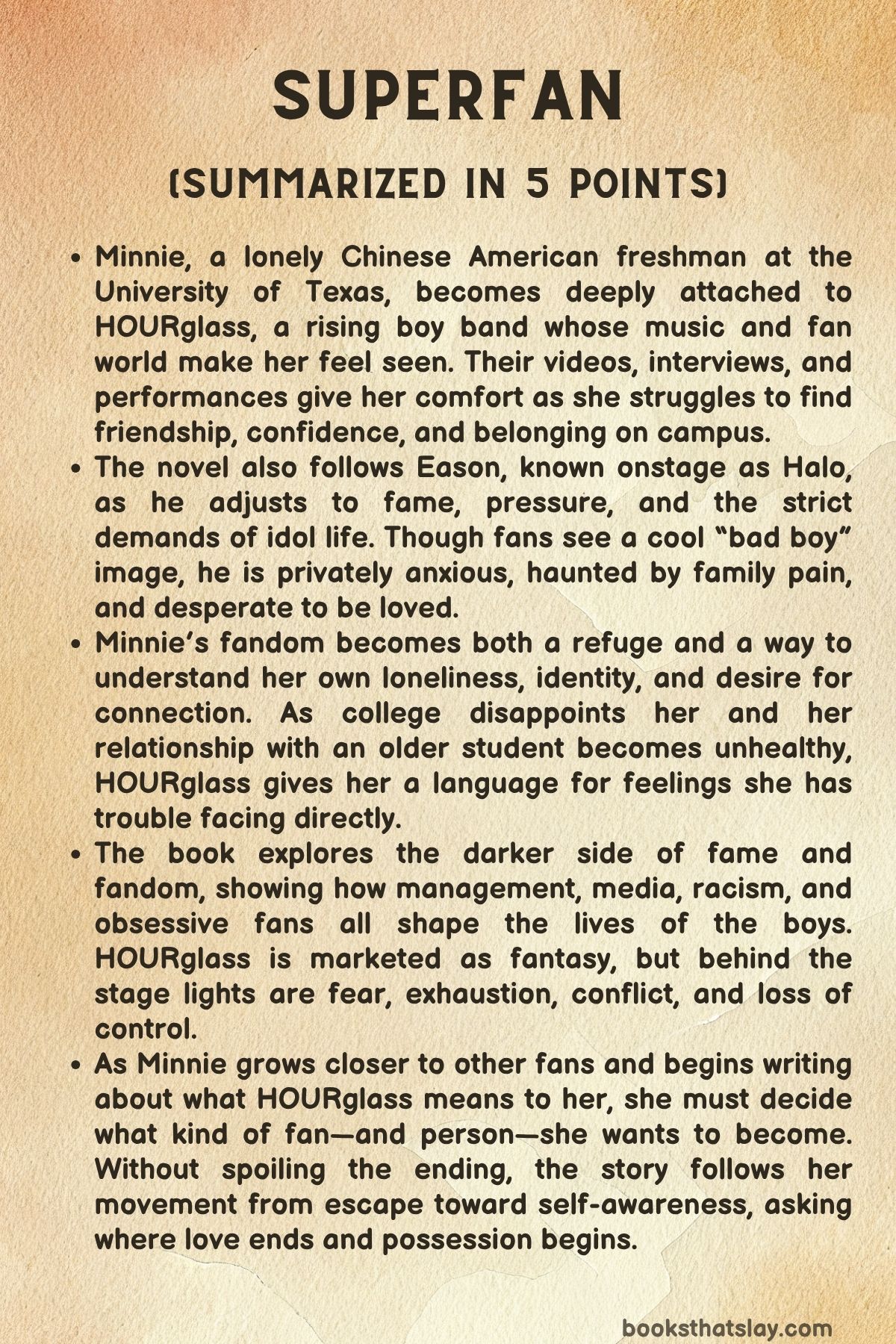
Superfan by Jenny Tinghui Zhang is a novel about loneliness, fandom, identity, and the dangers of mistaking visibility for intimacy. It follows Minnie, a Chinese American college freshman who feels unseen in every part of her life, and Eason, the young idol known as Halo in the boy band HOURglass.
As Minnie’s devotion to the band grows, HOURglass becomes both refuge and escape, while Eason struggles with fame, control, and a painful past. The book examines how pop culture can offer comfort, but also how obsession, secrecy, and unmet need can blur the line between love and harm.
Summary
Minnie arrives at the University of Texas hoping college will give her a new life. As a Chinese American student who immigrated from China as a child, she has spent years feeling out of place.
Her name, her language, and her memories all carry the weight of being remade for other people’s comfort. She wants college to be the place where she becomes confident, interesting, and loved, but the reality is disappointing.
She eats alone, fails to bond with the girls in her dorm, and watches other students form friendships with ease. Her loneliness makes her feel as if she is watching life happen from outside a window.
That changes when she discovers a viral video of HOURglass, a new boy band made up of Minwoo, Denim, Jelly, and Halo. Their music, beauty, dancing, interviews, and fan clips hit her with the force of recognition.
Minnie begins spending hours watching their videos, memorizing their facts, reading fan theories, and following online spaces dedicated to them. The band gives her a sense of companionship she cannot find on campus.
In the quiet of her dorm room, they seem to speak directly to the parts of her that feel unwanted. HOURglass becomes a world where she feels noticed, protected, and transformed.
The novel also follows Eason, who performs as Halo. Before HOURglass’s first major festival set, he is terrified.
He feels sick, shaky, and unprepared, knowing he lacks the polished training of the other members. Yet once he steps onstage and hears the crowd respond, something shifts.
The performance goes viral, and HOURglass becomes famous almost overnight. Eason wants the love that fame promises, but he is never fully comfortable inside the persona created for him.
Halo is supposed to be dangerous, cool, and detached. Eason, underneath that image, is anxious and frightened.
Eason’s path into the group began by accident. He was delivering wings when he ended up at an audition for BabyGold Records.
The label did not choose him because he was the strongest performer. They wanted his look, his guarded energy, and the suggestion of danger they could build into Halo.
After joining the company, he enters a punishing training system with Minwoo, Colt, and Julian. The boys live together in a cramped Koreatown apartment, practice constantly, diet, and submit to the label’s demands.
Eason struggles, but Julian helps him improve with patience and kindness. Their bond becomes one of the few real comforts in Eason’s controlled life.
Both Minnie and Eason carry painful histories. Minnie grew up feeling diminished by racism, language barriers, and the quiet shame of never fully belonging.
Eason grew up in a damaged household after his father left. His mother became consumed by the idea of a family curse, and her instability harmed the family, especially his sister Faye.
Eason eventually left home and refused to return, but the memories remain inside him. His desire to be adored by fans is tied to a deeper need: he wants love that will not abandon him.
As HOURglass grows more popular, the group is forced through cruel and demeaning publicity. On a radio show, DJ Quicksand asks racist and degrading questions.
Eason nearly loses control, but he turns the moment into a charming answer that satisfies the label. Outside, he breaks protocol to comfort a young fan, but security responds harshly and the scene turns chaotic.
His manager Brooks scolds him afterward, reminding him that the group’s success depends on obedience. Eason learns again that care, anger, and fear must all be hidden behind the performance.
Minnie, meanwhile, begins dating Nate, an older student she meets at the campus bookstore. She sees him as mature, intellectual, and worldly.
His attention makes her feel chosen, even though he often looks down on her interests. At first, dating him seems to move her closer to the college life she imagined.
At one of his parties, she briefly feels accepted after winning a drinking game, but then she sees Nate kissing another woman. His roommate Clark comforts her, gives her strong alcohol, and leads her into a bathroom.
Minnie is very drunk and vulnerable. Clark locks the door and crosses her boundaries.
She leaves the party alone, shaken, and unable to name what has happened to her.
After the party, Minnie tells no one. Instead, she withdraws further into HOURglass.
When Halo responds to one of her comments about loneliness during a livestream, she treats his words as if they were meant for her alone. His attention feels like protection.
She avoids going home for Thanksgiving and tries to write for Anna Peng’s zine, though she doubts herself. Akash, another zine member, encourages her to write honestly about what HOURglass means to her.
Nate returns and mocks her devotion to the band, but Minnie is not yet ready to let him go. When he touches her in her dorm room, memories of Clark return, and she pretends she is fine.
During winter break in Colorado, Minnie is still anxious and lonely after fighting with Nate. She posts on The Heaven, a HOURglass fan forum, and receives comfort from other fans.
One admired user, Ladybeth42, begins messaging her privately. Ladybeth gains Minnie’s trust by listening to her worries about Nate and reassuring her through their shared love for HOURglass.
Minnie’s parents are present, but her mind stays fixed on Nate’s slow replies and the band’s updates. When Ladybeth sends her a secret photo of Halo and Jelly dancing closely together and tells her not to share it, Minnie feels chosen.
The secret makes her believe she has been allowed closer to the boys.
Eason’s past becomes more troubling when a threatening comment appears during a New Year livestream, calling him a “stealer and killer.” The words bring back memories of Faye’s pregnancy. Years earlier, Eason found Faye’s pregnancy test and learned that she planned to keep the baby.
He feared losing her, especially when she prepared to leave for Chicago with help from Henry’s family. Feeling abandoned and terrified of being left alone with their unstable mother, Eason betrayed Faye by telling their mother about the pregnancy.
The guilt still haunts him.
Back at school, Minnie attends the launch party for Anna’s zine and apologizes for not contributing properly. She pitches an essay about HOURglass and why the band matters to her.
At a diner afterward, she proves her commitment in a strange, impulsive way by drinking an entire syrup dispenser, which convinces Anna to believe in her. Ladybeth then sends Minnie Halo’s cologne as a gift.
Minnie’s attachment to Ladybeth and to the private fan world grows stronger.
At the same time, HOURglass is pushed into more invasive publicity. During a sunflower-field photoshoot, Eason and Julian are made to pose shirtless and romantically to encourage fan rumors about Halo and Jelly.
Julian objects to being exploited, but Eason insists they do what the label wants for the sake of the group. Their argument turns cruel when Eason attacks Julian’s failed skating career.
Julian ends their friendship, leaving Eason more isolated than before.
Minnie later attends another party with Nate and discovers it is for Clark. Nate and his friends mock HOURglass and discuss a story Nate has written using Minnie’s fandom as material.
Clark approaches her drunk, fails to recognize her, and makes racist, crude comments. Minnie leaves angry and shaken.
Ladybeth urges her to expose Nate through her essay and reveals that she belongs to a secret fan group called the Hellians. The group follows HOURglass, collects private information, and believes the band’s manager is trying to keep Halo and Jelly apart.
Minnie is disturbed, but her need to belong keeps pulling her closer.
Minnie finally breaks up with Nate and finishes her essay. Anna praises it and arranges backstage access to HOURglass’s Houston concert through her uncle, giving Minnie the chance to interview the band.
Ladybeth sees this as Minnie’s opportunity to join the Hellians. She asks Minnie to deliver a warning to Halo and shows her a video filmed inside his hotel bathroom, pointing out what she claims are anxiety pills.
Minnie agrees, still caught between concern, fantasy, and the desire to be important.
In Houston, HOURglass is mobbed at the airport by obsessive fans who grab, scratch, and nearly crush the members. Julian condemns the fans during a radio interview, but the clip goes viral and he is blamed for being violent.
The Hellians read the incident as proof that the boys need protection. Minnie and Anna drive to Houston together and grow closer during the trip.
They visit the Rothko Chapel before the concert, giving Minnie a quiet moment before facing the world she has built in her mind.
At NRG Arena, Minnie is overwhelmed by seeing HOURglass perform in person. Afterward, she and Anna attend the meet and greet.
Minnie gives Halo Ladybeth’s warning and mentions Faye. Eason reacts with anger and fear, making Minnie realize that the information she has carried is not harmless.
Later, Minnie lies to Ladybeth to get the band’s hotel and flight details, then stops responding. At the hotel, she begins to understand how Ladybeth manipulated her and how she herself became part of something invasive.
She deletes her messages on The Heaven, saves Hannah’s email, and deletes her account. When she later sees Nate with Jillian, she feels acceptance rather than pain.
Minnie has not solved everything, but she has started to separate care from obsession, and fantasy from the real lives of other people.
Characters
Minnie
Minnie is the emotional center of Superfan, a lonely Chinese American freshman whose devotion to HOURglass grows out of a deep need to feel seen, chosen, and protected. Her isolation at the University of Texas makes her especially vulnerable to the intense comfort that fan culture offers.
She enters college hoping for reinvention, friendship, romance, and belonging, but instead she finds herself eating alone, struggling to connect with other girls, and feeling invisible in the social world she expected to transform her. HOURglass becomes more than entertainment for her; the band becomes an imagined refuge where beauty, attention, music, and fantasy soften the pain of ordinary rejection.
Minnie’s fandom reveals both her imagination and her hunger for emotional safety.
Her immigrant background is essential to understanding her character. Being renamed Minnie after a childhood comment about Disney World shows how easily her identity has been reshaped by other people’s expectations.
She grows up with the burden of language loss, racism, and the feeling of being reduced or misunderstood. Because of this, her attachment to HOURglass is not shallow.
It is connected to her desire to exist fully in a world that has often made her feel small. The boys appear to offer her a kind of recognition she does not receive from classmates, romantic partners, or even the broader culture around her.
Minnie’s relationship with Nate exposes her vulnerability and her desire to be validated by someone who seems older, sophisticated, and intelligent. She mistakes his attention for love because she wants college life to finally match the dream she has carried.
However, Nate often belittles her interests, especially her love for HOURglass, which shows that he does not truly respect the parts of her that matter most. Her experiences with Nate and Clark leave her ashamed, confused, and traumatized, and her retreat into fandom afterward becomes a coping mechanism.
Rather than immediately confronting what happened, she clings to Halo’s livestream and to the fan world because they give her language for loneliness when real life feels unbearable.
Minnie’s growth comes through her gradual recognition that fantasy can both comfort and endanger her. Ladybeth makes Minnie feel special by offering secrets, gifts, and access, but this attention is manipulative.
Minnie wants to belong so badly that she ignores warning signs and becomes involved in behavior that violates the privacy and safety of the very people she claims to love. By the end of the story, her decision to cut off Ladybeth, delete her Heaven account, and save Hannah’s email shows that she is beginning to separate genuine care from obsession.
Minnie does not stop being a fan, but she starts to understand that love without boundaries can become harmful.
Eason / Halo
Eason, who performs as Halo, is one of the most conflicted figures in the book because he lives between the person he is and the image he has been trained to sell. As Halo, he is supposed to appear dangerous, detached, seductive, and confident.
As Eason, he is frightened, insecure, physically anxious, and desperate to be loved. His stage persona is not simply a costume; it is a survival strategy created by BabyGold Records and accepted by Eason because fame seems to promise escape from his painful past.
The contrast between his public image and private fear gives his character much of its emotional force.
His entry into the idol world happens almost accidentally, which makes him different from the other members. He is not chosen because he is the most polished singer or dancer, but because the label sees marketable danger in him.
This makes Eason feel both lucky and inadequate. He struggles in rehearsals, fears being exposed by cameras, and depends on Julian’s patience to improve.
Yet once he steps onstage and feels the crowd responding, he experiences fame as a kind of rescue. The audience’s love seems to confirm that he can become someone new, someone untouchable, someone finally wanted.
Eason’s family history explains why he clings so fiercely to HOURglass. His father’s abandonment and his mother’s obsession with a family curse create a home filled with fear and instability.
His relationship with Faye is especially painful because she represents both love and abandonment to him. When Faye becomes pregnant and plans a future away from home, Eason feels betrayed by the possibility that she will leave him behind with their mother.
His decision to tell their mother about the pregnancy is an act of panic, jealousy, and desperation, and it becomes one of the wounds that continues to haunt him. The threatening livestream comment calling him a “stealer and killer” strikes at this buried guilt.
Eason’s tragedy is that the fame he thinks will save him also traps him. The label controls his image, his body, his relationships, and even his emotional responses.
When DJ Quicksand humiliates the group with racist and degrading questions, Eason wants to lash out, but he forces himself to answer charmingly because the system rewards obedience. When he comforts a young fan, he is punished for breaking protocol.
When fans invade his privacy and Minnie brings him a message involving Faye, his anger reveals how deeply violated and afraid he feels. In Superfan, Eason becomes a symbol of the human cost behind idol fantasy: adored by strangers, but rarely treated as fully human.
Minwoo
Minwoo is one of the members of HOURglass, and although the story material gives him less individual focus than Eason or Julian, he still represents the polished professionalism expected within the idol system. As part of the group, he contributes to the beauty, discipline, and performance quality that first overwhelms Minnie.
He is part of the carefully constructed image that allows fans to imagine HOURglass as perfect companions who can fill loneliness and provide emotional meaning.
Within the group dynamic, Minwoo also helps show the contrast between Eason and the more trained members. Eason enters BabyGold Records without the same preparation, while members like Minwoo appear to belong more naturally to the world of rehearsals, choreography, dieting, interviews, and constant public performance.
Minwoo’s presence therefore emphasizes Eason’s insecurity. Even when Minwoo is not the central emotional focus, he is part of the standard Eason fears he cannot meet.
Minwoo also matters because HOURglass functions as a collective fantasy. Minnie does not love only one member at first; she is absorbed by the group’s videos, songs, dancing, interviews, and fan content.
Minwoo’s role in that fantasy is to help create the dazzling surface that draws Minnie in. His character shows how idol groups are built not only from individual personalities but from coordinated images, group chemistry, and the illusion of intimacy.
Denim / Colt
Denim, also known as Colt, is another member of HOURglass whose presence helps define the group’s manufactured appeal. Like Minwoo, he is part of the polished structure that surrounds Eason and makes HOURglass seem complete.
His dual naming also reflects the way performers in the story are shaped into public identities. The existence of a stage name suggests that the boys are not simply presenting themselves; they are being packaged, renamed, and transformed into figures that fans can consume.
Colt’s role is important because he belongs to the demanding training environment that Eason enters. The cramped apartment, strict dieting, and relentless rehearsals show that all the boys are subjected to pressure, not only Eason.
Colt helps represent the shared cost of fame. Even when he is not foregrounded emotionally, his place in the group reminds the reader that HOURglass’s glamour depends on exhaustion, discipline, and constant self-suppression.
For Minnie, Colt is part of the group’s emotional spell. The members’ combined beauty and performance style give her a sense of companionship that she lacks in college.
Colt’s character therefore contributes to the larger question at the heart of the story: how much of what fans love is the real person, and how much is a carefully designed image? His presence helps show that every member of HOURglass is both a person and a product.
Jelly / Julian
Julian, who performs as Jelly, is one of the most sympathetic members of HOURglass because he combines discipline, kindness, and moral discomfort. He patiently helps Eason improve in rehearsals, which shows that he is not merely a rival or groupmate but someone capable of tenderness and loyalty.
His support matters because Eason feels behind the others and fears being exposed as unworthy. Julian becomes one of the few people who sees Eason’s weakness without immediately exploiting it.
Julian’s failed skating career gives him emotional depth. It suggests that he has already experienced disappointment before becoming an idol, and that HOURglass is not simply a dream but also a second chance.
This makes Eason’s cruel attack on his past especially painful. When Eason uses Julian’s failed skating career against him, he wounds Julian at the place where he is most vulnerable.
Their friendship breaks not because of one argument alone, but because the pressures around them have made sincerity difficult to protect.
Julian also serves as the moral conscience of the group. During the sunflower-field photoshoot, he recognizes that the label is exploiting fan rumors about Halo and Jelly by pushing them into shirtless, romantic poses.
His objection shows that he understands how management turns personal relationships and bodies into marketing tools. Unlike Eason, who wants to endure the discomfort for the group’s survival, Julian sees the danger of surrendering too much.
His later criticism of invasive fans during a radio interview further shows that he is willing to say what others may be afraid to say, even when the public punishes him for it.
Anna Peng
Anna Peng is an important figure in Minnie’s college life because she offers a possible path toward real community rather than fantasy-based belonging. As the leader of the zine, Anna represents creativity, confidence, and intellectual seriousness.
Minnie initially feels out of place around her, which reflects Minnie’s broader insecurity in college spaces. Anna seems to belong to the world Minnie wants to enter but does not yet know how to join.
Anna’s importance grows when Minnie pitches her essay about HOURglass. Instead of dismissing the subject as silly, Anna eventually recognizes Minnie’s seriousness.
The diner scene, where Minnie proves her commitment in an unusual and extreme way, shows both Minnie’s desperation to be believed and Anna’s willingness to take her seriously. Anna becomes one of the first people in Minnie’s real life to treat her fandom as something worth thinking and writing about rather than something shameful.
The road trip to Houston deepens Anna’s role. As she and Minnie grow closer, Anna becomes a contrast to Ladybeth.
Both women are connected to Minnie’s HOURglass journey, but Anna offers real friendship, collaboration, and creative possibility, while Ladybeth offers secrecy and manipulation. Anna’s presence suggests that Minnie does not have to choose between loving something intensely and living in the real world.
She can transform her obsession into expression, analysis, and connection.
Akash
Akash is a quieter but meaningful character because he encourages Minnie to write honestly. As a member of the zine, he belongs to the creative community Minnie nearly abandons.
His encouragement matters because Minnie is ashamed of her obsession and uncertain whether HOURglass is a worthy subject. Akash helps her see that her emotional truth has value.
His role is especially important because he does not appear to mock Minnie’s fandom in the way Nate does. Nate uses Minnie’s devotion as evidence of childishness or inferiority, but Akash treats it as material for art and self-understanding.
This difference helps Minnie move from private shame toward public expression. Through Akash, the story shows the importance of people who make room for sincerity, even when that sincerity is messy or unconventional.
Akash also helps connect Minnie’s fan identity to her developing voice as a writer. He does not rescue her, but he gives her a push toward honesty.
In a story filled with people who manipulate Minnie’s loneliness, Akash’s encouragement stands out because it asks her to become more herself rather than less.
Nate
Nate is Minnie’s older boyfriend and one of the clearest examples of false validation in the story. Minnie is drawn to him because he seems mature, intellectual, and worldly.
To her, dating Nate appears to prove that college life is finally becoming glamorous and meaningful. However, his attention is never as generous as she wants it to be.
He often dismisses her tastes and treats her fandom as something embarrassing, revealing that he is more interested in shaping Minnie than knowing her.
Nate’s relationship with Minnie is unequal. His age, experience, and social confidence give him power, while Minnie’s loneliness makes her eager to please him.
He draws her into his world but does not protect her within it. His kiss with Kristín humiliates Minnie, and his later reappearance pulls her back into a dynamic where she suppresses her discomfort to maintain his approval.
When he kisses and touches her in her dorm room, Minnie’s memories of Clark return, but she pretends she is okay because she has learned to doubt her own boundaries.
Nate also exploits Minnie creatively. His short story inspired by her fandom shows that he treats her inner life as material while still looking down on it.
This is especially cruel because Minnie’s attachment to HOURglass is connected to trauma, loneliness, immigration, and identity. Nate reduces something emotionally complex into something he can use.
Minnie’s eventual breakup with him is therefore a major step in reclaiming her dignity. By the time she later sees him with Jillian and feels acceptance rather than devastation, she has begun to loosen his hold over her.
Clark
Clark is one of the most disturbing characters in the book because he represents predatory danger disguised as casual college friendliness. At Nate’s party, he first appears to comfort Minnie after she sees Nate kissing Kristín.
He gives her strong alcohol, tells her Nate uses freshmen, and positions himself as someone who understands the situation. This apparent sympathy is manipulative because Minnie is already hurt, drunk, and vulnerable.
His later actions in the bathroom violate Minnie’s boundaries and leave her traumatized. The scene is important not only because of what Clark does, but because of how Minnie responds afterward.
She hides what happened, retreats inward, and struggles with shame. Clark’s behavior becomes part of the emotional reason Minnie clings even more tightly to HOURglass and to Halo’s words about loneliness.
The fantasy world feels safer than the real world because the real world has failed to protect her.
When Minnie later encounters Clark again at Nate’s party, his failure to recognize her intensifies the harm. To Minnie, the event was life-altering; to Clark, she is so insignificant that he does not even remember her.
His crude racist comments further reveal his entitlement and dehumanization of others. Clark is not a complexly sympathetic character; he functions as a reminder of how social spaces can protect charming or careless men while leaving vulnerable women to carry the consequences.
Ladybeth42
Ladybeth42 is one of the most dangerous characters in Superfan because she understands Minnie’s loneliness and uses it to gain influence over her. At first, she seems like the ideal fan friend: knowledgeable, generous, reassuring, and emotionally available.
She comforts Minnie during winter break, validates her insecurity about Nate, and makes her feel chosen within the vast world of HOURglass fandom. For Minnie, who feels ignored in real life, Ladybeth’s attention is intoxicating.
Her manipulation works through intimacy and secrecy. By sending Minnie a private photo of Halo and Jelly, giving her Halo’s cologne, and inviting her closer to the Hellians, Ladybeth makes Minnie feel special.
Each secret becomes a test of loyalty. Minnie begins to confuse access with friendship and danger with belonging.
Ladybeth’s behavior shows how fan communities can imitate care while actually encouraging obsession, surveillance, and control.
Ladybeth’s connection to the Hellians reveals the extreme side of fandom. The group follows HOURglass, gathers private information, interprets management decisions through conspiracy, and believes they are protecting the boys by invading their lives.
Ladybeth’s request that Minnie deliver a warning to Halo crosses a serious boundary. Her video from inside Halo’s hotel bathroom is a clear violation, but she frames it as concern.
Through Ladybeth, the story shows how love can become possessive when fans stop recognizing artists as real people with privacy, fear, and autonomy.
Brooks
Brooks, the manager of HOURglass, represents the controlling machinery behind fame. He is less concerned with the boys’ emotional well-being than with protecting the formula that has made them successful.
When Eason breaks protocol to comfort a young fan, Brooks berates him, not because Eason lacked compassion, but because compassion disrupted the system. His reaction reveals the cold logic of the entertainment industry in the story: every gesture must serve the brand.
Brooks’s role is especially important in Eason’s character arc. Eason wants love, but Brooks teaches him that love must be managed, packaged, and restricted.
Fans are necessary, but they are also treated as a risk. The boys must appear available while remaining controlled.
Brooks enforces this contradiction, reminding Eason that fame depends on obedience.
His firing suggests that even those who control the boys are replaceable within the industry. Management changes, but the system itself becomes tighter rather than kinder.
Brooks is therefore not simply an individual antagonist; he is part of a larger structure that treats young performers as products and mistakes emotional damage for professional discipline.
Faye
Faye is Eason’s sister and one of the most important figures in his hidden past. Although she is not present in the idol world, her influence over Eason is powerful.
She represents family, abandonment, guilt, and the life Eason tried to escape. Her pregnancy becomes the center of one of Eason’s most painful memories because it threatens the fragile bond he has with her.
Faye’s plan to keep the baby and possibly go to Chicago with help from Henry’s family makes Eason feel abandoned. From Faye’s perspective, she may be seeking safety and a future.
From Eason’s perspective, she is leaving him behind with their unstable mother. This emotional conflict makes his betrayal more understandable, though not excusable.
By telling their mother about the pregnancy, he acts out of fear and desperation, trying to stop Faye from leaving.
Faye’s importance lies in the guilt she leaves behind. The threatening livestream comment wounds Eason because it points toward something unresolved and shameful.
His reaction to Minnie mentioning Faye during the meet and greet shows that fame has not erased his past. Faye remains the person whose memory can break through Halo’s carefully constructed persona and expose Eason’s fear.
Eason’s Mother
Eason’s mother is a tragic and frightening figure whose obsession with a family curse damages the household. After Eason’s father leaves, she becomes increasingly unstable, and her behavior harms her children, especially Faye.
She represents the kind of home life Eason feels he must escape in order to survive.
Her belief in the curse creates an atmosphere of fear and helplessness. For Eason, home is not a place of comfort but a place where love is mixed with danger.
This helps explain why he is so desperate for the love of fans. The crowd offers him a version of belonging that his family could not provide.
However, because his need for love is rooted in trauma, it also makes him vulnerable to the idol system’s exploitation.
Eason’s mother also shapes the conflict between Eason and Faye. When Eason tells her about Faye’s pregnancy, he knows he is bringing Faye back under the power of someone harmful.
This makes his betrayal so devastating. His mother’s presence in the story shows how family wounds can follow a character even after he enters a completely different world.
Eason’s Father
Eason’s father is significant because his absence helps create the emotional instability that defines Eason’s childhood. His leaving fractures the family and contributes to the mother’s decline.
Even though he is not a major active presence, his abandonment shapes the conditions that Eason and Faye must survive.
For Eason, his father’s departure helps establish a pattern of people leaving. This fear of abandonment later appears in his reaction to Faye’s pregnancy and possible move.
Eason’s desperation to be loved by fans can also be read as a response to this early loss. The crowd becomes a substitute for the family security he never had.
His father’s role is therefore quiet but foundational. He is part of the emotional emptiness that fame seems to fill.
The story does not need to make him constantly visible because the damage caused by his absence is already present in Eason’s fear, guilt, and longing.
DJ Quicksand
DJ Quicksand represents the racism and humiliation that HOURglass must endure in public while maintaining charm and professionalism. His degrading questions during the radio show expose the hostility beneath entertainment media.
The boys are expected to smile through disrespect because their success depends on appearing pleasant, marketable, and controlled.
His scene is especially revealing for Eason. Eason nearly lashes out, which would be a natural response to humiliation, but he suppresses himself and gives an answer that pleases the label.
This moment shows how idol performers are denied ordinary emotional reactions. They must absorb insult and convert it into good publicity.
DJ Quicksand’s role also connects Minnie and HOURglass thematically. Both Minnie and the band experience forms of racial diminishment, though in different contexts.
Minnie faces loneliness and racism in her personal life, while HOURglass faces public stereotyping and degradation. DJ Quicksand helps show that the fantasy of fame does not protect the boys from racism; it often places that racism on a larger stage.
Minnie’s Parents
Minnie’s parents are important because they connect her to her immigrant childhood and the life she is trying to both honor and escape. During winter break in Colorado, Minnie spends time with them, but she remains mentally elsewhere, preoccupied with Nate, HOURglass updates, and Ladybeth’s messages.
This distance shows the emotional gap between Minnie’s family life and her private inner world.
They also help reveal Minnie’s divided identity. Her childhood immigration, renaming, and experiences of cultural displacement shape the person she becomes in college.
Her parents are part of that history, even when they do not fully understand the depth of her loneliness. Minnie’s inability to fully share her pain with them makes her turn instead to online fandom, where she can express feelings she struggles to bring into family space.
Their role is not villainous. Rather, they represent the ordinary family background that cannot completely protect Minnie from isolation, racism, sexual trauma, or emotional manipulation.
They show that Minnie is not unloved, but she is still profoundly lonely.
Kristín
Kristín is a minor but significant character because Minnie sees Nate kissing her at the party, shattering Minnie’s idealized view of him. Kristín’s role is less about her own interior life and more about what her presence reveals to Minnie.
She becomes part of the moment when Minnie realizes that Nate’s attention is not as special or secure as she imagined.
The kiss with Kristín humiliates Minnie and pushes her into the vulnerable state that Clark later exploits. In this way, Kristín is connected to a turning point in Minnie’s college experience.
She represents the social world Minnie wants to enter but cannot control, a world where she feels replaceable and naive.
Kristín also helps expose Nate’s character. His behavior with her shows his carelessness and his willingness to hurt Minnie while maintaining his own social freedom.
Through Kristín, the story punctures Minnie’s fantasy of romantic arrival and reveals the cruelty beneath Nate’s sophistication.
Jillian
Jillian appears near the end when Minnie sees her with Nate and feels acceptance rather than jealousy or devastation. Her role is brief, but it marks Minnie’s emotional progress.
Earlier, seeing Nate with another woman wounds Minnie deeply because she still wants his validation. By the time she sees him with Jillian, Minnie has begun to understand him more clearly and no longer needs him in the same way.
Jillian therefore functions as a measure of Minnie’s growth. She is not important because of her relationship with Nate alone, but because Minnie’s reaction to her shows change.
Minnie is no longer trapped in the fantasy that Nate can complete her college life or prove her worth.
Her presence also quietly reinforces the pattern of Nate’s behavior. He moves from one woman to another, while Minnie finally steps outside the cycle of wanting to be chosen by him.
Jillian helps close that emotional chapter.
Henry
Henry is connected to Faye’s possible future and therefore to Eason’s fear of abandonment. His family’s willingness to help Faye prepare for the baby and possibly go to Chicago suggests that Faye has access to support outside her damaged household.
For Faye, Henry’s family may represent escape, stability, and hope.
For Eason, however, Henry’s world is threatening because it offers Faye a life that does not center him. This does not make Henry an antagonist in a direct sense, but it makes him part of the emotional situation that leads Eason to betray Faye.
Henry represents the future Eason fears being excluded from.
His role helps clarify Eason’s immaturity and desperation. Eason cannot bear the idea that Faye might choose motherhood, Henry’s family, or a new city over staying with him.
Henry’s presence therefore deepens the family conflict by showing that Faye’s departure is not simply abandonment; it may also be her attempt to survive.
Themes
Fandom as Comfort and Escape
Minnie’s attachment to HOURglass grows from a deep need for comfort at a time when college makes her feel invisible, lonely, and unwanted. The band becomes more than entertainment; it becomes an emotional shelter where she can imagine herself loved without having to risk rejection in real life.
Their videos, interviews, songs, and fan spaces give her a sense of routine and purpose when her dorm room feels empty and her social life feels disappointing. This comfort is not shown as foolish or shallow.
In Superfan, fandom gives Minnie courage, language, and a temporary community when she has very little else. At the same time, the story shows how easily comfort can become dependence.
Minnie begins to treat Halo’s livestream response as if it were personal protection, and she trusts Ladybeth because their shared devotion feels like proof of intimacy. Fandom becomes powerful because it answers a real emotional wound, but it also becomes dangerous when it replaces judgment, boundaries, and self-trust.
Loneliness and the Desire to Be Seen
Both Minnie and Eason are driven by the need to be seen clearly and loved fully. Minnie’s loneliness begins long before college, shaped by immigration, racism, language loss, and the feeling that her identity has been reduced into something easier for others to handle.
At university, she hopes for reinvention, but instead she eats alone, watches other students form friendships, and feels herself shrinking. Eason’s loneliness has a different shape, but it comes from a similar hunger.
His idol persona gives him applause, attention, and adoration, yet it also hides the frightened young man underneath. He wants love badly enough to endure harsh training, public humiliation, and management control.
The contrast between Minnie and Eason shows that being watched is not the same as being known. Minnie feels seen by a celebrity who cannot truly know her, while Eason is adored by crowds who mostly love the version of him that has been manufactured for them.
Identity, Performance, and Reinvention
Identity in Superfan is shaped by names, images, expectations, and the pressure to become someone acceptable to others. Minnie’s childhood renaming marks an early loss of control over how she is understood.
Her college life then becomes another attempted reinvention, as she tries to become confident, social, desirable, and sophisticated. Nate seems to offer access to that imagined adult self, but his dismissal of her interests reveals how much of this reinvention depends on pleasing people who do not respect her.
Eason’s transformation into Halo is even more explicit. The label values his “bad boy” image, trains his body, controls his behavior, and teaches him to perform charm even when he is scared or angry.
Both characters are caught between who they are and who others want them to be. The theme becomes especially painful because performance brings rewards: Minnie gains attention when she acts like she is okay, and Eason gains fame by hiding fear.
The cost is self-erasure.
Exploitation, Control, and Boundaries
The story repeatedly shows how people and institutions exploit vulnerability. BabyGold Records controls HOURglass through dieting, exhausting rehearsals, staged intimacy, public relations rules, and fear of failure.
Eason’s body, friendship with Julian, and private pain are all treated as material that can be used to sell the group. Minnie faces exploitation in more personal spaces.
Nate treats her youth and admiration as something he can use, while Clark takes advantage of her drunkenness and vulnerability. Later, Ladybeth manipulates Minnie’s loneliness by offering secrecy, praise, and belonging, gradually pulling her into harmful fan behavior.
These situations differ in scale, but they share the same pattern: someone with more confidence, knowledge, access, or power pressures someone vulnerable into giving up boundaries. The theme becomes strongest when Minnie begins to recognize her own role in the cycle.
By rejecting Ladybeth’s demands and deleting her account, she does not solve everything, but she begins choosing privacy, safety, and self-respect over obsession.