The Heir and the Spare Summary, Characters and Themes | Harper L. Woods
The Heir and the Spare by Harper L. Woods is a fantasy romance centered on court politics, forced alliances, hidden power, and the uneasy pull between duty and desire. It is a novella in the Of Flesh & Bone series (recommended after Book 4, What Sleeps Within the Cove).
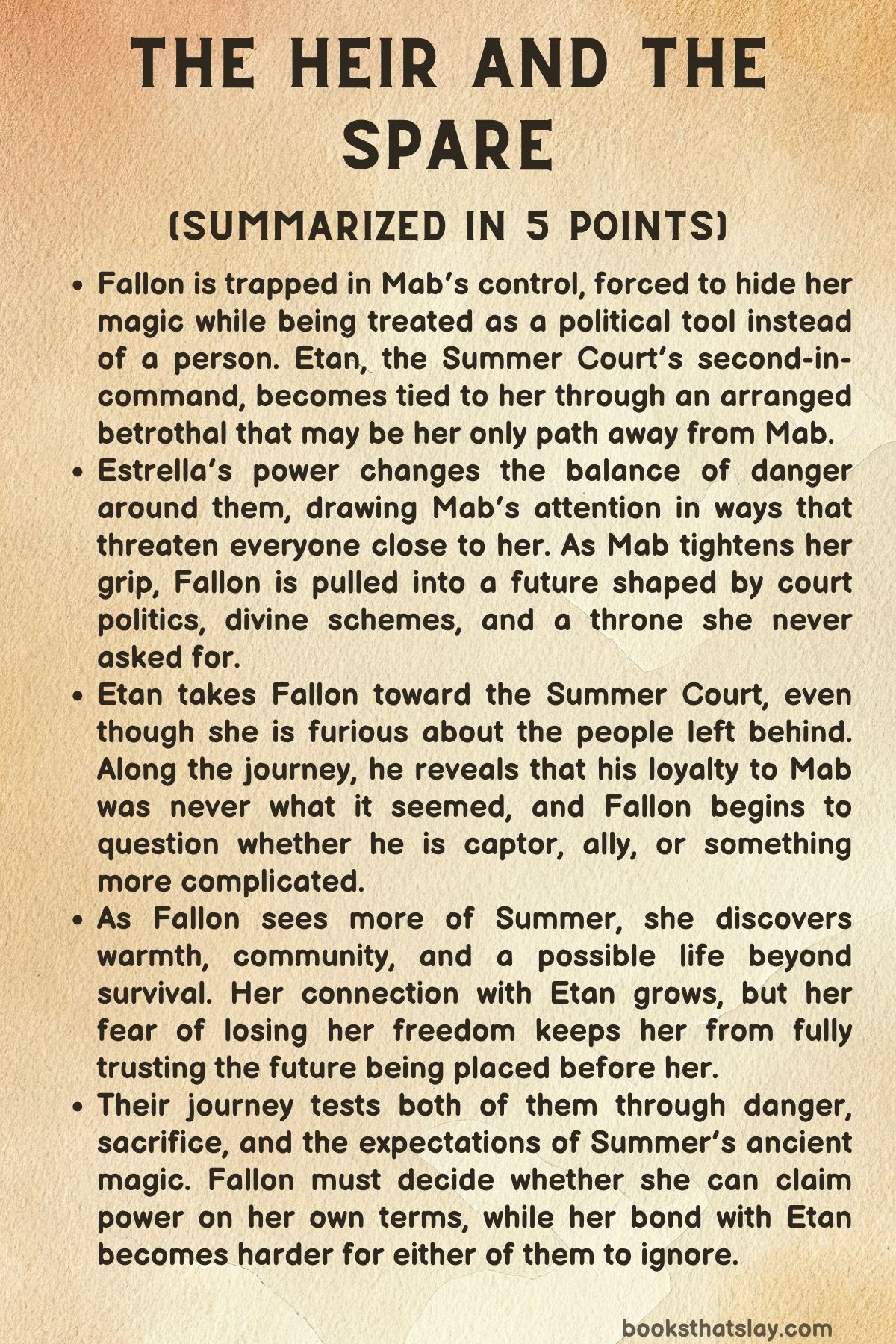
The story follows Fallon after she is dragged into the dangerous schemes of Mab, a ruler willing to use torture, marriage, and divine bargains to secure control. Etan, tied to the Summer Court and outwardly loyal to Mab, becomes both Fallon’s protector and her intended husband. As Fallon is taken from captivity toward a throne she never asked for, she must decide whether power, love, and freedom can exist together.
Summary
Fallon begins the story trapped under Mab’s power, no longer treated as a lost daughter but as a weapon waiting to be unlocked. Mab believes Fallon has magic hidden inside her and is determined to force it into the open.
Fallon insists that she is not Maeve, the daughter Mab claims to have recovered, but Mab refuses to accept her identity on Fallon’s terms. To Mab, names and choices matter only when they serve her ambitions.
Etan, second-in-command to Rheaghan of the Summer Court, watches Mab torture Fallon and quickly understands that Fallon is in terrible danger. Mab’s cruelty is not random; she wants proof of Fallon’s power and will keep breaking her until she gets it.
Fallon manages to conceal her magic with Imelda’s help, but Etan can see enough to know that Mab will not stop. He is drawn to Fallon from the beginning, not only because of desire, but because he recognizes strength in her refusal to submit.
Etan begins to work carefully against Mab from within her own circle. Rather than openly challenge her, which would only get him killed and leave Fallon helpless, he encourages Mab to believe that Fallon’s magic might rise properly in the Summer Court.
This creates a way to remove Fallon from Mab’s immediate reach. Mab and Malazan decide that Fallon should be betrothed to Etan, giving him permission to take her away once the Tithe is complete.
Mab then turns her attention to Fallon and Estrella. She forces the two women into a cruel choice: one of them must reveal useful magic and remain with Mab, while the other will be married off to Etan.
Fallon knows that refusing may only lead to worse punishment for both of them. She persuades Estrella to show what she can do, hoping this will protect them from an even harsher fate.
Estrella reveals power far greater than Mab expected. She pulls the moons and stars from the sky and shows that she can touch the threads of fate itself.
Mab realizes that Estrella is a Primordial, a being whose strength makes her almost priceless and almost impossible to trust. Estrella’s power changes the balance of the moment, but it also makes her Mab’s target in a new way.
She is no longer only a prisoner; she is a prize.
The Tithe becomes a turning point for everyone. Mab chooses Caldris as the godly sacrifice and stabs him through the heart.
Estrella refuses to let him die. She feeds him her golden blood and saves him, changing him in the process.
His shadows become touched with golden power, marking the cost and consequence of her intervention.
Mab responds by tightening her control. She places an iron-toothed snake inside Estrella’s heart, binding her through pain and threat.
Then she sends Estrella into Tartarus to retrieve a snake from Medusa’s crown. Mab’s command is both a mission and a punishment, meant to force Estrella into obedience no matter the danger.
When Rheaghan tries to stop her, Mab kills him without hesitation.
Rheaghan’s death changes Fallon’s future instantly. By blood, Fallon becomes the rightful heir to the Summer Court.
Because of the arranged marriage, Etan is positioned as the future king beside her. What was first a political escape route becomes a claim to rule, and that claim must be secured before Mab’s enemies or allies can move against them.
Fallon is devastated by the chaos around her, especially because Estrella and Imelda are left behind. She wants to follow Estrella into Tartarus, but Etan refuses to let her throw herself into almost certain death.
He takes Fallon away from the cove, even as she fights him. To stop her from rushing after Estrella, he locks her in his room and goes to Mab to gain permission to leave Tar Mesa early.
Etan also convinces Mab to delay the other gods. He knows that he and Fallon need time to reach Vallania and claim the Summer Court before any rival can challenge their rule.
Fallon resists with everything she has, but Etan uses Eryx’s sleep dust to sedate her after she attacks him. He then carries her out of Tar Mesa, choosing survival and strategy over her immediate wishes.
When Fallon wakes outside Tar Mesa, she is furious. She feels betrayed by Etan for taking her away and leaving Imelda and Estrella behind.
Her anger is not simple stubbornness; it comes from loyalty and fear. She has already lost too much control over her own life, and Etan’s decision feels like another cage, even if he insists it was meant to keep her alive.
As they ride toward the Summer Court, Etan begins to explain the truth about himself. He was never truly loyal to Mab.
His position near her allowed him to protect the Summer Court and weaken Mab’s plans from within. He has spent years appearing obedient while searching for ways to preserve his people.
Fallon does not forgive him immediately, but she begins to understand that his choices were shaped by danger, duty, and limited options.
During the journey, Fallon notices something important about herself. Sunlight strengthens the magic Imelda had hidden inside her.
The more time she spends in Summer’s warmth, the more aware she becomes of the power waiting beneath the surface. She keeps this discovery from Etan, still uncertain whether she can trust him fully and afraid of what people will demand from her if they learn what she is becoming.
The road through Summer changes Fallon’s view of the court she may one day rule. She and Etan share one horse and spend long hours together, their guarded conversations slowly becoming more honest.
Etan tells her that marriage to him will not mean the loss of her freedom. He promises that they can travel, that he does not want to imprison her, and that he wants her beside him as a partner rather than a possession.
In Oceanmere, Fallon experiences a side of life she has rarely known: warmth, music, laughter, and ordinary peace. She drinks Faerie wine, dances, braids children’s hair, and sees a community that is not built only on fear.
The Summer Court begins to feel less like a political burden and more like a place with people who might need her. For the first time, she can imagine a future that is not only about escape.
Her relationship with Etan deepens during this time. Their attraction becomes harder to deny, but the emotional shift matters just as much.
Fallon sees his patience, his restraint, and his devotion to Summer. Etan sees her courage, her compassion, and her unwillingness to abandon the people she loves.
Still, Fallon remains afraid that accepting him, the court, or the crown will cost her the independence she has fought to keep.
Their journey turns deadly when a Nuckelavee attacks them in the desert. Etan tries to make himself the sacrifice so Fallon can get away, but Fallon refuses to leave him behind.
Her response reveals who she is under pressure: reckless, brave, and fiercely loyal. She uses throwing knives, Thunder, and sheer determination to help wound the creature.
Together, they survive, and the attack strengthens the trust growing between them.
Eventually, they reach Diell’s sanctuary, a sacred place where Summer rulers must make an offering to the Primordials to receive their blessing. Etan tells Fallon that she does not have to enter the sacred bath.
He gives her a choice, but he is honest about the consequence: if she refuses, she cannot become Queen. Fallon chooses to enter because she does not want to stand beneath him or behind him.
She wants to be his equal.
Inside the sanctuary, the magic of the place takes hold of them. Fallon and Etan consummate their relationship as part of the offering demanded by the Primordials.
The moment is both intimate and political, personal and magical. It binds them more deeply while also forcing Fallon to face the truth that her path is no longer separate from Summer’s fate.
Then the Summer Court’s magic makes its choice. It does not choose Etan as its host and true ruler.
It chooses Fallon. This revelation overturns the assumptions surrounding their marriage and future.
Fallon is not merely the bride who will give Etan a stronger claim. She is the one Summer itself recognizes.
The discovery terrifies her. Fallon wanted to stand as Etan’s equal, but being chosen by the court’s magic means a level of responsibility she never asked for.
It threatens the freedom she has been trying to protect since Mab first tried to define and control her. Etan tries to reassure her, but the moment brings another truth to the surface.
The bond between them awakens, revealing that Fallon is not only Etan’s intended wife or political partner. She is his mate.
This changes everything between them. Their connection is no longer only a matter of strategy, attraction, or choice.
It is tied to magic, fate, and the future of the Summer Court, leaving Fallon to face the hardest question of all: whether love and power can become something she chooses, rather than another destiny forced upon her.
Characters
Etan
Etan is one of the central figures in The Heir and the Spare, and his character is built around restraint, hidden loyalty, and difficult moral choices. At first, he appears to be Rheaghan’s second-in-command and someone close enough to Mab’s rule to seem complicit in her cruelty.
However, as the book develops, it becomes clear that Etan’s closeness to Mab is not true loyalty but strategy. He has remained near her in order to protect the Summer Court and weaken her influence from within.
This makes him a politically careful and emotionally disciplined character, someone who understands that open rebellion would likely destroy the people he wants to save.
Etan’s relationship with Fallon reveals the softer and more conflicted parts of his nature. He is immediately drawn to her when he sees Mab torturing her, but his concern is not only romantic attraction.
He recognizes that Fallon is in danger and understands that Mab will eventually break or kill her if she remains under her control. His decision to manipulate Mab into sending Fallon to the Summer Court shows both intelligence and courage, but it also shows his willingness to make choices for Fallon without her consent.
This makes him protective, but not always entirely gentle. He believes he is saving her, yet his methods sometimes mirror the control Fallon is desperate to escape.
Etan’s greatest internal conflict comes from the tension between love and duty. He wants to protect Fallon, but he is also focused on securing the Summer Court before rivals can challenge them.
His decision to lock Fallon in his room, sedate her with Eryx’s sleep dust, and carry her out of Tar Mesa shows how far he is willing to go when he believes the larger political situation demands it. These actions make him morally complex rather than simply heroic.
He is not cruel, but he can be forceful and secretive, especially when he thinks he understands the danger better than others do.
As the story progresses, Etan becomes more emotionally open. During the journey through the Summer Court, he begins to offer Fallon not just protection but partnership.
He promises that marriage to him will not become a prison and that she will still be able to travel and make choices. His willingness to sacrifice himself during the Nuckelavee attack also shows that his love is not possessive at its core.
He wants Fallon alive, even if that means losing her. By the end, the revelation that Fallon is his mate deepens his role from political husband to fated partner, but his most important growth lies in learning that Fallon cannot simply be protected; she must be trusted as his equal.
Fallon
Fallon is the emotional and political heart of the book. She begins as someone trapped between stolen identity, hidden magic, and Mab’s violence.
Although Mab insists that she is Maeve, Fallon clings to her own name and sense of self, refusing to surrender even when tortured. This resistance is one of her defining traits.
She is not powerful because she is fearless; she is powerful because she continues to resist even while afraid, confused, and isolated.
Fallon’s magic represents both danger and identity. With Imelda’s help, she hides her power from Mab, knowing that revealing it could make her even more valuable and more vulnerable.
Her relationship with magic is complicated because it is tied to questions of freedom. The more she learns about who she is and what she can do, the more the world tries to claim her.
When Rheaghan dies and she becomes the rightful heir to the Summer Court through blood, her hidden identity becomes impossible to separate from political destiny. She does not simply inherit a title; she inherits expectations, danger, and a future she never asked for.
Fallon’s loyalty is one of her strongest qualities. She desperately wants to follow Estrella into danger and is furious when Etan takes her away from Tar Mesa.
Her anger comes from love and from the fear of becoming someone who survives by abandoning others. She is also deeply protective of Imelda and resents that she has been forced to leave people behind.
This makes Fallon emotionally intense and sometimes reckless, but her recklessness often comes from a refusal to let others suffer alone.
Her journey through the Summer Court allows a different side of her to emerge. In Oceanmere, she experiences warmth, music, wine, children, dancing, and ordinary joy.
These moments matter because they show Fallon what life could be beyond survival. She begins to imagine a future that is not defined only by captivity or flight.
Still, she remains afraid that marriage, power, and court politics will become another kind of cage. Even when Etan offers partnership, Fallon struggles to believe that love will not cost her freedom.
By the end of The Heir and the Spare, Fallon becomes far more than the woman Etan tried to rescue. The Summer Court’s magic chooses her, not Etan, as its true host and ruler.
This is a major turning point because it confirms that Fallon’s power is not secondary to Etan’s authority. She is not merely the spare bride, the hidden daughter, or the mate of a future king.
She is the chosen ruler in her own right. Her panic afterward is understandable because the choice of the magic threatens the freedom she has fought to protect, but it also marks her transformation into someone whose destiny is larger than anyone else’s plans for her.
Mab
Mab is the primary force of cruelty, domination, and political terror in the story. She is a ruler who uses pain as a method of control and treats even her own daughter as a tool to be broken open for power.
Her torture of Fallon shows how little maternal feeling she possesses, or at least how completely her hunger for control has consumed it. Mab does not seek loyalty through love or justice; she demands obedience through fear.
Her treatment of Fallon and Estrella reveals her calculating nature. By forcing the two women into a choice over who will reveal useful magic and who will be married off, Mab turns intimacy and loyalty into weapons.
She understands that people who love each other can be manipulated through sacrifice. This makes her especially dangerous because she does not rely only on physical violence.
She knows how to create impossible choices and then benefit from the suffering those choices cause.
Mab’s response to Estrella’s power shows both ambition and fear. When Estrella pulls the moons and stars from the sky and proves herself a Primordial, Mab immediately recognizes her value.
Yet she also sees her as a threat. This combination of greed and fear drives Mab’s cruelty.
She wants powerful beings near her, but only if she can control them completely. Her use of the iron-toothed snake inside Estrella’s heart is one of the clearest examples of her rule: she turns living beings into servants by making resistance physically unbearable.
Mab’s murder of Rheaghan further establishes her as ruthless and politically destructive. She kills him when he tries to intervene, but in doing so she unknowingly changes the balance of power by making Fallon the rightful heir to the Summer Court.
This shows one of Mab’s weaknesses: her cruelty can be impulsive, and her confidence can blind her to consequences. She is terrifying because she is powerful, but she is not invincible.
Her need to dominate creates the very conditions that allow others to rise against her.
Estrella
Estrella is one of the most powerful and sacrificial characters in the book. Her bond with Fallon is central to her role, because much of her significance comes through loyalty, love, and shared danger.
When Mab forces Fallon and Estrella into a cruel choice, Estrella becomes the one whose hidden power changes everything. Her ability to pull the moons and stars from the sky reveals that she can grasp the threads of fate, making her a Primordial and placing her among the most dangerous and valuable beings in Mab’s eyes.
Estrella’s power is vast, but her situation is tragic because power does not immediately bring freedom. Instead, it makes her a target.
Mab recognizes what Estrella is and immediately seeks to control her. The iron-toothed snake placed inside her heart turns her body into a prison and makes her power serve Mab’s will.
This contrast between cosmic strength and physical enslavement makes Estrella deeply tragic. She can touch fate itself, yet she is forced into obedience through pain.
Her saving of Caldris reveals her compassion and courage. When Mab stabs Caldris through the heart and declares him the sacrifice, Estrella feeds him her golden blood and saves him.
This act changes him, giving his shadows golden power, but it also exposes the extraordinary nature of Estrella’s blood and being. She saves someone else even when doing so increases the danger to herself.
That makes her heroic, but also vulnerable to exploitation by those who see her gifts as tools.
Estrella’s forced journey into Tartarus to retrieve a snake from Medusa’s crown places her in a mythic and dangerous role. She becomes a character caught between divine power, punishment, and destiny.
Even when she is not physically present with Fallon afterward, her absence shapes Fallon’s emotional state. Fallon’s desperation to follow her and fury at being taken away show how deeply Estrella matters.
Estrella represents both the cost of Mab’s cruelty and the strength of loyalty in a world where power is often used to control rather than protect.
Caldris
Caldris plays a significant role through his connection to sacrifice, survival, and transformation. When Mab stabs him through the heart and declares him the godly sacrifice during the Tithe, he becomes a symbol of Mab’s willingness to destroy even divine or powerful beings for her purposes.
His near-death moment reveals the brutality of the ritual and raises the stakes for everyone present. It is not simply an act of violence; it is a public display of Mab’s authority.
His survival depends on Estrella, whose golden blood saves him and changes him. This transformation gives his shadows a golden power, suggesting that Caldris becomes marked by Estrella’s magic in a lasting way.
He is no longer only what he was before the sacrifice. His body and power are altered by her intervention, which makes him part of the larger web of consequences created by Mab’s cruelty and Estrella’s divine nature.
Although Caldris is not the emotional center of the provided events, his role matters because he shows how power can be remade through sacrifice and love. His survival also proves that Mab’s declarations are not absolute.
She can wound, command, and punish, but she cannot fully control the outcomes once others act with courage. Caldris’s changed shadows become a sign that even violence meant to end a life can create something unexpected when opposed by a greater power.
Rheaghan
Rheaghan is important both as a political figure and as the person whose death transforms Fallon’s future. As connected to the Summer Court and positioned above Etan, he represents the older structure of Summer authority before Fallon’s claim becomes active.
His presence establishes that the Summer Court has its own hierarchy, loyalties, and vulnerabilities under Mab’s larger influence.
His attempt to intervene when Mab forces Estrella into servitude shows that he has limits to what he will tolerate. Unlike those who remain passive under Mab’s cruelty, Rheaghan tries to act when the situation becomes unbearable.
This choice costs him his life, but it also gives him moral weight. He may not be able to defeat Mab, yet his willingness to step in separates him from those who survive by silence.
Rheaghan’s death is one of the most important political turning points in the story. By killing him, Mab unintentionally makes Fallon the rightful heir to the Summer Court through blood.
This means Rheaghan’s death does not merely remove a character from power; it transfers legitimacy to Fallon. His end exposes the instability of Mab’s control, because her violence creates the very succession she might have wanted to prevent.
Imelda
Imelda is a quieter but deeply important character because she protects Fallon’s identity and power. Her help in hiding Fallon’s magic from Mab makes her one of the key reasons Fallon survives long enough to reach the Summer Court.
Imelda’s role is not based on open force but on secrecy, knowledge, and protective magic. She works in the hidden spaces where survival is made possible.
Her connection to Fallon suggests trust and care. Fallon’s anger at being taken away from Tar Mesa partly comes from the fact that Imelda is left behind.
This shows that Imelda is not merely a helper in the plot; she matters emotionally to Fallon. She represents safety, memory, and the kind of protection that does not demand ownership in return.
Imelda’s warding of Fallon’s magic also adds complexity to Fallon’s later journey. When Fallon realizes that sunlight strengthens the magic Imelda had hidden inside her, Imelda’s earlier actions continue to shape the story even in her absence.
She becomes part of Fallon’s awakening, not by forcing power into the open, but by keeping it safe until Fallon can begin to understand it herself.
Malazan
Malazan appears as a figure aligned with Mab’s political arrangements and authority. His role in arranging Fallon’s betrothal to Etan shows that he participates in the systems Mab uses to control people through marriage, power, and court strategy.
He is not described as the main source of cruelty, but he functions within Mab’s machinery of rule.
His importance lies in how he helps turn Fallon’s future into a political transaction. The betrothal to Etan is arranged not because Fallon chooses it, but because Mab and Malazan believe it serves their interests.
This makes Malazan part of the broader court structure that treats women, heirs, and magical beings as pieces to be moved. He represents the administrative and strategic side of oppressive power.
Because Etan manipulates Mab into believing Fallon’s magic may awaken in the Summer Court, Malazan’s involvement also shows how political systems can be deceived from within. He helps arrange the very outcome that allows Etan to remove Fallon from Mab’s immediate reach.
In that sense, Malazan is useful to Mab’s plans but also vulnerable to Etan’s hidden agenda.
Eryx
Eryx has a smaller role, but his sleep dust becomes important because it allows Etan to remove Fallon from Tar Mesa. The sleep dust is a practical tool, yet its use raises moral questions about consent and protection.
Through Eryx’s contribution, the story shows how even minor characters can influence major turning points.
Eryx’s presence also expands the sense of a world filled with specialized powers, resources, and hidden methods. His sleep dust is not simply an object; it becomes part of the conflict between Fallon’s desire to choose for herself and Etan’s determination to keep her alive.
Because Etan uses it after Fallon fights him, Eryx’s role is indirectly tied to one of the more troubling moments in Etan and Fallon’s relationship.
Though Eryx is not developed as deeply as the central characters in the book, his contribution matters because it enables Etan’s escape plan. Without the sleep dust, Fallon might have rushed into Tartarus after Estrella, potentially destroying herself before she could claim her place in the Summer Court.
Diell
Diell is associated with sanctuary, sacred power, and the ancient traditions of the Summer Court. The sanctuary connected to Diell is where rulers of Summer must make an offering to the Primordials to receive their blessing.
This makes Diell’s space one of testing, transformation, and legitimacy. It is not merely a place of rest after danger; it is where Fallon and Etan’s political and spiritual futures are decided.
The sanctuary forces Fallon to confront what becoming Queen would actually mean. Etan tells her she does not have to enter the sacred bath, but refusing would mean she cannot be Queen.
Through this moment, Diell’s sanctuary becomes a place where choice and destiny meet. Fallon chooses to enter because she wants to stand as Etan’s equal, and that decision marks a major step in her development.
The magic within the sanctuary also reveals that the Summer Court chooses Fallon rather than Etan. This makes Diell’s sacred space crucial to the ending of The Heir and the Spare, because it confirms Fallon’s true authority.
The sanctuary does not simply bless an arranged marriage; it overturns expectations by recognizing Fallon as the real host of Summer’s magic.
Medusa
Medusa appears through the dangerous task Mab assigns to Estrella: retrieving a snake from Medusa’s crown. Even if Medusa is not directly developed in the provided events, her presence carries symbolic weight.
She represents ancient danger, mythic power, and the terrifying depth of the world beyond the courts.
The reference to Medusa’s crown also intensifies the danger of Tartarus. Estrella is not being sent on an ordinary mission; she is being forced into a realm and task connected to legendary threat.
This makes Mab’s command even more brutal, because she sends Estrella into a situation where survival is uncertain and obedience is enforced through the snake inside her heart.
Medusa’s role also mirrors the broader use of serpents in the story. Mab uses an iron-toothed snake as a tool of control, while Estrella is sent to retrieve another snake from Medusa’s crown.
Snakes become symbols of punishment, power, and forced submission. Through this connection, Medusa’s presence strengthens the darker mythological atmosphere of the book.
Themes
Power, Control, and Resistance
Power in The Heir and the Spare is shown as something that can protect, imprison, or destroy depending on who holds it. Mab uses authority through fear, torture, forced choices, political marriages, and physical control.
Her rule depends on making others believe they have no real freedom, whether she is threatening Fallon, using Estrella’s magic, or killing Rheaghan when he challenges her. Against this cruelty, resistance does not always look loud or heroic.
Fallon resists by hiding her magic, refusing to give Mab what she wants, and trying to protect Estrella even when she is powerless. Etan resists in a quieter way, pretending loyalty while working to protect the Summer Court from inside Mab’s circle.
The theme becomes more complex because power is not only external; Fallon’s own magic is growing inside her, and she must decide whether accepting it will free her or trap her in another role. The struggle is not simply about defeating Mab, but about learning how to hold power without becoming like her.
Freedom, Duty, and the Fear of Becoming Trapped
Fallon’s deepest conflict comes from wanting freedom while being pushed toward duty. She has already been controlled by Mab, separated from people she loves, and forced into a marriage arrangement she did not choose.
Because of this, every new responsibility feels dangerous, even when it comes from a place of care or destiny rather than cruelty. Etan promises that marriage to him will not become another prison, but Fallon’s fear is not easy to dismiss because her life has taught her that promises can become chains.
Her journey through the Summer Court begins to shift her perspective. Oceanmere shows her a version of belonging that is warm rather than suffocating, and her bond with ordinary people helps her imagine leadership as something more than confinement.
Still, when the Summer Court’s magic chooses her, panic rises because queenship threatens the independence she has fought to keep. The theme shows that freedom is not just escape; it is the ability to choose duty willingly, without losing the self.
Trust, Vulnerability, and Emotional Healing
Trust grows slowly because both Fallon and Etan begin from places shaped by fear, secrecy, and survival. Fallon sees Etan first as a captor because he takes her away from Estrella, locks her in his room, and sedates her to stop her from running into danger.
Even when his motives are protective, his actions echo the control she has already suffered. Etan, meanwhile, carries the burden of pretending loyalty to Mab, hiding his true intentions, and making harsh choices for the sake of the Summer Court.
Their emotional movement depends on difficult honesty. As Etan reveals that he has been undermining Mab rather than serving her, Fallon begins to see the difference between control meant to dominate and protection born from desperation.
Their shared journey forces them into closeness, but true intimacy comes through moments of risk: his willingness to sacrifice himself, her refusal to abandon him, and their gradual acceptance of each other’s pain. Healing is presented as uneven, fragile, and built through repeated acts of courage.
Identity, Destiny, and Equal Partnership
Fallon’s identity is constantly being defined by others: Mab calls her Maeve, politics names her heir, marriage positions her beside Etan, and magic marks her as ruler. Her struggle is to claim who she is before these roles consume her.
In The Heir and the Spare, identity is not fixed by blood alone; it is tested through choice, loyalty, and the courage to accept unwanted truths. Fallon does not enter the sacred bath because she wants a crown for its own sake.
She enters because she refuses to stand beneath Etan or become only the woman attached to his rule. That decision changes the meaning of their relationship.
The Summer Court chooses her, proving that she is not secondary to Etan’s claim but central to the court’s future. The awakening of the mate bond deepens this theme because partnership becomes more than political convenience or arranged marriage.
Yet destiny does not erase fear. Fallon must still decide how to live with a role she did not seek while insisting on equality, agency, and selfhood.