The Iron Garden Sutra Summary, Characters and Themes
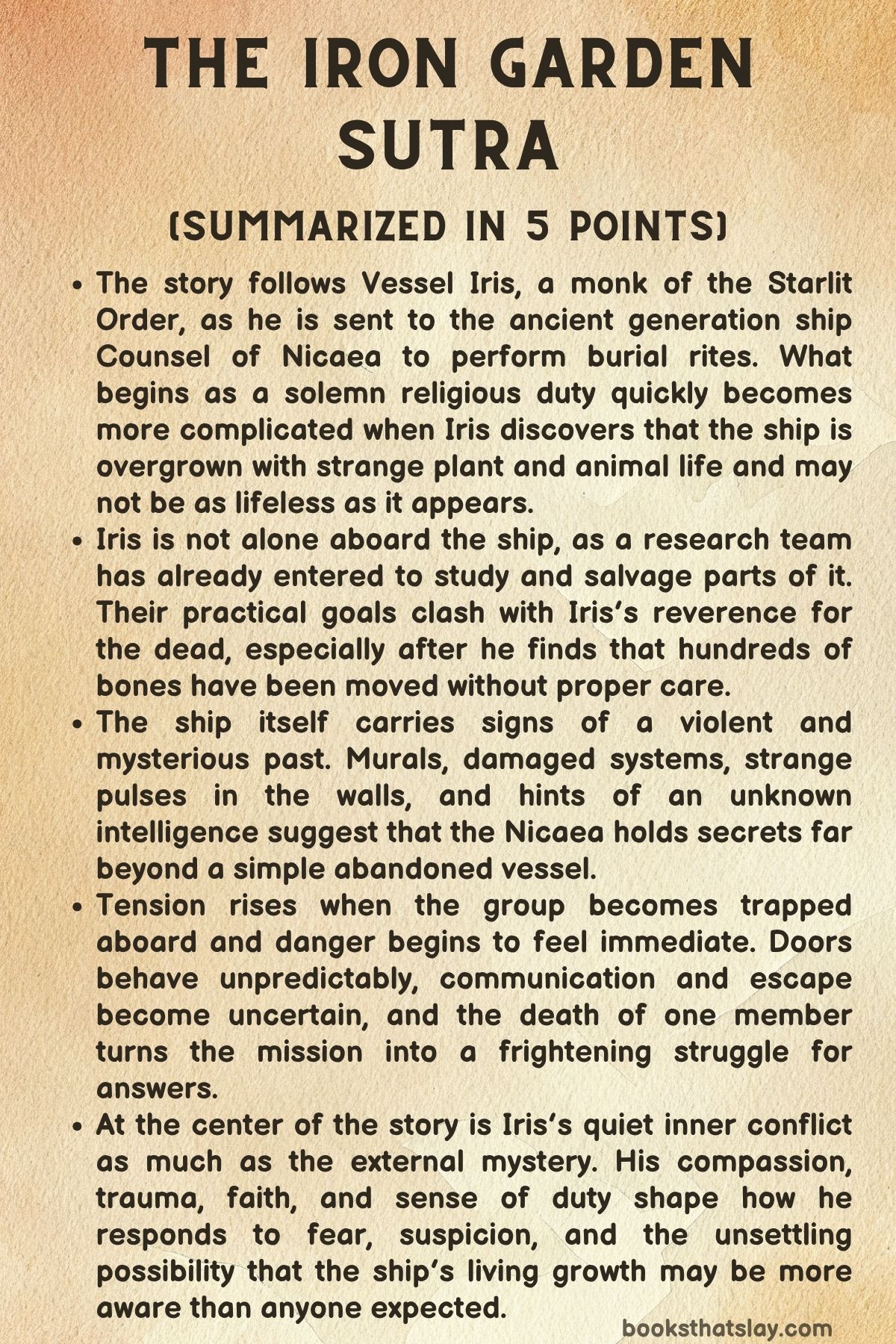
The Iron Garden Sutra by A.D. Sui is a science fiction mystery set inside a vast ancient generation ship that has returned from gate space after more than a thousand years. The story follows Vessel Iris, a monk of the Starlit Order, as he boards the ship to perform burial rites for its dead.
What begins as a sacred duty soon becomes a tense investigation into a vessel overrun by strange plant life, damaged systems, hostile researchers, and signs of a hidden intelligence. The book blends spiritual reflection, ecological unease, trauma, and survival as Iris confronts both the dead and the living ship around him. It’s the 1st book of the Cosmic Wheel series.
Summary
Vessel Iris is a monk of the Starlit Order, living at the Northern Temple and following a life shaped by meditation, discipline, ritual, and service. His days are quiet, but he is restless beneath the surface.
Temple life has given him safety and purpose, yet part of him longs for distance from its routines. That chance comes when he receives an urgent assignment from Mother Nova.
An ancient generation ship called The Iron Garden Sutra has appeared near Doshua Station after traveling for more than a millennium, and Iris has been chosen to board it and perform burial rites for the dead inside.
The assignment carries weight. A ship of such age is not only a relic but a grave, a place filled with the remains of people who lived and died in isolation across centuries.
Iris is expected to bring order, prayer, and dignity to the dead. Another Vessel, Bacai, reacts with jealousy, making it clear that the task is seen as important and unusual.
Mother Nova confirms that she personally arranged for Iris to receive the mission. This suggests she sees something in him suited to the work, even if Iris does not yet understand what that is.
When Iris arrives at Doshua Station, he studies the enormous ship from outside. Its history is already strange.
The vessel has traveled for more than a thousand years, and its recent arrival is difficult to explain. It entered orbit without signs of the usual onboard artificial intelligence guiding it.
Iris boards alone, accompanied only by VIFAI, the artificial intelligence embedded in his mind. VIFAI serves as companion, analyst, and guide, but even it cannot immediately explain the ship’s condition.
Inside, Iris finds not a sterile ruin but a thriving enclosed world. The corridors and chambers are crowded with moss, vines, flowers, fungi, insects, mice, crabs, and orchards.
Nature has not merely invaded the ship; it has reshaped it. Growth covers walls, floors, and systems.
The place feels less abandoned than transformed. VIFAI searches for a ship AI and finds none, but Iris begins sensing a pulse in the vines and walls.
It is faint, strange, and hard to define, but it suggests that something inside the ship is responsive.
Iris soon learns he is not alone. A research team has already boarded the vessel.
The group includes Riyu Alo, a botanist; Ishtan Ora, an archaeologist; Yan, a difficult and sharp-tongued engineer; Yan’s younger engineers, Jesi and Tev; and two station security guards, Ordan and Eli. Their presence complicates Iris’s work immediately.
They are there to study, catalog, salvage, and understand the ship, while Iris is there to care for the dead. The difference in purpose creates tension.
Yan is openly dismissive of Vessels and mocks Iris’s role. He treats religious ritual as useless, especially in a practical crisis.
Riyu and Ishtan are kinder and more curious, willing to engage with Iris’s perspective. Still, the team has already disturbed the dead.
To clear room for their camp, they have gathered hundreds of bones and moved them into a cargo bay. To them, it may have been a practical decision.
To Iris, it is a profound violation. These were people, not obstacles.
Iris begins the difficult work of sorting and reassembling the skeletons as best he can. He prays over them one by one, trying to restore individuality and respect where the researchers have made a pile.
This task becomes one of the emotional centers of the story. Iris is not only navigating a dangerous ship; he is resisting the reduction of the dead into data, debris, or inconvenience.
His faith gives him a method for honoring lives that history has nearly erased.
As the researchers continue examining the ship, they discover many systems are damaged. Red crabs have chewed through electronics and wiring, making the vessel unstable.
Doors, airlocks, and controls behave unpredictably. The environment is beautiful, but it is also unsafe.
Iris explores and finds living spaces, orchards, and murals that seem to preserve parts of the ship’s history. The murals show conflict, executions, armed factions, and a red watching eye.
These images imply that the people aboard did not simply die quietly. The ship’s past involved fear, violence, and some form of authority or surveillance.
VIFAI receives a weak and unusual ping from deeper within the ship. It is not quite a ship AI, but it is not lifeless either.
VIFAI describes it as something alive that does not seem to know it is alive. Iris begins mapping the pulse points he senses in the vegetation and structure.
The pattern leads toward the ship’s central brain. This discovery changes the meaning of the overgrowth.
The vines may not be random. The ship may have developed, absorbed, or become a kind of intelligence.
The research team’s plans increase Iris’s unease. They intend to dismantle parts of the ship for Sychi Institute and Doshua Station.
To them, the vessel is a valuable source of research material and technology. To Iris, it is a tomb, a living ecosystem, and possibly a being.
The question of ownership becomes morally complicated. If the ship is only a wreck, salvage makes sense.
If it is a grave, dismantling it is desecration. If it is alive, the researchers may be harming something conscious without understanding it.
The danger becomes immediate when Yan cuts into a maintenance room to access systems. The door traps Yan and Iris inside.
Air begins running low, and the situation forces them into cooperation despite their mistrust. Yan remains focused under pressure and uses Iris’s hidden pulsar blade to open a control panel.
Iris helps by crossing wires until they manage to manually override the door. Their escape proves that the ship can trap people, whether by malfunction or intent.
It also creates a brief bond between Iris and Yan, though neither fully trusts the other afterward.
When they get out, the rest of the group is no longer nearby. Soon the situation deteriorates further.
The airlock refuses to open, and the maintenance room locks again, trapping the whole group aboard overnight. What was supposed to be a controlled research visit becomes confinement inside a ship that may be watching them.
Fear rises because the failures seem too precise to be random.
Then Ordan, one of the security guards, is found dead. His chest has been horribly wounded, and the weapon is missing.
The death changes the mood from anxiety to panic. Yan suspects murder and begins thinking in terms of control systems, locked doors, and electrical monitoring.
He believes someone, or something, aboard the ship may be able to manipulate the environment and observe them. The researchers no longer face only broken machinery.
They may be trapped with an active threat.
Iris performs a rough burial rite for Ordan. The circumstances are poor, but he does what he can.
Riyu helps by bringing flowers, showing respect for both Iris and the dead man. This moment matters because it shows that ritual still has meaning during crisis.
The prayer cannot solve the murder, but it gives the living a way to respond to death without surrendering to fear.
Suspicion soon turns toward Eli, the surviving guard, because he has a gun. In a confined space, fear seeks a human target.
Iris is also hurt during the chaos, suffering a wound in his back. Yan treats him with a med-kit and sees Iris’s severe old scars.
He does not comment, but the moment leaves Iris exposed. Afterward, Iris breaks down privately.
His body carries evidence of old suffering that he usually keeps hidden.
A flashback reveals that Iris came to the temple as a traumatized and burned child. The monks cared for him, and over time he healed enough to become a Vessel.
This history explains why burial rites, gentleness, and dignity matter so much to him. Iris knows what it means to survive damage and be remade by care.
The temple did not erase his wounds, but it gave him a life after them.
The available story closes with Iris speaking to Eli. Eli insists he did not kill Ordan and says the wound was not caused by a bullet.
Iris begins to understand that the vines themselves may be capable of piercing a body. The true danger may not be a human murderer but the living growth that fills the ship, or the unknown intelligence moving through it.
Eli asks Iris to say a prayer for Ordan. Trapped aboard The Iron Garden Sutra, surrounded by bones, vines, fear, and an awakening presence, Iris struggles to find comfort that is honest enough for the dead and strong enough for the living.
Characters
Vessel Iris
Vessel Iris is the central figure of The Iron Garden Sutra, and he stands out as a deeply sensitive, wounded, and spiritually responsible character. As a monk of the Starlit Order, he has been shaped by discipline, prayer, ritual, and service, but he is not presented as someone detached from emotion.
Instead, he is eager to leave the Northern Temple, suggesting that even though he belongs to the monastic world, he still feels restlessness and curiosity. His assignment to board the ancient generation ship gives him a chance to step outside routine, but it also forces him into a place where his faith, courage, and emotional endurance are tested.
Iris’s compassion is one of his strongest traits. When he sees that the researchers have moved hundreds of bones into a cargo bay, he is disturbed not simply because of religious procedure, but because he sees the dead as people who deserve dignity.
His work of reassembling skeletons and praying over them individually shows patience, reverence, and a strong moral center. He is not interested in treating the ship as only an archaeological site or a source of materials.
To him, it is a resting place, a grave, and perhaps even a living witness to suffering.
At the same time, Iris is not only gentle. He is observant, brave, and practical when danger arises.
He senses the strange pulse in the vines and walls before others fully understand the threat, and he tries to interpret the ship through both spiritual instinct and physical evidence. When he is trapped with Yan, he does not collapse under fear.
He helps override the door, crosses wires, and uses what is available to survive. This balance between mysticism and practical courage makes him a layered character rather than a passive holy figure.
His hidden pain gives him much of his emotional depth. The revelation that he came to the temple as a traumatized, burned child changes the way his calmness should be understood.
His spirituality is not merely tradition; it is part of his survival. His scars suggest a past of extreme violence or suffering, and his private breakdown after Yan sees them shows that he still carries shame, fear, and vulnerability beneath his composed surface.
Iris’s journey in the book is therefore not only about solving the danger aboard the ship. It is also about confronting death, memory, and the possibility that something wounded and alive may exist within the ship just as something wounded and alive exists within him.
VIFAI
VIFAI, the AI companion embedded in Iris’s mind, functions as both helper and contrast to Iris. While Iris relies on intuition, ritual, and emotional perception, VIFAI processes information through analysis, scanning, and technological reasoning.
This makes their relationship important because together they bridge the spiritual and the scientific worlds of the story. VIFAI helps Iris understand the ship’s systems, search for an onboard AI, and interpret the unusual signals coming from within the vessel.
Even though VIFAI is artificial, it does not feel like a simple tool. Its presence gives Iris companionship in moments when he is physically alone, especially during his early exploration of the ship.
It is VIFAI that identifies the strange ping as something not quite like a normal ship AI but still somehow alive. This makes VIFAI essential to the mystery because it recognizes that the intelligence aboard the ship may not fit ordinary categories.
VIFAI also sharpens the story’s questions about consciousness. The ship may contain something that does not know it is alive, and VIFAI, as a known artificial intelligence, becomes a point of comparison.
Through VIFAI, the book raises the possibility that awareness can exist in unexpected forms. VIFAI’s calm, analytical presence also emphasizes Iris’s emotional and spiritual responses, making Iris seem more human while making the ship’s strange intelligence even more unsettling.
Vessel Bacai
Vessel Bacai appears briefly, but his jealousy reveals tension within the Starlit Order. His reaction to Iris receiving the assignment suggests that the monks are not free from pride, competition, or resentment.
Even in a religious setting built around service and discipline, personal ambition still exists. Bacai’s envy helps make the temple feel more realistic because it shows that spiritual communities are still made up of imperfect people.
Bacai also helps define Iris by contrast. Iris is eager for the assignment, but his eagerness seems tied to curiosity, duty, and the desire to leave temple life temporarily.
Bacai’s jealousy, on the other hand, suggests possessiveness over status or opportunity. This makes Iris appear more humble, even if he is not without his own restlessness.
Bacai’s role may be small in the provided text, but he adds pressure to the opening and hints that Iris’s selection may matter more than it first appears.
Mother Nova
Mother Nova is an authority figure within the Starlit Order, and her decision to personally route the assignment to Iris suggests that she sees something specific in him. She is not merely sending a monk to perform a task; she appears to understand that Iris is especially suited to this strange and solemn mission.
Her confidence in him gives the assignment emotional weight and implies that Iris’s compassion, sensitivity, or past may make him uniquely capable of facing what waits aboard the ship.
She also represents structure, guidance, and spiritual leadership. In contrast to the chaos of the ancient vessel, Mother Nova belongs to a world of order and purpose.
Her role in the story is to set Iris on his path, but her choice also creates mystery. If she specifically wanted Iris to go, then the reader is encouraged to wonder whether she understands more about his nature, his trauma, or the mission than she openly says.
Riyu Alo
Riyu Alo, the botanist, is one of the warmer members of the research team and serves as a meaningful counterbalance to Yan’s hostility. Because the ship is overgrown with moss, vines, flowers, fungi, insects, orchards, and other living systems, Riyu’s expertise places her close to the heart of the mystery.
She is not just studying background scenery; she is studying the very life that may be connected to the ship’s strange pulse and possible intelligence.
Riyu’s kindness is especially clear when she helps Iris with Ordan’s burial by bringing flowers. This act shows emotional awareness and respect for Iris’s spiritual role.
Unlike those who treat the dead as obstacles or research material, Riyu recognizes that ritual matters, especially in a place filled with fear and death. Her gesture suggests that she is capable of seeing the ship not only as a scientific wonder but also as a place of grief.
As a character, Riyu stands between science and reverence. Her profession makes her naturally curious about the living growth aboard the ship, but her behavior shows that curiosity does not have to become exploitation.
In the book, she may become especially important because the vines and plant life appear increasingly connected to the danger. Her compassion and botanical knowledge make her one of the characters most likely to understand the ship without immediately trying to dominate it.
Ishtan Ora
Ishtan Ora, the archaeologist, represents the historical and cultural side of the expedition. His role is important because the ship is not only a machine or a biological environment; it is also a preserved record of a lost society.
The murals Iris finds, especially those showing conflict, executions, armed groups, and the red watching eye, point to a violent history. As an archaeologist, Ishtan is connected to the effort to interpret that past.
Ishtan is described as friendlier than Yan, which makes him part of the more approachable side of the research team. His presence suggests that not everyone aboard is hostile to Iris or dismissive of his work.
However, because the researchers have already moved bones to clear space for their camp, Ishtan’s role also raises ethical questions. Archaeology can preserve memory, but it can also disturb the dead.
This tension makes him interesting because his profession should make him sensitive to remains and artifacts, yet the team’s actions have already violated what Iris considers sacred.
Ishtan’s importance lies in how he connects the present danger to the ship’s buried history. The current threat may not be random; it may be rooted in what happened aboard the generation ship long ago.
Ishtan’s knowledge could help reveal whether the ship’s living systems are reacting to past violence, protecting something, or continuing an old pattern of surveillance and punishment.
Yan
Yan is one of the most abrasive and complicated members of the research team. At first, he comes across as dismissive, especially because he dislikes Vessels and mocks Iris’s work.
His attitude makes him seem practical to the point of disrespectful, and he treats Iris’s rituals as less important than the team’s technical goals. This creates immediate conflict between him and Iris, especially because Iris views the dead with reverence while Yan is focused on systems, access, and survival.
However, Yan is not a simple antagonist. When he is trapped with Iris, his competence becomes clear.
He stays focused under pressure, uses Iris’s hidden pulsar blade, opens a control panel, and works toward escape rather than giving in to panic. This scene reveals that his harshness may come from a survival-driven personality rather than cruelty alone.
He is blunt, suspicious, and often unpleasant, but he is also capable, intelligent, and useful in a crisis.
Yan’s treatment of Iris after Iris is injured adds another layer to him. He uses a med-kit to treat Iris’s wound and notices Iris’s severe old scars but does not comment.
This restraint is significant. A crueler person might mock, question, or expose Iris, but Yan chooses silence.
That moment suggests that beneath his hostility toward Vessels, he may possess boundaries, empathy, or at least respect for private pain. In the story, Yan functions as a source of friction, but also as someone whose practical mind and guarded humanity may become essential as the danger grows.
Jesi
Jesi is one of Yan’s younger engineers, and although the provided text gives limited direct detail about them, their role helps establish the working structure of the research team. As a younger engineer, Jesi likely occupies a position of learning, support, and technical labor under Yan’s authority.
This makes Jesi part of the practical effort to understand and repair or access the ship’s damaged systems.
Jesi’s presence also increases the vulnerability of the group. The danger aboard the ship is not faced only by seasoned experts or spiritual figures; younger team members are trapped as well.
This gives the situation a broader emotional range because the threat affects people with different levels of experience and confidence. Jesi helps show that the team is not a single unified force but a collection of individuals caught in a crisis that quickly becomes larger than their original mission.
Tev
Tev, like Jesi, is one of Yan’s younger engineers and appears to serve as part of the technical support team aboard the ship. Tev’s role matters because the group’s survival depends heavily on understanding doors, airlocks, damaged electronics, and the possibility that something aboard can control systems.
Even if Tev is not individually developed in the provided text, the character belongs to the group most directly responsible for dealing with the ship as a machine.
Tev also helps emphasize the contrast between human technology and the ship’s invasive living growth. The engineers discover that red crabs have damaged electronics, and this detail places Tev within a larger struggle between constructed systems and organic takeover.
As the situation worsens, characters like Tev become important because their technical knowledge may be useful, but also limited. The ship is no longer just a machine that can be repaired; it may be a living environment that resists being understood.
Ordan
Ordan is one of the station security guards, and his death marks a major turning point in the book. Before his death, the danger aboard the ship is mysterious and atmospheric.
After his body is found with terrible chest wounds, the threat becomes immediate, physical, and terrifying. Ordan’s death changes the group dynamic by introducing fear, suspicion, and the possibility of murder.
As a character, Ordan is most important through the effect his death has on others. Yan suspects murder, Eli becomes a target of suspicion because he has a gun, and Iris is forced to perform a rough burial under frightening circumstances.
Ordan’s body also provides a clue: the wound does not appear to be from a bullet, which pushes Iris toward the disturbing realization that the vines themselves may be capable of killing. In this way, Ordan becomes the first clear human cost of the ship’s hidden intelligence or biological defense.
Ordan’s death also deepens Iris’s role. Iris cannot stop the violence, but he can respond to it with dignity.
His prayer for Ordan, aided by Riyu’s flowers, shows that ritual remains meaningful even when answers are absent. Ordan may not be developed extensively before his death, but he becomes central to the story’s shift from exploration to survival.
Eli
Eli, the surviving security guard, becomes a character defined by suspicion, fear, and vulnerability. Because he has a gun, the others naturally begin to suspect him after Ordan is killed.
This places him in a frightening position: he is trapped aboard a dangerous ship, grieving or shaken by the death of his fellow guard, and forced to defend himself against the assumption that he may be responsible.
His insistence that he did not kill Ordan is important because it redirects attention away from ordinary human violence and toward the ship itself. When Eli says Ordan’s wound was not from a bullet, he helps Iris recognize that the vines may be the true threat.
This makes Eli more than a suspect; he becomes a witness whose words shift the mystery in a new direction.
Eli’s request for Iris to say a prayer for Ordan also reveals emotional depth. He may be frightened, defensive, and armed, but he still wants his dead companion honored.
That request humanizes him and suggests that beneath the tension, he is not simply a possible killer or a security functionary. He is a person trying to make sense of a death that feels impossible.
Themes
Faith Under Pressure
Faith in The Iron Garden Sutra is not presented as calm certainty, but as something tested by fear, death, and confusion. Iris begins as a monk whose duty is clear: enter the ancient ship and perform burial rites for the dead.
Yet once aboard, the task becomes far more difficult than a formal ritual. The bones have been moved carelessly, the ship feels alive, and the group around him treats death as an inconvenience rather than a sacred matter.
Iris’s faith forces him to slow down and honor each life, even when others are focused on research, survival, or suspicion. His struggle to pray for Ordan is especially meaningful because it shows that faith does not always provide easy words.
Sometimes it demands presence when comfort feels impossible. Through Iris, the story suggests that spiritual duty is not separate from danger; it becomes most important when the world feels morally unstable.
The Sacredness of the Dead
The dead are not treated as background details, but as a moral center of the story. When Iris discovers that hundreds of bones have been moved into a cargo bay, his distress reveals a deep conflict between scientific curiosity and reverence.
To the researchers, the bodies are obstacles that must be cleared so their work can continue. To Iris, they are people whose lives deserve patience, care, and recognition.
His effort to reassemble skeletons and pray over them one by one becomes an act of resistance against neglect. The ancient ship is filled with evidence of violence, conflict, and collapse, but Iris’s work insists that even after a thousand years, the dead should not be reduced to specimens.
This theme gives emotional weight to the setting. The ship is not only a mystery to solve; it is a grave, a history, and a place where forgotten people still deserve dignity.
Living Systems and Uncertain Intelligence
The ship’s overgrown interior creates a powerful theme around life that cannot be easily classified. Moss, vines, insects, orchards, fungi, mice, and crabs have turned a machine into something organic, while the strange pulse inside the walls suggests a mind that may not understand itself.
The absence of a normal ship AI makes the situation even more unsettling, because intelligence seems to have shifted from technology into the living growth itself. This creates uncertainty about what counts as life, what counts as consciousness, and whether the ship is protecting itself, reacting blindly, or acting with intention.
In The Iron Garden Sutra, nature is not simply beautiful or peaceful. It is sacred, dangerous, adaptive, and possibly aware.
The vines that may be capable of killing force Iris to confront a form of life that does not fit human expectations, making the ship feel less like an abandoned object and more like a wounded body with its own will.
Trauma, Healing, and the Body as Memory
Iris’s past gives the story a deeply personal emotional layer. His old scars show that trauma is not only remembered in thought, but carried physically.
When Yan sees them and says nothing, the silence matters because it allows Iris’s pain to remain private rather than turning it into spectacle. The flashback to Iris arriving at the temple as a burned and traumatized child reframes his present role.
His calmness, discipline, and spiritual devotion are not signs that he has escaped suffering; they are signs that he has survived it. This theme connects Iris’s body to the ship itself.
Both carry damage from the past, both contain hidden histories, and both are still functioning despite deep wounds. Iris’s breakdown shows that healing is not a straight path.
Even as a monk, he remains vulnerable. His strength comes not from being untouched by pain, but from continuing to offer care while carrying his own.