The New Neighbors Summary, Characters and Themes
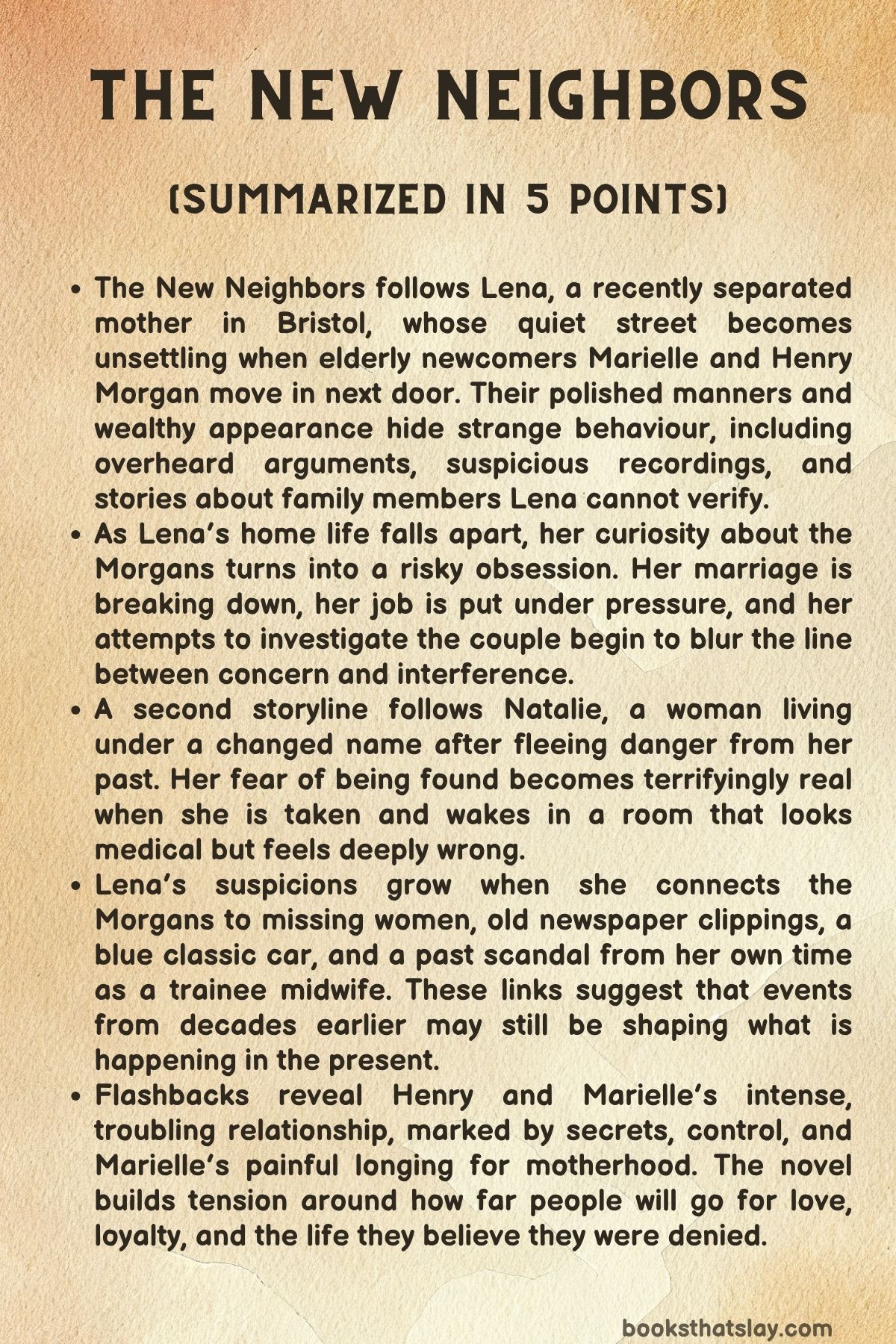
The New Neighbors by Claire Douglas is a domestic suspense novel about suspicion, secrets, and the danger of assuming that respectable appearances mean harmless lives. The story follows Lena, a separated mother in Bristol, who becomes unsettled by the wealthy elderly couple next door after overhearing a disturbing argument.
What begins as neighbourly curiosity turns into an obsessive search for the truth, pulling Lena into old crimes, false identities, missing women, and memories from her own past. Claire Douglas builds tension through ordinary settings, private fears, and shifting timelines, showing how the past can return through the smallest cracks in daily life.
Summary
Lena is living in Bristol after separating from her husband, Charlie, and trying to keep life steady for her teenage son, Rufus. She is already under pressure when she meets her new neighbours, Marielle and Henry Morgan.
On the surface, they appear refined, wealthy, and perfectly respectable. They are elderly, well dressed, and polite, the kind of couple who seem unlikely to cause concern.
Yet Lena soon hears something that makes her question everything about them.
While helping Rufus collect sounds for a college project, Lena accidentally records part of a tense conversation between the Morgans. Henry sounds afraid and says that something is too dangerous and that they could get caught.
Marielle insists that he promised to “take her,” says that the room is ready, and reminds him that they got away with something before. The words are vague, but their meaning feels threatening.
Lena cannot ignore the sense that something serious is hidden behind the walls of the house next door.
Lena’s personal life makes her more vulnerable to becoming absorbed by the mystery. Rufus is growing up and moving toward independence.
Charlie has moved out, and Lena later sees him kissing another woman. He also tells her that they may need to sell the family home and talk seriously about divorce.
With her marriage breaking down and her future uncertain, Lena becomes increasingly focused on the Morgans. Her friend Jo listens to the recording with her, and together they decide to leave the microphone running overnight.
That night, Lena hears a disturbance in her garden and finds the gate open and a pot overturned. The recording later captures a man saying he had forgotten about the dog, which makes Lena even more uneasy.
At the same time, another woman’s story unfolds. Natalie is living under a different name because she is frightened of people from her past.
After her photograph appears in a local newspaper, she becomes convinced that she is being watched. When a caller uses her real name, she panics and decides to leave.
She packs quickly and goes out at night, but in a park she realizes someone is following her. She runs toward a car for help, only to be grabbed.
When she wakes, she is in a strange room that looks clinical, but she soon understands she is not in a hospital. She is weak, drugged, and being held prisoner by a masked woman who behaves like a nurse.
Back in Bristol, Lena notices more strange details about Marielle. Marielle claims to have a grandson named Arthur, but she repeatedly stops Lena and Lena’s mother from seeing inside the pram.
Lena also sees Marielle carrying medical supplies. The story Marielle gives about her family begins to seem false.
Lena then meets Drew Mayhew through her work at Citizens Advice. Drew is searching for his missing sister, Sarah-Jane, and Lena learns that Henry once worked with her at a clinic.
Drew says Sarah-Jane had felt unsafe before she vanished and believed she was being followed by a blue classic car. Since Henry drives a blue Jaguar and lies about Sarah-Jane being sacked, Lena begins to suspect that the Morgans may have had something to do with her disappearance.
Lena’s suspicion grows when she finds a key with a knitted pink bear in the Morgans’ garden. She also discovers an old spare key to their house.
When the Morgans say they are away, she lets herself into their home. Inside, she hears a baby crying upstairs and finds a nursery.
But the baby in the cot is not real. It is a lifelike doll.
This discovery shocks her and convinces her that Marielle’s talk of a grandson may be part of a larger deception. Later, Lena checks the library where Marielle claimed her daughter-in-law Heidi works.
She learns that the woman she saw with Marielle is actually Lindy, a former student with a baby daughter, not Marielle’s daughter-in-law. Marielle seems to have invented a son, a daughter-in-law, and a grandchild.
Lena’s involvement with Drew becomes professionally risky. She crosses boundaries by visiting his home and helping him search for Sarah-Jane.
Her manager, Susi, reprimands her, gives her a verbal warning, and withdraws the possibility of full-time hours. Lena hides the full truth from Rufus, telling him only that work will remain part-time.
Rufus offers to find a summer job to help with money, but Lena refuses to let him carry that burden. Even though the warning should make her step back, Lena cannot stop thinking about the Morgans.
Drew later tells Lena that Sarah-Jane has been found safe in St Albans. She was not kidnapped by the Morgans after all.
The blue car that followed her belonged to an obsessive ex, not Henry. This should weaken Lena’s suspicions, but it does not explain the fake baby, the locked pram, the medical supplies, or Henry’s threat.
When Lena is inside the Morgans’ house again, another intruder enters, and she barely escapes after realizing the person is not Drew.
The story also moves into the past, showing Henry and Marielle’s early relationship in London during the 1980s. Henry is a lonely surgeon with a painful childhood and a history of abuse.
He meets Marielle at a party and becomes deeply devoted to her. Marielle is beautiful, confident, and used to getting what she wants.
She worries that her stepmother, Violet, is turning her wealthy father against her. When Violet later dies in a suspicious drowning, Marielle treats the death almost like a victory and uses it as a reason to celebrate her engagement to Henry.
As their wedding approaches, Marielle begins speaking eagerly about children, while Henry grows frightened. He believes he should never become a father.
In the present, Jo visits Lena and urges her to stop interfering, especially after the trouble at work. But Lena has gathered too many disturbing clues to let the matter go.
She studies photographs of newspaper clippings from the Morgans’ house and notices one from the Salisbury Journal about an electrical company winning an award. In the picture, she sees a woman who looks like Simone Harvey, a former supervising midwife from Lena’s past.
This discovery pulls Lena back to 1999, when she was training as a midwife at St Calvert’s Maternity Hospital in London. Simone was confident, stylish, and impressive, and Lena admired her.
They began spending time together, but Simone’s friend Dan warned Lena that Simone was ambitious in a dangerous way and involved in something illegal at the hospital. Lena ignored him and became close to Simone’s brother, Oliver, starting a relationship with him.
Over time, Lena saw signs that Simone was lying about her life and was involved with Dr Hugh Warrington, a married doctor. Lena became especially suspicious when Simone and Hugh appeared to falsify drug records for a patient named Natalie Grant.
Natalie died after giving birth, and the scandal led to a court case. Simone was acquitted, but Lena believed she was guilty and cut her out of her life.
Lena begins digging into Marielle’s background and discovers that Marielle had a wealthy father and a stepmother, Violet, whose drowning was ruled accidental. Lena visits Marielle’s half-sister Savannah while pretending to be interested in osteopathy.
Savannah reveals that Marielle never had children. This confirms that Peter, Heidi, and baby Arthur are all inventions.
Lena then finds Oliver online and notices that he has a blue knitted bear keyring matching the pink one found near the Morgans’ garden. She contacts him to ask about Simone.
Oliver tells Lena that Simone is missing. When they meet in Salisbury, he explains that Simone had been living there under the name Natalie Grant.
She had retrained as an electrician and was hiding from a drugs gang. Oliver recognizes the pink bear keyring as Simone’s.
Lena tells him about the Morgans, the newspaper clipping, the fake baby, and Henry’s warning. Oliver reveals that Simone did not disappear recently, but the previous August.
Lena realizes that the link between Simone and the Morgans may be older, stranger, and more dangerous than she first imagined.
Meanwhile, Natalie remains trapped in the clinical room, hungry and terrified. A nurse and a masked man come in with a syringe and demand answers from her.
When the man says a name, Natalie remembers who they are and why they have taken her. The past that Lena thought she had left behind is now tied directly to the house next door.
Henry’s memories reveal more about his marriage. He never wanted children, but Marielle desperately did.
When fertility problems prevented them from becoming parents, Marielle’s longing hardened into obsession. Henry fears what she is planning now, but he remains bound to her by love, guilt, and shared crimes.
He knows they already have “blood on their hands,” yet he still agrees to help her.
By this point, Lena understands that the Morgans’ respectable image is a cover for a long history of lies. Their fake family, their locked rooms, their connection to Simone, and Marielle’s obsession with motherhood all point toward something far darker than a neighbourly secret.
As Lena’s own life falls apart, she is drawn deeper into a dangerous search for the truth, one that links her present fears to old betrayals, missing women, and crimes that were never fully buried.
Characters
Lena
Lena is the central figure through whom much of the tension and suspicion in The New Neighbors develops. She is a recently separated mother living in Bristol, and her emotional life is already unstable before the mystery around the Morgans begins.
Her husband Charlie has moved out, her son Rufus is growing older and becoming more independent, and her financial security is threatened by the possibility of selling the family home. These pressures make Lena vulnerable, but they also sharpen her instincts.
She notices things other people might ignore: Marielle and Henry’s strange argument, the hidden pram, the medical supplies, the fake family story, and the suspicious links to missing women. Lena’s greatest strength is her persistence, but that persistence also becomes her weakness.
She crosses boundaries at work, enters the Morgans’ house without permission, and becomes so absorbed in the mystery that she risks her job, her safety, and her relationship with her son. She is not portrayed as simply nosy; rather, she is a woman whose sense of justice and fear of hidden wrongdoing push her into dangerous territory.
Her past connection to Simone also deepens her role in the book, because Lena is not only investigating strangers next door but also confronting unresolved guilt and suspicion from an earlier part of her life.
Marielle Morgan
Marielle Morgan is one of the most unsettling characters in the book because she hides disturbing emotional needs beneath elegance, wealth and social polish. When Lena first meets her, Marielle appears respectable, controlled and charming, but her behaviour soon reveals a much darker personality.
She invents a son, a daughter-in-law and a grandson, uses a lifelike doll as a substitute baby, and carefully prevents others from seeing too much. Her obsession with motherhood appears to come from deep emotional emptiness and long-term frustration, especially after fertility problems and Henry’s refusal or inability to share her desire for children.
Marielle’s past also suggests a frightening capacity for manipulation. Her reaction to Violet’s drowning, and her insistence that Henry has helped her before, show that she may be able to treat death and crime as obstacles rather than moral horrors.
She is dangerous because she combines charm with delusion. Marielle does not merely lie to protect herself; she seems to build entire false realities around what she wants.
Her invented family shows how far she is willing to go to preserve an image of the life she believes she deserved.
Henry Morgan
Henry Morgan is a deeply conflicted and morally compromised character. He is introduced as Marielle’s elderly husband and appears respectable, but his private conversations and later threats reveal a man trapped by fear, guilt and loyalty.
His past as a lonely surgeon with an abusive background helps explain his emotional dependence on Marielle. In the earlier timeline, he falls intensely in love with her, and that love becomes frightening because he seems willing to surrender his judgment to her desires.
Henry knows the danger of Marielle’s plans, and he often appears more cautious than she is, but caution is not the same as innocence. His references to having blood on their hands and having got away with something before suggest that he has already crossed serious moral lines.
Henry’s tragedy lies in his awareness. He understands that what Marielle wants is dangerous, but he continues to help her because his devotion, guilt and fear bind him to her.
He is not simply a villain; he is a weak man who has allowed love to become obedience.
Natalie
Natalie is a figure of fear, survival and hidden identity. She lives under a changed name because she is frightened of people from her past, and her storyline immediately creates a sense of pursuit and vulnerability.
Her panic after being recognized, her attempt to flee, and her abduction place her at the centre of the book’s most claustrophobic danger. When she wakes in a clinical-looking room, drugged and weak, the situation becomes horrifying because she slowly realizes she is not being treated but imprisoned.
Natalie’s character represents the terror of losing control over one’s own body and identity. She is also important because her name connects past and present.
The use of “Natalie Grant” links her to the earlier hospital scandal and to Simone’s later hidden life, creating confusion about identity and guilt. Natalie’s fear is not abstract; it comes from real threats, old crimes and people who know how to manipulate appearances.
Simone Harvey
Simone Harvey is one of the most morally ambiguous and important figures in the story. In Lena’s memories, Simone first appears glamorous, confident and generous, someone Lena admires during her midwifery placement.
She has charisma, ambition and the ability to make others feel chosen, which explains why Lena is drawn to her despite warnings from Dan. Over time, however, Simone’s charm becomes suspicious.
She lies about her life, becomes involved with Dr Hugh Warrington, and appears connected to falsified drug records surrounding Natalie Grant’s death. Even though Simone is acquitted, Lena continues to believe she was guilty, which leaves a lasting emotional stain on Lena’s past.
In the present, Simone’s disappearance under the name Natalie Grant complicates the reader’s view of her. She may have once been corrupt or dangerous, but she later becomes a frightened woman in hiding.
This makes Simone more than a simple villain from Lena’s past. She is a character shaped by ambition, secrecy, possible guilt and eventual vulnerability.
Rufus
Rufus is Lena’s teenage son, and his role in the book brings emotional grounding to Lena’s life. He is nearing adulthood, which creates a quiet sadness for Lena because she is facing separation from Charlie at the same time that her son is becoming more independent.
Rufus is also indirectly involved in the mystery because his college sound project leads to Lena recording part of Marielle and Henry’s disturbing conversation. This makes him important to the plot without making him an investigator himself.
Rufus shows maturity when he offers to get a summer job to help financially, revealing that he understands more about the family’s difficulties than Lena might wish. His presence reminds the reader that Lena’s choices do not affect only her.
Every risk she takes, every lie she tells, and every obsession she follows has consequences for her home life. Rufus represents the future Lena is trying to protect, even when her actions place that future under strain.
Charlie
Charlie is Lena’s estranged husband, and he represents the collapse of Lena’s former stability. His move out of the family home, his possible new romantic relationship, and his suggestion that they may need to sell the house force Lena to confront the practical and emotional consequences of separation.
Charlie is not presented as the centre of the mystery, but his role is important because he intensifies Lena’s vulnerability. At a time when she needs security, he brings uncertainty.
At a time when she is becoming obsessed with the Morgans, he is another reminder that her own life is already fractured. His character also helps explain why Lena clings so strongly to the mystery next door.
Investigating Marielle and Henry gives her a sense of purpose when her marriage, finances and future feel beyond her control.
Jo
Jo is Lena’s friend and one of the more sensible voices in the story. She listens to Lena’s suspicions, helps her process the recordings, and takes an interest in the strange behaviour of the Morgans.
However, Jo also recognizes the danger of Lena’s obsession. When Lena explains the fake baby, the invented daughter-in-law, the newspaper clippings and Henry’s behaviour, Jo urges her to stop interfering.
This makes Jo a balancing character. She does not dismiss Lena entirely, but she understands that Lena’s actions are becoming reckless.
Jo’s role is important because she reflects the reader’s own uncertainty. Lena’s suspicions often seem justified, but her methods are increasingly risky.
Jo’s concern shows that the danger is not only outside Lena’s house; it is also in Lena’s inability to step back.
Drew Mayhew
Drew Mayhew is a vulnerable and desperate character whose search for his missing sister draws Lena further into the mystery. He first appears through Lena’s work at Citizens Advice, which makes their connection professionally complicated from the start.
Drew’s fear for Sarah-Jane seems genuine, and his information about Henry’s possible link to her disappearance gives Lena another reason to suspect the Morgans. However, once Sarah-Jane is found safe, Drew’s role shifts.
He becomes a reminder that Lena’s assumptions can be wrong, even when they are based on convincing clues. His presence also causes serious consequences for Lena, because her involvement with him leads to a reprimand at work and costs her the chance of full-time hours.
Drew is not merely a plot device; he represents the emotional pull of someone else’s crisis. Lena wants to help him, but helping him allows her to justify behaviour that becomes increasingly dangerous.
Sarah-Jane
Sarah-Jane is Drew’s missing sister, and although she is not physically present for much of the story described, her disappearance drives a major part of Lena’s suspicion. She once worked with Henry at a clinic, felt unsafe, believed she was being followed by a blue classic car, and then vanished.
These details make her seem like a likely victim of the Morgans, especially because Henry drives a blue Jaguar and lies about her employment. However, the revelation that Sarah-Jane is safe in St Albans changes the meaning of her character.
She becomes an example of how fear, coincidence and partial information can create a misleading pattern. Her situation is still serious, especially because the car belonged to an obsessive ex, but it is not the crime Lena imagined.
Sarah-Jane’s role shows how the book builds suspense by placing real danger beside false leads.
Susi
Susi is Lena’s authority figure at work, and she represents professional boundaries, responsibility and consequence. Her reprimand of Lena is not merely bureaucratic; it shows that Lena’s obsession has begun to damage her judgment.
Lena’s work at Citizens Advice requires trust and restraint, but her involvement with Drew becomes personal and inappropriate. Susi’s warning costs Lena the chance of full-time hours, making the consequences both emotional and financial.
Through Susi, the story shows that Lena’s investigation is not heroic in a simple way. Even if some of her suspicions are correct, her behaviour still has real costs.
Susi’s role is important because she forces Lena to face the fact that good intentions do not excuse every action.
Oliver
Oliver is Simone’s brother and Lena’s former romantic connection, making him a bridge between Lena’s past and the present mystery. In the flashbacks, he is part of Lena’s social world through Simone, but in the present he becomes a source of crucial information.
When Lena contacts him, she learns that Simone has disappeared and had been living under the name Natalie Grant. Oliver’s recognition of the pink bear keyring strengthens the link between Simone and the Morgans, making him essential to the unfolding investigation.
Oliver also gives emotional weight to Simone’s disappearance because he is not just reporting a missing person; he is speaking about his sister. His character helps transform Simone from a figure in Lena’s memory into a present-day victim or target.
Dan
Dan is Simone’s friend and one of the earliest warning voices in Lena’s past. He tells Lena that Simone is ruthlessly ambitious and involved in something illegal at the hospital, but Lena ignores him because she is still impressed by Simone.
Dan’s role is brief but significant because he introduces doubt before Lena is ready to accept it. He represents the uncomfortable truth that is visible to some people long before the central character is prepared to see it.
In the structure of the story, Dan’s warning also deepens Lena’s later guilt. She had been told something was wrong, but admiration, friendship and perhaps naivety kept her from acting on it sooner.
Dr Hugh Warrington
Dr Hugh Warrington is a morally suspect figure from Lena’s past and is closely tied to the hospital scandal. He is a married doctor involved with Simone, and his relationship with her suggests secrecy, abuse of power and professional corruption.
Lena becomes suspicious when Simone and Hugh appear to falsify drug records for Natalie Grant, whose death later leads to a court case. Hugh’s role shows how institutions can hide wrongdoing behind authority and respectability.
As a doctor, he should represent care and trust, but instead he becomes associated with manipulation and possible negligence or crime. His character also mirrors Henry in some ways, since both are medical men whose professional status hides darker personal and moral failures.
Natalie Grant
Natalie Grant is important both as a past victim and as a name that echoes through the present. In Lena’s memories, Natalie is a labouring patient whose drug records appear to be falsified before she dies after giving birth.
Her death becomes the centre of a scandal and court case, shaping Lena’s distrust of Simone for years. Natalie Grant’s role is tragic because she appears as someone failed by the people who were meant to protect her.
Her name later becomes even more significant when Simone is revealed to have lived under it in hiding. This doubling of identity creates a haunting effect: the dead woman’s name becomes a shield for another woman with a dangerous past.
Natalie Grant therefore represents both the original wound in Lena’s memory and the unresolved moral consequences that continue into the present.
Savannah
Savannah is Marielle’s half-sister and a key source of truth about Marielle’s invented life. Lena visits her under false pretences, and Savannah reveals that Marielle never had children.
This information destroys Marielle’s claims about Peter, Heidi and Arthur, confirming that the family story is fabricated. Savannah’s role is important because she connects Marielle’s present behaviour to her family history.
Through her, Lena learns more about Marielle’s wealthy background and the death of Violet. Savannah does not need to be a major presence to be significant; she provides the confirmation that turns Lena’s suspicions about Marielle from uneasy guesswork into something much more solid.
Violet
Violet is Marielle’s stepmother, and her suspicious drowning casts a long shadow over Marielle and Henry’s past. Although Violet is not active in the present timeline, she is important because her death reveals the possible beginning of Marielle and Henry’s shared criminal history.
Marielle worries that Violet is influencing her wealthy father against her, and after Violet dies, Marielle treats the event as a reason to celebrate her engagement rather than as a tragedy. This reaction is chilling because it suggests emotional coldness and possibly guilt.
Violet’s role in the book is therefore symbolic as well as plot-related. She represents the first known obstacle that may have been removed from Marielle’s path, and her death helps explain Henry’s later fear that they have already got away with something before.
Lindy
Lindy is the woman Lena initially believes may be Marielle’s daughter-in-law Heidi, but Lena later discovers that she is actually a former student with a baby daughter. This makes Lindy important because she exposes one of Marielle’s lies.
Her presence helps Lena understand that Marielle has constructed a false family narrative and is borrowing real people to support it. Lindy herself may not be sinister, but her connection to Marielle becomes unsettling because it shows how Marielle uses others to maintain appearances.
Lindy’s baby also sharpens the danger around Marielle’s obsession with motherhood, because real babies and invented babies begin to overlap in disturbing ways.
Heidi
Heidi is an invented figure in Marielle’s false family story. Marielle claims that Heidi is her daughter-in-law and that she works at the library, but Lena discovers this is untrue.
Although Heidi does not exist as a real person in the events described, she is still important as a psychological projection. Through Heidi, Marielle creates the appearance of a normal family structure: son, daughter-in-law and grandchild.
The invention of Heidi shows Marielle’s need not only for a baby but for a whole social identity built around motherhood and grandmotherhood. Heidi’s absence is therefore meaningful.
She reveals how carefully Marielle has built a fantasy life to cover the emptiness beneath it.
Peter
Peter is another invented member of Marielle’s false family. Marielle claims he is her son, but Savannah’s revelation that Marielle never had children proves that Peter does not exist.
Like Heidi, Peter matters because of what his invention reveals about Marielle. He is the imaginary child Marielle never had, transformed into an adult son who can give her the role of mother and grandmother at once.
Peter’s invented existence shows that Marielle’s deception is not casual. She has created a full emotional and social structure around a fantasy, suggesting both longing and dangerous instability.
Arthur
Arthur is the supposed grandson Marielle claims to have, but the baby associated with him is revealed to be a lifelike doll. Arthur represents the most disturbing part of Marielle’s invented family because he turns her obsession with babies into something visible and eerie.
The hidden pram, the nursery, the sound of crying and the doll in the cot all build a sense of horror around this false child. Arthur is not simply a lie; he is the centre of Marielle’s fantasy of grandmotherhood.
His invented presence makes Lena realize that Marielle’s behaviour goes beyond ordinary deception and may be connected to a deeper, more dangerous plan.
Phoenix
Phoenix appears through the discovery of the pink knitted bear keyring in the hedge near the Morgans’ garden. Although not developed as deeply as the major characters, Phoenix’s role is important because the keyring becomes a clue linking Simone to the Morgans.
The object Phoenix finds later gains meaning when Oliver recognizes it as Simone’s. This makes Phoenix part of the chain of discovery that moves Lena closer to the truth.
In a mystery-driven story, even a smaller character can matter because they help reveal evidence that the main character cannot ignore.
Joan
Joan is important because of the old spare key to the Morgans’ house. That key allows Lena to enter the house secretly, which leads to the discovery of the nursery and the lifelike doll.
Joan’s role is therefore connected to access, secrecy and transgression. She may not be central as a personality in the provided events, but her old key becomes a practical doorway into the Morgans’ hidden world.
Through Joan’s connection to the house, Lena moves from suspicion into direct invasion of private space, crossing a line that changes the danger of the story.
Themes
Obsession and Control
Love becomes dangerous when it stops respecting another person’s freedom. Henry’s devotion to Marielle is not presented as gentle or balanced; it grows into a form of surrender where his own judgement weakens under her influence.
He knows that certain actions are wrong, yet his fear of losing her and his need to remain useful to her push him toward silence, complicity and possible violence. Marielle’s desire for motherhood also becomes obsessive, especially after disappointment and loss.
Instead of accepting reality, she creates false stories about a son, a daughter-in-law and a grandson, then builds a nursery around an invented family. This shows how obsession can distort grief into something more frightening.
In The New Neighbors, control works quietly at first through charm, respectability and emotional pressure, but it gradually becomes physical, secretive and threatening. The theme is powerful because it shows that obsession often hides behind ordinary language: promises, loyalty, marriage and love.
Appearance Versus Reality
Respectability is used as a mask throughout the story. Marielle and Henry appear wealthy, polite and harmless when Lena first meets them, which makes their behaviour even more disturbing once cracks begin to show.
Their polished manners, expensive lifestyle and elderly-neighbour image encourage others to underestimate them. Yet the overheard argument, the hidden nursery, the fake baby, the invented relatives and the medical supplies suggest that the truth beneath their surface is far darker.
Lena’s own assumptions are also challenged. Some of her suspicions are correct, while others lead her in the wrong direction, such as her belief that Sarah-Jane may have been taken by the Morgans.
This creates a world where truth is difficult to separate from fear. The theme also applies to Simone, who reinvents herself under another name and hides from her past.
People repeatedly perform versions of themselves, either to survive, manipulate, escape blame or protect secrets.
Guilt, Complicity and the Past
The past refuses to remain buried. Old choices continue to shape the present, especially through Henry, Marielle, Simone and Lena.
Henry’s memories reveal a man damaged by his upbringing and weakened by his dependence on Marielle, but his suffering does not excuse his choices. His awareness that he and Marielle have “blood on their hands” suggests that guilt has not disappeared; it has only been managed, hidden and justified over time.
Lena is also haunted by her past connection to Simone and the hospital scandal. Her earlier failure to act with certainty, her misplaced trust and her lingering belief that Simone was guilty all return when Simone’s disappearance seems connected to the Morgans.
In The New Neighbors, guilt is not limited to those who commit obvious crimes. It also belongs to those who look away, stay silent, follow orders, or become too emotionally attached to the wrong person.
The theme shows how unresolved wrongdoing can return years later in unexpected and dangerous forms.
Suspicion, Isolation and Vulnerability
Lena’s separation from Charlie, financial worries, strained work position and concern for Rufus make her vulnerable before the mystery even begins. Her loneliness sharpens her attention to the Morgans, and her need to regain control over some part of her life makes the investigation feel personal.
As she notices more strange details, her suspicion becomes both useful and risky. It helps her uncover lies, but it also damages her judgement, pushes her across professional boundaries and places her in physical danger.
Natalie’s imprisonment presents vulnerability in its most extreme form: trapped, drugged, weakened and dependent on captors who hide behind medical authority. The theme connects domestic insecurity with physical captivity, showing different ways people can lose power over their own lives.
Suspicion is treated as necessary but unstable. It can protect a person from danger, yet it can also isolate them from friends, family and common sense when fear begins to dominate every decision.