They Call Her Regret Summary, Characters and Themes
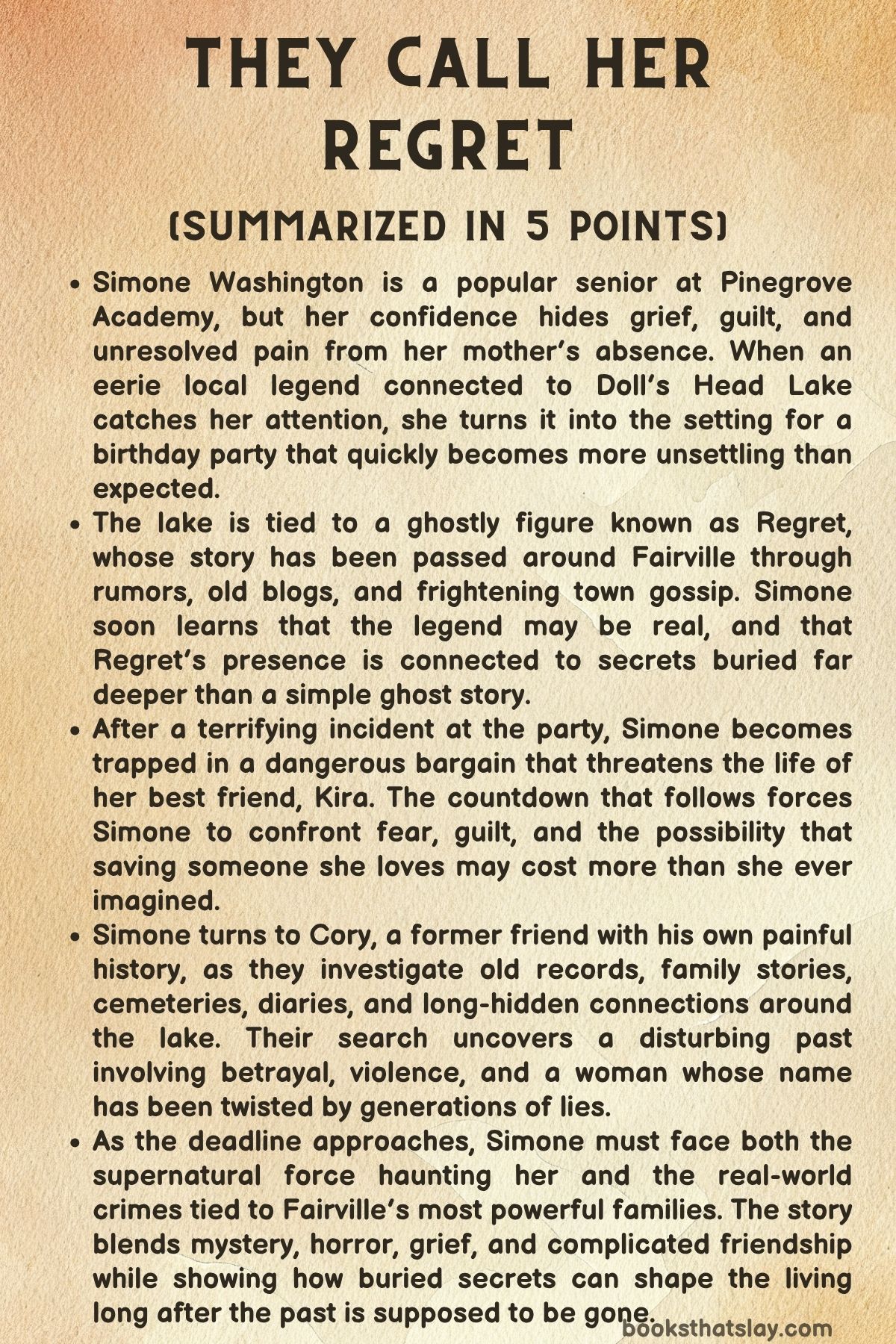
They Call Her Regret by Channelle Desamours is a young adult supernatural mystery about guilt, friendship, secrets, and the cost of second chances. Set in Fairville, Georgia, the story follows Simone Washington, a high school senior who hides her pain behind popularity and control.
A birthday party at a haunted lake turns into a nightmare when Simone makes a bargain with a spirit called Regret to save her best friend’s life. What begins as a ghost story becomes a search for buried truth, exposing old crimes, family shame, and the danger of refusing to face the past.
Summary
Simone Washington is a senior at Pinegrove Academy in Fairville, Georgia. To most people, she looks confident, sharp, and socially secure, but much of that image hides loneliness and anger.
Her mother left her and her father, and Simone carries that abandonment everywhere. One of her private hiding places is the third stall in Ozzy’s Pizza, where her mother once wrote “Camille + Tony forever” before the marriage fell apart.
That small piece of graffiti becomes a painful reminder of how love can promise forever and still disappear.
After a football game, Simone goes to Ozzy’s with her best friend Kira and their group. Kira is dating Rich, a popular football player, but Simone does not trust him.
She has seen enough of his flirting to believe he is not loyal. At Ozzy’s, Simone runs into Cory Gooding, a former Pinegrove student who now works there and once meant a lot to her.
Their friendship ended badly, and the distance between them is tied to Trenton Jones, Cory’s friend who died in a hit-and-run two years earlier. Simone had been close to both boys in secret, and Trenton’s death still haunts her.
Cory mentions that Natalie Dawson, a missing local girl, may be dead because Mama Dee claimed to have seen her ghost. He also has a blog about creepy local legends, including Doll’s Head Lake, a hidden place near Champlain Park and Recreation Center.
The lake is filled with discarded dolls and tied to a ghost called Regret. Simone reads Cory’s blog later, though she does not want him to know she follows it.
Drawn to the strange setting, she decides to hold a seniors-only birthday party near the lake. With Kira’s help, and through Kira’s sister Layla, they get access to a cabin owned by Margaret Yearwood.
On the night of the party, Simone prepares the cabin and explores the trail near the lake. She finds old toys, creepy dolls, and signs that the place has a history people prefer not to discuss.
She hides a speaker so she can scare her guests later. She also notices strange lights and meets Nate Hightower, a suspicious groundskeeper.
When the party begins, Simone performs the role everyone expects from her: bold, funny, and in control. Cory unexpectedly arrives to deliver pizza, which unsettles her because their shared past remains unresolved.
Around the bonfire, Simone tells a scary story based on Cory’s blog. She describes vanished students, doll offerings, and a ghostly woman who demands payment.
The story feels like entertainment at first, but the atmosphere changes when Simone finds messages showing that Rich planned to meet Shaina at the dock after everyone fell asleep. Determined to prove that Rich is cheating on Kira, Simone wakes Kira and takes her into the woods.
They find Rich alone at the dock. Simone demands his phone, a struggle follows, and she accidentally shoves Kira into the lake.
Rich pulls Kira from the water, but Kira is badly hurt and not breathing. Rich runs for help while Simone tries to save her.
Then a supernatural woman appears and calls herself Regret. She offers Simone a terrible bargain: Kira can live, but another life must be given in exchange.
Regret also says Simone must free her by October 30, or Kira will die again, this time by Simone’s own hand. Regret shows Simone a possible future in which Rich blames her in court for Kira’s death.
Panicked and desperate, Simone chooses Rich as the life to trade.
Then everything seems to reset. Simone finds herself back in the woods with Kira alive and dry, and Rich still alive as well.
For a moment, Simone wonders if she imagined it all. The next morning, Rich is found dead outside the cabin, electrocuted while trying to use a generator during a storm.
The police treat his death as an accident, but Simone knows better. A doll named Gabby Greta begins sending her countdown messages, proving that the bargain was real.
Rich’s death leaves Simone trapped between fear and guilt. She is haunted by visions, anonymous messages, and memories she would rather bury, including the fact that she once kissed Rich.
When Kira begins to remember pieces of what happened at the lake, Simone feels a frightening urge to hurt her and runs away before she can act on it. She realizes she must understand Regret’s history if she wants to save Kira and herself.
Simone turns to Cory for help. At first, she keeps parts of the truth from him, but he becomes her partner in investigating the legend.
They speak to older Fairville residents, follow town records, visit cemeteries, and track names connected to the lake, including Evelyn Young, Violet Savoie, and William Day. Ms. Tandy shows them an old photo album and identifies Regret as Evelyn Young, a free-spirited woman who once lived near the lake.
According to local legend, Evelyn had a child, lost the child in the lake, and became the vengeful spirit people now call Regret.
The Gabby Greta doll keeps reappearing, even after Simone throws it away, and its countdown forces her to face the shrinking deadline. Simone finally tells Cory everything: she saw Regret, made a deal to save Kira, and now must free the spirit.
Their search leads them to Violet Savoie’s daughter, Elmira Simpson, who owns Evelyn’s old family house. Elmira refuses to say much, but a cleaning worker secretly helps them.
Simone and Cory break into the attic and find Violet’s diary and spell books. The diary claims Evelyn killed Violet’s cousin Dorothy in 1956 and that Violet used magic to bind Evelyn to the lake.
Cory persuades Elmira to write a letter forgiving Evelyn on Violet’s behalf. Simone and Cory take it to Doll’s Head Lake, hoping forgiveness will release Regret.
Instead, the attempt fails. Regret appears in rage, rejects the letter, and says Violet was the real murderer.
She forces Simone to read Violet’s diary aloud and calls it a lie. Regret does not want forgiveness.
She wants the truth exposed.
Simone and Cory keep searching. At Fairville First Baptist, Simone finds a record showing Evelyn gave up a young son for adoption, with Deidra Hightower, known as Mama Dee, involved in the adoption.
At the same time, Simone finds a gold “K” necklace at the lake and thinks it belongs to Kira, but Kira denies it. Simone later learns it belonged to Natalie Dawson, the missing college student.
Natalie’s photos connect her to an astronaut sticker, Rich, and a rave scene. Simone and Cory follow these clues to a Sittersville rave location and uncover links to drugs, including GHB.
Mama Dee finally reveals the buried truth. Dorothy had a son whom Evelyn loved, but Violet’s family wanted money and land.
Violet killed Dorothy, framed Evelyn, and trapped her at the lake with a spell. Over time, the Yearwood family became tied to the lake’s violence.
Simone also uncovers another painful truth from her own life: her mother was the drunk driver who killed Trenton. Simone and Cory had blamed themselves for being late, but the true guilt belonged elsewhere.
As the deadline nears, Simone returns to the lake alone with evidence. John Yearwood finds her and realizes she knows too much about Natalie.
He admits Natalie created a problem for him and attacks Simone. Kira arrives and fights him, revealing that she had suspected John’s involvement with Natalie.
Simone understands that Yearwood men have used the lake to hide the bodies of women, including Dorothy. Regret asks Simone to let her in, and Simone agrees.
Regret takes over Simone’s body and kills John.
Regret is freed, but freedom does not give Simone a simple ending. Two months later, Cory explains that Kira is alive, Simone is not in jail, and John is officially missing.
Police recover Natalie’s remains and the bodies of other women from the lake after Simone sends an anonymous tip. Simone also plans to expose her mother for Trenton’s death.
On New Year’s Eve, Simone dresses like Evelyn. She has survived, but she is changed.
Cory senses that some part of Regret’s hunger may now remain inside her.
Characters
Simone Washington
Simone Washington is the central character of They Call Her Regret, and she is shaped by grief, guilt, fear, pride, and a desperate need to control how others see her. On the outside, she appears confident, socially secure, and capable of leading her friend group, but the book gradually reveals that much of this confidence is a mask.
Her secret attachment to the third stall at Ozzy’s Pizza shows how deeply her mother’s abandonment has wounded her. That small, private place becomes a symbol of Simone’s longing for a family that once seemed whole and permanent.
She wants to appear untouched by pain, yet she is constantly returning to reminders of what she has lost.
Simone’s flaws make her especially complex. She is protective of Kira, but her protectiveness often turns into control.
Her distrust of Rich is partly justified, but it is also tangled with jealousy, secrecy, and her own guilt over having kissed him. When she follows Rich to the dock and demands his phone, she believes she is exposing betrayal, but the situation spirals because Simone is acting from panic rather than honesty.
Her accidental shove of Kira into the lake becomes the turning point of her character arc, forcing her to face the frightening truth that her choices can hurt the people she loves most.
Her deal with Regret exposes both her love and her moral weakness. Simone chooses to save Kira, but she sacrifices Rich to do it.
This decision reveals the terrifying pressure she is under, yet it also shows how easily fear can push her into selfishness. After Rich dies, Simone is not simply haunted by a ghost; she is haunted by herself.
The countdown, the Gabby Greta doll, and the visions all externalize the guilt she tries to suppress. Her investigation into Evelyn’s past becomes more than a supernatural mystery.
It becomes Simone’s attempt to understand whether guilt can be repaired, whether truth can free the dead, and whether she can survive the consequences of her own actions.
By the end of the story, Simone has changed, but not in a simple or fully comforting way. She becomes braver, more honest, and more willing to confront painful truths, especially regarding Trenton’s death and her mother’s responsibility.
At the same time, her connection with Regret leaves a darker mark on her. Simone begins the book as a girl hiding sadness behind popularity, but she ends it as someone who understands rage, revenge, and survival far more intimately than before.
Her development is powerful because she does not become purely innocent or purely corrupted; she becomes someone permanently altered by what she has seen, done, and chosen.
Kira
Kira is Simone’s best friend and one of the emotional anchors of the book. She is loyal, trusting, and deeply important to Simone, but she is not merely a passive friend who exists to be protected.
Her relationship with Rich places her at the center of the social and emotional conflict, and her bond with Simone becomes strained because Simone keeps secrets from her while claiming to act in her best interest. Kira’s trust in Rich frustrates Simone, but it also shows that Kira wants to believe in the people she loves, even when others doubt them.
Kira’s near-death at the lake changes the entire direction of the story. She becomes the life Simone is trying to save, but the book also makes it clear that Kira is more perceptive than Simone realizes.
After the incident, Kira remembers fragments of what happened, and those fragments threaten Simone’s version of events. This makes Kira both vulnerable and dangerous to Simone, because she represents the truth Simone cannot fully control.
The supernatural command that Simone may eventually kill Kira adds a disturbing layer to their friendship, turning love into fear and protection into potential violence.
Kira’s later actions reveal her strength. She is not simply the girl Simone must rescue.
When John attacks Simone, Kira arrives and fights him, showing courage, suspicion, and agency. Her anger over the necklace also matters because it proves she has her own emotional boundaries and refuses to be absorbed into Simone’s assumptions.
Kira’s survival is central to Simone’s choices, but Kira herself stands as a reminder that friendship cannot survive on secrecy, control, or sacrifice alone. She represents the person Simone most wants to save, but also the person Simone must learn to respect as independent from her own guilt.
Cory Gooding
Cory Gooding is one of the most important characters in the story because he connects Simone’s present crisis to her hidden past. As a former Pinegrove student, Simone’s ex-friend, and Trenton’s close friend, Cory carries emotional history that Simone has tried to bury.
His presence at Ozzy’s unsettles her because he reminds her of a version of herself she has avoided confronting. Their relationship is marked by distance, grief, and unfinished pain, especially because their friendship with Trenton was once secret and meaningful.
Cory’s blog is the doorway through which Simone first becomes interested in Doll’s Head Lake and the legend of Regret. His fascination with strange local stories gives him the role of investigator, but he is more than a source of information.
He is emotionally observant, persistent, and willing to help Simone even when she withholds the full truth. Once Simone confesses what happened at the lake, Cory becomes her partner in uncovering Evelyn’s history.
His intelligence and curiosity help move the mystery forward, but his loyalty to Simone gives the investigation emotional depth.
Cory also represents forgiveness and shared grief. He and Simone both carried guilt over Trenton’s death, believing their lateness somehow contributed to it.
The discovery that Simone’s mother was actually responsible reframes Cory’s pain and allows both characters to see that they were children trapped inside a tragedy they did not cause. In the final section, Cory’s narration gives the ending a thoughtful and uneasy tone.
He sees that Simone has survived, but he also recognizes that something of Regret may remain inside her. Cory therefore becomes the character who witnesses Simone most clearly: not as the confident girl she pretends to be, but as someone wounded, dangerous, brave, and changed.
Rich
Rich is a popular football player and Kira’s boyfriend, but his role in the book is much more complicated than that of a simple bad boyfriend. Simone distrusts him because he flirts with other girls, and his planned meeting with Shaina confirms that he is not entirely loyal to Kira.
He represents the kind of charming, socially powerful figure who can move through Pinegrove with confidence while leaving emotional damage behind him. To Simone, he becomes the symbol of everything that might hurt Kira.
At the same time, Rich’s death forces the reader to question Simone’s moral judgment. He is flawed, dishonest, and possibly connected to darker events through the astronaut sticker and the rave scene, but Simone still chooses him as the life to exchange for Kira’s survival.
This makes his death morally disturbing rather than simple justice. The fact that he dies through an apparent accident after Simone’s supernatural bargain confirms that Regret’s deal is real, but it also traps Simone in guilt.
Rich becomes both victim and warning: a person Simone disliked, a person who may have done wrong, and yet still a life she deliberately offered in exchange for another.
Rich’s presence continues after his death through grief, suspicion, and hidden connections. His memorial and funeral reveal how public tragedy can simplify a person into an image, while Simone knows there are secrets beneath that image.
His connection to Natalie’s disappearance through visual clues makes him part of the larger web of corruption surrounding the lake. Rich is important because he challenges easy moral categories.
He is not innocent in his behavior, but Simone’s choice to sacrifice him stains her conscience and pushes the book into darker ethical territory.
Regret / Evelyn Young
Regret, later revealed as Evelyn Young, is the supernatural force at the center of the story and one of its most tragic figures. At first, she appears as a terrifying lake spirit who bargains in lives, demands freedom, and threatens Kira’s survival.
Her presence is frightening because she knows Simone’s guilt and uses it against her. She does not simply haunt the lake; she manipulates fear, memory, and consequence.
Her name, Regret, immediately connects her to the emotional burden carried by Simone and nearly every major character.
As Evelyn Young, however, Regret becomes more than a monster. She was once a free-spirited woman whose life was twisted by betrayal, lies, and violence.
The town’s legend paints her as a grieving, dangerous figure who lost a child and became vengeful, but the investigation reveals that this story is built on falsehoods. Violet’s diary accuses Evelyn of murder, yet Regret’s rage shows that the official version of history is a prison as powerful as the spell binding her to the lake.
She is not seeking simple forgiveness because forgiveness would accept the lie that she was the guilty one. What she wants is truth.
Regret’s relationship with Simone is disturbing because it is both predatory and intimate. She forces Simone into a bargain, threatens Kira, and eventually possesses Simone’s body to kill John.
Yet she also exposes hidden crimes and gives voice to women whose suffering was buried. Her rage is frightening, but it is rooted in injustice.
By the end of the book, her release does not feel purely peaceful, because her hunger for vengeance may have left a trace inside Simone. Regret is therefore both victim and threat, a woman destroyed by lies who becomes dangerous because truth was denied to her for too long.
Violet Savoie
Violet Savoie is one of the key hidden antagonists in the story because her version of events shapes the false legend surrounding Evelyn. Through her diary and spell books, Violet appears at first to be a witness who recorded Evelyn’s crimes and used magic to protect others.
However, as Simone and Cory continue investigating, Violet’s account begins to collapse. Her words are revealed as a weapon, not a reliable confession.
She helped create the story that turned Evelyn into Regret.
Violet’s significance lies in how she uses narrative power. She does not merely harm Evelyn physically or magically; she harms her by controlling how the town remembers her.
By accusing Evelyn of killing Dorothy and binding her to the lake, Violet transforms the victim into the monster. This makes Violet a figure of betrayal, cowardice, and manipulation.
Her actions show how lies can become local legend when repeated long enough, especially when the person being accused has no power to defend herself.
Violet also represents the greed and social cruelty surrounding the lake’s history. Mama Dee’s later explanation reveals that Violet’s family wanted money and land, and that Dorothy’s death was tied to those motives.
Violet’s restriction spell becomes a symbol of injustice disguised as protection. Her role in the book is crucial because she proves that the supernatural horror began with human wrongdoing.
The ghost may be terrifying, but the original evil came from jealousy, greed, and the deliberate destruction of an innocent woman’s name.
Dorothy
Dorothy is a character whose death lies at the heart of Evelyn’s tragedy. Although she does not appear actively in the main timeline, her importance grows as the truth is uncovered.
At first, Dorothy is presented through Violet’s account as someone Evelyn supposedly killed, but this accusation is eventually revealed to be part of the lie that trapped Evelyn. Dorothy’s real story is tied to betrayal, family greed, and the violence that later becomes associated with Doll’s Head Lake.
Dorothy’s son is also central to Evelyn’s pain. Evelyn loved the child, and the adoption records reveal that the story of Evelyn losing a child in the lake was distorted.
Dorothy’s death and the child’s removal contribute to the making of Regret, not because Evelyn was monstrous, but because she was robbed of truth, love, and justice. Dorothy becomes one of the first women whose suffering is hidden beneath the lake’s legend.
In the larger structure of the story, Dorothy represents the beginning of a pattern. Later revelations suggest that Yearwood men dumped multiple women in the lake, and Dorothy is connected to that buried history of violence.
Her character shows how the past continues to shape the present even when the victims are silenced. Dorothy’s tragedy matters because it exposes the human cruelty beneath the supernatural myth.
Mama Dee / Deidra Hightower
Mama Dee, whose full name is Deidra Hightower, is an elder figure connected to Fairville’s hidden history. Early in the book, she is mentioned as someone who saw Natalie Dawson’s ghost, which gives her an association with the supernatural before her deeper importance is revealed.
She is not simply a source of spooky rumor; she becomes one of the people who knows the truth about Evelyn, Dorothy, and the child given up for adoption.
As an adoption coordinator, Mama Dee holds a key piece of the mystery. Her knowledge reveals that Evelyn’s story was not what the town believed.
She explains that Dorothy had a son whom Evelyn loved, and that the false accusations against Evelyn were rooted in Violet’s family’s greed. This makes Mama Dee a keeper of buried truth.
Her role is important because she helps restore Evelyn’s humanity after decades of distortion.
Mama Dee’s character also reflects the burden of witnessing. She has lived long enough to know that legends often hide real violence, and her testimony helps Simone and Cory move beyond rumor into truth.
She is a bridge between the past and present, between supernatural fear and historical injustice. Through her, the book shows that truth often survives in fragments, held by people who were close enough to see what others chose to ignore.
Natalie Dawson
Natalie Dawson is a missing college student whose fate connects the current mystery to the older violence at Doll’s Head Lake. At first, she appears as part of local gossip, with Cory mentioning that she may be dead because Mama Dee saw her ghost.
This makes Natalie seem like another eerie rumor surrounding Fairville, but her disappearance gradually becomes central to exposing the crimes connected to John Yearwood and the lake.
Natalie’s gold “K” necklace is an important clue because Simone initially assumes it belongs to Kira. That mistake shows how Simone’s fear for Kira shapes her interpretation of everything.
When the necklace is revealed to be Natalie’s, the investigation widens. Natalie is no longer an abstract missing girl; she becomes a victim whose personal belongings, photos, and connections point toward real human wrongdoing.
Her link to the astronaut sticker, Rich, and the rave scene helps Simone and Cory uncover a network of secrets.
Natalie’s body being recovered after Simone’s anonymous tip gives her story a measure of justice. Like Dorothy and the other women connected to the lake, Natalie represents the victims whose lives were hidden beneath silence, rumor, and male violence.
Her character matters because she brings the horror into the present day. The lake is not only haunted by old injustice; it is still being used to conceal new crimes.
Trenton Jones
Trenton Jones is physically absent from the main events, but his death deeply shapes Simone and Cory. He was Cory’s friend and someone Simone was close to, though she kept that friendship secret.
His death in a hit-and-run two years earlier created a wound that neither Simone nor Cory fully healed from. Because they believed they were late and somehow responsible, Trenton became a symbol of unresolved guilt between them.
The truth about Trenton’s death is one of the most painful revelations in the book. Simone realizes that her mother, Camille, was the drunk driver who killed him.
This discovery changes the meaning of Simone’s guilt. She and Cory were not responsible for Trenton’s death in the way they feared, but Simone must now confront an even more devastating truth: the mother who abandoned her was also responsible for killing someone she loved.
Trenton’s death therefore links Simone’s family trauma to her friendship trauma.
Trenton’s importance lies in how memory shapes the living. He is remembered through grief, secrecy, and blame, and his absence affects Simone’s ability to trust herself.
By planning to expose her mother, Simone begins to honor Trenton with truth instead of silence. His character shows that the dead in this story do not disappear; they remain active forces in the choices, fears, and moral reckonings of the living.
Camille
Camille, Simone’s mother, is one of the most emotionally significant absent characters. Her old writing in the Ozzy’s Pizza stall, “Camille + Tony forever,” represents a version of love and family that Simone desperately wants to believe once existed.
Camille’s abandonment leaves Simone with a deep sadness that she hides behind confidence. Even before the truth about Trenton is revealed, Camille’s absence shapes Simone’s insecurity, anger, and longing.
Camille becomes even more important when Simone realizes she was the drunk driver who killed Trenton. This revelation transforms her from an absent parent into a source of moral horror.
Simone’s pain is no longer only about being left behind; it is also about discovering that her mother’s actions destroyed another life and left Simone and Cory trapped in false guilt. Camille’s hidden crime mirrors the larger pattern of buried truths in the story.
As a character, Camille represents the damage caused by abandonment and secrecy. She wounds Simone by leaving, but she wounds her even more by allowing the truth about Trenton to remain buried.
Simone’s plan to expose her mother shows her growth. She is no longer willing to protect comforting illusions or family myths.
Camille’s role is crucial because she forces Simone to choose truth over loyalty to a false version of the past.
Tony
Tony, Simone’s father, is less central than Camille, but his presence matters because he is part of the broken family Simone carries inside her. The phrase “Camille + Tony forever” symbolizes the promise of lasting love that did not survive.
Tony remains with Simone after Camille leaves, which makes him part of her everyday life, but the emotional weight of the family’s collapse still shapes her identity.
Tony represents the parent who stayed, yet the book’s focus on Simone’s private grief suggests that his presence cannot fully repair Camille’s absence. Simone’s emotional hiding may also imply that she does not feel able to share the depth of her sadness with him.
He is important not because he drives the mystery, but because he belongs to the domestic world Simone is trying to hold together while supernatural and moral chaos closes in around her.
In Simone’s character arc, Tony helps define what she has lost. The old memory of her parents’ love contrasts sharply with the reality of abandonment, secrets, and crime.
His role is quieter, but he is part of the emotional background that explains why Simone clings so strongly to appearances, friendship, and control.
John Yearwood
John Yearwood is one of the major human villains of the book. At first, he appears indirectly through Layla as the person connected to the cabin near Doll’s Head Lake.
His position as Layla’s husband and his family tie to the property allow him to seem ordinary and respectable. That surface respectability is part of what makes him dangerous.
He belongs to the kind of family structure that can hide violence behind social normalcy.
As the mystery develops, John becomes connected to Natalie Dawson’s disappearance and the darker history of the lake. When he finds Simone near the deadline and realizes she knows too much, his mask falls.
His attack on Simone reveals the threat he has represented all along. He is not a supernatural monster, but his actions are monstrous.
The revelation that Yearwood men have dumped multiple women in the lake places him within a generational pattern of violence and concealment.
John’s death at Regret’s hands through Simone’s body is both climactic and morally unsettling. He deserves exposure and punishment, but the way he dies leaves Simone marked by possession and vengeance.
John functions as the living continuation of the lake’s evil. Through him, the book shows that ghosts may haunt places, but human beings create the crimes that make haunting possible.
Layla
Layla is Kira’s sister and John’s wife, and her role is important because she helps make the birthday party at the cabin possible. By arranging access to the cabin owned by John’s aunt, Margaret Yearwood, Layla unknowingly places Simone and her friends directly in the space where the supernatural and criminal histories of the lake converge.
Her involvement appears practical at first, but it becomes significant because of her connection to John.
Layla also represents the danger of being close to someone whose secrets are hidden beneath ordinary family life. As John’s wife, she is tied to the Yearwood family, though the provided events do not show her as participating in his crimes.
Her character shows how evil can exist near ordinary domestic relationships without being immediately visible. The cabin arrangement that seems like a simple favor becomes the doorway into the book’s central horror.
Although Layla is not developed as deeply as Simone, Kira, or Cory, she serves an important structural purpose. She connects the teenage world of parties and friendships to the adult world of property, family history, and buried violence.
Her presence reminds the reader that the younger characters are walking into dangers created long before them.
Margaret Yearwood
Margaret Yearwood is John’s aunt and the owner of the cabin used for Simone’s birthday party. Though she does not take an active role in the events described, her property is crucial to the plot.
The cabin gives Simone and her friends access to Doll’s Head Lake, the trail of discarded dolls, and the place where Regret’s power is strongest. Margaret’s connection to the Yearwood family also places her near the larger history of violence tied to the lake.
As a character, Margaret is more significant by association than by action. Her ownership of the cabin shows how family property can carry hidden histories.
What appears to be a convenient party location is actually attached to a legacy of disappearance, death, and concealment. The Yearwood name becomes increasingly ominous as Simone uncovers more about the lake, and Margaret’s cabin becomes one of the physical spaces where that legacy enters the present.
Margaret’s role helps build the sense that evil is not isolated to one person or one night. The land, the cabin, the family, and the lake all carry history.
Even characters who remain on the edges of the action can be connected to the structures that allow secrets to survive.
Nate Hightower
Nate Hightower is the suspicious groundskeeper Simone encounters near the cabin. His appearance adds unease before the supernatural events fully unfold.
Because Simone is already trying to create fear for the party and use the eerie setting, Nate’s presence blurs the line between planned scares and genuine danger. He makes the woods feel watched and unsafe.
His surname connects him to Mama Dee, which gives him a place within Fairville’s wider network of local history. Even if Nate is not revealed as a central villain in the events provided, his role contributes to the atmosphere of suspicion.
In a story where old residents, local legends, and family names matter, even a brief encounter can feel meaningful. Nate’s presence reminds Simone that Doll’s Head Lake is not an empty playground for a senior party; it is a place already occupied by people, rumors, and secrets.
Nate functions as an early warning sign. He unsettles Simone before she understands the true danger of the lake, helping the book build tension gradually.
His character shows how the setting itself is guarded by uneasy figures who seem to know more than they say.
Shaina
Shaina is important because of her connection to Rich’s planned betrayal of Kira. The messages showing that Rich intended to meet Shaina at the dock after everyone fell asleep trigger Simone’s decision to wake Kira and follow him.
Although Shaina does not appear as deeply as the central characters, her role is crucial because she helps ignite the chain of events that leads to Kira’s near-death, Simone’s bargain with Regret, and Rich’s death.
Shaina represents temptation, secrecy, and the social messiness surrounding Rich. To Simone, she is proof that Rich cannot be trusted.
However, Shaina’s role also reveals Simone’s impulsiveness. Instead of calmly telling Kira or waiting for clearer proof, Simone turns the situation into a confrontation.
Shaina’s importance therefore lies less in her individual personality and more in what her existence exposes about Rich and Simone.
In the emotional structure of the book, Shaina is part of the jealousy and betrayal that precede the supernatural horror. Her connection to Rich gives Simone a reason to act, but Simone’s response shows that the real danger comes from secrecy, panic, and the need to force the truth into the open at the worst possible moment.
Elmira Simpson
Elmira Simpson is Violet Savoie’s daughter and the current owner of Evelyn’s old family house. Her connection to the past makes her important to Simone and Cory’s investigation.
When they visit her, she refuses to reveal much, which creates another barrier between the present and the truth. Her silence suggests that Fairville’s old secrets have not simply vanished; they have been inherited, guarded, or avoided by later generations.
Elmira’s house becomes a key location because the attic contains Violet’s diary and spell books. These materials initially seem to provide answers, but they also lead Simone and Cory into a false version of events.
Elmira’s connection to these records makes her part of the chain through which Violet’s lies survive. Whether or not Elmira fully understands the truth, she occupies a place shaped by her mother’s legacy.
As a character, Elmira represents inherited silence. She is not the origin of the injustice against Evelyn, but she lives among its remains.
Her refusal to discuss the past contrasts with Simone and Cory’s determination to uncover it. Through Elmira, the book shows that secrets can pass from one generation to the next through homes, boxes, documents, and the choice not to speak.
Ms. Tandy
Ms. Tandy is a guide into Fairville’s past. When Simone and Cory ask about Evelyn Ruth Young, she shows them an old photo album and identifies Regret as Evelyn Young.
This moment is important because it begins to transform Regret from a frightening legend into a real woman with a history. Ms. Tandy helps the investigation move from rumor into memory.
Her role is that of a local storyteller and keeper of old knowledge. She shares the town’s legend about Evelyn having a child, losing the child in the lake, and becoming the spirit called Regret.
However, because the legend later proves incomplete and misleading, Ms. Tandy also shows how community memory can preserve both truth and falsehood. She is not necessarily malicious; she passes on what the town believes.
But the story she tells reveals how easily a woman’s life can be reduced to a frightening myth.
Ms. Tandy is significant because she opens the door to the deeper mystery of They Call Her Regret. Without her, Simone and Cory might not connect the ghost to Evelyn’s human identity.
Her character reminds the reader that every legend has a source, but not every legend tells the truth.
William Day
William Day is one of the names Simone and Cory investigate while trying to understand Regret’s history. Although the provided events do not reveal as much about him as they do about Evelyn, Violet, or Dorothy, his inclusion shows how broad and tangled the mystery becomes.
Simone and Cory are not solving a simple haunting; they are sorting through names, records, family histories, and old connections in Fairville.
William’s role is therefore investigative rather than emotional. He represents one of the possible threads in the past that might explain how Evelyn became Regret.
Characters like William help create the sense of a town with layered history, where many names may be connected to buried events. Even when a figure is not central, the act of investigating him shows Simone and Cory’s growing commitment to truth.
In the structure of the book, William Day helps expand the mystery beyond one ghost story. His name belongs to the network of clues that forces Simone and Cory to look deeper into Fairville’s past rather than accepting the easiest explanation.
Gabby Greta
Gabby Greta, the creepy doll Simone takes from the cabin, functions almost like a supernatural messenger. While she is not human, she has enough presence and agency in the story to feel like a character within the haunting.
After Simone throws the doll away, it reappears in the thrift shop, proving that Simone cannot escape the deal she made with Regret. Its countdown messages make the bargain physical, visible, and inescapable.
Gabby Greta represents the way guilt follows Simone. The doll is unsettling because it looks childish but carries a deathly purpose.
Its connection to the discarded dolls around Doll’s Head Lake also ties it to offerings, memory, and trapped spirits. Each countdown message increases pressure on Simone, reminding her that Kira’s life is still in danger and that the supernatural bargain has rules Simone does not fully understand.
As an object-character, Gabby Greta makes the horror intimate. Regret herself belongs to the lake, but the doll can follow Simone into ordinary spaces.
It turns the haunting into something portable and personal. In They Call Her Regret, Gabby Greta is one of the clearest signs that Simone’s attempt to dismiss the lake incident as hallucination is impossible; the curse has entered her life and will not leave until the truth is faced.
Themes
Guilt and the Need for Accountability
Guilt follows Simone long before the supernatural deal makes it visible. She carries the pain of losing her mother, the secrecy around her friendship with Cory and Trenton, her distrust of Rich, and later the terrible choice she makes when she trades Rich’s life to save Kira.
In They Call Her Regret, guilt is not shown as a simple feeling of sadness; it becomes a force that changes how Simone sees the world and herself. She wants to protect Kira, but her protection often becomes control, jealousy, and fear.
Her guilt also makes her vulnerable to Regret, because the ghost understands what it means to be blamed, trapped, and misunderstood. The truth about Trenton’s death deepens this theme because Simone learns that the burden she and Cory carried was based on an incomplete truth.
By the end, accountability becomes more important than escape. Simone cannot undo what happened, but she can expose hidden crimes and stop silence from protecting the guilty.
The Damage Caused by Secrets
Secrets shape nearly every relationship in the story. Simone hides her sadness behind confidence, hides her past friendship with Cory and Trenton, hides her kiss with Rich, and hides the truth about the lake incident from Kira.
These secrets do not protect anyone for long; they create distance, suspicion, and danger. Kira’s own knowledge about John and Natalie shows that Simone is not the only one keeping painful information buried.
The town also survives on secrets, especially the lies surrounding Evelyn, Dorothy, Violet, and the Yearwood family. What first appears to be a ghost story becomes a history of people using silence to avoid blame.
The longer the truth is hidden, the more power it gains over the living. This makes the supernatural threat feel connected to ordinary human behavior.
Regret’s curse is frightening, but the real horror comes from the people who lied, covered up violence, and allowed innocent women to be blamed or forgotten.
Female Anger, Injustice, and Revenge
Regret represents anger that has been denied justice for too long. Evelyn is remembered as a monster, but the truth reveals that she was framed, trapped, and turned into a warning story by people who wanted to protect themselves.
Her rage is violent and dangerous, yet it comes from a history of betrayal. The story refuses to make revenge look completely heroic, because Regret’s hunger harms others and nearly consumes Simone.
At the same time, it shows why anger can grow monstrous when truth is buried and victims are denied justice. Simone’s own anger mirrors Evelyn’s.
She is angry at Rich, at Kira’s pain, at Cory’s distance, at her mother, and at the town’s lies. By allowing Regret into her body, Simone crosses a moral line, but she also ends a cycle of male violence linked to the lake.
They Call Her Regret suggests that rage can reveal truth, but it can also leave lasting darkness behind.
Friendship, Loyalty, and Control
Simone’s friendship with Kira is built on love, but it is also marked by fear and control. Simone believes she is protecting Kira from Rich, yet her actions at the lake show how quickly loyalty can become possession.
She wants to expose Rich, but she ignores Kira’s agency and pulls her into danger. After the deal, Simone’s desire to save Kira becomes even more complicated because the curse makes her afraid that she may become Kira’s greatest threat.
Cory offers a different kind of loyalty. He helps Simone investigate, listens to her truth, and shares the emotional weight of Trenton’s death.
His loyalty does not erase Simone’s mistakes, but it gives her the courage to face them. The story shows that real friendship cannot survive on secrets, control, or appearances.
It needs honesty, even when honesty is painful. By the end, Simone’s relationships are changed because loyalty is no longer just about protection; it is about truth.