Throne of Nightmares Summary, Characters and Themes
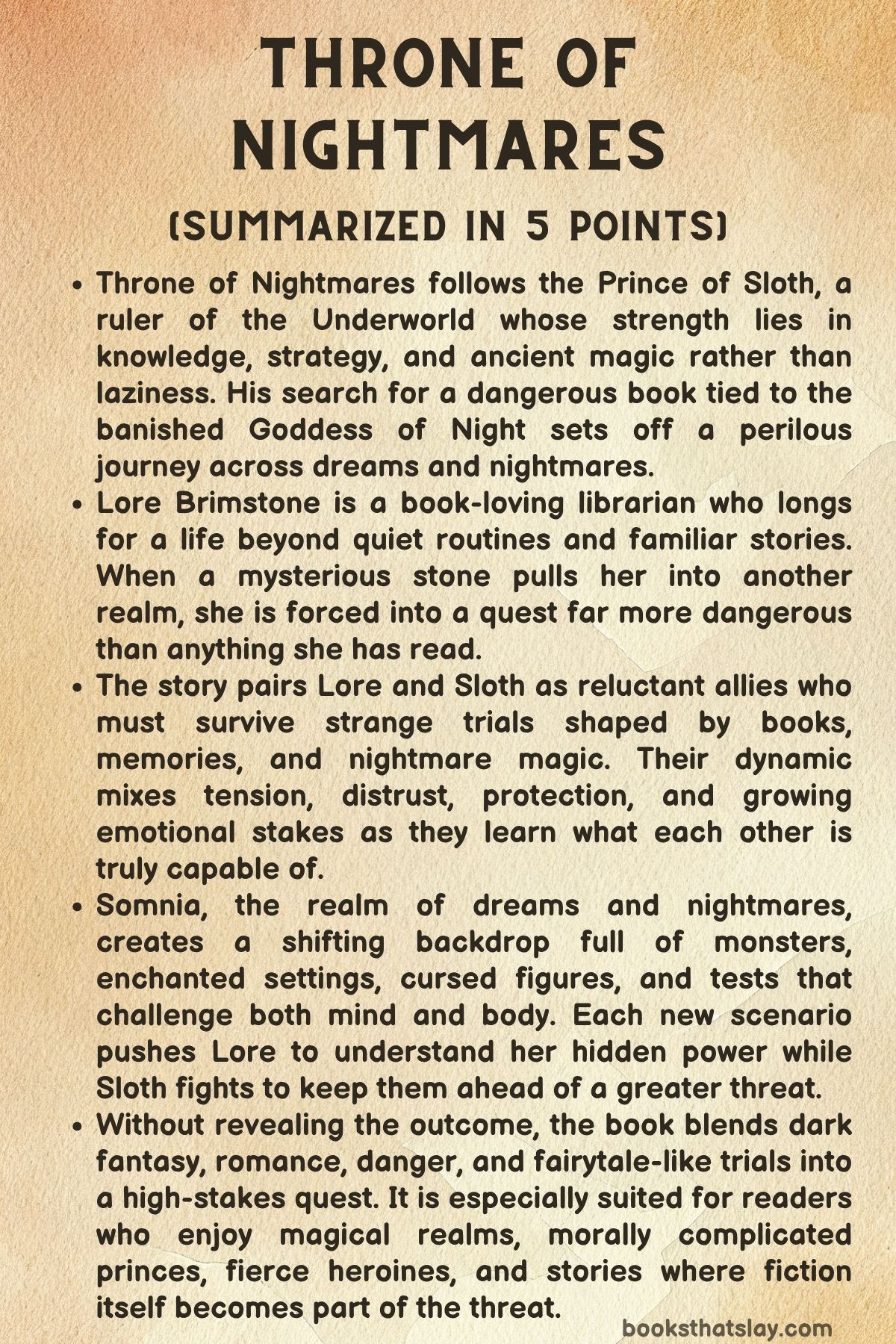
Throne of Nightmares by Kerri Maniscalco is a dark fantasy romance set across the Seven Circles of the Underworld and the strange realm of Somnia, where dreams, nightmares, gods, and stories can become dangerously real. The book follows the Prince of Sloth, a ruler whose strength lies in knowledge rather than idleness, and Lore Brimstone, a book-loving librarian pulled into a deadly magical quest.
Together, they must survive trials shaped by Lore’s own reading life while trying to stop the Liber Noctem, the Book of Nightmares, from restoring the power of a banished goddess. It’s the 3rd book in the Prince of Sin series.
Summary
The story begins in the Seven Circles of the Underworld, where the Prince of Sloth rules as one of the seven Wicked princes. His name suggests laziness to outsiders, but his true nature is very different.
Sloth is a scholar, a collector of knowledge, and a ruler whose power is tied to books, study, memory, and hidden truths. For centuries, he has searched for the Liber Noctem, also called the Book of Nightmares, a dangerous magical text connected to Nyantha, the banished Goddess of Night.
Sloth’s search leads him and his master librarian, Xavier, to a deadly temple carved into Mount Lyra on the Shifting Isles. The place is ancient, violent, and heavily protected.
Corpses, impaling stakes, magic-blocking wards, and moonlit runes warn them that the temple was made to keep something powerful hidden. When Sloth’s blood falls onto a skull, an altar made of bones rises and reveals the Liber Noctem.
The book bears the mark of a golden phoenix, and when Sloth touches it, dark magic floods through him. A phoenix-like tattoo burns itself into his skin, linking him to the book in a way he does not fully understand.
The moment the book is uncovered, shadow creatures called Nocturnas attack. Sloth fights them while ordering Xavier to carry the book.
Instead of helping him, Xavier betrays him. He reveals that he came prepared with a portal stone, declares Nyantha’s motto, “Carpe noctem,” and escapes to Somnia with the Liber Noctem.
Sloth realizes his trusted librarian may have been serving Nyantha all along. Furious and alarmed, he sets out to follow him before the book can be used to free or strengthen the goddess.
Far from the Underworld, Lore Brimstone lives in Bellington as a librarian. She loves stories and longs for the kind of adventure found in her favorite books.
After a book club meeting, her brother Fable takes her to a traveling caravan that has arrived in town. There, an old woman gives Lore a mysterious black stone and tells her she has accepted a quest.
The woman also warns that “he” is coming. Lore does not yet understand what she has been given or what bargain has been made on her behalf.
Sloth soon arrives in Bellington, searching for the nearest portal stone. Before either he or Lore can make sense of the situation, the stone activates.
A shadow portal opens and drags them both away from Bellington.
They land in Somnia, the realm of dreams and nightmares. Sloth immediately recognizes it as the place where Nyantha is imprisoned.
The danger becomes real almost at once when giant nightmare spiders attack. Sloth fights to protect Lore, but he is badly wounded.
Lore’s stone activates again, transporting them to a cabin that Lore recognizes from one of her books. At first the cabin seems like shelter, but a woman named Jessa Maya appears, and Lore realizes she is a cannibalistic goblin from the story.
When Jessa attacks with axes, Lore and Sloth escape through a window, only to be chased through the forest by Jessa riding a massive wolf.
Sloth hides Lore in a tree, but the freezing conditions nearly kill her. He carries her to a cave, starts a fire, treats her hypothermia, and deals with the venom from his own wound.
During their recovery, Sloth explains what he believes has happened. Lore’s stone is not a normal portal stone.
It is the phoenix tear, once part of the Liber Noctem. Because Lore can use it, Sloth suspects she is a dreamweaver, someone with rare and godlike magic tied to dreams and creation.
The Liber Noctem has begun the Trials of Unbinding, forcing Lore into tests based on stories she knows. These trials are not harmless illusions.
They can injure, trap, or kill them, and if Lore fails, the book may use her power to cause great destruction and aid Nyantha’s return. Lore also learns that the dangerous man traveling with her is not simply a stranger from another realm.
He is the Prince of Sloth himself.
Their surroundings shift again, this time into a tavern brawl from another story Lore has read. Sloth secures them a room, but he also spots someone who appears to be Xavier with the Liber Noctem.
This confirms that the book is close and that Xavier’s betrayal remains central to the threat. Sloth tells Lore that both of them must survive the Trials because failure could endanger multiple realms.
He begins teaching her to shield her mind and control her magic.
The next shift places them in a historical romance setting. Lore must navigate a world of titles, manners, ballrooms, social expectations, and fictional characters such as Lord Winters, Lady Brimstone, the dragon shifter Logan Blaze, and a betrothal ball.
Lore adapts quickly because she knows the type of story they have entered. Sloth, by contrast, struggles with the rules and rituals of polite society.
Yet his attention stays fixed on Lore. When he sees her dancing with the marquess, he steps in and claims the next dance.
The trials soon become more dangerous. After a pirate ship disaster, Lore is trapped underwater by a giant sea monster.
Sloth swims after her, reaches her in time, and gives her air with a desperate kiss. He attacks the creature so she can escape, stabbing it in the eye.
But instead of saving himself, he allows the monster’s tentacles to capture him. Lore watches in horror as he is dragged into the darkness.
She dives after him, but she cannot find him and is forced to surface.
Alone in the ocean, Lore has another terrible vision from the Liber Noctem. She sees herself cold and detached, watching a drowning man suffer.
The vision frightens her because it suggests the book may be showing her a darker version of herself or trying to shape her into something cruel. Exhausted and freezing, she continues searching for Sloth until her body can no longer endure the water.
She finally swims toward land.
Lore reaches a rocky beach she believes may be the Isle of the Damned. She is injured, freezing, heartbroken over Sloth’s disappearance, and afraid that the Book of Nightmares has separated them for another trial.
With no light and no clear path inland, she stays on the beach through the night. While trying to regain control of her dreamweaver magic, she uses the phoenix tear and manages to summon a tiny shadow creature.
She names it Theodore, or Teddy. By calling Teddy out and sending him back into her magic, Lore begins practicing with her shadows instead of fearing them.
Teddy’s presence also gives her comfort while she is alone.
At dawn, cursed specters appear on the beach. Before Lore can fight them, they vanish when a tall, arrogant Fae male arrives.
He orders her to follow him. Lore refuses at first, draws her dagger, and discovers that ordinary steel is useless against him.
When he threatens to force her obedience, she goes with him. As they travel through an eerie forest, she secretly leaves markers in the hope that Sloth will find her, but the Fae notices and threatens to bind her with vines.
The Fae leads Lore through streams and forest paths to a vast castle grown from an ancient tree. Near a waterfall and hot spring, he orders her to bathe before the coming event.
When Lore asks what she is being prepared for, he tells her she will take part in a hunt beginning at midnight. She realizes she has entered a twisted version of one of her books, Hunted by the Horsemen, and suspects the Fae is Prince Leif Saxon, known as Conquest.
Meanwhile, Sloth survives the sea monster and washes ashore elsewhere. His powers are fading, his wounds are not healing correctly, and he suspects the tattoo branded onto him may contain ink from the Liber Noctem.
He searches the island for Lore, guided first by instinct and then by her trail. When he catches her scent mixed with another male’s, his protective instincts turn violent.
Before he can reach her, Sloth is attacked by pale, vampire-like specters. He kills many, but they overwhelm him.
One bites his wrist and injects venom into him. The venom clouds his judgment, sharpens his senses, and awakens possessive, predatory instincts centered on Lore.
His need to find and protect her becomes even more intense.
Conquest brings Lore into the tree-castle settlement, where she meets War. Although War is beautiful and once matched one of her fictional crushes, Lore feels no real attraction to him.
She finds him rude and dull. Conquest then shows her a pen filled with frightened mortals chosen as prey.
Lore realizes the hunt is not a noble game or festival tradition. It is a repeated slaughter staged for the amusement of the Fae.
At midnight, Conquest selects Lore and four others for the hunt. They are taken to a bloodstained amphitheater before a watching crowd.
The four horsemen appear, and the prey are told they have ten minutes to hide in the forest. Anyone who survives until sunrise wins.
Lore runs into the woods, searching for water, shelter, and any chance of staying alive. She climbs trees, hides, listens for hunters, and tries to control her panic as danger closes in.
During one desperate moment, Lore is grabbed by the ankle and pinned against a tree. She expects War, Death, or another hunter, but the figure holding her is Sloth.
Relief overwhelms her, and she embraces him. Sloth tells her he will always find her.
He also warns that anyone who tries to touch or take her will be destroyed. Their reunion marks a turning point: they are still trapped inside the trials, the Book of Nightmares remains active, Xavier remains a threat, and Nyantha’s power still looms over Somnia, but Lore and Sloth are together again.
Their bond has become one of the strongest forces helping them survive the deadly stories turned real around them.
Characters
Lore Brimstone
Lore Brimstone is the central mortal heroine of Throne of nightmares, and her character is shaped by the contrast between the quiet life she knows and the dangerous adventures she has always imagined through books. At the beginning, she appears curious, bookish, restless, and deeply hungry for something beyond her ordinary existence in Bellington.
Her love of stories is not a shallow interest; it becomes the foundation of her survival. Because the Trials of Unbinding pull her into worlds and situations inspired by books she knows, Lore’s imagination, memory, and emotional connection to fiction become practical tools.
She is not simply a reader caught in danger; she becomes someone whose knowledge of stories gives her a way to understand threats, predict roles, and adapt when reality shifts around her.
Lore’s courage grows through fear rather than replacing it. She is often terrified, confused, injured, or outmatched, but she repeatedly chooses action over surrender.
When Sloth disappears beneath the sea, her grief and panic do not make her passive. She searches for him, survives alone, reaches shore, and begins experimenting with her own magic.
This shows one of her most important qualities: she learns while suffering. Lore is not instantly powerful or perfectly composed.
Her strength comes from her willingness to keep trying even when she is cold, wounded, and afraid. The moment she summons Theodore is especially important because it shows her beginning to accept the shadowy side of her power instead of treating it only as something frightening.
Her emotional arc also depends on trust. At first, Sloth is dangerous, mysterious, and intimidating, but Lore gradually sees that beneath his arrogance and power, he repeatedly protects her.
Her bond with him develops through crisis, rescue, argument, and shared vulnerability. She does not become dependent on him, though.
In the hunt, when she is separated from him, she survives by using her instincts. Lore’s character works because she is both romantic and practical, frightened and bold, inexperienced and increasingly formidable.
She represents the kind of heroine who begins as someone who dreams of adventure and is then forced to discover what adventure truly costs.
Prince Sloth
Prince Sloth is one of the most layered characters in Throne of nightmares because his title creates a misleading expectation. Outsiders associate him with laziness, but his true power is connected to knowledge, study, books, and patience.
He is a scholar-prince as much as a ruler, and his centuries-long search for the Liber Noctem shows discipline rather than idleness. His identity is built around intellect, strategy, and control.
The temple scene establishes him as powerful and experienced, but also vulnerable to betrayal. Xavier’s treachery wounds him not only because the book is stolen, but because it reveals that someone close to his inner world of scholarship and trust may have been serving Nyantha all along.
Sloth’s personality combines arrogance, restraint, danger, and deep protectiveness. He often behaves like someone used to command, secrecy, and survival, but his actions toward Lore reveal a more compassionate and instinctive side.
He protects her from nightmare spiders, treats her hypothermia, explains the danger of the phoenix tear, trains her to shield her mind, and repeatedly risks himself to keep her alive. His rescue of Lore underwater is especially revealing because he gives her air, fights the sea monster, and then allows himself to be taken so she can escape.
That moment shows that beneath his pride and princely menace, he is capable of self-sacrifice.
His weakening powers and the strange tattoo connected to the Liber Noctem complicate his role. Sloth is not an untouchable savior; he is being altered, drained, and possibly influenced by the same nightmare magic he is trying to stop.
When the specter venom heightens his possessive instincts, the darker side of his nature becomes more visible. His need to find and claim Lore is romantic in intensity but also dangerous, showing that his protective feelings can blur into predatory obsession when supernatural forces strip away his control.
This makes him morally complex. He is heroic in action, but not harmless.
His character depends on the tension between intellect and instinct, restraint and violence, devotion and domination.
Xavier
Xavier is one of the most important betrayal figures in the book because he begins as Sloth’s master librarian, a position that should represent loyalty, scholarship, and shared purpose. His role makes his betrayal especially damaging.
He is not a random enemy who steals the Liber Noctem; he is someone close enough to accompany Sloth into the deadly temple and trusted enough to carry the book during the attack. This makes him dangerous not only because of what he does, but because of how carefully he appears to have prepared for it.
Xavier’s use of the portal stone and his cry of “Carpe noctem” suggest that his betrayal is ideological, not impulsive. He seems connected to Nyantha’s cause or at least to forces that want the Book of Nightmares restored to power.
As a librarian, he also mirrors Sloth in a darker way. Both men are tied to books and hidden knowledge, but while Sloth seeks the Liber Noctem to understand or contain its threat, Xavier uses knowledge as a weapon.
His treachery turns the world of libraries, archives, and scholarship into a battlefield.
Although Xavier does not appear for long in the provided events, his presence drives much of the conflict. By stealing the book, he triggers Sloth’s pursuit, Lore’s involvement, and the growing danger of the Trials of Unbinding.
He functions as a shadowy antagonist whose full motives remain uncertain, which makes him more threatening. He may be a servant, a believer, a manipulator, or a pawn, but his betrayal proves that the enemy has already reached into Sloth’s most trusted spaces.
Nyantha
Nyantha, the banished Goddess of Night, is the great unseen force behind much of the danger in the story. Even when she is not physically present, her influence shapes the plot through the Liber Noctem, the Nocturnas, Somnia, and the Trials of Unbinding.
She represents ancient, imprisoned power waiting for a chance to return. Her connection to nightmares makes her threat psychological as well as magical.
She does not merely endanger bodies; she invades dreams, stories, fears, and identities.
As an antagonist, Nyantha is frightening because her power works indirectly. The Liber Noctem seems to test, manipulate, and corrupt others on her behalf.
Lore’s visions suggest that the book can reveal or awaken cruel possibilities within her, making Nyantha’s danger more intimate than a simple external villain. She threatens to turn imagination into a trap and power into corruption.
This makes her presence especially suited to a story built around books, dreams, and nightmare realms.
Nyantha’s imprisonment in Somnia also gives her a mythic quality. She is not just a villain seeking revenge; she is a divine force whose return could destabilize multiple realms.
The fear surrounding her is not exaggerated, because every object and creature connected to her seems capable of spreading destruction. Her motto, “Carpe noctem,” reinforces her identity as a figure who wants the night seized, claimed, and unleashed.
Fable Brimstone
Fable Brimstone, Lore’s brother, has a smaller but meaningful role. He represents Lore’s connection to ordinary family life before she is pulled into supernatural danger.
By taking her to the traveling caravan, he unknowingly helps set the quest in motion. His presence at the beginning reminds the reader that Lore is not born into the Underworld’s politics or divine conflicts.
She comes from a more familiar human environment, with family ties and everyday routines.
Fable’s function is also emotional. He helps establish what Lore leaves behind when the phoenix tear drags her away.
Because he is her brother, his involvement gives her disappearance personal stakes beyond the magical quest. He is not developed as a warrior or ruler, but he matters because he anchors Lore’s original world.
Through him, the story briefly shows the life Lore had before adventure became dangerous reality.
Jessa Maya
Jessa Maya is a frightening example of how Lore’s beloved stories become deadly inside the Trials. She appears at first as someone recognizable from fiction, but that recognition quickly becomes horror when Lore realizes she is a cannibalistic goblin.
Jessa represents the danger of romanticizing adventure without facing its violence. In a book, such a figure may be thrilling or entertaining; inside the trial, she becomes immediate physical danger.
Jessa’s attack with axes and her pursuit on a giant wolf make her a chaotic, predatory threat. She is not morally complex in the same way as Sloth or Lore, but she is highly effective as a nightmare embodiment.
Her purpose is to show that the Liber Noctem can weaponize Lore’s reading history. Jessa also forces Lore and Sloth into cooperation early in their journey, helping push their relationship from distrust toward survival partnership.
Theodore, or Teddy
Theodore, whom Lore nicknames Teddy, is a small shadow creature summoned through Lore’s growing dreamweaver magic. Though physically minor compared with gods, princes, monsters, and Fae, Teddy is emotionally significant.
He appears when Lore is alone, injured, and terrified after losing Sloth. His presence comforts her and helps her begin to relate to her shadow magic with curiosity rather than only fear.
Teddy represents Lore’s first real step toward accepting her own power. By naming him, she makes the unknown less terrifying.
She turns a piece of darkness into a companion. This matters because Lore’s magic could easily be framed as monstrous or corrupting, especially under the influence of the Liber Noctem.
Teddy complicates that fear by showing that shadow does not have to mean evil. It can also become protection, comfort, and connection if Lore learns to control it.
Prince Leif Saxon, or Conquest
Prince Leif Saxon, also known as Conquest, is introduced as a beautiful, arrogant, and threatening Fae male who takes control of Lore after she reaches the island. His rudeness and command over the environment immediately place Lore at a disadvantage.
He does not treat her as a guest or equal; he treats her as someone to be prepared, displayed, and hunted. This makes him a strong embodiment of domination, fitting his identity as Conquest.
Conquest’s cruelty is not wild or impulsive. It is organized, ceremonial, and socially accepted within the twisted world Lore enters.
He brings her to the tree-castle settlement, shows her the livestock pen of terrified mortals, and participates in a hunt that turns people into prey. This makes him disturbing because he belongs to a culture that has normalized brutality.
He is not merely a dangerous individual; he represents a system of power that enjoys fear, spectacle, and control.
His interactions with Lore also reveal her resistance. She challenges him, draws a dagger, questions him, and refuses to be impressed by his authority.
Even when she is forced to follow, she tries to leave markers for Sloth and keeps thinking strategically. Conquest therefore works as both an antagonist and a test of Lore’s will.
He tries to reduce her to prey, but she continues to behave like a thinking, defiant person.
War
War is an intimidating and beautiful figure who appears in the Fae settlement connected to the hunt. Lore’s reaction to him is important because she once had a fictional crush on him, yet when she meets him in the dangerous reality of the trial, the attraction disappears.
This contrast shows Lore’s growing maturity. She can distinguish between fantasy appeal and real cruelty.
What seemed exciting in a story becomes rude, boring, and threatening when she is the one at risk.
War’s character helps expose the difference between romanticized violence and actual violence. His beauty does not soften his role in the hunt, and his power does not make him admirable to Lore.
By refusing to be dazzled by him, she shows that her experiences with Sloth have changed her understanding of danger, desire, and character. War may be impressive on the surface, but Lore sees enough to reject the fantasy version of him.
Lord Winters
Lord Winters belongs to the historical romance-style trial, where Lore and Sloth are forced into social roles involving courtship, reputation, and performance. As a marquess, he represents the polished, rule-bound world of aristocratic romance.
His role is important because he creates a different kind of challenge from monsters and temples. Instead of physical survival alone, Lore must navigate manners, expectations, attraction, and public performance.
Lord Winters also functions as a source of tension between Lore and Sloth. When Lore dances with him, Sloth watches and then steps in to claim the next dance.
This moment reveals how the trial uses romantic conventions to pressure the characters emotionally. Lord Winters may not be the main romantic interest, but his presence helps expose Sloth’s jealousy and Lore’s ability to adapt gracefully to unfamiliar roles.
Lady Brimstone
Lady Brimstone appears in the historical romance setting as part of the roles and social framework created by the trial. Her name connects to Lore’s assigned identity within that scenario, making her part of the strange blending between Lore’s real self and the fictional world she has entered.
She represents the way the Liber Noctem does not merely place Lore into danger; it rewrites the surrounding world so that Lore must perform within an existing story structure.
Although Lady Brimstone is not developed as deeply as Lore or Sloth, her presence matters because she helps create the illusion of a complete social world. In this trial, danger comes through etiquette and roleplay as much as through violence.
Lady Brimstone’s function is to strengthen that setting and increase the pressure on Lore to understand the rules quickly.
Logan Blaze
Logan Blaze, the dragon shifter in the historical romance trial, represents the more extravagant and supernatural side of the fictional worlds Lore is forced to enter. His presence shows how the Trials of Unbinding combine familiar literary genres with real magical danger.
A dragon shifter might be exciting in a romance novel, but within the trial, he is part of a world that Lore and Sloth must survive rather than simply enjoy.
Logan’s role also broadens the sense of the book’s internal fiction. The trials are not limited to one genre or one kind of threat.
They can shift from temples to goblin horror, from tavern brawls to historical romance, from pirate disaster to Fae hunts. Logan helps demonstrate the range of stories the Liber Noctem can draw from, and his presence reinforces how unpredictable Lore’s reading knowledge has become as a magical battleground.
The Nocturnas
The Nocturnas are shadow wraiths connected to Nyantha and the nightmare power surrounding the Liber Noctem. They are important because they appear at the moment the book is revealed, immediately showing that the text is not just a magical object but a living source of danger.
Their attack turns discovery into battle and makes clear that the Book of Nightmares is guarded by forces of darkness.
As creatures, the Nocturnas embody the atmosphere of nightmare: shadowy, hostile, and tied to forbidden power. They also help reveal Sloth’s combat ability.
While Xavier escapes with the book, Sloth is forced to fight them off, which increases the sense of betrayal. The Nocturnas are not psychologically developed characters, but they matter as extensions of Nyantha’s influence and as early proof that the quest has awakened something deadly.
Themes
Knowledge as Power and Danger
In Throne of Nightmares, knowledge is never treated as harmless. Sloth’s identity is built around books, study, and the belief that information can give him control over dangerous forces.
His search for the Liber Noctem shows how learning can become a form of authority, especially in a world where magical texts can shape reality, summon monsters, and awaken forgotten gods. Yet the same knowledge that makes Sloth powerful also places him in danger.
The book does not simply offer answers; it brands him, weakens him, and forces him into trials he cannot fully predict. Xavier’s betrayal deepens this theme because it shows that knowledge can also be hidden, manipulated, and used as a weapon.
Sloth’s trust in his librarian fails because Xavier knows more than he reveals. Through this, the story suggests that intelligence alone is not enough.
Knowledge must be matched with judgment, loyalty, and caution, or it can become destructive.
Fantasy, Escape, and the Cost of Adventure
Lore begins as someone who loves stories because they offer adventure beyond her ordinary life. Her longing for excitement makes the magical quest feel like the kind of escape she has always imagined, but the trials quickly destroy the romantic idea of adventure.
The worlds based on books she knows are not safe or charming recreations; they are violent, distorted, and deadly. A cabin from fiction becomes a trap, a romantic setting becomes another test, and a hunt becomes a brutal slaughter.
This theme shows the gap between reading about danger and living through it. Lore’s imagination helps her recognize patterns, roles, and threats, but it cannot protect her from fear, cold, injury, or grief.
The story does not reject fantasy; instead, it shows that stories gain weight when their consequences become real. Lore’s love of books becomes useful, but her survival depends on courage, adaptability, and the painful acceptance that adventure demands more than curiosity.
Trust, Betrayal, and Chosen Loyalty
Trust is tested repeatedly through betrayal, secrecy, and forced partnership. Sloth’s betrayal by Xavier wounds him because it comes from someone close to his world of knowledge and duty.
Xavier’s escape with the Liber Noctem proves that loyalty can be performed convincingly while hiding another allegiance. This creates a strong contrast with Lore and Sloth’s growing bond.
They begin as strangers thrown together by magic, suspicion, and danger, yet their loyalty becomes stronger because it is proven through action rather than words. Sloth protects Lore from monsters, cold, and enemies even when he is injured or weakened.
Lore, in turn, refuses to abandon him when he is dragged away and continues searching despite exhaustion and terror. Their relationship develops through survival, not instant trust.
In Throne of Nightmares, loyalty is not shown as blind faith. It is something earned through sacrifice, repeated choices, and the willingness to protect another person even when fear or self-preservation would make leaving easier.
Identity, Hidden Power, and Self-Mastery
Lore’s discovery that she may be a dreamweaver shifts her sense of identity from ordinary librarian to someone with dangerous, godlike potential. Her power is frightening because it is tied to shadows, nightmares, and the Liber Noctem’s ability to exploit her mind.
The visions she experiences suggest that darkness is not only around her but also something the book may awaken within her. This makes self-mastery one of the most important struggles in the story.
Lore must learn that having power is not the same as controlling it. Her creation of Teddy is important because it marks a small but meaningful step toward accepting her shadows rather than fearing them completely.
Sloth faces a similar conflict as the tattoo, weakening magic, venom, and possessive instincts threaten his control. Both characters are forced to confront versions of themselves shaped by magic and fear.
The theme shows that true strength comes from understanding one’s power without surrendering moral choice.