Hotel on the Corner of Bitter and Sweet Summary, Characters and Themes
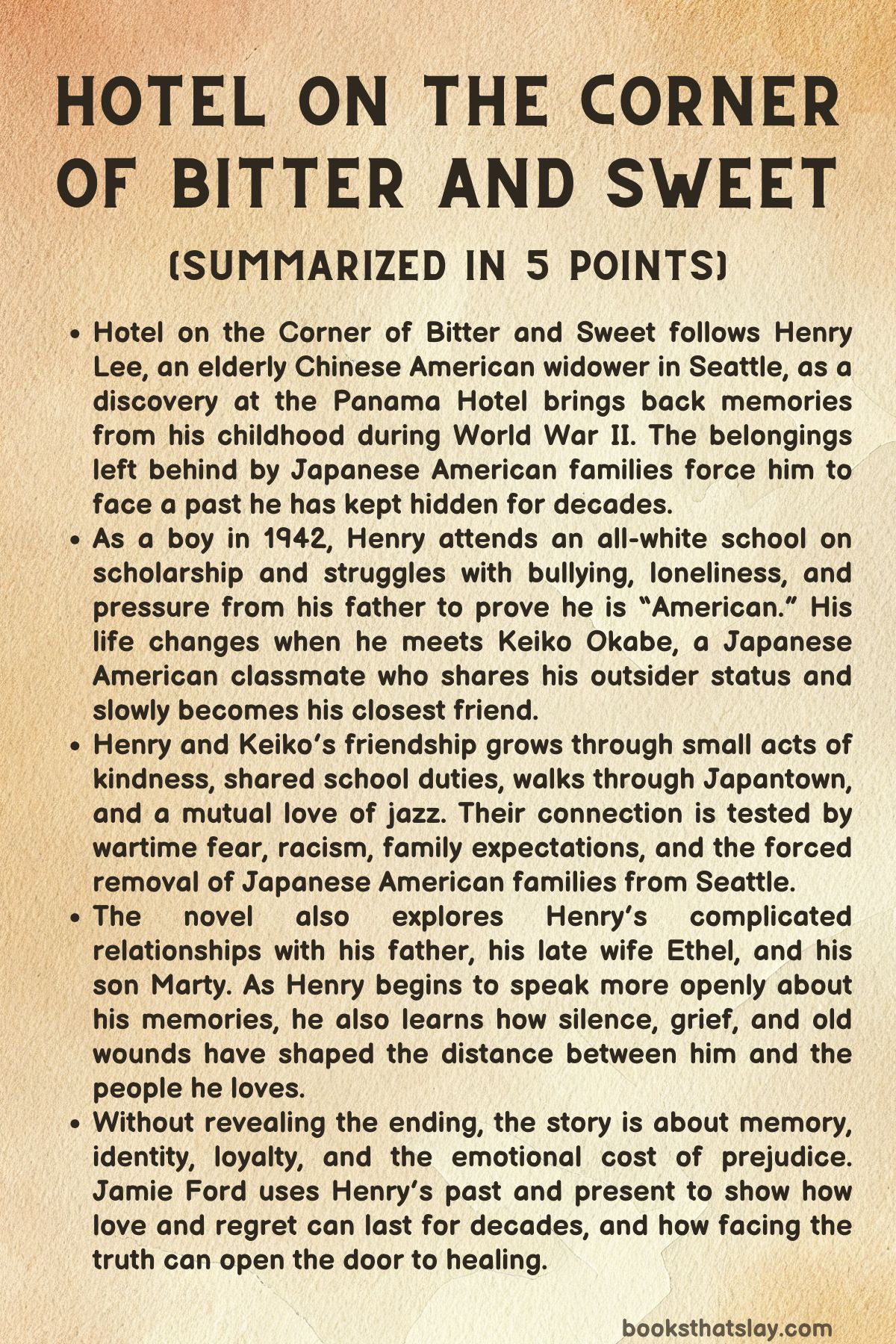
Hotel on the Corner of Bitter and Sweet by Jamie Ford is a historical novel about memory, loss, family duty, and a love shaped by racism and war. Set mainly in Seattle during World War II and in 1986, the book follows Henry Lee, a Chinese American man who is forced to face a past he has kept buried for decades.
Through Henry’s memories of Keiko Okabe, a Japanese American girl sent away with her family during the internment, the novel explores prejudice, identity, silence between parents and children, and the lasting cost of choices made under pressure.
Summary
In 1986 Seattle, Henry Lee is an older widower still learning how to live after the death of his wife, Ethel. He has spent years caring for her through cancer, and now that she is gone, his days feel quiet and uncertain.
His son Marty worries about him, but their relationship is careful and distant. Henry has never been easy with his emotions, and Marty knows very little about the deeper parts of his father’s life.
Henry is drawn to the Panama Hotel after its new owner makes a discovery in the basement: trunks, boxes, clothing, photographs, records, and keepsakes left behind by Japanese American families who were removed from Seattle during World War II. The hotel stands between Chinatown and what used to be Japantown, so the discovery carries a heavy meaning for Henry.
It brings back memories of Keiko Okabe, a girl he knew and loved when they were both children.
The story returns to 1942, when Henry is twelve years old. His Chinese parents send him to Rainier Elementary on a scholarship because they want him to become more American and have better chances than they did.
His father orders him not to speak Chinese at home so he can learn English, but at the same time he makes Henry wear a button that says “I am Chinese.” After Pearl Harbor, anti-Japanese hatred is everywhere, and Henry’s father does not want anyone to mistake his son for Japanese. This places Henry in a painful position.
He is expected to be American, Chinese, obedient, and separate from Japanese people, all at once.
At school, Henry is lonely. White classmates bully him, especially Chaz Preston, and he works in the cafeteria as part of his scholarship.
There he meets Keiko Okabe, a Japanese American girl who has also been assigned kitchen work. At first they are simply two children stuck in the same difficult place, serving lunch and washing trays while others mock them.
Slowly they begin to trust each other. They share small moments in the storage room, talk during their work, and walk together after school.
Keiko opens Henry’s eyes to a world he has been taught to avoid. She takes him through Japantown, where Japanese families try to prove their loyalty with American flags even as suspicion grows around them.
Henry sees that Keiko is not foreign or dangerous, as his father believes. She is American, just like him, and she does not even speak Japanese.
Their friendship becomes a quiet rebellion against the fear and hatred surrounding them.
Henry and Keiko also share a love of jazz. Through Sheldon, a kind Black saxophonist Henry befriends, they discover music that feels freer than the world around them.
One night, Henry and Keiko sneak into the Black Elks Club to hear Sheldon and Oscar Holden perform. The evening becomes one of their most important memories, full of sound, excitement, and a sense of belonging.
But the night is interrupted when FBI agents raid the club and arrest Japanese patrons suspected of being enemies. Keiko is hurt when Henry protects himself by stressing that he is Chinese.
To her, the difference does not matter in the way adults want it to matter. She is American, and yet she is being treated as an outsider.
As the war grows harsher, Japanese American families in Seattle begin destroying letters, photographs, clothing, and heirlooms that might be used against them. Keiko’s family gives their photo albums to Henry for safekeeping.
He hides them at home, understanding that these are not just objects but pieces of a family’s life. Keiko also gives Henry an Oscar Holden record, a gift that becomes a symbol of their bond.
Henry’s father discovers his connection to Keiko and becomes furious. His hatred of Japan is tied to China’s suffering during the war, and he cannot accept his son’s friendship with a Japanese American girl.
Henry is torn between loyalty to his parents and loyalty to what he knows is right. When evacuation orders arrive, Keiko and her family are forced to leave Seattle with other Japanese Americans.
Henry goes to say goodbye. He gives Keiko his “I am Chinese” button, and she promises not to forget him.
She pins the button inside her diary before leaving.
After Keiko is sent to Camp Harmony at the Puyallup Fairgrounds, Henry is miserable. Mrs. Beatty, the cafeteria worker, helps him by hiring him to work at the camp, which allows him to search for Keiko.
At first he cannot find her, but eventually he meets her father, who arranges for Henry and Keiko to see each other at the visitors’ fence. Their meetings are brief and watched, but they mean everything to them.
Keiko asks Henry to bring paper, stamps, fabric for curtains, and music, small things that can make life in the camp feel a little more human.
Henry tries to recover the Oscar Holden record from the Panama Hotel but cannot get inside. Sheldon gives him another copy, and Henry also buys Keiko art supplies for her birthday.
At home, his father finds the hidden Okabe photographs and throws them out the window. He threatens to disown Henry if he retrieves them.
Henry chooses Keiko and the truth over obedience. He gathers the photographs and declares that he is American.
After that, his parents stop speaking to him, though his mother still quietly looks after him.
Henry continues visiting Keiko with Mrs. Beatty’s help. He gives her the sketchbook, supplies, fabric, and record.
During a storm, Keiko plays the record inside the camp, and Henry hears the music as he leaves. Later, Keiko’s family is moved to Minidoka in Idaho.
Henry secretly travels there with Sheldon and spends precious time with Keiko. They admit that they love each other, but they are still children living under forces far beyond their control.
Back in Seattle, Henry’s father suffers a stroke. Henry tries to apologize, but his father calls him a stranger.
Keiko writes from Minidoka, but the letters become less frequent and colder over time. Henry later learns that his father has been interfering with their correspondence, hiding or destroying letters.
This betrayal helps explain the silence that grew between Henry and Keiko, but by then their lives have already moved in different directions.
When the war ends, Henry hopes Keiko might return to Seattle. But Japantown has changed, the Panama Hotel is being sold, and the world he once shared with her seems gone.
Henry meets Ethel Chen and begins building a life with her. On V-J Day, his father dies.
Henry moves toward adulthood with Ethel, but he never fully releases Keiko’s memory.
In 1986, the objects in the Panama Hotel basement bring Henry’s past back into the open. He searches with Marty and Marty’s girlfriend Samantha.
They find Keiko’s sketchbooks, filled with drawings of Seattle and portraits of young Henry. Samantha also finds the Oscar Holden record Henry has wanted for decades, though it is broken.
Even damaged, the record matters to him because it proves that what he remembers was real.
Henry finally tells Marty about Keiko. This changes something between father and son.
Marty, who is engaged to Samantha, begins to understand the private sadness his father has carried. Henry, in turn, accepts Samantha warmly, showing that he has learned from the pain caused by his own father’s prejudice.
Sheldon, now dying, urges Henry to repair what can still be repaired. Henry takes the broken record to Bud’s Jazz Records, where Bud restores it enough to make a playable copy.
Then Marty finds Keiko, now known as Kay Hatsune, a widow living in New York. He gives Henry a plane ticket, encouraging him to face the past rather than keep hiding from it.
Before leaving, Henry visits Sheldon one last time and plays the restored Oscar Holden song for him. Soon after, Sheldon dies.
Henry then travels to New York with the record. He arrives at Keiko’s apartment without calling first.
She recognizes him and says she had almost given up on him. Inside, her apartment is filled with her art, including images of Seattle, internment, and memory.
Henry sees that she kept a drawing of them from Minidoka.
Henry places the record on her turntable. As their old song plays, they greet each other in Japanese, a language neither of them truly owned as children but which now carries the weight of all they lost and found again.
After more than forty years, Henry and Keiko are reunited, not as the children they once were, but as two people who have survived grief, silence, and time.
Characters
The characters in Hotel on the Corner of Bitter and Sweet are shaped by war, race, memory, silence, family duty, and the long emotional consequences of choices made in childhood. Each character contributes to the story’s central conflict between what people are told to believe and what they personally know to be true.
Henry Lee
Henry Lee is the emotional center of the book, and his character is defined by the tension between obedience and self-discovery. As a child, he is caught between his Chinese heritage, his father’s strict expectations, and his own desire to belong in America.
His father wants him to become “American,” yet also forces him to wear an “I am Chinese” button, showing how Henry’s identity is controlled by fear, racism, and family pressure. Henry’s friendship and love for Keiko help him see beyond the prejudices he has inherited.
Through her, he learns that nationality and identity are not as simple as the labels society places on people.
As an adult, Henry is quieter, lonelier, and weighed down by grief. Ethel’s death leaves him emotionally exposed, and the discovery at the Panama Hotel forces him to confront a past he has spent decades burying.
His relationship with Marty shows how silence has damaged him; Henry loves his son, but he has not known how to share the most painful parts of his life. His journey is not only about finding Keiko again but also about reclaiming the part of himself that was silenced by his father, by war, and by regret.
By the end, Henry becomes a character who chooses emotional honesty over avoidance, showing that healing can begin even after many years of loss.
Keiko Okabe
Keiko Okabe is one of the most important and deeply sympathetic figures in the book. She represents innocence harmed by injustice, but she is never shown as weak or passive.
As a Japanese American girl, she insists on her Americanness even when the country treats her family as enemies. Her pain is especially powerful because she does not see herself as foreign; she speaks, thinks, and lives as an American child, yet she is punished for her ancestry.
This makes her character a strong reflection of the cruelty and absurdity of wartime racism.
Keiko also brings warmth, creativity, and emotional openness into Henry’s life. Her sketchbooks reveal how observant and sensitive she is, preserving places and people that others might forget.
Her drawings of Henry show that she sees him clearly, even when he struggles to understand himself. Her love of art and jazz gives her a private world of beauty during a time of fear and displacement.
As an adult, now known as Kay Hatsune, she remains connected to her past through her artwork and memories. Her reunion with Henry shows that she has carried both pain and hope, and her character becomes a symbol of love that survives separation, silence, and time.
Marty Lee
Marty Lee is Henry’s son, and his character helps show the emotional distance created by Henry’s long silence. At first, Marty worries about Henry but does not fully understand him.
Their relationship is strained because Henry has kept much of his past hidden, leaving Marty with only a limited understanding of who his father really is. Marty’s engagement to Samantha also reflects a generational shift.
Unlike Henry’s father, Henry accepts Marty’s relationship with a white woman, which shows that Henry has learned from the pain caused by prejudice and rigid family expectations.
Marty becomes more than just a concerned son as the story develops. He actively helps Henry reconnect with his past, especially by encouraging him to search for Keiko and eventually locating her.
In this way, Marty becomes a bridge between Henry’s buried memories and his chance for closure. His role is important because he helps Henry move from silence into communication.
Through Marty, the story suggests that younger generations can help heal wounds created by older conflicts, especially when they respond with openness rather than judgment.
Samantha
Samantha is Marty’s fiancée, and although she is not as central as Henry or Keiko, she plays a meaningful role in opening Henry’s family life. As a white woman engaged to Marty, she could have reminded Henry of the racial barriers that shaped his youth.
Instead, Henry’s warm acceptance of her shows how much he has grown beyond the prejudices that once controlled his own family. Samantha’s presence allows Henry to show Marty a gentler and more accepting side of himself.
Samantha is also curious, respectful, and supportive during the search at the Panama Hotel. She helps uncover pieces of Henry’s past, including Keiko’s sketchbooks and the broken record.
Her importance lies partly in the fact that she enters the family without the burden of its old silences. She listens, observes, and helps Marty understand that Henry’s past is not simply a private sadness but a living part of who he is.
Her character adds warmth to the present-day storyline and helps create the conditions for Henry’s emotional release.
Ethel Chen
Ethel Chen is Henry’s late wife, and her character carries emotional complexity because she is connected to both love and loss. Henry genuinely cared for her, especially during her illness, and his years of caring for her through cancer show loyalty, tenderness, and responsibility.
Ethel represents the life Henry chose after losing contact with Keiko. She is not presented as a replacement for Keiko, but as a real and important part of Henry’s adult life.
At the same time, Ethel’s death creates the emotional opening that allows Henry to revisit his past. Her absence leaves Henry alone with memories he had avoided for decades.
This makes Ethel important even when she is not physically present in much of the story. She represents the life Henry built, while Keiko represents the life that was interrupted.
Through Ethel, the book shows that people can carry more than one form of love, and that remembering an old love does not erase the meaning of a later one.
Henry’s Father
Henry’s father is one of the most rigid and painful figures in the story. His hatred of the Japanese is shaped by historical conflict, nationalism, and personal prejudice, and he passes that hatred onto Henry through rules, anger, and emotional pressure.
He wants Henry to succeed in America, yet his idea of success is full of contradiction. He tells Henry not to speak Chinese so he can become more American, but he also insists that Henry separate himself from Japanese Americans by wearing the “I am Chinese” button.
His character shows how fear and prejudice can distort parental love.
Despite his harshness, Henry’s father is not a simple villain. He is a man shaped by his own history and by the political tensions between China and Japan.
However, his inability to see Keiko as an individual causes deep harm. When he throws out Keiko’s family photographs and threatens to disown Henry, he forces Henry into a painful choice between obedience and conscience.
His later interference with Henry and Keiko’s letters makes him responsible for years of separation and misunderstanding. His stroke and final distance from Henry add tragedy to his character because he dies without fully repairing the damage he caused.
Henry’s Mother
Henry’s mother is quieter than Henry’s father, but her presence is emotionally significant. She lives within the strict structure of the family and often does not openly challenge her husband’s authority.
However, her care for Henry continues even when his father stops speaking to him. This quiet support shows that she loves her son, even if she lacks the power or courage to defend him openly.
Her character represents the kind of love that survives beneath silence. She does not transform the family conflict in a dramatic way, but her small acts of care matter because Henry is otherwise isolated at home.
She reflects the limited choices available to someone living under a dominant spouse and within a traditional family structure. Through her, the story shows that silence can contain both weakness and tenderness.
Sheldon
Sheldon is a warm, generous, and wise presence in the book. As a Black saxophonist, he exists outside the Chinese and Japanese communities at the center of Henry’s childhood, yet he understands exclusion and discrimination in his own way.
His love of jazz connects him to Henry and Keiko, giving them access to a world where music briefly rises above racial boundaries. Sheldon’s kindness helps Henry experience freedom, beauty, and friendship beyond the narrow rules of school and family.
Sheldon also functions as a guide. He helps Henry with music, encourages his connection to Keiko, and later travels with him to Minidoka.
In 1986, as he is dying, his instruction to Henry to “fix it” carries emotional weight. He understands that Henry’s unfinished past is not only about a broken record but about a broken connection.
Sheldon’s character represents loyalty, artistic spirit, and the moral clarity of someone who sees love as something worth protecting.
Mrs. Beatty
Mrs. Beatty begins as a practical and somewhat stern cafeteria worker, but she becomes an important helper in Henry’s life. At Rainier Elementary, she supervises Henry and Keiko while they work in the kitchen, placing her near the beginning of their friendship.
Her role grows after Keiko is sent away, when she hires Henry to help serve food at Camp Harmony. This decision allows Henry to keep seeing Keiko when nearly every other force is separating them.
Mrs. Beatty’s character shows that kindness does not always appear soft or sentimental. She is practical, direct, and not overly emotional, but her actions reveal compassion.
She does not make grand speeches against injustice, yet she helps Henry in a concrete way. Her character suggests that ordinary people can either cooperate with cruelty or quietly create openings for humanity.
Mrs. Beatty chooses the latter.
Chaz Preston
Chaz Preston is Henry’s bully at school and represents the everyday racism and cruelty Henry faces as a child. He targets Henry because Henry is different, isolated, and visibly marked by his ethnicity.
Chaz’s behavior shows how children can absorb and repeat the prejudices of the adult world. His bullying is not separate from the larger atmosphere of wartime fear; it is a smaller version of the same hatred that allows communities to turn against Japanese Americans.
Chaz is important because he helps reveal Henry’s loneliness at Rainier Elementary. Henry is not fully accepted by white classmates, and his scholarship position makes him even more vulnerable.
Chaz’s cruelty also contrasts with Keiko’s kindness. Through this contrast, Henry begins to understand the difference between people who define others by race and people who see them as individuals.
Mr. Okabe
Mr. Okabe, Keiko’s father, is a dignified and caring figure who tries to protect his family under impossible circumstances. When Japanese American families are forced from their homes, he faces humiliation and loss, yet he still helps arrange Henry and Keiko’s meeting at the visitors’ fence.
His willingness to support their friendship shows that he recognizes Henry’s sincerity and does not judge him by the prejudice of Henry’s father.
His character represents the quiet strength of the families who endured forced removal and incarceration. He must accept conditions that are unjust while still trying to preserve family, dignity, and hope.
Through Mr. Okabe, the book shows the emotional burden placed on parents who cannot protect their children from the actions of the government. His calm cooperation with Henry is also a contrast to Henry’s father’s bitterness, showing two very different responses to fear and suffering.
Mrs. Okabe
Mrs. Okabe is less visible than Keiko’s father, but she is part of the family world that Keiko loses when the evacuation begins. Her character represents the many Japanese American mothers whose lives were uprooted by wartime suspicion.
She is connected to the domestic details of displacement: belongings, photographs, clothing, and the painful need to abandon or hide parts of family history.
Her importance lies in what she helps represent collectively. The Okabe family’s experience is not only Keiko’s tragedy but the tragedy of entire households forced to pack, leave, and live under guard.
Mrs. Okabe helps make that suffering feel personal rather than abstract. Through her presence, the story reminds readers that internment harmed families across generations, not just individuals.
Oscar Holden
Oscar Holden is not a central active character, but his music has a powerful symbolic role. As a jazz musician, he represents the beauty and freedom that Henry and Keiko discover together.
The record connected to him becomes one of the most important objects in the story because it preserves the emotional truth of Henry and Keiko’s bond. Even when the record is broken, it still matters because it proves that their shared past was real.
Oscar’s music links memory, love, and place. The record survives as a fragile object, much like Henry’s memories of Keiko.
When Bud repairs it enough to make a playable copy, the music becomes a way for Henry to return emotionally to the past without remaining trapped there. Oscar Holden’s character therefore matters less as a person in the plot and more as a symbol of art’s ability to carry feeling across time.
Bud
Bud, the owner of Bud’s Jazz Records, plays a small but meaningful role in the later part of the story. He helps Henry repair the broken Oscar Holden record, making it possible for Henry to carry the song to Keiko in New York.
His work with the record is practical, but symbolically it helps restore a damaged piece of Henry’s past.
Bud’s character represents the importance of preservation. Just as the Panama Hotel preserves forgotten belongings, Bud helps preserve forgotten music.
He cannot undo the past, but he can help Henry recover enough of it to make reconnection possible. His role shows that healing often depends not only on major emotional decisions but also on small acts of care from others.
Kay Hatsune
Kay Hatsune is Keiko’s adult identity, and she represents survival after loss. Though she has lived a long life after the war, her apartment and artwork show that she has never fully left the past behind.
She has continued to remember Seattle, Minidoka, and Henry through art, proving that memory remained central to her life.
Kay is important because she shows that Keiko did not simply disappear from Henry’s life; she continued living, grieving, creating, and remembering. Her reunion with Henry is powerful because it brings together the girl she was and the woman she became.
In the final moments, she is not only a lost love recovered but a fully formed person whose life has also been shaped by absence. Her character gives the ending of Hotel on the Corner of Bitter and Sweet its emotional tenderness and sense of long-delayed healing.
Themes
Racial Identity and the Pressure to Belong
Henry’s childhood is shaped by the painful demand to prove who he is in a society that judges people by race before character. His “I am Chinese” button becomes a small object with a heavy meaning: it protects him from being mistaken for Japanese, but it also forces him to separate himself from Keiko, even though both children are American in the deepest sense.
His father’s insistence that Henry learn “American” while also rejecting Japanese people shows the confusion of immigrant identity during wartime. Henry is pushed to fit into America, obey his Chinese heritage, and avoid association with Japanese Americans, all at the same time.
Keiko, by contrast, confidently sees herself as American, even when the country refuses to treat her that way. Through Henry and Keiko, Hotel on the Corner of Bitter and Sweet shows how racism turns identity into a test, making children defend themselves against labels they did not choose.
Love Across Barriers
Henry and Keiko’s relationship grows in a world determined to keep them apart. Their love begins quietly through shared work, music, walks, sketches, and small acts of trust, but every part of their bond faces pressure from outside forces.
Henry’s father sees Keiko through wartime hatred, not as a girl with kindness, talent, and courage. The government removes Keiko’s family from their home, making distance a weapon against their friendship.
Even after separation, Henry’s visits, gifts, letters, and journey to Minidoka show that love survives through effort, memory, and loyalty. Yet the relationship is also damaged by silence, family control, and time.
Henry’s later life with Ethel does not erase Keiko; instead, it shows that people can carry more than one kind of love. The reunion in old age gives the theme emotional weight because it suggests that love delayed is not always love destroyed.
Memory, Grief, and the Past Returning
The Panama Hotel becomes a physical symbol of buried memory. Its basement holds belongings left behind by Japanese American families, and for Henry, those objects are not simply historical items; they are proof of a past he tried to hide from his son and perhaps even from himself.
After Ethel’s death, Henry is already living with grief, but the discovery at the hotel reopens another grief that began in childhood. The broken record, Keiko’s sketches, and the stored trunks all show how memory can survive even when people are forced to leave, lose, or remain silent.
Henry’s pain is not only about missing Keiko; it is also about lost chances, words never spoken, and years shaped by misunderstanding. By returning to the past, he begins repairing his relationship with Marty as well.
Hotel on the Corner of Bitter and Sweet presents memory as painful, but also necessary for healing.
Injustice and the Cost of Silence
The forced removal of Japanese American families reveals how fear can make injustice seem acceptable to a wider society. Keiko’s family, like many others, loses home, safety, dignity, and freedom despite their loyalty to America.
The scenes of families burning letters, hiding photographs, and storing possessions show how deeply government suspicion enters private life. Silence becomes another form of harm: neighbors watch communities vanish, Henry’s father lets prejudice control his judgment, and Henry himself spends decades keeping his story from Marty.
The novel shows that injustice does not end when the official event ends; it continues in broken families, lost relationships, and unanswered questions. Yet the story also values people who resist silence in small ways.
Henry saves photographs, visits Keiko, shares the truth with Marty, and finally searches for her. These actions cannot undo the past, but they challenge the silence that allowed pain to remain hidden for so long.