How We Decide Summary and Analysis
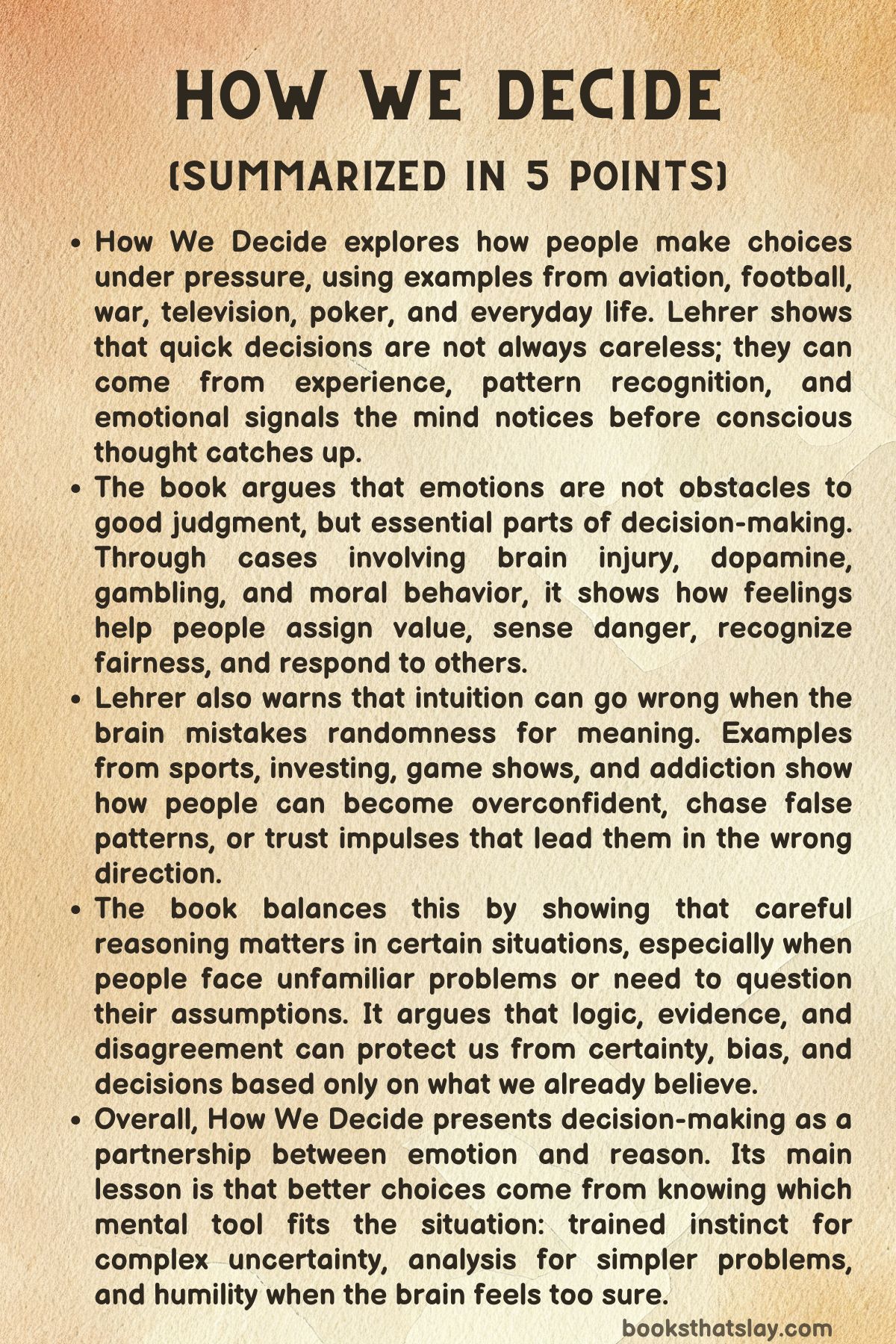
How We Decide by Jonah Lehrer is a popular science book about the hidden forces behind human choices. It argues that decision-making is not a simple battle between reason and emotion.
Instead, the best choices often come from knowing when to trust instinct, when to slow down and think, and when to let both systems check each other. Through aviation crises, sports, gambling, medicine, morality, consumer behavior, poker, and neuroscience, Lehrer shows that feelings can contain useful information, but they can also mislead us. The book presents the mind as an active, conflicted system built to choose under pressure.
Summary
How We Decide opens with a dramatic emergency inside a Boeing 737 approaching Tokyo Narita. At seven thousand feet, the left engine catches fire, alarms fill the cockpit, and the aircraft begins to bank and lose speed.
The narrator faces a decision that must be made in seconds. One option is to climb using the remaining engine.
The other is to dive, gain speed, and try to regain control. He pushes the plane downward, recovers enough speed to stabilize it, lines up with the runway, and lands roughly but safely.
The scene then reveals its lesson: the crisis happened inside a flight simulator. When the same scenario is repeated and the narrator chooses to climb instead, the plane stalls and crashes.
The incident introduces one of the book’s main ideas: good decisions often depend on fast emotional signals shaped by experience, not just on careful logic.
The book then moves to the 2002 Super Bowl, where the New England Patriots are tied with the St. Louis Rams. With only eighty-one seconds left and the Patriots deep in their own territory, the safe choice appears to be running out the clock and going to overtime.
Instead, Tom Brady calmly leads a final drive. He takes what the defense gives him, avoids reckless throws, and uses short passes to move the ball into field-goal range.
His choices are not flashy, but they are controlled and precise. Adam Vinatieri then kicks the winning field goal as time expires.
The scene shows that expert decision-making under pressure is not only about boldness. It is also about reading the moment, managing emotion, and choosing the right level of risk.
The story of Antonio Damasio’s patient Elliot gives the book its central neurological argument. Elliot has a tumor removed from his frontal brain area.
After the surgery, his intelligence remains intact, but his life falls apart. He can analyze facts, discuss options, and reason clearly, yet he cannot make ordinary decisions.
He spends excessive time on small choices, loses his job, fails in business, becomes bankrupt, and seems emotionally detached from his losses. Damasio discovers that Elliot no longer responds emotionally even to disturbing images.
The lesson is that emotion is not the enemy of reason. Without emotional signals, the mind cannot sort important choices from trivial ones.
Feelings help assign value.
The same theme appears in the work of Herb Stein, a long-time director of Days of Our Lives. Stein works under severe time pressure and must make decisions constantly about camera angles, actor movements, scenes, and casting.
He often knows within seconds whether an actor fits a role, even before he can explain why. His judgment comes from years of practice.
The book uses Stein to show that intuition can be a form of learned expertise. It is not magic.
It is the brain recognizing patterns faster than conscious language can describe them.
One of the strongest examples of this pattern recognition comes from the Gulf War. Lieutenant Commander Michael Riley is aboard HMS Gloucester when a radar blip appears, moving toward the USS Missouri.
It looks almost identical to a returning American aircraft, and the available data are incomplete. Riley cannot fully explain his fear, but something about the blip feels wrong.
He orders missiles fired, and the target is destroyed moments before it reaches the battleship. Later, investigators confirm that it was an Iraqi Silkworm missile.
Analysis shows that Riley’s brain had noticed a subtle timing difference: the blip appeared several radar sweeps later than friendly aircraft usually did. His conscious mind did not yet have the explanation, but his emotional alarm was based on real evidence.
The book then explains this process through dopamine. In experiments, monkeys learn that certain tones predict juice rewards.
Their dopamine neurons respond not only to rewards but also to prediction errors: when expected rewards fail to appear, the neurons react sharply. This system helps the brain learn from surprises.
Similar patterns appear in gambling experiments. People begin to show bodily signs of nervousness around bad card decks before they can consciously explain which decks are dangerous.
The body knows first, because emotional learning has already detected the pattern.
But feelings can also mislead. Ann Klinestiver, a Parkinson’s patient, begins taking the dopamine drug Requip.
Afterward, she develops a severe gambling addiction. She spends long periods at slot machines, loses more than $250,000, sells belongings, harms her marriage, and steals from relatives.
When she stops taking the drug, the compulsion disappears. Her case shows that the brain’s reward system can be chemically distorted.
The same circuits that help people learn from experience can also trap them in destructive habits when dopamine signals become unreliable.
The book also examines how easily people mistake randomness for meaning. Basketball fans and players believe in the “hot hand,” assuming that a player who has made recent shots is more likely to keep making them.
Studies of teams such as the 76ers and Celtics, however, find no strong evidence for a true streak effect. Investors make a similar mistake in financial markets.
They see patterns in random movement, chase rising stocks, and panic during falls. On Deal or No Deal, contestants face another version of the same conflict, as mathematical probability battles fear, hope, regret, and pressure from the crowd.
In these cases, emotion does not clarify judgment; it distorts it.
The book then turns to moments when deliberate thinking becomes essential. In the Mann Gulch fire, smokejumper Wag Dodge survives because he stops following instinct.
While others keep running from the flames, Dodge invents an escape fire, burning the grass around him and lying in the cleared area as the main fire passes. His survival depends on resisting panic and creating a new solution.
A similar kind of reasoning appears on United Flight 232. After the aircraft loses hydraulic control, Captain Al Haynes and his crew improvise by using engine thrust to steer.
They cannot save the plane completely, but their teamwork and flexible thinking allow many people to survive the crash landing at Sioux City.
Still, the book warns that too much conscious thought can hurt performance. People may overanalyze preferences until they choose what they do not actually like.
Athletes and performers can choke when they begin consciously controlling skills that normally run automatically. Jean Van de Velde’s collapse at the British Open becomes a lesson in how pressure can disrupt trained instinct.
The mind must know when to think and when to stop thinking.
The later sections extend the argument into morality. John Wayne Gacy appeared ordinary and respectable while secretly murdering thirty-three boys.
His case introduces psychopathy. Psychopaths may reason clearly, but they lack the emotional responses that make other people’s suffering matter.
They do not experience fear, guilt, or sympathy in the usual way. Brain research points to weak or damaged emotional systems, especially involving the amygdala.
The book uses this to argue that moral judgment is not pure logic. Emotion is central to conscience.
Experiments support this view. Jonathan Haidt’s scenario about siblings Julie and Mark shows that people often make moral judgments instantly and then search for reasons afterward.
Even when rational objections are removed, many still insist the act is wrong. Trolley problems reveal a similar divide.
People often accept turning a trolley so that one person dies instead of five, but reject pushing a man to stop the trolley. Direct personal harm activates emotional brain systems connected to imagining another person’s mind.
Moral choice depends heavily on sympathy.
Sympathy also shapes fairness. In the ultimatum game, people reject unfair offers even when rejection leaves them with nothing.
Proposers usually offer fair splits because they can imagine the responder’s anger. Acts of generosity are linked to reward circuits, suggesting that helping others can feel satisfying because the brain treats social good as valuable.
Autism is discussed as a condition in which reading other minds can be difficult. People with autism may struggle with facial expressions and social expectations, which can make their decisions highly logical but socially ineffective.
The dictator game shows the opposite problem: when recipients are unseen, sympathy weakens and people give less.
The book then looks at emotional development. Harry Harlow’s monkey experiments show that infant primates need comfort, not only food.
Monkeys raised without affection become socially damaged, aggressive, and unable to care for their young. Neglected children in Romanian orphanages suffer related emotional, hormonal, and brain-development problems.
Abused toddlers may try to comfort others but do so in confused or aggressive ways because they have not learned healthy emotional responses. Even rhesus monkeys will stop pulling a chain for food if doing so shocks another monkey.
Sympathy is not a thin social rule; it is rooted deep in the brain.
Finally, How We Decide presents the brain as an internal argument. Consumer choices involve desire, price anxiety, and calculation competing at once.
The nucleus accumbens responds to wanted products, the insula reacts to painful prices, and the prefrontal cortex weighs the deal. Retailers exploit these systems through discounts, samples, and credit cards.
The same danger appears in politics and intelligence work, where certainty can silence useful disagreement. Partisan voters excuse contradictions, pundits cling to theories, and Israeli intelligence before the Yom Kippur War ignores warning signs because leaders trust “the Concept.” Good judgment requires doubt, evidence, and competing viewpoints.
The book closes with poker player Michael Binger at the World Series of Poker. He uses mathematics to fold weak hands and bet strong ones, but he also relies on trained intuition to read opponents and make uncertain moves.
Poker becomes the final model for decision-making. Some choices are math problems.
Others are mysteries. Simple problems need conscious reason.
Complex situations often benefit from unconscious processing built through experience. The best decisions come from knowing which mental tool fits the moment.
Key Figures
In How We Decide, the “figures” are mostly real people, patients, athletes, soldiers, scientists, criminals, and experimental subjects used to explore how human decision-making works. Each of them helps reveal a different force inside the mind: instinct, emotion, reason, sympathy, error, fear, experience, or overthinking.
The Narrator in the Flight Simulator
The narrator functions as the reader’s entry point into the book’s central question: how do people make decisions when everything depends on a single choice? Inside the Boeing 737 flight simulator, he faces a terrifying emergency in which the left engine catches fire, the plane loses balance, and the aircraft begins to stall.
His first successful decision, pushing the plane downward to gain speed instead of climbing, shows that good judgment can sometimes feel counterintuitive. The narrator’s experience also creates suspense because the crisis seems real until it is revealed to be a simulation.
As a character in the book, he represents the ordinary person placed inside an extraordinary decision-making situation, showing how difficult it is to choose correctly under pressure when instinct, fear, and logic are all competing at once.
Tom Brady
Tom Brady is presented as a model of calm decision-making under pressure. During the Super Bowl drive, he does not act like a reckless hero trying to win the game with one dramatic throw.
Instead, he reads the defense, accepts short passes, avoids unnecessary risks, and gradually moves the Patriots into scoring position. His strength as a character in the book lies in his emotional control.
He shows that expert decision-making is not always flashy; sometimes it is patient, restrained, and built on taking what the situation allows. Brady’s final drive illustrates trained intuition, because his choices appear quick and natural, but they are shaped by experience, discipline, and the ability to remain composed while others expect panic.
Troy Brown
Troy Brown plays a smaller but important role in the Super Bowl example. His crucial catch over the middle helps turn Brady’s careful decision-making into actual progress on the field.
As a character in the book, Brown represents the importance of trust and execution in a high-pressure system. Brady’s decisions matter, but they only succeed because his teammates understand the situation and perform their roles.
Brown’s presence shows that good decisions are often collective in their outcome, even when one person seems to be at the center of the moment. He becomes part of the larger example of how experience, timing, and teamwork can transform pressure into success.
Adam Vinatieri
Adam Vinatieri appears as the final point of calm precision in the Super Bowl sequence. After Brady and the offense move the ball into position, Vinatieri must complete the decision-making chain by making the game-winning kick.
His role in the book is symbolic because he represents the moment when preparation must become action. A field goal at the end of a Super Bowl carries enormous emotional pressure, yet Vinatieri’s job requires focus, routine, and confidence.
He shows that successful decisions often depend not only on choosing the right strategy but also on executing a practiced skill when the stakes are highest.
Antonio Damasio
Antonio Damasio is one of the book’s most important scientific figures because his work challenges the idea that reason alone produces good decisions. Through his study of Elliot, Damasio shows that emotion is not the enemy of rational thought but one of its foundations.
His role in the book is that of a guide who helps reveal the hidden importance of feeling. Damasio’s insight is powerful because Elliot’s intelligence remains intact, yet his life collapses when his emotional responses are damaged.
As a character in the book’s argument, Damasio represents scientific curiosity and the willingness to rethink old assumptions about the mind.
Elliot
Elliot is one of the most important and tragic figures in the book. After surgery removes a tumor from his frontal brain area, he keeps his intelligence but loses the emotional signals that help ordinary people make choices.
His life becomes a painful demonstration that pure reason is not enough. He can analyze options endlessly, but he cannot decide which option matters.
His inability to feel emotional weight causes him to waste hours on trivial choices, lose jobs, damage relationships, and fall into financial ruin. Elliot is significant because he proves that emotions are not distractions from decision-making; they are often what allow decisions to happen at all.
Without emotional guidance, even a highly intelligent person can become helpless in everyday life.
Herb Stein
Herb Stein, the veteran director of Days of Our Lives, represents the power of professional intuition. Working under intense time pressure, he must make rapid decisions about camera angles, actor movements, and casting.
His judgments often happen too quickly for him to explain, yet they are not random guesses. They are the result of long experience.
Stein’s character shows how intuition can become reliable when it has been trained in a familiar environment. His ability to recognize whether an actor fits a role within seconds suggests that the brain can absorb patterns long before conscious language can describe them.
He represents the expert mind working efficiently beneath the surface.
Lieutenant Commander Michael Riley
Michael Riley is one of the clearest examples of life-or-death intuition in the book. During the Gulf War, he sees a radar blip that resembles a friendly American aircraft, yet something about it feels wrong.
Without complete data, he orders the target destroyed, later discovering that it was an Iraqi Silkworm missile headed toward the USS Missouri. Riley’s importance lies in the fact that his fear was not irrational.
His brain had unconsciously noticed a subtle timing difference in the radar pattern. As a character in the book, Riley shows that intuition can be a form of hidden analysis.
His decision proves that the mind can detect patterns before conscious awareness catches up, especially when a person has deep experience in a field.
The Dopamine Monkeys
The monkeys in the dopamine experiments are not human characters, but they play an essential role in the book’s explanation of learning and prediction. Their brains respond not simply to rewards but to the difference between expected and actual rewards.
When a tone predicts juice, their dopamine neurons learn the pattern. When the prediction fails, the brain reacts strongly.
These monkeys represent the biological roots of decision-making. They show that the brain is constantly making forecasts about the world and adjusting behavior when those forecasts are wrong.
Their role helps explain why humans learn from success, disappointment, surprise, and repeated experience.
Ann Klinestiver
Ann Klinestiver is one of the most disturbing and sympathetic figures in the book. As a Parkinson’s patient treated with the dopamine drug Requip, she develops a gambling addiction that overwhelms her ordinary judgment.
She spends days at slot machines, loses more than $250,000, sells possessions, damages her marriage, and steals from family members. Her story is powerful because it shows how decision-making can be chemically distorted.
Ann is not presented as simply irresponsible; her behavior changes because the drug affects the reward system in her brain. Once she stops taking the medication, the compulsion disappears.
As a character in the book, she reveals how fragile self-control can be when the brain’s reward machinery is pushed out of balance.
Wag Dodge
Wag Dodge is portrayed as a figure of desperate creativity under extreme pressure. In the Mann Gulch fire, while others continue running from the flames, Dodge invents an escape fire and survives.
His decision is remarkable because it goes against the obvious instinct to flee. Dodge’s role in the book is to show that deliberate reasoning can save lives when instinct becomes dangerous.
His survival depends on his ability to stop, think, and imagine a solution that others cannot understand in time. He represents the kind of decision-maker who can break free from panic and create a new option when all familiar options have failed.
Captain Al Haynes
Captain Al Haynes is another example of disciplined improvisation in a crisis. After United Flight 232 loses hydraulic control, Haynes and his crew face a situation that should be impossible to manage.
Instead of surrendering to chaos, they experiment, communicate, and use the limited control available to bring the aircraft toward Sioux City. Although the landing ends in a crash, many lives are saved because of the crew’s decisions.
Haynes represents teamwork, humility, and practical intelligence. His importance in the book comes from the way he combines experience with flexibility.
He does not solve the crisis through a perfect plan, but through continuous adjustment.
John Wayne Gacy
John Wayne Gacy is one of the darkest figures in the book. He appears outwardly normal and respectable while secretly committing horrific murders.
His role is to introduce the idea of psychopathy and to show that reasoning ability alone does not make a person moral. Gacy can appear socially functional, but he lacks the emotional responses that normally restrain cruelty.
As a character in the book, he represents the terrifying gap between intelligence and sympathy. His example shows that moral decision-making depends not only on knowing rules but also on feeling the suffering of others as real and meaningful.
Immanuel Kant
Immanuel Kant appears as a philosophical contrast to the book’s argument about morality. He represents the traditional belief that moral judgment comes mainly from reason.
In this view, people decide what is right by applying principles and thinking rationally. The book uses Kant as a counterpoint to modern psychological and neurological evidence suggesting that moral judgment is often emotional first and rational afterward.
As a character in the intellectual argument, Kant stands for the older ideal of reason as the highest moral authority. His presence helps clarify the book’s challenge to that ideal.
Jonathan Haidt
Jonathan Haidt is important because his experiments show that people often make moral judgments before they can explain them. His Julie and Mark scenario demonstrates that people may insist something is wrong even after their rational objections are removed.
Haidt’s role in the book is to reveal the hidden emotional basis of moral certainty. He shows that reasoning often behaves like a lawyer defending a verdict already reached by feeling.
As a character in the book’s scientific discussion, Haidt helps shift morality away from pure logic and toward emotional intuition, social instinct, and unconscious judgment.
Julie and Mark
Julie and Mark are fictional figures in Haidt’s moral scenario, but they play an important role in the book’s exploration of moral intuition. Their situation is designed to remove ordinary rational objections and force people to confront the source of their moral judgment.
Readers and experimental subjects often continue to feel that their action is wrong even when they cannot explain why. As characters in the book, Julie and Mark are less important as individuals than as a test of the mind.
They reveal how moral disgust and emotional reaction can survive even when conscious reasoning has no clear argument left.
The Man in the Trolley Problem
The man in the trolley problem functions as a symbolic figure in the book’s discussion of moral emotion. When people imagine pushing him to stop a trolley and save five others, many refuse, even though they might accept pulling a switch that produces the same numerical result.
His importance comes from his physical closeness. He is not an abstract number; he is a person whose death must be directly caused.
As a character in the book’s moral framework, he shows that the brain reacts differently to personal harm than to distant harm. He represents the emotional force of human presence in moral judgment.
The Responder in the Ultimatum Game
The responder in the ultimatum game represents the human demand for fairness. Even when accepting an unfair offer would produce some financial gain, responders often reject the offer to punish selfishness.
This figure shows that decision-making is not always about maximizing money. People are willing to lose something in order to defend dignity, fairness, and social expectations.
As a character in the book’s argument, the responder reveals how emotion and morality enter economic choices. Anger at unfairness becomes a decision-making force.
The Proposer in the Ultimatum Game
The proposer in the ultimatum game represents the social imagination involved in decision-making. Proposers often make fair offers because they can anticipate how responders will feel if treated unfairly.
This character shows that sympathy and prediction are connected. A person makes a better decision by imagining another person’s reaction.
The proposer’s role in the book is to show that fairness is not only a moral ideal but also a practical strategy shaped by emotional intelligence. The ability to imagine anger, resentment, or rejection helps guide behavior.
People with Autism in the Economic Games
People with autism are discussed in the book to show how social decision-making can become difficult when reading other minds is impaired. Their choices in economic games may be more strictly rational, but those choices can fail socially because they do not account for how others will emotionally interpret unfairness.
The book presents this not as a lack of intelligence but as a difference in social perception. These figures reveal that successful decisions often require more than logic.
They require the ability to imagine another person’s feelings, expectations, and likely reactions.
Harry Harlow
Harry Harlow appears as a researcher whose experiments reveal the emotional foundations of social development. His monkey studies show that infant primates need comfort and affection, not merely food.
Harlow’s role in the book is important because his work demonstrates that sympathy and emotional connection are learned through care. The monkeys raised without comfort become disturbed, violent, and unable to parent normally.
As a character in the book’s scientific landscape, Harlow helps show that moral and social behavior grows out of early emotional experience.
The Neglected Romanian Orphans
The Romanian orphans are among the most heartbreaking figures in the book. Raised in environments lacking affection and stable care, they suffer emotional, social, hormonal, and brain-development damage.
Their role is to show the consequences of emotional deprivation. They demonstrate that sympathy is not simply an abstract moral quality; it depends on early human connection.
As characters in the book, they reveal how neglect can damage the systems that allow people to trust, bond, and respond to others with care.
The Abused Toddlers
The abused toddlers in the book show how damaged emotional learning can distort even attempts at kindness. When they try to comfort crying children, their gestures can become aggressive because they have not learned healthy patterns of sympathy and care.
Their behavior is tragic because it suggests that they are not incapable of concern, but their emotional responses have been shaped by violence and fear. As characters in the book, they show how early experience teaches the brain what emotions mean and how they should be expressed.
The Rhesus Monkeys
The rhesus monkeys that stop pulling chains for food when doing so shocks another monkey are powerful examples of primitive sympathy. Their behavior suggests that concern for another creature’s suffering is not limited to human moral philosophy.
As characters in the book, they represent the deep biological roots of empathy. Their refusal to harm another monkey for personal gain supports the idea that moral emotion is ancient, embodied, and instinctive.
They help show that sympathy is not just learned reasoning but a basic social force.
The Partisan Voters
The partisan voters in the book represent the danger of motivated reasoning. When confronted with contradictions from their preferred candidates, they excuse the inconsistencies and feel rewarded after defending their side.
Their role is to show how intelligence and reasoning can be misused. Instead of helping people discover the truth, reasoning can become a tool for protecting identity and prior belief.
As characters in the book’s argument, these voters reveal that certainty can be emotionally satisfying even when it makes people less accurate.
Philip Tetlock
Philip Tetlock appears as a researcher who exposes the weakness of overconfident expert prediction. His work on pundits shows that people with grand theories can perform worse than chance because they force events to fit their preferred explanations.
Tetlock’s role in the book is to warn against intellectual arrogance. He shows that the mind often prefers coherence to accuracy.
As a character in the book’s discussion of judgment, Tetlock represents skepticism, humility, and the need to test beliefs against reality.
The Pundits
The pundits in Tetlock’s research serve as examples of overconfident thinking. They believe their theories explain the world, but their predictions often fail because they cling too tightly to those theories.
Their importance in the book is that they show how expertise can become a trap. When people become too certain, they stop listening to evidence that contradicts them.
As characters in the book, the pundits represent the danger of using intelligence to defend a worldview instead of revise it.
Israeli Intelligence Officials
The Israeli intelligence officials connected to the Yom Kippur War are used to show the danger of fixed assumptions. Because they are committed to “the Concept,” they ignore strong signs of an approaching attack.
Their role in the book is to demonstrate how certainty can blind institutions as well as individuals. These officials are not portrayed as foolish; rather, their failure comes from being too attached to an existing interpretation.
As characters in the book, they show that decision-making improves when people welcome disagreement and actively search for evidence that challenges their beliefs.
Michael Binger
Michael Binger is one of the book’s most complete examples of balanced decision-making. As a physicist and poker player, he begins with mathematics, calculating probabilities and making disciplined choices.
But as the poker tournament progresses, he also uses intuition to read opponents, bluff, and sense hidden opportunities. His strength as a character lies in his ability to combine reason and instinct.
He understands that some decisions are math problems, while others are mysteries shaped by uncertainty and human behavior. Binger represents the ideal decision-maker: analytical when the situation demands calculation, intuitive when experience can detect what numbers alone cannot reveal.
Paul Wasicka
Paul Wasicka appears as Binger’s opponent in a key poker moment. His role is important because he becomes part of the psychological contest that reveals the limits of pure calculation.
Poker is not only about cards but also about reading another person’s confidence, hesitation, and intentions. Wasicka’s presence allows Binger’s intuition and strategy to become visible.
As a character in the book, Wasicka represents the uncertainty created by other minds. He reminds the reader that many real decisions involve opponents, hidden motives, and incomplete information.
Ap Dijksterhuis
Ap Dijksterhuis appears as a researcher who studies the role of unconscious thought in complex decisions. His experiments suggest that conscious reasoning can help with simple choices, while unconscious processing can improve decisions involving many variables, such as choosing cars, furniture, or art.
His role in the book is to complicate the idea that more thought always produces better results. As a character in the book’s scientific argument, Dijksterhuis shows that the mind sometimes works best when it is not forcing every detail into conscious awareness.
His work supports the broader lesson that different kinds of decisions require different mental tools.
Jean Van de Velde
Jean Van de Velde represents the danger of overthinking under pressure. His collapse at the British Open shows how a skilled performer can lose control when conscious thought interferes with practiced ability.
As a character in the book, he demonstrates that expertise can be disrupted when the mind becomes too self-aware at the wrong moment. His failure is not simply a lack of skill; it is an example of choking, where pressure causes a person to analyze movements or decisions that should remain automatic.
Van de Velde’s role reinforces one of the book’s central warnings: thinking more is not always thinking better.
The Deal or No Deal Contestants
The contestants on Deal or No Deal represent ordinary people caught between probability and emotion. Their choices are shaped by mathematical odds, fear of regret, hope for a bigger prize, and the pressure of the game’s drama.
As characters in the book, they show how difficult it is to make rational decisions when money, suspense, and public attention are involved. Their behavior reveals that people do not experience risk as a cold calculation.
They feel it physically and emotionally. The contestants help show why real-life decisions often depart from what simple mathematics would recommend.
Basketball Fans and Players
The basketball fans and players who believe in the “hot hand” represent the human tendency to see patterns in randomness. They feel certain that a player who has made several shots is more likely to keep scoring, even when studies suggest that such streaks may not truly exist in the way people imagine.
As characters in the book, they reveal how convincing false patterns can feel. Their belief shows that the brain is eager to turn randomness into a story, especially in competitive and emotional settings.
Investors
The investors in the book serve as another example of people mistaking randomness for meaningful patterns. They chase rising markets, panic when prices fall, and often treat short-term movement as if it reveals a deeper truth.
Their role is to show how emotion can distort financial judgment. Greed, fear, and overconfidence make investors vulnerable to bad decisions.
As characters in the book, they represent a broader human weakness: the desire to find certainty in systems that are partly unpredictable.
The Newspaper Editorial Board
The divided newspaper editorial board in the 2008 New Hampshire primary functions as a metaphorical character for the brain itself. Its internal disagreement reflects how decisions often emerge from competing voices rather than from one unified self.
The board’s debate shows that conflict is not always a weakness; it can help produce better judgment by forcing different views to challenge one another. As a character-like example in the book, the editorial board represents the mind as a committee, where desire, caution, evidence, memory, and emotion all struggle to influence the final choice.
Themes
Emotion as a Guide to Decision-Making
The experiences of the pilot in the simulator, Tom Brady in the Super Bowl, and Michael Riley during the Gulf War show that emotion is not the enemy of good judgment. Fear, pressure, and bodily signals can carry hidden knowledge gathered from past experience.
Riley could not fully explain why the radar blip felt wrong, yet his unease came from his brain noticing a pattern before his conscious mind could name it. Similarly, Brady’s calmness under pressure allowed him to make short, safe choices instead of forcing a heroic play.
The book suggests that emotions often act like compressed experience: they turn small clues, memories, and learned patterns into immediate feelings. This does not mean every feeling is correct, but it does mean that wise decisions often depend on listening to trained emotional responses.
In How We Decide, emotion becomes a practical tool, especially in urgent situations where slow reasoning arrives too late.
The Limits of Pure Reason
Elliot’s case shows that intelligence alone is not enough to make decisions. After losing normal emotional responses, he can analyze choices endlessly but cannot choose effectively.
His problem is not lack of logic; it is the absence of emotional weight. Ordinary decisions require value, preference, urgency, and personal meaning, and these come from emotion.
Without them, every option becomes equally abstract. This idea challenges the belief that better decisions always come from removing feeling.
The text repeatedly shows that when people try to depend only on reason, they may become stuck, slow, or detached from consequences. Herb Stein’s quick casting judgments and the poker player’s growing reliance on intuition also support this theme.
Some choices are too complex to solve by listing every factor. Reason is useful, but it needs emotion to mark what matters.
The book presents decision-making as a partnership between analysis and feeling, not a victory of one over the other.
The Danger of Misreading Patterns
People often mistake randomness for meaning, especially when they want control over uncertain events. The belief in the “hot hand” shows how easily the mind sees streaks where none truly exist.
Basketball players, fans, investors, gamblers, and game-show contestants all fall into similar traps: they treat chance as if it has a message. This theme becomes especially powerful in the story of Ann Klinestiver, whose dopamine medication pushes her into compulsive gambling.
Her brain becomes trapped by the promise of reward, even as her real life falls apart. Stock-market behavior follows the same pattern on a larger scale, as investors chase rising prices and panic during declines because they imagine patterns in noisy data.
The text warns that the brain is built to learn from prediction, but this strength can become dangerous when the environment is random. Good judgment requires knowing when a signal is meaningful and when it is only chance wearing a convincing mask.
Moral Judgment and Sympathy
The sections on psychopathy, moral experiments, autism, childhood neglect, and altruism argue that morality grows from emotional connection as much as from rules. Psychopaths can reason, but their lack of fear, guilt, and sympathy prevents them from treating other people’s suffering as meaningful.
Moral decisions often happen quickly because the brain responds emotionally before it builds a rational explanation. The trolley examples show this clearly: people accept distant harm more easily than direct personal violence because face-to-face harm activates sympathy and imagination.
The ultimatum game also reveals that fairness depends on feeling another person’s anger or humiliation. Childhood development strengthens this point.
Harlow’s monkeys, neglected children, and abused toddlers show that sympathy must be nurtured through care, comfort, and social contact. Without emotional learning, people may struggle to respond humanely even when they understand the situation.
In How We Decide, morality is not presented as cold obedience to logic, but as the ability to feel the reality of another mind.