Hunger by Michael Grant Summary, Characters and Themes
Hunger by Michael Grant is the second book in the Gone series, a dark young adult science fiction story about children trapped inside the mysterious FAYZ, a sealed world where every adult has vanished. In this sequel, the danger is not only violence, fear, and strange mutant powers, but starvation.
Food is disappearing, order is breaking down, and the divide between ordinary kids and those with powers grows sharper. Michael Grant uses survival, leadership, and moral pressure to show how quickly society can fracture when children are forced to govern themselves in a world without safety, rules, or rescue.
Summary
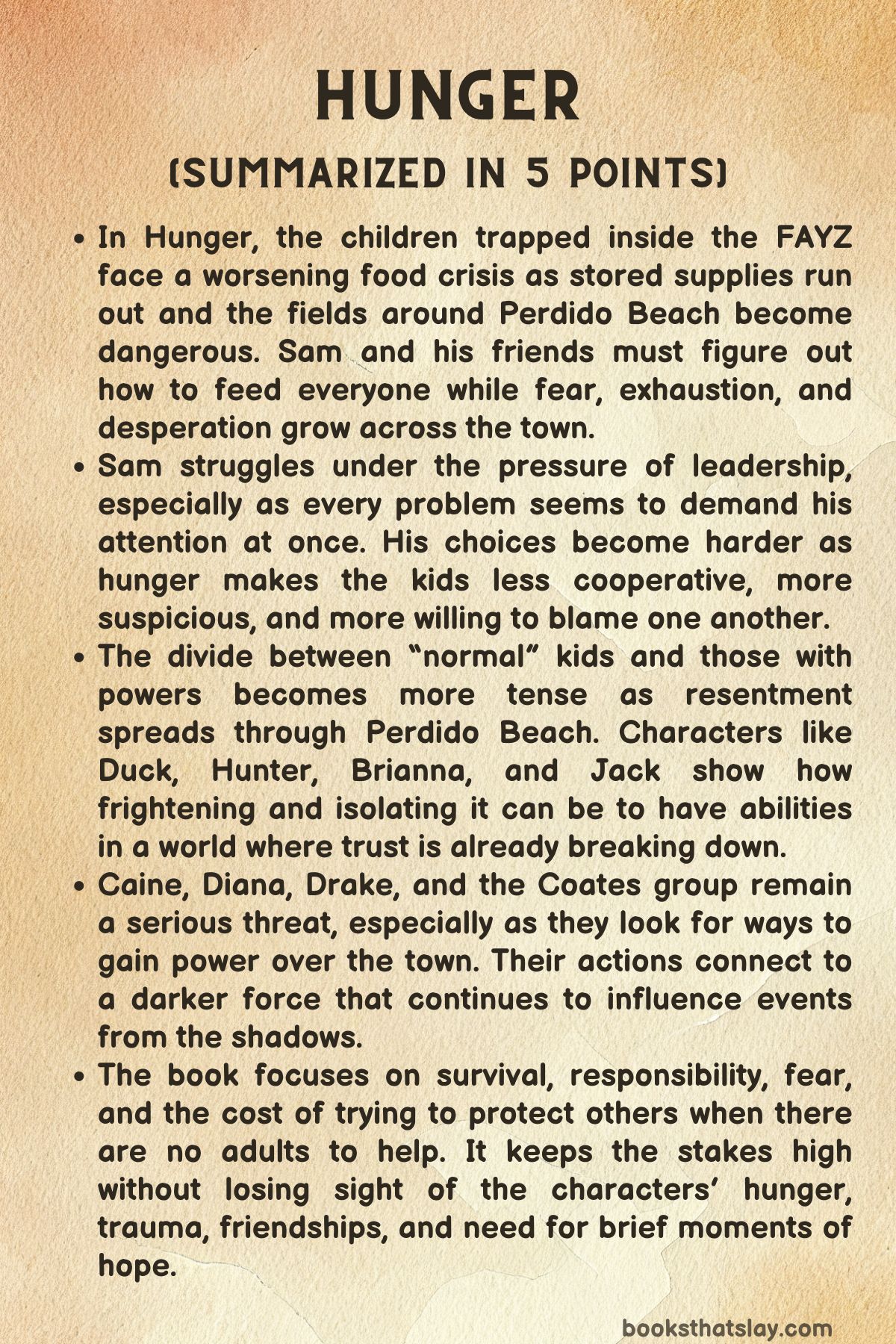
In Hunger, Perdido Beach is running out of food. The children trapped inside the FAYZ have already wasted much of what was available, and what remains is spoiled, scarce, or barely edible.
Sam Temple, still acting as the main leader of the town, tours the nearby fields with Edilio, Albert, and E.Z. in search of crops that can keep everyone alive. Albert identifies a cabbage field that could feed the town, but the discovery turns terrible when E.Z. steps into the field and is attacked by strange wormlike creatures living in the soil.
The worms burrow into him and kill him while Sam, Edilio, and Albert watch helplessly. Sam burns E.Z.’s remains with the light from his hands, and the group realizes that even the food source they need may be deadly.
The food crisis deepens the stress already hanging over Perdido Beach. Sam is exhausted by responsibility, haunted by failure, and forced to make choices that many kids resent.
He tries to organize work crews to harvest food, but most of the town is hungry, angry, frightened, and unwilling to listen. The cabbage field becomes a symbol of the larger problem: survival is possible, but only if the children accept danger, labor, and discipline.
Sam has authority, but not enough obedience. The children want him to save them, yet many refuse to help.
Astrid, Sam’s girlfriend, studies one of the dead worms and adds it to her growing records of mutations inside the FAYZ. She suspects the creatures may be territorial, since they attacked only in the cabbage field.
Astrid is also caring for her younger brother, Little Pete, whose strange powers remain mysterious and frightening. She worries about him while trying to support Sam, but even their relationship is strained by hunger, fear, and the pressure of leadership.
Elsewhere, Lana, known as the Healer, lives apart from the town with her dog, Patrick. Children constantly seek her help, and she feels trapped by the way others treat her as a miracle worker.
She is also tormented by memories of the Darkness, the powerful creature in the mine. Its voice continues calling to her, convincing her that she is not free from its influence.
Lana’s struggle becomes one of the most dangerous threads in the story, because the Darkness wants to use her healing ability for its own survival.
At Coates Academy, Caine is recovering after months of illness and madness caused by his connection to the Darkness. Diana has cared for him, but she warns him not to restart his war with Sam.
Caine still wants power, and he learns that Drake has been acting in his name. Drake, now even more dangerous because of the whip arm given to him by the Darkness, remains violent and cruel.
Caine decides that instead of fighting Sam directly, he will seize control of the nuclear power plant. Since the town depends on electricity, he believes this will give him the leverage to demand food and obedience.
Caine sends Bug, an invisible spy, to scout the power plant. Drake threatens Bug into obeying.
At the same time, Caine learns that Computer Jack has developed immense physical strength, something Diana had hidden from him. Jack becomes important to Caine’s plan because he understands technology and can manipulate the plant’s systems.
Caine and Drake force Jack to help shut down the power, though Jack quietly resists when Drake sets a trap that could kill Brianna.
While these larger conflicts build, the social order in Perdido Beach keeps weakening. Zil and his gang stir hatred against mutants, calling them freaks and blaming them for the town’s suffering.
Duck Zhang, a quiet boy who only wants to avoid trouble, discovers that he has a strange power: when frightened or angry, he can become incredibly heavy and sink through solid ground. Zil humiliates and attacks him, then uses the event to spread more fear of powered kids.
Duck wants no part in the conflict, but his ability will later become vital.
Mary Terrafino, who runs the day care with her brother John, is also falling apart. She is starving herself while taking pills and obsessing over her weight, even though she is dangerously thin.
The day care is short of food, supplies, and help, but the youngest children still depend on her. Her private suffering shows another side of the FAYZ: even those who seem responsible and needed are breaking under the strain.
Caine’s takeover of the power plant succeeds at first. Jack shuts off Perdido Beach’s electricity, leaving the town in darkness.
Sam gathers Edilio, Dekka, Orc, Howard, Brianna, Taylor, and armed kids to confront Caine. Sam tries to use strategy, deception, and force, but Caine has hostages, including Mike, Mickey, and the injured Brittney.
The conflict becomes a standoff. Sam points out that Caine has trapped himself inside the power plant with no food, while Sam can surround him.
Caine then realizes something horrifying: the plan was not truly his own. The Darkness, also called the gaiaphage, has influenced him because it wants the uranium from the plant.
The gaiaphage is hungry, and it wants the fuel rod brought to the mine. Caine, under its mental pressure, takes the uranium and heads toward the creature with Drake, Diana, and Jack.
Diana understands that Drake will betray Caine and that giving the fuel to the gaiaphage could doom everyone. When she insults Drake, he strikes her with his whip arm, badly injuring her.
Caine is shaken by Diana’s injury and turns against Drake. Sam arrives wounded and uses his power to stop Drake from shooting Caine.
In rage, Caine throws the fuel rod at Drake, sending him down the mine shaft, then collapses the entrance with debris.
But Lana is still inside the mine with the gaiaphage. Sam, Caine, and Duck enter through a tunnel Duck creates by sinking through the ground.
Inside, Lana realizes the creature is feeding on the uranium and trying to use her healing power to build a body that can regenerate endlessly. The gaiaphage begins forming a mirrored crystalline shape around her.
Sam’s light cannot destroy it because it has prepared for him. Caine’s power is not enough either.
Duck becomes their only chance. He asks Caine to throw him at the creature.
As Duck falls, he increases his density and crashes through the gaiaphage with enormous force, dragging it down into a deep hole. Duck dies, but his sacrifice saves the others.
Afterward, Quinn finds Sam, Caine, and Lana alive. Lana is freed and heals Diana, Edilio, Dekka, Brianna, and Sam.
The town begins to recover, though the cost has been severe. Mickey and Brittney are buried, and Duck is honored as a hero.
Albert creates a gold-backed currency using McDonald’s game pieces, helping restart trade and order. The children discover a way to harvest cabbage by feeding the worms blue bats, easing the food crisis.
A Temporary Council is formed to share leadership. Sam, worn down by everything he has carried, is ordered to rest.
His friends arrange for him to go surfing, giving him a small moment of peace after hunger, violence, and fear have nearly destroyed them all.
Characters
Sam Temple
Sam Temple is the exhausted moral center of Hunger, a leader who carries authority less because he wants power and more because everyone else needs someone to stand between them and chaos. His reaction to E.Z.’s death shows both his courage and his limits: he instinctively tries to run into danger to save him, but he also has to face the awful truth that bravery alone cannot overcome every threat in the FAYZ.
Sam’s hunger, guilt, and horror after burning E.Z.’s remains make him deeply human, because even his body betrays him with a physical response he finds shameful. Throughout the book, Sam is burdened by fires, food shortages, injuries, Caine, Drake, neglected children, and the constant expectation that he will solve everything.
By the end, his friends forcing him to rest shows that his greatest weakness is not cowardice but self-sacrifice taken too far.
Edilio
Edilio is one of the most dependable and grounded figures in the book. He repeatedly acts with practical courage, whether stopping Sam from rushing into the worm-infested field, helping retrieve E.Z.’s body, guarding the town, or standing with Sam at the power plant.
Unlike some characters who seek status, Edilio’s strength comes from loyalty, discipline, and common sense. He is often the person who does the hard, unpleasant work without demanding recognition.
His injury later in the story reinforces how much he gives for the survival of others, and the fact that Lana’s healing of him matters so deeply shows how essential he has become to the fragile structure of Perdido Beach.
Albert
Albert is practical, observant, and increasingly important as a builder of order in a collapsing society. His ability to identify the cabbage field as a major food source shows that he thinks in terms of systems rather than immediate panic.
Earlier, he tries to keep McDonald’s functioning until the food disappears, and later he introduces a gold-backed currency using game pieces, proving that he understands children cannot survive on courage alone; they also need trade, structure, and incentives. Albert’s importance lies in his realism.
He does not have the flashiest power, but he helps transform scattered survival into something closer to a community.
E.Z.
E.Z. is a brief but emotionally powerful character because his death demonstrates how dangerous the FAYZ has become. His cheerful, easygoing personality makes the scene in the cabbage field even more disturbing, since he enters the field casually, trying to help, and is destroyed almost instantly.
His final pleading for Sam’s help leaves a lasting mark because it exposes Sam’s helplessness and the cruelty of the mutated world around them. E.Z. represents innocence caught in a disaster no child is equipped to understand.
His death also changes the meaning of food itself: even the crops that could save everyone may be guarded by horrors.
Caine
Caine is ambitious, proud, unstable, and deeply vulnerable beneath his arrogance. At the beginning, he is physically and mentally weakened after months of nightmares, sickness, and manipulation by the Darkness.
His desire to regain control leads him to target the power plant, not simply as a tactical move but as a way to reassert his superiority over Sam. Yet Caine is not only a villainous rival.
His horror when Diana is injured and his eventual defiance of the gaiaphage reveal that he is capable of attachment, shame, and resistance. He remains dangerous because his ego constantly invites disaster, but his final actions show that he is not completely owned by the evil influencing him.
Diana
Diana is intelligent, strategic, and emotionally complicated. She understands Caine better than almost anyone, caring for him during his illness while also fearing what he may do when he regains strength.
Her warnings about not fighting Sam and not trusting Drake show her political awareness and her instinct for survival. Diana often appears cold or manipulative, but her choices suggest that she is trying to navigate a world ruled by violent boys and supernatural forces without losing herself completely.
Her injury at Drake’s hands becomes a turning point because it awakens Caine’s genuine emotion and helps break the gaiaphage’s control over him.
Drake
Drake is one of the most openly sadistic characters in the story. He enjoys intimidation, violence, and control, and his whip arm turns his cruelty into a constant physical threat.
Unlike Caine, who wants power and recognition, Drake seems to take pleasure in suffering itself. His loyalty is unstable because he serves whoever or whatever gives him the best opportunity to hurt others, including the Darkness.
His plan to set wires for Brianna reveals his calculated viciousness, while his attack on Diana shows that he cannot tolerate humiliation or defiance. Drake represents the kind of evil that flourishes when normal rules vanish.
Bug
Bug is frightened, hungry, and morally weak, but he is not as malicious as Drake or Caine. His camouflage power makes him useful as a spy, yet his scenes show that usefulness does not equal confidence.
He is terrified of Drake, tempted to disobey, and mostly concerned with survival and food. Bug’s role at the power plant shows how children in the FAYZ are often pressured into dangerous missions by stronger personalities.
He is not a leader or a true believer; he is a scared boy whose power traps him in other people’s plans.
Astrid
Astrid is thoughtful, analytical, and emotionally guarded. Her examination of the worm shows her scientific side, as she tries to impose logic on a world of mutations, terror, and hunger.
She supports Sam not by pretending everything is fine, but by helping him interpret events and by reassuring him when he is horrified by his own bodily reaction to E.Z.’s burning remains. At the same time, Astrid carries private fear about Little Pete, whose mental changes worry her deeply.
She represents reason, conscience, and observation, but she is also under enormous emotional pressure because she must care for her brother while helping Sam carry the burden of leadership.
Little Pete
Little Pete remains mysterious and unsettling because his presence suggests power beyond ordinary understanding. Astrid’s concern that he is changing mentally gives him an eerie importance even when he is not directly active in the events described.
He is vulnerable because he depends on Astrid, yet he is also potentially one of the most powerful beings in the story’s world. That contrast makes him difficult to categorize.
He is not simply a child to be protected; he is also a source of uncertainty, fear, and possible transformation.
Lana
Lana is powerful, isolated, traumatized, and deeply burdened by being the Healer. Her ability makes her essential, but it also traps her, because everyone needs her and few understand the emotional cost of that need.
Her isolation at the Clifftop Resort shows her desire to escape being treated like a saint or public resource. The Darkness still calling to her reveals the lingering trauma of her earlier encounter with it, and her time in the mine shows how close she comes to being used as a tool for something monstrous.
Lana’s grief after realizing what she did under the gaiaphage’s influence makes her one of the most tragic figures in the book, but her healing of Diana, Edilio, Dekka, Brianna, and Sam also confirms her courage and importance.
Patrick
Patrick is Lana’s loyal dog and a quiet emotional anchor for her. In a world where human society has fractured, Patrick represents companionship that is simple, faithful, and nonjudgmental.
Lana’s concern about feeding him shows the depth of the food crisis, but it also shows her need to protect something innocent. Patrick’s presence softens Lana’s isolation and gives her a connection to ordinary affection when almost everything around her is defined by fear, hunger, and manipulation.
Mary Terrafino
Mary is a heartbreaking character because her outer responsibility hides inner collapse. She cares for the younger children at the day care and tries to maintain order despite damaged rooms, too few supplies, and unreliable helpers.
Yet her obsession with weight, her pill-taking, and her belief that she still looks fat at eighty-one pounds reveal a severe mental and physical crisis. Mary’s tragedy lies in the contrast between how much others depend on her and how badly she herself needs help.
She is a caretaker who is slowly disappearing.
John Terrafino
John supports Mary in managing the younger children, and his role highlights how responsibility has fallen on children who should still be cared for themselves. He is less central than Mary, but his presence at the day care matters because it shows that survival in Perdido Beach depends not only on fighters and mutants, but also on those who keep the smallest children alive.
John’s character helps show the everyday strain of the FAYZ, where even ordinary caregiving becomes exhausting and heroic.
Francis
Francis represents the unwilling helpers who are dragged into responsibility because the crisis leaves no room for choice. His reluctance at the day care shows that not every child rises nobly to the emergency.
Some are tired, resentful, or simply immature. Through Francis, the book shows that community survival depends on people who may not want to serve but are still needed.
He adds realism to the social breakdown because not everyone becomes brave, generous, or disciplined under pressure.
Duck Zhang
Duck Zhang has one of the most meaningful character arcs in the story. At first, he seems like an ordinary hungry kid who wants only a private place to swim and avoid conflict.
His power, triggered by fear and anger, makes him terrifyingly heavy and able to sink through solid ground, but he experiences it as a curse rather than a gift. Duck is frightened, ashamed, and reluctant, especially after betraying Hunter’s hiding place to save himself.
Yet his final choice transforms him. By agreeing to descend into the mine and then sacrificing himself to destroy the gaiaphage’s forming body, Duck becomes a hero not because he is fearless, but because he acts despite fear.
Zil
Zil is bitter, insecure, and dangerous because he turns fear into hatred. After Duck’s power humiliates him, he immediately reframes the event as an attack by a “mutant freak,” using prejudice to protect his pride.
His hostility toward mutants gives shape to a growing social conflict between so-called normal children and those with powers. Zil’s cruelty toward Duck and Hunter shows how quickly hunger and fear can be redirected into scapegoating.
He is not powerful in the supernatural sense, but his influence is dangerous because he gives scared children someone to blame.
Hank
Hank is part of Zil’s group and helps represent the mob mentality forming among the children. He is not as individually developed as Zil, but his presence matters because Zil’s cruelty depends on followers who are willing to intimidate others.
Hank shows how prejudice spreads when people join in for belonging, fear, or the thrill of dominance. He adds to the sense that the FAYZ is not only threatened by monsters and starvation, but also by ordinary social violence.
Antoine
Antoine, like Hank, functions as part of the hostile group around Zil. His role in invading Duck’s pool and participating in intimidation shows how easily children can become cruel when they move as a group.
He nearly dies when Duck sinks through the pool, which makes the scene important because it shows that hatred of mutants is partly born from fear of powers that no one understands. Antoine’s character helps show how quickly conflict escalates when humiliation, hunger, and fear combine.
Brianna
Brianna is bold, fast, reckless, and emotionally wounded. Her super-speed makes her one of Sam’s most powerful allies, but her confidence sometimes leads her into danger, as seen when she tries to “fly” across the power plant buildings and ends up badly injured on the roof.
Her conversation with Jack about the cell phone system reveals her vulnerability, especially her brief hope of calling her mother and her pain when she learns that contact outside the barrier is impossible. Brianna’s hatred of the Coates group is personal and understandable because of what she suffered.
She is fierce and funny, but beneath her energy is a child who has been hurt and wants safety.
Computer Jack
Computer Jack is intelligent, timid, and morally growing. His technical skills make him valuable to both sides, especially when he repairs the cell system and later works on the power plant controls.
For much of the story, he is frightened of stronger personalities like Caine and Drake, but his refusal to continue working while the wires threaten Brianna marks an important moment of courage. Jack’s great strength frightens him because it reveals he is no longer merely a computer expert hiding behind machines.
His arc is about learning that intelligence and power both carry responsibility, and that even a scared person can make a brave choice.
Orc
Orc is a physically altered and morally complicated figure. His possible invulnerability makes him useful in the plan to harvest the dangerous cabbage field, but Howard’s demand for beer as payment shows how Orc is also tied to addiction, exploitation, and damaged loyalty.
Orc is not presented as a simple monster despite his appearance and strength. He is part of the town’s survival system, but he also represents the painful consequences of mutation, violence, and dependency.
Howard
Howard is cunning, opportunistic, and practical in a morally uncomfortable way. He often acts as Orc’s handler and negotiator, using Orc’s strength as leverage.
His suggestion that Orc harvest the cabbage because he may be invulnerable is useful, but his demand for beer as payment shows how survival needs become bargaining tools. Howard is not heroic, yet he understands power, scarcity, and negotiation.
He belongs to the darker side of community-building, where even necessary solutions can be selfish or exploitative.
Taylor
Taylor is brave in a sudden, impulsive way. Her teleportation makes her useful, but her decision to scout ahead at the power plant also shows personal loyalty to Sam, especially because she feels she owes him her life.
She risks herself to uncover the hidden ambush, and her successful escape helps Sam’s group avoid disaster. Taylor’s character shows that courage does not always look like physical strength or leadership.
Sometimes it appears as a quick decision made by someone who knows the danger and acts anyway.
Dekka
Dekka is loyal, tough, and essential to Sam’s side. Her gravity-related power makes her a major force in confrontations, but her importance also comes from her steadiness.
She stands with Sam in the attack on the power plant and is badly injured during the crisis around the mine. Dekka’s role emphasizes the cost paid by Sam’s closest allies.
She is one of the characters who helps hold the line when the situation becomes desperate, and her survival after Lana heals her reinforces how much the group depends on cooperation among powerful but vulnerable children.
Hunter
Hunter is isolated by fear and prejudice. After accidentally hurting Harry while trying to attack Zil, he hides near the church and becomes a symbol of how dangerous mutant identity has become.
His warning to Duck that the conflict is becoming “freaks” against “normals” shows that he understands the social danger growing in Perdido Beach. Yet Hunter is also morally complicated because his own violence has consequences.
His later exile, while he still hunts food for the town, makes him a tragic outsider: rejected by the community but still contributing to its survival.
Quinn
Quinn grows into a steadier and more compassionate character than he may first appear. His arrival in the mine and his reassurance to Lana that Edilio is not dead yet help bring her back from despair.
Later, he comforts her along with Patrick, showing emotional maturity and kindness. Quinn also helps arrange Sam’s brief escape through surfing, which reflects his understanding of Sam as a person, not merely a leader.
He represents friendship that survives fear and exhaustion.
Mike
Mike is one of the hostages used by Caine during the power plant standoff. His importance lies less in individual development and more in what his situation reveals about Caine’s tactics.
By threatening hostages, Caine turns children into bargaining tools, forcing Sam to stop his attack. Mike’s presence reminds the reader that even characters outside the central power struggle are placed in danger by the decisions of leaders and rivals.
Mickey
Mickey is another hostage caught in the violence at the power plant, and his death adds to the cost of the conflict. His burial by Edilio after the crisis gives him dignity, even though he is not one of the most developed characters.
Mickey’s role shows how the struggle for power and survival produces casualties among children who are not necessarily seeking control or conflict. His death deepens the sense that every tactical decision in the FAYZ can have irreversible human consequences.
Brittney
Brittney is badly hurt during the power plant crisis and later buried, making her one of the victims of the struggle around electricity and control. Like Mickey, she represents the children who suffer because of battles between more powerful figures.
Her injury being used as part of the tense confrontation shows how vulnerable ordinary kids are when leaders and villains make ruthless choices. Her death contributes to the grief that follows the victory over the gaiaphage.
Cookie
Cookie accompanies Lana to the old mining ghost town and helps show that Lana is not entirely alone, even when she feels isolated. His presence during the dangerous trip toward the mine adds a practical survival element to Lana’s mission.
Though he remains outside while Lana enters the mine, he is part of the small circle surrounding one of the story’s most frightening confrontations. Cookie’s role is modest but useful, showing how even secondary characters support major turning points.
Pack Leader
Pack Leader is a threatening reminder that the FAYZ’s dangers are not limited to human enemies. Its connection to Caine’s desert wandering and Lana’s return to the mine links it to the wider influence of the Darkness.
When it watches Lana near the mine, it becomes part of the atmosphere of pursuit and menace surrounding her. Pack Leader represents the predatory, mutated wilderness that has grown around the children’s fragile society.
Chunk
Chunk’s death, caused by Caine during one of his violent episodes, reveals how dangerous Caine becomes when mentally unstable and influenced by the word “Gaiaphage.” Even though Chunk is not present for long in the action, his fate matters because it shows that Caine’s sickness is not harmless weakness. It has already killed someone.
Chunk’s death also helps explain Diana’s fear and caution around Caine after his return to awareness.
Hermit Jim
Hermit Jim is present mainly through his corpse in the mine, but his role is important because the keys Lana retrieves from him become part of the survival effort. His dead body also adds to the grim atmosphere of the mining ghost town and reminds the reader that the FAYZ is layered over older histories of isolation, danger, and death.
Hermit Jim’s presence turns the mine into a place haunted not only by the Darkness, but also by the ordinary mortality that existed before the children were trapped.
Themes
Hunger as a Force That Changes Morality
Physical hunger shapes almost every decision in Hunger, turning ordinary needs into moral tests. Food is no longer a background detail of life; it becomes power, fear, temptation, and survival.
Sam’s reaction to the smell of E.Z.’s burned body shows how deeply starvation has affected even the most decent characters. He is horrified not because he wants to become cruel, but because his body responds before his conscience can stop it.
The children’s earlier waste of food also becomes painfully important, showing how a lack of adult structure has consequences that cannot be undone easily. Albert’s practical thinking, the attempt to harvest crops, and the creation of a currency all show that survival requires systems, not just courage.
Hunger strips away comfort and exposes what people are willing to do when the body is desperate. It also creates inequality, because whoever controls food or resources can influence others.
In this way, starvation is not only a crisis of the body but also a crisis of leadership, order, and humanity.
Leadership and the Burden of Responsibility
Sam’s leadership is defined less by glory than by exhaustion, guilt, and impossible choices. He is expected to solve every emergency: food shortages, attacks, illness, fires, fear, Caine, Drake, and the power plant crisis.
Yet he is still a child, and the weight of authority isolates him from others. His decisions are rarely clean.
Agreeing to give Orc beer so the cabbage can be harvested is morally uncomfortable, but Sam accepts it because the town may starve otherwise. This shows how leadership in the FAYZ often means choosing the least harmful option rather than the right one.
His frustration at the poorly attended town meeting reveals another painful truth: people want protection, but many do not want the responsibility that survival demands. By the end, the council forcing Sam to rest suggests that leadership cannot depend on one person’s suffering forever.
The story presents leadership as necessary, but also dangerous when it consumes the leader completely. Sam’s strength lies not in being fearless, but in continuing despite fear, guilt, and physical collapse.
Fear, Prejudice, and the Division Between “Freaks” and “Normals”
The conflict between children with powers and those without them shows how fear can quickly become hatred. Zil’s reaction to Duck’s power is especially important because he twists his own humiliation into a political story about being attacked by a “mutant freak.” Instead of admitting that he bullied Duck and nearly drowned him, he presents himself as the victim.
This pattern reveals how prejudice often grows: fear is given a target, and that target is blamed for problems everyone is suffering from. Hunter’s warning to Duck that the conflict is becoming “freaks” against “normals” shows that the FAYZ is not only threatened by monsters, hunger, or the Darkness, but also by social collapse from within.
Mutant powers could help the community survive, as seen with Lana, Brianna, Duck, Jack, and Sam, but resentment turns those gifts into reasons for suspicion. The hatred toward mutants is especially tragic because everyone is trapped in the same crisis.
Instead of unity, fear creates smaller groups competing for safety, blame, and control.
Sacrifice and the Meaning of Heroism
Heroism in Hunger is often painful, reluctant, and unnoticed until after the cost has already been paid. Duck’s sacrifice is the clearest example.
He does not begin as a confident hero; he is frightened, unsure, and ashamed of his power. Yet when the moment comes, he chooses to use the very ability that has made him feel monstrous to save everyone else.
His death gives meaning to a power he never wanted, transforming it from a source of fear into an act of protection. Other characters also show sacrifice in quieter ways.
Lana endures the pull of the Darkness and later uses her healing even after trauma and guilt. Jack risks Drake’s violence to protect Brianna.
Sam repeatedly places himself in danger despite being physically and emotionally worn down. The story suggests that heroism is not about being naturally brave or powerful.
It is about choosing responsibility when escape would be easier. Sacrifice becomes the proof that humanity still exists inside a world shaped by hunger, violence, and fear.