Max by James Patterson Summary, Characters and Themes
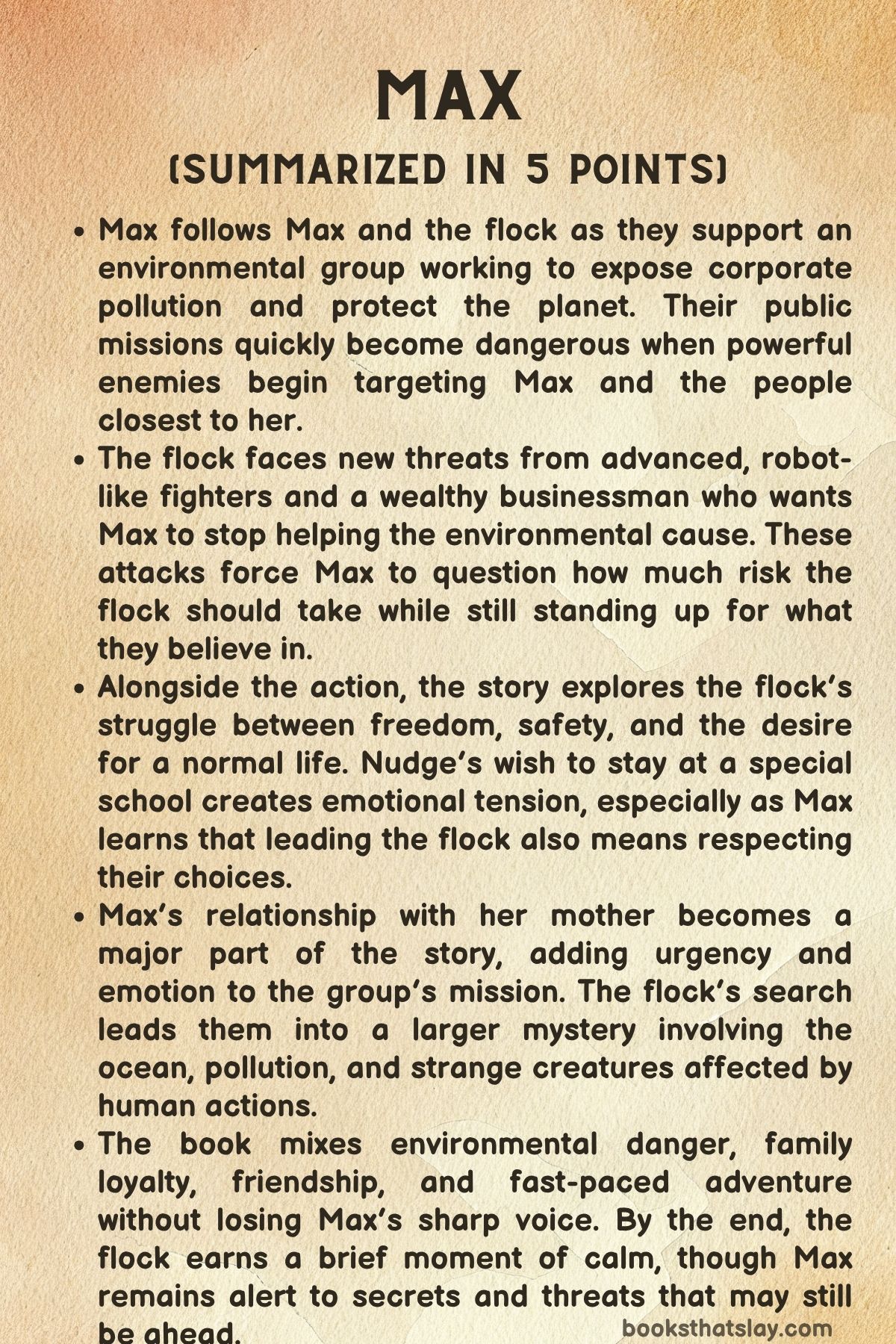
Max by James Patterson is a fast-moving science fiction adventure from the Maximum Ride series (5th book of the series). The story follows Max and her flock, a group of genetically altered children with wings, as they move from public environmental activism into a dangerous fight against a powerful corporation.
What begins with air shows for a cause soon turns into attacks, kidnapping, underwater missions, and disturbing discoveries about pollution and mutation. The book mixes action, family conflict, loyalty, romance, and environmental danger, while keeping Max’s sharp, restless voice at the center of the story.
Summary
Max and the flock are working with the Coalition to Stop the Madness, an environmental group that campaigns against corporate damage to the planet. The group is partly led by Dr. Valencia Martinez, Max’s mother, which gives the work a personal meaning for Max.
The flock performs air shows to attract attention to the cause, using their wings and unusual abilities to impress crowds and spread the CSM’s message. At first, the shows seem like a bold way to help, but the danger around them quickly becomes clear.
During a show near Los Angeles, Angel senses that something is wrong. A cyborg sniper named Devin is preparing to shoot Max from a nearby building.
Angel reacts in time and knocks Max out of the bullet’s path, saving her life. Total, the talking dog, is hit in the tail instead.
The flock immediately attacks the sniper, hoping to stop him and find out who sent him. Before they can get answers, Devin blows himself up.
The attack leaves the flock shaken and proves that their public work has made them targets.
After the attack, the flock briefly enters the world of Hollywood. Talent agents try to turn them into celebrities, models, merchandise, and entertainment products.
The offer might give them fame and comfort, but Max refuses. She sees that the agents do not truly understand them and only want to profit from their strangeness.
The flock escapes in their usual dramatic way by flying off a balcony.
The flock continues helping the CSM, but Fang worries that the air shows are becoming too risky. Max agrees to do only one more show, this time in Mexico City.
During that show, the flock is attacked again. Their enemies are no longer only cyborgs.
They now face robot-like fighters covered in flesh, which Max names M-Geeks. These attackers are strong, unnatural, and frighteningly persistent.
The flock defeats them, but the attack convinces Max that the air shows must stop. Public performances are giving their enemies too many chances to strike.
At a safe house in Mexico, Max reunites with Dr. Martinez and with Ella, her half sister. This reunion gives Max a brief taste of family life, something she has always wanted but rarely been able to trust.
Jeb, the complicated father figure from Max’s past, suggests that the flock attend the Day and Night School in Utah, a special school for gifted children. Max does not trust the idea.
Her life has taught her that institutions often hide danger behind friendly faces. Still, the flock later votes to try the school, showing that not everyone shares Max’s instinct to keep running.
Before they go, Max is shot while flying alone and captured by M-Geeks. She is taken to Mr. Chu, a rich and powerful businessman whose calm manner hides a cruel nature.
Chu tells Max to break ties with the CSM. He wants the environmental group silenced because it threatens his business interests.
Max refuses to obey him. She is threatened, beaten, and eventually dumped near the safe house.
When she tells Jeb about Chu, Jeb reacts with fear, which confirms that Chu is not just another villain. He is someone with serious power and reach.
The flock then goes to the Day and Night School. To Max’s surprise, the school does not immediately seem like a trap.
The children are tested, studied, and treated well. For some of the flock, especially Nudge, the place offers something deeply tempting: normal life.
Nudge becomes attached to the school and begins to imagine staying there. She even says she wants her wings removed so she can live like an ordinary girl.
Max is horrified by this. To her, the flock’s wings are part of who they are, and removing them feels like surrendering identity.
But Max also begins to understand that she cannot control Nudge’s choices forever. Love does not mean forcing someone to stay.
While these emotional tensions grow, Max and Fang’s relationship also shifts. They share a serious romantic moment in the desert, bringing feelings that have long been present closer to the surface.
Their bond is strong, but it is complicated by danger, leadership, and the pressure Max feels to protect everyone.
When Max and Fang return, they discover that Dr. Martinez has been kidnapped. A fax message says she will be held until the CSM stops pressuring major corporations.
The threat connects Valencia’s kidnapping directly to the environmental campaign and to the forces trying to protect corporate secrets. Soon after, the safe house is surrounded by M-Geeks, including one that looks like Ari, a figure from Max’s painful past.
The attackers are dangerous, but Gazzy and Iggy use a lightning rod to destroy them, saving the group.
The search for Valencia takes the flock to San Diego, where they meet with the Navy. Max, Fang, Iggy, Gazzy, Angel, Total, John Abate, and Brigid Dwyer learn about strange events at sea.
The Navy shows them footage of odd birdlike creatures, a destroyed fishing boat called the Nani Moku, and evidence that Valencia may be held underwater near Hawaii. Nudge stays behind at the school, though Max forbids her from going through with wing removal.
This separation hurts Max, but she must continue the rescue mission.
In Hawaii, the flock receives Navy survival training to prepare for an underwater search. They board a submarine and begin looking for Valencia.
Nudge later returns to the flock because she cannot stay away from them. Her return shows that even though she wants normal life, her connection to the group remains powerful.
Underwater, the flock discovers mutated sea creatures called the Krelp. These creatures have been harmed or changed by radioactive waste dumped by the Chu Corporation.
Angel, who can communicate with animals and other beings, reaches out to them and learns that they have attacked boats because fishing nets damaged their eggs and young. The Krelp are not simply monsters.
They are victims defending themselves and their families after human greed poisoned their home.
The Krelp lead the flock and the Navy toward Mr. Chu’s underwater dome. Inside the dome, Valencia is being held and tortured.
Chu’s people are pressuring her to publicly denounce the CSM, but she refuses. Her courage mirrors Max’s own refusal to submit to Chu.
Mother and daughter are both stubborn, brave, and unwilling to help powerful people hide the truth.
Max and Angel scout the dome and confirm that Valencia is alive. The group also finds barrels of radioactive material marked as property of the Chu Corporation.
This evidence proves that Chu’s company is responsible for the pollution that harmed the ocean and the Krelp. Chu’s M-Geeks attack the Navy submarine, badly damaging it and putting everyone in danger.
The situation becomes chaotic underwater, where escape is far harder than in the sky.
Angel continues communicating with the Krelp, and Max goes into the water to rescue her. With help from the creatures, the group locates Valencia and saves her.
The rescue also exposes the scale of Chu’s crimes. His corporation has damaged the environment, created suffering, and used violence to silence anyone who might reveal the truth.
After Valencia is rescued, Max reunites her mother with Ella and Jeb. For a short time, the flock gets a break in Hawaii.
The setting offers warmth, beauty, and peace after constant danger. But Max cannot fully relax.
She sees Brigid secretly talking with Mr. Chu, which suggests that Brigid may have been connected to him all along. This discovery leaves Max suspicious and alert.
The immediate mission is over, but the larger threat remains. Chu is still dangerous, and betrayal may be closer than Max wants to believe.
Characters
In Max by James Patterson, the characters are shaped by danger, loyalty, environmental conflict, and the constant struggle between wanting freedom and needing family. The book uses each major figure to show a different emotional pressure on the flock, whether it is leadership, fear, betrayal, innocence, ambition, or the desire for a normal life.
Max
Max is the central figure of the book and the emotional leader of the flock. She is brave, protective, sarcastic, and deeply responsible, but her strength often comes with loneliness because she feels that every danger facing the group ultimately becomes her burden.
Her leadership is tested repeatedly, first through public attacks, then through her kidnapping, and later through her mother’s abduction. Even when she is beaten or threatened, she refuses to abandon the Coalition to Stop the Madness or betray the values she believes in.
This makes her not only physically courageous but morally firm as well. Max’s emotional depth becomes clearer through her relationships with Fang, Nudge, Angel, and Dr. Martinez.
She wants to protect everyone, but the book forces her to understand that protection does not always mean control. Her reaction to Nudge wanting her wings removed shows how deeply she connects the flock’s identity with survival and freedom.
At the same time, her growing romantic feelings for Fang reveal a softer side beneath her defensive humor and warrior-like attitude. By the end, Max remains alert and suspicious, especially after seeing Brigid’s connection to Mr. Chu, showing that she has learned peace is often temporary and must be guarded carefully.
Fang
Fang is calm, watchful, and emotionally restrained, but his quietness should not be mistaken for passivity. In the book, he often acts as Max’s strongest support and sometimes as the voice of caution.
He warns that the air shows are dangerous, and his concern proves justified when the flock is attacked. Fang’s seriousness balances Max’s impulsive courage.
He does not always express his feelings openly, but his loyalty is consistent and powerful. His relationship with Max becomes more intimate and emotionally important, especially during their serious moment in the desert.
This scene shows that Fang is not only a fighter but also someone capable of deep attachment, even if he expresses it in a controlled way. He understands the pressure Max carries and often stands beside her without trying to take leadership away from her.
Fang’s role in the story is important because he represents stability, strategic thinking, and emotional restraint within a group that is constantly surrounded by chaos.
Angel
Angel is one of the most powerful and mysterious members of the flock. Although she is young, her abilities often make her central to the group’s survival.
Her warning during the sniper attack saves Max’s life, showing both her mental sensitivity and her instinctive devotion to the flock. Angel’s connection with the Krelp later becomes especially important because she is able to communicate with them and understand that they are not simply monsters but suffering creatures reacting to human harm.
This makes Angel a bridge between the flock and the damaged natural world. She is childlike in some ways, but the book also presents her as unusually perceptive and emotionally complex.
Her powers can sometimes make her unsettling because she understands more than others expect, yet her actions repeatedly show compassion. Angel’s willingness to go underwater and connect with the Krelp proves that her courage is not loud or aggressive but rooted in empathy and trust.
Nudge
Nudge is one of the most emotionally vulnerable characters in the book because she longs for normalcy more openly than the others. At the Day and Night School, she becomes attached to the possibility of staying because the school offers comfort, acceptance, and a life that feels less dangerous.
Her desire to have her wings removed is shocking to Max because it feels like a rejection of the flock’s shared identity, but Nudge’s wish comes from pain rather than betrayal. She wants to belong somewhere without always being hunted, stared at, or forced into battle.
This makes her conflict deeply human. Nudge’s temporary separation from the flock shows that she is growing into someone who wants the right to choose her own life, even if her choices frighten the others.
Her eventual return proves that her bond with the flock is stronger than her fantasy of normal life. Nudge represents the emotional cost of being extraordinary: she has gifts, but she also wants the peace and simplicity that ordinary people take for granted.
Iggy
Iggy is clever, resilient, and technically skilled, and his blindness does not prevent him from being one of the flock’s most capable members. In the book, he contributes especially through practical intelligence and quick thinking.
His partnership with Gazzy is important because together they often provide the flock’s inventive and explosive solutions to danger. When the safe house is surrounded by M-Geeks, Iggy helps use the lightning rod to destroy the attackers, showing his courage and technical confidence under pressure.
Iggy’s character also adds emotional variety to the flock because he combines humor, toughness, and competence. He is not usually the emotional center of the story, but his reliability makes him essential.
His presence reminds the reader that every member of the flock has a specialized strength, and survival depends on all of them working together.
Gazzy
Gazzy brings energy, humor, and explosive creativity to the flock. He is younger than some of the others, but he is far from helpless.
His talent for building and using destructive devices becomes crucial during the attack on the safe house, where he and Iggy turn a desperate situation into a victory. Gazzy often adds comic relief, but the book also shows that his playfulness exists alongside real bravery.
He is loyal to the flock and willing to fight terrifying enemies despite his age. His character reflects the strange childhood the flock has been forced to live: he has the instincts of a kid but the responsibilities of a soldier.
This mixture makes him both entertaining and quietly tragic, because his intelligence and courage have grown out of constant danger rather than a normal childhood.
Total
Total is small, dramatic, talkative, and often humorous, but he is also a genuine member of the flock rather than just comic relief. His injury during the sniper attack makes the danger feel personal and immediate, because even a character who often lightens the mood can be hurt.
Total’s presence gives the book warmth and personality, especially during moments when the flock’s life becomes intensely violent or frightening. He often behaves with confidence far larger than his size, which makes him memorable.
His loyalty to the group is clear, and his role helps soften the darker parts of the story. Through Total, the book keeps a sense of humor and affection alive even when the flock is facing cyborg assassins, corporate threats, and underwater danger.
Dr. Valencia Martinez
Dr. Valencia Martinez is Max’s mother and one of the moral anchors of the book. She is compassionate, principled, and brave, especially in her work with the Coalition to Stop the Madness.
Her commitment to exposing environmental harm puts her directly in danger, but she refuses to back down even when kidnapped and tortured. This makes her courage similar to Max’s, though expressed in a different form.
Valencia fights through activism, science, and public resistance rather than through physical combat. Her refusal to denounce the CSM shows that she values truth and responsibility more than her own safety.
As Max’s mother, she also represents emotional belonging and family, something Max has not always been able to depend on. Her kidnapping raises the stakes because it attacks Max not only as a leader but as a daughter.
Valencia’s character connects the personal and political sides of the story: the fight against Chu is not just about saving one person, but about resisting greed, pollution, and intimidation.
Ella
Ella is Max’s half sister and represents the ordinary family life that Max rarely gets to experience. She does not play as active a role in the battles, but her presence matters emotionally.
Ella reminds Max that she has ties beyond the flock and that her identity is not limited to being a fighter or leader. The reunion between Valencia, Ella, Jeb, and Max gives the story a moment of emotional relief after the violence and fear surrounding the underwater rescue.
Ella’s importance lies in what she symbolizes: family, innocence, and the possibility of a life connected to love rather than survival. She also helps show the contrast between Max’s dangerous existence and the more normal world Max is partly separated from.
Jeb
Jeb is complicated because he carries knowledge, authority, and a history that makes the flock unsure how fully they can trust him. His suggestion that the flock attend the Day and Night School appears practical, but Max’s refusal shows her instinctive suspicion toward institutions and adults who claim to know what is best for them.
Jeb’s fearful reaction when Max mentions Mr. Chu is especially revealing. It confirms that Chu is not an ordinary enemy and that Jeb understands more about the danger than he initially explains.
This makes Jeb a character associated with secrets and uneasy guidance. He cares about the flock in some way, but his past and his guarded behavior make his care difficult to accept without doubt.
In the book, Jeb functions as a reminder that adult authority is rarely simple in Max’s world; even helpful adults may withhold information, make questionable decisions, or carry hidden fear.
Mr. Chu
Mr. Chu is the main human villain of the book and represents corporate greed, cruelty, and environmental corruption. He is wealthy, powerful, and willing to use violence to protect his interests.
His attempt to force Max to cut ties with the CSM shows that he understands the power of public resistance and wants to silence it before it damages him. Chu’s villainy becomes even more serious when the flock discovers the radioactive waste connected to his corporation and the suffering it has caused underwater.
He is not merely a personal enemy to Max; he is a symbol of destructive power hiding behind business influence. His underwater dome reflects his arrogance and secrecy, as if he believes he can build his own protected world while poisoning the natural one.
Chu’s treatment of Valencia also shows his dependence on intimidation. He wants public control, not truth.
By the end, his possible connection to Brigid suggests that his influence may reach farther than the flock realizes, making him a lingering threat rather than a defeated villain.
Devin
Devin is the cyborg sniper who attacks Max during the air show near Los Angeles. Though his role is brief, he sets the tone for the danger that follows throughout the book.
His attack proves that the flock’s public appearances have made them vulnerable and that their enemies are willing to strike in front of crowds. Devin’s self-destruction before capture also shows how difficult these enemies are to understand or interrogate.
He is less a fully developed emotional character and more an early sign of the organized violence surrounding Max and the CSM. His presence pushes Max and the flock toward the realization that their environmental activism is not just risky in theory; it has made them targets of powerful forces.
The M-Geeks
The M-Geeks are terrifying because they combine machine-like violence with flesh-covered bodies that make them seem both artificial and disturbingly human. They are not ordinary enemies; they are manufactured weapons designed to hunt and intimidate.
Max’s name for them gives the flock a way to define the threat, but their repeated attacks show that they are part of a larger system controlled by Chu and his allies. The M-Geeks represent technology stripped of morality.
They are created not to help people but to enforce silence and fear. Their presence also connects to the book’s wider concern with unnatural scientific and corporate interference.
Just as radioactive waste has damaged sea life, the M-Geeks show how human invention can become monstrous when guided by greed and control.
The Ari-like M-Geek
The M-Geek that resembles Ari is especially disturbing because it turns a painful part of the flock’s past into a weapon. Ari’s image carries emotional weight for Max and the others, so seeing an enemy that looks like him is not just physically threatening but psychologically cruel.
This figure suggests that the flock’s enemies understand how to manipulate memory, fear, and trauma. The Ari-like attacker makes the battle at the safe house more personal, reminding the flock that their past is never fully behind them.
Even if this creature is not Ari himself, its resemblance is enough to unsettle the group and deepen the horror of the M-Geeks as enemies designed to attack both body and mind.
John Abate
John Abate is connected to the Navy side of the story and helps move the flock toward the underwater mission. His role is more functional than emotional, but he is important because he represents official support in a situation that has grown too large for the flock alone.
Through John and the Navy, the book expands from the flock’s personal battles into a broader investigation involving destroyed boats, strange sea creatures, and corporate pollution. He helps provide access, information, and structure, allowing the flock to pursue Valencia’s rescue in a more organized way.
John’s presence also shows that not every adult institution is hostile or manipulative; some can be useful allies when the threat is serious enough.
Brigid Dwyer
Brigid Dwyer is intelligent and helpful on the surface, but the ending makes her one of the more suspicious characters in the book. Her involvement with the mission places her close to the flock, and she appears to be part of the effort to understand the underwater threat.
However, Max seeing her secretly talking with Mr. Chu changes the way her character must be viewed. This moment suggests hidden motives and possible betrayal.
Brigid becomes unsettling because she is not openly villainous like Chu; instead, her danger lies in ambiguity. She may be an informant, a manipulator, or someone with divided loyalties.
Her character adds tension to the ending of Max, because even after Valencia is rescued and the flock finds a moment of peace, Max realizes that danger may still be close and disguised as trust.
The Krelp
The Krelp are among the most sympathetic nonhuman figures in the book. At first, they seem like dangerous mutated sea creatures because they have attacked boats, but Angel’s communication with them reveals a more tragic truth.
They are creatures harmed by pollution, radioactive waste, and human carelessness. Their aggression comes from pain and protection, especially because fishing nets have harmed their eggs and young.
This makes them victims as much as threats. The Krelp deepen the environmental message of the story by showing that damaged nature may appear monstrous to humans, even when humans caused the damage in the first place.
Their decision to help the flock rescue Valencia also proves that they are capable of understanding, cooperation, and moral response. They are not villains; they are wounded beings defending their world.
Themes
Courage Under Pressure
In Max, courage is shown as a repeated choice made under fear, pain, and uncertainty, not as a simple absence of fear. The central character is attacked, captured, threatened, beaten, and warned to abandon the environmental cause, yet she refuses to protect herself by surrendering her principles.
Her courage is especially meaningful because it is not reckless confidence; she often understands the danger clearly and still acts. The flock’s bravery also appears in their willingness to defend one another, whether during public attacks, underwater missions, or battles against artificial enemies.
Their powers make them unusual, but the story does not present strength as the same thing as courage. True courage comes from deciding what must be protected: family, freedom, innocent lives, and the truth about environmental harm.
Even when the enemies have money, technology, secrecy, and violence on their side, the flock continues resisting. This makes courage a moral force in the story, because survival alone is not enough; the characters must survive without allowing fear to decide who they become.
Family, Loyalty, and Chosen Bonds
Family in the story is not limited to blood relationships. The flock functions as a chosen family built through shared danger, trust, sacrifice, and emotional dependence.
They argue, disagree, and make painful choices, but their bond remains central to their identity. The kidnapping of Dr. Martinez brings biological family into direct conflict with political violence, showing how love becomes a point of vulnerability but also a source of strength.
The central character’s concern for her mother, her half sister, and the flock reveals that leadership is not only about giving orders; it is about carrying the emotional weight of everyone’s safety. Nudge’s desire to leave and live a normal life tests this bond deeply.
Rather than treating loyalty as blind obedience, the story shows that real loyalty sometimes requires allowing others to choose their own path. The flock’s eventual reunion suggests that family is strongest when it is chosen freely.
Their connection survives because it is based on care, not control.
Environmental Responsibility and Corporate Greed
The conflict with the Chu Corporation gives Max a clear environmental message. Pollution is not shown as an abstract problem but as something that damages living creatures, destroys habitats, harms families, and creates violence.
The radioactive waste dumped into the ocean affects the Krelp, who are not simply monsters but victims of human carelessness and corporate wrongdoing. Their attacks on boats come from fear and protection of their young, which shifts the reader’s understanding of blame.
The true threat is not nature becoming hostile without reason; it is powerful people treating nature as a place to hide the consequences of greed. Mr. Chu represents a form of wealth that believes it can buy silence, control public opinion, and use technology to escape responsibility.
Dr. Martinez’s refusal to denounce the environmental movement becomes important because truth is shown as dangerous to corrupt power. The story argues that environmental harm is also moral harm, especially when profit matters more than life.
Identity, Freedom, and the Desire for Normalcy
The flock’s struggle is not only against outside enemies but also against the question of what kind of life they deserve. Their wings give them power and freedom, but they also separate them from ordinary human life.
This conflict becomes strongest through Nudge, who longs for school, acceptance, and normal teenage experiences so intensely that she considers removing her wings. Her wish is painful because it shows how difference can feel like a burden, even when it is also part of one’s strength.
The central character’s reaction is protective, but she must face the limits of leadership: she cannot decide someone else’s identity for them. The school offers comfort, safety, and belonging, making the choice more complicated than simply freedom versus captivity.
The flock’s lives are shaped by experiments and manipulation, so choosing who they want to be becomes an act of resistance. The story suggests that identity cannot be forced by science, enemies, family, or even love.
Freedom means having the right to choose oneself.