New York by Edward Rutherfurd Summary, Characters and Themes
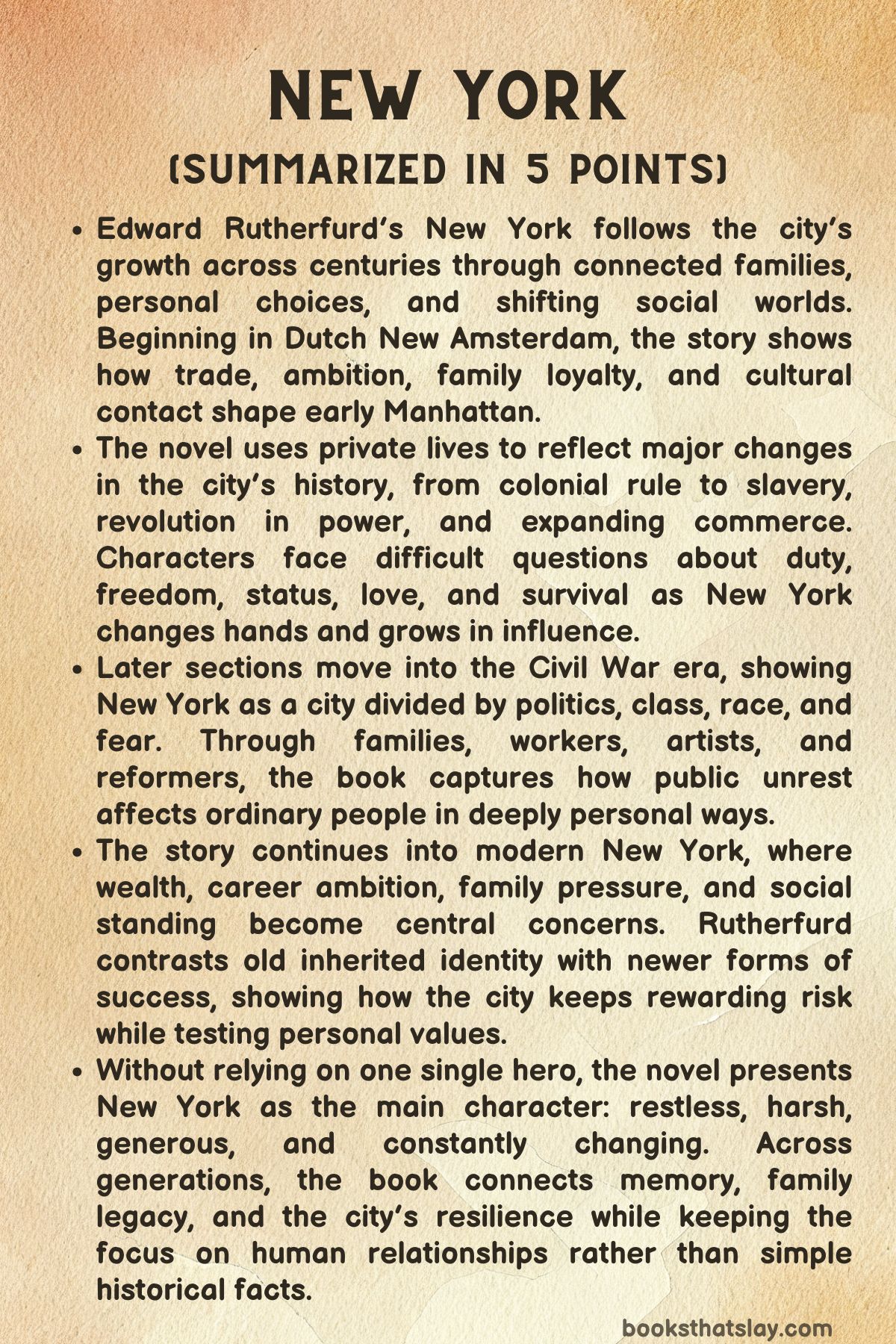
New York by Edward Rutherfurd is a historical novel about the growth of New York City from its Dutch colonial beginnings to the aftermath of 9/11. Through linked families, inherited objects, personal losses, social conflict, and changing fortunes, the book presents the city as both a physical place and a living force.
It follows traders, enslaved people, merchants, immigrants, artists, bankers, lawyers, and families as they move through war, slavery, political change, riots, prosperity, and disaster. At its center is the idea that New York’s history is built from private choices as much as public events.
Summary
New York begins in 1664, when Dirk van Dyck, a Dutch fur trader in New Amsterdam, travels along the Hudson River with Pale Feather, his half-Indian daughter. Dirk loves her, but because she was born outside his marriage, he makes her hide the truth of their relationship.
In New Amsterdam, he tries to show her the town quietly, but his wife, Margaretha, sees them and quickly understands who the girl is. Margaretha refuses to let Pale Feather enter their home.
Dirk, unwilling to reject his daughter, takes her north along an old Indian trail. They spend a peaceful day together, and he tells her about her dead mother.
Pale Feather shows her closeness to the land, even approaching a deer with skill and patience. Before leaving him, she tells Dirk that when he cannot see her, he can still hear her voice in the wind.
Back in New Amsterdam, Margaretha tries to pull Dirk into a more respectable world. She encourages him to join a merchant syndicate using money she controls through her marriage agreement.
Dirk accepts and gains social standing, becoming known as “Boss.” Margaretha hopes trade, wealth, and status will keep him away from the wilderness and from Indian women. Dirk, however, continues to feel drawn to the river and to Pale Feather.
He sets off again despite Margaretha’s warnings about the English threat to the Dutch colony.
On this journey, Dirk illegally trades watered brandy with the Mohawks for pelts. He visits Pale Feather’s village first, where she gives him a wampum belt with a pattern that names him as her father.
Dirk is deeply moved and promises to wear it always. Later, he meets Tom Master, a reckless young Englishman from Boston who has been rejected by his Puritan brother.
From Tom, Dirk buys a Dutch silver dollar in a small box, intending it as a gift for Pale Feather. On his return, Governor Peter Stuyvesant overtakes Dirk and orders him back to help defend New Amsterdam from the English fleet.
Dirk doubts the Dutch merchants will fight and chooses instead to return to Pale Feather with the gift. Stuyvesant calls him a traitor and threatens to expose his secret, but Dirk goes back anyway.
The city soon changes hands. The Dutch merchants accept English terms, and New Amsterdam becomes New York under Colonel Nicolls.
Life changes politically, but many Dutch customs and families remain powerful. In the van Dyck household, Quash, an enslaved man, tries to improve his life.
He asks whether joining the Dutch Church might help him, but the minister suspects he wants religion only as a path to freedom. Quash learns more about slavery and free Black life in and around Manhattan.
He meets Cudjo, a free Black property owner who even owns an enslaved girl, which shocks him.
Quash later falls in love with Naomi, a young enslaved woman bought by the van Dycks. They live together as husband and wife and have children, Hudson and Martha.
Quash’s loyalty to the van Dycks grows complicated. During a Dutch return to power, Margaretha helps disable guns in the fort, and Quash saves her from a soldier.
Later, Dirk sends Quash to help sick Indians near the city, and Quash saves children from fever. Dirk privately promises that Quash will be freed after his death.
Quash’s happiness is shattered when fever brought by sick slaves kills Martha and then Naomi. His son Hudson becomes his comfort.
Hudson longs for the sea, and Captain Kidd wants to buy him. Quash begs Dirk not to sell the boy, so Dirk rents him to Kidd instead.
When Kidd is later accused of piracy and arrested, Dirk travels to Boston and brings Hudson home, protecting him by explaining that Hudson had only been rented.
Near death, Dirk tells Quash that his will frees both Quash and Hudson. He also gives Quash a final task: deliver Pale Feather’s wampum belt to Clara’s son Dirk.
After Dirk dies, Quash carries out the promise, but Margaretha discovers what has happened. Furious, she burns the English will that would have freed Quash and Hudson, relies on an older Dutch will, sells Hudson to a ship captain, and sells Quash to a cruel English planter.
Quash is beaten and forced into harsh labor. Clara and Henry Master eventually find him and buy him back, though Hudson is lost.
Quash later serves Clara’s family and becomes close to her son Dirk, who loves the river and treasures the wampum belt.
The story then moves forward to the Civil War era. Frank Master and his wife Hetty argue bitterly about Lincoln, emancipation, the draft, and their son Tom.
Frank opposes Lincoln and resents the war, while Hetty defends it as necessary to end slavery. Their marriage is strained, and Frank uses the argument as an excuse to leave home.
At the same time, Mary O’Donnell visits Coney Island with Gretchen Keller. Gretchen’s brother Theodore joins them, and Mary is drawn to him despite Gretchen’s warning that he is dangerous.
Theodore praises Mary’s artistic eye and begins to seduce her, but Gretchen interrupts them.
In New York, anger grows after the draft lottery begins. Sean O’Donnell senses trouble among Irish workers and hides his Black employee, Hudson River, in the cellar.
The draft riots break out, and mobs attack the draft office, police, Black neighborhoods, and eventually the Colored Orphan Asylum. Hetty, searching for Frank, ends up near the orphanage and tries to stop the mob.
A large Irishman helps her reach the front, but when he speaks against the crowd, he is beaten to death. The children escape while the building is looted and destroyed.
Frank, who had been away with Lily de Chantal, finds Hetty afterward and brings her home. Both are shaken, and Frank promises not to leave her again.
Mary, Gretchen, and Theodore see fires from Brooklyn and eventually cross back to Manhattan after dark. Mary reaches safety but becomes feverish and is nursed by Mrs. Master.
Years later, Theodore has become a successful photographer, helped by his Civil War work and Frank’s patronage. In 1871, he prepares an exhibition.
Frank urges him to include photographs linked to Boss Tweed, Thomas Nast, and the courthouse because Tweed has just been arrested. Theodore resists, but Mary convinces him.
The exhibition succeeds, and Theodore attracts attention from the press.
The later part of New York follows Gorham Master and his wife Maggie O’Donnell in the late twentieth century. Maggie, a successful corporate lawyer, goes into labor during a meeting and calmly leaves for the hospital.
Gorham, anxious and excited, rushes to join her. Their son, Gorham Vandyck Master Jr., is born.
Gorham is happy, but he is also troubled by his career. He once lost money through private stock trading during the 1987 crash and later turns down a chance to move into investment banking.
As years pass, he and Maggie have more children, move into a larger apartment, hire help, and buy a country house. Their life is secure, yet Gorham feels disappointed.
He watches others become far richer during the dot-com boom and regrets his caution.
By 2001, Gorham is considering a new job in Boston, which would keep him away from home during the week. Maggie sees this as a betrayal of the family, and their marriage suffers.
He is also involved in a co-op board dispute over Dr. Caruso, the obstetrician who delivered their first child. Gorham supports Caruso’s application to buy an apartment, while the board chairman rejects him for lacking elite social status.
On September 11, 2001, Gorham has breakfast with Sarah Adler, an art dealer who once loved his father. He returns a Motherwell drawing meant for her years earlier.
Sarah gives him the family wampum belt and tells him he has misunderstood both New York and his own life. Her words move him, and he decides not to attend his meeting at the World Trade Center about the Boston job.
He calls Maggie’s office to say he is not going.
Soon after, the first plane hits the North Tower. Dr. Caruso is in the South Tower, and Katie Keller is downtown for a presentation.
Gorham watches the catastrophe unfold and understands, after the second plane strikes, that the city is under attack. He then learns Maggie is also at the World Trade Center.
She calls from the South Tower stairwell, saying she is coming down. The tower collapses while they are speaking, but she survives after escaping just in time.
Sarah dies in the tower, and the wampum belt is destroyed.
In 2009, Gorham walks through the city with his daughter Emma. He thinks about the years after the attacks.
Katie survived and became successful. Dr. Caruso prospered, while the wealthy buyer once preferred by the co-op board was later indicted for fraud.
Gorham eventually left banking and became CEO of Peter Codford’s foundation for inner cities, work that finally gave him purpose. As he walks through New York and thinks of his family, the city’s past, and the new Freedom Tower, he feels thankful for the life he almost lost and for the city that continues to endure.
Characters
Dirk van Dyck
Dirk van Dyck is one of the earliest major figures in New York, and he represents the restless, divided spirit of the colonial frontier. As a Dutch fur trader, he is drawn toward trade, wilderness, river journeys, and contact with Native communities, but he also belongs to a European household governed by social rules, inheritance, marriage, and public reputation.
His love for Pale Feather reveals a tender and deeply human side of him, yet his refusal to openly acknowledge her as his daughter also shows his fear of scandal and his dependence on the colonial world’s expectations. Dirk’s emotional conflict comes from the fact that he genuinely loves Pale Feather but cannot fully protect her from the shame created by his own secrecy.
Dirk is also a man who resists control. Margaretha tries to bind him to respectable merchant life, but he continues to seek freedom upriver.
His illegal brandy trade shows his moral flexibility and willingness to profit from dangerous dealings, while his decision to turn away from Stuyvesant in order to visit Pale Feather shows that his private loyalty can outweigh political duty. He is neither purely heroic nor purely selfish.
He is loving, impulsive, proud, and compromised. Through Dirk, the book shows how personal desire, commerce, colonial ambition, and family secrecy become tangled together in the making of early Manhattan.
Pale Feather
Pale Feather is a gentle, striking, and emotionally powerful character whose presence exposes the hidden cost of Dirk’s divided life. As Dirk’s half-Native daughter, she belongs to a world that he loves but cannot publicly claim.
Her innocence makes her especially moving: she does not fully understand why her father must hide the truth, and her pain when Margaretha rejects her shows how adult guilt and prejudice wound the young. Pale Feather’s bond with nature is one of her defining traits.
Her ability to stalk and touch a deer suggests grace, patience, and a deep harmony with the natural world that contrasts strongly with the suspicion and ambition of colonial society.
The wampum belt she gives Dirk is central to her character because it expresses what she cannot receive openly from him: recognition. By naming him as her father through the belt, she quietly insists on the truth of their relationship.
Her statement that Dirk can hear her voice in the wind gives her a spiritual and almost haunting quality. She becomes more than a child Dirk loves; she becomes a symbol of memory, loss, and the Native presence that remains beneath the city’s later history.
Pale Feather’s role is tender but tragic because she is loved deeply, yet still kept at the edge of legitimacy.
Margaretha van Dyck
Margaretha is a proud, intelligent, and forceful woman who understands power within the limits of her time. She controls inherited money through her marriage agreement, and she uses that financial authority to push Dirk toward merchant status and social respectability.
Her ambition is practical: she wants him away from the wilderness, away from Native women, and firmly inside the world of Dutch wealth and influence. She is not passive or helpless.
She knows how to maneuver indirectly, how to wait before confronting him, and how to use money, status, and family obligation as tools.
At the same time, Margaretha’s strength often appears as coldness. Her treatment of Pale Feather is harsh because she sees the child not as an innocent girl but as proof of Dirk’s betrayal and as a threat to her household.
Later, her fury over Dirk’s will shows how possessive and vengeful she can become. When she burns the will, sells Hudson, and has Quash sent away, she turns private resentment into devastating action.
Margaretha is morally severe, socially ambitious, and emotionally wounded. The book uses her to show how fear of dishonor and hunger for control can harden into cruelty.
Governor Peter Stuyvesant
Peter Stuyvesant appears as a proud, stubborn, and old-fashioned leader facing the collapse of Dutch authority. He wants to resist the English fleet, but he is surrounded by merchants who prefer compromise to destruction.
His frustration comes from the fact that he still thinks in terms of loyalty, military honor, and colonial sovereignty, while the city’s commercial class is already thinking in terms of business survival. Stuyvesant’s anger at Dirk for turning away from defense duty reflects his belief that public responsibility should come before private feeling.
Yet Stuyvesant is also rigid and politically outmatched. His threat to expose Pale Feather shows that even his sense of duty can become personally cruel when he is desperate.
He represents a fading order: stern, hierarchical, martial, and unable to stop the shift from Dutch New Amsterdam to English New York. His importance lies less in personal development and more in what he embodies.
Through him, the book captures the moment when political power changes hands but the deeper habits of trade, compromise, and self-interest continue.
Quash
Quash is one of the most tragic and morally significant figures in the book. As an enslaved man in the van Dyck household, he begins by looking for ways to improve his position, even considering whether joining the Dutch Church might bring him closer to freedom.
His early hope is cautious and practical, but he quickly learns that institutions often interpret his desire for dignity as manipulation. Over time, Quash becomes a witness to the contradictions of colonial society: a place where free Black people can own property, where enslaved people can form families, and where the promise of freedom remains fragile because it depends on white power.
His love for Naomi and his devotion to their children give his character deep emotional weight. The deaths of Naomi and Martha break his family, while Hudson’s sale destroys his hope for the future.
Quash’s loyalty to Dirk van Dyck, especially in carrying out the secret task of delivering the wampum belt, shows his integrity even when he has every reason to distrust those who own him. His suffering under the cruel planter reveals the brutality that polite households often hide.
Yet Quash is not defined only by victimhood. He is observant, resilient, loving, resourceful, and capable of forming meaningful bonds with Clara’s family and with young Dirk Master.
His life exposes the human cost of slavery while also showing the endurance of memory, loyalty, and paternal love.
Naomi
Naomi is a loving and quietly important character whose relationship with Quash gives emotional depth to the enslaved household. Bought by the van Dycks, she enters a world in which her body and future are controlled by others, yet she still creates a life of affection with Quash.
Their union as husband and wife is meaningful precisely because the law and the slave system do not fully protect it. Naomi’s character represents the attempt to build tenderness, family, and stability inside a system designed to deny all three.
Her death from fever is devastating because it shows how enslaved people are exposed to dangers created by trade and profit. The illness that kills her and Martha comes through the movement of sick enslaved people connected to the Boss’s ventures, making her death part of a wider pattern of exploitation.
Naomi’s role is brief compared with Quash’s, but her impact is lasting. She gives Quash love, children, and a vision of family life that makes later losses even more painful.
Hudson
Hudson, Quash and Naomi’s son, is lively, curious, and drawn to ships from an early age. His fascination with the sea makes him seem full of possibility, but because he is enslaved, even his dreams can be turned into danger.
When Captain Kidd wants to buy him, Hudson’s future depends not on his own choice but on negotiations among powerful men. Being rented rather than sold briefly saves him, but it also shows the insecurity of his life.
He can be sent away, reclaimed, or lost according to the decisions of others.
Hudson’s disappearance after Margaretha sells him is one of the cruelest blows in Quash’s story. To Quash, Hudson is not merely a son but the last living connection to Naomi and Martha.
His loss represents the violence slavery commits against family bonds. Hudson is also important symbolically because his name connects him to the river, movement, and the city’s maritime world, yet he is denied freedom within that world.
His character captures both youthful hope and historical vulnerability.
Martha
Martha is a tender figure whose role centers on family love and loss. As Quash and Naomi’s daughter, she represents the domestic happiness they manage to create despite enslavement.
Her presence softens Quash’s life and gives him emotional purpose beyond survival. Because she is a child, her death from fever feels especially unjust.
It shows how enslaved families are exposed not only to direct violence but also to neglect, disease, and the consequences of commercial exploitation.
Martha’s importance lies in the emotional wound she leaves behind. Her death comes just before Naomi’s, multiplying Quash’s grief and stripping away the family world he had built.
Though she does not act on the plot in a large way, she deepens the reader’s understanding of what is at stake for Quash. She reminds us that the victims of historical systems are not abstractions but children, parents, and households.
Cudjo
Cudjo is a surprising and complex figure because he challenges Quash’s assumptions about Black life in Manhattan. As a prosperous free Black man who owns property and even owns an enslaved girl, he reveals that freedom in this society is not simple or morally pure.
His existence shows Quash that a Black person can gain status and economic security, but it also shows that the logic of ownership can be adopted even by someone who has escaped slavery himself.
Cudjo’s role is important because he expands the social world around Quash. He demonstrates that Black life in early New York includes more than enslavement alone: there are free people, property holders, workers, families, and complicated moral choices.
At the same time, his ownership of another person prevents him from becoming a simple symbol of liberation. He reflects the unsettling truth that oppressive systems can shape the behavior of those who survive within them.
Clara Master
Clara is a compassionate and active character who helps rescue Quash from brutal exploitation. Her decision, along with Henry Master, to find and buy him back shows moral courage and practical kindness.
She stands in contrast to Margaretha because she responds to Quash as a human being rather than as disposable property. Her household becomes a place where Quash can recover some dignity after violence and loss.
Clara also serves as a bridge between family lines and generations. Through her son Dirk Master, the wampum belt and the memory of Pale Feather continue forward.
Clara’s importance is therefore both emotional and structural. She helps preserve human continuity in a story filled with rupture.
Her character suggests that while inherited systems of power can be cruel, individuals can still act with mercy and responsibility.
Henry Master
Henry Master is significant chiefly through his role in helping Clara recover Quash. His actions place him on the side of decency in a world where legality and morality are often opposed.
Buying Quash back does not erase the larger injustice of slavery, but it does save him from immediate cruelty and gives him a chance to live in a less brutal household.
Henry’s character represents a moderate form of goodness within a compromised society. He is not portrayed as a revolutionary figure who overturns the system, but he does act when action matters.
His importance lies in the practical rescue he helps make possible. Through him, the book shows that compassion must often take concrete form, even if it remains limited by the social order around it.
Jan
Jan is a practical and calculating figure connected to the family’s internal power struggles. His role becomes especially important after the Boss’s death, when questions of inheritance, wills, and control emerge.
The destruction of the English will and the reliance on the Dutch will reveal the dangerous legal and emotional conflicts within the household. Jan benefits from arrangements that preserve property and family advantage.
His later decision to place Quash in Lord Cornbury’s service is partly protective and partly strategic. He wants to keep Quash away from the returning Mistress, which suggests some awareness of danger, but he also treats Quash’s placement as something to be managed.
Jan is not drawn as openly cruel in the same way as Margaretha, yet he operates within the same world of ownership and family calculation. He represents the colder machinery of inheritance and social survival.
Lord Cornbury
Lord Cornbury is an eccentric and unexpectedly humane figure. As governor, he holds political power, but his private interest in dressing as Queen Anne gives him a comic, unusual, and vulnerable dimension.
His treatment of Quash is kinder than what Quash has suffered elsewhere, and he even seeks news of Hudson. This makes him one of the few powerful characters who shows personal concern for Quash’s deepest loss.
Cornbury’s character blends absurdity with compassion. His private habits could easily make him ridiculous, but the story gives him a measure of warmth because he responds to Quash with more humanity than many socially respectable characters do.
His scenes also show Quash’s intelligence and adaptability, as Quash gains favor by helping him discreetly. Cornbury complicates the idea that dignity always comes from public respectability; in his case, private oddity exists alongside real kindness.
Tom Master
Tom Master is reckless, charming, and morally unreliable. As a young Englishman rejected by his Puritan brother Eliot, he enters the story as someone fleeing discipline and expectation.
His tricking of Eliot, his westward wandering, and his affair with a Dutch farmer’s woman all show a man driven by appetite and opportunism. He is clever enough to survive but not steady enough to be trusted.
His encounter with Dirk van Dyck matters because he becomes the source of the silver dollar Dirk intends to give Pale Feather. Tom therefore affects the emotional plot even though his own motives are mostly self-interested.
He represents a different kind of colonial energy from Dirk: less rooted, less loyal, more roguish. Through Tom, the book shows how the early city and its surrounding settlements attract not only merchants and settlers but also drifters, adventurers, and men trying to remake themselves.
Eliot Master
Eliot Master is stern, religious, and unforgiving. As Tom’s Puritan brother, he represents the rigid moral world from which Tom escapes.
His rejection of Tom after their father’s death reveals a harsh sense of duty and discipline. Eliot believes in order, restraint, and moral judgment, but his severity helps push Tom further into deception and wandering.
Though Eliot appears briefly, he helps define Tom by contrast. Where Tom is impulsive and sensual, Eliot is controlled and punitive.
The tension between them reflects a larger conflict between Puritan moral strictness and the looser, more opportunistic world of trade and settlement. Eliot’s role is therefore small but useful in showing the different colonial cultures feeding into the city’s growth.
Frank Master
Frank Master is intelligent, privileged, argumentative, and morally evasive. During the Civil War period, he speaks bitterly against Lincoln, the Emancipation Proclamation, and the draft, presenting himself as politically clear-sighted while also using politics to mask personal selfishness.
His quarrel with Hetty exposes his tendency to turn public issues into private accusations. When he accuses her of wanting to send their son to die, he is not simply debating; he is trying to wound her.
Frank’s affair with Lily de Chantal further reveals his weakness. While the city descends into violence, he has been hiding in comfort and betrayal.
Yet he is not beyond moral shock. When he finds Hetty after the attack on the Colored Orphan Asylum, he is shaken into renewed devotion and promises not to leave her again.
Frank is a flawed man whose privilege allows him to avoid responsibility until crisis forces him to confront what he might lose. His later patronage of Theodore Keller also shows his influence in the city’s artistic and social circles.
Hetty Master
Hetty Master is morally courageous, emotionally strong, and politically serious. Her defense of the Civil War as a fight for freedom shows that she sees beyond the discomforts and fears of her own class.
Unlike Frank, she understands the moral stakes of emancipation. Her argument with him reveals both her conviction and her vulnerability as a mother, since the war’s ideals are tied to the possible sacrifice of her own son.
Her finest moment comes during the draft riots, when she tries to stop the mob from attacking the Colored Orphan Asylum. Hetty’s courage is not abstract; she physically enters danger to protect Black children.
The fact that she cannot stop the destruction does not diminish her bravery. She represents conscience in a city overcome by racial hatred, fear, and mob violence.
Her character shows that moral action may be dangerous and imperfect, but it still matters.
Mary O’Donnell
Mary O’Donnell is sensitive, artistic, and emotionally awakening during the Civil War section of the story. Her trip to Coney Island with Gretchen Keller opens a space of youth, friendship, attraction, and danger away from the city’s immediate tensions.
Her sketches of the deer and ruined shelter reveal her eye for beauty and atmosphere. She sees the world visually, and Theodore’s praise of her drawing helps awaken both her confidence and her attraction to him.
Mary’s relationship with Theodore is marked by desire, risk, and memory. She is drawn to him even after being warned that he is dangerous, and their later affair suggests a passionate connection that cannot become stable.
Her role also links personal awakening with public crisis: while she experiences attraction and artistic encouragement, New York is erupting in violence. Later, her influence helps Theodore include politically important photographs in his exhibition.
Mary is not merely a romantic figure; she also has judgment, persuasion, and a lasting effect on Theodore’s career.
Gretchen Keller
Gretchen Keller is practical, protective, and emotionally alert. As Mary’s friend, she provides companionship and warning.
Her caution about Theodore suggests that she understands her brother’s charm and danger better than Mary does. Gretchen’s quarrel with him and her interruption of his seduction of Mary show her protective instincts, even when her own family relationships are strained.
During the riot crisis, Gretchen’s main concern is her children, which grounds her character in maternal responsibility. Her fear and urgency contrast with Theodore’s more adventurous nature and Mary’s emotional uncertainty.
Gretchen is not as central as Mary or Theodore, but she provides moral and emotional balance. She sees danger clearly and responds to it in practical terms.
Theodore Keller
Theodore Keller is charismatic, talented, and dangerous. His arrival at Coney Island changes the emotional atmosphere immediately.
He recognizes Mary’s artistic eye and encourages her, but he also uses charm and intimacy in a way that feels risky. His attempt to seduce Mary shows both his attraction to her and his willingness to cross boundaries.
Gretchen’s warning about him is important because it frames him as a man whose appeal can lead others into emotional danger.
Theodore’s later career as a photographer gives his character greater depth. His Civil War photography and his exhibition place him at the intersection of art, history, and public memory.
At first, he resists Frank’s demand that he include images connected to Boss Tweed and political corruption, but Mary persuades him. This suggests that Theodore’s artistic pride needs guidance toward historical responsibility.
He is gifted and ambitious, but not always morally centered. His development lies in learning that photography can be more than personal achievement; it can become a record of the city’s truth.
Sean O’Donnell
Sean O’Donnell is cautious, observant, and protective. As the owner of a saloon where Irish workers gather, he understands the mood of the city before violence erupts.
His decision to secure the shutters and hide Hudson River in the cellar shows that he recognizes the danger facing Black people during the draft riots. Sean’s intelligence is practical rather than theoretical.
He reads people, anticipates trouble, and acts quickly.
His role during the riots shows decency under pressure. He helps arrange transport for Hetty and tries to protect those within his reach.
As an Irishman, he is connected to the community from which much of the riot violence emerges, but he does not share the mob’s cruelty. Sean’s character is important because he complicates the portrayal of the Irish working class.
He belongs to that world, yet he resists its worst impulses.
Hudson River
Hudson River is a vulnerable but symbolically important character in the Civil War section. As Sean’s Black employee, he becomes endangered by the racist fury unleashed during the draft riots.
Sean’s decision to hide him in the cellar shows how quickly ordinary life can become a matter of survival. Hudson River’s name also links him to the city’s geography and history, echoing the older Hudson from Quash’s family line and reinforcing the book’s concern with continuity.
Though he does not dominate the plot, Hudson River’s presence makes the racial danger of the riots immediate and personal. He is not an abstract victim of mob violence; he is someone known, employed, and protected by Sean.
His character helps show how Black New Yorkers were forced into hiding and fear when public anger turned murderous.
Lily de Chantal
Lily de Chantal represents Frank Master’s hidden life of pleasure and betrayal. Her presence at the St. Nicholas Hotel exposes the gap between Frank’s public arguments and private conduct.
While he quarrels with Hetty over war, duty, and family, he is also escaping into an affair. Lily therefore functions as a mirror of Frank’s evasions.
She is important less for her own development than for what she reveals about Frank. Hetty’s accidental encounter with her is charged with dramatic irony because Hetty does not understand the full connection.
Lily’s role adds emotional tension to the riot section by placing private infidelity beside public catastrophe. In that contrast, Frank’s selfishness becomes clearer.
Madame Restell
Madame Restell is a worldly and practical figure who moves through crisis with surprising usefulness. Her decision to give Hetty a ride uptown helps place Hetty near the Colored Orphan Asylum at a crucial moment.
Madame Restell belongs to a morally complicated urban world, but in this episode she becomes part of the chain of actions that allows Hetty to witness and resist the mob’s violence.
Her character reflects the variety of people who make up the city. She is not presented as conventionally respectable, yet she acts with practical assistance when it matters.
Through her, the book suggests that social reputation and moral usefulness do not always align neatly.
Gorham Master
Gorham Master is a modern character shaped by ambition, regret, family responsibility, and the emotional shock of September 11. At the beginning of his section, he is anxious but loving, rushing to Maggie during labor and experiencing genuine joy at the birth of their son.
Yet beneath his family happiness lies dissatisfaction. His secret stock losses, his regret over not entering investment banking, and his envy during the dot-com boom reveal a man who measures himself against wealth and status.
Gorham’s central conflict is his inability to recognize the value of the life he already has. He sees himself as insufficiently successful despite a comfortable marriage, children, apartment, and country house.
His possible move to Boston becomes a symbol of emotional escape: he frames it as career advancement, while Maggie sees it as abandonment. Sarah Adler’s conversation with him forces a moral awakening.
By returning the Motherwell drawing and receiving the family wampum belt, Gorham is reconnected to memory, inheritance, and a deeper understanding of the city. The September 11 attacks then transform his perspective completely.
Maggie’s near death, Sarah’s death, and the destruction of the belt make him understand the fragility of ambition compared with love and survival. By the epilogue, his work with Peter Codford’s foundation shows that he has finally found purpose beyond status.
Maggie O’Donnell Master
Maggie O’Donnell Master is capable, disciplined, intelligent, and emotionally direct. As a successful corporate lawyer, she moves through professional life with calm authority, even leaving a meeting for childbirth with remarkable composure.
During labor, her humor with Gorham shows intimacy and strength. She is not idealized as merely nurturing; she is ambitious, practical, and fully engaged in work and family.
Her conflict with Gorham comes from her clear understanding of what his restlessness threatens. She sees that his desire for the Boston job is not just a career decision but a withdrawal from their family life.
Her anger is rooted in emotional realism. On September 11, her survival after escaping the South Tower becomes one of the most powerful events in the modern section.
Maggie represents the life Gorham nearly fails to value until it is almost taken from him. She is the emotional center of his awakening because she embodies both achievement and home.
Gorham Vandyck Master, Jr.
Gorham Vandyck Master, Jr. is important as the first child of Gorham and Maggie and as a symbol of continuation. His birth brings joy, anxiety, and a moment of unity to his parents.
The naming also emphasizes inheritance, carrying forward the van Dyck and Master family lines into the modern age.
Though he is not developed as deeply as his parents, his arrival changes the meaning of Gorham’s life. Fatherhood gives Gorham something more enduring than career ambition, even if he does not immediately understand that.
The child’s role is therefore symbolic and emotional, marking the beginning of Gorham’s family responsibilities.
Richard Master
Richard, Gorham and Maggie’s second son, represents the expansion of the family life that Gorham later takes for granted. His presence helps show that Gorham is not trapped in failure but surrounded by a full domestic world.
The larger apartment, nanny, and country house all develop around the growing family.
Richard’s individual personality is not explored in depth, but his role contributes to the contrast between Gorham’s actual blessings and his sense of dissatisfaction. He is part of the family Gorham risks emotionally neglecting in pursuit of greater status.
Emma Master
Emma is Gorham and Maggie’s daughter, and she becomes especially important in the epilogue. Walking with Gorham through the city in 2009, she represents the future and the survival of family after trauma.
Her presence allows Gorham to reflect on the years after September 11 with gratitude rather than bitterness.
Emma’s role is quiet but meaningful. She stands beside a father who has changed, matured, and learned to value life differently.
Through her, the story ends not in destruction but in continuity. She represents a generation that inherits the city after catastrophe and renewal.
Bella
Bella, the housekeeper, is a warm and practical presence in Gorham and Maggie’s household. When Gorham panics during Maggie’s labor, Bella helps steady the situation, reminding him of what needs to be done.
Her calmness contrasts with his nervous energy and shows her importance within the domestic structure of the family.
Her toast with Gorham after the baby’s birth gives her role emotional warmth. She is not merely background help; she participates in the household’s joy.
Bella represents the often-unseen people who make family life function and who share in its intimate milestones.
Dr. Caruso
Dr. Caruso is competent, respectable, and socially underestimated. As Maggie’s obstetrician, he is associated first with birth and care, delivering Gorham and Maggie’s son safely.
Later, his attempt to buy an apartment in Gorham’s building exposes the prejudice of elite social gatekeeping. John Vorpal’s objection to him is not based on character or financial reliability but on social credentials.
Caruso’s presence during September 11 places him in direct danger, since he is in the South Tower for an insurance meeting. His survival and later prosperity are important because they vindicate Gorham’s earlier defense of him.
By the epilogue, Caruso has done well, while the supposedly preferable buyer for the co-op has been exposed as fraudulent. Caruso’s character shows the difference between genuine worth and superficial status.
John Vorpal
John Vorpal is a gatekeeper of social exclusivity. As co-op board chairman, he judges Dr. Caruso not by decency or financial solidity but by whether he fits the building’s elite image.
His opposition reveals the snobbery of old social hierarchies surviving in modern New York. Vorpal is less concerned with community than with preserving a certain idea of prestige.
His character matters because he sharpens Gorham’s moral conflict. Gorham’s defense of Caruso shows that he can still recognize fairness, even while he is personally dissatisfied and status-conscious.
Vorpal represents the kind of narrow social judgment that the book often criticizes: wealth and position pretending to be virtue.
Peter Codford
Peter Codford is a wealthy former Columbia classmate whose success intensifies Gorham’s insecurity. At dinner, his wealth becomes a mirror in which Gorham sees his own life as inadequate.
Peter’s role in this part of the story is therefore psychological. He does not need to attack Gorham; his mere presence makes Gorham feel that he has failed to take enough risks.
Later, however, Peter becomes connected to Gorham’s redemption by offering him leadership of a foundation for inner cities. This job finally gives Gorham meaningful work and happiness.
Peter’s character thus moves from symbol of envy to instrument of purpose. Through him, the story shows that wealth can either provoke hollow comparison or be directed toward civic good.
Sarah Adler
Sarah Adler is one of the most important figures in Gorham’s transformation. As an art dealer who once loved his father, she carries emotional knowledge from the past that Gorham does not fully understand.
Her meeting with him on September 11 is intimate, reflective, and morally decisive. By receiving the Motherwell drawing and giving him the family wampum belt, she reconnects him to love, memory, and ancestry.
Sarah’s insight is that Gorham has misunderstood both the city and his life. She helps him see that his restless ambition has blinded him to what matters.
Her death in the tower gives her character tragic force. The destruction of the wampum belt with her is deeply symbolic: a physical link to the past is lost, but its meaning has already been passed to Gorham.
Sarah becomes a guide, a witness, and a final messenger from the past.
Katie Keller
Katie Keller is a survivor and a figure of modern resilience. During September 11, she is downtown for a business presentation and is caught near the catastrophe.
Her survival places her among the many ordinary people whose lives are suddenly transformed by public disaster.
In the epilogue, Katie’s later success shows recovery after trauma. She is not defined only by the attack but by what she becomes afterward.
Her character contributes to the book’s wider pattern of endurance: people suffer, cities burn, towers fall, but lives continue and sometimes flourish.
The Wealthy Buyer for Apartment 7B
The wealthy buyer preferred by some members of the co-op board represents the false glamour of status. Unlike Dr. Caruso, this buyer appears socially desirable because of money and prestige, but his later indictment for fraud exposes the emptiness of those assumptions.
He is a minor character, yet his role is sharply satirical.
Through him, the book criticizes the habit of confusing wealth with character. His downfall proves that the board’s standards were not only unfair but foolish.
He serves as a contrast to Caruso, whose genuine respectability outlasts social prejudice.
Boss Tweed
Boss Tweed appears as a symbol of political corruption and public spectacle in the postwar city. His arrest and Theodore Keller’s exhibition connect politics, journalism, and visual culture.
Tweed’s presence matters because he represents the machinery of urban power: patronage, influence, and corruption on a grand scale.
Although he is not explored as an intimate character here, he affects the world around Theodore and Frank. Including photographs connected to Tweed turns Theodore’s exhibition into something more historically serious.
Tweed stands for the city’s corrupt vitality, a reminder that New York’s growth is tied not only to ambition and immigration but also to scandal and political manipulation.
Thomas Nast
Thomas Nast is significant as a figure of political exposure and visual criticism. His connection to the Tweed material emphasizes the power of images to shape public understanding.
In a section concerned with Theodore’s photography, Nast’s presence reinforces the idea that art and visual representation can become political weapons.
Nast’s role is brief but meaningful. He represents the artist as public critic, someone whose work can challenge corruption.
By placing him near Theodore’s exhibition, the book links photography, illustration, journalism, and reform.
Abraham Lincoln
Abraham Lincoln appears mainly through Frank and Hetty’s argument, but he functions as a moral and political dividing line. Frank sees him as cynical and tyrannical, while Hetty understands his wartime leadership and emancipation policy as necessary for freedom.
Lincoln’s presence therefore reveals the characters who discuss him. He becomes a test of moral vision.
The debate around Lincoln shows the divided loyalties and fears of Civil War New York. For some, he represents federal overreach and forced sacrifice; for others, he represents the painful but necessary struggle against slavery.
Even without appearing directly, he shapes the ethical atmosphere of that section.
Colonel Nicolls
Colonel Nicolls represents the English takeover of New Amsterdam. His arrival marks the formal political transformation of the city, though Dutch customs and merchants remain powerful.
He is important because he shows that conquest does not always erase local habits. Instead, power changes hands while commerce adapts.
As a character, Nicolls is more historical force than intimate personality. He embodies transition, imperial authority, and the beginning of English New York.
His role helps frame the city as a place repeatedly reshaped by political change while retaining older layers beneath the surface.
Dominie Cornelius
Dominie Cornelius is the Dutch minister who rebukes Quash when Quash asks whether he can join the church. His suspicion that Quash wants religion as a route to freedom reveals the limits of Christian compassion in the slaveholding society around him.
Rather than welcoming spiritual interest, he polices motives and reinforces hierarchy.
His character is important because he exposes institutional hypocrisy. Religion, which might have offered dignity or hope, becomes another gatekeeping structure.
Through Dominie Cornelius, the book shows how even moral institutions can protect social power rather than challenge injustice.
Captain Kidd
Captain Kidd is adventurous, dangerous, and tied to the uncertain world of maritime trade and piracy. His interest in buying Hudson shows how enslaved people could be pulled into global networks of sea labor, privateering, and criminal suspicion.
For Hudson, Kidd represents both the excitement of ships and the danger of being carried beyond family protection.
Kidd’s later arrest and the rumors of piracy bring fear into Quash’s life, since Hudson’s fate becomes entangled with Kidd’s reputation. The Boss’s intervention saves Hudson temporarily by proving he was only rented.
Kidd’s role gives the story a wider Atlantic dimension, connecting New York households to ships, empire, and lawless profit.
The Boss
The Boss, the older Dirk van Dyck, is a deeply conflicted patriarch. He participates in trade, privateering, and slaveholding, yet he also shows personal affection, gratitude, and a desire to repair some wrongs before death.
His promise to free Quash after Quash helps the sick Indians suggests that he recognizes Quash’s humanity and loyalty. However, the fact that Quash’s freedom depends on his will also shows the injustice of the system he benefits from.
His secret task involving the wampum belt reveals that memory and guilt remain alive in him. He wants the belt delivered to Clara’s son Dirk, preserving the connection to Pale Feather and the hidden family past.
Yet his attempt to do right is vulnerable because legal documents and family power can be destroyed after his death. The Boss is therefore both compassionate and compromised, capable of tenderness but still embedded in ownership and secrecy.
The Mistress
The Mistress, Margaretha in later life, becomes one of the harshest embodiments of pride, resentment, and control. Her earlier coldness toward Pale Feather grows into destructive rage after the Boss’s death.
When she discovers the will that frees Quash and Hudson and favors Jan, she burns it and acts swiftly to undo the Boss’s intentions. Her sale of Hudson and Quash is not merely practical; it is punitive.
Her character shows how personal bitterness can become life-altering violence when joined with legal and social power. She is especially cruel because she attacks the very bonds that matter most to Quash.
In her, the book presents a person whose need to dominate outlives love, mercy, and justice.
Katie’s Business World
Katie’s professional life, though only lightly sketched, reflects the modern city’s entrepreneurial energy. Her presence downtown for a presentation on September 11 places ordinary ambition in the path of catastrophe.
She is part of a city where people are constantly moving, pitching, working, and building futures.
Her later success matters because it shows the city’s capacity for renewal. Like Gorham’s career change and the rebuilding symbolized by the Freedom Tower, Katie’s survival and prosperity suggest that lives can be redirected after trauma.
She helps close New York on a note of endurance rather than despair.
Themes
Identity, Belonging, and Hidden Lineage
In New York, identity is often shaped by what characters are forced to hide as much as by what they are allowed to claim. Dirk’s love for Pale Feather is genuine, yet he cannot openly name her as his daughter because her mixed heritage threatens his social position, marriage, and Dutch respectability.
The wampum belt becomes a private truth that public life refuses to accept. This pattern continues through later generations, where family ties, racial identity, class background, and inherited objects carry emotional weight even when society denies their full value.
Quash’s struggle also reflects this theme: he seeks recognition as a Christian, a husband, a father, and eventually a free man, but others repeatedly reduce him to property. By the modern section, Gorham’s crisis is less about legal identity and more about personal meaning.
He has status, money, and family history, but he feels disconnected from what should matter. The novel suggests that belonging is not simply inherited; it must be acknowledged honestly.
Power, Class, and Social Control
Power in the novel often works quietly through money, marriage, property, race, and reputation. Margaretha controls Dirk not through affection but through inherited wealth and social pressure, pushing him toward merchant status so that he becomes easier to contain.
The Dutch merchants’ willingness to accept English rule also shows how economic interest can outweigh loyalty or political pride. Later, Quash’s life exposes the cruelest form of power: ownership of another human being.
Even promises of freedom depend on the will of those above him, and a burned document can destroy his future and his son’s. In the Civil War section, class and racial tensions explode during the draft riots, where poorer white workers turn their anger against Black citizens instead of the wealthy men who can avoid service.
In the modern era, co-op boards, banks, and elite circles continue this pattern in subtler ways, judging people by wealth, pedigree, and social usefulness. Power changes form, but it keeps deciding who is protected.
Love, Loyalty, and Moral Choice
Love in the novel is rarely simple, because it often demands a choice between safety and duty. Dirk’s affection for Pale Feather conflicts with his marriage, reputation, and political obligations, yet his decision to turn back toward her shows that private love can overcome public pressure.
Quash’s devotion to Naomi, Martha, and Hudson gives his life purpose, but it also makes his suffering sharper when the people he loves are taken from him. Hetty’s courage during the riots presents love as moral action rather than sentiment; she risks herself for children whom the mob has chosen to hate.
Frank’s failure lies in using conflict as an escape from responsibility, but the violence he witnesses forces him to recognize the value of the family he nearly betrays. Gorham’s turning point works in a similar way.
He nearly chooses ambition over home, but Sarah’s words and the attacks force him to see that loyalty to family is not a limitation. It is the ground of a meaningful life.
The City as Survival, Change, and Memory
New York presents the city as a place that survives by changing, but also as a place marked by memory. New Amsterdam becomes New York, Dutch rule gives way to English control, slavery grows beside trade, riots tear through neighborhoods, finance reshapes ambition, and terrorism wounds the modern city.
Yet across these changes, certain emotional patterns remain: families rise and fall, outsiders fight for recognition, and people measure themselves against the city’s promise. The wampum belt is especially important because it carries memory across generations, linking Native presence, family guilt, love, loss, and inheritance.
Its destruction on September 11 does not erase the past; instead, it shows how fragile memory can be when history turns violent. Gorham’s later walk with Emma suggests that survival is not the same as forgetting.
The city’s strength lies in its ability to absorb grief and still move forward, while its people learn that gratitude, not success alone, gives life depth.