Princess of the Midnight Ball Summary, Characters and Themes
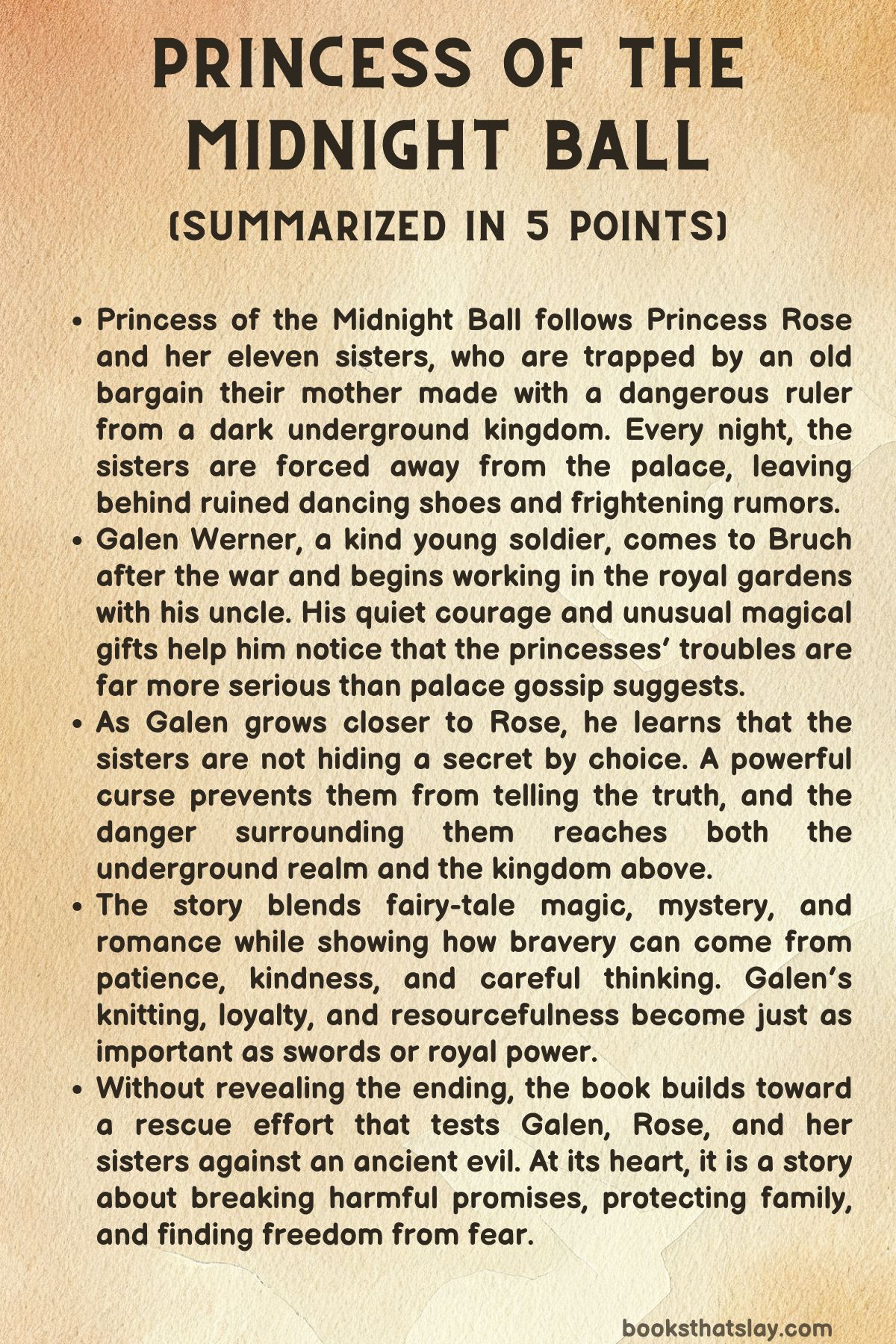
Princess of the Midnight Ball by Jessica Day George is a fantasy retelling of “The Twelve Dancing Princesses.” The story follows Princess Rose and her eleven sisters, who are trapped by an old bargain made before they were born. Every night, they are forced into an underground kingdom ruled by the cruel King Under Stone, where they must dance until morning.
Their ruined shoes, failing health, and silence make others suspect dark magic. Into this danger comes Galen Werner, a kind former soldier and gardener, whose courage, patience, and strange magical gifts may be the only hope the princesses have.
Summary
Princess of the Midnight Ball begins with the shadow of Queen Maude’s desperate choices. Westfalin has suffered through war, fear, and uncertainty, and Maude longs for children as well as victory for her kingdom.
In her need, she makes bargains with the King Under Stone, an ancient sorcerer-king imprisoned beneath the earth. At first, she asks him for children.
Later, she asks for help in winning the war. These requests come at a terrible cost.
Maude is bound to the King Under Stone’s dark realm, and the curse eventually reaches her twelve daughters.
The King Under Stone is not simply helping the queen. He has his own plan.
He has twelve sons, half-mortal princes who cannot fully claim life above ground without brides. By binding Maude’s daughters, he intends to force the twelve princesses into marriage with his sons.
Through these marriages, his family line would regain a place in the world above. The princesses, though royal and admired, are living under a secret command they cannot escape or explain.
After the war ends, Galen Werner travels to the capital city of Bruch. He is a young soldier who has lost his close family and now hopes to find shelter with his aunt and uncle.
On the road, he meets an old woman and treats her with generosity, sharing his food and giving her a scarf. In return, she gives him three magical gifts: an invisibility cloak, black wool that can bind, and white wool that can protect.
Galen does not yet know how important these gifts will become.
When Galen reaches Bruch, he finds his aunt Liesel and uncle Reiner Orm, who welcome him warmly. Reiner works as the royal gardener, and Galen soon joins him in the palace gardens.
This work brings Galen close to the royal household. One day near the swan fountain, he startles Princess Rose, the eldest of King Gregor’s daughters, and saves her from a dangerous fall into the water.
Their meeting is awkward but important, beginning a connection built on kindness, trust, and shared concern.
Rose is weak and unwell, and her sisters are also suffering. Every morning, their shoes are found worn to pieces, though no one knows where they have gone.
The truth is that each night, the twelve princesses are forced to descend through a secret golden stair hidden beneath a rug in their sitting room. They enter the underground world of the King Under Stone, passing through a silver forest and crossing a black lake in golden boats.
Once they reach his palace, they must dance until dawn with the princes who have been chosen for them.
The curse prevents the princesses from telling anyone the truth. They cannot openly explain where they go or why they return exhausted.
Their father, King Gregor, becomes increasingly desperate. He wants to protect his daughters, but he cannot understand what is happening to them.
Foreign princes come to the palace and attempt to solve the mystery, hoping to win royal favor or marriage. Each fails, and each later dies in a strange way.
As fear grows, rumors spread that the princesses are involved in witchcraft.
Galen begins to notice signs that something is deeply wrong. He cares for Rose and is troubled by the suffering of all twelve sisters.
When the princesses miss one night of dancing, strange creatures from the underground realm enter the palace garden, proving that the danger is real and close. Galen receives permission to investigate and uses the invisibility cloak to follow the sisters when they descend below the palace.
Hidden from sight, Galen witnesses the journey to the King Under Stone’s realm. He sees the silver forest, the lake, the boats, the Midnight Ball, and the princes who claim the princesses as their future brides.
He realizes that the sisters are not guilty of witchcraft or deceit. They are prisoners of an old bargain, trapped by magic and fear.
Galen gathers proof of what he has seen and begins searching for a way to defeat the power holding them.
His search leads him to old records about the King Under Stone. He discovers that the underground ruler was once Wolfram von Aue, a wicked magician whose true name carries power.
Knowing this gives Galen a possible weapon. He prepares carefully, using the magical gifts he received from the old woman.
With silver twigs from the underground forest as knitting needles, he makes a chain from the black wool. He strengthens it with basil and nightshade and carries his mother’s silver cross.
He also makes Rose a shawl from the white wool, hoping it will protect her.
The King Under Stone eventually realizes that an invisible intruder has entered his realm. In anger, he curses Galen to die before the full moon and keeps the princesses below.
Above ground, the situation worsens. Bruch grows restless, and fear turns into violence.
Anne, the princesses’ governess, is accused of witchcraft, while the princesses remain unable to defend themselves. Galen knows he must act before the curse, the mob, or the King Under Stone destroys them all.
Galen returns to the underground kingdom for the rescue. The escape is dangerous because the King Under Stone’s power is old and strong, and his sons are determined to keep the princesses.
During the confrontation, Galen uses what he has learned about the king’s true identity. He marks a silver twig with the name Wolfram von Aue and stabs the King Under Stone through the heart.
The sorcerer-king dies, but the danger does not end.
The king’s power passes to his son Illiken, who becomes the new King Under Stone. Illiken tries to keep Rose and her sisters in the underground realm and continue his father’s plan.
Galen shoots him, but ordinary weapons cannot kill the new ruler. Rose helps Galen obtain another silver twig, and Galen marks it with Illiken’s name.
He then stabs Illiken as well, breaking his hold over the princesses.
The sisters flee from the underground palace. Their escape across the black lake seems impossible, but Rose’s white shawl changes into a floating raft, allowing them to cross safely.
Once they reach the gate between the worlds, Galen uses the black wool chain and his mother’s silver cross to seal it. This shuts the path to the King Under Stone’s realm and prevents its power from reaching the princesses again.
Back in the palace, Galen explains the truth to King Gregor and the council. He presents objects from the underground world as evidence, proving that the princesses were victims rather than criminals.
The accusations against Anne are cleared, and the suspicions surrounding Rose and her sisters are finally put to rest. With the gate sealed and the rulers of Under Stone defeated, the princesses are free from the nightly dances.
The kingdom can begin to heal, and Rose and Galen’s bond stands as one of the story’s brightest signs of hope after years of fear.
Characters
Galen Werner
Galen Werner is the central heroic figure in Princess of the Midnight Ball, and his strength comes from a quiet mixture of courage, kindness, patience, and practical intelligence. He is not introduced as a grand prince or a powerful nobleman, but as a young soldier who has already suffered loss and hardship.
His past makes him serious and resilient, but it does not make him bitter. His kindness to the old woman on the road shows that he is compassionate even when he has little to give, and this generosity becomes important because it brings him the magical tools he later uses to save the princesses.
Galen’s heroism is not based only on bravery; it is also based on careful observation and steady effort. He notices what others ignore, investigates the mystery without trying to exploit the princesses, and treats Rose and her sisters as prisoners who need help rather than as suspects.
His knitting is especially meaningful because it turns a gentle, domestic skill into a weapon against dark magic. Through Galen, the book presents heroism as something thoughtful, humble, and protective rather than loud or prideful.
Princess Rose
Princess Rose is one of the most emotionally important characters in the book because she carries both royal responsibility and private suffering. As the eldest princess, she feels deeply responsible for her eleven younger sisters, and much of her behavior is shaped by the need to protect them.
Her illness and exhaustion show the physical cost of the curse, but her emotional burden is just as heavy. She cannot freely explain what is happening, and this silence makes her appear mysterious to others even though she is actually trapped.
Rose’s relationship with Galen develops through trust, vulnerability, and shared danger. She is cautious at first because the curse has made truth dangerous, but she gradually recognizes Galen’s sincerity.
Rose is not merely a damsel waiting to be saved; she actively helps in the final struggle, especially when she assists Galen in defeating Illiken. Her courage is quieter than Galen’s, but it is just as essential.
She represents endurance, loyalty, and the strength needed to hope after years of fear.
Queen Maude
Queen Maude is one of the most tragic figures in the story because her choices begin the chain of suffering that traps her daughters. Her bargains with the King Under Stone come from understandable desires: first, the longing for children, and later, the desperate wish to save Westfalin during war.
However, her mistake lies in trusting a dark power and accepting help without fully escaping its cost. Maude’s actions are morally complicated because they are not purely selfish or evil; she wants family and victory for her kingdom, but the consequences fall heavily on her daughters.
Her character shows how desperation can make dangerous bargains seem necessary. Even though she is not present as an active force throughout most of the story, her decisions haunt the entire plot.
She becomes a reminder that love and fear, when mixed with forbidden power, can create suffering for the next generation.
King Under Stone / Wolfram von Aue
The King Under Stone is the main villain of the book, and his menace comes from his combination of ancient power, cruelty, patience, and possessiveness. Once known as Wolfram von Aue, he is not simply a monster but a sorcerer-king with a history, a true name, and a carefully guarded weakness.
His underground realm reflects his nature: beautiful in a cold and unnatural way, but also imprisoning, lifeless, and corrupt. He manipulates Queen Maude’s desires, turns bargains into chains, and treats the princesses as objects meant to continue his bloodline.
His plan to marry them to his sons reveals how completely he denies their freedom. He is dangerous not only because of magic, but because he understands how to trap people through promises, silence, and obligation.
In Princess of the Midnight Ball, he represents the destructive power of bargains made without freedom and relationships built on control rather than love.
Illiken
Illiken is an important extension of his father’s evil, but he is also threatening in his own right. As one of the sons of the King Under Stone, he sees Rose not as a person with her own will, but as a bride who has been promised to him.
His attitude reveals the cruelty of the underground court, where the princesses’ fear and exhaustion are ignored because the men of that realm believe they are entitled to them. After his father dies and power passes to him, Illiken becomes even more dangerous because he inherits the role of King Under Stone.
His survival after Galen shoots him shows that ordinary force cannot defeat this kind of dark magic. Illiken’s defeat requires Rose’s help, which is significant because it gives her a direct role in breaking the power that tried to claim her.
He represents inherited corruption and the continuation of tyranny unless it is actively stopped.
King Gregor
King Gregor is a loving but troubled father whose authority is weakened by confusion, grief, and fear. He sees his daughters suffering, notices the ruined shoes, and understands that something unnatural is happening, but he cannot discover the truth.
His desperation leads him to invite foreign princes to solve the mystery, which shows both his concern and his helplessness. Gregor’s position is painful because he is king, yet he cannot protect his own children from a curse hidden inside his palace.
His frustration also reflects the pressure of ruling a kingdom where rumors of witchcraft and unrest are spreading. Once Galen reveals the truth, Gregor’s willingness to listen and accept evidence becomes important.
He is not a perfect protector, but he is not cruel or indifferent. His character shows the limits of earthly power when faced with hidden magic, and also the importance of humility when truth finally appears.
Anne
Anne, the governess, is a sympathetic character because she becomes a victim of fear and suspicion. When the people of Bruch cannot understand the princesses’ strange condition, they look for someone to blame, and Anne is accused of witchcraft.
Her situation reveals how quickly a frightened society can turn against an innocent person. She represents the ordinary people who suffer when rumors grow stronger than truth.
Anne’s accusation also raises the stakes of the story because the curse no longer harms only the princesses in private; it begins to poison the public life of the kingdom. Her innocence helps emphasize the injustice caused by ignorance and panic.
Through Anne, the story shows that evil does not always work directly; sometimes it spreads by making innocent people appear guilty.
Liesel Orm
Liesel Orm, Galen’s aunt, gives him a place of warmth and belonging after loss and war. Her role may be quieter than that of the magical or royal characters, but she is important because she helps ground Galen in family and ordinary life.
By welcoming him into her home, she gives him stability at a time when he has no surviving immediate family. Liesel’s presence shows that kindness does not need to be dramatic to matter.
She helps create the safe domestic world that contrasts with the cold, dangerous world beneath the earth. Her character also strengthens Galen’s connection to Bruch, making his decision to help the princesses feel personal rather than merely adventurous.
Reiner Orm
Reiner Orm, Galen’s uncle and the royal gardener, plays an important supporting role by connecting Galen to the palace. Through Reiner, Galen gains work in the gardens, which allows him to observe palace life closely and eventually become involved in the mystery of the princesses.
As a gardener, Reiner is associated with growth, care, and ordinary labor, all of which contrast sharply with the barren magic of the underground realm. His role also emphasizes that Galen enters the palace not through rank or ambition, but through honest work.
Reiner’s presence helps keep the story rooted in practical reality, showing that the solution to a magical curse begins with simple human connections.
Themes
The Burden of Inherited Consequences
The suffering of the twelve princesses grows from choices they did not make. Queen Maude’s bargains place her daughters under a curse before they are old enough to understand the danger, turning family legacy into a form of imprisonment.
This theme shows how one generation’s desperation can become the next generation’s burden. Maude asks first for children and then for victory, both desires rooted in understandable human longing, yet the cost is hidden until it becomes unbearable.
The daughters inherit not only royal status but also their mother’s debt, and their nightly dancing becomes a punishment disguised as ceremony. In Princess of the Midnight Ball, inheritance is not limited to crowns, names, or bloodlines; it includes secrets, fear, guilt, and obligations passed down without consent.
The princesses’ silence makes this burden even heavier because they cannot defend themselves or explain their exhaustion. Their struggle suggests that freedom requires confronting the past honestly, not pretending that old bargains no longer matter.
Courage Shown Through Kindness and Patience
Galen’s heroism is built through quiet acts rather than grand displays of power. His first important action is not fighting a monster or making a bold speech, but sharing food and warmth with an old woman on the road.
That kindness later gives him the magical tools he needs, showing that compassion can become a source of strength. His courage also appears in his patience: he observes, listens, gathers evidence, and tries to understand the princesses’ situation before acting.
He does not treat Rose and her sisters as prizes to be won or mysteries to be solved for personal glory. Instead, he recognizes their fear and respects their helplessness under the curse.
His soldier’s discipline matters, but his gentleness matters just as much. The theme suggests that true bravery is not only physical risk; it is also the willingness to protect others carefully, especially when they cannot fully explain their pain.
Freedom Against Control
The underground realm represents control in its most threatening form. The princesses are forced to dance, forced into silence, and nearly forced into marriages that would serve the King Under Stone’s desire to extend his bloodline above ground.
Their bodies, choices, voices, and futures are all claimed by someone else. This loss of freedom is especially painful because the princesses continue to appear privileged to the outside world.
They live in a palace, wear fine dresses, and belong to a royal family, yet their lives are ruled by fear every night. The contrast shows that outward status does not guarantee real freedom.
Rose’s growing trust in Galen becomes important because it allows her to act, not simply be rescued. When she helps in the final escape, her role proves that freedom is not handed to her; she participates in reclaiming it.
The theme argues that control survives through secrecy, but it weakens when truth, courage, and shared action break its hold.
Truth, Suspicion, and Justice
Fear turns Bruch against the wrong people. Because the princesses cannot reveal the truth, rumors fill the silence, and innocent women become targets of suspicion.
Anne’s accusation shows how quickly a frightened society can search for someone convenient to blame. The worn-out shoes, mysterious deaths, and the princesses’ illness all point to something strange, but without real evidence, people choose superstition over justice.
Galen’s investigation challenges that pattern. He does not rely on gossip or public anger; he follows clues, confirms what he sees, and brings back proof.
This makes truth an active moral duty, not just a piece of information. In Princess of the Midnight Ball, justice depends on patience, evidence, and the courage to question easy explanations.
Once Galen explains the curse and proves the princesses’ innocence, the false story collapses. The ending restores order not simply because evil is defeated, but because truth finally replaces fear.