Rosemary and Rue Summary, Characters and Themes
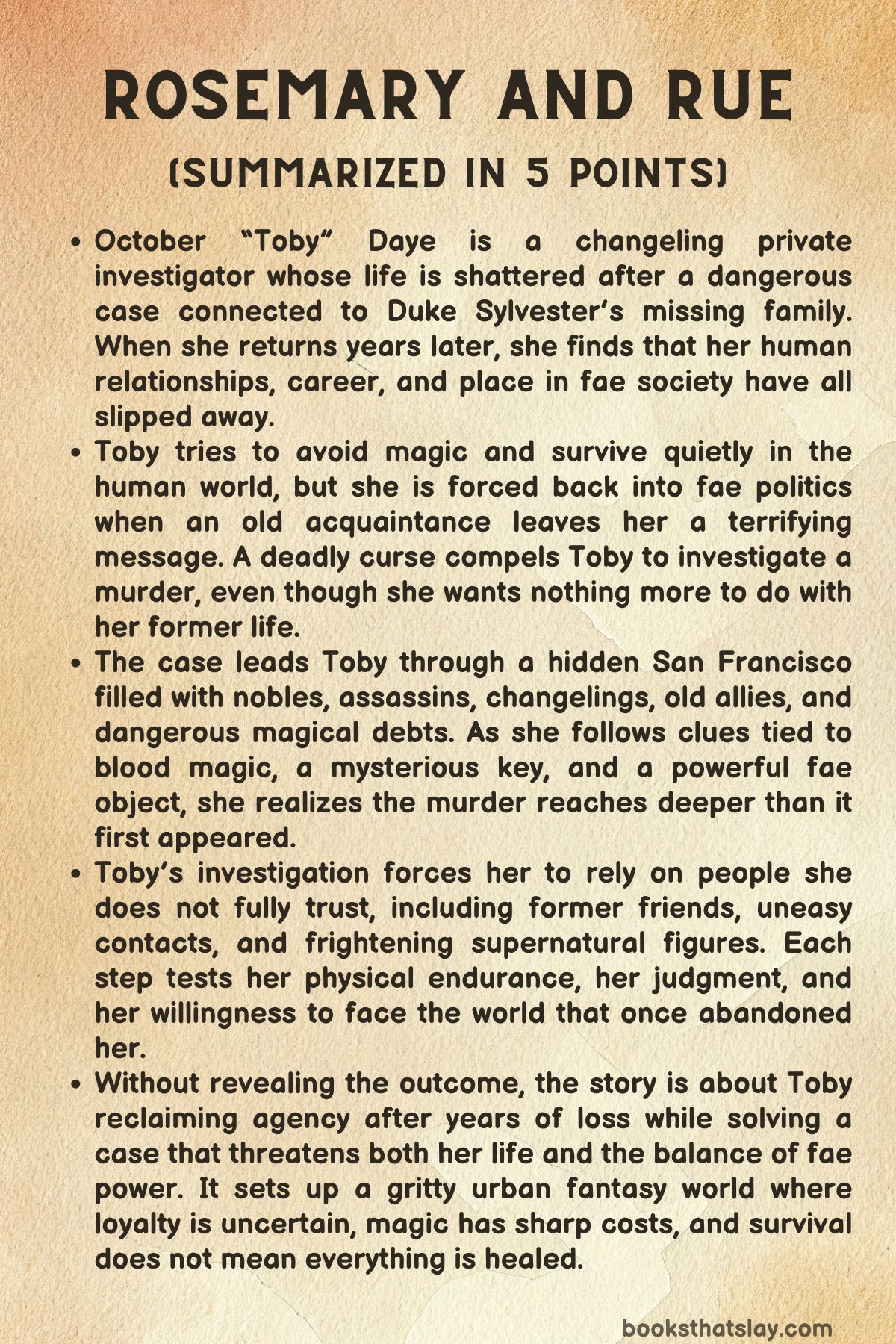
Rosemary and Rue by Seanan McGuire is an urban fantasy novel about October “Toby” Daye, a half-human, half-fae private investigator trying to survive after magic steals fourteen years of her life. Set in San Francisco and the hidden fae realms around it, the book combines murder mystery, political danger, old debts, and personal loss.
Toby is not a chosen hero looking for adventure; she is a wounded woman dragged back into a world she tried to abandon. The story follows her return to fae society as one death forces her to face loyalty, betrayal, and the cost of survival.
Summary
In Rosemary and Rue, October “Toby” Daye begins as a changeling private investigator with one foot in the human world and one in the world of Faerie. She is also a knight sworn to Duke Sylvester Torquill, a powerful noble of the fae.
Her life is dangerous, but it still has shape and purpose. She has a fiancé, Cliff, a young daughter named Gillian, and a career built around solving problems that cross the border between human and fae society.
That life is destroyed in 1995 when Toby is assigned to follow Simon Torquill, Sylvester’s brother. Simon is suspected of being involved in the disappearance of Sylvester’s wife, Luna, and daughter, Rayseline.
Toby tracks him to the Japanese Tea Gardens, where she discovers that Simon is not working alone. He is allied with Oleander de Merelands, a deadly assassin.
Before Toby can escape and warn Sylvester, Simon and Oleander catch her. Simon uses magic to transform Toby into a koi fish and leaves her trapped in a pond.
To the rest of the world, Toby simply vanishes.
Fourteen years pass before Toby regains her human form. When she returns in 2009, everything she once loved has moved on without her.
Cliff has rebuilt his life, and Gillian, who grew up believing her mother abandoned her, wants nothing to do with Toby. Her old place in fae society is gone, her work as a private investigator has collapsed, and the people who once depended on her can no longer reach her in the same way.
Toby is alive, but the world she returns to is not the one she left.
Rather than reclaim her former life, Toby withdraws. She works nights at a Safeway and keeps her distance from magic, fae politics, and old friends.
She avoids Sylvester’s attempts to contact her and refuses to return to the responsibilities she once carried. Friends such as Mitch and Stacy still care about her, but Toby keeps them at arm’s length.
She has survived the impossible, yet survival has left her bitter, exhausted, and afraid of belonging anywhere again.
Her fragile quiet ends when she receives phone messages from Evening Winterrose, a fae countess and an old acquaintance. Evening sounds terrified.
She says she wants to hire Toby to investigate a murder, but the situation is worse than a normal request. Evening uses magic to bind Toby with a curse: if Toby does not find out who killed Evening, Toby will die.
The final message captures Evening being attacked and murdered.
Toby has no choice but to investigate. She goes to Evening’s apartment and uses illusion magic to slip past the police.
Inside, she finds Evening’s body and realizes the murder was not only violent but clearly tied to fae affairs. Evening was shot, then killed with iron, a substance especially dangerous to fae blood.
The use of iron marks the crime as cruel, deliberate, and deeply personal.
Toby uses blood magic to read fragments of Evening’s final memories. This magic is painful and risky, but it gives her clues: a key, a sprite, and the importance of Goldengreen, Evening’s hidden fae estate.
Toby reports the death to the Queen of the Mists, expecting help or at least official concern. Instead, the Queen refuses to assist her and warns Toby away from asking further questions.
This makes the investigation even more dangerous. Toby is trapped by Evening’s curse, but the people with power either will not help or have their own reasons for staying silent.
With few options, Toby turns to old contacts. One of the most important is Devin, her former lover and mentor.
Devin runs Home, a refuge for changeling children who have been abandoned, rejected, or left without protection. Toby’s history with him is complicated.
He helped shape her into the person she became, but he also represents a part of her past filled with manipulation and pain. Still, she needs information, and Devin appears willing to help.
He sends two young people from Home, Dare and Manuel, to watch over Toby.
As Toby follows the trail, it becomes clear that someone is trying to stop her from solving the murder. She is attacked by hired killers, including a Redcap and a Doppelganger.
These attacks are not random. They show that Evening’s murder is connected to something valuable enough to kill for, and that Toby has become a target because she is getting too close.
During one attack, Toby is badly wounded by iron, and the injury nearly kills her.
She is saved through Devin’s intervention and taken to the Luidaeg, an ancient and feared sea-witch. The Luidaeg is terrifying, powerful, and far older than most of the fae Toby usually deals with.
She treats Toby’s wounds and also explains the seriousness of Evening’s curse. There is no easy way out.
Toby must solve the murder, or the curse will claim her. From the Luidaeg, Toby also learns more about the object at the center of the case: the hope chest.
The hope chest is a powerful magical artifact connected to blood, identity, and the balance between fae and human heritage. For changelings, who live between those worlds, such an object could change everything.
It could alter the balance of fae and human blood, making it valuable to anyone who wants power over lineage, status, or transformation. Evening’s key is linked to this object, and Goldengreen becomes the next major focus of Toby’s search.
At Goldengreen, Toby finds the hope chest, confirming that Evening’s death was tied to far more than personal hatred. The artifact is real, and people are willing to kill for it.
Toby is attacked again, proving that the murderer or their agents are still watching her closely. Realizing that she cannot safely keep the hope chest herself, she gives it to Tybalt, the King of Cats, for protection.
Tybalt is proud, sharp, and often difficult, but he is also powerful and independent enough to keep the artifact away from Toby’s enemies.
Toby continues using blood magic to uncover the truth. With help from Lily, she gains a clearer vision of what happened and finally understands the shape of the betrayal.
Devin, the person who offered help and shelter, was behind the murder. He wanted the hope chest for himself.
He arranged Evening’s death, hired assassins, and tried to have Toby killed once she became a threat to his plan. The discovery is devastating because Devin is not a distant enemy.
He is part of Toby’s past, someone who once held power over her and over many vulnerable changelings.
Toby returns to Home to confront him. The confrontation is filled with old wounds, fear, and divided loyalties.
Devin admits enough to make his guilt clear. He is not sorry in the way Toby needs him to be; he is driven by greed, ambition, and the belief that he can control the people around him.
Manuel, one of the young people from Home, is loyal to Devin and terrified of what will happen if Devin falls. He points a gun at Toby, making the situation even more unstable.
Dare, another of Devin’s young charges, steps in. The confrontation turns violent, and Dare is killed.
Her death adds another cost to a case already shaped by loss. Toby defeats Devin, and he dies, ending the immediate threat.
With Devin responsible for Evening’s murder, Evening’s curse is fulfilled, and Toby is freed from the death sentence placed on her.
After the case ends, Toby helps deal with what remains of Home. The refuge Devin built was never as safe as it appeared, and its destruction marks the end of one more false shelter in Toby’s life.
She and Sylvester burn it down, closing a painful chapter. Manuel is taken to Shadowed Hills, Sylvester’s domain, where he will have a chance at a different future.
Toby gives the hope chest to the Queen of the Mists, even though the Queen gave her little help when she needed it. The political world of the fae remains cold, dangerous, and unfair, but Toby has begun to reenter it.
She starts restoring her private investigator’s license and accepts that she cannot keep pretending she has no place among the fae. She has not recovered her lost years, her broken family, or the life Simon stole from her.
Simon and Oleander are still free, and many wounds remain open.
By the end of Rosemary and Rue, Toby has solved Evening’s murder, survived the curse, exposed Devin’s betrayal, and taken the first steps back toward becoming herself. The story does not pretend that survival fixes everything.
Toby is still grieving, still damaged, and still unsure of where she belongs. But she is moving again.
Instead of hiding from the fae world, she begins to face it, carrying her losses with her while choosing a life that is finally her own.
Characters
October “Toby” Daye
October “Toby” Daye is the emotional and moral center of Rosemary and Rue, and her character is shaped by loss, survival, and reluctant responsibility. At the beginning of the story, Toby is not simply a detective returning to work; she is someone whose life has been violently interrupted and almost erased.
Being transformed into a koi fish for fourteen years destroys her human relationships, her career, and her sense of belonging in both the human and fae worlds. This makes her guarded, bitter, and deeply exhausted when she returns to human form.
Her refusal to rejoin fae society is not cowardice but self-protection, because the fae world has already taken almost everything from her.
Toby’s strength lies in the fact that she keeps moving even when she has every reason to stop. The curse placed on her by Evening forces her into the investigation, but Toby’s actions gradually become more personal than survival alone.
She is angry, wounded, and often physically overmatched, yet she continues to follow the truth because justice still matters to her. Her blood magic, detective instincts, and ability to endure pain make her effective, but her real power is persistence.
She is not portrayed as untouched by trauma; instead, the book shows her as someone who is damaged but still capable of choosing action, loyalty, and moral courage.
Toby is also important because she stands between worlds. As a changeling, she is never fully accepted by fae society, and after her disappearance, she is no longer fully at home in the human world either.
This in-between identity makes her vulnerable, but it also gives her insight into people who are ignored, exploited, or discarded. Her connections with changelings such as Dare and Manuel show that she understands the pain of being treated as lesser.
By the end of the story, Toby has not healed completely, but she has begun to reclaim her identity. Her return to investigation and fae life is not a neat victory; it is the first step toward rebuilding herself on her own terms.
Evening Winterrose
Evening Winterrose is a powerful and unsettling figure whose death drives the central conflict of the book. Even though she dies early, her presence continues to shape the story through her curse, her secrets, and the danger surrounding the hope chest.
Evening is not presented as warm or innocent. She is aristocratic, manipulative, and capable of forcing Toby into action by binding her life to the murder investigation.
This makes her morally complicated, because she seeks justice for her own death but does so by violating Toby’s freedom.
Evening’s character represents the cold calculation often found in fae politics. She knows that Toby is capable, and she also knows that Toby may refuse to help unless she has no choice.
Her decision to curse Toby shows both desperation and ruthlessness. Yet her fear before her death suggests that even someone as powerful as Evening can become trapped by forces beyond her control.
Her murder reveals how dangerous the struggle for magical power has become, especially when an object like the hope chest is involved.
Evening’s importance lies less in her emotional relationship with Toby and more in the mystery she leaves behind. Her memories, her key, and her connection to Goldengreen turn her from a victim into a hidden guide.
She is dead, but she still directs the investigation through the fragments Toby uncovers. In this way, Evening remains influential throughout the story, embodying the idea that fae debts, bargains, and secrets can continue to control the living long after death.
Devin
Devin is one of the most tragic and corrupt characters in the book because he combines genuine care with exploitation. As the leader of Home, he presents himself as a protector of changeling children who have nowhere else to go.
This makes him appear compassionate, especially in a society where changelings are often undervalued. However, his kindness is tied to control.
He offers shelter, but he also creates dependence. The young people around him rely on him emotionally, socially, and practically, which allows him to use them for his own purposes.
His past relationship with Toby makes his betrayal especially painful. Devin is not a distant villain; he is someone Toby once trusted, loved, and learned from.
That personal history gives him emotional power over her, and he uses familiarity to hide his guilt. His desire for the hope chest reveals the selfishness beneath his protective image.
He wants power, and he is willing to arrange Evening’s murder, hire killers, and endanger Toby to get it. His actions show how easily a person can justify cruelty when they believe they have been denied status or respect.
Devin’s downfall is powerful because it exposes the rot inside a place that was supposed to be safe. Home becomes a symbol of corrupted refuge.
His death does not erase the harm he caused, especially to Dare and Manuel, but it ends his control over the vulnerable people he gathered around himself. Devin is memorable because he is not evil in a simple way.
He has charm, history, and moments that suggest he understands pain, but he ultimately chooses ambition and possession over love, loyalty, or justice.
Dare
Dare is a young changeling whose loyalty, bravery, and vulnerability make her one of the most emotionally affecting characters in the story. She comes from Home, a place that should protect her but instead places her under Devin’s influence.
Dare’s connection to Toby allows the reader to see her as more than one of Devin’s followers. She is young, eager, and caught between obedience to the person who raised her and an instinctive sense of what is right.
Her death is one of the clearest examples of the cost of Devin’s betrayal. Dare is not a political player or a power-seeker.
She is someone shaped by a harsh world and by the limited choices available to changelings. When she intervenes during the confrontation at Home, her courage becomes undeniable.
She acts because she recognizes danger and injustice, even though she is surrounded by fear and manipulation. Her choice shows that she has a moral strength Devin failed to destroy.
Dare’s role also deepens Toby’s grief and guilt. Toby understands what it means to be a changeling used by stronger fae, and Dare’s death reinforces the cruelty of a society that leaves young changelings dependent on dangerous protectors.
Dare represents innocence damaged by fae politics and adult selfishness. Her loss gives the ending a bitter weight, reminding the reader that solving the case does not undo the lives destroyed along the way.
Manuel
Manuel is a frightened and conflicted young changeling whose actions show how loyalty can be twisted by dependence and fear. Like Dare, he comes from Home and lives under Devin’s authority.
Unlike Dare, Manuel responds to pressure by clinging more tightly to the person who controls him. His loyalty to Devin is not simple villainy; it is the loyalty of someone who has been shaped to believe that survival depends on obedience.
When Manuel points a gun at Toby, the moment reveals how deeply Devin’s influence has damaged him. Manuel is dangerous, but he is also scared.
He does not seem fully in control of the moral meaning of what he is doing. His fear makes him easy to use, and Devin’s manipulation turns him into a weapon.
This makes Manuel a painful character rather than a purely hateful one, because his choices are harmful but rooted in emotional dependency.
By being taken to Shadowed Hills after the destruction of Home, Manuel is given the possibility of a different future. His character shows that not everyone harmed by corruption immediately becomes free once the corrupt person is gone.
He will have to unlearn fear, obedience, and misplaced loyalty. Manuel’s presence adds complexity to the story’s treatment of victims and accomplices, showing that the line between the two can become blurred when vulnerable people are raised inside abusive systems.
Duke Sylvester Torquill
Duke Sylvester Torquill is a figure of loyalty, grief, and imperfect authority. As Toby’s liege, he represents the fae world she tries to avoid after returning from her fourteen-year imprisonment.
His connection to her is not merely political; he cares about her and continues trying to reach her even when she rejects him. This persistence shows his loyalty, but it also reminds Toby of the obligations and pain she wants to escape.
Sylvester’s own suffering shapes his character. The kidnapping of Luna and Rayseline leaves him wounded and desperate, and Toby’s disappearance adds another loss to his life.
He is powerful, but his power does not protect the people he loves. This makes him a more sympathetic noble figure than the Queen of the Mists.
While he belongs to fae hierarchy, he is not coldly detached from those beneath him. His concern for Toby suggests a sense of responsibility that goes beyond rank.
At the end, Sylvester helps Toby burn down Home, which is both a practical and symbolic act. He stands with her as she closes a painful chapter connected to Devin and the exploited changelings.
His role in the book is not to rescue Toby or control her choices, but to remain a connection to the fae world that is not entirely corrupt. Through him, Toby’s return to fae life becomes possible, though still difficult.
Simon Torquill
Simon Torquill is one of the most dangerous figures in the story because his cruelty begins the catastrophe that destroys Toby’s life. His transformation of Toby into a koi fish is not just an attack; it is an act of erasure.
By trapping her for fourteen years, he steals her family, her career, her social ties, and her future. This makes him a haunting presence even though he is not the main villain of the murder investigation.
Simon’s connection to Duke Sylvester gives his betrayal added weight. As Sylvester’s brother, he represents corruption within a noble family and the danger of intimate treachery.
His role in the kidnapping of Luna and Rayseline places him at the center of older wounds that remain unresolved. He is not simply an outside enemy but someone whose actions fracture family, loyalty, and political trust.
Because Simon remains free, he also represents unfinished justice. Toby survives the damage he caused, but she does not fully defeat him in this story.
His continued absence after the opening events creates a shadow over the ending. Toby has solved Evening’s murder and survived Devin’s betrayal, but Simon’s freedom reminds the reader that her larger trauma and the broader dangers of the fae world are still unresolved.
Oleander de Merelands
Oleander de Merelands is a lethal and sinister presence whose role emphasizes the brutality of fae violence. As an assassin working with Simon, she is tied directly to Toby’s transformation and the destruction of her old life.
Oleander’s danger comes from her professionalism and lack of mercy. She does not need to appear often to feel threatening, because her reputation and actions mark her as someone capable of extreme cruelty.
Her partnership with Simon suggests a world of hidden alliances, hired violence, and political schemes. Oleander represents the kind of fae power that operates in shadows, where enemies are not challenged openly but removed through curses, transformations, poison, and murder.
Her presence helps establish the tone of the story’s fae society: beautiful and ancient on the surface, but often vicious underneath.
Like Simon, Oleander remains unresolved by the end, which makes her important to the book’s sense of ongoing danger. Toby’s survival does not mean she is safe from the people who originally destroyed her life.
Oleander stands as a reminder that the first crime against Toby still matters, and that the world Toby is returning to contains enemies who are patient, skilled, and still beyond punishment.
Luna Torquill
Luna Torquill is central to the emotional background of the story even though she is not active in the main investigation. Her kidnapping is one of the events that leads Toby into danger in 1995, and her absence shapes Sylvester’s grief and desperation.
Luna represents the personal stakes behind noble politics. The conflict is not only about power or territory; it is also about families being broken.
Her role also reveals Toby’s loyalty before her transformation. Toby risks herself because Sylvester’s wife and daughter have been taken, and this shows that Toby once had a stronger connection to fae duty than she later wants to admit.
Luna’s kidnapping is therefore tied to Toby’s lost past, a time when she still believed she could act within fae society and make a difference.
Although Luna is not deeply developed in the provided events, her importance lies in what her disappearance causes. She becomes part of the wound that never fully closes for Sylvester and Toby.
Her character represents the innocent or semi-innocent people caught inside fae conflicts, where family members can become targets in battles of betrayal and ambition.
Rayseline Torquill
Rayseline Torquill, like Luna, is important because her kidnapping helps set the original tragedy in motion. As Sylvester’s daughter, she embodies vulnerability within a powerful family.
Her disappearance makes Simon’s betrayal more personal and cruel, because it is not merely a political act but an attack on a child and a family bond.
Rayseline’s role also deepens the sense of loss surrounding Toby’s missing years. Toby’s attempt to help find her leads to Toby’s own imprisonment, meaning Rayseline is connected to the moment when Toby’s life splits into before and after.
Even without direct involvement in the later investigation, Rayseline remains part of the emotional history that Toby cannot escape.
Her character functions as a reminder that fae nobility does not guarantee safety. Rank, bloodline, and title do not protect Luna or Rayseline from being used as pieces in someone else’s scheme.
Through Rayseline, the story reinforces the danger of a world where family loyalty can be violated by ambition, revenge, or hidden political motives.
Cliff
Cliff represents the human life Toby loses while she is trapped in fish form. As her former fiancé, he is tied to the possibility of ordinary happiness, domestic stability, and a future outside the dangers of fae politics.
When Toby returns and finds that Cliff has moved on, the loss is devastating but also understandable. Fourteen years have passed, and his life could not remain frozen for her.
His character is important because he shows that Toby’s suffering does not affect only her. Her disappearance wounds the people who loved her, and because they do not know the truth, they experience her absence as abandonment or tragedy.
Cliff’s moving on is not portrayed as betrayal; it is part of the irreversible damage caused by Simon’s spell. Time has continued without Toby, and Cliff proves that some losses cannot be repaired simply by returning.
Cliff also anchors the human side of Toby’s identity. Through him, the story shows how impossible it is for Toby to fully resume her old life.
Even if she wants to reject fae society, her human relationships have been broken by fae violence. Cliff’s role is therefore quiet but painful, representing the ordinary future Toby can no longer claim.
Gillian
Gillian is Toby’s daughter and one of the most painful reminders of what Toby’s fourteen-year imprisonment cost her. Gillian’s rejection of Toby is emotionally devastating because it strikes at Toby’s identity as a mother.
Toby did not choose to leave, but Gillian still grew up without her. The tragedy lies in the gap between Toby’s innocence and Gillian’s lived experience of abandonment.
Gillian’s character makes Toby’s trauma more personal. Losing a career or social standing is painful, but losing a child’s trust is far deeper.
Gillian cannot simply accept an explanation involving fae magic and lost years, and the story does not force her to forgive Toby quickly. This makes their relationship feel more honest.
Love does not automatically heal absence, especially when the absence lasted most of Gillian’s life.
Through Gillian, the book explores the cost of being pulled between human and fae worlds. Toby’s fae enemies destroy her human family, and there is no easy way to repair that damage.
Gillian represents the life Toby wanted to protect but could not. Her presence in the story keeps Toby’s grief grounded in something intimate and human.
The Queen of the Mists
The Queen of the Mists is a cold and politically powerful figure who represents the indifference of fae authority. When Toby brings Evening’s death to her attention, the Queen refuses to help and instead shuts down further inquiry.
This reaction reveals a ruler more concerned with control and appearances than justice. She is not presented as a source of safety, even though her position suggests she should be.
Her treatment of Toby also shows the unstable position of changelings in fae society. Toby is useful when she solves problems, but she is not respected enough to be protected or fully heard.
The Queen’s dismissal reinforces Toby’s isolation and makes the investigation more dangerous. Instead of receiving institutional support, Toby has to rely on her own skill and uncertain alliances.
The Queen’s later possession of the hope chest is significant because it places a dangerous magical object in the hands of someone already shown to be politically calculating. Her character adds tension to the ending.
Justice for Evening may be achieved, but power has not necessarily become safer or kinder. The Queen remains a reminder that the structures of fae society are deeply flawed.
Tybalt
Tybalt, the King of Cats, is proud, sharp, and independent, making him one of Toby’s most intriguing allies. He does not fit neatly into Toby’s circle of friends, and his relationship with her is marked by tension, verbal sparring, and guarded respect.
His title gives him authority outside the courtly structures that dominate much of fae politics, which allows him to operate by his own rules.
Tybalt’s decision to protect the hope chest is important because it shows that Toby trusts him in a way she may not openly admit. He is not gentle or sentimental, but he is reliable when it matters.
His independence makes him valuable because he is not easily controlled by the Queen, Devin, or other political forces. In a story filled with betrayal, Tybalt’s difficult but genuine dependability stands out.
His character also adds energy to Toby’s world. He challenges her, irritates her, and forces her to engage with someone who sees through some of her defenses.
Tybalt is not merely a helper; he is a powerful figure with his own pride and motives. His presence suggests that Toby’s return to fae life will involve complicated alliances rather than simple friendships.
The Luidaeg
The Luidaeg is one of the most ancient and frightening figures in the story, and her role combines terror, wisdom, and reluctant aid. She is not comforting in an ordinary sense.
Her power is immense, her manner is intimidating, and Toby approaches her because the situation is desperate. Yet the Luidaeg provides crucial truth about Evening’s curse, making her one of the few characters who speaks with real authority about the magical forces at work.
Her importance lies in the way she expands the scale of the world. Through the Luidaeg, the story reaches beyond court politics and personal betrayal into older, deeper fae power.
She represents a kind of magic that is not decorative or polite but primal and dangerous. Her presence reminds the reader that the fae world is ancient, and that some beings within it operate according to rules far older than the current courts.
Despite her fearsome nature, the Luidaeg helps Toby survive. This makes her morally complex rather than simply monstrous.
She may be terrifying, but she is not deceitful in the same way Devin or the Queen can be. Her honesty is harsh, but valuable.
In a world filled with manipulation, the Luidaeg’s brutal clarity becomes a strange form of trustworthiness.
Lily
Lily is a gentle but powerful figure whose role contrasts with the harsher forces around Toby. Her connection to healing and blood magic makes her important to Toby’s investigation and survival.
Where the Luidaeg represents ancient terror, Lily represents quiet strength, compassion, and spiritual depth. She helps Toby access the truth without turning that help into domination.
Lily’s presence also emphasizes the importance of memory and magical insight in the story. Toby’s investigation is not solved through ordinary detective work alone.
She needs blood, visions, and the guidance of people who understand fae magic more deeply than she does. Lily helps Toby see what is hidden, making her part of the process by which buried truth comes to light.
Her character offers a softer form of authority. She is not weak, but her power does not depend on intimidation.
In a story filled with violence, betrayal, and political cruelty, Lily provides a sense of grace. She helps show that the fae world, though dangerous, still contains figures of wisdom and care.
Stacy
Stacy is one of Toby’s human-side connections and represents the friendships Toby tries to avoid after returning to herself. Toby’s distance from Stacy shows how trauma can make even loving relationships feel painful.
Avoiding friends is part of Toby’s attempt to live quietly and deny the full extent of what she has lost.
Stacy’s importance comes from what she represents rather than from direct involvement in the mystery. She is part of the life Toby cannot easily reenter.
While fae politics pull Toby back into danger, people like Stacy remind the reader that Toby also has ordinary emotional obligations. She has friends who cared about her, missed her, and were affected by her disappearance.
Through Stacy, the story shows that isolation is one of Toby’s main defenses. Toby avoids people not because they are unimportant, but because they matter too much.
Reconnecting with friends would mean facing grief, explanations, and the reality that time moved on without her. Stacy therefore helps reveal the emotional cost of Toby’s survival.
Mitch
Mitch, like Stacy, belongs to the circle of ordinary relationships Toby keeps at a distance after her return. His role highlights Toby’s withdrawal from the life she once had.
She does not only reject fae society; she also avoids the human connections that might force her to confront what happened to her.
Mitch represents the kind of friendship that becomes difficult after trauma. For Toby, reconnecting would require vulnerability, and vulnerability is something she can barely afford at the beginning of the story.
His presence in the background helps establish that Toby’s isolation is self-imposed but understandable. She has people she could reach out to, yet doing so would mean admitting that she is not fine.
Although Mitch is not central to the murder investigation, he helps shape the emotional landscape of the book. Toby’s story is not only about solving Evening’s death; it is also about whether Toby can return to any form of community.
Mitch stands as part of the human world Toby has not fully lost, but also has not yet found the courage to reclaim.
The Redcap
The Redcap is one of the hired killers sent after Toby and represents the physical danger surrounding the investigation. This character is less psychologically developed than figures such as Devin or Evening, but serves an important function by showing that the conspiracy against Toby is active and violent.
The Redcap’s attack proves that someone powerful wants Toby stopped.
As a threat, the Redcap also reinforces Toby’s vulnerability. She is skilled and determined, but she can be badly hurt.
The use of hired killers shows that the enemy is not relying only on secrecy; they are willing to use open violence when necessary. This raises the stakes of the investigation and makes Toby’s persistence more impressive.
The Redcap also contributes to the darker atmosphere of fae society. In this world, assassins and monsters are not distant legends but practical tools used by ambitious people.
The character’s role is brief but effective, showing how quickly Toby’s search for truth turns into a fight for survival.
The Doppelganger
The Doppelganger is another hired attacker whose role emphasizes deception and instability. In a mystery built around hidden motives, false appearances, and magical manipulation, a Doppelganger is especially fitting.
This character represents the danger of not knowing who or what can be trusted.
The attack involving the Doppelganger also shows the lengths Devin is willing to go to in order to protect his plan. He does not merely lie to Toby; he sends threats that exploit the strange and dangerous nature of fae magic.
The Doppelganger’s presence makes the investigation feel more paranoid, because identity itself can become uncertain.
Although not a major character in emotional terms, the Doppelganger strengthens the book’s themes of disguise and betrayal. The story repeatedly shows that appearances are unreliable: protectors can be exploiters, friends can be murderers, and familiar faces can hide deadly intentions.
The Doppelganger makes that theme literal.
Themes
Loss, Displacement, and the Cost of Survival
Toby’s return to human form after fourteen years is not a simple rescue; it is the beginning of a painful second life. In Rosemary and Rue, survival comes at the price of everything that once gave her identity: her family, career, relationships, and place in fae society.
Her transformation into a koi fish does not merely pause her life; it erases her from the world while everyone else is forced to continue without her. When she comes back, Cliff has moved on, Gillian rejects her, and even her old skills feel useless because the world she knew has changed.
This theme is powerful because the novel does not treat survival as victory by itself. Toby is alive, but she must face the emotional wreckage left behind.
Her quiet work at Safeway shows how deeply she wants to avoid the world that hurt her. Yet the curse tied to Evening’s murder forces her back into action, making survival something active rather than passive.
She must decide whether merely existing is enough, or whether she is willing to rebuild herself.
Identity Between Human and Fae Worlds
Toby’s changeling identity places her in a constant state of tension because she belongs fully to neither the human world nor the fae world. Her human life gives her family, work, and ordinary routines, but it cannot protect her from magic, old duties, or supernatural violence.
The fae world gives her power, status, and purpose, but it is also cruel, political, and dangerous. This split identity shapes nearly every decision she makes.
After losing fourteen years, she tries to choose the human side by rejecting Sylvester, avoiding fae society, and working a normal night job. However, Evening’s curse proves that she cannot simply resign from her past.
Her blood magic also emphasizes that her mixed nature is not a weakness but a source of truth and perception. By tasting blood, she can uncover memories and hidden facts that others miss.
The novel presents identity as something uncomfortable but necessary: Toby cannot heal by denying either part of herself. Her strength comes from accepting the difficult space between both worlds.
Betrayal and Broken Trust
Trust is dangerous in Toby’s world because affection, loyalty, and dependence can all be used as weapons. Devin’s betrayal is especially painful because he is not a distant enemy; he is someone tied to Toby’s past, someone who once offered shelter, training, and intimacy.
Home appears to be a refuge for vulnerable changeling children, but beneath that surface it becomes a place shaped by control, fear, and exploitation. Devin’s desire for the hope chest exposes how easily protection can become possession.
His betrayal also forces Toby to reconsider the emotional debts of her past. She cannot defeat him only as an investigator solving a case; she must confront the fact that someone who helped form her also tried to destroy her.
Dare and Manuel deepen the tragedy because they show how betrayal spreads through systems of dependence. Dare’s death reveals the human cost of Devin’s manipulation, while Manuel’s fear shows how loyalty can be twisted.
The theme matters because the murder mystery becomes more than a search for a killer; it becomes a reckoning with corrupted love and false safety.
Duty, Justice, and Reclaiming Agency
Toby begins the story wanting distance from responsibility, but Evening’s curse removes the comfort of refusal. In Rosemary and Rue, duty first appears as coercion: Toby must solve the murder or die.
Yet as the investigation continues, her actions become less about forced obedience and more about reclaiming choice. She follows clues, risks herself, protects the hope chest, and confronts Devin not only because she has been cursed but because justice demands it.
This shift is important because Toby has spent years feeling acted upon by others: Simon transforms her, time steals her life, her family rejects her, and fae politics dismiss her. The investigation gives her a way to act with purpose again.
Even when the Queen refuses meaningful help, Toby continues because justice cannot depend on official power. By the end, fulfilling the curse does not restore what she lost, but it proves she is no longer only a victim of other people’s decisions.
Her renewed private investigator’s license symbolizes a return to agency, not a return to the past.