The Leopard Summary, Characters and Themes | Jo Nesbø
The Leopard (original Norwegian title ‘Panserhjerte’) by Jo Nesbø is a dark crime thriller centered on Harry Hole, a damaged but brilliant detective pulled back into police work after a series of shocking murders in Norway. The case begins with a strange weapon and victims who seem unrelated, but Harry soon discovers that their deaths may be tied to one night at a mountain cabin.
Set across Oslo, Hong Kong, Rwanda and Congo, the book follows a murder investigation shaped by rivalry, corruption, addiction, grief and revenge. At its core, The Leopard is about a man trying to solve a case while his own life keeps breaking apart. It’s the 8th book of the Harry Hole series.
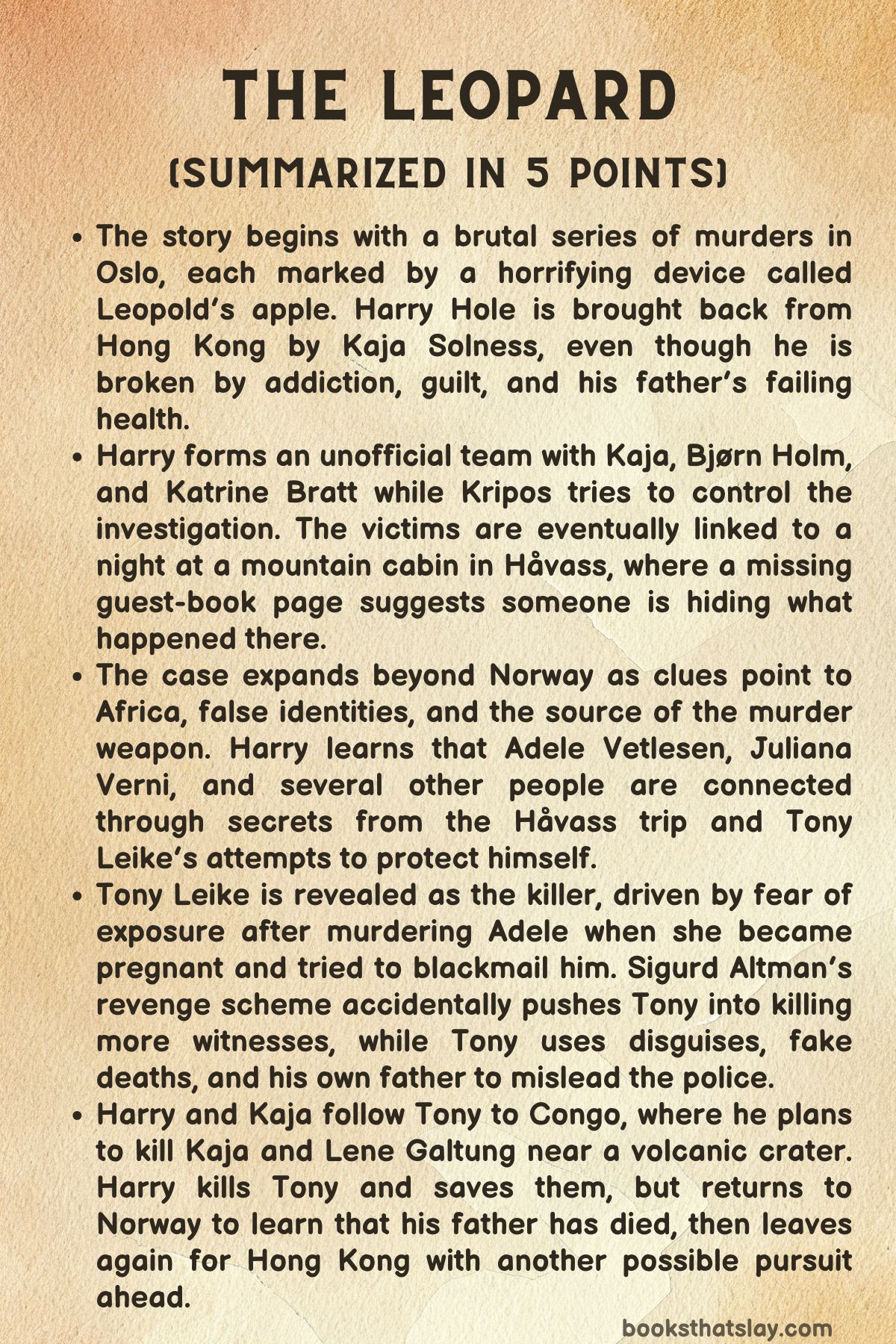
Summary
The Leopard begins with the terrifying death of Borgny Stem-Myhre, who wakes inside a bare concrete room with a metal ball forced into her mouth. She remembers being taken by a masked man, warned not to touch a wire, and injected in the neck.
As her throat swells and pain takes over, she panics and pulls the wire. The device opens inside her mouth, firing needles through her face, throat, eyes and brain.
She dies in agony, drowning in blood. The killer later records and preserves the details of the murder in a private room filled with victim photographs, preparing for more deaths.
In Hong Kong, Detective Kaja Solness searches for Harry Hole, who vanished after the Snowman case. She finds him living in Chungking Mansions, addicted to opium, hiding from creditors and refusing to return to Norway.
Kaja tells him that two women in Oslo have been murdered with the same strange method, but Harry has no interest in helping the police again. Only when she reveals that his father, Olav, is seriously ill does Harry agree to go home.
Even then, he insists he is done with investigations.
Back in Oslo, Harry meets Gunnar Hagen, who wants him to assist unofficially because Kripos has taken over the case. Kripos is led by Mikael Bellman, an ambitious officer who sees Harry as a threat.
Harry first tries to stay away from the murders and focus on his dying father, but another killing forces him closer to the truth. Socialist MP Marit Olsen is found dead in Frogner Park, killed after being pushed from a diving tower with a rope around her neck.
Harry notices evidence suggesting she did not enter the closed pool area alone. Bellman catches him examining the scene and has him arrested, making the rivalry between them personal.
Harry builds a secret team outside official channels. Kaja helps him, along with forensic officer Bjørn Holm and Katrine Bratt, a highly talented former detective now staying in psychiatric care.
They connect the victims: Borgny Stem-Myhre, Charlotte Lolles and Marit Olsen. The murder weapon appears to be a rare device that causes twenty-four wounds inside the mouth, leaving traces of iron and coltan.
Katrine discovers another missing woman, Adele Vetlesen, and finds a shared link between the dead women: they had all been at a mountain cabin at Håvass near Ustaoset. When the team investigates the cabin, they find that the guest-book page from the relevant date has been torn out.
A man named Elias Skog contacts Stine, a woman in Stavanger, and hints that he knows how the murdered women are connected. Harry and Kaja travel there, but Elias is found dead in his bathroom before they can get answers.
The investigation also turns toward Lake Lyseren and an old rope-making business, as the rope used in Marit’s killing may have come from there. At the same time, Harry follows clues involving basalt stones, volcanic areas and coltan, which lead him toward Rwanda and Congo.
He learns that Juliana Verni, using Adele Vetlesen’s identity, had gone to Africa to obtain the murder weapon. She was later murdered in Leipzig in the same brutal way.
The case becomes increasingly tangled as Harry’s secret investigation clashes with Bellman and Kripos. A body found underwater in Lake Lyseren is believed to be Adele.
Meanwhile, the killer keeps writing private notes and watching the police. Harry begins to understand the killer as someone driven by humiliation, revenge and a need to punish people connected to the Håvass cabin.
Katrine traces a hidden phone number to Tony Leike, a rich investor engaged to Lene Galtung. Harry and Kaja go to Tony’s house, but Kripos arrives first, suggesting someone has leaked Harry’s information to Bellman.
Harry wrongly suspects Bjørn Holm and attacks him, then falls back into drinking. It is later revealed that Kaja has been having an affair with Bellman, who is married and manipulative.
Harry eventually takes Kaja to Akershus Fortress and quietly confronts her. She breaks down and admits that she has been feeding information to Bellman.
Bellman uses Harry’s weaknesses against him. He plants opium in Harry’s house and forces him to sign a statement accepting blame for Tony Leike’s wrongful arrest.
At the same time, Harry’s private life grows more painful. His father tells him that he has always loved him and been proud of him, shortly before slipping into a coma.
Harry is torn between the investigation and the knowledge that he is losing one of the few stable figures in his life.
Harry returns to the Håvass cabin mystery. He learns from Australia that Charlotte was nearly assaulted by Krongli after leaving the cabin, and Krongli reacts violently when confronted.
Harry also considers whether Elias Skog witnessed what looked like rape outside the cabin. Gradually, he begins to suspect that the encounter may have been consensual role-play involving Adele and an unknown eighth guest, rather than a straightforward assault.
Under pressure, Bellman plans to lure the killer by using Iska Peller as bait. Since Iska refuses to return from Australia, Harry suggests that Kaja impersonate her at Håvass because the killer likely does not know Iska’s appearance.
The police announce Iska’s return publicly and set a trap at the mountain cabin, with Harry, Kaja, Kolkka and hidden officers waiting nearby.
The operation fails badly. The killer sets off an avalanche with dynamite.
Kolkka dies, Kaja is buried and Harry survives under the snow by relying on survival lessons learned from his father. Harry and Bellman follow snowmobile tracks and find a burned body near a ravine, first believed to be Tony Leike.
They later find an abandoned cabin with signs that someone had been held and tortured there.
The dead man is not Tony but Odd Utmo, Tony’s father. Harry uncovers the truth behind the murders: Sigurd Altman, who called himself Prince Charming, had seen Tony murder Adele and started blackmailing him by sending letters in the names of people linked to Håvass.
Tony responded by killing those he believed were witnesses. Altman’s revenge scheme did not directly aim to cause the murders, but it set Tony’s killing spree in motion.
Tony used disguises, his father and severed fingers to create false deaths and misleading alibis.
Harry realizes Tony is alive and has fled to Congo with Lene Galtung, using Juliana Verni’s passport and Lene’s money. Harry and Kaja follow him to Goma.
Tony confesses to Lene that he killed Adele after she became pregnant and tried to extort him. He also admits using Juliana, Odd Utmo and others to hide his crimes.
He captures Kaja and Lene and plans a disturbing execution near a volcanic crater, staging it like a twisted wedding.
Harry escapes Tony’s hired killers and reaches the crater. Tony forces Lene and Kaja into danger with Leopold’s apples in their mouths, echoing the murder weapon used earlier.
Harry fires through a windshield and kills Tony, saving both women. On the flight back to Norway, Harry learns that his father has died.
After returning to Oslo, Harry attends Olav’s funeral and says goodbye to Kaja, who loves him but understands that he will not remain with her. Bellman protects his career through political bargaining with Hagen.
Harry visits Rakel and Oleg, showing that the emotional ties from his past still matter to him. He also meets the imprisoned Snowman to ask about ketanome, the drug Tony used.
In the end, Harry leaves Norway once again for Hong Kong. There he reconnects with his old life, meets Øystein, and receives a message from Katrine saying Sigurd Altman is in Shanghai.
Harry moves toward another pursuit, still unable to escape violence, guilt and the need for answers.
Characters
Harry Hole
Harry Hole is the central detective figure in The Leopard, and he appears as a man deeply damaged by earlier trauma, addiction, guilt and exhaustion. When Kaja finds him in Hong Kong, he is not simply hiding from Norway but from himself, living in a haze of opium, debt and self-destruction.
His refusal to return at first shows how completely the Snowman case has hollowed him out, but his father’s illness becomes the emotional pull that brings him back. Harry’s greatest strength in the book is his ability to see patterns where others see only separate crimes.
He is instinctive, obsessive and willing to enter dangerous moral territory if it helps him understand the killer. At the same time, he is not presented as a clean heroic figure.
He drinks, lashes out, wrongly suspects Bjørn, and often hurts the people closest to him. His relationship with Kaja reveals both tenderness and distance: he cares for her, protects her, and understands her pain, but he cannot offer the stability she wants.
His father’s death gives his arc a quieter emotional weight, reminding the reader that beneath the hardened investigator is a son who has spent much of his life feeling unworthy of love. By the end of the story, Harry solves the case, saves lives and exposes the truth, but he still leaves Norway again, suggesting that victory in the investigation does not heal the damage inside him.
Kaja Solness
Kaja Solness is one of the most emotionally layered characters in the book. She begins as a determined detective sent to retrieve Harry from Hong Kong, and her calm persistence shows both courage and intelligence.
She is not intimidated by Harry’s reputation or by his broken condition, and she becomes one of the few people capable of reaching him. Kaja’s professional ability is clear throughout the investigation: she is disciplined, observant and brave, especially when she agrees to impersonate Iska at Håvass despite the obvious danger.
Yet her character is also shaped by vulnerability. Her affair with Mikael Bellman exposes her longing for affection and approval, and Bellman exploits this weakness for his own advantage.
When Harry realizes she has been leaking information, the moment is not treated as simple betrayal but as a painful revelation of manipulation, guilt and emotional confusion. Kaja is not corrupt in the same way Bellman is; she is compromised by loneliness, loyalty and shame.
Her feelings for Harry deepen her tragedy because she sees in him someone who understands darkness, but she also realizes that he is incapable of staying. By the end, Kaja stands as a capable detective and a wounded human being, someone who survives the case but does not escape it untouched.
Tony Leike
Tony Leike is the main murderer and one of the most disturbing figures in the story because his violence is hidden beneath wealth, charm and social success. Outwardly, he appears to be a powerful investor engaged to Lene Galtung, a man with status, ambition and control.
In truth, he is driven by fear, humiliation and a desperate need to erase the consequences of his past. His killing of Adele after she becomes pregnant and tries to extort him reveals the brutality beneath his polished image.
Tony’s later murders are not random acts of madness; they are calculated attempts to silence those connected to Håvass and to protect the life he has built. This makes him especially frightening because his intelligence is practical and manipulative.
He uses disguises, false deaths, severed fingers, his father, Juliana’s identity and international escape routes to keep himself ahead of the police. His final plan in Congo, where he stages a grotesque wedding-like execution near a volcanic crater, exposes the theatrical cruelty at the center of his personality.
Tony wants not only to kill but to dominate the emotional meaning of death. He is a character who turns fear into violence and self-preservation into monstrous control.
Borgny Stem-Myhre
Borgny Stem-Myhre is one of the first victims, and her death establishes the horror and cruelty of the crimes. She wakes in a dark concrete room with the metal ball forced into her mouth, and her terror places the reader immediately inside the killer’s sadistic method.
Borgny’s character is not developed through long personal scenes, but her importance lies in how her death reveals the killer’s nature. The murder is intimate, inventive and designed to make the victim participate in her own destruction by pulling the wire when the pain becomes unbearable.
Borgny therefore represents more than a body in an investigation; she represents the helplessness and suffering that motivate Harry to look beyond official procedure. Her death also helps establish the pattern that links the victims to the hidden events at Håvass.
Charlotte Lolles
Charlotte Lolles is another victim whose significance grows as the investigation uncovers the connection between the murdered women. Like Borgny, she is tied to the strange weapon that leaves wounds inside the mouth, making her death part of the killer’s signature.
Charlotte’s importance becomes clearer when Harry learns that she was nearly assaulted by Krongli after leaving the Håvass cabin. This detail expands the moral darkness surrounding the cabin gathering and shows that the past was full of secrets, threat and sexual violence.
Charlotte functions as both a victim of the killer and a witness to the hidden ugliness of that earlier night. Her death shows how people connected to a single past event can become targets long after they believe the danger has passed.
Marit Olsen
Marit Olsen, the Socialist MP murdered in Frogner Park, brings a public and political dimension to the case. Her death is staged differently from the earlier mouth-device murders, which makes the investigation more complicated and forces Harry to look beyond a single method.
As a public figure, Marit’s murder increases pressure on the police and gives Mikael Bellman an opportunity to tighten Kripos control over the case. Her position also makes her death harder to dismiss as private tragedy; it becomes a public scandal.
In character terms, Marit is important because her murder proves that the killer is adaptable, bold and willing to strike in symbolic spaces. She is also part of the Håvass connection, showing that social status does not protect anyone from the consequences of the buried past.
Adele Vetlesen
Adele Vetlesen is one of the most important absent figures in the novel because her fate is the emotional and criminal root of the later murders. For much of the investigation, she is a missing woman whose name links the victims through the Håvass cabin.
As the truth emerges, Adele becomes central to Tony’s motive. Her pregnancy and attempt to extort Tony lead to her murder, and that original crime sets the later chain of killings into motion.
Adele’s character is filtered through other people’s memories, lies and assumptions, which makes her both mysterious and tragic. The uncertainty around whether a sexual encounter near the cabin was assault or consensual role-play shows how easily truth becomes distorted when shame, desire and secrecy are involved.
Adele is not just a victim from the past; she is the person whose death creates the pressure that destroys everyone connected to the case.
Katrine Bratt
Katrine Bratt is a brilliant but fragile former detective whose role in the investigation shows the value of damaged minds in uncovering hidden truth. Though she is in psychiatric care, her intelligence remains sharp, and her discovery of Adele Vetlesen as the link between the victims is crucial.
Katrine’s presence also mirrors Harry’s own instability. Both are gifted investigators who carry psychological wounds, and both exist partly outside normal police structures.
She is not treated as merely broken; instead, her insight proves essential. Her later information about Sigurd Altman being in Shanghai suggests that even after the main case ends, Katrine remains connected to Harry’s world of unresolved pursuits and unfinished reckonings.
Bjørn Holm
Bjørn Holm is the forensic officer who supports Harry’s unofficial team and represents loyalty, technical skill and quiet steadiness. His work with evidence, including the unusual wounds, traces of iron and coltan, helps give the investigation scientific grounding.
Bjørn is not a dramatic or aggressive character, but his dependability makes him important. Harry’s mistaken suspicion of him and the violent punch show how paranoia and pressure can damage trust within the team.
Bjørn’s character also highlights Harry’s flaws: Harry’s instincts are often brilliant, but they can become destructive when mixed with alcohol, guilt and fear. Bjørn’s loyalty contrasts sharply with the self-serving behavior of Bellman and the manipulations surrounding Kripos.
Gunnar Hagen
Gunnar Hagen is the police leader who understands Harry’s value even when Harry is officially outside the investigation. He wants Harry to help because he knows Harry can see what others miss, but he must also navigate institutional pressure from Kripos and Mikael Bellman.
Hagen is pragmatic rather than idealistic. He does not always have full control, and he is forced to make political compromises, especially near the end when Bellman negotiates to protect himself.
Hagen’s character shows the difficulty of doing police work inside a system shaped by ambition, reputation and bureaucracy. He respects Harry, but he also belongs to an institution that cannot fully contain or protect someone like him.
Mikael Bellman
Mikael Bellman is one of the most morally compromised authority figures in the book. As the ambitious head of Kripos, he is obsessed with control, reputation and advancement.
He treats the murder investigation as a political battlefield, seeing Harry less as an ally than as a threat to his own power. Bellman’s manipulation of Kaja is especially revealing.
His affair with her is not simply personal weakness; it becomes part of a pattern in which he uses people emotionally and professionally. He has Harry arrested, corners him with planted opium, and forces him to sign a false statement, showing that he is willing to abuse authority to protect himself.
Bellman is not the killer, but his corruption obstructs justice and deepens the danger. He represents institutional rot: the kind of polished, career-driven power that can be almost as damaging as criminal violence because it hides behind legitimacy.
Olav Hole
Olav Hole, Harry’s father, gives the story its emotional center. His illness is the reason Harry returns from Hong Kong, and his presence pulls Harry back into the human world he has tried to abandon.
Olav is important not because he affects the mechanics of the case, but because he reveals Harry’s softer and more wounded side. His final words to Harry, expressing love and pride, offer a rare moment of emotional peace in an otherwise brutal story.
Harry’s survival under the snow also connects back to lessons from his father, making Olav’s influence both emotional and practical. His death marks a turning point for Harry.
It closes one of the few remaining bonds tying him to Norway, which helps explain why Harry leaves again at the end.
Lene Galtung
Lene Galtung is Tony Leike’s fiancée and one of the characters most deeply deceived by his false identity. She represents trust placed in the wrong person.
Her wealth and relationship with Tony make her useful to him, especially when he flees to Congo using her money and Juliana Verni’s passport. Lene’s tragedy lies in discovering that the man she intended to marry is not merely flawed but monstrous.
In the Congo climax, Tony turns the idea of marriage into a grotesque death ritual, forcing Lene into a nightmare built from betrayal and control. Her survival matters because it breaks Tony’s fantasy of ownership.
Lene is not the central investigator, but her emotional awakening is crucial to exposing the full horror of Tony’s double life.
Juliana Verni
Juliana Verni is a tragic secondary figure whose identity is used as part of Tony’s larger web of deception. She travels to Africa using Adele Vetlesen’s identity to obtain the murder weapon, which connects her to the international dimension of the crimes.
Her later death in Leipzig shows how disposable people become once they are useful to Tony. Juliana’s role reveals the scale of the cover-up: the murders are not limited to Norway, and Tony’s crimes depend on movement across borders, false names and exploitation.
She is another victim of a system of manipulation, pulled into events that ultimately destroy her.
Elias Skog
Elias Skog is a key witness figure whose attempt to reveal the truth makes him dangerous to the killer. When he contacts Stine and hints that he knows the link between the dead women, he briefly becomes a possible path to solving the case.
His murder prevents that truth from emerging directly, but it also confirms that the killer is actively eliminating anyone connected to Håvass. Elias’s importance lies in what he may have seen: a sexual encounter outside the cabin that Harry later reinterprets in a more complicated way.
Elias is a character defined by dangerous knowledge. His death shows that in this story, knowing too much can be fatal.
Stine
Stine is a minor but important connecting character because Elias reaches out to her before his death. She serves as part of the chain through which hidden information almost reaches the investigators.
Although she is not central to the action, her presence helps move Harry and Kaja toward Stavanger and toward Elias’s murder. Stine’s role shows how the case spreads through ordinary personal connections, not just through official evidence.
She is a reminder that the consequences of the Håvass secret touch people beyond the immediate circle of victims and suspects.
Krongli
Krongli is a disturbing figure connected to the darker sexual atmosphere around the Håvass cabin. Harry learns from Australia that Charlotte was nearly assaulted by him after leaving the cabin, and Krongli’s violent reaction when confronted suggests guilt, fear or at least a deep connection to the hidden events of that night.
Krongli functions as a possible suspect and as a symbol of the predatory behavior surrounding the original gathering. Even if he is not the central killer, his presence complicates the moral landscape.
He shows that the truth Harry is chasing is not only about murder but also about shame, sexual threat and the ways people hide their worst actions.
Iska Peller
Iska Peller is important because her name becomes part of the police plan to lure the killer. Although she refuses to return from Australia, her connection to the Håvass list makes her a potential target.
Her absence forces Harry to propose that Kaja impersonate her, which leads directly to the dangerous trap at the cabin. Iska’s character is therefore shaped largely by absence and risk.
She represents one of the remaining names the killer may want to erase, and her refusal to return is understandable because the danger surrounding the case is real. Through Iska, the story shows how survival sometimes depends on distance.
Kolkka
Kolkka is part of the police operation at Håvass and becomes one of the casualties when the trap fails. His death in the avalanche shows how badly the plan goes wrong and how dangerous the killer’s preparations are.
Kolkka’s character may not receive the same depth as Harry or Kaja, but his death matters because it turns the police strategy into a human disaster. He represents the officers who enter the case as part of duty and pay the price for decisions made under pressure by others.
His death also increases the emotional and moral weight of the failed operation.
Odd Utmo
Odd Utmo, Tony Leike’s father, is a grim part of Tony’s machinery of deception. His burned corpse is first assumed to be Tony’s, helping create the illusion that Tony is dead.
The revelation that the body is actually Odd exposes the cruelty and calculation of Tony’s plan. Odd is used by his own son as a tool, which shows the depth of Tony’s selfishness.
Whether through coercion, manipulation or exploitation, Odd becomes part of the false trail that allows Tony to escape. His fate also adds a family horror to the crime: Tony’s violence is not limited to strangers or witnesses but reaches into his own bloodline.
Sigurd Altman
Sigurd Altman, who calls himself Prince Charming, is one of the most morally ambiguous characters in the book. He is not the main murderer, but his blackmail campaign helps trigger the killings.
After seeing Tony murder Adele, he sends letters in the names of Håvass witnesses to torment and extort him. Altman’s actions come from revenge and opportunism rather than justice.
He wants to punish Tony, but he does so through manipulation, not by revealing the truth to the police. This makes him partly responsible for the later deaths because Tony responds by killing the supposed letter-writers.
Altman’s character shows how revenge can become a destructive force even when aimed at a guilty man. He exposes evil but also feeds it.
Rakel
Rakel appears near the end as one of Harry’s deepest emotional ties. Her presence reminds the reader of the life Harry might have had if he were not consumed by violence, addiction and investigation.
When Harry visits Rakel and Oleg, the scene carries a sense of longing and impossibility. Rakel represents love, domestic peace and emotional history, but she also represents something Harry cannot fully return to.
Her role is quiet but powerful because she shows what Harry has lost and what he continues to keep at a distance. She is part of the human world that still matters to him, even when he chooses exile.
Oleg
Oleg is connected to Harry through Rakel and represents innocence, family and the possibility of belonging. His presence gives Harry’s emotional life more depth because Harry’s bond with him is not merely romantic or professional.
Oleg stands for a future Harry might have helped build, but Harry’s instability and dangerous work keep him from fully inhabiting that role. In the story, Oleg does not drive the investigation, but he matters as part of Harry’s emotional conflict.
He reminds the reader that Harry’s choices affect not only himself but also the people who once depended on his presence.
The Snowman
The imprisoned Snowman appears briefly but significantly when Harry visits him to ask about ketanome, the drug Tony used. His presence connects this book to Harry’s earlier trauma and shows that past evil continues to echo into the present.
The Snowman is not the active threat in this case, but his knowledge remains useful, making him a disturbing source of information. For Harry, visiting him is also psychologically loaded.
It means returning to the shadow of an earlier nightmare in order to solve the current one. His role reinforces the idea that Harry’s cases do not end cleanly; they leave residues that follow him.
Li Yuan
Li Yuan is part of Harry’s Hong Kong world and appears at the end when Harry returns there. His glass noodles give the closing scenes a grounded, ordinary texture after the violence of Norway and Congo.
Li Yuan represents the strange refuge Harry has chosen: not a healthy home, but a place where he can disappear, eat familiar food and remain outside the life he left behind. His role is small, but it helps frame Harry’s return to exile.
In a story filled with murder and betrayal, Li Yuan’s presence provides a brief sense of routine.
Øystein
Øystein appears near the end in Hong Kong and serves as a reminder of Harry’s old friendships and enduring connections. His presence suggests that even when Harry runs, he is not entirely alone.
Øystein belongs to the world of Harry’s past, but he also meets Harry in the self-imposed distance of Hong Kong. This makes him a bridge between Harry’s Norwegian life and his exile.
His role is not central to the murder plot, but it helps humanize the ending by showing that Harry still has people who seek him out or remain near him in some way.
Themes
Revenge and the Damage It Creates
Revenge grows from pain, humiliation, and the need to make others suffer for a past wound, but it never stays controlled. In The Leopard, the murders begin as acts tied to an old event at a mountain cabin, where secrets, desire, shame, and fear left lasting consequences.
The killer does not simply want death; he wants punishment that feels symbolic, personal, and unforgettable. This makes the violence especially disturbing because each murder becomes a message rather than only a crime.
The theme shows how revenge can turn a victim’s anger into cruelty and make justice impossible. Tony Leike’s actions reveal this most clearly: he tries to erase everyone who might expose him, but every murder only creates more danger.
Sigurd Altman’s blackmail also shows how revenge can spread beyond its original target. Even when someone does not intend mass destruction, revenge can set loose forces that cannot be managed.
The novel presents revenge as a cycle where guilt, fear, and violence keep feeding one another until many lives are ruined.
Guilt, Secrets, and Moral Corruption
Hidden guilt drives much of the story. Many characters are connected by what happened at Håvass, but the truth remains buried because people protect themselves, lie, or stay silent.
The past becomes dangerous not because it is forgotten, but because it has been covered up badly. Tony’s guilt over Adele’s pregnancy and death turns him into someone willing to kill repeatedly to preserve his image, wealth, and future marriage.
His crimes show how one secret can demand more secrets until a person becomes trapped by his own cover-up. Kaja’s betrayal also fits this theme, though in a more human and painful way.
Her relationship with Bellman makes her vulnerable to manipulation, and her guilt comes from weakness rather than evil. Bellman’s corruption is colder: he uses power, reputation, and political skill to protect himself.
Through these different forms of guilt, the story suggests that moral collapse often begins with one compromise. Once someone chooses reputation over truth, every later choice becomes harder to defend.
Isolation and Emotional Damage
Harry Hole’s isolation is not only physical; it is emotional, psychological, and moral. When Kaja finds him in Hong Kong, he has removed himself from ordinary life and seems determined to disappear through addiction, debt, and self-destruction.
His return to Norway is not driven by professional ambition but by his father’s illness, which forces him back into family, memory, and responsibility. Throughout the investigation, Harry remains close to people but rarely lets himself belong to them.
Kaja loves him, Rakel and Oleg still matter deeply to him, and his father’s final words give him comfort, yet Harry continues moving away from connection. This theme gives the detective plot a painful emotional center.
Solving the case does not heal Harry; it only proves that he can still function inside danger. His grief over Olav’s death, his failure to stay with Kaja, and his return to Hong Kong show a man who understands love but cannot remain safely inside it.
Isolation becomes both his shield and his punishment.
Power, Ambition, and Institutional Failure
The investigation is shaped not only by murder but also by competition between police units, personal ambition, and political self-protection. Mikael Bellman wants control of the case because success will strengthen his career, and he treats Harry less as an ally than as a threat.
This damages the search for truth because evidence, suspicion, and strategy become tied to status. Bellman’s manipulation of Kaja and his attempt to frame Harry with planted opium show how authority can be abused when reputation matters more than justice.
The official system repeatedly appears concerned with appearances, jurisdiction, and blame. Harry’s unofficial team, made up of Kaja, Bjørn, and Katrine, becomes necessary because the formal investigation is compromised by ego and rivalry.
Yet even this team is vulnerable to mistrust, as seen when Harry wrongly suspects Bjørn and spirals into drinking. The theme suggests that institutions fail when leaders care more about winning than solving the crime.
Justice depends not only on intelligence, but also on honesty, humility, and moral courage.