What the Dog Saw and Other Adventures Summary and Analysis
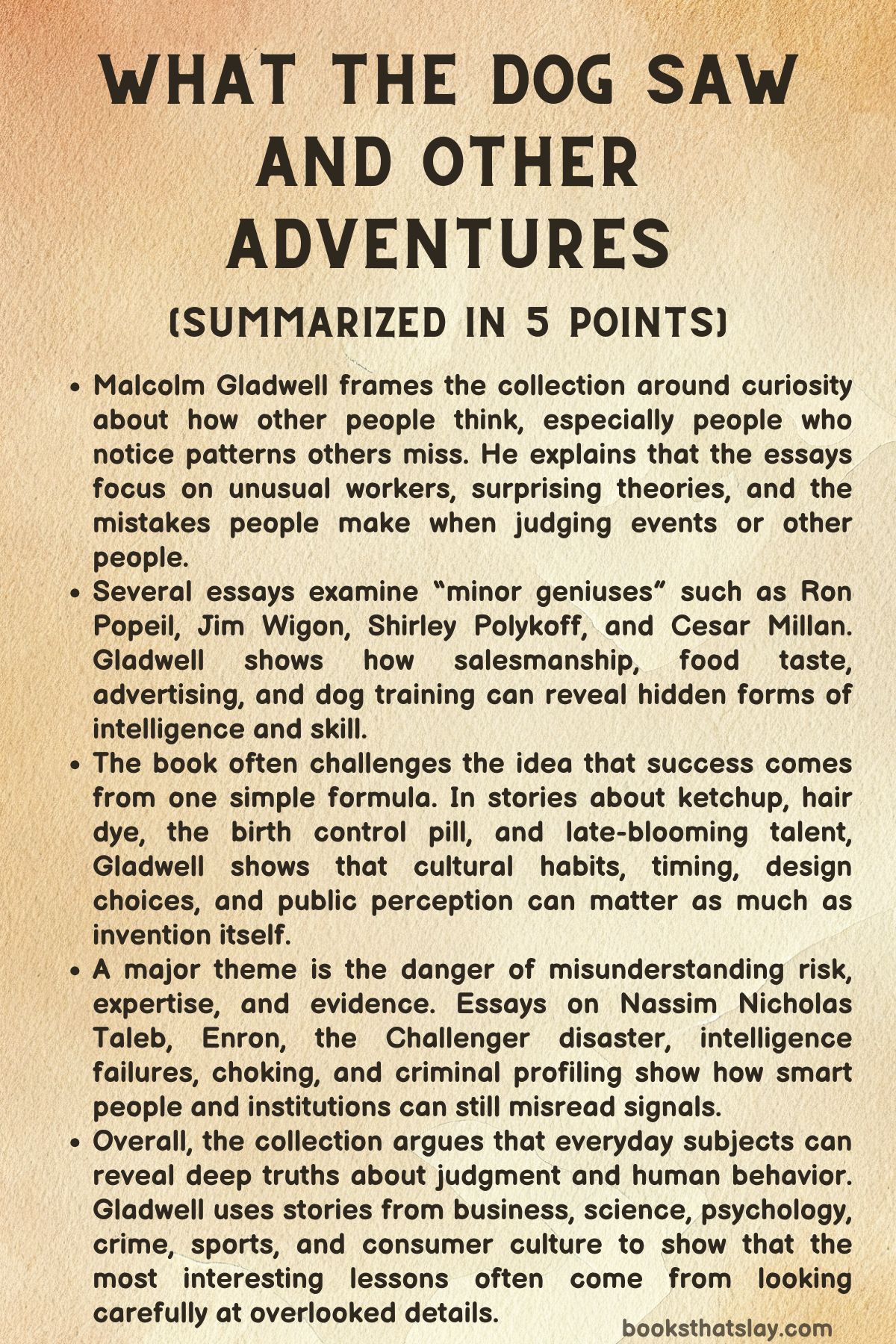
What the Dog Saw and Other Adventures by Malcolm Gladwell is a nonfiction collection of essays of the author’s New Yorker pieces – built around curiosity: how people think, judge, sell, decide, fail, and sometimes see what others miss.
Gladwell turns magazine essays into a broad study of human behavior, using inventors, advertisers, traders, doctors, dog trainers, executives, and investigators as his subjects. The book is less about one argument than a habit of looking closely. It asks why certain ideas succeed, why experts get things wrong, and why small details can change how we understand a person, product, business, or crisis.
What The Book Contains
What the Dog Saw and Other Adventures contains 19 essays, grouped into three sections.
I. Obsessives, Pioneers, and Other Varieties of Minor Genius
- The Pitchman
- The Ketchup Conundrum
- Blowing Up
- True Colors
- John Rock’s Error
- What the Dog Saw
II. Theories, Predictions, and Diagnoses
- Open Secrets
- Million-Dollar Murray
- The Picture Problem
- Something Borrowed
- Connecting the Dots
- The Art of Failure
- Blowup
III. Personality, Character, and Intelligence
- Late Bloomers
- Most Likely to Succeed
- Dangerous Minds
- The Talent Myth
- The New-Boy Network
- Troublemakers
Summaries of the 19 Essays
Part I: Obsessives, Pioneers, and Other Varieties of Minor Genius
1. The Pitchman
Gladwell profiles Ron Popeil, the infomercial genius behind gadgets like the Showtime Rotisserie. The essay argues that great selling is not just persuasion but performance: a pitchman must entertain, build trust, demonstrate mastery, and then make “the turn” from showman to salesman. Popeil’s success comes from understanding ordinary household frustrations and turning them into irresistible products.
2. The Ketchup Conundrum
This essay asks why mustard, spaghetti sauce, and many foods come in endless varieties, while ketchup remains dominated by one classic taste. Gladwell uses food scientist Howard Moskowitz’s work on consumer preferences to show that people do not always want one “perfect” version of a product. But Heinz ketchup is unusual because it hits many taste notes at once, making it hard for competitors to improve on it.
3. Blowing Up
Gladwell examines Nassim Nicholas Taleb’s investment strategy, which is built around rare, catastrophic events. Taleb bets against the assumption that markets are predictable and normally distributed. The essay’s larger point is that many systems look stable until an unlikely disaster exposes how fragile they really are.
4. True Colors
Through the history of hair-dye advertising, Gladwell explores changes in postwar American womanhood. Campaigns like Clairol’s “Does she or doesn’t she?” and L’Oréal’s “Because I’m worth it” reflected deeper shifts in identity, assimilation, feminism, ambition, and self-presentation. The essay shows how a seemingly trivial consumer product can reveal large cultural changes.
5. John Rock’s Error
John Rock, one of the developers of the birth-control pill, tried to make the Pill seem “natural” and acceptable to Catholic doctrine by preserving the monthly cycle. Gladwell argues that the familiar 28-day pill cycle was shaped partly by religious and cultural assumptions, not strict medical necessity. The essay questions how ideas of “naturalness” can influence science and medicine.
6. What the Dog Saw
The title essay follows dog trainer Cesar Millan and asks what makes his skill so effective. Gladwell suggests that Millan’s genius is physical and intuitive: he reads dogs through movement, posture, timing, and energy rather than through verbal commands. The essay is really about mastery—how experts see situations from perspectives that ordinary people miss.
Part II: Theories, Predictions, and Diagnoses
7. Open Secrets
Gladwell uses Enron to distinguish between a “puzzle,” where information is hidden, and a “mystery,” where information is available but difficult to interpret. Enron’s problems were not completely invisible; much of the relevant data existed in public disclosures. The failure was that analysts and observers could not make sense of the complexity.
8. Million-Dollar Murray
This essay tells the story of Murray Barr, a chronically homeless man whose repeated hospital visits, police encounters, and social-service needs cost the public enormous amounts of money. Gladwell argues that some social problems are cheaper to solve directly than to manage indefinitely. The essay makes the case for targeted help, especially housing-first approaches, for the small number of people who generate the highest social costs.
9. The Picture Problem
Gladwell compares mammography with aerial reconnaissance to explore the limits of interpreting images. We often assume pictures provide clear truth, but medical scans and military images are ambiguous and require human judgment. The essay argues that seeing is not the same as understanding.
10. Something Borrowed
Gladwell reflects on plagiarism after discovering that parts of his own reporting had been used in Bryony Lavery’s play Frozen. At first he feels wronged, but he gradually complicates his view, asking whether all borrowing is equally harmful. The essay explores the blurry boundary between theft, influence, transformation, and artistic reuse.
11. Connecting the Dots
This essay examines intelligence failures and the temptation, after disasters, to believe the warning signs were obvious. Gladwell argues that hindsight bias makes events look clearer than they were beforehand. Intelligence work is hard not because there are no clues, but because there are too many signals, many of which turn out to be meaningless.
12. The Art of Failure
Gladwell separates two kinds of failure under pressure: choking and panicking. Choking happens when someone overthinks a skill they normally perform automatically; panic happens when someone stops thinking clearly and falls back on instinct. The essay shows that failure is not one single thing, and understanding its type matters.
13. Blowup
Using the Challenger disaster and theories of complex-system accidents, Gladwell challenges the idea that every catastrophe can be traced to one guilty person. In tightly connected systems, accidents may arise from ordinary decisions interacting in unexpected ways. The essay argues that some disasters are “normal accidents” built into complex technologies.
Part III: Personality, Character, and Intelligence
14. Late Bloomers
Gladwell contrasts early geniuses like Picasso with late-developing artists like Cézanne. He argues that some creators are conceptual and peak early, while others are experimental and require years of trial and error. The essay defends patience, patronage, and persistence as essential conditions for certain kinds of genius.
15. Most Likely to Succeed
This essay compares hiring teachers to scouting NFL quarterbacks: both jobs are difficult to predict before someone actually performs in the real setting. Gladwell argues that résumés, credentials, and interviews often fail to reveal who will be excellent. The better approach is to observe performance closely, give feedback, and select based on real evidence.
16. Dangerous Minds
Gladwell investigates criminal profiling and questions its scientific reliability. Profilers appear persuasive because their descriptions often sound specific while remaining flexible enough to fit many cases. The essay warns that seductive explanations can feel like insight even when the evidence behind them is weak.
17. The Talent Myth
Gladwell criticizes the corporate obsession with hiring “stars,” especially through the example of Enron and McKinsey-style talent culture. He argues that organizations succeed less because of brilliant individuals than because of strong systems, teamwork, norms, and accountability. The essay’s central claim is that smart people are often overrated when institutions around them are poorly designed.
18. The New-Boy Network
This essay questions the value of traditional job interviews. Gladwell argues that unstructured interviews often reward charm, similarity, and snap impressions rather than true ability. The result is a modern version of the “old-boy network,” where hiring feels meritocratic but still reproduces bias.
19. Troublemakers
Gladwell uses pit-bull bans to examine the danger of broad generalizations. A category like “pit bull” may seem useful, but it can hide more predictive factors such as owner behavior, training, environment, and individual history. The essay connects dog-breed profiling to human profiling, showing how crude categories can produce unfair and ineffective policies.
Key Figures
Malcolm Gladwell
Malcolm Gladwell functions as the guiding intelligence behind What the Dog Saw and Other Adventures. He is not a character in the usual fictional sense, but he becomes an important presence because the book is shaped by his curiosity, his habits of observation, and his desire to understand how other people think.
The opening description of him watching his mathematician father at work reveals the emotional foundation of the entire collection: he is fascinated by the hidden processes inside another person’s mind. This makes him less interested in judging people from the outside and more interested in entering their mental worlds, whether they are salesmen, traders, advertisers, doctors, dog trainers, or experts who have misunderstood the very things they claim to know.
Gladwell’s role in the book is that of an interpreter. He looks at unusual people and ordinary problems with equal seriousness, treating a kitchen-gadget salesman, a ketchup maker, or a dog trainer as worthy of deep intellectual attention.
His character is defined by curiosity rather than certainty. He does not simply present success stories or failures; instead, he asks why certain people see possibilities that others miss, why institutions misread situations, and why human judgment can be so fragile. Through him, the book becomes a study of perception, expertise, talent, risk, and error.
Ron Popeil
Ron Popeil is one of the most vivid and memorable figures in the book because he represents both showmanship and invention. He is not merely a salesman who happens to sell kitchen gadgets; he is someone who understands how a product must come alive in front of an audience.
His genius lies in recognizing that a successful device must be simple, visible, dramatic, and emotionally satisfying. The Showtime Rotisserie succeeds not only because it cooks food, but because it can be demonstrated in a way that makes viewers immediately understand its value. Ron’s talent is therefore a blend of engineering instinct, performance skill, and psychological insight.
Ron’s personal background adds emotional depth to his public success. His painful childhood and distant relationship with his father suggest that his confidence as a performer may have been built over private insecurity and neglect. He inherits the Morris-Popeil family tradition of pitching, but he also transforms it.
Earlier members of the family sold gadgets on boardwalks and in stores; Ron brings that world into television and infomercials. His rise shows how a person can turn family inheritance, personal hardship, and obsessive attention to detail into a distinctive form of mastery. By the time he appears on QVC and sells huge numbers of rotisseries in a single hour, he is not just selling a machine; he is completing the long evolution of the American pitchman.
Nathan Morris
Nathan Morris is important because he represents the older tradition from which Ron Popeil emerges. He belongs to the world of boardwalks, stores, live demonstrations, and face-to-face persuasion.
His character embodies the early American culture of gadget selling, where the pitchman had to attract a crowd, hold attention, create desire, and close the sale in real time. In that environment, selling was not a passive commercial act but a performance that demanded timing, confidence, humor, and control.
Nathan’s significance lies in the way he helps establish pitching as a craft. He is part of a family and professional tradition in which slicers, graters, choppers, and other devices become tools of theater. Through figures like him, the book shows that salesmanship is not simply manipulation.
At its highest level, it requires an understanding of what people want to see, what they fear, what they find useful, and what makes them believe. Nathan helps form the background against which Ron’s later success becomes meaningful.
S. J. Popeil
S. J. Popeil stands as another foundational figure in the family world of invention and selling. As Ron Popeil’s father, he is important not only because of his professional influence but also because of the emotional distance that shapes Ron’s life.
He is associated with the creation and promotion of household devices, and his presence connects Ron to a lineage of practical invention.
Yet he also appears as a remote and difficult parental figure, which gives Ron’s achievement a more complicated emotional meaning.
S. J. Popeil’s character shows how talent and coldness can exist in the same person. He contributes to the world that makes Ron possible, but he does not appear to provide the warmth or support a child might need.
This tension makes Ron’s success feel partly like inheritance and partly like self-rescue. S. J. is therefore not just a figure from the history of kitchen gadgets; he is also part of the personal wound that Ron carries into adulthood.
Arnold Morris
Arnold Morris belongs to the same tradition of American pitchmen and helps represent the collective energy of the Morris-Popeil clan. His character is less individually developed than Ron’s, but he is important as part of the culture that turns demonstration into art.
People like Arnold make the selling of everyday devices seem dramatic and skillful. They show that the pitchman’s work depends on reading an audience, creating rhythm, and making a simple object appear necessary.
Arnold’s role in the book is to widen the story beyond one man. Ron Popeil may become the central figure, but Arnold helps show that Ron’s genius did not come from nowhere.
It emerged from a family system where invention, persuasion, and performance were constantly practiced. Arnold represents the older commercial world that Ron later adapts to television, proving that modern infomercials have roots in a much older form of public selling.
Jim Wigon
Jim Wigon is a determined but somewhat tragic entrepreneurial figure. He believes he can do for ketchup what Grey Poupon did for mustard, turning an ordinary condiment into a gourmet product with variety, personality, and sophistication. His ambition is admirable because he sees a market where others might see only a fixed habit.
By creating World’s Best Ketchup in several flavors, he challenges the assumption that ketchup must always be simple, mass-produced, and dominated by one brand.
Yet Wigon’s struggle reveals the limits of innovation when a product is deeply tied to collective taste and memory. His ketchup may be bold and distinctive, but it cannot easily replace the balance and familiarity of Heinz.
This makes him a figure of frustrated originality. He has imagination and courage, but he is working against something more powerful than marketing: the deeply settled sensory expectations of consumers. His character shows that being different is not always enough; a product must also satisfy the hidden structure of what people already love.
Howard Moskowitz
Howard Moskowitz is one of the great intellectual problem-solvers in the book. His importance comes from his discovery that people do not necessarily want one perfect version of a food product; they want different versions that match different preferences.
This insight changes the way companies think about taste. Instead of searching for a single ideal spaghetti sauce, he shows that variety itself can be the answer. His work helps lead to products such as extra-chunky Prego and reshapes consumer research.
Moskowitz’s character is defined by his willingness to question the idea of universality. He understands that human preference is diverse, layered, and often difficult for people to explain directly.
His intelligence lies in listening to patterns rather than slogans. In the ketchup story, however, his ideas also help reveal why Heinz is unusual. Ketchup does not behave like spaghetti sauce because Heinz already occupies a remarkably complete sensory position.
Moskowitz therefore becomes both a symbol of innovation and a reminder that some products succeed because they satisfy many cravings at once.
Nassim Nicholas Taleb
Nassim Nicholas Taleb is one of the most intellectually intense figures in the book. He is defined by his obsession with rare, devastating events and his refusal to trust patterns of ordinary success.
As an options trader, he builds his strategy around the possibility that markets are more fragile and unpredictable than they appear.
His firm, Empirica, accepts small repeated losses in exchange for the chance of enormous gains when disaster strikes. This makes him seem cautious and extreme at the same time: cautious because he fears hidden risk, extreme because he organizes his life around events most people ignore.
Taleb’s character is shaped by skepticism. He admires brilliance, but he distrusts success that may depend on luck. His view of the world is grim, disciplined, and almost philosophical.
He believes that unexpected events shape history and markets more than ordinary models admit. In contrast to traders who seek steady profit and confidence, Taleb lives with anxiety and suspicion.
His strength is that he sees danger where others see stability; his burden is that this vision makes ordinary success seem almost meaningless unless it has survived catastrophe.
Victor Niederhoffer
Victor Niederhoffer is presented as a brilliant but vulnerable figure because his success depends on a strategy that appears safe until disaster arrives. He is admired by Taleb, but he also represents everything Taleb fears about hidden risk.
Niederhoffer’s method of selling options allows him to earn steady profits, creating the appearance of mastery and control. Yet this stability is deceptive because it exposes him to extreme losses when the market moves violently against him.
Niederhoffer’s character carries the drama of overconfidence and fragility. He is not foolish; in fact, his brilliance makes his collapse more revealing. His downfall during the 1997 market crash shows how intelligence can coexist with dangerous exposure.
He becomes a warning about systems that reward people for taking risks that remain invisible until it is too late. In the book, he serves as Taleb’s opposite: where Taleb prepares for disaster, Niederhoffer is destroyed by it.
Shirley Polykoff
Shirley Polykoff is a fascinating figure because her personal insecurity becomes the foundation for one of the most influential advertising ideas in the book.
Her decision to dye her hair occurs at a time when hair coloring is socially suspicious, especially for women who want to appear respectable. This private tension gives her insight into the emotional world of the consumer. She understands that women do not simply want a product; they want permission to change themselves without being judged.
Her famous advertising question, “Does she or doesn’t she?” succeeds because it captures the delicate balance between transformation and secrecy. Polykoff’s character represents the connection between personal experience and cultural change.
She turns embarrassment into strategy and helps make hair dye acceptable by framing it as subtle, feminine, and socially safe. Through her, the book shows how advertising can reshape not only consumer habits but also ideas about identity, gender, and self-presentation.
John Rock
John Rock is one of the most morally and intellectually complex figures in the book. As a Catholic doctor involved in the creation of the birth control pill, he stands at the intersection of medicine, religion, science, and social change. His effort to design the pill around a monthly cycle reflects his desire to make it seem natural and acceptable. This choice reveals both his scientific ambition and his need to reconcile innovation with existing moral and religious frameworks.
Rock’s error lies in the way his attempt at acceptability shapes the medical design of the pill. He is not portrayed as careless or malicious; rather, he is a figure whose assumptions have lasting consequences.
His character shows how even intelligent and well-intentioned people can be limited by the cultural pressures around them. He wants to bring a revolutionary medical technology into the world, but he also wants it to fit within ideas of nature, respectability, and religious approval.
That tension makes him a deeply revealing figure.
Cesar Millan
Cesar Millan is portrayed as a master of perception. His gift is not simply that he trains dogs, but that he sees what others fail to see in movement, posture, rhythm, and energy.
Where ordinary observers may focus on a dog’s obvious behavior, Millan reads the body as a language. His authority comes from his ability to interpret signals quickly and respond with calm control. This makes him one of the clearest examples of the book’s interest in expertise that operates beneath ordinary explanation.
Millan’s character is compelling because his skill appears almost mysterious, yet it is grounded in observation. He understands that troubled dogs are not only reacting to commands; they are responding to the emotional and physical signals around them.
His work shows that communication is often nonverbal and that mastery can involve seeing tiny details that others overlook. In the story, he becomes a figure of intuitive intelligence, someone whose knowledge is expressed through action rather than theory.
The Enron Figures
The people connected to Enron function as a collective character representing corporate opacity, ambition, and misjudgment. Rather than appearing as simple villains, they are part of a larger problem involving information, interpretation, and institutional blindness.
The Enron story shows that failure does not always happen because information is hidden; sometimes it happens because the available information is too complex, too scattered, or too poorly understood.
The figures involved become examples of how intelligence and sophistication can produce confusion instead of clarity.
As characters in the book, the Enron figures reveal the danger of mistaking complexity for success. They occupy a world where financial language, corporate confidence, and analytical difficulty create an illusion of control. Their importance lies in showing that judgment can fail even in environments filled with data.
The Enron material expands the book’s larger concern with misreading: people may look directly at a situation and still fail to understand what it means.
The Homeless Individuals
The homeless individuals discussed in the book represent the human cost of systems that misunderstand the problems they are trying to solve. They are not treated merely as social statistics; they become figures through whom the reader can see how homelessness is often misread as a single broad condition when it may involve very different levels of need.
Some individuals require far more public resources than others, and the usual assumptions about charity, punishment, or temporary support may fail to address the real issue.
Their role in the book is to challenge conventional thinking. They show that a problem may appear morally or politically simple from a distance but become more complicated when examined closely.
The analysis of homelessness asks readers to look at individuals rather than categories. In doing so, the book suggests that compassion must be joined with accuracy. To help people effectively, society must first understand who they are and what kind of help their situations actually require.
The Intelligence Analysts
The intelligence analysts in the book stand for the difficulty of interpreting uncertain information.
Their work involves trying to identify threats, patterns, and meanings before events become clear. They are surrounded by clues, but those clues do not automatically produce understanding.
Their character as a group is defined by pressure: they must make judgments under uncertainty, and their failures can have enormous consequences.
These analysts help develop one of the book’s central ideas: information is not the same as insight. A person or institution can possess many facts and still fail to understand what is happening.
The intelligence figures are therefore not simply examples of incompetence. They reveal the limits of human interpretation when signals are ambiguous, incomplete, or overwhelming. Their role makes the book’s concern with judgment feel urgent and consequential.
The Choking Performers
The performers and athletes associated with choking represent the fragile relationship between skill and pressure. They are people who know how to perform well, yet fail when the moment becomes too psychologically intense.
Their importance comes from the difference between ability and execution. Choking is not the absence of talent; it is the disruption of talent by self-consciousness, fear, or overthinking.
As figures in the book, they show that expertise can break down when the mind interferes with automatic action.
A person may have practiced for years and still lose access to that training under pressure. These characters deepen the book’s interest in hidden mental processes.
Their failures are not merely dramatic collapses; they reveal how performance depends on trust, rhythm, and the ability to act without becoming trapped inside one’s own awareness.
The Plagiarism Figures
The figures involved in the plagiarism discussion represent the complicated relationship between influence, memory, ownership, and creativity. They show that borrowing is not always simple theft and that originality can be harder to define than people assume.
Their role in the book is to complicate moral judgment. Instead of treating plagiarism as a single clear category, the discussion asks how ideas move through culture and how people may absorb, reshape, or repeat material without fully understanding where it came from.
These characters matter because they reveal the uncertainty behind creative work. Writers and artists are influenced by what they read, hear, and experience, and those influences may return in disguised forms. The book does not excuse wrongdoing, but it does ask readers to think carefully about intention, memory, and resemblance.
Through these figures, plagiarism becomes not only a legal or ethical issue but also a psychological one.
The Challenger Disaster Figures
The people connected to the Challenger disaster represent institutional failure and the danger of normalizing risk.
They are part of a system in which warning signs exist, but those signs are interpreted within a culture that has become used to danger.
Their importance lies in showing how catastrophic events may not result from one dramatic mistake. Instead, disaster can grow from repeated small accommodations, bureaucratic pressure, and a gradual acceptance of flawed conditions.
As characters in the book, these engineers, officials, and decision-makers reveal how organizations can become blind to the meaning of their own evidence. They do not necessarily lack intelligence or information. Their failure comes from how they interpret risk and how institutional habits shape what seems acceptable.
The Challenger material turns a technological disaster into a study of human judgment inside complex systems.
The Late Bloomers
The late bloomers in the book represent talent that develops slowly rather than appearing in sudden youthful brilliance.
They challenge the cultural preference for prodigies and early achievement. Their character is defined by persistence, uncertainty, and gradual refinement. Unlike people whose genius is visible early, late bloomers may need time, support, experimentation, and repeated failure before their abilities fully emerge.
These figures are important because they widen the meaning of talent. They suggest that greatness is not always obvious at the beginning and that judging people too early can lead to serious mistakes.
The book uses them to question systems that reward immediate promise while overlooking slow development. Their presence gives the collection a more humane view of ability, one that values endurance as much as precocity.
The Hiring Candidates
The hiring candidates discussed in the book represent the uncertainty of judging people before they have been tested in real conditions. They are important because they expose the weakness of interviews, credentials, and first impressions.
Employers often believe they can identify talent through brief encounters, but these candidates show how unreliable that confidence can be. A person may appear impressive in an interview and fail in the job, while another may seem ordinary and later prove highly capable.
Their role is to demonstrate that human potential is difficult to measure from the outside.
The hiring process becomes a setting where people mistake performance in an artificial situation for evidence of real ability. These characters support the book’s broader concern with misjudgment. They remind readers that people are often more complex than the systems used to evaluate them.
The Criminal Profilers
The criminal profilers in the book represent the seductive appeal of expert certainty. Their work seems powerful because it promises to read hidden truths from patterns of behavior.
They appear to offer a way to understand criminals psychologically, turning scattered clues into a coherent portrait. Yet the book treats this confidence with skepticism, asking whether profiling is as reliable as it appears.
As characters, the profilers reveal how expertise can become theatrical. Their authority depends not only on accuracy but also on the persuasive force of their interpretations.
They show how people can be impressed by explanations that sound deep, even when the evidence behind them is uncertain. In this way, they become part of the book’s larger examination of judgment, performance, and the danger of believing too quickly in expert insight.
The Corporate Talent Believers
The corporate leaders and thinkers who embrace the talent myth represent a mistaken faith in individual brilliance.
They believe that organizations succeed by finding and rewarding exceptionally gifted people, often at the expense of structure, humility, and teamwork. Their character as a group is defined by confidence in elite talent and by the assumption that smart people will naturally produce good outcomes.
Their importance in the book lies in the way they expose the limits of this belief. When companies worship talent too much, they may ignore character, discipline, cooperation, and accountability.
These figures show how institutions can be damaged by the very ideas they think will make them strong. The talent myth becomes a warning against confusing intelligence with wisdom and confidence with competence.
The Job Interviewers
The job interviewers in the book are significant because they represent the ordinary human tendency to overtrust first impressions.
They believe they are evaluating candidates carefully, but the interview setting often rewards charm, confidence, and quick verbal performance rather than actual job ability.
Their character is defined by misplaced certainty. They think they are seeing the person clearly, when they may only be seeing a performance designed for the interview room.
These interviewers matter because they show that misjudgment is not limited to dramatic disasters or expert failures. It happens in everyday professional life.
Their role in the book is to reveal how easily people mistake a brief social encounter for deep knowledge of another person. Through them, the book questions one of the most common rituals of modern work and suggests that institutions often rely on tools that feel useful but may be deeply flawed.
The Pit Bulls
The pit bulls in the book function almost like characters because they are at the center of a debate about fear, classification, and responsibility.
They are not treated simply as dangerous animals; rather, they become a way to examine how societies make judgments about groups based on visible traits. The discussion asks whether danger belongs to a breed as a whole, to individual animals, to owners, or to specific circumstances.
This makes the pit bulls important not only as animals but as symbols of how people generalize.
Their role is to challenge easy categories.
The book uses them to explore the moral and practical risks of judging individuals by group identity. Pit bulls become part of a larger argument about prediction and fairness.
Like many other figures in What the Dog Saw and Other Adventures, they reveal how difficult it is to distinguish real risk from fear, pattern from prejudice, and responsible judgment from convenient labeling.
Themes
Curiosity About Hidden Ways of Thinking
Malcolm Gladwell presents curiosity as an active attempt to understand how other people make sense of the world.
In What the Dog Saw and Other Adventures, the opening idea of wanting to enter another person’s mind becomes the foundation for many of the essays. The focus is not only on famous figures or dramatic events, but on the mental habits of pitchmen, traders, advertisers, researchers, doctors, and dog trainers. These people often notice details that others ignore, and their success depends on seeing familiar situations from an unusual angle. Ron Popeil understands that a product must almost sell itself through demonstration.
Cesar Millan reads tiny changes in posture and movement. Howard Moskowitz changes food marketing by questioning the idea that everyone wants the same taste. Through such examples, curiosity becomes a method of discovery. The collection suggests that ordinary surfaces often hide complex patterns, and real understanding begins when someone asks how another mind is working.
The Limits of Expertise and Judgment
The essays repeatedly show that intelligence, training, and confidence do not always lead to accurate judgment. Experts can misread situations because they trust the wrong signals, depend too heavily on familiar systems, or fail to see hidden risks.
The stories about markets, corporate failure, criminal profiling, hiring, and disasters all challenge the belief that experts naturally understand what is happening better than everyone else. Nassim Nicholas Taleb’s view of rare events exposes the danger of mistaking past success for genuine skill, especially when luck and risk are difficult to separate. Similar problems appear when institutions judge employees, criminals, companies, or crises using methods that seem scientific but may rest on weak assumptions.
The theme is not that expertise is useless, but that it must remain humble. Gladwell shows that judgment becomes dangerous when people stop questioning their tools, their evidence, or their own confidence. The strongest thinkers are often those who know how easily they can be wrong.
The Power of Presentation and Perception
Many essays examine how success depends not only on what something is, but on how it is presented and perceived. Ron Popeil’s kitchen gadgets succeed because they are designed to be demonstrated clearly, turning usefulness into a form of public performance.
Shirley Polykoff’s advertising for hair dye works because it understands embarrassment, aspiration, and social change, allowing a private choice to appear stylish and acceptable. Heinz ketchup dominates not simply because it is familiar, but because its taste creates a complete sensory experience that people recognize and trust. These examples show that people rarely respond to products, ideas, or identities in a purely logical way. They respond to stories, images, emotions, and cultural meanings. Presentation shapes desire by making something feel natural, exciting, safe, or necessary. Gladwell’s essays reveal that persuasion often works best when it seems effortless, when the audience feels that the choice was obvious all along.
The Hidden Role of Risk and Uncertainty
Risk in the collection often appears quietly before it becomes visible. Markets seem stable until a rare event exposes the weakness of a strategy.
A company appears innovative until its confusing structure hides failure. A disaster seems sudden, though small warning signs may have existed earlier. Gladwell is interested in situations where people believe they understand cause and effect, only to discover that the real danger was harder to measure. Taleb’s investment philosophy makes this theme especially clear: repeated small losses may be wiser than steady gains that can be destroyed by one extreme event.
The same idea applies beyond finance. Institutions, experts, and ordinary observers often prefer neat explanations because uncertainty is uncomfortable. Yet the essays suggest that uncertainty cannot be removed simply by using models, rules, or professional confidence.
Better judgment requires accepting what cannot be predicted, noticing weak signals, and respecting the possibility that the most important event may be the one nobody expected.