Our Perfect Storm Summary, Characters and Themes
Our Perfect Storm by Carley Fortune is a contemporary romance about friendship, desire, family wounds, and the frightening honesty required to choose the life one truly wants. The story follows Frankie Gardiner and George Saint James, childhood best friends whose bond has shaped nearly every part of their lives.
When Frankie is abandoned by her fiancé just before her wedding, George steps back into her life with a plan to help her recover. A honeymoon trip meant to heal a broken engagement becomes the place where old promises, buried attraction, and long-held fears finally rise to the surface.
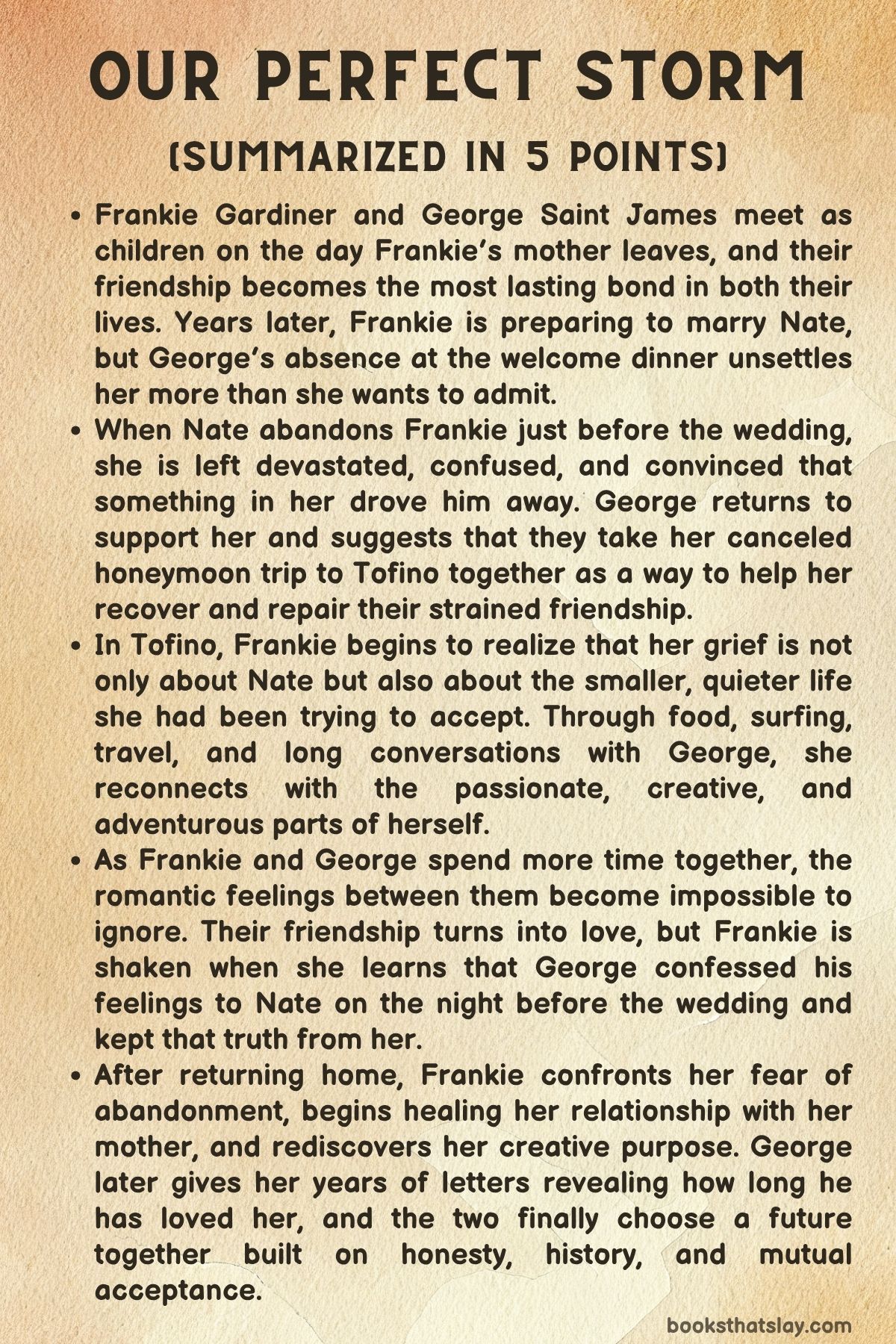
Summary
Francesca “Frankie” Gardiner first meets George Saint James when she is eight years old, on the day her mother leaves the family. Frankie is confused, hurt, and lonely, wearing a raincoat over her nightgown and wandering outside while rain falls around her.
While chasing a rabbit near the hedge that divides her family’s property from the grand neighboring house, she discovers George watching her from the other side. He lives there with his grandmother, Mimi, and although Frankie has imagined the house as a frightening place, George quickly becomes the adventure she has been craving.
Their meeting begins a friendship that changes the course of both their lives.
Years later, Frankie is thirty and preparing to marry Nate Bacon at Darlington Manor. The wedding is expensive, polished, and carefully arranged, but Frankie feels trapped by anxiety.
One empty chair unsettles her more than anything else: George has not arrived. She leaves him a desperate voicemail, needing him there as her best friend and anchor.
When he finally enters the room, she is flooded with relief. Their reunion makes her feel able to breathe again, even though there is tension beneath their easy familiarity.
George behaves politely toward Nate, but Frankie knows him well enough to read his quiet dislike.
That evening, the old magic of Frankie and George’s bond returns. They dance together with the ease of people who have known each other since childhood, and Frankie remembers how Mimi once taught them to waltz.
Around George, she feels bright, alive, and fully seen. Yet George asks whether she is truly happy, and the question carries more weight than she wants to admit.
She insists that she is. By morning, everything has changed.
Nate leaves a note saying he loves her but cannot marry her. Frankie collapses under the shock, unable to understand what she has done wrong.
After the canceled wedding, Frankie moves through grief in fragments. She stays on Aurora and Betty’s sofa, calls Nate repeatedly, and blames herself for being too emotional, too difficult, and too much.
George helps collect her belongings but has to leave for work, which worsens Frankie’s panic. When Nate finally meets her, he apologizes but gives no real explanation.
He suggests that she take the already planned honeymoon to Tofino, but Frankie refuses at first. Eventually, she returns to her childhood home, broken, embarrassed, and unsure where to go next.
Back in the Kawartha Lakes, Frankie begins reconnecting with the places that shaped her. She visits Mimi at the Big House, swims in the pool where she and George spent so many childhood summers, and remembers the secret mailbox in the hedge where they once exchanged letters.
She also recalls the childhood “wedding” she and George held under the apple tree when they were ten, promising to be best friends forever. Their bond was forged in loyalty, jealousy, anger, forgiveness, and the need to belong to someone when the rest of the world felt unstable.
George returns and surprises Frankie at Mimi’s pool. Their reunion is tender but strained.
Frankie accuses him of leaving her when she needed him, while George apologizes for the distance between them. He proposes that they go to Tofino together, using the honeymoon as a chance for Frankie to heal and for them to repair their friendship.
Frankie agrees, sensing that the trip may offer her the adventure and closeness she has been missing.
In Tofino, George reveals that he has planned a week of recovery for Frankie, with each day centered on a different emotional task. At first, Frankie is disappointed that the trip seems organized around Nate rather than around her friendship with George.
Still, she goes along with it because she wants her best friend back. At the resort, everyone assumes they are newlyweds, and George plays along.
The luxurious villa, romantic setting, and constant nearness make it harder for both of them to ignore the charged energy between them.
As the days pass, Frankie begins to understand that Nate was not the true center of her heartbreak. He represented safety, calm, and the smaller life she thought she should want after burning out in her work as a chef.
Around Nate, she had made herself quieter and less intense. Around George, she eats freely, laughs easily, argues honestly, and remembers her hunger for food, travel, creativity, and risk.
Their meals, surfing lessons, beach walks, and private conversations awaken parts of her that she had tried to bury.
George, too, begins revealing more of himself. He admits that he started therapy after covering devastating wildfires and that he wants a stable, lasting love rather than the casual relationships Frankie assumed he preferred.
His work as an environmental journalist has taken him across the world, but his emotional life has always circled Frankie. During moments of closeness, Frankie realizes that losing George would hurt far more than losing Nate.
Their friendship has become the measure by which every other relationship falls short.
Memories from the past clarify the present. As teenagers, Frankie once tried to make George her first sexual experience, but he refused because he knew it would damage them.
At eighteen, they got matching tattoos of each other’s names. When George left Toronto for work, Frankie felt as if she had been abandoned again.
During the wildfires, George called her believing he might die and told her he loved her, but Frankie did not understand the full meaning behind his words.
In Tofino, the attraction between them becomes impossible to deny. They kiss in the rain, try to dismiss it as a mistake, and then slowly admit that what exists between them is not passing confusion.
Frankie asks George to treat one night as a first date, and he agrees. Their relationship shifts from friendship into romance, and when they finally sleep together, Frankie feels that their entire history is being remade rather than erased.
George promises he will never leave her, and for a brief time, their future seems certain.
Then the truth breaks open. On the last day, Frankie receives a gift from Nate and calls to thank him.
When Nate hears George’s voice, he tells her to ask George for clarity. George confesses that on the night before the wedding, while drunk, he confronted Nate and spoke about Frankie in a way that revealed how deeply he loved her.
Nate asked if George was in love with her, and George told the truth. Although George insists he never meant to make Nate leave, Frankie is devastated.
She realizes that George knew more than he admitted while she spent months blaming herself.
Frankie ends things with George, not because she does not love him, but because the secrecy frightens her. She returns home and begins rebuilding herself.
She talks honestly with Darwin, Aurora, Mimi, and her mother. Rebecca finally explains why she left when Frankie was young: she had been suffocating under the loss of her marine-biology career and needed to pursue work with whales, though leaving her children wounded them deeply.
Frankie also learns about the death of Francesca, the whale she was named after, and grieves both the animal and the old ache connected to her mother.
During this time, Frankie starts therapy and rediscovers her creative drive. She imagines a cookbook inspired by Canadian regions and reconnects with food as a source of identity rather than performance.
She asks George to tell her the story of how he fell in love with his best friend. He responds through letters, leaving pages in their old mailbox.
Frankie reads his history of loving her from childhood onward and slowly sees their shared life from his side.
When George returns, he brings the mahogany chest that holds years of letters, keepsakes, and unsent confessions. In the Big House library, they face what happened without pretending either of them is blameless.
Frankie admits that she was too stubborn and frightened to see what George could mean to her. George admits that his love for her has been part of him for years.
They choose each other, not as children clinging to an old promise, but as adults willing to risk honesty.
One year later, Frankie and George are together in the Bay of Fundy, watching right whales and building a shared life of travel, work, food, writing, and family. Frankie has found new purpose in her career, and George has made a life with the person he has always loved.
Their love does not erase abandonment, fear, or past mistakes, but it gives them a home in each other.
Characters
Francesca “Frankie” Gardiner
Frankie is the emotional center of Our Perfect Storm, and her journey is built around learning that being intense does not make her unlovable. As a child, she experiences her mother’s departure as proof that people can leave when she is too hard to handle, and that wound follows her into adulthood.
Her failed wedding to Nate exposes how much she has been trying to make herself smaller. With Nate, she wants stability so badly that she suppresses her temper, appetite, style, ambition, and sense of adventure.
Her return home and her trip to Tofino force her to confront the difference between comfort and true belonging. Frankie is passionate, reactive, loyal, funny, and often stubborn, but the book refuses to treat those traits as flaws that must be erased.
Instead, her growth comes from understanding why she has feared her own emotional force. Her love for cooking mirrors her inner life: when she is trying to please others, her food becomes mechanical, but when she reconnects with desire and curiosity, it becomes expressive again.
Her relationship with George teaches her that love should not require self-erasure, while her reconciliation with Rebecca helps her see abandonment in a more complicated light. By the end, Frankie becomes someone who can choose love without surrendering her selfhood.
George Saint James
George is one of the most tender and conflicted figures in Our Perfect Storm, shaped by early loss, neglect, and a lifelong attachment to Frankie. His mother’s death and his father’s failures leave him with a deep fear of needing too much from anyone, and Frankie becomes the person who gives him steadiness when his childhood feels unsafe.
His love for her begins long before he is able to name it openly, and his silence becomes both protective and damaging. George’s greatest strength is his devotion: he remembers what Frankie likes, anticipates her needs, supports her ambitions, and sees the version of her that others miss.
Yet his greatest weakness is his belief that waiting, hiding, and managing pain privately will protect the people he loves. His confrontation with Nate reveals the pressure of years of unspoken longing, but it also shows how secrecy can harm even when it comes from fear rather than malice.
George’s career as an environmental journalist reflects his seriousness and moral purpose, while his trauma after the wildfires reveals his vulnerability. He wants to be brave, useful, and worthy, but he must learn that love requires direct truth, not only loyalty from a distance.
His letters finally allow him to speak with the honesty he had avoided for years.
Rebecca Gardiner
Rebecca is one of the most important emotional forces in Our Perfect Storm, even though much of her influence comes from an absence that occurred when Frankie was young. To Frankie, Rebecca’s departure becomes the original wound, the event that teaches her to fear being left.
As a mother, Rebecca is loving but flawed, and the book treats her choice with complexity rather than simple judgment. She left because she felt she had lost a vital part of herself after giving up marine biology and whale conservation, but her pursuit of identity came at a painful cost to her children.
Her return does not automatically repair the damage, especially for Frankie, who associates whales with abandonment for years. Rebecca’s later honesty gives Frankie a new way to understand her: not as a careless mother, but as a woman who was trying to survive a life that had become too narrow.
Her connection to whales also deepens the story’s ideas about bonds, migration, loss, and return. Rebecca’s grief over the whale Francesca shows that love for work, nature, and family can exist together, even when people make painful mistakes while trying to balance them.
Her renewed closeness with Frankie becomes a quiet but powerful act of repair.
George’s Grandmother, Mimi Saint James
Mimi is glamorous, sharp, theatrical, and emotionally perceptive. As the guardian of the Big House, she gives Frankie and George a place where imagination and refuge can exist side by side.
Her past as a ballerina gives her a sense of drama and discipline, and she often speaks with blunt wisdom rather than soft comfort. Mimi sees more than she says, especially regarding George’s feelings for Frankie and Frankie’s uncertain future with Nate.
Her disapproval of Nate is not based on cruelty but on recognition; she understands that Frankie needs a life with more fire, motion, and truth. Mimi also represents the endurance of reinvention.
She once had a brilliant dance career, then lost one life and built another. That history allows her to counsel Frankie through disappointment without pretending that loss is easy.
Her love for George is protective, and her affection for Frankie is almost familial. She functions as a keeper of memory, guarding the house, the old routines, the secret spaces, and the emotional history that Frankie and George eventually have to face.
Nate Bacon
Nate is not a villain, even though his abandonment of Frankie just before the wedding causes enormous pain. He represents the kind of safe life Frankie thinks she should want after professional burnout and emotional exhaustion.
As a mathematics professor, older than Frankie and seemingly stable, he offers order and calm. Yet his relationship with Frankie is built on an incomplete version of her.
He does not fully know her wildness, her anger, her history with George, her hunger for adventure, or the parts of herself she has hidden to make the relationship work. His decision to leave is cruel in timing but not entirely wrong in insight.
After George’s drunken confession, Nate understands that he is about to marry someone whose deepest bond belongs elsewhere. His inability to explain himself clearly leaves Frankie trapped in self-blame, and that is his greatest failure.
Still, his later gift of a chef’s knife and journal shows that he did see some part of her creative self. Nate’s role is to expose the danger of choosing a life that looks secure but requires too much self-denial.
Aurora
Aurora is Frankie’s loyal friend and one of the clearest voices of emotional common sense in the book. She offers Frankie shelter after the canceled wedding, manages practical communication with Nate, encourages her to take the Tofino trip, and repeatedly pushes her toward truths Frankie does not want to face.
Aurora’s strength lies in how well she balances sympathy with honesty. She does not treat Frankie as fragile, but she also does not minimize her pain.
Her comments about Frankie and George being in love may sound teasing at first, yet they reveal how obvious their bond is to outsiders. Aurora also encourages therapy, which becomes an important step in Frankie’s healing.
Her relationship with Betty gives her own life a grounded quality, making her home a temporary safe place for Frankie. She functions as the friend who can stand outside the central romance and name what the people inside it are too frightened to admit.
Darwin Gardiner
Darwin, Frankie’s older brother, is steady, practical, and protective. He works in the family cabinetry business and remains close to the rhythms of home, which makes him part of the stability Frankie returns to after the wedding disaster.
Darwin’s role grows more important when Frankie learns that he and Moby knew about George’s feelings. His defense of George does not erase Frankie’s hurt, but it gives her a broader understanding of the situation.
Darwin sees that Frankie and George belong together, yet he also understands that no one could force Frankie to realize it before she was ready. His conversation with Frankie after Tofino helps her separate betrayal from intention.
He validates her pain while reminding her that George has been quietly struggling for years. Darwin also reflects the way Rebecca’s departure affected all the Gardiner children differently.
He is less verbally dramatic than Frankie, but his loyalty is clear in the way he shows up, listens, and protects the family without demanding attention for it.
Moby Gardiner
Moby brings humor, sharp observation, and sibling honesty to the book. As Frankie’s brother, he is affectionate but blunt, teasing her about George’s name tattoo and even suggesting that she call off the wedding when he sees how unwell she looks.
His jokes often reveal truths that others are avoiding. Moby works in cybersecurity, which gives him a life outside the family business, but he remains emotionally tied to the Gardiners and to George, who has long been treated almost like another sibling.
Like Darwin, Moby has known about George’s feelings for years, which complicates Frankie’s sense of trust after the truth comes out. His presence helps show that Frankie and George’s bond has never been invisible to the people around them.
Moby may not carry the emotional weight of the central characters, but he adds warmth, friction, and realism to the family dynamic.
Frankie’s Father
Frankie’s father is a quiet but significant figure, defined by steadiness, tenderness, and a deep knowledge of his daughter’s pain. When Nate leaves, he is one of the people who physically brings Frankie home, echoing the role he played during Rebecca’s absence.
His remark that he has seen Frankie devastated before, on the birthday Rebecca missed, shows that he has carried witness to his children’s wounds for years. He is connected to the family cabinetry business, suggesting a grounded, hands-on life rooted in place and continuity.
His love is not loud, but it is reliable. Later, when Frankie is trying to decide what to do about George, he offers support without pressure.
That matters because much of Frankie’s fear comes from feeling pushed by other people’s choices and departures. Her father gives her the opposite: room to decide, along with the assurance that she will not be abandoned for choosing slowly.
Birdie
Birdie, Darwin and Anh’s young daughter, represents the next generation of the Gardiner family and adds softness to the story’s family scenes. Her presence shows Frankie’s connection to home not only as a place of old wounds but also as a living, changing family structure.
George’s warmth with Birdie also reveals his gentleness and ease within the Gardiner world. He is not a visitor in Frankie’s family; he belongs there naturally.
Birdie’s innocence contrasts with the adult pain surrounding the canceled wedding, parental regrets, and romantic uncertainty. She reminds readers that family is not only about the past but also about what people continue to build.
Anh
Anh, Darwin’s wife, appears in a smaller role, but she helps create the sense of a full family life around Frankie. Her presence with Darwin and Birdie shows a stable domestic unit within the Gardiner family.
While she is not central to the romantic conflict, she contributes to the atmosphere of support that surrounds Frankie when she returns home. Anh’s role also helps show that Frankie is not isolated after the wedding collapse, even when she feels emotionally alone.
The wider family remains intact, offering ordinary forms of care that contrast with the dramatic rupture of Nate’s departure.
Betty
Betty, Aurora’s girlfriend, is part of Frankie’s immediate support system after the wedding disaster. Her home becomes Frankie’s temporary shelter, and her gentle suggestion that Frankie look for an apartment reflects both kindness and realism.
Betty is not cruel or impatient; she simply recognizes that grief cannot become permanent paralysis. Her role is brief but useful because she helps mark the transition between crisis care and the need for Frankie to begin rebuilding.
Alongside Aurora, she gives Frankie a safe landing place at a moment when Frankie has no home, no marriage, and no plan.
Brie Palmer
Brie Palmer, Frankie’s college friend and employer, represents Frankie’s professional compromise. Frankie develops recipes for Brie’s food-influencer business, a job that gives her stability after restaurant burnout but does not satisfy her deeper creative instincts.
Through Brie, the book explores the difference between producing content and creating meaningful food. Brie’s business is shaped by algorithms, traffic, and audience expectations, which frustrates Frankie when she begins wanting something more soulful.
Yet Brie is not presented as an enemy. When Frankie expresses interest in finding a creative jolt and possibly working toward a cookbook, Brie responds supportively.
This makes Brie part of Frankie’s career renewal rather than simply a symbol of stagnation. Her role shows that Frankie does not need to abandon all stability to reclaim passion; she needs to reshape her work around a truer vision.
Beau Saint James
Beau, George’s father, is one of the clearest sources of George’s emotional damage. After George’s mother dies, Beau is unable to provide the care his son needs, and his neglect leaves George dependent on Mimi and deeply attached to Frankie’s family.
His later attempt to reconnect seems hopeful at first, but when he steals George’s birthday money and disappears, the betrayal confirms George’s worst fears about trust and abandonment. Beau’s failure helps explain why George becomes someone who loves intensely but hides his needs.
He is afraid of being too much, being rejected, or losing what little stability he has. Beau’s role is painful because he shows how a parent’s weakness can shape a child’s entire emotional life.
He also serves as a contrast to the Gardiners, who, despite their flaws, repeatedly bring George into warmth and belonging.
George’s Mother
George’s mother is absent from the present action, but her memory shapes George profoundly. Her death leaves him with a grief so deep that speaking about her feels like losing her again.
The lullaby he hums becomes one of the book’s most intimate traces of her, and Frankie’s ability to notice when he hums it shows how closely she understands him. George’s wish that his mother could have met Frankie reveals both his love for Frankie and the depth of the life he has imagined with her.
His mother represents a lost origin of safety, affection, and identity. Because she is gone, George clings to letters, memories, objects, and private rituals.
Her absence also helps explain why Frankie becomes so central to him: Frankie is not a replacement for his mother, but she becomes the person who makes the world feel survivable after that first great loss.
Kevin
Kevin, the resort’s head of guest experiences, brings humor, awkwardness, and later surprising insight to the Tofino section. At first, his flirtatious attention toward George and his enthusiastic treatment of Frankie and George as honeymooners add comedy to an emotionally tense trip.
He also helps maintain the illusion that they are a married couple, even though he knows the truth because Nate has contacted the resort. His decision to go along with the act is not merely professional politeness; he recognizes George’s love for Frankie almost immediately.
Kevin’s role becomes important near the end of the trip when his knowledge helps trigger the revelation about Nate and George. He begins as a light side character but becomes a small catalyst for the truth.
Derek
Derek, the retired fire chief, is connected to George’s wildfire reporting and gives readers another glimpse of George’s life outside Frankie. His assumption that Frankie and George are a couple is telling because it shows how naturally they appear bonded to others.
Derek’s kindness in taking them to a private floating sauna creates one of the settings where Frankie and George begin speaking more honestly about adulthood, distance, and longing. His friendship with George also hints at the emotional aftermath of George’s reporting work.
George formed connections during difficult assignments, and Derek’s presence suggests that George’s life has been rich, heavy, and meaningful even during the years Frankie felt him slipping away.
Liz
Liz, the surfing instructor, plays a brief but meaningful role in Frankie’s awakening. During the surfing lesson, Frankie begins by trying to compete and prove herself, but the experience shifts into joy, freedom, and connection with the ocean.
Liz’s practical guidance helps Frankie move from tension into embodiment. Later, Liz notices the romantic tension between Frankie and George and asks the simple question Frankie cannot answer: why are they not together?
That question matters because it exposes how thin Frankie’s old explanations have become. Liz functions as an outsider who sees what is obvious without being burdened by the pair’s history.
Lydia
Lydia, Frankie’s therapist, appears late in the book but marks a major step in Frankie’s healing. Until this point, Frankie has resisted therapy, preferring motion, cooking, anger, or avoidance over direct emotional work.
Lydia gives her a structured space to examine her mother’s departure, her fear of abandonment, and her patterns in love. The therapy session is described as cathartic, and Frankie chooses to continue, which signals real growth.
Lydia’s role is not to solve Frankie’s life but to help Frankie start asking better questions. Through her, the book makes clear that romance alone cannot heal every wound; Frankie must also do her own work.
Avery Harper-Klyne
Avery Harper-Klyne is a comic side figure connected to Frankie and George’s long-running jokes. Her message after the wedding disaster mixes sympathy, awkward self-interest, and humor, especially when she mentions her divorce, tries to recruit Frankie into a hair-product pyramid scheme, and asks whether George is single.
Avery’s role is minor, but she helps lighten the emotional heaviness of Frankie’s post-wedding collapse. She also shows how news of personal disaster travels through social circles in strange and uncomfortable ways.
Her presence adds texture to the world around the central characters.
Francesca the Whale
Francesca the whale, based on right whale Catalog Number 1950, is both a real-world reference and a symbolic presence in the book. Frankie is named after this whale, but after Rebecca leaves to work in whale conservation, Frankie rejects whales as a way of rejecting the pain associated with her mother.
The whale’s story later becomes a bridge between Frankie and Rebecca. Learning that Francesca died from a vessel strike after being seen with a calf gives Frankie a grief that is personal, ecological, and maternal all at once.
The whale represents beauty, danger, survival, and the vulnerability of bonds. Her death helps Frankie understand that love and loss are not separate forces.
They often exist together, and choosing connection means accepting the possibility of pain.
Atomic Yellow
Atomic Yellow, Aurora and Betty’s cat, is a small but memorable presence during Frankie’s period of collapse. The cat’s companionship on the sofa adds a domestic detail to Frankie’s temporary life after the canceled wedding.
While not a major figure, Atomic Yellow helps create the feeling of a real household taking Frankie in. The cat also adds a little warmth and absurdity during a bleak stretch, reminding readers that healing often begins in ordinary spaces, under blankets, with small comforts nearby.
Baryshnikov
Baryshnikov, the black cat at the Big House, belongs to the mythology of Frankie and George’s childhood. When Frankie first imagines the house as a witch-like place, George tells her that the only witchy thing about it is the cat.
That detail helps transform the Big House from a frightening unknown into a place of play, secrets, and friendship. Baryshnikov is minor, but he belongs to the first doorway between Frankie’s lonely childhood and her life with George.
Themes
Friendship as the First Language of Love
Frankie and George’s bond begins before either of them can understand romance, which makes their later love feel less like a sudden change and more like a truth they have been circling for years. In Our Perfect Storm, friendship is not treated as a lesser form of intimacy.
It is the foundation of recognition, care, memory, and belonging. Frankie and George know each other through childhood games, letters, fights, family wounds, shared homes, tattoos, and years of ordinary habits.
That history gives their romance power, but it also makes it dangerous. If a casual relationship fails, the loss is painful; if this relationship fails, they risk damaging the central bond of their lives.
The book takes that fear seriously. Frankie’s hesitation is not simply denial, and George’s silence is not simply cowardice.
Both are protecting something sacred, even when their methods cause harm. Their love becomes possible only when they stop treating friendship as something that must remain frozen to survive.
The story argues that a true lifelong bond can change shape without losing its meaning, but only if both people are willing to be honest about what they want.
Fear of Abandonment and the Work of Staying
Frankie’s fear of being left begins when her mother disappears during her childhood, and that wound shapes how she understands nearly every later loss. Nate’s abandoned wedding does not hurt only because a relationship ends; it reopens the old belief that something in Frankie makes people leave.
This is why she responds by making lists of her flaws and blaming her temper, appetite, intensity, and emotional needs. George carries his own version of abandonment through his father’s neglect and betrayal.
Unlike Frankie, he responds by hiding his needs, creating distance, and trying to protect himself through silence. The book places these two abandonment patterns beside each other: Frankie fears being too much, while George fears asking for too much.
Their conflict after Tofino matters because love alone cannot erase those patterns. Frankie needs George to tell the truth instead of managing her from the shadows, and George needs to trust that he can speak directly without losing her.
Staying, in this story, is not passive. It requires confession, repair, patience, and the courage to remain present after pain has been caused.
Choosing a Life Big Enough for the Self
Frankie’s romantic crisis is also a crisis of identity. Before Nate leaves, she has been living inside a smaller version of herself.
She has stepped away from the pressure of restaurant kitchens, but instead of building a new creative life, she has accepted work that leaves her uninspired and a relationship that rewards restraint. Her vintage belongings, bold tastes, strong opinions, and deep appetite for experience are all pushed aside in favor of calm.
Tofino reawakens her through food, weather, surfing, whales, and the sensory pleasure of being alive. The meals she eats and imagines become signs of returning desire.
She does not simply want George; she wants movement, creative purpose, travel, family repair, and work that feels connected to place. The cookbook idea is so important because it gives her a future that belongs to her rather than to a fiancé, employer, parent, or childhood promise.
The book suggests that love is healthiest when it expands the self rather than replacing it. George matters because he does not ask Frankie to become quieter.
He helps her hear the parts of herself that were already asking for more.
Family Bonds, Forgiveness, and Inherited Wounds
The family relationships in the book are marked by love, failure, silence, and repair. Rebecca’s departure hurts Frankie deeply, but the later truth complicates the story Frankie has carried for years.
Rebecca was not a mother who lacked love for her children; she was a woman grieving the loss of a calling that had formed her identity before motherhood. That does not erase the damage she caused, but it allows Frankie to see her as a whole person rather than only the source of abandonment.
George’s family wound is different. His father’s neglect and theft leave him with little reason to trust parental love, while Mimi becomes the stable adult who preserves his sense of home.
The Gardiner family also adopts George emotionally, making family something chosen as well as inherited. Forgiveness in the book is not presented as instant or simple.
Frankie does not excuse Rebecca’s leaving, and she does not immediately excuse George’s secrecy. Instead, she slowly learns to hold love and anger together.
The book’s vision of family is honest: people can wound one another profoundly and still build new forms of closeness when truth is finally spoken.