Churchill’s Secret Messenger Summary, Characters and Themes
Churchill’s Secret Messenger is a World War II historical novel by Alan Hlad about courage, secrecy, sacrifice, and survival under Nazi occupation. The story follows Rose Teasdale, a young British woman whose personal losses lead her from Churchill’s underground war rooms into the dangerous world of the Special Operations Executive.
Sent to occupied France, she becomes part of the Resistance and forms a deep bond with Lazare Aron, a Jewish saboteur fighting his own war against oppression. The book combines espionage, wartime romance, moral courage, and the lasting cost of hidden service.
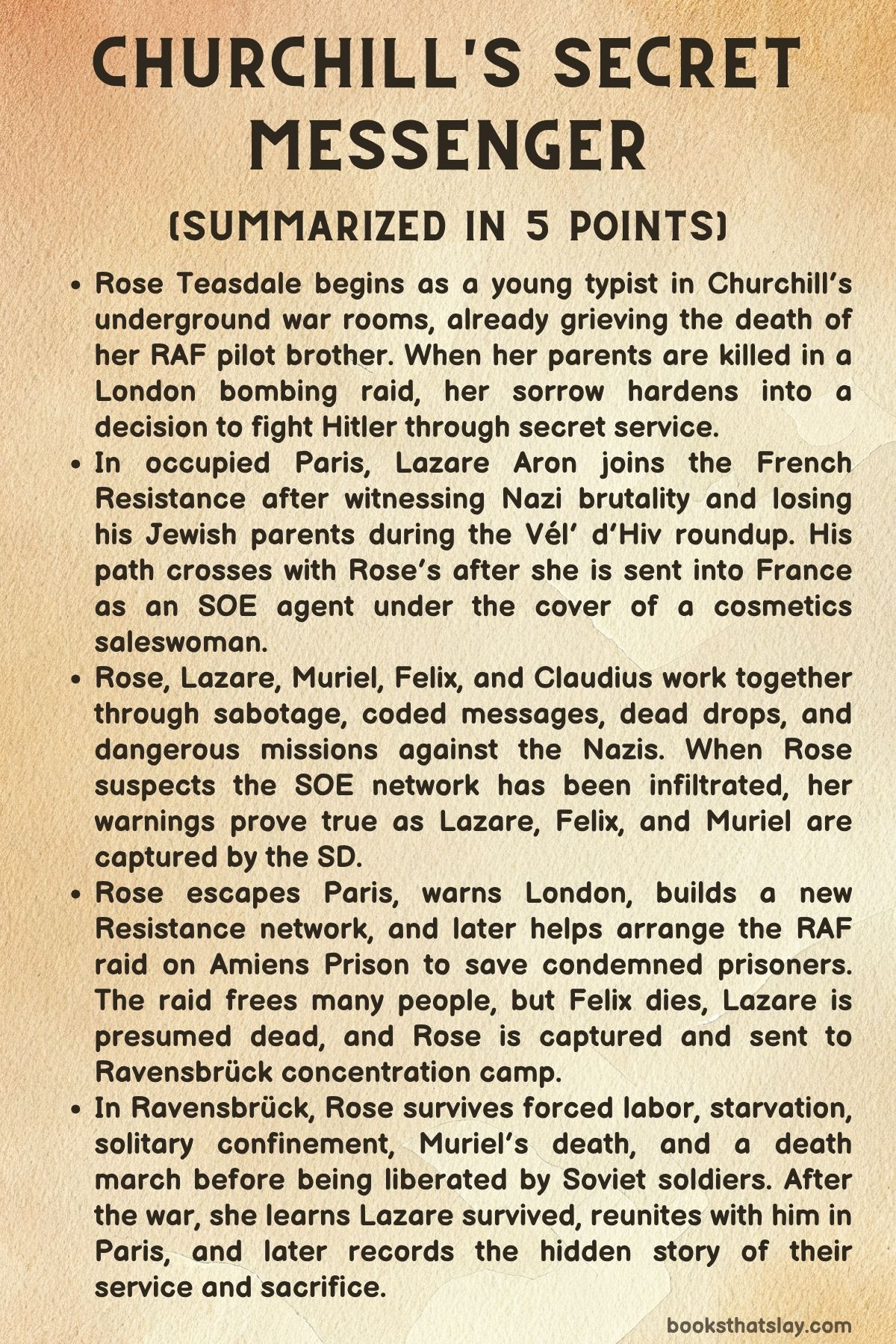
Summary
The story begins in wartime London, where Rose Teasdale works as a typist in Churchill’s underground Cabinet War Rooms. Britain is under constant German bombing, and Rose is already carrying the grief of losing her brother Charlie, an RAF pilot killed over the Channel.
Her work is ordinary on the surface, but the atmosphere around her is charged with fear, discipline, and national purpose. When she volunteers for a long shift to help a friend, she survives another night of bombing, only to return home and discover that her parents have been killed after a bomb destroys their grocery shop and apartment.
With her brother already dead and her parents gone, Rose is left alone, her grief turning into a firm desire to fight Hitler in any way she can.
In occupied Paris, Lazare Aron is also struggling against Nazi control. He is a young Jewish Frenchman whose damaged hand kept him out of the army, leaving him ashamed that he cannot serve in a traditional way.
He begins by secretly posting anti-Nazi propaganda, but after a German officer kills an elderly man who reads one of his signs, Lazare is crushed by guilt. His parents, Gervais and Magda, urge caution, while Lazare begs them to flee Paris as antisemitic persecution grows worse.
They believe their French citizenship and Gervais’s service in the Great War will protect them. Lazare knows that faith is dangerous, but he cannot convince them to leave.
Rose’s grief eventually leads to recruitment by the Special Operations Executive. Her fluent French, knowledge of Paris, courage, and hatred of Nazi violence make her a candidate for secret service in occupied France.
She is interviewed, tested, and sent to Scotland for training. There, she meets other recruits, including Muriel Brown, a mother who has left behind a young daughter, and Felix Renaud, a former French racing driver.
Rose struggles physically, especially with obstacle training, and one instructor believes she is too weak. Rather than accept dismissal, she breaks into his room and forges a favorable report, proving that she has the nerve, stealth, and boldness required for secret work.
Her superiors recognize that these qualities may matter more than conventional strength.
Meanwhile, Lazare joins the French Resistance after being rescued from a failed sabotage attempt. He becomes part of a group led by Claudius, working in the underground spaces of Paris and using British-supplied weapons and explosives.
His personal fight becomes even more desperate when Jews in Paris are forced to wear the yellow star and French police participate in mass arrests. Lazare’s parents are taken during the Vél’ d’Hiv roundup.
He tries to find them and receives a smuggled letter from his father, who absolves him of guilt and urges him to keep fighting. Their capture changes Lazare’s struggle from resistance against occupation into a deeply personal battle against a system of cruelty, betrayal, and mass murder.
After completing training, Rose is sent into occupied France with Muriel and Felix. Their network, Conjurer, operates under a larger SOE structure in Paris.
Rose uses the cover identity of a cosmetics saleswoman, while Muriel works as a wireless operator and Felix acts as organizer. Rose’s parachute drop goes wrong, and she lands away from the reception point, where Lazare finds and helps her.
Their first meeting is marked by caution, but also by mutual respect. In Paris, Rose quickly learns that the city she once knew from childhood visits has been transformed by occupation: hunger, fear, armed patrols, and swastika flags dominate the streets.
Rose and Lazare begin working together on sabotage and communication tasks. He shows her dead drops, safe routes, and hidden spaces, while she proves herself calm and resourceful under pressure.
During a mission to destroy a transformer station near SD headquarters, they barely escape after Lazare is injured by a guard dog. Rose saves him, and in the aftermath, they share stories of their losses.
The bond between them grows from trust into love, strengthened by the knowledge that both have lost families to the war and both have chosen danger rather than helplessness.
Rose’s cover brings her into contact with Zelie, a cabaret singer connected to Josef Kieffer, the head of the SD in Paris. Rose suspects that Kieffer may possess information about SOE networks.
During a visit to Zelie’s hotel suite, she glimpses a German report that suggests British-backed networks may have been compromised. Her instincts tell her something is wrong, but others are slow to believe her.
She warns Felix and London, yet the response from headquarters is initially dismissive. Lazare, however, trusts her judgment and begins changing Resistance procedures to reduce risk.
Rose’s fears prove correct. A reception operation is ambushed, and Lazare is captured.
Soon after, Muriel and Felix are arrested as the Germans break into SOE apartments and seize wireless equipment. Rose narrowly escapes and hides in Lazare’s catacomb refuge, where she meets Claudius.
Together they conclude that the Germans are using captured transmitters and security codes to impersonate SOE operators and lure more agents into traps. Rose makes a dangerous journey to Montluçon, where she contacts another network and finally convinces London that the Paris network has been penetrated.
Instead of accepting evacuation, she chooses to remain in France and builds a new network called Dragonfly, operating as organizer, courier, and wireless operator.
Lazare and Felix are imprisoned and tortured by the SD. Lazare refuses to reveal Rose’s location or Resistance secrets, even when he is beaten and suspended in agony.
Eventually, he and Felix are transferred to Amiens Prison, where many Resistance prisoners are being held. When more than 100 prisoners, including Felix and Lazare, are marked for execution, Rose requests an RAF bombing raid to break open the prison walls.
The plan is risky and controversial, but it is approved. The raid, known as Operation Jericho, breaches the prison and allows many prisoners to escape.
Lazare helps free others but is buried under rubble when another bomb hits the cellblock. Rose rescues Felix and other prisoners, but Felix dies after being shot.
Rose is captured while trying to escape.
Rose is eventually sent to Ravensbrück concentration camp. There she reunites with Muriel, who has also survived capture.
The camp is a place of starvation, forced labor, disease, beatings, and mass death. Rose and Muriel are assigned to sew Nazi winter coats, and Rose begins sabotaging the seams.
Her quiet act of resistance spreads among the women, but when the sabotage is discovered, Rose takes the blame to protect Muriel and the others. She is beaten and sentenced to solitary confinement on half rations.
Muriel secretly sends food to keep her alive, an act that later fills Rose with guilt when Muriel grows sick with typhus.
After Rose is released from solitary confinement, she helps care for Muriel with the aid of Yana, a Soviet prisoner and former medic. Muriel weakens and asks Rose to write a final message to her daughter, Mabel.
Rose records the message on scraps and sews it into her dress. When sick prisoners are taken away to be murdered, Muriel disappears among them.
Rose is shattered but clings to Muriel’s letter as a sacred duty. As the war nears its end, the SS evacuate the camp and force surviving prisoners onto a death march.
Rose is nearly executed in the woods, but Soviet soldiers arrive in time and save the remaining women.
After the war, Rose returns to London, physically damaged and bound by secrecy. She delivers Muriel’s message to Mabel and Muriel’s parents in Edinburgh, giving them the comfort of knowing Muriel’s love endured to the end.
In Paris, Lazare is revealed to have survived the prison bombing, though he has been badly injured and now uses braces and crutches. He tries to push Rose away because he fears becoming a burden, but she confronts him and makes clear that his injuries do not change her love.
They reunite and build a life together. Years later, Rose writes the hidden story of her service, the Resistance, Ravensbrück, and the people whose courage official records could not yet reveal.
Characters
Rose Teasdale
In Churchill’s Secret Messenger, Rose Teasdale is the emotional and moral center of the book, beginning as an ordinary young typist and becoming a secret agent shaped by grief, courage, and duty. Her transformation does not happen because she is fearless; it happens because she learns to act despite fear.
The deaths of Charlie and her parents destroy the domestic world that once gave her stability, but they also give her a reason to resist. Rose is not physically imposing, and her training exposes her limits, yet her intelligence, nerve, and ability to improvise make her valuable.
She proves herself by thinking like an agent before she officially becomes one, breaking rules when survival or justice demands it. In France, Rose grows into a leader who trusts instinct, observes danger carefully, and refuses to accept official reassurance when evidence suggests otherwise.
Her love for Lazare softens her without weakening her, and her survival in Ravensbrück shows another form of resistance: bearing witness. By the end of the story, Rose represents the hidden labor of women in war, especially those whose bravery remained classified, unrecognized, or known only to the people they saved.
Lazare Aron
Within Churchill’s Secret Messenger, Lazare Aron is one of the book’s most wounded yet resilient figures, shaped by disability, Jewish identity, family love, and political awakening. His maimed hand first appears to him as a mark of failure because it prevents him from joining the French army, but the story gradually recasts it as part of his strength.
Lazare’s resistance begins with words and printed signs, showing his roots as the son of a journalist and an artist, but Nazi violence pushes him toward sabotage. The murder of the old man who reads his poster becomes a defining trauma, teaching him that even small acts of protest carry deadly consequences under occupation.
His parents’ arrest during the Vél’ d’Hiv roundup deepens his pain and gives his fight a sharper moral urgency. Lazare is brave, but not reckless without feeling; he fears, grieves, loves, and doubts himself.
His endurance under torture is one of the clearest signs of his loyalty, especially because he protects Rose by refusing to speak. After the war, his injuries leave him afraid that love will turn into pity, but his reunion with Rose shows that his worth has never depended on physical wholeness.
He remains a man of conscience, memory, and truth.
Muriel Brown
Across Churchill’s Secret Messenger, Muriel Brown brings a deeply human dimension to the cost of secret war because she is both an agent and a mother separated from her child. Her decision to join the SOE is not driven by adventure, but by the fear that her daughter Mabel could grow up under Nazi domination.
That motive gives her courage a quiet force. As Rose’s roommate and later her fellow prisoner, Muriel becomes a source of warmth, humor, and emotional steadiness.
Her work as a wireless operator is among the most dangerous roles in occupied France, and the book shows how exposed such agents were to detection and capture. In Ravensbrück, Muriel’s love becomes sacrificial.
She risks her own survival by smuggling food to Rose during solitary confinement, and that act saves Rose’s life. Her decline from typhus is devastating because it is tied to both the physical cruelty of the camp and the moral pressure of friendship.
Her final letter to Mabel preserves her identity as a mother when the camp tries to reduce her to a number. Muriel’s character shows that resistance can be technical, maternal, loyal, and selfless all at once.
Felix Renaud
Felix Renaud is a complicated figure because he combines charm, experience, pride, and serious misjudgment. As a former racing driver, he carries a public identity that makes secrecy difficult, yet he brings confidence and mechanical skill to the mission in Paris.
Felix is brave and committed, but his flaw is that he underestimates certain dangers, especially Rose’s warning that the network may be compromised and Lazare’s concerns about wireless detection. His skepticism is not simple arrogance; it also reflects the pressure of command, the need to keep operations moving, and the difficulty of acting on incomplete evidence.
Still, the consequences are severe. Muriel is left exposed, and the network collapses more quickly than it might have if Rose’s instincts had been fully trusted.
Felix’s imprisonment and final escape attempt restore much of his dignity. He endures torture, tries to protect others, and dies after helping prisoners flee during Operation Jericho.
His final thoughts for his wife and son reveal a man burdened by love and regret. Felix is neither villain nor pure hero; he is a brave operative whose mistakes help show how fragile underground networks could be.
Claudius
Claudius is one of the book’s strongest supporting figures, serving as a Resistance leader, protector, strategist, and moral anchor. He first appears as the man who rescues Lazare from danger and draws him into organized resistance, giving Lazare a way to turn grief and anger into disciplined action.
Claudius understands the realities of occupation better than most people: trust is necessary, but misplaced trust can destroy entire networks. He is practical and often cautious, yet he is not passive.
His loyalty to Lazare, Rose, and his sister Marcelline gives him emotional depth beneath his hard exterior. When the networks collapse, Claudius becomes one of the few people Rose can still rely on.
He helps her interpret the disaster, rebuild resistance activity, and push forward the plan that leads to Operation Jericho. He also survives into the postwar years, becoming part of Rose and Lazare’s extended family.
His later role as a café owner and surrogate grandfather suggests that resistance fighters were not only warriors; they were people who had to rebuild ordinary life after years of secrecy, danger, and loss.
Winston Churchill
Winston Churchill appears less as a constant character than as a force whose decisions shape Rose’s path. His early encounter with Rose in the war rooms is important because he sees not only a typist but a young woman marked by sacrifice.
His condolence after her family’s death and his later recommendation for recruitment connect the private grief of civilians to the larger machinery of war. Churchill’s portrayal emphasizes authority, secrecy, and the burden of decisions that cannot be publicly explained.
He recognizes Rose’s potential before she fully understands it herself, but he does not remove her agency; Rose repeatedly insists that joining the fight was her choice. His later meeting with her at Chartwell is quiet and restrained, marked by gratitude rather than ceremony.
The fact that he confirms the continued secrecy of her service gives his character a bittersweet function. He can honor Rose privately, but he cannot give her or her fallen friends public recognition.
Through him, the story shows how wartime leadership often depends on invisible sacrifices made by people whose names history may not immediately record.
Josef Kieffer
Josef Kieffer is one of the central faces of Nazi power in the story, representing the calculated intelligence apparatus that hunts Resistance members and SOE agents. He is dangerous not only because he has authority, but because he understands networks, fear, surveillance, and psychological pressure.
Rose first encounters him through Zelie, where his presence turns an undercover errand into a moment of serious danger. Later, his role at Avenue Foch reveals the machinery behind German counterintelligence: captured agents, stolen codes, false transmissions, interrogation, and manipulation.
Kieffer’s cruelty is controlled rather than chaotic, which makes him especially threatening. He delegates much of the physical brutality to Vogel, but his responsibility remains clear.
He is also capable of suspicion toward those close to him, as seen in the consequences for Zelie, suggesting that the system he serves poisons even personal relationships. Kieffer functions as a reminder that occupation was enforced not only through soldiers in the street, but through files, reports, informants, coded messages, and rooms designed to break human beings.
Eberhard Vogel
Eberhard Vogel is one of the book’s most brutal characters, acting as Kieffer’s assistant and interpreter while also carrying out torture. He represents the intimate cruelty of the Nazi security state: the man in the room who watches pain closely, mocks weakness, and tries to turn bodies into sources of information.
His treatment of Lazare is especially revealing because he attacks both Lazare’s Resistance identity and his disability, using the prosthetic hand as an object of humiliation. Vogel’s cruelty is not only physical; it is designed to erase dignity.
He wants prisoners to feel reduced, helpless, and isolated. Yet his failure to break Lazare gives the character an important narrative purpose.
Vogel can damage the body, but he cannot fully control memory, loyalty, or love. Lazare survives his sessions by thinking of Rose and by holding on to his duty toward others.
Vogel’s presence also deepens the horror Rose later faces when she is brought to Avenue Foch. He links multiple threads of suffering in the story and shows how bureaucratic evil becomes personal in the interrogation room.
Yana
Yana is a vital figure in the Ravensbrück section of the book because she brings medical knowledge, discipline, and compassion into an environment designed to destroy all three. A Soviet political prisoner and former Red Army medic, she understands disease, starvation, and camp procedure better than Rose does.
Her decision to create a quarantine area for sick women is an act of resistance because the official hospital has become a place of murder rather than healing. Yana is practical, unsentimental when necessary, and deeply humane.
She helps Rose care for Muriel, smuggles food, and later gives Rose a better chance of surviving the death march by exchanging coats and hiding supplies in the pockets. Her courage is not dramatic in the usual sense; it appears in repeated acts of care under impossible conditions.
Yana’s presence broadens the book’s moral world beyond British and French resistance, showing that prisoners from many nations fought to preserve life inside the camps. She is one of the characters who keeps Rose alive, physically and ethically.
Lucy
Lucy is Rose’s connection to ordinary life, friendship, and the home front. At the beginning, Rose volunteers for a long shift partly to help Lucy keep her plans, and that small act indirectly places Rose away from home when her parents are killed.
Lucy’s later guilt reflects how war turns ordinary choices into sources of pain, even when no real blame belongs to the person who made them. Rose’s insistence that Hitler is responsible shows the strength of their friendship and Rose’s refusal to let grief become misplaced accusation.
After the war, Lucy becomes a safe presence for Rose, someone who receives her without demanding explanations she cannot give. Her marriage and pregnancy contrast with Rose’s trauma, showing the uneven ways people emerge from war.
Lucy’s discovery of Rose’s scars brings the hidden violence of Rose’s service into domestic space. She cannot fully know what Rose endured, but her tenderness gives Rose a small measure of comfort.
Lucy represents the civilian friendships that help survivors return, however painfully, to life.
Gervais and Magda Aron
Gervais and Magda Aron are central to Lazare’s emotional foundation. They are loving, principled, cultured people who believe in France, art, journalism, and moral reason.
Their refusal to flee Paris is tragic because it comes from dignity and faith in the country they consider home. Gervais’s service in the Great War and their French citizenship seem to them like forms of protection, but the occupation destroys those assumptions.
Magda’s work as a painter and her careful repainting of Lazare’s prosthetic hand show her tenderness and artistic gift. Gervais’s final letter from the Vél’ d’Hiv becomes one of the book’s strongest statements of parental love.
Rather than blame Lazare, he frees him from guilt and commands him to keep fighting. Their fate also exposes French collaboration in antisemitic persecution, since French police are directly involved in their arrest.
Through Gervais and Magda, the story shows how families rooted in culture, patriotism, and decency were targeted by a system that denied their belonging and humanity.
Herbert, Emilienne, and Charlie Teasdale
Herbert, Emilienne, and Charlie Teasdale shape Rose’s character even though they die early in the story. Charlie’s death as an RAF pilot gives Rose her first direct wound from the war, and his photograph becomes a private object of memory and devotion.
Herbert and Emilienne represent the working-class London life Rose loses in the bombing: family, shop, neighborhood, and routine. Their deaths transform the war from a national emergency into a personal rupture.
The detail that Herbert stayed with Emilienne rather than go to the Tube shelter because of her pain gives their marriage quiet depth. They are not developed through long scenes, but through the force of Rose’s love for them and the way their absence drives her.
Her promise to honor them becomes part of her motivation throughout training, fieldwork, imprisonment, and survival. Charlie’s memory also returns through Rose’s later child, named after him, suggesting that the dead remain present in the life Rose builds after war.
Zelie
Zelie is a morally ambiguous figure whose glamour contrasts sharply with the hunger and fear of occupied Paris. As a cabaret singer living in luxury while ordinary Parisians struggle for food, she appears at first to benefit from proximity to German power.
Her relationship with Kieffer places her in a dangerous social world where charm, survival, collaboration, and vulnerability are difficult to separate. Rose’s disgust at Zelie’s suite is understandable, yet Zelie’s later arrest suggests that closeness to power does not guarantee safety.
She is useful in the plot because she gives Rose access to Kieffer’s private space and the report that reveals possible infiltration. Symbolically, Zelie shows the compromised spaces of occupied society, where people may perform elegance while violence operates just outside the door.
She is neither explored as a full villain nor redeemed as a hero; instead, she occupies the uneasy middle ground of wartime survival, where choices are judged under pressure but still carry consequence.
Mabel Brown
Mabel Brown is a child, but her importance is much larger than her amount of direct action. She represents the future Muriel is trying to protect.
Muriel’s decision to serve, her longing during deployment, and her final message all return to Mabel as the emotional reason behind her courage. Because Mabel is too young to understand the full cost of war, the adults around her carry memory on her behalf.
Rose’s visit to Edinburgh after liberation is one of the book’s most moving acts of duty because she gives Mabel not strategic truth, but emotional truth: her mother was brave, loving, and thinking of her until the end. Mabel’s grief also reminds the reader that wartime heroism leaves children with absences they must spend their lives understanding.
Through her, the story asks what freedom costs the next generation and how love can survive even when the person who gives it does not return.
Harriet Renaud
Harriet Renaud, Felix’s wife, appears late in the story but adds weight to Felix’s private life and sacrifice. She receives Rose with warmth, even while sensing that there are truths Rose cannot legally or safely reveal.
Her strength is quiet and practical. She has lost not only Felix but also her son Mathieu, and the vineyard has been damaged by occupation, yet she speaks of rebuilding rather than surrendering to despair.
Harriet’s restraint is important because it respects both grief and secrecy. She does not force Rose to betray classified details, but she understands enough to honor Felix’s courage.
Her invitation for Rose to stay and work in exchange for room and board gives Rose a temporary place of restoration after trauma. Harriet represents the survivors who must rebuild homes, farms, families, and livelihoods after the official end of war, carrying losses that public victory cannot erase.
Themes
Resistance as a Moral Choice
Resistance in the story begins long before weapons, sabotage, or coded transmissions. It begins when people decide that obedience to evil is not neutral.
Rose’s decision to join the SOE grows from personal loss, but it matures into a broader commitment to protect others and expose the truth. Lazare’s first acts of resistance are written signs, which may seem small beside explosives, yet the book treats them as morally serious because words challenge the lies that occupation depends on.
Muriel’s wireless work, Claudius’s underground organizing, Yana’s medical care, and the sabotage of Nazi coats in Ravensbrück all show that resistance can take many forms. In Churchill’s Secret Messenger, the strongest acts are not always the most visible.
A forged report, a hidden message, a loosened seam, a smuggled sausage, a preserved letter, or a refusal to answer under torture can all become acts of defiance. The theme matters because it rejects the idea that courage belongs only to soldiers.
The story insists that ordinary people become resisters when they choose responsibility over safety, even when the result is suffering, secrecy, or death.
The Cost of Hidden Service
Secret service demands not only courage during danger but silence afterward. Rose, Muriel, Felix, and others risk their lives in operations that cannot be publicly acknowledged, and that secrecy becomes another burden after the fighting ends.
The book shows the pain of classified sacrifice through Rose’s return to England, where she carries scars, memories, and grief that she cannot fully explain. Felix and Muriel die as heroes, but official records cannot immediately honor them.
Churchill can thank Rose in private, yet even he confirms that the truth must remain sealed. This creates a painful gap between lived experience and public history.
Rose knows what happened, but the world is not allowed to know. The theme also affects personal relationships.
Lucy can care for Rose but cannot fully understand her. Muriel’s family receives only part of the truth.
Harriet senses Felix’s secret role but cannot demand details. By having Rose write her manuscript years later, the story presents memory as a delayed form of justice.
Hidden service may be buried by governments, but survivors still carry the duty to preserve names, choices, and losses.
Love Under Conditions of War
Love in the story is never separate from danger. Romantic love, parental love, friendship, and loyalty all exist under pressure from violence, distance, imprisonment, and secrecy.
Rose and Lazare’s relationship grows because each recognizes the other’s grief and courage, but their love is shadowed by the knowledge that either could be captured or killed at any time. Their brief happiness in Paris is powerful because it occurs in a world where the future has become uncertain.
Muriel’s love for Mabel is equally important. She joins the fight to protect her daughter’s future, survives by holding on to memory, and leaves behind a letter so Mabel will know she was cherished.
Gervais’s letter to Lazare is another expression of love under extreme conditions, freeing his son from guilt even as he faces deportation. Love does not prevent suffering in the book, but it gives characters reasons to endure.
Lazare survives torture by thinking of Rose. Rose survives Ravensbrück partly through Muriel’s sacrifice and the duty to deliver her message.
The story treats love not as escape from war, but as one of the forces that allows people to remain human inside it.
Bearing Witness and Preserving Memory
The need to remember becomes one of the story’s deepest concerns. Nazi violence depends not only on killing people but also on erasing evidence, names, and truth.
Ravensbrück is especially important to this theme because Rose understands that survival is not only personal; it is testimonial. She wants to live so the world will know what was done to the prisoners.
Her observations of forced labor, starvation, disease, cremation ash, gas chambers, and the death march become part of a moral record. Lazare’s postwar journalism serves a similar purpose.
By writing about the Vél’ d’Hiv roundup and French police complicity, he refuses to let national memory become comfortable or false. Rose’s final manuscript continues that work, preserving the story of Conjurer, the camps, and the people whose actions were hidden by classification.
Memory is also intimate. Muriel’s letter to Mabel, the gold dragonfly brooch, the family names passed to Rose and Lazare’s children, and the wreath at the Arc de Triomphe all turn private grief into acts of remembrance.
The theme argues that freedom requires more than victory; it requires honest memory of the cost.