Imperium by Robert Harris Summary, Characters and Themes
Imperium by Robert Harris is a historical political novel about ambition, law, reputation, and the dangerous machinery of power in the late Roman Republic. Told through the voice of Tiro, Cicero’s enslaved secretary, the novel follows Marcus Tullius Cicero as he rises from a brilliant but socially insecure advocate to the highest office in Rome.
Rather than presenting politics as noble public service, the book shows it as a contest of favors, fear, money, legal skill, and survival. It is both a portrait of Cicero’s genius and a study of how power changes those who seek it. Also, the book is the first in the Cicero series.
Summary
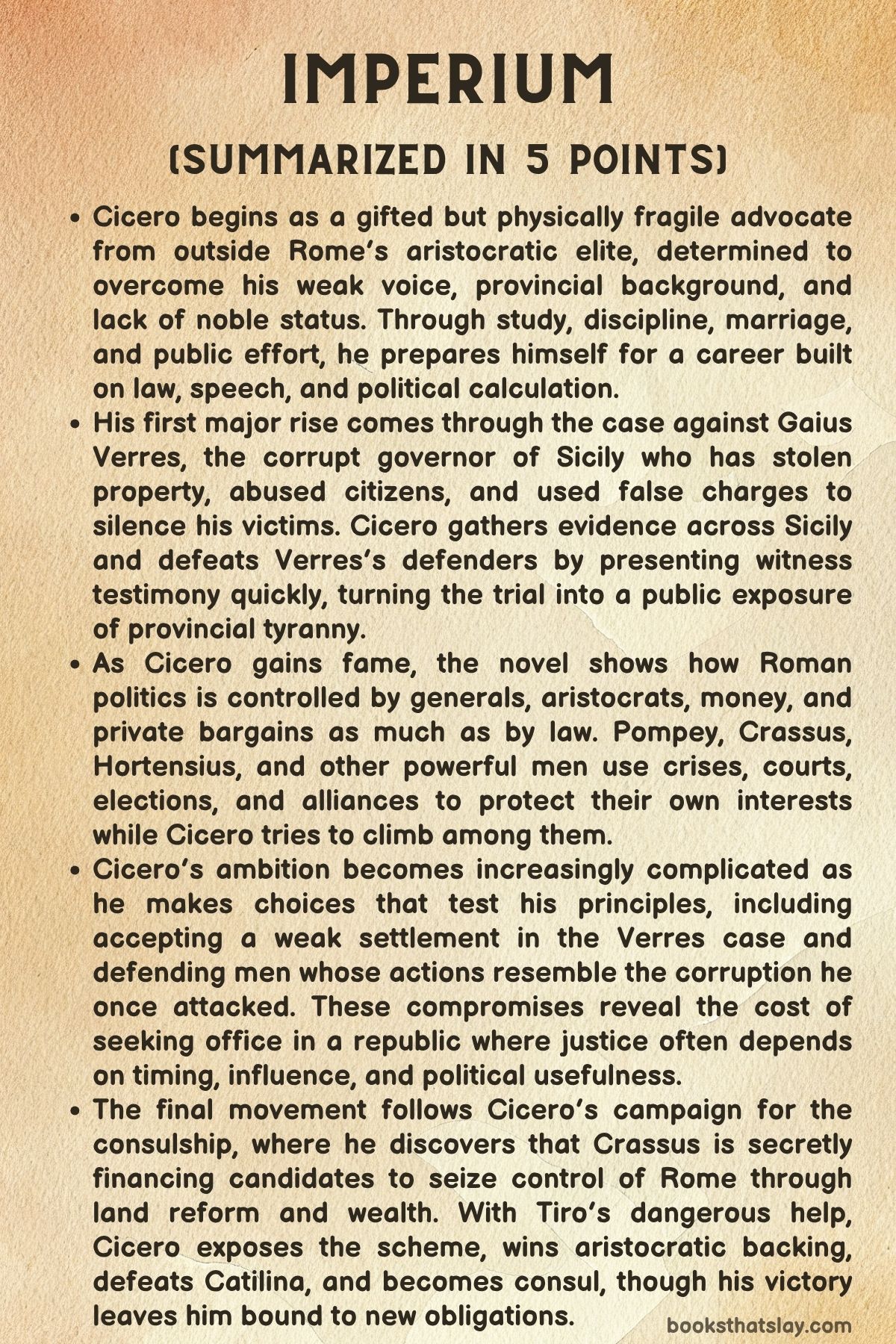
Tiro, an old man looking back across nearly a century of life, introduces himself as the former confidential secretary of Marcus Tullius Cicero. Once enslaved in Cicero’s household, he became indispensable because of his loyalty, intelligence, and invention of a shorthand system that allowed him to record speeches with remarkable speed.
From the beginning, Tiro makes clear that his story is not only about Cicero as a lawyer or statesman, but about power itself: the kind of official authority that gives a man control over life, death, reputation, and the future of the state.
The story begins with Cicero as a young advocate who lacks many of the advantages expected of Rome’s ruling class. He is not a noble aristocrat, he comes from a provincial background, and his body seems poorly suited to public life.
He suffers from a weak voice, a stutter, and fragile health. Determined to transform himself, he travels east with Tiro to study philosophy and rhetoric.
Under the training of Apollonius Molon in Rhodes, Cicero strengthens his voice, discipline, and delivery. Molon predicts that Cicero will conquer Rome, not through military force, but through speech.
To qualify for a political career, Cicero marries Terentia, a wealthy woman whose fortune helps him meet the property requirements for public office. He is elected quaestor and serves in Sicily, where he gains a reputation for honesty.
Yet when he returns to Italy, he expects admiration and finds indifference instead. The humiliation teaches him a hard lesson: virtue alone is not enough in Rome.
A man who wants office must remain visible, talked about, and useful.
Years later, Cicero is living in Rome with Terentia, their daughter Tullia, and a large household that includes Tiro. One morning, Sthenius of Thermae, a wealthy Sicilian acquaintance, arrives in distress.
He explains that Gaius Verres, the governor of Sicily, has robbed him of valuable art and then used false charges to punish him for resisting further theft. Verres has convicted Sthenius in his absence and is preparing a capital prosecution that could end in crucifixion.
Cicero recognizes not only the injustice but the opportunity. Verres is corrupt, arrogant, and politically protected.
Bringing him down could make Cicero famous.
At first, Cicero tries to stop the immediate danger through the Senate, but the powerful advocate Hortensius, who represents Verres, blocks him with the help of aristocratic allies. Cicero then turns to the tribunes, whose ancient power to defend ordinary citizens has been reduced but not entirely destroyed.
Through the tribune Palicanus, Cicero gains support for Sthenius while also connecting himself to the cause of Pompey, the popular general who wants the tribunes’ powers restored. Cicero speaks before the tribunes’ assembly and attacks senatorial corruption, securing protection for Sthenius and advancing his own political position.
As Rome waits for Pompey and Crassus to return with their armies, Cicero finds himself caught between rival giants. Crassus, having crushed the rebellion of enslaved people led by Spartacus, pressures Cicero for support.
Pompey, returning from Spain, is equally ambitious. Cicero hopes to benefit from Pompey’s popularity, but he quickly learns that the great commanders see men like him as useful but not equal.
Deals are made among the powerful: Pompey and Crassus will become consuls, the tribunes’ powers will be restored, and aristocrats will receive future offices. Cicero is left outside the room where the real bargains are struck.
Still, Verres’s crimes continue to offer Cicero a path forward. More Sicilian victims arrive with evidence of theft, extortion, false trials, and abuse.
Cicero decides to run for aedile and prosecute Verres for corruption. Terentia supports the decision and funds the campaign, though her financial power also unsettles Cicero.
He wants glory, but he depends on her wealth to pursue it.
To win the right to prosecute, Cicero must first defeat a rival claimant, Caecilius Niger, who is put forward by Verres’s allies to weaken the case. In court, Cicero ridicules Caecilius and exposes the arrangement behind his candidacy.
He wins by a narrow vote and receives permission to travel to Sicily to gather evidence. With Tiro and a small team, he moves quickly through the province, collecting statements and documents from communities ruined by Verres’s greed.
In Sicily, Cicero discovers a pattern of organized theft and terror. Verres has stolen art, extorted farmers, manipulated tax records, imprisoned innocent men, ransomed prisoners, and executed Roman citizens without proper trial.
Cicero faces intimidation from Lucius Metellus, the new governor and an ally of Verres, but he continues gathering evidence. He seizes records, exposes falsified accounts, and identifies payments hidden under aliases.
By the time he returns to Rome, he has enough material to ruin Verres if he can force the trial to proceed before political conditions change.
Hortensius’s strategy is delay. Festivals, court schedules, and elections all threaten to push the case into the following year, when a friendlier judge may preside.
Cicero realizes that a traditional long speech will help the defense by wasting precious days. After being elected aedile despite bribery by Verres’s side, he makes a bold decision.
When the trial begins, he refuses to give the expected grand opening address. Instead, he calls witness after witness and lets the evidence speak rapidly and directly.
The tactic works. Sicilian witnesses testify to Verres’s extortion and cruelty.
Roman citizens describe illegal executions. The testimony becomes impossible to contain.
Verres flees Rome before the case ends, and Hortensius offers a settlement far below the true scale of the damage. Cicero accepts after pressure from Pompey.
Lucius, Cicero’s cousin, is disgusted, believing Cicero has allowed politics to compromise justice. Cicero insists that he has still achieved a victory for Sicily, but the episode shows the moral cost of operating within Rome’s system.
He defeats Verres, wins fame, and claims higher status, but he also learns that even justice may require negotiation with power.
The novel then moves ahead as Cicero’s career continues to rise. His aedileship succeeds, helped by grateful Sicilians who keep grain prices low.
He buys a villa near Tusculum and appears to be moving steadily toward greater office. Yet his choices grow more troubling.
He defends Marcus Fonteius, a former governor accused of extorting the Gauls, even though he had earlier built his reputation by attacking provincial corruption. In court, Cicero attacks the foreign witnesses and uses emotional spectacle to secure acquittal.
Lucius sees this as betrayal. Soon afterward, Lucius dies by suicide, though Tiro conceals the truth from the family.
Cicero also loses his father, deepening the sense that private grief must be pushed aside for public ambition.
A crisis over piracy gives Pompey another chance to seek extraordinary power. At a meeting near Tusculum, Pompey proposes a vast command over the Mediterranean, giving one supreme commander authority over coastlines, fleets, and armies.
Cicero advises political caution, suggesting that the bill not name Pompey directly. Tiro accidentally witnesses Caesar’s affair with Pompey’s wife, Mucia, and keeps silent.
The private scandal reflects the wider world of hidden alliances and personal risks beneath public politics.
In Rome, the tribune Gabinius promotes the law granting sweeping command against the pirates. The Senate resists, especially Hortensius and Catulus, while Crassus tries to block the measure through purchased tribunes.
Cicero searches Roman precedent and finds an old example from the struggle around Tiberius Gracchus: a tribune who blocks the popular will can be threatened with removal by the people. Gabinius uses this precedent against Crassus’s man Trebellius, who withdraws his veto in fear.
The law passes, Pompey receives the command, and he soon defeats the pirates with astonishing speed.
Cicero is elected praetor and presides over important cases, including the conviction of Caius Licinius Macer, a supporter of Crassus. This worsens Crassus’s hatred of him.
Cicero now looks toward the consulship, the supreme elected office in Rome. His path, however, is crowded with dangerous rivals.
Antonius Hybrida, once dismissed as corrupt and weak, becomes a serious candidate after staging expensive games. Lucius Sergius Catilina, violent, ambitious, and backed by powerful interests, emerges as an even greater threat.
Cicero considers defending Catilina in an extortion case to control the political danger, but he learns the trial has already been fixed through bribery. He withdraws, making Catilina an enemy.
His consular campaign becomes a fight not merely against rival candidates but against a larger conspiracy of money. Atticus, recently returned from Greece, brings news that Crassus may be secretly financing an entire slate of candidates, including Catilina, Hybrida, and others.
Cicero begins to understand that Crassus is trying to buy the Roman government.
To expose the scheme, Cicero sends agents into the world of vote-buying. They discover that a single hidden client has already purchased vast numbers of votes.
Cicero intimidates a broker into admitting that Crassus is behind the operation. Yet legal attempts to stop the bribery fail when a tribune vetoes reform.
Then Caelius Rufus gives Cicero a dangerous chance: Tiro can hide in Crassus’s house and record a secret meeting. Cicero promises Tiro freedom, and Tiro, terrified but loyal, agrees.
Tiro records a meeting involving Crassus, Caesar, Catilina, Hybrida, and their allies. Cicero deciphers the notes and learns the plan.
After winning office, the conspirators intend to pass a land reform bill that will create a powerful commission controlled by Crassus and Caesar. Under the cover of land redistribution, they would gain control over public land and eventually the wealth of Egypt, making themselves masters of Rome.
Cicero uses the transcript to win over the aristocracy, sending it to Hortensius. On the eve of the election, he delivers a fierce public speech attacking Catilina and Hybrida as puppets of a hidden power.
Catilina loses control and lunges at him. That night, Cicero is summoned to a secret meeting with aristocratic leaders.
Tiro proves the authenticity of his shorthand, and Cicero negotiates their support.
On election day, Hortensius publicly endorses Cicero, signaling that the aristocratic bloc has shifted behind him. Cicero wins the consulship unanimously, with Hybrida as his colleague, while Catilina is defeated.
At home, Cicero admits the price of victory. He must oppose popular land reform and support triumphs for aristocratic generals, choices that may alienate Pompey and the people.
Quintus warns that he may end up isolated. Cicero accepts the risk.
He has reached the height of Roman public life, but the victory is already shadowed by compromise.
Characters
Marcus Tullius Cicero
In Imperium, Cicero is presented as a man who makes himself powerful through discipline, language, calculation, and relentless public effort. He begins without the natural advantages of the old aristocracy, and this insecurity stays with him even after his victories.
His provincial background, weak body, and early humiliation make him determined never to be ignored again. Cicero’s greatness lies in his ability to read institutions, audiences, and opponents.
He understands that a courtroom is not only a legal space but also a stage where reputation is made. His prosecution of Verres shows courage, intelligence, and tactical brilliance, especially when he abandons a long opening speech and lets the witnesses destroy the defense.
Yet the book does not treat him as purely noble. He accepts compromises, courts powerful men, changes positions when ambition requires it, and slowly becomes more comfortable with moral bargaining.
His rise is admirable, but it also reveals how Roman politics forces even gifted men to trade purity for influence.
Tiro
Tiro is the book’s observer, recorder, servant, and quiet moral center. Because he is Cicero’s enslaved secretary, he stands close to power without truly possessing it.
His shorthand gives him unusual access to speeches, trials, private meetings, and dangerous secrets, yet his own freedom depends on the choices of others. Tiro’s loyalty to Cicero is deep, but it is not blind.
He admires Cicero’s genius and energy while noticing his vanity, impatience, and increasing hunger for office. Tiro’s perspective gives Imperium a reflective tone because he understands both the excitement of public achievement and the human cost hidden behind it.
His fear during the secret mission in Crassus’s house is especially revealing: the great men of Rome gamble with states and armies, while someone like Tiro risks his body and life for their ambitions. His promised freedom adds emotional weight to the political plot, showing that liberty is not an abstract principle for everyone in Rome.
Terentia
Terentia is far more than Cicero’s wife; she is one of the strongest practical forces behind his career. Within Imperium, she represents money, household authority, political instinct, and emotional toughness.
Her wealth enables Cicero to enter and sustain public life, and she knows it. She can wound him by reminding him of his dependence and provincial insecurity, but she also backs him when his ambition aligns with her sense of revenge or advancement.
Terentia is shrewd in judging enemies and opportunities. When Cicero hesitates, she often pushes him toward decisive action, especially when dealing with Verres or the aristocrats.
Her pregnancy and the birth of Marcus add a domestic dimension to Cicero’s public career, but she is not confined to the private sphere. She understands that Roman politics is tied to family status, property, reputation, and inheritance.
Her presence exposes how much Cicero’s public identity rests on private resources he sometimes resents.
Quintus Cicero
Quintus is Cicero’s brother and one of his most important political partners. He is practical, organized, and deeply invested in the family’s rise.
His role in managing campaigns shows his understanding of Roman electoral mechanics, especially the importance of tribes, agents, favors, and public visibility. Quintus often acts as the cautious voice in Cicero’s circle.
He recognizes dangers that Cicero sometimes minimizes and warns him when ambition threatens to leave him politically exposed. Unlike Cicero, who often thinks in terms of speeches and historical judgment, Quintus is more focused on survival, organization, and consequences.
His horror at the price Cicero pays for aristocratic support after the consular election shows his clear reading of the political landscape. He understands that victory can create new enemies and that alliances made under pressure may trap a man later.
Quintus’s loyalty is firm, but it includes disagreement, which makes him a useful counterweight to Cicero’s self-belief.
Lucius Cicero
Lucius, Cicero’s cousin, is one of the book’s strongest moral critics. He supports Cicero’s early prosecution of Verres because it appears to serve justice and defend abused provincials.
However, he becomes increasingly disturbed when Cicero’s actions begin to serve ambition more than principle. His anger over the settlement in the Verres case shows his unwillingness to accept political convenience as justice.
Later, Cicero’s defense of Fonteius feels like a betrayal to him because Cicero uses methods against provincial witnesses that resemble the prejudices he once opposed. Lucius’s suicide gives his role a tragic force, though the family is spared the truth.
His death suggests that moral disgust can become unbearable in a world where talented men learn to justify compromise. Lucius is important because he shows what Cicero might have been if principle had mattered more than success.
He is not politically powerful, but his judgment lingers as a measure of Cicero’s decline.
Pompey
Pompey is a military hero whose power comes from victory, popularity, and the aura of command. He is not portrayed as a deep thinker in the same way as Cicero or Caesar, but he understands image and public expectation.
His return from Spain, rivalry with Crassus, and later campaign against the pirates all show a man who can use crisis to gain extraordinary authority. Pompey often appears distant and dismissive toward Cicero, treating him as useful rather than equal.
Yet he also depends on men like Cicero to shape arguments, draft speeches, and make unconstitutional ambition sound like public necessity. His manipulation of the pirate crisis shows how fear can be turned into political capital.
Pompey’s greatest strength is that the people want to believe in him. His weakness is that he often lets others design the political machinery around his fame, which makes him powerful but also vulnerable to sharper minds.
Marcus Licinius Crassus
Crassus is one of the most menacing figures in the story because his power is rooted in wealth rather than public affection or eloquence. He treats politics as something that can be purchased, arranged, and enforced.
His meeting with Cicero near the road lined with crucified rebels shows the brutal foundation beneath his polished dealings. He offers favors and threats with equal calm.
Crassus’s rivalry with Pompey shapes much of the political action, but his deeper ambition becomes clear during the consular campaign, when he secretly funds a slate of candidates to take control of the state. His planned land reform is not presented as idealism but as a mechanism for domination.
Crassus is dangerous because he understands men’s prices. He buys votes, tribunes, influence, and silence.
Unlike Cicero, who wants glory, Crassus wants control. Unlike Pompey, who wants honor, Crassus wants ownership.
Gaius Verres
Verres is the book’s clearest example of corrupt provincial power. As governor of Sicily, he turns office into a license for theft, humiliation, and cruelty.
He steals art, falsifies charges, extorts communities, manipulates records, and uses fear to silence resistance. His treatment of Sthenius and other Sicilians shows how Roman authority can become predatory when far from Rome’s direct scrutiny.
Verres is not merely greedy; he is arrogant enough to believe that aristocratic protection will save him from consequence. His crimes give Cicero the opportunity to build a national reputation, but they also expose the rot inside the Roman justice system.
Verres can function only because men like Hortensius, the Metelli, and other elites are willing to shield him. His flight from Rome during the trial is a practical defeat, but the low settlement also suggests that even a ruined corrupt man can escape full justice if he has the right connections.
Quintus Hortensius
Hortensius is Cicero’s great legal rival and the leading advocate of the Roman elite. He represents the older order of courtroom prestige, aristocratic connection, and procedural control.
His defense of Verres relies less on proving innocence than on delay, influence, and manipulation of timing. This makes him a perfect opponent for Cicero, whose ambition requires him to defeat both the man and the system he represents.
Hortensius is not foolish; he recognizes Cicero’s talent and understands the danger he poses. Later, however, he also proves flexible enough to support Cicero when Crassus’s scheme threatens aristocratic interests.
His public endorsement on election day is decisive because it signals the old nobility’s shift. Hortensius therefore functions as both rival and gatekeeper.
Cicero may defeat him in court, but he still needs his acceptance to reach the consulship. That dependence complicates Cicero’s triumph.
Catulus
Catulus is an aristocrat who embodies the conservative ideals of the Republic. He opposes extraordinary commands and popular pressure because he fears the breakdown of constitutional norms.
His resistance to Pompey’s pirate command reflects a real concern that Rome is granting too much power to individual generals. Yet Catulus is not shown as merely selfish or obstructive.
During Cicero’s struggle to prosecute Verres, his decision to abstain helps Cicero win the right to bring the case. This suggests that he still values legal principle, even when it cuts against his political circle.
Catulus’s importance lies in his connection to the old senatorial order. He represents dignity, tradition, and suspicion of popular politics, but also the limits of that tradition.
The Republic he wants to preserve is already full of bribery, fear, and private bargains, which weakens the moral force of his conservatism.
Julius Caesar
Caesar appears as a younger political figure whose intelligence, appetite, and ambition are already visible. He is not yet the dominant man he will become, but the book presents him as someone to watch carefully.
His support for Pompey’s extraordinary command suggests a willingness to use popular measures to break aristocratic resistance. His suspected role in shaping Pompey’s plan shows his strategic imagination.
The private scene between Caesar and Mucia reveals his recklessness and confidence, especially because he notices Tiro and chooses silence rather than panic. Later, his presence in Crassus’s secret plan connects him to a broader attempt to reshape Roman power through land reform and control of wealth.
Caesar is dangerous because he combines charm, boldness, and ideological flexibility. He can appear playful, but beneath that surface is a man already studying how the Republic may be bent.
Lucius Sergius Catilina
Catilina is violent, reckless, charismatic, and politically toxic. He enters the story as a rival whose reputation is filled with crime and danger, yet he remains attractive to powerful backers because he can mobilize anger and serve their plans.
Cicero initially considers defending him for tactical reasons, hoping either to place him in debt or remove him through conviction. But once Cicero sees that Catilina’s trial is fixed, he recognizes that cooperation would stain him and withdraws.
Catilina’s rage at Cicero marks the beginning of a deadly rivalry. During the election crisis, Catilina becomes the public face of a deeper threat financed by Crassus.
His attempt to lunge at Cicero after being denounced shows his lack of restraint. Catilina is frightening because he joins personal resentment to political ambition.
He is not the architect of every plot, but he is the kind of man who can turn conspiracy into violence.
Antonius Hybrida
Antonius Hybrida is corrupt, opportunistic, and underestimated. Cicero initially supports him for praetor because he seems politically manageable and not especially dangerous.
That judgment proves naïve when Hybrida becomes a serious consular candidate after using public games to raise his profile. His alliance with Catilina makes him part of the electoral threat facing Cicero.
Hybrida is not presented as a visionary or mastermind; his importance comes from his usefulness to stronger interests. Men like Crassus can support him because he is purchasable and likely to serve the forces that elevate him.
His eventual election as Cicero’s colleague is one of the compromises hidden beneath Cicero’s triumph. Cicero wins the consulship, but he must share office with a man whose corruption he understands.
Hybrida therefore represents the kind of damaged partner that Roman politics can force upon even a victorious candidate.
Atticus
Atticus is Cicero’s wealthy, intelligent, and well-connected friend. His return from Greece strengthens Cicero’s campaign because he brings moneyed confidence, social access, and crucial information.
Unlike Cicero, Atticus prefers to remain outside the direct struggle for office, but that distance makes him a valuable observer. He understands elite networks and hears things that formal politics hides.
His report about Lentulus Sura’s boast helps Cicero grasp the scale of Crassus’s electoral scheme. Atticus represents a different kind of power: the influence of the private man who knows everyone, risks less, and supplies knowledge at the right moment.
His friendship with Cicero is useful and genuine, but it also shows how Roman public life depends on private intelligence. In a city of rumors, dinners, favors, and secret commitments, Atticus’s calm access to information becomes a political weapon.
Caelius Rufus
Caelius Rufus is young, clever, ambitious, and morally flexible. As an apprentice in Cicero’s campaign operation, he absorbs the practical arts of politics quickly.
His value becomes clear when he reveals the existence of Crassus’s secret meeting and the hidden place where Tiro can listen. Caelius’s plan is daring and dangerous, and it shows both his nerve and his willingness to use people as instruments.
He helps Cicero at a crucial moment, but the nature of the help suggests a man who enjoys risk and intrigue. Caelius belongs to the next generation of Roman political actors, one less bound by old restraints and more comfortable with manipulation.
He is useful to Cicero, but not innocent. His presence hints that the future of Roman politics will be even sharper, faster, and less restrained than the world Cicero has struggled to master.
Sthenius
Sthenius is the first major victim whose suffering draws Cicero into the case against Verres. As a wealthy Sicilian, he has status, property, and local importance, yet none of that protects him when a Roman governor decides to destroy him.
His stolen art collection and false conviction reveal how provincial subjects are exposed to abuse by officials who know that distance from Rome gives them room to act. Sthenius’s situation also gives Cicero a moral and political opening.
By defending him, Cicero can present himself as a protector of justice while advancing his own career. Sthenius is not simply a helpless victim, however.
He brings evidence, persistence, and credibility. His testimony at trial helps establish the pattern of Verres’s conduct.
Through him, the story shows how one personal injustice can uncover a wider system of exploitation.
Servius Sulpicius
Servius Sulpicius represents legal expertise without Cicero’s bold political imagination. When Sthenius appears trapped by Verres’s machinery of false conviction and provincial authority, Servius reads the situation according to strict legal limits and concludes that no real remedy remains.
His advice that Sthenius choose suicide reflects the harshness of Roman honor culture and the narrowness of legal protection when power has already been abused. Servius is not cruel; he is realistic within the law as he understands it.
Cicero’s difference lies in his ability to search beyond ordinary procedure and use the tribunes as a political solution. Servius therefore helps define Cicero by contrast.
Where Servius sees closure, Cicero sees an opening. Where Servius relies on technical judgment, Cicero uses public speech, pressure, and institutional memory.
Palicanus
Palicanus is a tribune and ally of Pompey who connects Cicero to popular politics. He understands the importance of restoring tribunician power and sees Cicero as a useful advocate for the cause.
His offer to help Sthenius in exchange for Cicero’s support shows how public justice and political bargaining often move together. Palicanus is not portrayed as a grand statesman, but he is effective because he knows the mood of the people and the value of Pompey’s name.
Through him, Cicero steps more fully into a political world beyond the courts. Palicanus also shows that the tribunate, though weakened, still carries symbolic and practical force.
His role reminds readers that Roman politics is not only controlled by aristocrats in the Senate; crowds, tribunes, and public assemblies can still shift events.
Gabinius
Gabinius is the tribune who pushes through the law giving Pompey extraordinary command against the pirates. He is a political operator who uses public fear, crisis, and spectacle to build pressure on the Senate.
By promoting beacons and emphasizing the threat to Rome, he helps create the atmosphere in which resistance to Pompey can be painted as irresponsible. Gabinius’s courage is mixed with calculation.
When Trebellius attempts to veto the law, Gabinius uses Cicero’s dangerous precedent to threaten his removal, forcing the opposition to collapse. He is important because he turns Pompey’s ambition into legislation.
Gabinius shows how a tribune can act as the bridge between a popular general and the people, making extraordinary power appear to be the will of Rome itself.
Marcus Porcius Cato
Cato appears as a young aristocrat already marked by severity and principle. His personal crisis over Aemilia Lepida’s broken engagement introduces him not as a fully formed political force but as a man concerned with honor, obligation, and legal remedy.
Cicero’s reluctance to press the matter shows that not every injury can be usefully transformed into a case. Cato’s importance lies partly in what he foreshadows: a rigid moral personality entering a corrupt political world.
He contrasts with Cicero, who adapts, bargains, and calculates. Cato’s sense of right and wrong is less flexible.
Even in this smaller role, he represents a type of Roman virtue that can be admirable but also politically difficult. His presence adds another measure against which Cicero’s compromises can be judged.
Servilia
Servilia is intelligent, socially powerful, and sharply aware of hidden political arrangements. When Cicero visits her, she warns him that Hortensius has a scheme to frustrate the prosecution of Verres.
Her role is brief but important because she belongs to the world of elite knowledge that operates behind formal speeches and public votes. Servilia understands danger before it becomes visible.
She also gives the story a glimpse of aristocratic women as political observers and informal advisers. Like Terentia, she is not a passive figure, though her influence works through conversation, warning, and connection rather than office.
Her presence reinforces the idea that Roman politics is shaped in houses and private rooms as much as in courts and assemblies.
Gaius Verres’s Allies and Agents
The people around Verres, including Timarchides, Caecilius Niger, Scipio Nasica, and members of the Metellus family, show how corruption survives through networks. Timarchides acts as Verres’s enforcer, entering Cicero’s home in search of Sthenius and demonstrating the intimidation behind provincial abuse.
Caecilius serves as a false prosecutor, placed forward to weaken or control the legal process. Scipio’s possession of stolen art reveals how Verres spreads gifts among aristocrats to purchase protection.
The Metelli use office, influence, and procedure to protect their circle, with Lucius Metellus attempting to intimidate witnesses in Sicily and Marcus Metellus later positioned to preside over the extortion court. These figures matter because they show that Verres is not an isolated villain.
His crimes are made possible by a class willing to benefit from them.
Gaius Calpurnius Piso Frugi
Frugi is a young man connected to Cicero’s household through his betrothal to Tullia. His role in the Sicilian investigation shows promise, loyalty, and usefulness.
He helps Cicero examine records and later remains behind with Lucius to organize evidence and witnesses. Cicero’s choice to betroth Tullia to him reflects more than family arrangement; it signals Cicero’s desire for continuity, respectability, and a male successor shaped by his values.
Frugi represents the next generation Cicero hopes to influence. He is not yet politically central, but he stands at the intersection of family strategy and public ambition.
Through him, the book shows how marriage and career planning are tied together in Roman elite life.
Tullia
Tullia, Cicero’s daughter, is mostly seen through the family’s plans for her future, but her role is still meaningful. Her betrothal to Frugi reflects the way children of political families become part of alliances long before they can choose for themselves.
Cicero’s anxiety about lacking a male heir gives Tullia’s position a quiet sadness. She is loved, but the political culture around her values sons as carriers of name, status, and ambition.
Her presence humanizes Cicero by showing him as a father, while also revealing the limits placed on women in Roman family strategy. Tullia’s future becomes one more piece in Cicero’s effort to secure legacy.
Marcus Tullius Cicero Minor
Cicero’s son Marcus is born during a crucial moment in his father’s political life. His birth answers Cicero’s anxiety about succession and gives him a male heir, which matters deeply in the Roman world of family name and public memory.
The child himself does not act in the story, but his arrival affects the emotional and social meaning of Cicero’s rise. For Cicero, public achievement and family continuity are linked.
A consulship without a son would still be glorious, but a son promises continuation. Marcus Minor therefore symbolizes legacy, inheritance, and Cicero’s desire to make his ascent permanent.
Clodius Pulcher
Clodius Pulcher enters as a young nobleman with a scandalous reputation and a hunger for attention. His decision to prosecute Catilina is not a pure act of justice; it is a career move.
By facing Cicero in a major case, he can raise his own profile. His presence at the secret meeting with Catilina shows that he is already involved in the murky world of legal theater and political performance.
Clodius is important because he represents a rising kind of aristocratic opportunist: bold, shameless, and eager to turn scandal into advancement. He may not dominate this book’s central action, but he signals future disruption.
Lucullus
Lucullus appears as one of the powerful aristocratic generals whose support becomes important near the consular election. His palace is the site of the secret nighttime meeting where Cicero confronts the leaders of the aristocracy.
Lucullus represents wealth, military prestige, and senatorial authority. His presence in that scene shows that Cicero’s victory depends not only on public speeches but also on the approval of men who command old power.
Cicero may have the evidence against Crassus’s plan, but he must still negotiate with aristocrats who expect payment in policy and honors. Lucullus therefore helps mark the final bargain behind Cicero’s rise.
Themes
Power as Public Office and Private Control
Power in Imperium is never limited to titles, speeches, or election results. It appears as legal authority, military command, money, information, reputation, and access.
Cicero wants official power because it gives legitimacy to talent, but the book constantly shows that official power is only one layer of Roman life. Verres has provincial authority and uses it to steal and kill.
Pompey has military fame and turns crisis into extraordinary command. Crassus has money and uses it to buy votes, tribunes, candidates, and silence.
Cicero has language, and he uses it to expose enemies, rally crowds, and force institutions to act. Tiro has knowledge, recorded in shorthand, but he lacks freedom and status, making his power fragile.
The story’s central question is not only who holds office, but what hidden forces make office possible. Cicero reaches the consulship, yet his victory depends on aristocratic support, secret evidence, and promises that will bind him later.
The book presents power as something men claim in public but arrange in private. It is legal on the surface, personal underneath, and dangerous because every gain creates a new obligation.
Ambition and Moral Compromise
Cicero’s rise is built on talent and work, but it is also built on choices that gradually test his conscience. At the beginning, his ambition seems closely connected to justice.
He defends Sthenius, exposes Verres, and speaks against corruption with genuine force. Yet each success teaches him that Rome rewards not only courage but calculation.
He accepts Pompey’s pressure in the Verres settlement, even though the compensation is far below the damage done. He later defends Fonteius by attacking the credibility of provincial witnesses, despite having once stood as the champion of abused provincials.
He considers defending Catilina for tactical reasons, then withdraws when the corruption becomes too blatant. These moments show ambition as a force that does not immediately destroy morality but bends it through repeated necessity.
Cicero often has reasons for what he does, and those reasons are rarely absurd. He wants to win so that better men do not lose.
He wants office so that he can protect the state. But the book makes clear that every compromise changes the person who makes it.
By the time Cicero becomes consul, he has achieved greatness, yet the cost of that greatness has already begun to show.
Justice, Law, and the Limits of the Courts
The courts in the story are arenas of truth, performance, bribery, delay, and social influence. Cicero believes in law, but he also knows that legal procedure can be used to protect the guilty.
The Verres case shows both the strength and weakness of Roman justice. On one hand, evidence, witnesses, and brilliant advocacy can expose enormous wrongdoing.
Cicero’s strategy in court defeats Hortensius’s delay tactics and gives Sicily a voice in Rome. On the other hand, the case also shows how easily justice can be reduced by settlement, influence, and political timing.
Verres flees, but he does not fully pay for what he has done. Catilina’s trial is worse because its verdict is arranged before it begins.
The law becomes a stage on which corruption pretends to be process. Even anti-bribery reform fails because a purchased tribune can block it.
The book does not dismiss law as meaningless; Cicero’s legal brilliance matters deeply. But it shows that law requires political conditions to function.
Without honest judges, protected witnesses, and resistance to bribery, courts become another instrument of the powerful. Justice is possible, but only when someone can force the system to obey its own principles.
Speech, Memory, and Reputation
Speech is Cicero’s weapon, but memory is what gives speech lasting power. The book is narrated by Tiro, whose shorthand preserves words that would otherwise vanish.
This matters because Roman politics depends on what people hear, repeat, and remember. Cicero’s speeches can rescue Sthenius, ruin Verres, support Pompey, attack Catilina, and persuade aristocrats to change sides.
His voice turns private evidence into public force. Yet speech is also theatrical.
Cicero adjusts his words to audiences, sometimes for justice, sometimes for strategy, and sometimes for self-preservation. Reputation grows from these performances.
The young Cicero learns this after being ignored on his return from Sicily; from then on, he understands that public memory must be fed constantly. Tiro’s role complicates this theme because he records not only Cicero’s triumphs but also his bargains, fears, and evasions.
The official memory of a statesman may celebrate victory, but Tiro’s memory keeps the human truth alive. Through this, the story suggests that history is shaped by speakers, but it is also shaped by those who listen, write, and survive long enough to tell what really happened.