A Thousand Perfect Lies Summary, Characters and Themes
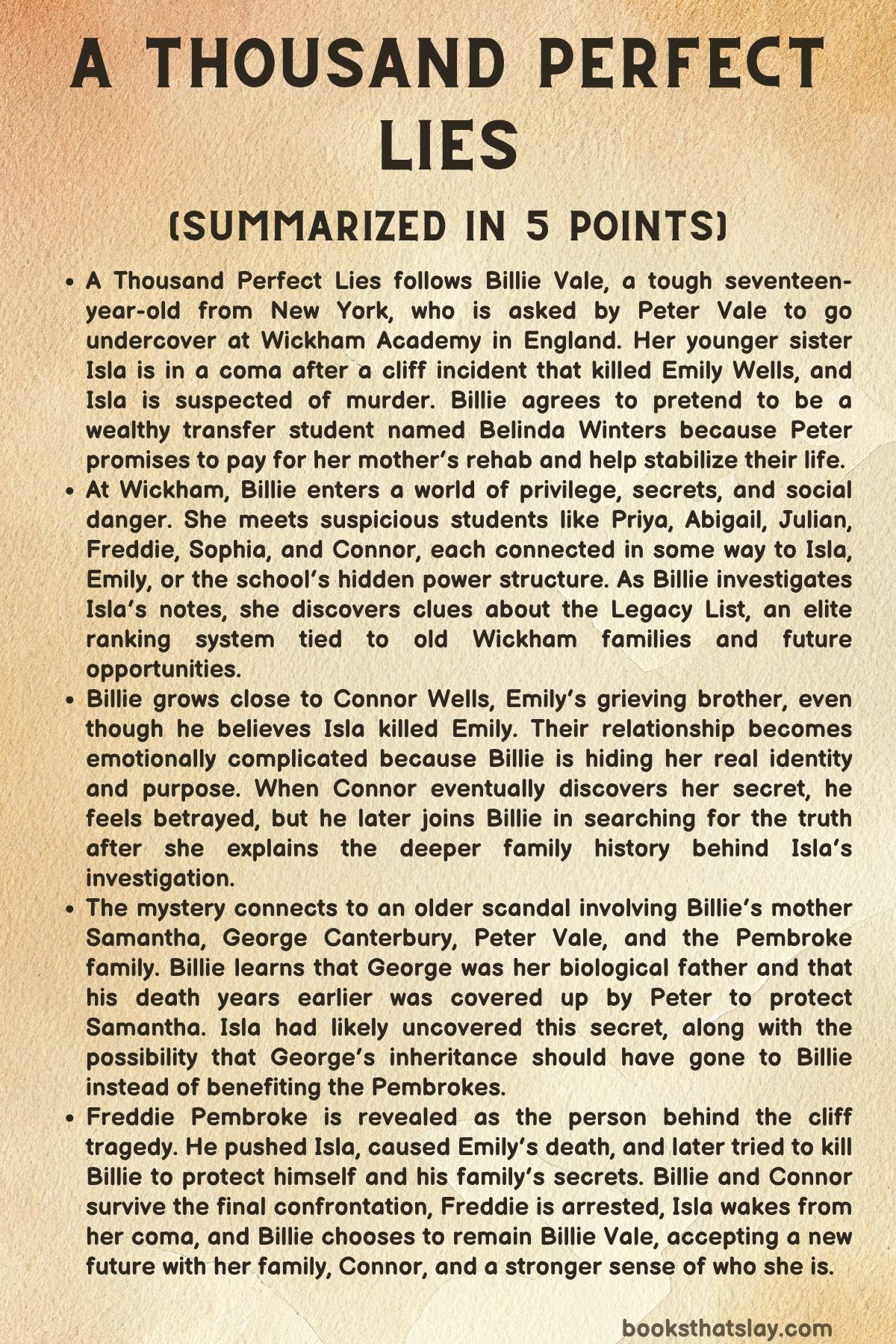
A Thousand Perfect Lies by Monica Murphy is a young adult mystery romance centered on Billie Vale, a tough New York teenager who is forced into a world of wealth, secrets, and old family damage. When her estranged father asks her to impersonate a polished student at an elite English academy, Billie agrees because her sister Isla is in a coma and accused of murder.
What begins as a desperate undercover mission soon becomes a search for truth, identity, and belonging. The novel combines a suspicious school setting, a tangled family history, and a romance shadowed by betrayal and danger.
Summary
Billie Vale has spent most of her life surviving without help. At seventeen, she works illegally in a New York bar, earns whatever money she can, and tries to care for her alcoholic mother.
Her life is hard, but it is familiar. That changes when Peter Vale, the wealthy man she believes is her father, summons her to England.
Billie’s younger sister Isla is in a coma after a terrible incident at Wickham Academy, an elite boarding school. Isla’s best friend, Emily Wells, is dead, and the official story suggests Isla pushed Emily from a cliff before jumping after her.
If Isla wakes, she may be arrested for murder.
Peter offers Billie a bargain. If she goes undercover at Wickham and finds out what really happened, he will pay for her mother’s rehab and keep their rent covered.
Billie agrees, partly out of necessity and partly because Isla is family, even if they have not grown up together. On the flight to England, Billie erases her old public identity and tries to become Belinda Winters, a rich, polished Manhattan transfer student.
The transformation is awkward from the start, but Billie has spent her life reading people and adapting quickly, skills that become essential once she reaches Wickham.
Before going to school, Billie visits Isla in the hospital. Seeing her sister unconscious makes the situation real.
A police officer posted nearby confirms that Isla is not being treated only as a victim. Peter gives Billie information about Wickham, Isla’s classmates, and the strange notes Isla left behind.
Billie learns that Isla had been investigating the school’s history before the cliff incident. Those notes become the first signs that Emily’s death and Isla’s injuries may be connected to secrets far older than either girl.
At Wickham, Billie enters a world ruled by money, status, reputation, and old family names. Peter’s wife, Whitney, warns her that no one can know who she really is.
Billie is placed in East House with Priya Shah, a brilliant and intimidating student, and soon meets Abigail Roth, Priya’s fiercely possessive best friend. She also hears about Connor Wells, Emily’s older brother, who believes Isla killed his sister.
Billie notices that Wickham is full of people who seem to be hiding something. Even her room feels unsafe.
She finds a hidden Polaroid of Isla with another girl whose face has been violently scribbled out, and soon someone moves Isla’s yearbook from its hiding place, proving that Billie’s belongings have been searched.
Billie’s first real ally is Sophia Harrington, the headmaster’s daughter. Sophia is kinder than most students and helps Billie understand Wickham’s social rules.
Through Sophia, Billie learns about the Legacy List, a secretive ranking system that grants favored students access to privilege, university opportunities, and future power. Isla’s notes refer to “LLAMAS,” a nickname tied to the list, and include the surnames of important Wickham families.
Billie begins connecting current students to their parents’ generation and realizes that Isla had been tracing a pattern involving Wickham’s past.
Billie also meets Connor in art class. Their first exchanges are tense, especially because Connor openly blames Isla for Emily’s death.
Yet their attraction grows despite the danger of Billie’s lies. Connor is grieving, angry, and isolated, but he is also perceptive and deeply wounded by his family’s disgrace.
His father was once linked to a corporate scandal involving William Pembroke and Lumateg, a powerful company tied to Wickham wealth. As Billie spends more time with Connor, she becomes aware that the truth may not be limited to Isla, Emily, and their classmates.
Wickham’s adult world may be just as guilty as its students.
Billie investigates several suspects. Priya admits she runs an anonymous exam-selling operation and wants the top Legacy List position because it could secure a future for her and help her family.
Isla had threatened to expose Priya unless she helped Emily, giving Priya a motive. Abigail, devoted to Priya, reacts with threatening loyalty and remains suspicious.
Julian Ashworth, Isla’s secret boyfriend, admits he hid their relationship because of a feud between his father and Peter Vale. Julian seems selfish and weak, but Billie doubts he is capable of murder.
Freddie Pembroke, however, becomes increasingly unsettling. He is charming, cruel, wealthy, and connected to the Lumateg scandal through his family.
Billie’s relationship with Connor deepens. He takes her on a thoughtful date, sees parts of her that others miss, and offers a kind of tenderness she has rarely known.
But when he discovers Isla’s yearbook and Peter’s dossier in the art room, he realizes Billie has been lying. She confesses that she is not Belinda Winters and that she came to Wickham to investigate Isla’s case.
Connor feels betrayed, especially because Billie’s mission involves his sister’s death. He rejects her and threatens to expose her.
Billie believes she has lost both the investigation and the one person at Wickham who truly understood her.
Before leaving, Billie goes to the hospital and confronts Peter about the older secrets Isla may have uncovered. Peter finally tells her the truth about Samantha, Billie’s mother, and George Canterbury, a Wickham student from the 1998 generation.
Samantha had been involved with George and was pregnant with Billie when George rejected her on the cliff. During the confrontation, Samantha pushed him, causing his death, and Peter covered it up to protect her.
Peter married Samantha knowing Billie was not biologically his. Billie learns that she is George Canterbury’s daughter by blood, but also that Peter protected her before she was even born.
This revelation changes everything. Billie and Connor later reason that Isla may have discovered Billie’s real paternity and the financial consequences tied to George’s inheritance.
If George’s trust should have gone to Billie but instead benefited Daphne and William Pembroke, then the Pembroke family had a powerful motive to silence Isla. Billie and Connor confront Freddie near the cliffside tree.
Freddie, drunk and unstable, admits that he found Billie’s hidden documents and tried to scare her. He also reveals that Isla had confronted him with evidence about George, Billie, and the money.
Freddie finally confesses what happened on the cliff. He pushed Isla, Emily reacted in fury, and when she rushed at him, he stepped aside and let her fall.
Then he pushed Isla again, leaving her badly injured. When Billie attacks him in rage, Connor restrains her, but Freddie becomes violent.
He injures Connor and tries to force Billie toward the cliff, planning to stage her death as suicide. Billie keeps him talking until help approaches, then tricks him by leaping at him instead of off the cliff.
She tackles him and holds him down until the police arrive.
Freddie is arrested, Connor survives his injuries, and Isla wakes from her coma. Billie tells Isla that they found the truth and cleared her name.
In the aftermath, Billie chooses the Vale name despite learning she is a Canterbury by blood. Weeks later, Isla returns home after rehabilitation, Billie begins building a life with Peter, Whitney, and her sister, and her mother continues recovery.
Billie’s future opens beyond survival. By pretending to be Belinda Winters, she discovers that she is not defined by abandonment, poverty, lies, or inheritance.
She is Billie Vale because that is the identity she claims for herself.
Characters
Billie Vale
Billie Vale is the emotional center of A Thousand Perfect Lies, and her growth gives the book its strongest sense of movement. At the beginning, she is a hardened survivor who has learned to depend on herself because the adults in her life have often failed her.
She works in a bar, protects her mother, manages fear through sarcasm, and treats vulnerability as a risk. Her undercover role as Belinda Winters forces her into a world that seems designed to reject her, yet Billie’s street intelligence becomes as valuable as wealth or social training.
She reads tone, body language, lies, and power dynamics with unusual sharpness. What makes her compelling is not that she is fearless, but that she keeps acting while afraid.
Her investigation into Isla’s case gradually becomes more than a bargain with Peter. It becomes a way to claim family, truth, and a future she never believed she could have.
Billie’s identity crisis is also central to her character. Learning that Peter is not her biological father could have shattered her, but instead it helps her understand that love and loyalty are not limited to blood.
By choosing to remain Billie Vale, she rejects the idea that inheritance or social status can define her worth.
Connor Wells
Connor Wells is shaped by grief, anger, and a strong need for justice. As Emily’s older brother, he enters the book carrying the belief that Isla is responsible for his sister’s death, which immediately places him in opposition to Billie’s mission.
His bitterness is not simple cruelty; it comes from loss, public shame, and a family history damaged by the Lumateg scandal. Connor’s father has been treated like a criminal, his family name has been damaged, and Emily’s death leaves him emotionally frozen.
His art reflects this pain, especially when grief blocks his ability to create. With Billie, Connor becomes more open, but never in a way that removes his suspicion or pride.
Their romance works because both of them are guarded, wounded, and used to surviving emotional danger. Connor’s greatest conflict is between his love for Billie and his anger over her deception.
His reaction when he discovers her identity is harsh but understandable because her lie touches the rawest part of his life. Still, he proves capable of listening, reasoning, and choosing truth over revenge.
His temptation to let Freddie fall shows the depth of his rage, while his eventual survival and reconciliation with Billie show that he is not defined only by pain.
Isla Vale
Isla Vale is physically absent for much of the story, but her presence drives almost every major event. She is introduced as a coma patient and a suspected murderer, yet the clues she leaves behind reveal a determined, intelligent, and brave young woman.
Isla had been investigating Wickham’s Legacy List, older family connections, and the truth about George Canterbury before she was attacked. Her curiosity was not casual; she followed patterns, collected evidence, and noticed that elite families were protecting secrets across generations.
This makes her more active than her condition initially suggests. Isla’s relationships also reveal her complexity.
Her friendship with Emily was intense enough to become central to the case, and her hidden romance with Julian shows how much pressure Wickham’s family rivalries placed on students. Isla is vulnerable because she is young and trapped within a system of adult power, but she is not passive.
She risks herself to expose a truth that powerful people would rather bury. When she wakes and asks for Emily, the tragedy of her experience becomes clear.
She has survived, but survival comes with grief, recovery, and the painful knowledge that her search for truth cost her best friend’s life.
Peter Vale
Peter Vale first appears cold, controlled, and transactional. He summons Billie to England and offers practical help for her mother in exchange for Billie’s cooperation, which makes him seem like a wealthy father using one daughter to save another.
Yet as the story develops, Peter becomes more layered. His emotional restraint hides guilt, fear, and old love.
His past with Samantha and George Canterbury explains much of his behavior. Peter covered up George’s death to protect Samantha, married her knowing Billie was not his biological child, and carried the consequences of that decision for years.
He failed Billie in many ways by allowing distance and abandonment to shape her childhood, but he is not heartless. His love for Isla is clear, and his eventual care for Billie becomes meaningful because it is imperfect and overdue.
Peter’s role in A Thousand Perfect Lies raises difficult questions about protection and concealment. He saved Samantha and Billie from immediate ruin, but the hidden truth allowed future harm to grow.
His character shows how secrets kept in the name of love can still become dangerous when they are never faced honestly.
Whitney Ashbourne-Vale
Whitney Ashbourne-Vale begins as an intimidating figure who seems more concerned with control than warmth. She understands Wickham’s elite world and knows exactly how dangerous exposure could be for Billie, Peter, and Isla.
Her instructions are sharp, and her emotional distance makes Billie wary of her. However, Whitney’s love for Isla soon breaks through her polished surface.
When Billie wants to quit, Whitney pleads with her to stay, revealing a mother’s desperation rather than a socialite’s calculation. This moment changes the way she should be understood.
Whitney is not simply Peter’s wealthy wife or Isla’s stepmother; she is a woman terrified of losing the child she loves. Her practical nature becomes a strength because she can organize, protect, and act quickly under pressure.
She also becomes unexpectedly caring toward Billie, especially when she talks about Billie’s future and university. Whitney represents a form of parenthood built through action.
She may not be openly soft, but she provides structure, protection, and long-term concern. Her development helps Billie see that family can arrive in unfamiliar forms and that care is not always expressed through easy affection.
Sophia Harrington
Sophia Harrington is one of the few characters at Wickham who offers Billie kindness without immediate self-interest. As the headmaster’s daughter, Sophia belongs to the privileged world Billie is trying to infiltrate, yet she is also lonely inside it.
Her room, with its impersonal perfection, reflects a life where appearances matter more than emotional comfort. Sophia becomes Billie’s refuge at a time when Priya, Abigail, and the larger social group feel threatening.
Her importance lies not only in her support but in her moral steadiness. She listens when Billie finally confesses the truth about being Isla’s sister, and instead of exposing her, she helps.
Sophia also plays a crucial role in the final confrontation by telling her parents about Billie and Connor’s plan, which brings help to the cliff in time. She is not as aggressive as Billie or as wounded as Connor, but she has quiet courage.
Her position gives her access, and her conscience helps her use that access wisely. Sophia’s character shows that privilege does not automatically erase loneliness, but it does create responsibility when someone has the power to help.
Priya Shah
Priya Shah is ambitious, brilliant, defensive, and morally complicated. As Billie’s roommate, she initially appears hostile and suspicious, and her relationship with Abigail adds another layer of tension.
Priya’s secret exam-selling business makes her a serious suspect because Isla had threatened to expose her. Yet Priya’s motives are not rooted only in selfishness layer of tension.
She wants the top Legacy List position because it could secure opportunities not just for herself but also for her younger siblings. Unlike many Wickham students, she does not have generations of family privilege protecting her.
Her intelligence is both a weapon and a survival tool. Priya has learned to operate within a corrupt system by becoming useful, feared, and difficult to challenge.
This does not excuse her actions, especially because selling exams harms others and gives her power over desperate students, but it makes her understandable. Her bond with Abigail is intense, private, and protective, suggesting that Priya’s emotional life is more fragile than her public image.
She is not the villain, but she is a reminder that pressure can push talented people into dangerous choices.
Abigail Roth
Abigail Roth is defined by loyalty, possessiveness, and sharp aggression. She is especially protective of Priya, and that protection often comes across as threatening.
Her hostility toward Billie makes her an early suspect, particularly when her language echoes the insults connected to the vandalized Polaroid and mirror. Abigail’s anger feels volatile enough that Billie can imagine her acting violently if Priya were in danger.
Yet Abigail is not a simple bully. Her behavior grows out of deep attachment and fear of losing control over the person she loves.
She sees Billie as an intruder who could damage Priya’s future, expose her secrets, or disrupt their bond. Abigail’s intensity makes her morally unsettling because love, in her case, can look like possession.
She also reflects Wickham’s atmosphere, where students learn to protect status and relationships through intimidation. Even when she is not responsible for the attack on Isla and Emily, she contributes to the climate of fear that allows secrets to survive.
Abigail shows how devotion can become dangerous when it leaves no room for honesty, trust, or the independence of the person being protected.
Freddie Pembroke
Freddie Pembroke is the central human threat in A Thousand Perfect Lies, though the full scale of his danger becomes clear only near the end. At first, he appears as a privileged, cruel, charming student who enjoys making others uncomfortable.
He uses humor and social confidence as weapons, and because he comes from an extremely powerful family, he seems used to moving through Wickham without consequences. His connection to William Pembroke and the Lumateg scandal places him inside the book’s wider structure of inherited wealth and hidden corruption.
Freddie’s violence is tied to entitlement. When Isla uncovers the possibility that George Canterbury’s trust should have gone to Billie instead of benefiting the Pembrokes, Freddie treats the truth as an attack on his family’s power.
His confession near the cliff reveals both cowardice and brutality. He pushed Isla, let Emily fall, and later tried to force Billie into a staged death to protect himself.
What makes Freddie frightening is his lack of remorse. He sees people as obstacles, not as lives.
His downfall exposes the danger of a world where wealth teaches young people that accountability is optional.
Julian Ashworth
Julian Ashworth is weak in a quieter but still damaging way. As Isla’s secret boyfriend, he loved her, or at least cared for her, but he lacked the courage to stand publicly beside her.
His secrecy is partly shaped by the feud between his father, Max Ashworth, and Peter Vale, but that explanation does not remove his responsibility. Julian benefits from silence while Isla carries more emotional risk.
When Billie confronts him, he appears guilty and regretful, but his regret comes too late to help Isla before the attack. He is not portrayed as murderous, and Billie eventually judges him as selfish rather than dangerous.
That distinction matters because the book separates moral failure from direct violence. Julian’s flaw is cowardice.
He wants love without consequences, and he hides behind family politics instead of challenging them. His later reconnection with Isla suggests that he may have a chance to grow, but trust will require more than affection.
Julian’s character shows how silence can hurt even when it is not intended as cruelty.
Emily Wells
Emily Wells is dead before the main action begins, but her life and death shape the emotional stakes of the story. To the police and many students, she is the victim whose death needs a culprit, and Isla becomes the easiest answer.
Through later revelations, Emily becomes more than a name attached to tragedy. She was academically vulnerable, connected to Priya through the “Little” system, and close enough to Isla that Isla risked pressure to help her.
Emily’s final act, rushing at Freddie after he hurt Isla, suggests fierce loyalty and courage. Her death is especially painful because it comes from an impulsive attempt to defend her friend.
Emily also matters because Connor’s grief over her drives much of his anger. He needs someone to blame because the alternative is facing a senseless loss inside a corrupt environment.
Emily represents the cost of Wickham’s hidden power games. She is not part of the old inheritance secret, yet she dies because that secret reaches into the lives of the next generation.
Samantha
Samantha, Billie’s mother, is one of the most tragic figures in the novel because her past explains much of Billie’s present. Once connected to Wickham and to George Canterbury, Samantha’s life changed after George rejected her while she was pregnant.
Her act of pushing George from the cliff was violent and irreversible, but it emerged from humiliation, fear, and emotional collapse. Peter’s cover-up saved her from legal consequences, yet it did not save her from trauma.
Years later, Samantha’s alcoholism and inability to care for Billie are part of the damage left behind by that buried event. She is not presented as a good mother in any simple sense; Billie has had to become the responsible one far too young.
Still, Samantha is not reduced to her failures. Her recovery arc, supported by rehab and Doug’s companionship, gives her a chance to become more stable.
Her character shows how unprocessed trauma can spread she dies because that secret reaches into the lives of the next generation.
Doug
Doug is a minor character in terms of plot, but he is important because he offers Billie one of the earliest examples of steady adult care. As Billie’s boss at the bar, he knows she is underage and working in difficult conditions, yet he treats her with concern rather than exploitation.
Their goodbye shows that their bond matters, even though both try to hide their emotions. Doug’s later role as Samantha’s supportive roommate and companion in sobriety adds quiet hope to the ending.
He is not wealthy, powerful, or connected to Wickham’s secrets, but he represents ordinary loyalty. In a book filled with elite families who protect reputations at any cost, Doug’s decency stands out.
He helps without turning that help into control. For Billie, who has spent much of her life expecting adults to disappoint her, Doug’s presence matters because it proves that care can be practical, consistent, and unglamorous.
He helps ground the story outside the world of privilege and reminds readers that chosen support systems can be just as meaningful as blood relations.
Themes
Identity Chosen Over Inheritance
Billie’s journey centers on the question of who gets to define her. At first, identity seems like something assigned by others.
Peter asks her to become Belinda Winters, Wickham judges her by wealth and manners, and the Canterbury secret threatens to reduce her to a bloodline and a lost inheritance. Yet Billie’s strongest moments come when she refuses to let any of those labels control her.
Her Belinda identity is false, but it teaches her how much performance exists inside elite society. Many Wickham students are also acting, only their roles are protected by money and history.
Billie’s discovery that George Canterbury is her biological father could have transformed her into someone chasing status or compensation, but she chooses the Vale name because it represents the family she claims through love, struggle, and choice. A Thousand Perfect Lies treats identity as something shaped by action rather than origin.
Billie is not only Samantha’s abandoned daughter, Peter’s mistake, George’s heir, or Belinda’s mask. She becomes herself by deciding what kind of loyalty matters, what truth she will carry, and what future she is willing to build.
Secrets as Inherited Damage
The story shows how secrets do not stay buried simply because one generation refuses to speak of them. Peter’s cover-up of George Canterbury’s death was meant to protect Samantha and unborn Billie, but the silence created conditions for later harm.
George’s hidden connection to Billie, the misdirected inheritance, and the Pembrokes’ financial benefit all become part of a dangerous chain. Isla’s investigation matters because she sees that the past has not disappeared; it has only been renamed, hidden in yearbooks, lists, family rivalries, and school traditions.
The adults at Wickham protect reputation so fiercely that young people inherit not just wealth, but fear, rivalry, and unfinished consequences. The tragedy at the cliff repeats the earlier cliff death in a distorted way, showing how unresolved guilt can return through new victims.
Billie’s refusal to let Freddie die is especially important because she breaks the pattern. She will not allow another death to become another secret.
The book argues that concealment may feel like protection in the moment, but when truth is avoided for too long, it becomes a danger passed down to people who never chose it.
Privilege, Power, and Accountability
Wickham Academy operates as a training ground for power. The Legacy List, elite family names, alumni influence, and quiet social rules all teach students that success is not only earned; it is inherited, arranged, and protected.
Priya’s exam business exposes one layer of corruption, but the deeper issue is the larger system that makes students desperate for ranking and approval. Freddie represents the most toxic result of this world.
He has absorbed the belief that his family’s status matters more than other people’s lives. His violence is shocking, but it grows from a culture that has repeatedly told him consequences can be managed.
William Pembroke’s corporate scandal expands this theme beyond school walls, showing that adult corruption and student cruelty are connected. Connor’s family suffers public shame while the more powerful figures remain protected for years.
Billie, coming from poverty and instability, sees Wickham more clearly because she is not fully trained to accept its rules. The novel criticizes privilege not by saying every wealthy person is cruel, but by showing how systems built around reputation and access can protect the worst behavior until someone forces the truth into the open.
Love, Loyalty, and Moral Choice
Love in the story is powerful, but it is never automatically pure. Abigail’s loyalty to Priya becomes controlling.
Julian’s love for Isla is weakened by cowardice. Peter’s love for Samantha leads him to hide a death.
Connor’s love for Emily fuels his anger, while his love for Billie is tested by betrayal. These relationships show that love only becomes meaningful when joined with moral courage.
Billie’s arc is shaped by learning the difference between loyalty that protects truth and loyalty that protects lies. She agrees to help Isla partly because of family duty, but her commitment grows into something deeper as she understands what Isla risked.
Her romance with Connor also depends on honesty. Their connection cannot survive as fantasy once he learns she has lied; it can only continue after she tells him the truth and allows him to choose what to do with it.
The final cliff confrontation brings this theme into sharp focus. Billie loves Connor and wants Freddie punished, but she still tries to prevent another death because she knows revenge would repeat the damage that ruined her family.
The story presents love as a force that must be guided by conscience, not possession, fear, or pride.