Between Two Fires Summary, Characters and Themes
Between Two Fires by Christopher Buehlman is a dark historical fantasy set in plague-stricken fourteenth-century France, where human suffering becomes the battlefield for a war between Heaven and Hell. The novel follows Thomas, a ruined knight living as a robber, and Delphine, a strange young girl who believes she has been chosen for a divine mission.
Their journey through burned towns, diseased cities, and places touched by demons turns into a harsh test of faith, guilt, courage, and mercy. The book blends medieval horror with religious conflict, showing a world where salvation is uncertain but still possible.
Summary
Between Two Fires begins in 1348, when Europe is being crushed by famine, war, and the Black Death. In this world, the plague is not only a natural disaster.
It is part of a larger assault by fallen angels who believe God has gone silent. Lucifer and his followers see human misery as a way to challenge Heaven, using sickness, fear, and corruption to weaken the order of creation.
Loyal angels still defend humanity where they can, but their power seems limited, and the world feels abandoned.
In Normandy, Thomas is far from the honorable knight he once was. Disgraced and dispossessed, he survives as a brigand with three rough companions.
They rob, kill, and prey on the weak in a countryside already ruined by war and disease. Their path changes when they encounter a young girl named Delphine, whose father has died.
She asks the men for help burying him. The situation turns violent when one of the brigands, Godefroy, tries to assault her.
Thomas kills him and another companion, then spares Jacquot only because Delphine asks him to. This act does not make Thomas a hero, but it shows that some buried part of his former honor remains.
Thomas helps bury Delphine’s father and means to leave her at the next town. Delphine, however, insists that she must go to Paris and then to Avignon.
She claims she has been guided by visions and that her journey matters to God. Thomas is doubtful and often irritated by her certainty, but he agrees to take her part of the way.
They are soon joined by Père Matthieu, a priest whose own faith has been badly shaken. Together, the three begin crossing a France that seems to be collapsing from both earthly and supernatural forces.
Their journey quickly shows that the world has become stranger and more dangerous than Thomas wants to admit. Villages are empty or full of corpses.
Churches stand abandoned. Monks lie dead.
Signs of demonic influence appear in forms that are both physical and spiritual. In the town of St. Martin-le-Preux, the travelers meet Matthieu, whose people are trapped by a monstrous creature in the river.
Thomas is pushed into facing it and kills the huge eel-like beast, though he is badly wounded and poisoned by the encounter.
Delphine then leads Matthieu to a shrine connected to a statue of the Virgin Mary. The shrine becomes the center of conflict between desperate villages, and the statue is destroyed.
Yet from its broken hand, Delphine performs a miracle and heals Thomas. This deepens the mystery around her.
She is still a child, frightened and vulnerable, but she also appears to be an instrument of Heaven. Thomas does not know whether to trust her visions, but he begins to feel responsible for her safety.
As the three move toward Paris, they arrive at a strange castle where Thomas and Matthieu are drawn into a grotesque feast. Delphine refuses to enter, sensing danger.
The castle’s lord stages a night tournament, but the event is revealed as a demonic trap. The feast, the tournament, and the castle itself expose the travelers to a world where evil can imitate the customs of nobility and religion while turning them into mockery.
Thomas survives, but the experience confirms that their road is being watched and contested by powers beyond ordinary human cruelty.
Paris is even worse. The city is burning, starving, and full of plague.
Madness and fear rule the streets. Delphine searches for an object she has been told she needs and eventually finds a hidden wooden statue of the Virgin in the home of a woman named Annette.
While there, Thomas is forced to face memories of his former life. He remembers the Battle of Crécy, his disgrace, and the betrayal that cost him his lands and standing.
These memories explain his bitterness, but they do not excuse the man he has become.
After Paris, Matthieu confesses the shame that has followed him. He had fallen in love with a widow and failed in his priestly duties.
His weakness helped drive his parishioners away from the sacraments at the very time they most needed spiritual care. Like Thomas, Matthieu carries guilt that cannot be easily erased.
Delphine’s mission forces both men to confront the truth about themselves. Their sins are different, but both have failed the people who depended on them.
The attacks against the travelers increase. They face plague victims, soldiers, monsters, and demonic figures that try to break their bodies and their faith.
Delphine suffers greatly. Her visions come with pain, bleeding, and signs that Heaven is using her at a terrible cost.
Thomas grows more protective of her, though he often resists her commands and questions whether she is truly holy. At times, he sees only a child being crushed by a burden no child should carry.
At other times, he cannot deny the miracles surrounding her.
Their road south is filled with ruined towns, false wonders, undead horrors, and armies touched by Hell. Delphine is separated from Thomas and Matthieu, and her recovery brings more violence.
Thomas also confronts figures from his past, including the Comte d’Évreux, an enemy tied to his fall. His memories of his wife Marguerite continue to haunt him.
Her death, and the betrayal connected to it, remain central wounds in his life. These encounters make Thomas’s journey more than a mission of protection.
It becomes a long reckoning with cowardice, rage, grief, and lost honor.
As they approach Avignon, Jacquot returns. He is no longer merely the spared brigand from the beginning of the story.
He has become connected to darker powers, showing how mercy can have dangerous consequences when a damaged soul chooses evil. His return also reminds Thomas that every decision made along the road carries weight.
In Avignon, the center of Church power, corruption and fear are everywhere. Matthieu’s brother Robert works within the papal household, and the city is full of politics, plague, and hidden demonic influence.
The forces of Hell plan an attack on the pope, hoping to damage Heaven’s order through the Church’s earthly leader. Delphine’s journey has been leading to this moment.
Her visions, the sacred objects, and the suffering she has endured all point toward a final confrontation inside the papal palace.
The battle in Avignon brings the spiritual war into the open. Angels and devils are no longer only distant forces behind plague and nightmare.
Their conflict erupts around Delphine, Thomas, Matthieu, and the pope. Thomas fights with everything he has to protect the girl and stop Lucifer’s plan.
In doing so, he gives himself fully to a cause beyond survival or revenge. His defense of Delphine becomes an act of love, courage, and repentance.
Thomas is killed in the struggle and descends into Hell, where he is tormented. His damnation seems to be the final result of his violent, sinful life.
Yet the novel does not leave him there. Delphine completes her holy purpose and helps bring the host of Heaven against the fallen powers.
Through mercy, Thomas is judged and restored. His salvation is not presented as something he has earned by being pure.
Instead, it comes through grace, sacrifice, and the part of him that chose to protect the innocent even after years of failure.
Thomas awakens later in a cart, wounded but alive, traveling again with Delphine and Matthieu. The world has not been healed.
The plague still exists, war still scars the land, and human suffering continues. But the immediate demonic assault has been broken.
The ending does not promise an easy peace. It offers something smaller but still powerful: survival, companionship, and the possibility that even in a ruined world, mercy can reach a soul thought to be lost.
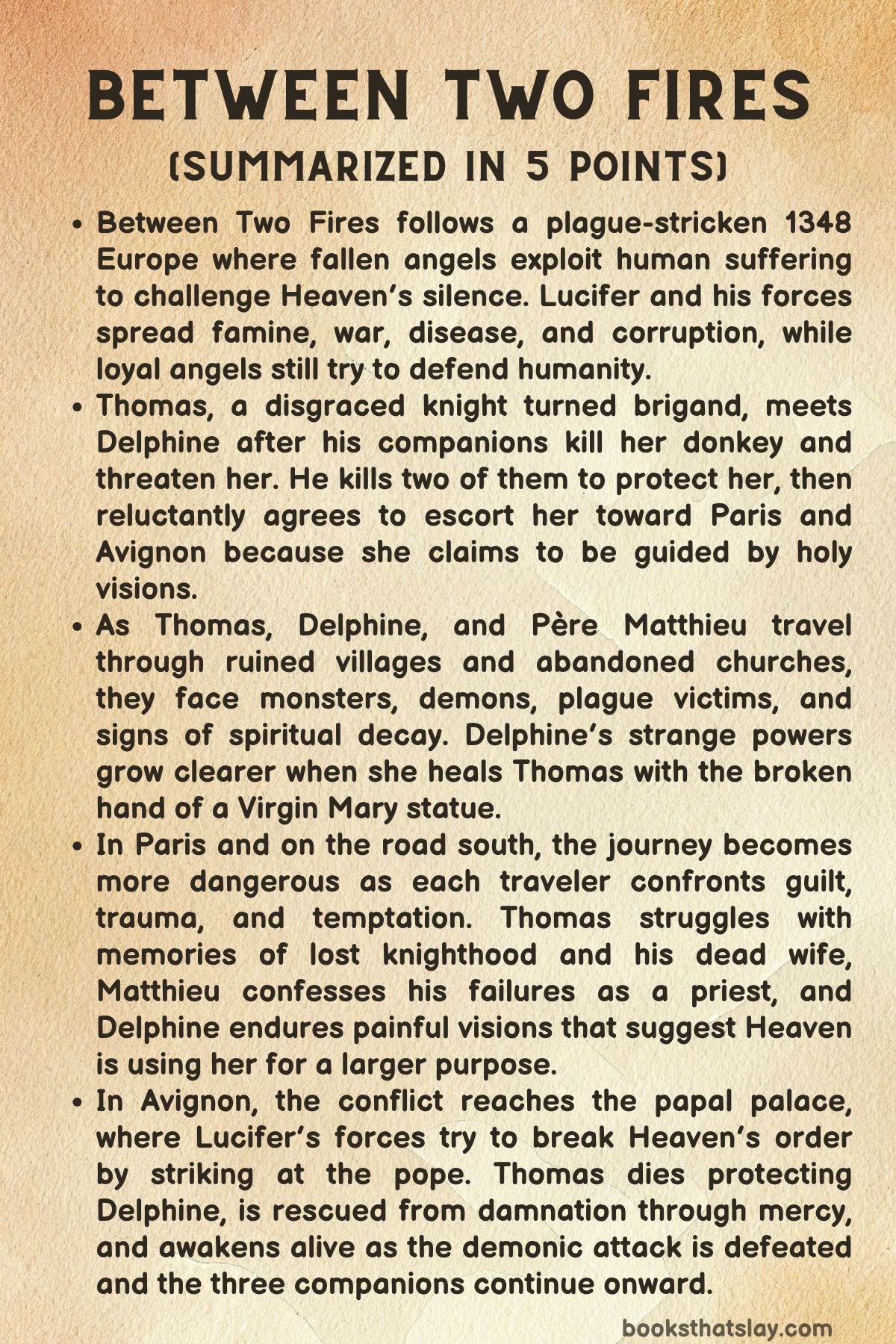
Characters
Thomas
Thomas is the central human figure in Between Two Fires, and his character is built around guilt, violence, wounded honor, and the difficult possibility of redemption. At the beginning of the story, he is no longer the noble knight he once was.
He has become a disgraced brigand, living by force and traveling with men who represent the cruelty and moral collapse of the plague-stricken world. Yet Thomas is never presented as purely evil.
His decision to protect Delphine from Godefroy reveals that some part of his old moral self still survives beneath his brutality. He is rough, angry, suspicious, and often selfish, but he is also capable of loyalty, courage, and sacrifice.
Thomas’s journey is not only a physical movement through ruined France, but also a spiritual struggle between damnation and grace. His memories of war, betrayal, Marguerite, and the loss of his former life show that he is a man broken by both public violence and private grief.
He often resists Delphine’s mission because he does not fully understand it, and because faith has become difficult for him after everything he has seen and done. Still, his growing protectiveness toward her gradually changes him.
He begins as someone who survives through violence, but he becomes someone who uses that violence in defense of the innocent. His death and descent into Hell are the fullest expression of his guilt, but his restoration shows that the book treats redemption as painful, mysterious, and possible even for a deeply sinful man.
Delphine
Delphine is one of the most important and mysterious characters in the book. She appears at first as a vulnerable young girl who has lost her father and has no obvious protection in a world ruled by plague, hunger, soldiers, demons, and fear.
However, she quickly proves to be much more than a helpless child. She is guided by visions and seems to be chosen by Heaven for a sacred purpose.
Her innocence gives her moral power, but that innocence is never simple or sentimental. She suffers intensely, both physically and spiritually, and her body becomes a place where divine purpose and human pain meet.
Delphine’s role is powerful because she combines childlike vulnerability with frightening spiritual authority. She can be gentle, pleading, and compassionate, as seen when she asks Thomas to spare Jacquot, but she can also command others with a certainty that unsettles them.
Thomas and Matthieu often struggle to understand whether she is a saint, a prophet, a witch, or simply a child being used by forces far beyond her understanding. This uncertainty makes her one of the most complex figures in the story.
Delphine represents hope, but not an easy kind of hope. Through her, the book suggests that divine grace may enter the world through suffering, obedience, and sacrifice rather than through comfort or safety.
Père Matthieu
Père Matthieu is a deeply human religious figure whose weakness makes him more believable and more moving. He is introduced as a frightened priest in a devastated town, and his fear is important because it shows how completely the world’s spiritual order has been shaken.
He is not a heroic priest untouched by doubt. Instead, he is ashamed, uncertain, and aware of his own failures.
His confession about falling in love with a widow and failing his parishioners shows that his guilt is not abstract. He believes he has betrayed his duties and helped lead others away from the sacraments at the very moment they needed spiritual strength most.
Matthieu’s character matters because he shows the difference between religious office and living faith. Although he is weak and frightened, he continues moving forward with Thomas and Delphine, and that decision becomes a form of courage.
He often serves as a moral and theological witness, trying to interpret events that are too terrible for ordinary explanation. His presence also balances Thomas’s violence and Delphine’s holiness.
Matthieu is neither warrior nor prophet, but a flawed servant of God who keeps trying despite his shame. His journey suggests that faith does not require the absence of fear; rather, it requires continuing to act when fear and guilt are still present.
Lucifer
Lucifer is the great spiritual antagonist of the story, and his importance lies not only in his power but in his argument against Heaven. He sees humanity’s suffering as evidence that God’s order can be challenged.
By bringing famine, war, plague, and demonic corruption into the world, he attempts to prove that Heaven is silent, distant, or vulnerable. His rebellion is therefore intellectual and spiritual as well as violent.
He does not merely want destruction; he wants suffering to become a kind of proof.
As a character, Lucifer represents pride, accusation, and the desire to turn pain into rebellion. His attack on humanity is also an attack on divine mercy, because he wants the brokenness of the world to appear stronger than grace.
He is terrifying because his evil works through both supernatural horror and ordinary despair. The plague, corrupted towns, political intrigue, and human cruelty all become part of his larger strategy.
In Between Two Fires, Lucifer is not just a monster commanding other monsters; he is the force that tries to make the world believe that abandonment is the final truth.
Godefroy
Godefroy is one of Thomas’s violent companions at the beginning of the story, and he represents the brutal lawlessness into which Thomas has fallen. His attempted assault on Delphine immediately marks him as predatory and morally degraded.
He is not a complicated redemptive figure like Thomas; instead, he functions as a dark reflection of what Thomas could become if he surrendered fully to cruelty. Godefroy’s behavior forces Thomas into a defining moral choice.
His death is important because it separates Thomas from the worst part of his brigand life. By killing Godefroy, Thomas does not become innocent, but he does draw a line.
That line begins his movement away from selfish survival and toward reluctant guardianship. Godefroy’s role in the book is brief but significant because he helps reveal the moral difference between a violent man who still has a conscience and a violent man who has abandoned one.
Jacquot
Jacquot begins as one of the brigands traveling with Thomas, and his survival depends on Delphine’s plea for mercy. This early moment is important because Jacquot becomes a reminder that mercy can have complicated consequences.
He is spared when others are killed, but his later return in service to sinister powers shows that being saved physically is not the same as being spiritually transformed. His character carries the uneasy question of whether mercy can be rejected by the person who receives it.
Jacquot also acts as a link between Thomas’s old life of crime and the demonic forces that later threaten the travelers. His reappearance near Avignon gives his character a darker purpose, suggesting that evil often works through familiar human faces rather than distant abstractions alone.
He is not as grand or powerful as Lucifer, but he is disturbing because he shows how ordinary cowardice, resentment, and corruption can be absorbed into a larger spiritual war.
Marguerite
Marguerite is Thomas’s dead wife, and although she is not present as an active traveling character, she has a powerful influence on Thomas’s inner life. Her memory is tied to his grief, shame, and sense of betrayal.
Through Marguerite, the book reveals that Thomas’s fall is not only the result of war or social disgrace, but also of personal devastation. She represents the life he lost and the emotional wound he carries beneath his anger.
Marguerite’s importance comes from the way she humanizes Thomas. Without her memory, he might seem only like a violent former knight.
With her, the reader sees that his brutality is connected to sorrow and humiliation. She also deepens the theme of lost love in a world where death and betrayal have damaged nearly every form of trust.
Thomas’s memories of her do not excuse his sins, but they help explain the broken man he has become.
The Comte d’Évreux
The Comte d’Évreux is connected to Thomas’s past humiliation and loss, making him an important figure in Thomas’s personal conflict. He represents the corrupt worldly power that helped destroy Thomas’s former identity as a knight, husband, and landholder.
When Thomas confronts him, the encounter is not merely about revenge. It is also about Thomas facing the human source of some of the bitterness that has shaped him.
The Comte’s role is significant because he shows that evil in the book is not limited to demons. Human betrayal, aristocratic cruelty, greed, and abuse of power are also part of the ruined moral landscape.
He belongs to the worldly system that has failed just as surely as villages, churches, and armies have failed. Through him, Thomas’s private history connects with the larger collapse of justice in plague-stricken France.
Robert
Robert, Matthieu’s brother, works within the papal household in Avignon and represents the political and institutional side of the religious world. Through him, the story enters a setting where faith, power, corruption, and bureaucracy are tightly intertwined.
Robert’s position near the papal court makes him important because Avignon is not only a holy destination, but also a place of intrigue and hidden danger.
Robert’s character helps show that the Church in the story is both spiritually necessary and humanly compromised. He is connected to Matthieu by family, but his world is very different from the ruined roads and villages the travelers have crossed.
His presence in Avignon emphasizes that the battle between Heaven and Hell is not only fought in wilderness, rivers, and burning towns, but also inside institutions that claim sacred authority.
Annette
Annette is important because she guards or possesses the hidden wooden statue of the Virgin that Delphine needs in Paris. Her role may be smaller than that of Thomas, Delphine, or Matthieu, but she becomes part of the chain of providence that allows the holy mission to continue.
In a city consumed by hunger, fire, plague, and madness, Annette’s connection to the statue makes her home a place where sacred meaning survives amid chaos.
Annette’s character also shows how ordinary people can become important within a divine struggle without fully understanding the scale of events around them. She is not a warrior or prophet, but she is linked to an object of deep spiritual importance.
Through her, the story suggests that holiness can be hidden in poor, frightened, or unexpected places.
Père Matthieu’s Widow
The widow whom Matthieu loved is important mainly through Matthieu’s confession and memory. She represents his failure to live fully according to his priestly vows and responsibilities.
His love for her is not portrayed simply as villainous, but it becomes a source of shame because it distracted him from his duties and contributed to the spiritual weakening of his parish.
Her character matters because she reveals Matthieu’s emotional humanity. He is not only a priest who failed in public; he is also a lonely man who desired love and comfort.
Through this unnamed widow, the book explores the tension between human longing and religious obligation. Matthieu’s guilt over her shows how private weakness can become spiritually devastating when it affects others who depend on him.
Delphine’s Father
Delphine’s father is dead when the main action begins, but his death sets the emotional and moral movement of the story in motion. Delphine’s request for help burying him brings her into contact with Thomas and his companions.
This moment exposes the cruelty of the brigands, but it also awakens Thomas’s buried conscience. In that sense, Delphine’s father matters because his burial becomes the first step in Thomas’s transformation.
He also represents the countless ordinary people destroyed by plague and social collapse. His death is personal for Delphine, but it also reflects the wider world of abandoned bodies, broken families, and lost rituals.
The need to bury him properly shows the importance of dignity even when civilization seems to have failed. His character is silent, but his death creates one of the first moral tests in the book.
The Pope
The pope is important less as an intimate character and more as a symbol of sacred order under attack. In Avignon, Lucifer’s forces seek to strike at him because damaging the papacy would mean more than killing one man.
It would represent an assault on the visible structure of Christian authority in the world. The pope therefore becomes a target through which the larger war between Heaven and Hell is focused.
His presence also reveals the vulnerability of religious institutions during catastrophe. The papal court is surrounded by plague, politics, corruption, and demonic influence, showing that holiness and danger can exist in the same place.
The pope’s role raises the stakes of Delphine’s mission and Thomas’s final acts of protection. Defending him becomes part of defending the fragile connection between Heaven and the human world.
Loyal Angels
The loyal angels represent Heaven’s continuing concern for humanity, even when God appears silent. They do not erase suffering, and they do not prevent the plague from devastating the world, but they work where they can to resist the fallen powers.
Their presence complicates the feeling of abandonment that hangs over the story. Heaven may be mysterious and difficult to understand, but it is not absent in a simple sense.
As characters within the spiritual structure of the book, the loyal angels embody obedience, protection, and hidden warfare. They contrast with Lucifer and the fallen angels, whose pride turns suffering into a weapon.
The loyal angels help make clear that the human journey of Thomas, Delphine, and Matthieu is part of a much larger conflict. Their actions show that the visible horrors of the world are only one layer of reality.
Themes
Faith Under Extreme Suffering
In Between Two Fires, faith is not presented as calm belief, but as something tested by fear, hunger, disease, violence, and silence. The world appears abandoned, and this makes belief much harder because suffering seems to have no limit and no clear reason.
Delphine’s visions suggest that Heaven has not fully withdrawn, yet the help she receives is painful, confusing, and often delayed. This makes faith feel less like certainty and more like endurance.
Thomas and Matthieu both struggle because they have seen too much cruelty to trust easily in divine goodness. Their journey shows that faith does not remove fear or doubt; instead, it forces people to act despite both.
The plague-ridden world becomes a place where belief must survive without comfort. The silence of God becomes one of the harshest trials, because characters must decide whether goodness still matters when Heaven seems distant.
Faith, therefore, becomes active resistance against despair.
Redemption Through Action
Thomas’s past is marked by disgrace, violence, failure, and betrayal, but his redemption does not come through words or regret alone. It comes through repeated choices to protect Delphine, help Matthieu, and fight against evil even when he expects no reward.
At first, he acts reluctantly, often out of irritation, guilt, or simple circumstance. Over time, however, his actions begin to reveal a buried sense of honor that his life as a brigand had almost destroyed.
His protection of Delphine becomes a way of recovering the knightly identity he lost, though the story does not make redemption easy or clean. Thomas still doubts, sins, rages, and resists.
This makes his growth more believable, because he is not suddenly transformed into a saint. His redemption is built through sacrifice, especially when he gives himself to defend others.
The novel suggests that a ruined person can still choose courage, and that mercy may reach even those who believe they are beyond saving.
Innocence Against Corruption
Delphine stands at the center of a world that has been poisoned by plague, war, greed, fear, and demonic influence. Her innocence does not mean weakness; instead, it gives her a strange moral force that exposes the corruption around her.
She is a child surrounded by men who exploit, kill, betray, and abandon others, yet she repeatedly changes the direction of those around her. Thomas first sees her as a burden, but her presence forces him to confront what he has become.
Matthieu, too, is drawn back toward his duties because of her. The contrast between Delphine and the ruined world makes the violence feel even more disturbing, because the story places purity directly beside decay.
At the same time, her innocence is not protected from suffering. Her body and spirit are used in painful ways, showing that holiness can carry a terrible cost.
Through Delphine, the novel presents innocence as fragile, powerful, and dangerous to evil.
The Battle Between Despair and Mercy
The story repeatedly places characters in situations where despair would be the easiest response. Towns are destroyed, churches are empty, bodies fill the roads, and even spiritual leaders fail in their duties.
Evil tries to prove that humanity is weak, corrupt, and unworthy of divine protection. Yet mercy keeps appearing in small but meaningful acts: Thomas spares Jacquot, Delphine heals, Matthieu confesses, and broken people continue helping one another.
These moments do not erase the horror around them, but they challenge the idea that suffering has the final word. The conflict between angels and devils is therefore also a conflict inside human beings.
The fallen powers depend on hopelessness, shame, and fear, while grace works through protection, forgiveness, and sacrifice. Thomas’s final judgment makes this theme especially clear, because justice alone would condemn him, but mercy allows another possibility.
The novel argues that mercy is not sentimental; it is a force strong enough to answer damnation itself.