First Witches Club Summary, Characters and Themes
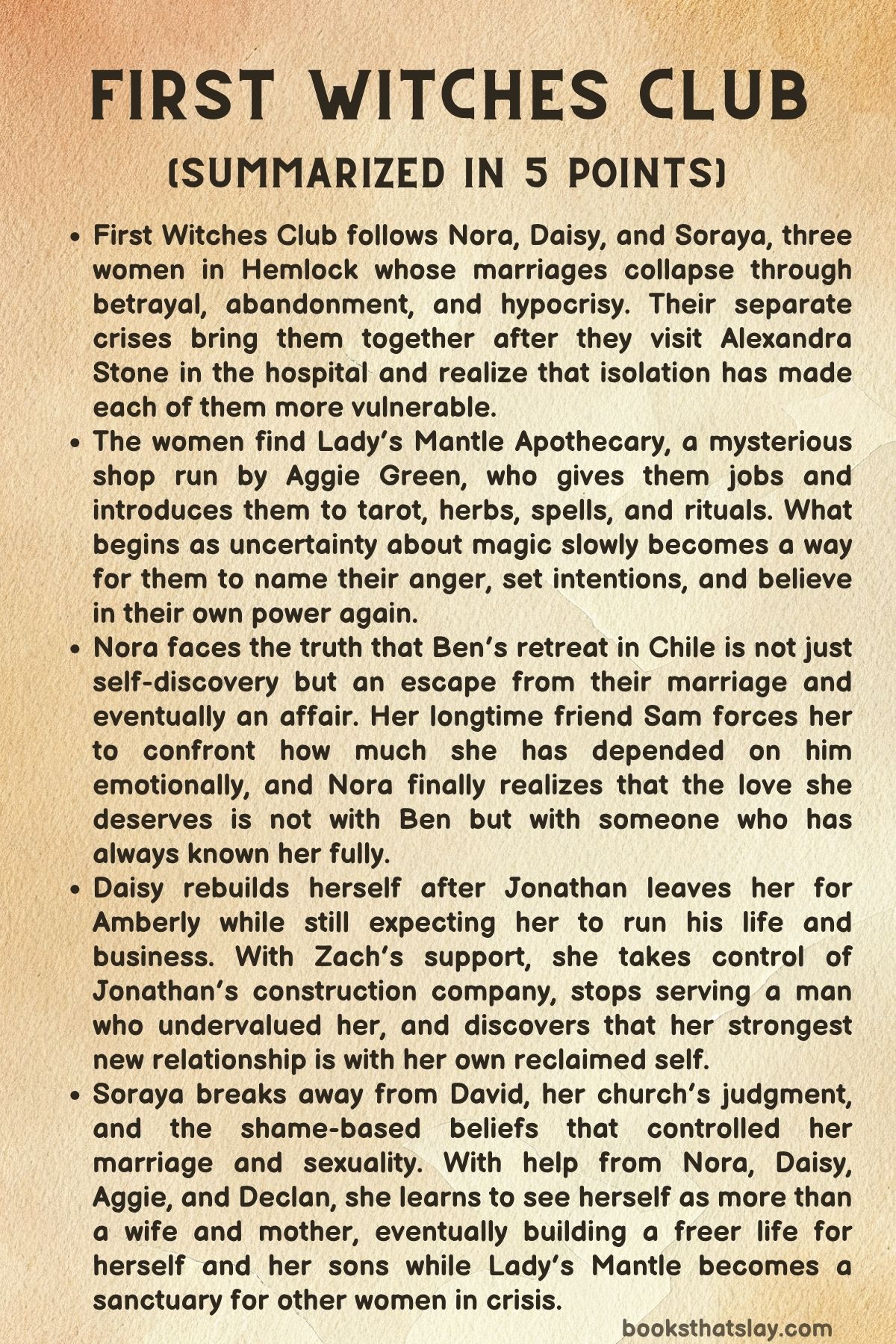
First Witches Club by Maisey Yates is a contemporary novel about three women whose broken marriages push them into an unexpected friendship, a witchy apothecary, and a new understanding of power. Nora, Daisy, and Soraya begin the story hurt, isolated, and unsure how to rebuild their lives after betrayal.
Through magic, work, desire, anger, and community, they learn that survival is not only about leaving the men who failed them, but also about choosing themselves. The book mixes romance, women’s friendship, domestic crisis, humor, and mystical elements to tell a story of reclamation.
Summary
Nora’s visit to Alexandra Stone in the hospital becomes the first crack in the life she has been trying to preserve. Alexandra, once one of Hemlock’s most admired women, lies unconscious after a terrible car crash, and her condition feels like a warning.
Nora runs into Daisy McNamara, an old friend she has let drift away, and the two are shaken by seeing Alexandra so reduced after years of public humiliation caused by her husband Christopher’s affair. On their way out, they find Soraya Nichols crying in the hospital gift shop.
Nora still carries resentment toward Soraya from high school, but Daisy’s kindness brings Soraya into their conversation. When the three women see Christopher walking through the hospital with his young mistress, their anger begins to unite them.
At lunch, politeness falls away and each woman reveals the collapse happening in her own marriage. Soraya has thrown David out after he accidentally sent her an intimate photo meant for another woman during church.
Her church community is pressuring her to forgive him, and her sons have been turned against her. Daisy’s husband Jonathan has left her for a much younger woman named Amberly while still expecting Daisy to keep managing the bookkeeping for his construction business.
Nora insists that her own situation is different because Ben is in Chile on a retreat, but the others’ confessions force her to admit how uncertain her future has become. After lunch, they discover Lady’s Mantle Apothecary, a strange new shop owned by Aggie Green.
Aggie immediately offers work that matches their needs: bookkeeping for Daisy, baking for Soraya, and counter work for Nora. Tarot readings unsettle them, but the shop also offers something they badly need: a place to begin again.
As the women start working at Lady’s Mantle, old beliefs and old wounds rise to the surface. Soraya is challenged by the shop’s witchy atmosphere because her religious background has taught her to fear anything connected to magic.
Aggie gently reframes spellwork as intention, ritual, and focused hope, which allows Soraya to stay curious instead of running away. Soraya also apologizes to Nora for cruel things she said years earlier when Nora’s mother abandoned her again.
Nora accepts the apology without denying the pain. Daisy begins to see her practical skills as real power rather than invisible labor.
The three women try small spells or intention rituals, asking for help with their immediate needs. Soon, Daisy gets help with the theater sets Jonathan abandoned, Nora receives a mural commission, and Soraya’s sourdough orders increase.
Whether magic, prayer, luck, or friendship is responsible matters less than the fact that something in their lives has started moving.
Nora’s marriage continues to crumble as Ben’s messages from Chile become more distant. Her longtime best friend Sam, an electrician who grew up with her in foster care, remains the person she calls when things fall apart.
His steady presence exposes the emptiness of her marriage to Ben, though Nora is not ready to face it. She looks around the house she shares with Ben and realizes almost none of it reflects who she is.
Her creativity, her anger, and her past have all been pushed into corners. A love spell at Lady’s Mantle brings the phrase “I have the love I deserve” into focus, but instead of thinking only of Ben, Nora sees Sam.
That realization frightens her because Sam represents a deeper, riskier kind of love than the polished safety she tried to build with Ben.
Soraya’s life also changes rapidly. David threatens to push her out of the house if she refuses to return to him and the church.
Aggie offers Soraya the apartment above Lady’s Mantle, giving her a safe place to live and a kitchen for her baking. Soraya accepts help from people her church would condemn and slowly realizes that the women labeled dangerous are the ones protecting her.
She asks for the truth about David to come to light. Soon after, a private sexual video involving David and Pastor John’s wife appears on the church screen during worship.
The revelation publicly exposes David’s hypocrisy and the church’s double standards. Soraya feels vindicated, but she also sees clearly that the same community that demanded she forgive David would never ask Pastor John to do the same.
Daisy’s heartbreak hardens into action when she sees Amberly’s engagement ring and realizes Jonathan plans to marry her before the divorce is even settled. Jonathan still expects Daisy to manage his business and soften the consequences of his choices.
Daisy eventually casts a karma spell against him, asking that he reap what he has sown. Her relationship with Zach Woods, Jonathan’s famous former-actor business partner, becomes a turning point.
Zach sees Daisy’s competence and offers to sell her his majority share of the construction company for one penny because he knows she was the one keeping it alive. Daisy worries that the offer may be tied to his attraction to her, but Zach is honest about wanting her while also believing she deserves power.
Their romance allows Daisy to feel desired, cared for, and valued without having to earn affection through service.
The women’s anger reaches a peak when Ben accidentally calls Nora while having sex with Tara, the woman from his retreat. The humiliating mistake confirms his affair and shatters Nora’s final denial.
The moment echoes Soraya’s discovery of David’s betrayal and strengthens the bond among the women. Together they perform a ritual around their wedding rings, calling their power back from the men who misused their devotion.
They name themselves the First Witches Club, turning the word “witch” into a sign of friendship, anger, protection, and choice.
As the consequences of the men’s actions intensify, the women wrestle with the cost of their power. Ben is badly injured in a hiking accident and airlifted home.
Jonathan suffers a serious accident involving his hand. David’s house catches fire after Pastor John attacks him in rage over the affair with his wife.
Soraya’s sons are inside the house when the danger begins, and though they survive, Soraya is terrified that her magic, sexuality, and anger somehow brought punishment on them. She tries to withdraw from Lady’s Mantle and from Declan, the kind owner of Dice and Dragons, with whom she has begun a tender and passionate connection.
Nora and Daisy refuse to let Soraya carry blame for David’s sins. They remind her that the men’s choices caused the destruction.
This becomes a turning point: the women decide their power must be used not only for revenge, but for healing and protection.
Nora imagines Lady’s Mantle becoming a support network for women facing divorce, abuse, financial instability, and isolation. Zach offers legal and practical resources.
Daisy steps into ownership of the construction company, confronts Jonathan, exposes his misuse of company funds, and begins reshaping the office and business around her own vision. Soraya begins dating Declan openly, talks honestly with her sons, and starts breaking the beliefs that taught them women must endure anything to keep a family intact.
Each woman is not simply leaving a marriage; each is building a new life with clearer values.
The shop’s first tarot night proves Nora’s vision can become real. Women from Hemlock gather at Lady’s Mantle, and Daisy discovers that her intuition and caretaking can help others see what they need.
One woman, Angela, reveals that she is unsafe with her husband, and Nora’s lawyer offers help. The gathering becomes a living network of shelter, legal aid, friendship, and courage.
When Alexandra suddenly needs surgery for a brain aneurysm, the women join together in a healing and truth ritual. Alexandra wakes with her memory restored and reveals that Christopher caused her crash after she discovered evidence of his financial crimes.
She had not simply been betrayed; he had tried to kill her. With Madison, Nora, Daisy, and Soraya beside her, Alexandra becomes another woman protected by the community growing around Lady’s Mantle.
The ending shows the women further into their reclaimed lives. Christopher faces legal consequences.
Daisy refuses Jonathan when he asks to come back, understanding that he misses being cared for, not loving her. She chooses herself, even as Zach remains part of her happiness.
Soraya’s divorce moves forward, and with Declan’s support she secures enough settlement money to buy a house for herself and her sons. She accepts love without surrendering her identity.
Nora leaves Ben’s house and moves into a life with Sam, finally admitting that the love she deserved was the love that had been standing beside her for years. She also begins thinking about writing her own book about women, friendship, and magic.
The final community dinner and fundraiser celebrates Alexandra and launches the Alexandra Stone Fund for domestic-violence survivors. Lady’s Mantle has become more than a shop; it is a sanctuary and a source of real change.
Alexandra is recovering, Angela is being helped, Daisy is powerful, Soraya is free, and Nora is loved without having to hide herself. After the event, the women return to the apothecary and find that Aggie has vanished, leaving them a letter and gifting the shop to them.
She names them as queens: Nora the Queen of Swords, Soraya the Queen of Pentacles, and Daisy the Queen of Cups. The three women lock up the shop that is now theirs, standing together in the magic they made from anger, friendship, and survival.
Characters
Nora
Nora is one of the central women in First Witches Club, and her story is shaped by abandonment, fear, creativity, and the hunger for a love that does not disappear. Her marriage to Ben initially appears less obviously broken than Daisy’s or Soraya’s, but the book gradually reveals that Nora has been living inside a polished life that does not truly fit her.
The house she shares with Ben reflects his taste, not hers, and that detail becomes a symbol of how much of herself she has hidden in order to feel safe. Her childhood in foster care taught her that love could be temporary and conditional, so she clings to stability even when it is emotionally empty.
Nora’s relationship with Sam is the emotional counterweight to her marriage. Sam knows her history, her anger, her fears, and her real self, which makes him both comforting and terrifying.
Her journey is not simply about discovering Ben’s affair; it is about admitting that she chose a smaller version of love because it seemed survivable. By the end, Nora grows into a woman who can leave false safety behind, accept the depth of her feelings for Sam, and imagine writing her own story instead of helping others shape theirs.
Daisy
Daisy’s character centers on invisible labor, competence, motherhood, and the painful process of realizing that being needed is not the same as being loved. At the start, Jonathan has left her for Amberly, yet he still expects Daisy to keep managing the bookkeeping and emotional fallout of his life.
This contradiction exposes how much he depended on her while failing to value her. Daisy is exhausted by responsibility: her children, the theater production, family expectations, finances, and the business all sit on her shoulders.
For a long time, she has mistaken constant usefulness for identity. Her connection with Zach becomes important because he sees not only her beauty but also her capability.
His offer to sell her his share of the construction company is not a rescue in the simple sense; it is a recognition of power she already had but was never allowed to claim. Daisy’s development is especially satisfying because she does not replace Jonathan with Zach as the center of her life.
Instead, she chooses herself. Her final rejection of Jonathan proves that she understands what he really misses: not Daisy as a person, but Daisy as the woman who managed his comfort.
Her strength lies in learning to stop serving people who refuse to honor her.
Soraya
Soraya is one of the most emotionally layered characters in the book because her betrayal is tied not only to marriage but also to religion, community, shame, and obedience. David’s affair exposes the hypocrisy of the world she trusted.
Instead of supporting Soraya, her church pressures her to forgive him, suggesting that his desire and sin are somehow her responsibility. Soraya has been raised to believe in modesty, submission, and marital duty, yet she is blamed for not satisfying a man she was never taught how to meet as an equal.
Her movement into Lady’s Mantle is therefore both practical and spiritual. The apartment above the shop gives her a physical home, but the women around her give her a new language for anger, pleasure, and freedom.
Her relationship with Declan is significant because it allows her to experience desire without duty and affection without control. Soraya’s growth also involves becoming a different kind of mother.
She begins teaching Levi and Jaden that love does not require women to endure humiliation. By the end, she does not abandon faith entirely; rather, she rejects the systems that used faith to keep her small.
Aggie Green
Aggie Green functions as guide, teacher, employer, and mysterious catalyst. She appears in Hemlock at the exact time Nora, Daisy, and Soraya need a place to work, gather, and rebuild, and her shop seems almost designed for their transformation.
Aggie’s wisdom lies in the way she reframes magic. She does not force the women into one belief system, nor does she demand that Soraya abandon her faith.
Instead, she presents spells, tarot, herbs, and rituals as tools for intention, clarity, protection, and self-knowledge. This flexibility makes Lady’s Mantle feel safe for women who arrive with different kinds of wounds.
Aggie also sees gifts in each of them before they see those gifts in themselves: Daisy’s intuition, Soraya’s kitchen magic, and Nora’s sharp truth-telling. Her disappearance at the end confirms her role as a threshold figure.
She does not stay to control what the women build. She gives them the shop, names their power, and leaves them ready to become the leaders of the sanctuary they once needed.
Alexandra Stone
Alexandra begins as a warning and becomes a survivor. At first, she is seen through the eyes of other women as someone who had once been glamorous, socially powerful, and admired, only to be publicly broken by Christopher’s affair.
Her hospital bed becomes a symbol of what can happen when betrayal, isolation, and male cruelty go unchecked. Yet the truth of Alexandra’s accident transforms her role completely.
Christopher did not merely humiliate her; he tried to kill her because she had discovered evidence of his crimes. This revelation shifts Alexandra from a passive figure of pity into a woman whose memory and testimony carry enormous force.
Her awakening after the healing and truth ritual connects her recovery to the collective strength of the women around Lady’s Mantle. Alexandra’s importance lies in showing that survival is not always neat or immediate.
Sometimes a woman needs other women to stand guard around her until she can speak again. Once she does, her voice becomes a legal and moral weapon against the man who tried to erase her.
Sam
Sam represents the difference between being rescued and being truly known. As Nora’s oldest friend from foster care, he understands parts of her that Ben never could or never wanted to face.
He is practical, loyal, protective, and emotionally tied to Nora in ways that blur the line between friendship and romantic love. For much of the book, Nora depends on Sam as her safest person while refusing to fully acknowledge what that dependence costs him.
Sam’s confrontation with Nora is one of his most important moments because it prevents him from becoming only a patient backup for her pain. He tells her that he has been acting like a husband without being chosen as one, and that honesty forces Nora to see how she has used his steadiness while hiding from the risk of loving him.
Sam is not perfect, but he is emotionally truthful. His love for Nora is not based on a fantasy of who she might become; it is rooted in the difficult, damaged, creative, angry, loyal woman she already is.
Zach Woods
Zach is introduced through reputation, fame, and scandal, but his role becomes far more grounded as the story continues. To Daisy, he offers something Jonathan never did: directness.
Zach does not pretend his attraction to Daisy is noble distance, but he also does not reduce her to an object of desire. He recognizes that she was the true force behind the construction company’s stability and acts on that recognition by giving her access to power she earned long before anyone named it.
His offer to sell his majority share for one penny could have felt like a fantasy rescue, but in the book it works because Zach repeatedly respects Daisy’s agency. He supports her children, helps in practical ways, and does not ask her to shrink.
His romance with Daisy is important because it gives her pleasure and care without demanding that she become someone’s manager again. Zach’s best quality is that he can stand beside Daisy’s transformation without trying to own it.
Declan
Declan is a gentle and appealing contrast to the rigid world Soraya is leaving behind. As the owner of Dice and Dragons, he initially represents something Soraya might once have judged without understanding.
Her willingness to speak to him marks an early sign that she is questioning inherited beliefs rather than repeating them. Declan treats Soraya as a whole person, not as a fallen wife, a church scandal, or a mother defined by sacrifice.
Their physical relationship is important because it allows Soraya to experience pleasure without shame for the first time. Yet Declan is not only a romantic escape.
His grief over the death of his son Brody gives him depth and vulnerability, and his honesty creates space for Soraya to be honest too. He does not rush her, shame her, or demand certainty.
That patience matters because Soraya’s greatest fear is that love will become another trap. Declan offers a model of affection that allows room for grief, desire, uncertainty, and freedom.
Ben
Ben is Nora’s husband and one of the clearest examples of self-centered betrayal wrapped in the language of personal growth. His retreat in Chile is presented as a journey to find himself, but that explanation becomes a shield for emotional distance and infidelity.
He frames his uncertainty as personal exploration while leaving Nora suspended in fear and financial instability. When the affair with Tara is exposed, Ben’s selfishness becomes harder to excuse.
Even after his accident, he expects Nora to step into the role of caretaker, as though his injury should erase his betrayal. His use of therapy language is especially damaging because he turns Nora’s trauma and guardedness into reasons for his choices.
Ben wanted a wife who made him feel stable, successful, and normal, but he did not truly accept the full reality of Nora’s past or personality. His final cruelty toward Sam exposes the class prejudice and emotional weakness beneath his polished surface.
Ben’s role is to show how a seemingly respectable man can still be cowardly, entitled, and deeply unworthy of the woman beside him.
Jonathan
Jonathan is Daisy’s husband, and his betrayal is rooted in entitlement as much as infidelity. He leaves Daisy for Amberly, yet he continues expecting Daisy to manage the business, protect his reputation, handle family communication, and absorb the consequences of his choices.
His behavior shows that he does not understand Daisy’s labor because he has always benefited from it. Even when he tries to blame her for the marriage’s failure, his accusations reveal cowardice rather than insight.
Jonathan wants the excitement of a younger woman without losing the stability Daisy created. His reaction to Daisy taking control of the company exposes how much he depended on power he had not truly earned.
Later, when he asks Daisy to come back, he presents it as clarity, but Daisy sees the truth: he misses comfort, not connection. Jonathan’s character is important because he embodies a common form of selfishness, the man who thinks a woman’s work is natural until she stops doing it.
David
David is Soraya’s husband and one of the book’s sharpest portraits of religious hypocrisy. He betrays Soraya sexually while benefiting from a church culture that pressures her to forgive, submit, and preserve the marriage.
His behavior is not limited to cheating; he manipulates their sons, threatens Soraya’s housing, and uses community authority to make himself appear repentant while avoiding true accountability. David’s public exposure in church is dramatic, but it works because his private sins have been protected by public respectability for too long.
His relationship with Levi and Jaden suffers because they eventually see that he lied and used them against their mother. David’s role is also tied to Soraya’s awakening.
By seeing him clearly, she begins to question the larger system that taught her to excuse men and blame women. He is not only a bad husband; he is a product and protector of a culture that values male authority over female truth.
Christopher Stone
Christopher Stone is Alexandra’s husband and the darkest example of male violence in First Witches Club. At first, he appears to be another publicly unfaithful man who humiliated his wife and continued moving through town with little shame.
The later revelation that he caused Alexandra’s crash changes the scale of his cruelty. Christopher is not merely selfish or weak; he is criminal, calculating, and willing to kill in order to protect himself from exposure.
His financial crimes and attempted murder show how social polish can hide extreme danger. The fact that Alexandra’s testimony helps bring consequences against him is crucial because it restores her voice after he tried to silence her permanently.
Christopher’s character also expands the book’s concern with domestic violence. Betrayal can be emotional, financial, sexual, or physical, and in his case, all forms of control meet in one terrifying act.
Madison
Madison, Alexandra’s daughter, carries anger, fear, and loyalty in a way that gives the story another generational layer. Her presence at Lady’s Mantle as the barista connects Alexandra’s private suffering to the younger women watching from the edges.
Madison understands Christopher’s cruelty more clearly than many adults around her, and her tarot reading hints at deception, collapse, and justice before the full truth is known. She is not simply a side character; she represents the children and daughters who witness the damage caused by powerful men and social silence.
Her concern for Alexandra also adds urgency to the women’s healing ritual. Through Madison, the book shows that women’s suffering rarely affects only one person.
It shapes families, children, reputations, and the emotional inheritance of those left to make sense of what happened.
Amberly
Amberly first appears to Daisy as the younger woman who has replaced her, and Daisy understandably imagines her as an enemy. Yet Amberly becomes more complicated when Daisy meets her directly.
She is sweet, admiring, and unaware of the full version of Jonathan that Daisy knows. Her shock during Jonathan’s accident and her care for the children show that she is not a simple villain.
This does not erase the harm of the affair, but it shifts Daisy’s understanding. Amberly is also being shaped by Jonathan’s lies and insults, even if she occupies a different position in the situation.
Her presence allows Daisy to separate Jonathan’s betrayal from the easy temptation to blame another woman entirely. Amberly’s character helps the story resist reducing women to rivals.
The real source of harm is Jonathan’s cowardice and entitlement, not a simple competition between an abandoned wife and a younger fiancée.
Kristi
Kristi begins as a painful representative of the church culture that wounds Soraya. When she visits Soraya on David’s behalf, she repeats the logic that protects men and burdens women: David was tempted, Soraya may have failed him, and forgiveness should restore the marriage.
Her words are damaging because they arrive dressed as concern. Kristi’s later apology matters because it shows that people inside harmful systems can begin to recognize their role in preserving injustice.
Her reconciliation with Soraya is tentative, not magically complete, which makes it more believable. Kristi does not become a perfect ally overnight, but she starts by admitting she was wrong and uncurious.
Her character shows how communities change only when individuals become willing to question the teachings they have repeated without compassion.
Levi and Jaden
Levi and Jaden, Soraya’s sons, are important because they show how patriarchal ideas pass from adults to children unless someone interrupts the pattern. At first, they blame Soraya for the breakup because David has shaped the story around his own innocence.
Their distance hurts her deeply, but Soraya also understands that they have been raised within the same system that taught her to excuse men and distrust female anger. After David’s lies become harder to deny, the boys begin to see their mother more clearly.
Their apology after the fire is an important emotional step, not because everything is instantly repaired, but because they recognize that they misjudged her. Soraya’s later honesty with them about Declan, dating, and her identity beyond motherhood helps build a healthier family dynamic.
Through Levi and Jaden, the story suggests that freedom is not only personal; it can change what the next generation learns about love, respect, and accountability.
Pastor John
Pastor John represents institutional hypocrisy and the collapse of false moral authority. As a religious leader, he belongs to the same community that pressures Soraya to forgive David and return to her marriage.
Yet his own household is implicated in the scandal when the video reveals his wife’s affair with David. His later violence against David and the fire at the house expose the difference between the forgiveness demanded of women and the rage permitted to men.
Pastor John’s role is not large, but it is symbolically powerful. He shows how institutions can preach grace while practicing control, and how quickly moral rules shift when male pride is wounded.
His confrontation with Soraya also allows her to speak back to the system that once defined her. She refuses to carry responsibility for men’s sins, and that refusal is one of her clearest acts of liberation.
Themes
Female Friendship as Survival
Friendship in this story is not casual companionship; it becomes an emergency structure that keeps women from disappearing into shame. Nora, Daisy, and Soraya begin as women who have drifted apart or misunderstood one another, but betrayal forces them into a new honesty.
Their bond starts awkwardly, through lunch, confession, and shared anger, then grows into something practical and life-saving. They bring takeout, help with moves, accompany one another to public confrontations, gather furniture, watch children, share legal resources, and refuse to let any one woman carry blame alone.
This is especially important because each woman’s original community has failed her in some way. Nora’s marriage leaves her emotionally isolated, Daisy’s family structure depends on her labor while undervaluing it, and Soraya’s church protects David more than it protects her.
Lady’s Mantle becomes powerful because it turns private pain into public support. The women do not heal because they become invulnerable.
They heal because they become witnessed. First Witches Club presents friendship as a force that can replace silence with action, shame with laughter, and fear with collective courage.
Reclaiming Power After Betrayal
Betrayal in the story is not treated as a single wound. It attacks the women’s homes, finances, sexuality, reputations, identities, and sense of reality.
Each husband tries to control the meaning of what happened. Ben frames abandonment and infidelity as self-discovery.
Jonathan treats Daisy as disposable while still relying on her competence. David hides behind repentance and religious authority.
Christopher tries to erase Alexandra entirely when she threatens his power. Against these patterns, reclamation becomes the women’s central work.
Their spells matter because they give form to feelings they were taught to suppress: anger, desire, ambition, grief, and hunger for justice. Yet the story does not leave power in the realm of ritual alone.
Daisy takes ownership of the company. Soraya builds a new home and speaks honestly to her sons.
Nora leaves Ben and chooses a love that sees her whole self. Alexandra wakes and testifies.
Power becomes legal, emotional, financial, sexual, creative, and communal. The women’s magic is strongest when it moves from private revenge toward protection, shelter, and structural change.
The Hypocrisy of Respectable Men
The men who cause the most harm often benefit from public images that make others doubt the women they hurt. David is protected by church language, repentance, and his role as father and coach.
Jonathan hides his dependence on Daisy beneath the appearance of business ownership and masculine confidence. Ben uses the language of therapy and personal growth to make betrayal sound thoughtful.
Christopher hides violence and financial crime behind wealth and social position. Pastor John’s authority collapses when his own anger exposes the double standard he represents.
The story repeatedly shows how communities help respectable men remain respectable by shifting blame onto women. Soraya is told to forgive.
Daisy is expected to keep working. Nora is made to feel difficult because of her trauma.
Alexandra is initially seen as a tragic, broken wife rather than a woman targeted for what she knew. This theme is powerful because the men are not all harmful in the same way.
Some are weak, some selfish, some violent, and some hypocritical. What connects them is the protection they receive until women begin comparing stories.
Once the women speak together, private patterns become visible, and respectability loses its shield.
Desire, Shame, and the Right to a Full Self
Desire in the story is closely tied to freedom because each woman has been taught, in different ways, to distrust what she wants. Soraya’s arc makes this most explicit.
Purity culture trains her to treat her body as dangerous, then marriage turns sex into duty, and David’s betrayal makes her feel blamed for desires she was never allowed to understand. Her relationship with Declan helps her experience pleasure as something chosen, mutual, and joyful rather than shameful or performative.
Daisy also reclaims desire through Zach, but for her the deeper issue is learning to receive care without earning it through labor. Being wanted without being used allows her to see herself beyond motherhood and abandonment.
Nora’s desire is more emotionally frightening because Sam represents a love that could truly hurt her if lost. She has to admit that safety without truth is not enough.
Across all three women’s lives, desire is not limited to romance or sex. It includes creativity, ownership, wildness, friendship, anger, money, beauty, and a home that reflects the self.
The story argues that a full life begins when women stop treating their own wanting as a problem to solve.