In Her Own League Summary, Characters and Themes
In Her Own League by Liz Tomforde is a sports romance about power, trust, ambition, and love under public pressure. Set inside the world of professional baseball, the story follows Reese Remington, a young team owner fighting to prove herself in a male-dominated industry, and Emmett “Monty” Montgomery, the respected general manager who first sees her as a threat.
Their relationship begins with conflict over the future of the Windy City Warriors, but as they face board politics, media judgment, and personal fears, their respect turns into attraction and then love.
Summary
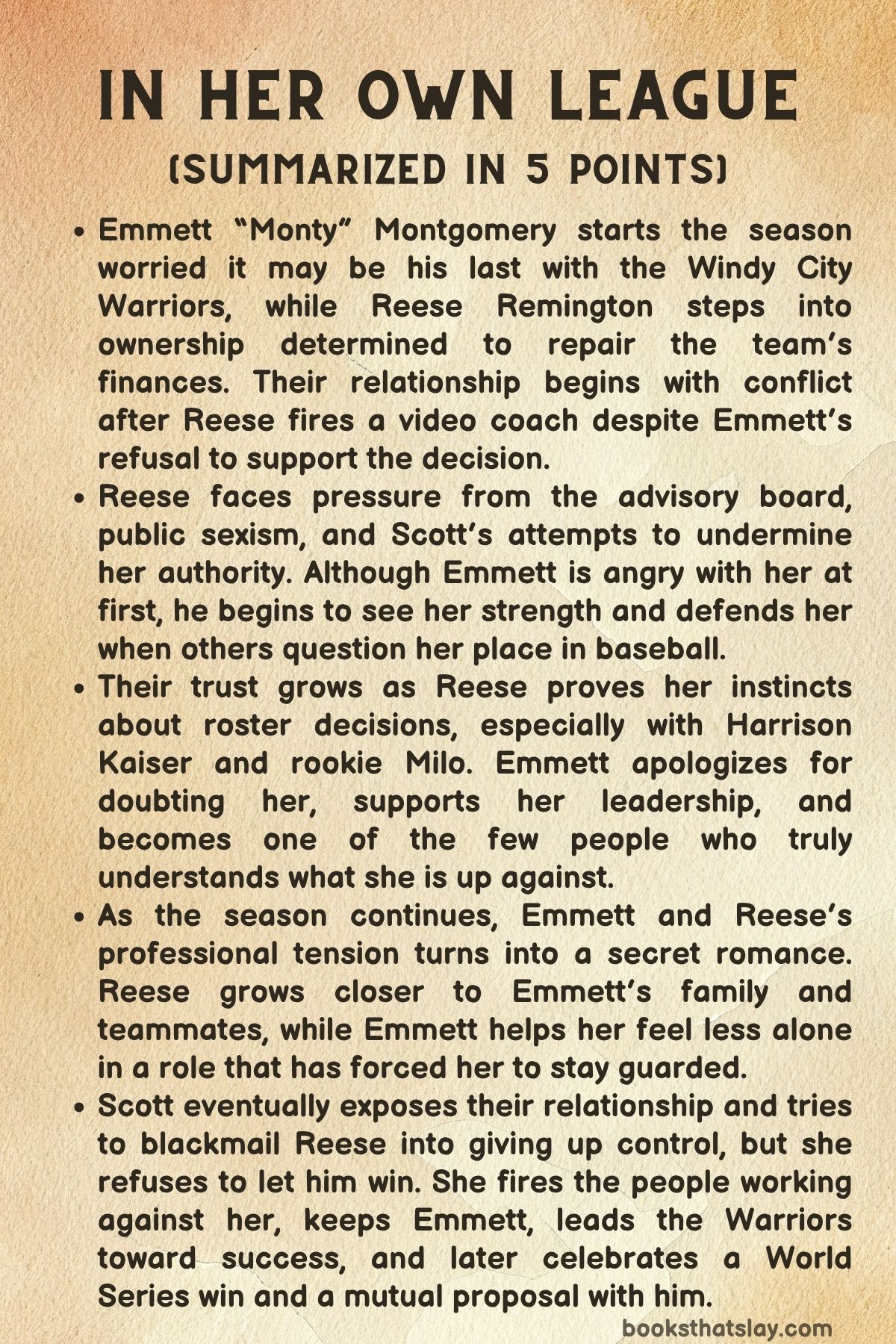
Emmett “Monty” Montgomery enters the new baseball season with a heavy sense that his time with the Windy City Warriors may be ending. He has spent years helping shape the team, and his loyalty to the organization runs deep.
But the team is now under new leadership. Reese Remington, the young owner and president of baseball operations, has inherited control from her grandfather and is determined to repair the team’s financial problems.
Reese understands that her position will not be easy. She is new, young, female, and surrounded by people who doubt her before she has the chance to prove herself.
Her first major clash with Emmett comes when she tells him that one of his three video coaches must be let go. Reese sees the cut as a financial necessity, but Emmett sees it as an attack on his staff and the work culture he has built.
He refuses to choose someone to fire and even offers to pay the salary himself. Reese does not accept that solution and eventually fires Nate, one of the coaches.
The decision leaves Emmett angry and convinces him that Reese is willing to hurt good people to balance numbers.
Reese is also dealing with pressure from the team’s advisory board. Several members question her authority and dismiss her plans.
Scott, one of the strongest voices against her, resents the fact that she has the role he wanted for himself. He treats her as unqualified and waits for chances to weaken her position.
Reese has to defend every decision while also facing public criticism as the first female MLB owner. At an early press conference, reporters ask her sexist questions and focus more on her identity than her ability.
Though Emmett is still furious with her over Nate, he steps in to defend her. That moment does not erase their conflict, but it shows Reese that he has principles beyond his anger.
Their working relationship slowly begins to shift. Reese calls Emmett and invites him to attend an advisory board meeting, hoping he might support her in a room where she has few allies.
The next major issue involves Harrison Kaiser, an expensive veteran player. Reese believes Harrison is overpaid and has become a poor fit for the team.
She wants to trade him, but Emmett disagrees and challenges her in front of the board. His opposition embarrasses her and makes her position harder.
Later, after speaking with Kai, Emmett realizes Reese was right about Harrison’s negative influence. He apologizes, and that apology becomes an important turning point.
He begins to see that Reese is not reckless or cold. She is observant, brave, and often correct.
Their bond grows further during a league conference in Las Vegas. Reese is treated as an outsider by other owners, and the event reminds her how difficult it is to be accepted in her role.
She also runs into her ex-husband, Jeremy, who once tried to use their marriage to gain control of the team. The encounter unsettles her, and Emmett helps her get away from him.
That night, they speak more honestly than they have before. Reese allows Emmett to see the fear and pressure behind her polished public image, while Emmett starts to understand how much she carries alone.
As the season continues, their attraction becomes harder to ignore. They spend time together in hotels, share private conversations, and find comfort in each other’s company.
Reese tries to hold boundaries because Emmett works for her and his contract is uncertain. She knows a relationship between them could create personal and professional problems.
Emmett also understands the risk, but their connection keeps pulling them closer. They eventually cross the line from attraction into romance, even though they both know secrecy may not protect them forever.
Reese continues making bold decisions for the Warriors. She trades Harrison and calls up rookie Milo, a move that causes public criticism and media attention.
Milo struggles at first, and Reese begins to doubt whether she made the right choice. Emmett supports her during this period.
Instead of undermining her, he encourages her to trust the instincts that led her to the decision in the first place. His faith in her matters because he once doubted her most.
Their partnership strengthens as they learn to challenge each other without destroying each other’s confidence.
Their secret relationship becomes more serious. Reese spends time with Emmett’s family and the people closest to him, including Miller, Kai, Max, Isaiah, and Kennedy.
Through them, she experiences a warmer and more personal side of the team community. She begins to feel less like someone standing outside the group and more like someone who belongs.
Emmett also shares important parts of his past with her. He shows her the house where he raised Miller after losing Claire, Miller’s mother.
These memories reveal how much responsibility and loss shaped him. Reese sees not only the strong general manager but the man who gave up pieces of his own life to care for others.
As Reese and Emmett fall in love, Reese’s fear remains. She worries that being open about their relationship could hurt both their careers and give her enemies another way to attack her.
Emmett is willing to face the consequences, but Reese knows the situation is more complicated for her. She has already had to fight for respect, and any sign of personal vulnerability could be used against her.
The crisis arrives after Miller and Kai’s wedding. Scott reveals that he has had Reese and Emmett followed and photographed.
He tries to blackmail Reese by threatening to expose their relationship unless she steps down as president of baseball operations. His goal is to take her place and gain the control he has wanted from the beginning.
Emmett is prepared to sacrifice his own position to protect Reese, but Reese decides to handle the threat herself.
At the advisory board meeting, Reese refuses to be intimidated. She exposes Scott’s blackmail, admits that she and Emmett are together, and makes it clear that her private life does not erase her ability to lead.
She fires Scott and the other board members who have worked against her, keeping Ed because he has shown respect and fairness. By removing those who undermined her, Reese takes full control of the team’s direction.
The budget that is freed also allows her to give Emmett the raise he deserves, proving that she can protect both the organization and the people who matter to it.
The Warriors reach the playoffs that season but lose in the Division Series. Even so, the team’s progress shows that Reese’s decisions are working.
Emmett moves into Reese’s condo, and their relationship becomes public. Instead of hiding, they begin building a life together with honesty and confidence.
One year later, the Warriors reach the World Series. Milo has become a star, Reese’s roster choices have paid off, and the team is stronger because she trusted her vision.
The Warriors win the championship at home, giving Reese and Emmett the professional victory they fought for through conflict, doubt, and outside pressure. On the field after the win, Reese proposes to Emmett first.
Emmett then reveals that he already has a ring and proposes to her as well. Reese says yes, and they celebrate not only the championship but the future they have chosen together.
In Her Own League ends with Reese fully owning her power and Emmett standing beside her, not in front of her. Their love story grows out of respect, hard choices, and the courage to stop hiding.
The book closes with victory on the field and in their personal lives, showing that Reese has earned her place in baseball and in a relationship where she is loved for her strength rather than asked to soften it.
Characters
The characters in In Her Own League are shaped by ambition, loyalty, grief, trust, and the pressure of proving themselves in a world that constantly judges them. Each major figure adds something important to the emotional and professional conflicts of the book, especially as the story explores leadership, love, family, and the cost of standing firm in a competitive environment.
Reese Remington
Reese Remington is the emotional and professional center of the book. As the young new owner and president of baseball operations for the Windy City Warriors, she carries the heavy responsibility of protecting her grandfather’s legacy while also making the difficult financial decisions needed to save the team.
Reese is intelligent, determined, and strategic, but she is also deeply guarded because she has spent so much of her life being underestimated. Her position as the first female MLB owner makes her every decision more visible and more harshly judged, and the sexist treatment she receives from reporters, board members, and other owners shows how much pressure she is under.
Reese’s strength comes from her ability to keep moving forward even when people question her authority, but her vulnerability appears in her fear of making mistakes and her hesitation to trust others completely.
Reese’s character development is closely tied to her growing confidence. At first, she tries to survive by keeping firm boundaries and maintaining emotional control, especially around Emmett.
She wants to prove that she belongs in her role without needing anyone to protect her. However, as the story continues, Reese learns that accepting support does not weaken her authority.
Her relationship with Emmett helps her soften without losing her power. By the time she confronts Scott and the advisory board, Reese has become someone who no longer asks for permission to lead.
She openly claims her relationship, exposes the blackmail, removes the people undermining her, and protects both herself and the team. Her final proposal to Emmett also reflects her growth, because she chooses love openly and confidently instead of hiding behind fear.
Emmett “Monty” Montgomery
Emmett “Monty” Montgomery is one of the most layered characters in the book because he combines authority, loyalty, grief, and emotional restraint. As the team’s leader, he begins the new season convinced that his future with the Warriors may be ending, which gives him a sense of quiet uncertainty beneath his strong exterior.
Emmett is protective of his staff, especially when Reese orders him to fire one of his video coaches. His refusal shows that he values loyalty and people over business calculations, but it also reveals his initial inability to understand the full weight of Reese’s responsibilities.
At first, he sees her decisions as cold or unfair, yet the book gradually shows that his anger comes from fear of losing the team culture he has helped build.
Emmett’s growth comes through his willingness to reconsider his assumptions. When he learns that Reese was right about Harrison Kaiser, he apologizes and begins to respect her judgment.
This is important because Emmett is not portrayed as perfect; he can be stubborn, proud, and protective to a fault. However, he is also emotionally mature enough to admit when he is wrong.
His relationship with Reese reveals his tenderness, especially through the way he supports her privately without trying to take over her battles. His past with Claire and his role in raising Miller add emotional depth to his character, showing that he has already lived through loss, responsibility, and sacrifice.
By the end of the story, Emmett becomes not just Reese’s romantic partner but her equal, someone who understands her ambition and loves her without asking her to become smaller.
Miller
Miller is an important part of Emmett’s emotional world and helps reveal the depth of his past. As the child Emmett raised after losing Claire, Miller represents family, responsibility, and the life Emmett built outside of baseball.
Through Miller, the book shows that Emmett is not only a coach or romantic lead but also a father figure shaped by sacrifice and devotion. Miller’s presence makes Emmett’s history feel more complete because it shows how much he has already given to the people he loves.
Miller also helps Reese see a more intimate side of Emmett. When Reese becomes connected to Emmett’s family and personal circle, Miller becomes part of the space where Reese learns what it means to belong outside her guarded professional identity.
Miller’s wedding to Kai is especially significant because it becomes the setting for the crisis that exposes Reese and Emmett’s relationship. Even though Miller is not at the center of the professional conflict, their place in the story is emotionally important because they represent the family bonds that shape Emmett and eventually welcome Reese.
Kai
Kai serves as both a personal and professional support figure in the book. He is connected to Miller through marriage and also plays a role in helping Emmett see the truth about Harrison Kaiser.
When Kai explains Harrison’s negative impact, he helps shift Emmett’s perspective and indirectly strengthens Reese’s authority. This makes Kai important because he becomes one of the characters who helps bridge the gap between Reese’s difficult business decisions and Emmett’s emotional loyalty to the team.
Kai also belongs to the warmer, more familial side of the story. His relationship with Miller and his presence among Emmett’s circle help create a sense of community around the main characters.
Through Kai, the book shows that love and loyalty exist in many forms, not only in the central romance. His wedding to Miller becomes a turning point because it is followed by Scott’s attempt to blackmail Reese, placing a joyful family event next to a major professional crisis.
This contrast highlights how private happiness and public pressure constantly collide in Reese and Emmett’s lives.
Scott
Scott is the clearest antagonist in the book because he represents entitlement, sexism, and the abuse of institutional power. He expected to control baseball operations himself, and Reese’s position threatens both his ambition and his ego.
His resistance to her leadership is not simply professional disagreement; it is rooted in his belief that she does not deserve the authority she has inherited and earned. Scott repeatedly undermines Reese, dismisses her ideas, and encourages the board’s lack of respect for her.
Through him, the story shows the kind of opposition Reese must face as a woman in power.
Scott becomes more dangerous when he has Reese and Emmett followed and photographed. His blackmail attempt reveals the full extent of his manipulation and cowardice.
Rather than challenging Reese openly on merit, he tries to use her private relationship to force her out of power. This makes his downfall especially satisfying because Reese defeats him not by hiding, but by exposing the truth.
Scott’s character is important because he pushes Reese into her strongest moment of public authority. By firing him and the other board members who supported his behavior, Reese proves that she will no longer tolerate people who confuse her restraint with weakness.
Nate
Nate’s role in the book is brief but meaningful because his firing becomes the first major conflict between Reese and Emmett. As one of the video coaches, Nate represents the human cost of the financial decisions Reese must make.
For Emmett, Nate is not just an expense on a balance sheet; he is a member of the staff and part of the team’s internal family. This is why Emmett reacts so strongly when Reese orders him to let one of the video coaches go.
Nate’s firing deepens the hostility between Reese and Emmett because it makes Emmett believe that Reese is willing to sacrifice people too easily.
At the same time, Nate’s role helps clarify Reese’s position. She is not making the decision out of cruelty but because she has inherited a team with serious financial problems.
The conflict surrounding Nate shows one of the book’s central tensions: leadership often requires choices that hurt people, even when those choices are necessary. Nate may not be a central character, but his presence matters because his firing forces both Reese and Emmett to confront the difference between emotional loyalty and organizational responsibility.
Harrison Kaiser
Harrison Kaiser functions as a symbol of outdated value and hidden damage within the team. He is an expensive veteran player, and Reese sees that he does not fit the direction the Warriors need to take.
Her desire to trade him is based on financial logic and team chemistry, but because she is still fighting to earn respect, her judgment is doubted. Harrison’s importance lies less in his personal development and more in what he reveals about the people around him.
The disagreement over his future exposes the gap between Reese’s vision and the board’s resistance, as well as Emmett’s initial reluctance to trust her.
Harrison also becomes a turning point in Emmett’s view of Reese. When Emmett learns from Kai that Reese was right about Harrison’s negative impact, he is forced to admit that his assumptions about her were unfair.
This makes Harrison a catalyst for trust between the two main characters. Reese’s choice to move him and call up Milo creates public criticism, but it also proves her willingness to take bold risks for the team’s future.
Harrison represents the kind of difficult decision a leader must make when loyalty to the past threatens progress.
Milo
Milo represents potential, risk, and the future of the Warriors. When Reese calls him up after trading Harrison, she makes one of her boldest roster decisions.
Milo’s early struggles create doubt and media pressure, making Reese question whether she trusted her instincts too quickly. His character is important because he tests Reese’s confidence as a leader.
Choosing Milo is not just a baseball decision; it is a statement that Reese believes in building the team around future growth instead of protecting the comfort of the past.
Milo’s later success confirms Reese’s vision. By the time the Warriors reach and win the World Series, Milo has become a star, proving that Reese’s controversial decision was the right one.
His arc gives the book a strong sense of payoff because it shows that Reese’s instincts were not only emotionally brave but professionally sound. Milo also helps reinforce one of the story’s larger ideas: progress often looks uncertain before it looks successful.
His transformation from struggling rookie to key star mirrors Reese’s own journey from doubted owner to championship-winning leader.
Jeremy
Jeremy, Reese’s ex-husband, represents betrayal, control, and the personal history that made Reese so guarded. His attempt to take control of the team through their marriage shows that Reese has already experienced someone using intimacy as a path to power.
This makes her hesitation with Emmett more understandable. Reese is not simply afraid of romance; she is afraid of repeating a past where love, trust, and ambition were twisted against her.
Jeremy’s presence at the league conference reminds her of that pain and briefly places her back in a situation where she feels exposed and cornered.
Jeremy’s role also helps distinguish Emmett from the men who have tried to control Reese. When Emmett helps her get away from the uncomfortable encounter, he does not use the moment to dominate her or make decisions for her.
Instead, he offers protection while still respecting her autonomy. This contrast is important because it shows why Reese eventually trusts Emmett.
Jeremy’s character may appear mainly through his impact on Reese, but that impact is significant. He represents the past she must overcome in order to believe that love can exist without manipulation.
Ed
Ed stands apart from the other board members because he is not grouped with those who actively undermine Reese. While many members of the advisory board dismiss her or side with Scott, Ed remains someone Reese ultimately keeps.
His continued place on the board suggests that he has either shown loyalty, fairness, or enough respect for Reese’s authority to deserve staying. In a story filled with people who question Reese’s leadership, Ed’s presence matters because he shows that not every older or established figure in the organization is automatically an obstacle.
Ed also helps sharpen the contrast between constructive guidance and destructive control. The problem is not that Reese receives advice; the problem is that people like Scott use advice as a disguise for disrespect and power grabbing.
By keeping Ed while firing the others who undermined her, Reese demonstrates judgment rather than revenge. She does not remove people simply because they disagree with her.
She removes those who have acted in bad faith. Ed’s role supports Reese’s growth as a leader who can separate useful counsel from toxic opposition.
Claire
Claire is important even though she is not physically present in the main events of the book. As Miller’s mother and a person Emmett lost, Claire represents grief, memory, and the emotional life Emmett had before Reese.
Her absence shaped Emmett into someone deeply responsible and protective. The fact that he raised Miller after losing Claire shows his capacity for devotion and sacrifice.
Claire’s place in his past helps explain why Emmett values family so strongly and why he does not give his loyalty lightly.
Claire also affects the romance between Reese and Emmett because she is part of the emotional truth Emmett eventually shares. When he shows Reese the house where he raised Miller, he allows her into a private part of his life marked by love and loss.
This moment deepens Reese’s understanding of him and helps their relationship move beyond attraction into real intimacy. Claire’s character is therefore important as a memory that continues to shape the living characters.
She adds emotional history to Emmett’s love story and shows that his future with Reese grows from a life that has already known both heartbreak and commitment.
Max
Max is part of the wider circle of teammates and friends who help Reese move beyond her isolated role as owner. His presence contributes to the sense of community surrounding Emmett, Miller, Kai, Isaiah, and Kennedy.
For Reese, entering this circle is meaningful because she is used to being judged through her title, her gender, and her decisions. Around Emmett’s people, she begins to experience a warmer and more personal form of acceptance.
Max helps build that atmosphere.
Although Max is not one of the central conflict-driving characters, he matters because the book uses side characters to show the kind of chosen family Reese is gradually welcomed into. His presence helps make the team world feel lived-in rather than purely professional.
Through characters like Max, Reese is not only the owner making hard decisions; she becomes someone who can attend gatherings, form bonds, and be seen as a person. This supports her emotional transformation and strengthens the contrast between the cold judgment of the board and the warmth of Emmett’s inner circle.
Isaiah
Isaiah is another member of the supportive group around Emmett and Reese. His role helps create the team-family environment that becomes increasingly important as Reese’s guarded life begins to open up.
While the main professional conflicts happen in boardrooms, press conferences, and roster decisions, characters like Isaiah show the personal side of the baseball world. They remind the reader that the Warriors are not only an organization with budgets and contracts but also a community of people connected by loyalty and shared history.
Isaiah’s importance lies in how he contributes to Reese’s growing sense of belonging. As she spends more time with Emmett’s circle, she becomes more comfortable outside the strict identity of owner and president.
Isaiah helps fill out that circle, making Reese’s emotional world broader and less lonely. His presence supports the book’s theme that leadership does not have to mean isolation.
Reese can be powerful and still be part of a personal community that accepts her.
Kennedy
Kennedy contributes to the supportive social world that surrounds Reese and Emmett. Like Max and Isaiah, she helps create a space where Reese can be more than the public figure constantly being judged.
Kennedy’s role is important because Reese’s growth is not only about defeating Scott or proving herself professionally; it is also about learning how to accept friendship, warmth, and connection. Kennedy belongs to the part of the story that gives Reese room to breathe.
Kennedy also helps balance the harsher parts of the book. Against the sexism of the press, the hostility of the board, and the manipulation of Scott and Jeremy, Kennedy’s presence adds to a more accepting environment.
This makes Reese’s eventual openness with Emmett feel more believable. She is not stepping from isolation directly into romance alone; she is gradually becoming part of a wider network of people.
Kennedy helps represent that softer, safer world where Reese can be valued as a person rather than challenged as a symbol.
Themes
Power, Authority, and Gender Bias
Reese’s position as owner and president places her in a space where power is constantly challenged, not because she lacks ability, but because others refuse to accept a young woman in control of a baseball organization. Her decisions are judged more harshly than those of the men around her, and the advisory board treats her leadership as something temporary or accidental.
Scott’s opposition shows how sexism can hide behind claims of experience, tradition, or financial concern. Reese must prove herself in public, in meetings, and within the team’s internal structure, while also carrying the pressure of representing women in a male-dominated sport.
In Her Own League presents authority as something Reese has inherited legally but must claim emotionally and professionally. Her growth comes from learning that leadership does not require constant approval.
By the end, her refusal to submit to blackmail becomes a powerful assertion of ownership, competence, and self-respect.
Trust and Changing Perspectives
Emmett and Reese begin from a place of conflict because both believe they are protecting the team in different ways. Emmett sees Reese’s financial decisions as cold and damaging, especially when Nate is fired, while Reese sees Emmett as resistant to necessary change.
Their early clashes reveal how easily people can misunderstand each other when pride, grief, and pressure shape their reactions. The turning point comes when Emmett realizes Reese’s judgment about Harrison is correct, forcing him to question his assumptions about her.
Trust develops slowly through apologies, honest conversations, and moments where each sees the other acting with care rather than selfishness. Reese also learns to trust Emmett not only as a manager but as someone who respects her mind and supports her authority.
Their relationship shows that trust is not instant attraction or blind loyalty. It is built through listening, admitting mistakes, and choosing to believe in someone’s intentions even after conflict.
Love, Boundaries, and Vulnerability
The romance between Reese and Emmett carries emotional weight because it grows in a setting where personal desire has professional consequences. Reese’s hesitation is not simply fear of scandal; it comes from understanding how easily her credibility can be attacked.
As Emmett’s boss and the public face of the organization, she has more to lose in the eyes of others, especially because people are already waiting for proof that she cannot lead. Emmett, meanwhile, offers emotional steadiness without trying to take control of her choices.
Their private conversations allow both of them to lower defenses they have built over years of responsibility, loss, and public judgment. Reese becomes more open as she is welcomed into Emmett’s personal world, while Emmett shows her the history that shaped his devotion to family.
Their love works because it does not erase their responsibilities. Instead, it asks them to be honest about what they want and brave enough to face the consequences together.
Leadership, Instinct, and Self-Belief
Reese’s leadership journey is defined by her struggle to trust her own instincts while surrounded by people who question every decision she makes. Trading Harrison, calling up Milo, and restructuring the organization are not easy choices because each one carries public risk and private doubt.
When Milo struggles at first, Reese’s confidence falters, showing that even strong leaders can feel shaken when outcomes take time to appear. Emmett’s support matters because he does not simply comfort her; he reminds her that vision often requires patience.
Reese’s success comes from combining financial awareness, baseball intelligence, and the courage to make decisions that others may not immediately understand. Her final confrontation with Scott proves that leadership also means protecting the culture of the organization, not just improving the roster.
By the championship ending, the team’s victory reflects more than athletic success. It confirms that Reese’s instincts, once dismissed, have reshaped the future of the Warriors.