Innamorata Summary, Characters and Themes
Innamorata by Ava Reid, the first book of the House of Teeth series, is a dark gothic fantasy about inheritance, forbidden desire, political cruelty, and the dangerous uses of memory. Set in Drepane, a city ruled by seven houses and bound by laws meant to prevent resurrection, the story follows Agnes and Marozia, granddaughters of the powerful Adele-Blanche.
After their grandmother’s death, both young women are pulled into a plan that reaches back to plague, conquest, and lost magic. What begins as a mission to restore the power of the House of Teeth becomes a tragedy shaped by ambition, love, silence, betrayal, and the cost of wanting more than the world allows.
Summary
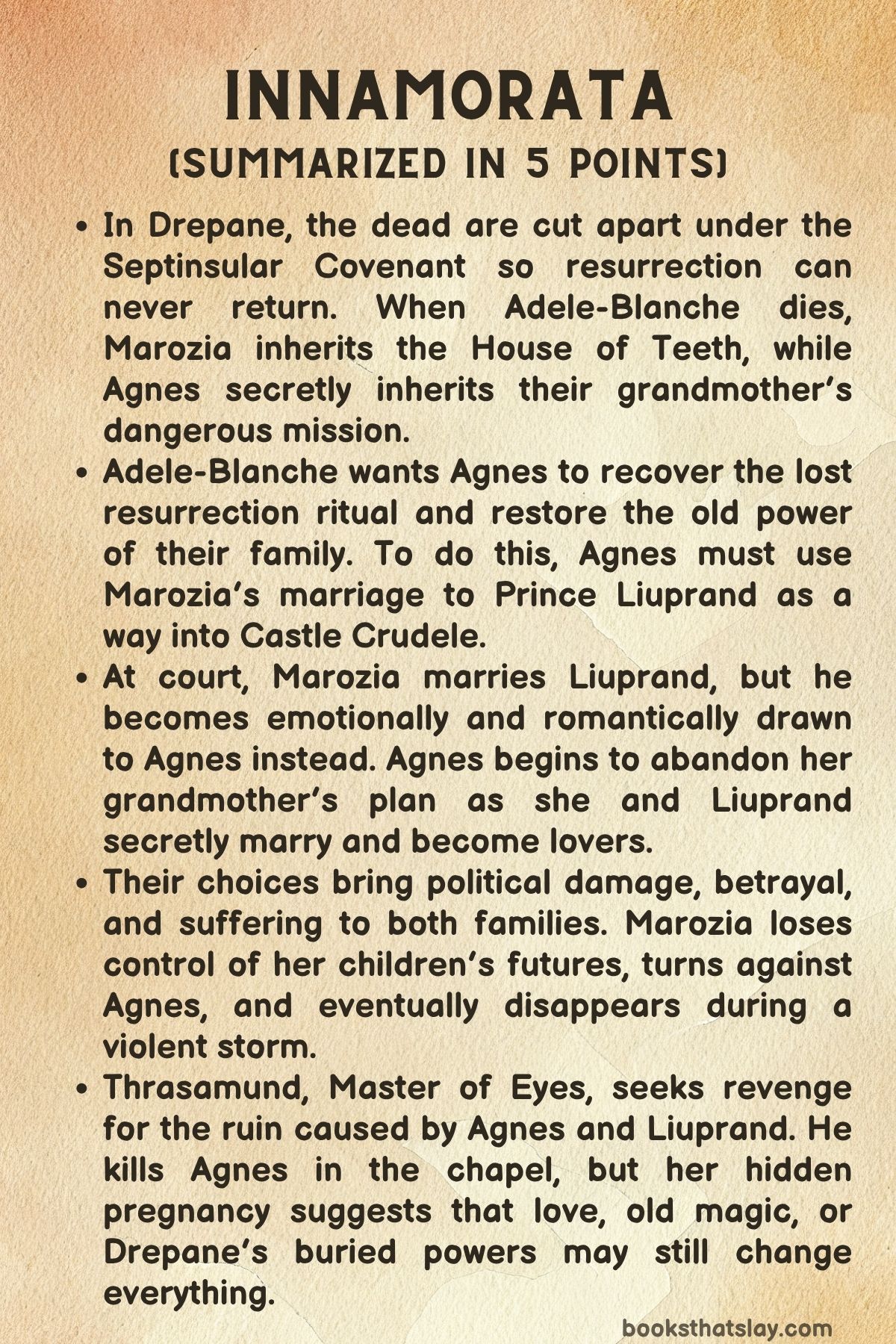
In Drepane, death is not allowed to remain whole. The Septinsular Covenant requires every corpse to be divided after death, with its parts handed over to the seven ruling houses.
This brutal custom exists for one reason: to make sure no one can ever restore the dead again. Long ago, the nobles of Drepane learned how to bring the dead back during a time of plague, but the resurrected became monstrous and hungry.
Berengar of Seraph conquered the city, destroyed much of the old knowledge, and established the Covenant to keep that horror from returning.
When Adele-Blanche, Mistress of Teeth, dies, her granddaughters Marozia and Agnes witness the ritual that breaks her body apart. Marozia, beautiful and socially polished, inherits the House of Teeth in name.
Agnes, quiet and watchful, receives the deeper inheritance. Adele-Blanche had spent years training her in silence, writing, poisons, visions, and hidden family history.
Through drugged messages and visions, she leaves Agnes with a secret command: recover the lost resurrection ritual, restore Adele-Blanche, and return the House of Teeth to its former strength.
Adele-Blanche’s plan depends on Marozia. Agnes is to use her sister’s beauty to secure a royal marriage with Prince Liuprand and gain access to Castle Crudele, where the lost knowledge may still be hidden.
Marozia and Agnes travel to the royal court, where they find a world ruled by appetite, fear, and calculation. King Nicephorus the Sluggard is coarse, cruel, and greedy, but he needs the wealth and status of the House of Teeth.
His son Liuprand is very different: intelligent, controlled, courteous, and drawn to books and private thought.
Marozia marries Liuprand, but the marriage is hollow. Liuprand does not want her, and Marozia soon finds herself trapped in a role that gives her status without affection.
Agnes, meanwhile, begins searching the royal library for forbidden knowledge. Though she is meant to stay in the shadows and serve Adele-Blanche’s mission, Liuprand notices her.
Their bond grows through books, quiet exchanges, and moth-borne messages. He understands parts of her that others ignore, and Agnes begins to care for him more than for the task she was sent to complete.
As Agnes and Liuprand grow closer, Agnes starts moving away from her grandmother’s purpose. With the help of Pliny, a loyal leech connected to the House of Teeth, Agnes secretly marries Liuprand in an abandoned chapel.
Their relationship becomes both a refuge and a danger. Publicly, Liuprand is still Marozia’s husband.
Privately, Agnes and Liuprand live as lovers, creating a hidden life inside the walls of Castle Crudele. Their happiness is real, but it is built on deception, and the cost of that deception grows heavier.
King Nicephorus eventually learns enough to punish them. He mutilates Agnes’s hand, marking her body with his power, and sends her away to marry Fredegar, Master of Blood.
The marriage is meant to repair political strain between the houses, but Liuprand accompanies Agnes, and their attachment does not end. Fredegar is gentle and not the monster Agnes may have expected, but kindness cannot undo the bonds and lies already in motion.
In the House of Blood, Agnes and Liuprand consummate their secret marriage again, choosing each other even as their choices harm others.
While there, they discover more of the suffering caused by the politics of Drepane. Fredegar’s son Childeric and others have been damaged by schemes shaped by hunger for control, inheritance, and alliance.
No house is innocent, and every family carries some wound created by the Covenant and the power struggles around it. Agnes begins to understand that court life is not simply a game of loyalty and betrayal.
It is a system that consumes children, women, servants, and heirs alike.
Nicephorus then forces Liuprand to fulfill his public marriage to Marozia. He must get her pregnant so her child can be used to bind the ruling houses together.
Marozia gives birth to twins: a son, Tisander, and a daughter, Meriope. Tisander is taken into the royal line, while Meriope is promised to Gamelyn, the new Master of Blood.
Marozia is crushed by the loss of control over her children. She also realizes that Agnes’s actions have helped bring about her suffering.
The bond between the sisters, already strained by rivalry and secrecy, breaks into bitterness.
Years pass, and the hidden consequences of Agnes and Liuprand’s choices deepen. Agnes raises Tisander and loves him.
She continues her secret life with Liuprand and gains influence within Castle Crudele. In some ways, she becomes exactly what Adele-Blanche had shaped her to be: clever, powerful, and able to survive in a world that would rather use her or silence her.
But her power rests on secrets. Marozia remains trapped with Meriope, knowing her daughter will eventually be taken for a political marriage.
Her comfort comes from Ninian, her devoted servant and lover, but even that love cannot free her.
Agnes later stages a masque during the formal betrothal celebrations for Meriope and Gamelyn. The performance exposes more than it conceals.
Through the events surrounding it, Marozia comes to understand the full truth of Agnes and Liuprand’s affair. The celebration collapses into violence and panic.
Meriope is taken away by the Houses of Blood and Eyes, and Marozia’s grief turns into complete ruin. During a storm, the stone beneath her gives way into the sea, and she disappears.
Agnes nearly dies as well, but Liuprand pulls her back.
The disaster draws Thrasamund, Master of Eyes, into the center of events. He wants revenge for his children and for the damage caused by Agnes and Liuprand’s choices.
He moves through Castle Crudele with patience and strategy, using hunger, secrets, and loyal men to gain the upper hand. By now, Agnes’s private rebellion has become part of a much larger collapse.
Her love for Liuprand may have felt like freedom, but it has also helped destroy Marozia, endanger Meriope, and unsettle the balance among the houses.
At last, Thrasamund captures Agnes in the chapel where she and Liuprand once met in secret. The place that had held their hidden marriage becomes the site of her death.
He cuts her throat, killing her and taking away the voice she had already spent much of her life being forced to hide. Her body is not divided according to the Covenant.
Instead, it is concealed in a makeshift tomb, left whole in defiance of Drepane’s law.
In the darkness after death, the story leaves one final disturbance. Agnes, believed to be barren, is carrying Liuprand’s child.
This revelation suggests that the forces buried beneath Drepane’s laws may not be dead after all. Love, old magic, blood inheritance, or the forgotten powers of the city may still be alive inside Agnes’s body.
The ending leaves the world unsettled, with the possibility that the Covenant’s order may be broken and that the past Adele-Blanche tried to restore may return in a form no one can control.
Characters
Innamorata presents its characters as people caught between inheritance, desire, power, and the violent rules of their world. Each figure is shaped by Drepane’s obsession with bodies, bloodlines, memory, and resurrection, and the conflicts among them grow out of both personal longing and political design.
Agnes
Agnes is the central and most inwardly conflicted character in the book. Trained by Adele-Blanche in silence, writing, poisons, visions, and secret family knowledge, she begins as someone shaped almost entirely by another person’s will.
Her muteness makes her appear passive to others, but the story reveals that her silence contains intelligence, observation, resentment, and desire. She is not simply an obedient granddaughter; she is someone who has been prepared as a weapon, even before she fully understands the cost of being used.
Agnes’s greatest conflict is between duty and longing. Adele-Blanche gives her a mission: use Marozia’s beauty, enter Castle Crudele, recover the lost resurrection ritual, and restore the old power of the House of Teeth.
At first, Agnes follows this plan with secrecy and discipline. However, her connection with Liuprand changes her sense of purpose.
Through books, moth messages, and shared silence, she begins to experience a life not ruled by her grandmother’s hunger for the past. Her love for Liuprand becomes both liberating and destructive, because it gives her emotional freedom while also trapping others in the consequences of her choices.
Agnes is morally complex because her suffering does not make her innocent. She is wounded by Nicephorus, controlled by family history, and denied ordinary forms of speech and power, yet she also helps create pain for Marozia, Meriope, and others.
Her secret marriage to Liuprand gives her private happiness, but it exists alongside public betrayal. Her love for Tisander shows tenderness and maternal devotion, but her increasing power at Castle Crudele suggests that she is not merely a victim of the system; she learns to survive within it and, at times, benefit from it.
By the end, her death at Thrasamund’s hands becomes a brutal silencing, yet the final suggestion that she carries Liuprand’s child makes her body a site of unfinished power, love, and possible upheaval.
Marozia
Marozia is one of the most tragic characters in the story because she is valued first for her beauty and political usefulness rather than for her inner life. She inherits the House of Teeth after Adele-Blanche’s death, which should make her powerful, but she is quickly revealed to be a pawn in a larger design.
Her beauty is used to secure marriage with Prince Liuprand, while Agnes carries the real burden of their grandmother’s plan. This imbalance creates one of the deepest wounds in Marozia’s character: she appears to have the visible inheritance, but Agnes possesses the hidden knowledge and purpose.
Marozia’s marriage to Liuprand becomes a source of humiliation and emotional starvation. She is publicly made into a wife and future mother, but privately she is unwanted.
Liuprand’s lack of desire for her is not merely romantic rejection; it strips her of the role she has been forced to perform. Her pain grows sharper when she discovers that Agnes, her own sister, has taken the love and intimacy that Marozia was expected to receive.
The betrayal is devastating because it is both personal and political. Agnes does not only love Liuprand; she helps make Marozia’s life into a cage.
Marozia’s motherhood intensifies her tragedy. The birth of Tisander and Meriope should give her a source of love and identity, but even her children are divided and claimed by political forces.
Tisander is taken into the royal line, while Meriope is promised to Gamelyn. Marozia’s grief over Meriope’s future makes her more than a jealous sister; she becomes a mother fighting against the machinery that consumes daughters for alliances.
Her relationship with Ninian gives her a private source of devotion, but it cannot save her from the collapse of her world. Her final disappearance during the storm feels like the physical expression of her life’s destruction: the ground beneath her literally gives way after betrayal, loss, and political violence have already broken her.
Prince Liuprand
Prince Liuprand is intelligent, courteous, and emotionally perceptive, which makes him stand apart from the brutality of Castle Crudele. Unlike Nicephorus, he notices Agnes not as a tool or obstacle but as a person.
His bond with her develops through intellectual intimacy, secrecy, and shared forms of communication that do not depend on ordinary speech. This makes their love feel unusually tender within a world built on dismemberment, hunger, and political cruelty.
However, Liuprand’s tenderness does not free him from moral responsibility. He publicly remains Marozia’s husband while privately marrying and loving Agnes.
His love for Agnes may be sincere, but it is also selfish because it deepens Marozia’s humiliation and helps produce the chain of events that harms Meriope and others. He is trapped by royal duty and his father’s power, yet he also repeatedly chooses private passion over public honesty.
The result is a character who is sympathetic but not blameless.
Liuprand’s weakness lies in the gap between feeling deeply and acting justly. He rescues Agnes during the collapse at the masque, accompanies her to the House of Blood, and remains bound to her through danger and secrecy.
These actions show devotion, but they also show his inability to separate love from damage. His relationship with Agnes becomes the emotional center of his life, yet the book makes clear that love alone does not absolve betrayal.
Liuprand is therefore a romantic figure and a politically compromised prince at the same time.
Adele-Blanche
Adele-Blanche is a powerful presence even after death. As Mistress of Teeth, she represents inheritance, ancestral ambition, and the dangerous persistence of old knowledge.
Her death begins the central conflict, but she has already shaped the future through Agnes’s training and through the secret plan she leaves behind. She is not simply a grandmother; she is a strategist who treats her descendants as instruments for restoring the lost power of the House of Teeth.
Her obsession with resurrection connects her to Drepane’s buried history. She wants the forbidden ritual recovered not as an abstract piece of knowledge but as a way to reverse death, restore herself, and revive the old strength of her house.
This makes her both visionary and monstrous. She understands that the Covenant has weakened the old noble powers, but her answer is not liberation; it is a return to a past associated with ravenous revived dead and aristocratic domination.
Adele-Blanche’s treatment of Agnes reveals her coldness most clearly. By training Agnes in silence, poisons, visions, and secrecy, she creates a granddaughter who is useful but deeply damaged.
She entrusts Agnes with truth, yet that truth functions as a burden rather than a gift. Her influence continues to haunt the story because Agnes’s struggle is partly a struggle to escape being the living extension of Adele-Blanche’s will.
In this sense, Adele-Blanche is one of the book’s most important unseen forces: dead, dismembered, and yet still commanding the living.
King Nicephorus
King Nicephorus is the embodiment of corrupted royal power. Crude, gluttonous, hostile, and politically ruthless, he rules through humiliation and bodily violence.
His nickname, the Sluggard, suggests laziness and excess, but he should not be mistaken for harmless. He may be grotesque, but he is dangerous because he understands how to use marriages, heirs, mutilation, and fear to keep power concentrated around the throne.
His treatment of Agnes shows his cruelty in its most personal form. By mutilating her hand and sending her to marry Fredegar, he punishes not only her body but also her means of expression and agency.
Since Agnes relies on writing and silence, the injury is a targeted attack on who she is. Nicephorus’s violence is never random; it is political and symbolic.
He uses pain to remind others that their bodies belong to power before they belong to themselves.
Nicephorus also manipulates Marozia and Liuprand through dynastic necessity. By forcing Liuprand to impregnate Marozia so that her child can be promised into another house, he turns sexuality, marriage, and birth into tools of control.
He represents the logic of the Covenant-era monarchy: prevent forbidden resurrection, control noble houses, and preserve rule through domination. His grotesque appetites mirror the larger hunger of the political system he governs.
Pliny
Pliny is a loyal leech whose role is quiet but meaningful. In a world where leeches are associated with the dismemberment of the dead and the enforcement of the Covenant, Pliny stands out because his loyalty is personal rather than merely institutional.
He assists Agnes and Liuprand in their secret marriage, becoming a witness to a love that exists outside public law and political arrangement.
Pliny’s importance lies in the contrast he creates. The leeches as a group are tied to ritualized violence against corpses, but Pliny is connected to intimacy, secrecy, and protection.
His presence suggests that even within systems of bodily control, individuals may form private loyalties that complicate their official roles. He helps Agnes cross from being a tool of Adele-Blanche’s plan into someone choosing her own forbidden bond.
Though he is not as dominant as the nobles, Pliny matters because he enables a major emotional and moral turning point. Without him, Agnes and Liuprand’s secret marriage would not carry the same ritual weight.
He becomes part of the hidden architecture of their relationship, supporting a union that is tender, unlawful, and ultimately catastrophic.
Fredegar
Fredegar, Master of Blood, is notable because he is gentle in a world where the House of Blood could easily be associated only with violence. When Agnes is sent to marry him, the arrangement is political and coercive, yet Fredegar himself is not presented as a monster.
His gentleness makes the situation more painful because Agnes’s heart remains with Liuprand, leaving Fredegar positioned as another person caught in a structure he did not fully create.
His character shows that political marriages damage even those who behave decently. Fredegar’s role is to repair tensions among powerful houses, but he cannot transform the arrangement into genuine emotional belonging.
Agnes and Liuprand consummate their secret marriage in the House of Blood, turning Fredegar’s domain into another stage for their betrayal and defiance. This does not make Fredegar cruel; instead, it emphasizes how often the innocent or gentle are pulled into the consequences of other people’s passions.
Fredegar also expands the story’s view of suffering beyond the central romance. Through him and his household, the book reveals that violent political schemes have already harmed Childeric and others.
He represents a quieter kind of tragedy: a man surrounded by blood, inheritance, and injury, yet marked by softness rather than brutality.
Childeric
Childeric, Fredegar’s son, appears as evidence of the damage caused by political violence. His suffering in the dungeons shows that the struggle among the ruling houses is not abstract.
Bodies are imprisoned, harmed, and used as leverage. Childeric’s role is therefore less about personal ambition and more about revealing the hidden cost of noble schemes.
He is important because he broadens the moral landscape. Agnes and Liuprand’s romance can seem intensely private, but Childeric reminds the reader that every political decision creates victims beyond the lovers themselves.
His suffering belongs to the same world that mutilates Agnes, exploits Marozia, and bargains over Meriope. Through him, the story insists that power does not only destroy rulers; it also damages children and dependents trapped beneath them.
Childeric also helps make the House of Blood feel like a place of wounded history rather than merely a political faction. His presence suggests that each house carries its own injuries, secrets, and griefs.
He may not drive the main plot, but he deepens the book’s atmosphere of inherited suffering.
Tisander
Tisander is Marozia’s son and one of the children produced by political coercion rather than free love. His birth should be a private family event, but he is immediately claimed by dynastic logic.
As the son taken into the royal line, he becomes valuable because of what he represents: continuity, legitimacy, and the binding of bloodlines.
Agnes’s love for Tisander complicates her character and his place in the story. Though he is Marozia’s child, Agnes raises and loves him, creating another painful overlap between the sisters.
Agnes’s care for him shows her capacity for tenderness, but it also deepens Marozia’s dispossession. Marozia has already lost Liuprand emotionally; losing maternal closeness with Tisander adds another layer to her grief.
Tisander represents the way children inherit the consequences of adult desire and political calculation. He is not responsible for the circumstances of his birth, yet his life is immediately shaped by them.
His existence links the royal line, the House of Teeth, Agnes’s hidden life with Liuprand, and Marozia’s suffering.
Meriope
Meriope is Marozia’s daughter and one of the most vulnerable figures in the book. Like Tisander, she is born into a world that treats children as political assets, but her fate is especially painful because she is promised to Gamelyn.
Her future is arranged before she can choose it, making her a mirror of Marozia’s own entrapment.
For Marozia, Meriope becomes the center of maternal fear and devotion. Marozia remains trapped while waiting for the day her daughter will be taken, and this anticipation shapes her grief into desperation.
Meriope’s promised betrothal is not simply a political event; it is the repetition of a cycle in which daughters are exchanged to stabilize power. Through Meriope, the story shows how systems of inheritance consume women across generations.
Her removal during the collapse of the festivities is one of the book’s most devastating moments. Meriope is carried away by the Houses of Blood and Eyes, becoming the living proof that the political machine continues even amid emotional and physical ruin.
She represents innocence claimed by power before it can become selfhood.
Gamelyn
Gamelyn, the new Master of Blood, is significant because of the role he plays in the political binding of houses. His promised marriage to Meriope turns him into part of the machinery that consumes Marozia’s daughter.
Whether or not he is personally cruel, his position makes him a symbol of dynastic arrangement and inherited authority.
His importance lies less in emotional complexity and more in what he represents structurally. As Master of Blood, he becomes the figure through whom the royal house, the House of Teeth, and the House of Blood are meant to be tied together.
Meriope’s betrothal to him reveals how children are used to stabilize adult conflicts. He is part of a system in which lineage matters more than consent.
Gamelyn also helps show the continuity of power after earlier damage. Fredegar’s gentleness and Childeric’s suffering do not prevent the House of Blood from remaining part of political exchange.
Gamelyn’s role suggests that offices and titles can outlive individual pain, carrying the same old demands into the next generation.
Ninian
Ninian is Marozia’s devoted servant-lover, and her presence gives Marozia a form of intimacy outside the cold structure of political marriage. While Liuprand refuses Marozia desire and Agnes betrays her emotionally, Ninian offers loyalty and tenderness.
This makes her important not only as a companion but as one of the few people who sees Marozia as more than a political object.
Ninian’s devotion contrasts sharply with the transactional relationships around her. In a court where marriages are arranged for wealth, heirs, and alliances, her love for Marozia feels private and human.
She cannot undo Marozia’s losses, but she gives her a space of emotional recognition. Through Ninian, Marozia is not only the rejected wife or grieving mother; she is also someone capable of being loved.
At the same time, Ninian’s inability to save Marozia emphasizes the limits of personal devotion in a violent political world. Love can comfort, but it cannot always protect.
Her role deepens Marozia’s tragedy because it shows that Marozia is not unloved; rather, the love available to her is not strong enough to defeat the structures destroying her life.
Thrasamund
Thrasamund, Master of Eyes, is a figure of revenge, hunger, and judgment. He arrives after years of damage caused by Agnes and Liuprand’s choices, seeking vengeance for his children and for the ruin that has spread through the noble houses.
As Master of Eyes, he is associated with watching, knowing, and uncovering what others try to hide. His movement through Castle Crudele feels like the arrival of consequences long delayed.
Thrasamund is frightening because he combines political intelligence with personal grievance. He uses hunger, secrets, and loyal men to maneuver through the castle, suggesting that he understands both bodily weakness and social weakness.
He does not simply lash out; he hunts through knowledge. His revenge is intimate because he knows where Agnes and Liuprand’s love began, and he captures Agnes in the chapel that had once protected their secret marriage.
His murder of Agnes is brutal and symbolic. By cutting her throat, he silences a woman who has already lived through silence, writing, mutilation, and secrecy.
The act is not only physical violence; it is a final attempt to erase her voice and agency. Yet because Agnes’s hidden pregnancy survives as a possibility beyond her death, Thrasamund’s vengeance may not be complete.
He becomes the instrument of punishment, but not necessarily the end of the story’s buried powers.
Berengar of Seraph
Berengar of Seraph is a historical figure whose choices define the world of the novel. A century before the main events, he conquered Drepane after the revived dead became powerful, ravenous monsters.
By creating the Septinsular Covenant, destroying old knowledge, and founding the royal line, he reshaped death, inheritance, and political authority.
His character represents order built through violence. The Covenant prevents resurrection by ensuring that corpses are divided among the seven ruling houses, but that order depends on ritual desecration.
Berengar’s solution to monstrous resurrection is itself monstrous in another way. He saves the world from one horror by creating a system that turns every dead body into a political object.
Berengar’s legacy is central because the present conflict grows from the knowledge he tried to erase. Adele-Blanche’s plan exists in opposition to his conquest, while Nicephorus’s kingship depends on the system Berengar founded.
He may belong to the past, but his decisions continue to govern every corpse, every house, and every forbidden desire for restoration in Innamorata.
Themes
Power, Control, and Political Inheritance
Innamorata presents power as something passed down through bloodlines, marriage contracts, rituals, and secrets rather than earned through justice or wisdom. Drepane’s ruling houses survive by dividing bodies, arranging children’s futures, and treating women as tools for alliances.
Agnes, Marozia, Meriope, and even Tisander are pulled into systems built before they were born, where private desire is repeatedly crushed by public duty. Adele-Blanche’s plan shows how inheritance can become a form of possession: she does not simply leave Agnes a legacy, but turns her into the instrument of an old ambition.
Nicephorus also uses power through humiliation, forced marriage, mutilation, and reproductive control, proving that political authority often depends on bodily violence. The tragedy grows from the fact that almost every character tries to escape control by controlling someone else.
Agnes resists her grandmother, yet helps trap Marozia. Marozia seeks security, yet loses her children to dynastic need.
Power here is never stable; it feeds on fear, secrecy, and sacrifice until the family itself becomes a battlefield.
The Body as Property and Weapon
Bodies in the story are rarely treated as fully personal. The Covenant turns corpses into political objects, cutting them apart so no single house can regain forbidden power.
This ritual creates a world where even death does not bring privacy or peace. Living bodies are controlled in similar ways.
Agnes’s silence, her wounded hand, Marozia’s beauty, Liuprand’s royal blood, and Meriope’s future marriage all become tools in larger political designs. The body is also connected to knowledge: teeth, blood, eyes, and other parts are not only symbols of houses, but sources of power and fear.
Agnes’s mutilation is especially important because it attacks both her agency and her identity; she has been trained to write, observe, poison, and act quietly, so damaging her hand is an attempt to reduce her power. Yet the ending complicates this violence.
Agnes’s dead body, hidden instead of divided, contains new life. What rulers try to possess, punish, or silence may still carry a force they cannot predict or command.
Love, Betrayal, and Moral Consequence
The romance between Agnes and Liuprand is passionate, secretive, and emotionally intense, but it is never innocent. Their bond grows out of recognition: he sees intelligence and desire in someone others overlook, while she finds in him a way out of her grandmother’s cold design.
Their love gives Agnes a private self beyond duty, but it also produces harm because it depends on concealment and denial. Marozia becomes the public wife whose humiliation is hidden beneath ceremony, and her children are drawn into consequences created by choices she did not fully understand.
Agnes’s tragedy lies in the gap between love as liberation and love as selfishness. She rejects Adele-Blanche’s command, but she does not truly free herself from using others.
Liuprand also fails to protect the people wounded by his desire; his tenderness toward Agnes does not erase his weakness in the face of royal pressure. The story refuses to treat love as pure rescue.
Love can create meaning, but when protected through lies, it becomes another force that damages the innocent.
Silence, Secrets, and Forbidden Knowledge
Silence is one of Agnes’s greatest sources of power, but it is also one of the forces that destroys her. She has been trained to listen, observe, write, and hide meaning, making her silence active rather than empty.
In the royal library, secret knowledge becomes a path toward both danger and intimacy: the search for the resurrection ritual begins as obedience to Adele-Blanche, but it leads Agnes toward Liuprand and away from her assigned role. Drepane’s history shows that knowledge has been violently managed by rulers who fear what the past can restore.
The Covenant depends not only on cutting bodies apart, but on cutting memory apart as well. Yet secrets do not remain contained.
Agnes and Liuprand’s hidden marriage, the truth of Adele-Blanche’s plan, Marozia’s suffering, and Thrasamund’s revenge all build pressure until silence turns deadly. Agnes is finally killed by a wound to the throat, a brutal image of enforced silence.
Even then, the ending suggests that suppressed truths can return in unexpected forms. What is buried may still speak.