Fire Line by Maggie Gates Summary, Characters and Themes
Fire Line by Maggie Gates is a contemporary romantic suspense novel set against the rugged backdrop of a Texas ranch. The story follows Lennon Maddox, a talented chef trying to rebuild her life after a criminal past she never fully chose, and Carson James “CJ” Griffith, a rancher carrying his own scars from loss, betrayal, and family sacrifice.
Their relationship begins with heat, conflict, and secrecy, then grows into trust as danger from Lennon’s past catches up with her. The book combines romance, family drama, ranch life, and suspense while focusing on second chances, belonging, and survival. It’s the 3rd book of the Griffith Brothers series.
Summary
Ten years before Lennon Maddox arrives in Texas, her life is changed by one terrible night. As a teenager, she is under the guardianship of her older brother, Justin, who has power over her choices and little concern for her safety.
Late one night, he forces her to drive him from New York to New Jersey. He tells her it is for business, but Lennon soon realizes that something is wrong.
Their destination is a closed Federal Credit Union, not a normal meeting place or errand.
Justin leaves Lennon waiting in the car. She is scared, confused, and unsure what he has involved her in.
Then she hears gunshots. Justin rushes back to the car covered in blood, throws a bag into the backseat, shows her a gun, and orders her to drive.
Lennon obeys because she is young, frightened, and trapped in the moment. That night becomes the event that destroys her future.
Although she did not plan the crime and did not understand the full situation, she is pulled into the consequences. She ends up with a criminal record, prison time, and years of hardship because of something her brother forced her into.
Years later, Lennon is trying to build a new life. She takes a job in Texas with Chef Luca DeRossi, who hires her as the acting executive chef at The Kitchen, a new restaurant on the Griffith Brothers Ranch.
The position is a major chance for her. She wants to prove herself through discipline, talent, and hard work.
She arrives before her official start and goes to a bar called the Silver Spur, where she meets Carson James Griffith, known as CJ.
Lennon and CJ do not know who the other really is. They flirt, play pool for money, and share an immediate attraction.
Their chemistry leads to a hookup that feels separate from the difficult realities of their lives. But that freedom does not last.
The next time they see each other is at the ranch’s grand-opening dinner, where Luca introduces Lennon to the Griffith family. CJ recognizes her immediately.
The surprise turns sour because CJ already resents the new lodge and restaurant. The development stands on land that used to be his, and he sees Lennon as part of something that took from him.
Lennon tries to focus on running the kitchen and earning respect, but CJ keeps challenging her. Their conversations often turn into arguments.
Their attraction remains strong, but both use anger to cover it. Lennon refuses to be intimidated by him.
When CJ insults her, she gets even by spiking his soup with extremely hot peppers. CJ answers with his own prank by letting cattle wander near the restaurant and lodge.
Their conflict creates problems for the ranch, and Cassandra Griffith, who manages the development, has to step in more than once.
Cassandra eventually learns that Lennon and CJ slept together before they knew they would be working around each other. That makes the situation more complicated, especially because CJ’s anger toward the restaurant is personal.
Lennon has her own private struggles, too. Because of her criminal record, she cannot find housing.
She ends up living in her car, showering at a gym, and hiding her situation from everyone at the ranch. She is determined not to ask for help or appear weak, even when she is exhausted and alone.
CJ eventually discovers the truth about Lennon’s living situation. He finds the setup in her car and confronts her.
This becomes a turning point between them. Lennon explains more about her past, including how Justin dragged her into the robbery, how she went to prison, and how she has spent years paying for a crime that was much larger than her own choices.
CJ has already hurt her by reading her file and exposing her legal name in front of her kitchen staff, but after hearing more, he begins to understand how unfairly she has been treated.
CJ starts trying to make things right. He asks Lennon to stay in the bunkhouse so she has a safe place to sleep.
He protects her from disrespectful staff and begins bringing her into daily ranch life. Lennon is wary of depending on him because life has taught her that trust can be dangerous.
Still, the distance between them shrinks. They start sleeping together again, but their connection becomes more than physical.
CJ sees her strength, and Lennon sees that CJ is not only the hostile rancher who tried to push her away.
CJ also reveals why he hates the lodge and restaurant so much. Years earlier, during construction, criminals connected to another family crisis caused a fire and explosion that nearly killed him.
The project was delayed, and the aftermath left him with lasting anger. He also sold his own land so the ranch could survive financially.
Even though the decision helped his family, he still feels the loss deeply. The restaurant and lodge remind him of sacrifice, pain, and a future he did not fully choose.
As Lennon and CJ grow closer, the Griffith family begins to accept her. She attends family dinners, forms relationships with the women of the ranch, and slowly experiences what it feels like to have people around her who care.
Receiving CJ’s ranch jacket becomes an important sign that she belongs. For Lennon, belonging is not simple.
She has spent years being judged by her record and treated as disposable. The Griffith family’s acceptance gives her something she has rarely had: a home that is not based on fear or survival.
Just as Lennon begins to feel safe, danger from her past returns. Someone breaks into the bunkhouse and searches her room.
The police later reveal that Justin has recently been released from prison and is suspected in the break-in. Then Justin is found dead with his throat slit.
His death proves that the old crime is not finished. Someone else from that night is still active, and Lennon may be the next target.
The truth comes out inside the restaurant. Julian, one of Lennon’s cooks, corners her in the storeroom.
He reveals that he was connected to the original robbery and has been hunting her. He killed Justin and has been hiding money and evidence that could have cleared Lennon years earlier.
His confession shows that Lennon and Justin had been used and framed, and that Lennon lost years of her life because the real criminals protected themselves.
Julian attacks Lennon. CJ arrives with a gun, desperate to save her.
In the confrontation, Julian shoots Lennon. CJ shoots and kills Julian.
Lennon is rushed into emergency surgery and survives, though the attack leaves everyone shaken. Afterward, the FBI searches Julian’s apartment and finds money and proof connected to the old robbery.
The evidence confirms that Lennon and Justin were framed and hunted for years.
Lennon cannot recover the time she lost, the reputation taken from her, or the years shaped by prison and fear. But she finally has the truth.
More than that, she has safety, love, and a place where people stand beside her. She returns to the Griffith ranch to heal, surrounded by the family she has gained and the man who refused to let her face danger alone.
CJ proposes in a way that reflects both romance and belonging. He gives Lennon a jacket and a ring, telling her that she belongs with him.
For Lennon, the proposal is not only about marriage. It is about being chosen openly and without shame.
She accepts. They marry and begin building a life together on the ranch.
Two years later, Lennon and CJ are living in their own unfinished house on Griffith land. Their life is still growing, still imperfect, and still full of change.
When Lennon learns she is pregnant with twins, she panics. The news overwhelms her because she knows how hard life can be and fears whether she is ready for motherhood.
CJ comforts her and promises they will face it together. The story ends with Lennon no longer alone, no longer running, and no longer defined only by the worst night of her past.
She has a family, a future, and a home.
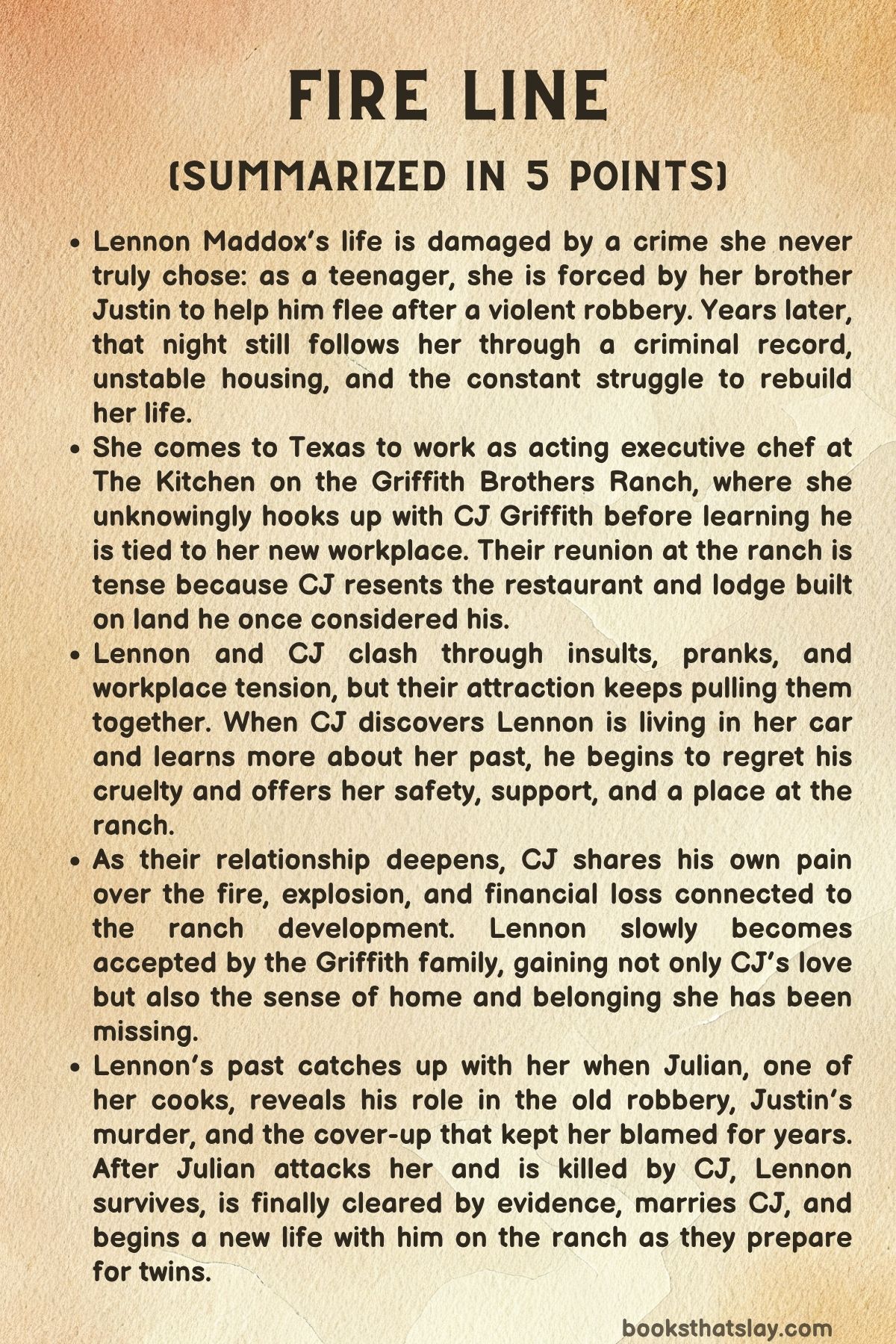
Characters
Lennon Maddox
Lennon Maddox is the emotional center of Fire Line, and her character is shaped by trauma, injustice, survival, and the slow rediscovery of belonging. As a teenager, she is trapped by her brother Justin’s authority over her and forced into a situation she does not fully understand until it is too late.
The robbery changes the direction of her life, not because she chooses violence or crime, but because she is young, frightened, dependent on her guardian, and unable to escape the consequences of his actions. This makes Lennon a deeply sympathetic character, because her criminal record is not presented as a simple sign of guilt, but as the lasting mark of a system and a family situation that failed her.
Her past follows her into adulthood, affecting her work, housing, reputation, and ability to trust others.
As an adult, Lennon is fiercely independent, but much of that independence comes from necessity rather than comfort. She has learned to survive without expecting rescue, which is why she hides the fact that she is living in her car and refuses to ask for help even when she desperately needs it.
Her pride is not arrogance; it is a defense mechanism built from years of being judged, abandoned, and reduced to her record. In the kitchen, she is disciplined, capable, and sharp-tongued, using her professionalism as a way to reclaim control over a life that has often been controlled by others.
Her talent as a chef gives her dignity, structure, and a future, making her job at The Kitchen more than employment. It becomes a chance to rebuild herself.
Lennon’s relationship with CJ reveals both her toughness and her vulnerability. At first, she responds to him with sarcasm, anger, and resistance because he threatens the fragile stability she is trying to create.
Their arguments and pranks show her fire, but they also show how guarded she is. When CJ discovers the truth about her living situation and learns more about her past, Lennon begins to soften, though not instantly.
Her growth lies in learning that accepting help does not make her weak. She has spent so long surviving alone that trust feels dangerous, yet the ranch gradually becomes a place where she can stop running.
By the end of the book, Lennon’s journey is not about erasing the past, because the years she lost cannot be returned. Instead, her arc is about gaining truth, safety, love, and chosen family after a life marked by fear and blame.
Her survival after Julian’s attack becomes symbolic of her larger survival: she has been wounded by the past, but not destroyed by it. Her acceptance of CJ’s proposal, her marriage, and her pregnancy with twins show that she has moved from isolation into a future filled with connection.
Lennon is a resilient, wounded, passionate character whose strength comes not from being untouched by pain, but from continuing to build a life after pain has tried to define her.
Carson James “CJ” Griffith
Carson James “CJ” Griffith is a complex romantic lead because he is not simply charming or protective; he is also stubborn, wounded, reactive, and at times unfair. His first connection with Lennon is playful and physical, built on attraction before either of them understands the complications waiting for them.
When he later realizes who she is and what role she will have at the ranch, his reaction is harsh because it collides with his existing resentment toward the lodge and restaurant. CJ sees the new development as a symbol of personal loss, since the land connected to it used to be his.
This makes his early hostility toward Lennon partly misplaced anger, because she becomes the visible face of a change he already hates.
CJ’s emotional conflict is rooted in grief, trauma, and sacrifice. The fire and explosion connected to the earlier criminal incident left him physically and emotionally scarred, and the sale of his land was not just a financial decision but a personal wound.
He sacrificed something meaningful for the survival of the ranch, but he has not fully made peace with that sacrifice. His anger toward the lodge and restaurant shows how loss can turn into bitterness when it is not processed.
CJ is not against progress in a simple way; he is struggling with the feeling that the future of the ranch was built partly on the destruction of something that belonged to him.
His treatment of Lennon is one of the most important measures of his growth. At first, he crosses lines, especially when he reads her file and exposes her legal name in front of the kitchen staff.
That moment shows his capacity for cruelty when he is hurt or defensive. However, CJ becomes more compelling because he recognizes the damage he has done and tries to repair it through action, not just words.
He offers Lennon shelter, defends her from disrespect, and slowly becomes someone she can rely on. His protectiveness is meaningful because it develops after he learns to see Lennon as a person rather than a problem.
CJ’s love for Lennon is tied to his own healing. Through her, he learns to confront his assumptions, soften his pride, and imagine a future beyond resentment.
His proposal with the jacket and ring is significant because it combines romance with belonging. The jacket represents family, home, and acceptance, while the ring represents personal commitment.
In the later part of the story, his reaction to Lennon’s pregnancy shows that his love is steady rather than performative. He does not dismiss her fear; he meets it with reassurance.
CJ’s character arc moves from anger and territorial pain to devotion, accountability, and emotional maturity.
Justin Maddox
Justin Maddox is one of the most destructive figures in the book because his choices set Lennon’s suffering in motion. As Lennon’s brother and guardian, he should have protected her, but he instead uses his authority to pull her into danger.
His decision to force her to drive him to the credit union shows a severe betrayal of trust. Lennon is young and dependent on him, which makes his manipulation even more damaging.
He does not simply commit a crime; he drags his sister into the consequences of that crime and leaves her life permanently altered.
Justin is morally complicated because he is both guilty and, in some ways, also caught in a larger criminal web. The later revelation that he and Lennon had been framed and hunted adds another layer to his role.
He is not innocent in the emotional sense, because he still forced Lennon into the situation and exposed her to violence, fear, prison, and social ruin. However, he is also not the sole architect of everything that happened.
His death after being released from prison shows that the past remained dangerous for him too. Justin’s life is marked by crime, poor choices, and vulnerability to worse people.
His relationship with Lennon is defined by betrayal rather than care. Even if he may have had reasons for his actions or pressures around him, the effect on Lennon is devastating.
He becomes the person who turns family into danger. The fact that Lennon must continue living under the shadow of what he made her part of gives him a haunting presence even when he is not physically present in much of the story.
His character represents how one person’s selfishness and desperation can ruin another person’s future.
Justin’s death also serves as a turning point because it proves that Lennon’s past has not stayed buried. It forces the hidden truth to begin surfacing and reveals that the danger around the old robbery is still active.
In this sense, Justin is both the origin of Lennon’s trauma and one of the keys to uncovering the truth. He is not presented as a heroic brother or a simple villain, but as a deeply flawed man whose failures as a guardian leave lasting damage.
Luca DeRossi
Chef Luca DeRossi plays an important role as the person who gives Lennon a professional opportunity when others might only see her criminal record. As the chef who hires her as acting executive chef at The Kitchen, Luca becomes a doorway into a new life.
His confidence in Lennon’s ability matters because she is a character who has been repeatedly judged by her past. By trusting her with responsibility, he recognizes her talent and work ethic rather than reducing her to the worst thing attached to her name.
Luca’s function in the story is also connected to stability and legitimacy. The Kitchen is not only a restaurant; it is the place where Lennon begins to rebuild her identity.
Through Luca’s decision to bring her in, she gets a chance to prove herself in a demanding environment. This makes him an important supporting figure, even if he is not at the emotional center of the romance or danger.
He represents the kind of person who can change another person’s path by offering trust at the right time.
Luca also helps connect Lennon to the Griffith family and the ranch community. By introducing her at the grand-opening dinner, he unknowingly places her in the middle of tension with CJ, but he also brings her into the world where she eventually finds home and acceptance.
His role is therefore both practical and symbolic. He gives Lennon a job, but that job becomes the foundation for her transformation.
As a character, Luca appears professional, perceptive, and confident in his own judgment. He does not seem interested in the gossip or stigma surrounding Lennon in the same way others might be.
His presence shows that Lennon’s future depends not only on romance, but also on people willing to value her skill and give her room to succeed. In that sense, Luca is a quiet but meaningful force in her recovery.
Cassandra Griffith
Cassandra Griffith is a stabilizing and managerial force within the ranch development. She is responsible for handling the lodge and restaurant side of the Griffith family’s expanding world, which places her in the middle of the conflict between CJ and Lennon.
Unlike CJ, Cassandra is more focused on keeping the project functional and protecting the family’s larger goals. She repeatedly intervenes when CJ and Lennon’s tension threatens to disrupt the workplace, showing that she is practical, observant, and unwilling to let personal drama damage what has been built.
Cassandra’s character is important because she sees more than people initially say. She eventually learns that Lennon and CJ hooked up before knowing each other’s full identities, and this knowledge gives her a clearer understanding of why their conflict is so charged.
Rather than existing only as a background family member, Cassandra becomes someone who monitors the emotional and professional consequences of their relationship. She understands that attraction, resentment, and workplace tension are all tangled together.
Her role also highlights the difference between family loyalty and blind approval. Cassandra is part of the Griffith family, but she does not simply excuse CJ’s behavior.
She is willing to step in, question, and manage situations when he acts out. This makes her a necessary counterbalance to CJ’s impulsiveness.
She helps maintain order in a story where emotions often run hot.
Cassandra also represents the ranch’s movement toward change. While CJ mourns what the lodge and restaurant cost him, Cassandra is connected to the future those developments create.
Through her, the book shows that growth can be painful but also necessary. She is a capable, grounded character whose importance comes from her ability to hold together family, business, and community when others are overwhelmed by emotion.
Julian
Julian is the hidden threat within Lennon’s new life, making him one of the most dangerous characters in the story. At first, he appears to be one of Lennon’s cooks, which allows him to remain close to her without immediately raising suspicion.
His position in the restaurant is especially disturbing because the kitchen is supposed to be Lennon’s place of control and renewal. By hiding there, Julian turns her safe professional space into a trap.
His revelation in the storeroom changes the understanding of the old robbery and Lennon’s suffering. Julian is not just a random attacker; he is connected to the crime that destroyed Lennon’s life.
He has been hunting her, killed Justin, and concealed money and evidence that could have cleared her years earlier. This makes him cruel not only because of his violence, but because he has allowed Lennon to carry guilt and punishment that could have been challenged.
His actions extend her suffering across years.
Julian’s character represents the way the past can disguise itself and return in familiar surroundings. Lennon believes she is building a new life, but Julian’s presence proves that unresolved danger has followed her.
He is patient, deceptive, and predatory, waiting until he can isolate her. His attack on Lennon is both physical and symbolic, because he tries to silence the person whose survival threatens the truth he has hidden.
His death at CJ’s hands brings the immediate danger to an end, but Julian’s larger importance lies in what is uncovered after his fall. The evidence found in his apartment finally proves that Lennon and Justin had been framed and hunted.
Julian is therefore the villain who embodies secrecy, manipulation, and delayed justice. He is essential to the story because defeating him allows Lennon’s name and future to begin separating from the crime that defined her for so long.
The Griffith Family
The Griffith family functions as more than a background group; they represent the possibility of belonging after isolation. For Lennon, who has been failed by her own family and judged by society, the Griffiths become a model of chosen acceptance.
Their ranch is not just a physical setting but an emotional world with its own traditions, loyalties, conflicts, and protections. When Lennon begins to be included in family dinners and receives CJ’s ranch jacket, those moments show that she is being welcomed into a community rather than merely dating one of its members.
The family is also important because it gives CJ a larger emotional context. His anger over the lodge and restaurant is tied to his sacrifice for the ranch’s survival, and that sacrifice only makes sense because family matters deeply to him.
The Griffiths are not perfect or free from conflict, but they are bound by commitment to one another and to the land. Their presence helps explain why CJ feels loss so intensely and why Lennon’s acceptance into the family carries so much meaning.
For Lennon, the Griffith family offers something she has rarely had: people who can learn the truth about her and still choose her. Their acceptance does not undo her trauma, but it challenges the shame and loneliness she has carried.
They allow her to imagine herself not as a burden or a criminal record, but as someone worthy of a permanent place. This is especially powerful because Lennon’s biological family connection with Justin brought danger, while the Griffith family brings protection and restoration.
As a collective, the Griffiths represent home, continuity, and healing. They help transform the ranch from a workplace into a place of emotional safety.
Their role in Fire Line is significant because Lennon’s happy ending depends not only on romantic love, but on the wider sense of family and community she gains through them.
The Women of the Ranch
The women of the ranch help broaden Lennon’s world beyond her relationship with CJ. As Lennon begins attending family dinners and forming bonds with them, they become part of her emotional integration into ranch life.
Their presence matters because Lennon needs more than romantic rescue; she needs friendship, acceptance, and a sense of ordinary connection. Through these women, she begins to experience the kind of community that was missing from her life for years.
They also help soften the edges of Lennon’s isolation. Lennon is used to hiding her struggles and expecting judgment, so every connection she forms is a step away from survival mode.
The women of the ranch offer a space where she can belong without constantly defending herself. Their acceptance shows that healing is not limited to one dramatic moment.
It also happens through dinners, conversations, shared routines, and the gradual feeling of being included.
As supporting characters, they strengthen the theme of chosen family. They show that the ranch is not only CJ’s world but a larger network of relationships that Lennon can enter.
Their role may be quieter than CJ’s or Julian’s, but it is emotionally important because they help create the environment that allows Lennon to stay. They are part of the reason the ranch becomes a home rather than just a hiding place.
Lennon’s Kitchen Staff
Lennon’s kitchen staff represents the professional world she must command while carrying the weight of her past. Their reactions to her, especially after CJ exposes her legal name, show how fragile her authority can become when people begin seeing her through the lens of her record.
This makes the kitchen a testing ground for Lennon’s strength. She must prove herself not only as a chef, but as a leader in a space where respect can be easily damaged by stigma.
The staff also helps reveal CJ’s growth. When he protects Lennon from disrespectful staff members, it shows that he has begun to understand the harm he caused by exposing her.
The kitchen becomes a place where public perception, private trauma, and professional authority collide. Lennon’s ability to continue leading despite humiliation and judgment shows her resilience.
Julian’s presence among the staff adds another layer of danger to this group. The fact that someone connected to Lennon’s past can hide in her workplace makes the staff environment more complicated.
It is not only a workplace community; it also becomes the place where the buried truth finally attacks her. This contrast makes the kitchen staff important to the structure of the story, because they surround both Lennon’s rebuilding and the threat to that rebuilding.
As a group, the staff reflects the social consequences of Lennon’s criminal record. Some people may respect her talent, while others can be influenced by suspicion or gossip.
Through them, the book shows that redemption is not only internal. Lennon must fight to be seen clearly by others, especially in the professional space where she is trying to reclaim her future.
The Police and FBI
The police and FBI function as forces of delayed justice in the story. Earlier in Lennon’s life, the legal system failed to protect the full truth of what happened, leaving her to carry the consequences of a crime whose deeper layers were hidden.
This makes their later involvement complicated. They are necessary to uncovering the facts about Justin’s death, Julian’s role, and the evidence that clears Lennon, but their presence also reminds the reader that official truth arrived painfully late.
Their investigation after the bunkhouse break-in and Justin’s murder helps move the past into the open. By identifying Justin’s release, his death, and the connection to someone from the original robbery, they reveal that Lennon’s danger is not imagined.
This matters because Lennon has spent years being doubted and punished. The investigation begins to confirm that she was never the simple criminal figure her record suggested.
The FBI’s discovery of money and proof in Julian’s apartment finally gives Lennon external validation. It cannot restore the years she lost, but it changes the meaning of her past in the eyes of the world.
Their role is therefore bittersweet. They bring truth, but only after Lennon has already endured prison, homelessness, fear, and violence.
This makes their presence important to the book’s themes of justice, damage, and partial restoration.
As characters in an institutional sense, the police and FBI are less emotionally intimate than the Griffith family or CJ, but they are crucial to the resolution. They confirm what Lennon could not prove on her own.
Their role shows that truth matters, even when it arrives too late to undo everything.
Themes
Trauma and the Long Shadow of the Past
Lennon’s life is shaped by a crime she never truly chose, yet she is forced to carry the punishment, shame, and fear that follow from it. Fire Line shows trauma not as a single painful memory, but as something that affects identity, relationships, work, and even basic survival.
Lennon’s criminal record follows her everywhere, making it difficult for her to find housing, trust others, or believe she deserves stability. Her past is not only emotional; it has practical consequences that keep her trapped in a cycle of judgment and insecurity.
The return of danger through Justin, Julian, and the hidden truth of the robbery proves that unresolved trauma does not disappear simply because time passes. Lennon’s recovery begins only when the truth is exposed and when she is surrounded by people who see more than her record.
The theme becomes powerful because healing is shown as difficult, slow, and incomplete, yet still possible when safety replaces fear.
Redemption Through Accountability and Trust
Redemption in the story is not presented as a quick apology or a romantic rescue. CJ’s growth depends on his willingness to face the harm he causes Lennon, especially after he invades her privacy, reads her file, and exposes her legal name in front of others.
His change matters because he does not simply feel guilty; he begins to act differently. He protects her dignity in the kitchen, offers her shelter, and learns to listen rather than judge.
Lennon’s own journey also connects to redemption, but in a different way. She does not need to be forgiven for the crime in the way others assume; she needs the chance to reclaim a life that was taken from her.
Trust becomes the bridge between both characters. CJ must prove he can be safe, while Lennon must decide whether accepting help means weakness or survival.
Their relationship grows because redemption is tied to consistent action, honesty, and emotional courage.
Home as Safety, Belonging, and Choice
Home is one of the strongest emotional ideas in the story because Lennon begins with almost no sense of safety or belonging. Living in her car shows how far she has been pushed to the margins, even while she is talented, hardworking, and determined.
The ranch gradually becomes more than a workplace; it becomes the first place where she is allowed to exist without constantly hiding. The bunkhouse, family dinners, the ranch jacket, and later her unfinished house with CJ all represent steps toward permanence.
This theme is important because home is not treated as only a physical location. For Lennon, home means being believed, defended, wanted, and included.
For CJ, home is complicated by loss, resentment, and the land he had to give up, but his relationship with Lennon helps him see that belonging can be rebuilt. By the end, home becomes a choice they make together rather than something either of them simply inherits.
Love as Protection Without Possession
The romance between Lennon and CJ develops through conflict, attraction, and gradual emotional honesty, but its deeper importance lies in how love changes the way both characters respond to fear. At first, their connection is physical and combative, shaped by misunderstanding and pride.
As they learn more about each other, love becomes less about winning arguments and more about creating safety. CJ’s protectiveness becomes meaningful when it is balanced by respect for Lennon’s strength.
He cannot erase her past or undo the years she lost, but he can stand beside her, defend her, and offer a future where she is not alone. Lennon’s love for CJ is equally significant because it requires her to risk vulnerability after years of being betrayed or blamed.
The final proposal, marriage, and pregnancy reveal that love is not shown as perfect certainty. It is shown as choosing someone through fear, change, and uncertainty, while promising to face the future together.