No Matter What Summary, Characters and Themes
No Matter What by Cara Bastone is a contemporary story about a marriage under pressure after trauma changes the lives of three people who once felt inseparable. At its center is Roz, a woman trying to understand why her husband, Vin, has quietly prepared to leave their home.
The book follows her confusion, grief, anger, and slow search for steadiness as she turns toward art, friendship, and painful honesty. It is also a story about recovery, silence, and the damage that can grow when people who love each other stop knowing how to speak. It’s the 3rd book of the Hearts of New York series.
Summary
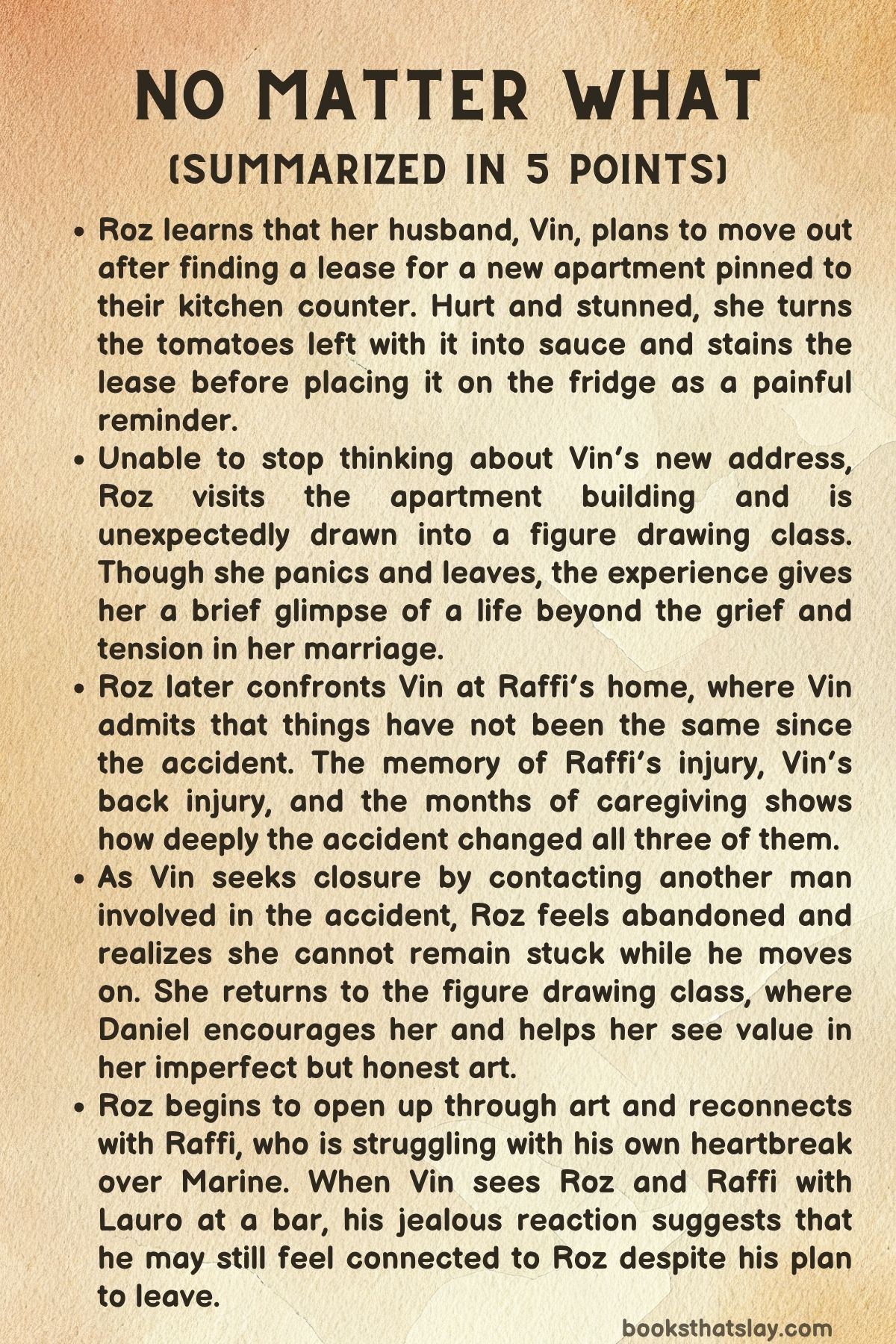
Roz, a recipe creator and food coordinator at Harvest NYC, discovers that her husband, Vin, may be planning to leave her when she finds a lease for a new apartment on their kitchen counter, pinned beneath a large can of diced tomatoes. The move-in date is August 15.
The casualness of the discovery wounds her: Vin has not told her he is leaving, but the document seems to confirm what their marriage has slowly been becoming. First Vin moved to the far side of the bed, then into the guest room after his younger brother Raffi moved out, and now, it appears, into a separate apartment altogether.
Rather than confront the lease immediately, Roz channels her shock into cooking. She opens the tomatoes and turns them into sauce, splattering some onto the lease before hanging the stained paper on the refrigerator where Vin cannot miss it.
When Vin comes home and sees it, he offers no real explanation. Roz tells him there is sauce on the stove, but instead of staying to talk, he leaves again.
The collapse of Roz and Vin’s marriage began roughly a year earlier, after a truck crashed through the front window of a café where Roz, Vin, and Raffi were sitting. Vin threw himself over Roz to protect her, sustaining a fourteen-inch laceration down his back. Roz suffered a sprained shoulder and a cut near her collarbone, while Raffi’s arm was shattered and he also sustained a severe concussion.
In the months afterward, Roz cared for both men as they recovered. Their lives became centered on pain, treatment, and survival. Vin and Roz stopped communicating, lost their intimacy, and fell into separate routines. Raffi’s presence kept the household moving, but when he finally moved out, Roz and Vin were left alone with everything they had avoided.
After finding the lease, Roz becomes fixated on its address: 954 East 12th Street. While picking up a framed portrait from St. Michel, her eccentric custom framer, she breaks down and admits aloud that her husband may be leaving her. Caught in a rainstorm afterward, she runs to the building listed on the lease.
There, Esther, the registrar for a figure drawing class, pulls her inside, mistaking her for someone expected. Daniel, the instructor, invites Roz to stay. Though Roz feels out of place, she sits down with a colored pencil and begins to draw.
Daniel responds warmly to her rough attempt, telling her that she constructs the model as an idea rather than merely copying a likeness. Roz panics and leaves, but the experience lingers.
Roz’s closest friend is Raffi, who is also Vin’s younger brother and the reason she and Vin met. Because Raffi remains emotionally bound to both of them, Roz and Vin agree to keep their possible separation secret from him.
When Roz visits Raffi, Vin is there too, and she confronts him about the lease. Vin says that nothing has been the same since the accident, a subject Roz can barely bear to discuss.
He tells her he will continue sleeping in the guest room until the lease begins, deepening her sense that he has already removed himself from their marriage.
Raffi tries to help Roz by taking her to a paint-and-sip class. What begins as a distraction becomes unexpectedly meaningful: making art quiets Roz’s mind. The act of looking, shaping, and creating gives her relief from the constant panic of her marriage falling apart.
Raffi notices this and encourages her to return to Daniel’s figure drawing class.
Meanwhile, Vin tells Roz he has found the identity of the fourth person injured in the café accident and wants to contact him before the anniversary, hoping for closure. Roz interprets this as further evidence that Vin wants to put the accident, and perhaps her, behind him. When she begins to cry, Vin does not comfort her; he withdraws.
Feeling that she cannot remain frozen while he makes decisions that will shape both their lives, Roz returns to the drawing class.
There she meets the class regulars, including Lauro, a charismatic and flirtatious artist; Em, a quiet and intensely talented woman; Penny; Esther’s grandson Fabi; and the model Pavel.
When Pavel strips nude, Roz is startled, and her first drawing accidentally resembles genitalia. Humiliated, she expects failure, but Daniel turns the moment into a lesson about the organic rhythms of the human body. He argues that an honest, imperfect drawing is better than a recognizable but empty symbol, such as a stick figure.
For Roz, the lesson matters deeply: she is not praised because her drawing is polished, but because she noticed something real and tried to put it on the page.
As weeks pass, Roz becomes more involved in the class while she and Vin continue their strained coexistence.
Their relationship remains full of contradictions. They nearly kiss in a bar bathroom, slow dance at Raffi’s housewarming party, and still share moments of tenderness, but Vin continues sleeping in the guest room and appears to be preparing to leave. Roz challenges him, listing the ways his actions confuse and hurt her: he texts her about groceries but has a lease, nearly sleeps with her but retreats from their bed.
When Vin holds up his wedding ring, Roz draws on Daniel’s lesson, telling him that a recognizable symbol is not the same as an honest one. Vin finally says that she is his wife, that they are having a hard time, but that does not mean he will not “do for” her. He reminds her that the lease does not begin until August 15 and tells her he is still there.
Roz’s growth as an artist accelerates, especially after Daniel quotes Michelangelo’s command: “Draw, Antonio, draw, Antonio. Draw, and don’t waste time.” When Roz considers finding figure models online, Vin becomes alarmed and offers to pose for her himself.
Their private drawing sessions become intensely intimate. Roz studies Vin’s body while he watches her, and the act of drawing him forces her to confront feelings she has tried to suppress. When Daniel later examines the drawings, he notes that Vin’s figure extends past the edges of the page, suggesting that the story is not over and evoking infinity.
Alone afterward, Roz admits to herself what the drawings reveal: she still loves Vin desperately.
The crisis reaches its peak when Roz finds moving boxes in Vin’s room. She assumes he is packing to leave, but Vin reveals that the boxes are only for the last of Raffi’s belongings. Then he tells her the truth: he never signed the lease. Every time Roz referred to it as signed, he tried to correct her, but she never heard the distinction.
The lease had been an option, not a decision. When Vin picked up the portrait from St. Michel, he was disturbed by the family photo Roz had chosen, in which Raffi stood between them. Vin had planned a surprise trip to Montauk and had also framed a photo from the night he and Roz first met, one that showed him gazing at her with undisguised love.
The unsigned lease was meant to offer Roz space if she wanted it.
But Raffi found the lease and mistook it for an apartment rented for him, and by the time Vin came home, Roz had already posted it on the refrigerator. That same night, Vin walked to a therapist’s office and has been attending weekly sessions ever since.
Roz and Vin reconcile, crying and holding each other. They visit Vin’s mother, Ramona, where Vin shaves his beard, and he and Roz kiss for the first time in over a year before making love.
That night, Raffi breaks down and reveals that he has known about their problems and blamed himself for staying too long after the accident. Roz reassures him and challenges him to stop wishing he were different.
Back in New York, Roz and Vin begin confronting their post-traumatic stress disorder together.
When Vin lies on top of Roz in bed, she flashes back to the accident and to the terrifying memory of his motionless weight over her body. She shoves him off. Vin explains that his therapist has taught him to name triggers aloud, and they begin developing a shared language for their trauma.
They compare themselves to two porcupines who love each other but must be careful when they hug.
Interspersed throughout the novel are passages in another voice, later revealed to be Vin speaking at a storytelling open mic. These sections describe falling in love with Roz and their early courtship, revealing feelings he has been unable to express directly.
Em eventually tells Roz that Vin has been performing at Sooth, a bar where he tells stories about her as part of therapy assigned by Dr. Elias Colewood. Roz rushes there with Raffi and watches from the crowd as Vin publicly tells the story of the accident for the first time.
He ends by saying that at least he knows he has something to die for. Afterward, Roz, Vin, and Raffi embrace, and Vin finally sobs with release.
Vin later meets Ethan, the fourth person injured in the accident, and returns reassured. Roz begins therapy as well and starts a cookbook project that combines recipes with hand-drawn food illustrations.
In a late-night conversation, she finally names the anger she has carried all year: she is furious at Vin for getting hurt while saving her, because his arms, once the safest place in the world, became terrifying when the accident happened while he was holding her.
In the end, Roz places a pearl ring on her left hand, made from Aunt Therese’s pearls, and calls it a marriage ring rather than a wedding ring. She asks Vin whether he will stay married to her for the rest of their lives, and he answers, “I will.” Roz draws the three of them older, sitting in a café and living normal lives, and Vin hangs the drawing beside his framed photo from the night they met.
The novel closes with Roz reflecting that a person cannot delete a chapter and still get the same ending.
She wants every tangle of their story, and she intends to draw beyond the edge of the page. She and Vin are “shooting for infinity.”
Characters
The characters in No Matter What are shaped by emotional injury, silence, loyalty, and the difficult process of trying to move forward after a shared trauma. The book presents them not simply as people reacting to one problem, but as individuals carrying private grief, fear, guilt, longing, and confusion.
Roz
Roz is the emotional center of the No Matter What, and her character is defined by the shock of realizing that the life she believed she still had with Vin may already be falling apart. Her discovery of the apartment lease is devastating because it shows that Vin has been planning a future without her while leaving her in uncertainty.
Roz’s response to the lease, especially turning the tomatoes into sauce and staining the paper, reveals how deeply hurt she is, but also how controlled and restrained she tries to appear. Rather than exploding, she turns pain into action, even if that action is symbolic and quietly angry.
Roz is also a character who has been trapped by the aftermath of the accident. Her memories of caring for Raffi and Vin show that she has lived for a long time in survival mode, focusing on other people’s injuries while suppressing her own emotional damage.
She is frightened by the idea of change because change means admitting that the old version of her marriage may not return. At the same time, her decision to go to the figure drawing class shows that she is beginning to resist emotional paralysis.
Art becomes a space where her mind can quiet down and where she can exist as more than a wife, caretaker, or abandoned partner. Roz’s journey is not simply about whether Vin stays or leaves; it is about whether she can rediscover herself while standing inside heartbreak.
Vin
Vin is one of the most emotionally guarded figures in the book. His decision to lease another apartment without directly telling Roz suggests avoidance, secrecy, and a deep inability to face the pain between them honestly.
He does not seem indifferent to Roz, but he is emotionally withdrawn, and that withdrawal wounds her more than an open argument might. His silence after seeing the sauce-stained lease shows how difficult it is for him to explain himself or confront the consequences of his choices.
Vin’s character is strongly shaped by the accident. His statement that nothing has been the same since then reveals that he sees the trauma as a dividing line between the life they had before and the life they are living now.
His desire to contact another man involved in the accident suggests that he is searching for closure, but his way of seeking closure may also involve cutting himself off from the people who shared the pain with him. This makes him complex rather than simply cruel.
He seems to be trying to move forward, but he does so in a way that leaves Roz behind emotionally. His jealousy or protectiveness when he sees Roz near Lauro also suggests that his feelings for her have not disappeared.
Vin is conflicted, wounded, and evasive, and much of the tension around him comes from the gap between what he feels and what he is willing to say.
Raffi
Raffi is Roz’s best friend and Vin’s younger brother, which places him in a painful emotional position. He is connected to both sides of the troubled marriage, yet he also has his own history of suffering because of the accident.
His serious arm injury makes him part of the shared trauma that has shaped Roz and Vin’s lives, but unlike Vin, Raffi seems more emotionally available to Roz. He offers companionship, practical help, and distraction when she is overwhelmed.
Raffi’s warmth makes him one of the most comforting characters in the story. He gives Roz clothes when she spills sauce on herself, takes her to a paint-and-sip class, and encourages her to return to the drawing class when he sees that art helps her.
At the same time, Raffi is not merely a cheerful support figure. His sadness over Marine shows that he is also carrying heartbreak and unresolved longing.
He understands loss because he is experiencing it too. His role in the book is important because he gives Roz a place to feel less alone, but his connection to Vin also complicates everything.
Raffi represents loyalty, emotional generosity, and the difficulty of loving people whose pain overlaps with your own.
Daniel
Daniel, the figure drawing instructor, represents patience, artistic perception, and the possibility of seeing value where someone else sees only failure. When Roz first enters the class, she is anxious and unprepared, but Daniel does not make her feel foolish for being new.
Instead, he gently encourages her to begin making marks on the page. His teaching style is significant because he does not demand perfection from Roz; he helps her notice honesty in her own work.
Daniel’s reaction to Roz’s awkward drawing shows his ability to transform embarrassment into learning. Rather than treating the drawing as a mistake, he uses it to explain organic rhythm and observation.
This makes him an important figure in Roz’s growth because he gives her a new way to understand herself. In her marriage, Roz feels unseen, abandoned, and emotionally stuck.
In Daniel’s class, she is seen as someone capable of expression, even when her work is rough. Daniel’s character brings calmness and creative possibility into the story, offering Roz a space where failure does not have to be humiliating and beginning again does not have to be terrifying.
Esther
Esther is an older woman whose presence brings warmth, eccentricity, and unexpected intervention into Roz’s life. She pulls Roz into the building where the figure drawing class is taking place, mistaking her for someone who is expected there.
This mistake becomes meaningful because it leads Roz toward an experience she would probably not have chosen for herself. Esther acts almost like a doorway into a new part of Roz’s life.
Her character adds a sense of spontaneity to the book. Roz arrives at the building in a state of emotional crisis, fixated on the address of Vin’s future apartment, but Esther redirects that moment into something surprising.
Although Esther may not fully understand Roz’s situation, her action helps interrupt Roz’s spiral. She represents the kind of accidental kindness that can change the direction of a person’s day, and perhaps even the direction of a person’s healing.
Esther’s importance lies in the fact that she does not solve Roz’s problems, but she helps place Roz in an environment where healing can begin.
St. Michel
St. Michel, Roz’s eccentric framing guy, appears briefly but meaningfully. He is present at a moment when Roz can no longer hold herself together.
While picking up the framed portrait for Vin’s mother, Roz breaks down and admits that her husband may be leaving her. This scene shows how grief sometimes escapes in front of unexpected people.
St. Michel’s role is not large, but his presence creates a moment where Roz’s private pain becomes visible outside her home and marriage.
As a character, St. Michel also belongs to the artistic world that slowly begins to open around Roz. His framing work connects him to preservation, presentation, and memory, which contrasts with Roz’s fear that her own life is coming apart.
The framed portrait is meant as a family gift, but the errand becomes tangled with Roz’s realization that the family structure around her may be changing. St. Michel’s eccentricity also softens the scene, keeping it from being only bleak.
He helps reveal how fragile Roz is beneath her controlled exterior.
Em
Em is one of the students Roz meets when she returns to the figure drawing class. Although the provided events do not give extensive detail about Em, the character contributes to the sense that the class is a living community rather than just a setting.
Em’s presence helps show that Roz is entering a space filled with people who have already accepted the vulnerability of looking, drawing, and learning together.
Em is important because the art class represents a world outside Roz’s marriage, outside the apartment, and outside the accident’s shadow. Each student in that room helps create an atmosphere where Roz can begin to be someone new.
Em’s role may be quiet, but it supports the larger emotional function of the class: it gives Roz a place where she is not defined by Vin’s silence or by the trauma that has shaped the past year.
Penny
Penny is another member of the figure drawing class, and her role helps expand the social world that Roz steps into when she decides not to remain frozen at home. Like Em, Penny contributes to the atmosphere of a group where creativity, awkwardness, and observation are shared.
Her presence helps make the class feel like an established community with its own rhythm.
Penny’s importance comes from what she represents in Roz’s emotional journey. Roz is frightened of beginning something new, especially while her marriage feels unstable, but the class offers her a place where newness is normal.
Penny is part of that environment. Even if she is not central to the conflict, she helps create the contrast between Roz’s silent, painful home life and the more open, imperfect, expressive world of the drawing class.
Fabi
Fabi is Esther’s grandson and one of the students connected to the drawing class. His relationship to Esther gives him a link to the person who first pulls Roz into this unexpected artistic space.
Because he belongs to the same community, Fabi helps reinforce the sense that Roz has stumbled into a network of people rather than a single isolated event.
Fabi’s character is significant because he helps make the class feel intergenerational and personal. The presence of Esther and her grandson suggests that the art space is not just about technique; it is also about relationships, habits, and people gathering together.
For Roz, who is experiencing distance and uncertainty in her most intimate relationship, this kind of community matters. Fabi’s role may be secondary, but he supports the book’s larger interest in how people can be held by unexpected circles of connection.
Lauro
Lauro is a lively and flirtatious presence who creates both comic energy and emotional tension. When he appears at the bar and flirts with Roz and Raffi, he brings a different kind of attention into Roz’s life.
His flirtation matters not necessarily because Roz is ready for romance, but because it reminds her that she can still be noticed by someone outside the painful dynamic of her marriage.
Lauro also becomes important because of Vin’s reaction to him. When Vin arrives and positions himself between Roz and Lauro, the moment exposes feelings Vin has not been expressing directly.
Lauro’s presence brings jealousy, protectiveness, or possessiveness to the surface, making visible the emotional conflict Vin has tried to keep hidden. In this way, Lauro functions as a catalyst.
He disrupts the quiet suffering between Roz and Vin by forcing tension into the open. His character adds charm and social brightness, but he also reveals how unresolved Roz and Vin’s relationship truly is.
Marine
Marine is Raffi’s ex, and although she does not appear directly in the provided events, her presence is emotionally important because of Raffi’s reaction to seeing her. Raffi admits that he still misses her, which reveals that he is also dealing with heartbreak.
This makes him more than just Roz’s supportive best friend. He has his own emotional wound, his own attachment to someone he has lost, and his own difficulty moving on.
Marine’s role deepens Raffi’s character and strengthens the book’s broader focus on relationships that remain emotionally powerful even after they have changed. Just as Roz is struggling with the possible end of her marriage, Raffi is struggling with the lingering pain of a past relationship.
Marine therefore becomes part of the story’s pattern of love, separation, and unresolved feeling. Even from a distance, she helps show that heartbreak takes different forms for different characters.
Vin’s Mother
Vin’s mother is connected to the story through the framed portrait Roz is picking up as a birthday gift. Though she does not appear directly in the provided events, her presence matters because she represents the family world that Roz is still trying to participate in even as her marriage becomes uncertain.
The gift suggests that Roz still sees herself as part of Vin’s family and is still carrying out gestures of care and obligation.
Her indirect role also increases the sadness of Roz’s situation. Roz is preparing something thoughtful for Vin’s mother while discovering that Vin may be preparing to leave their shared life.
This contrast shows how emotionally uneven the marriage has become. Vin’s mother therefore functions less as an active character and more as a symbol of the family bonds that may be threatened if Roz and Vin separate.
Themes
Emotional Abandonment Within Marriage
Roz’s discovery of Vin’s lease exposes a marriage where separation has already begun emotionally before it becomes physical. In No Matter What, the lease is not just proof that Vin plans to move out; it becomes a symbol of the silence, avoidance, and distance that have replaced honest conversation between them.
Roz is not given an explanation, a warning, or even the dignity of being included in the decision, which makes the betrayal feel colder than an argument would have. Vin’s retreat into the guest room, his refusal to comfort her when she cries, and his habit of leaving rather than speaking show how abandonment can happen while two people still share the same home.
Roz’s pain comes from realizing that the person closest to her has been making plans for a life without her. The theme becomes especially strong because Vin is not openly cruel, but his silence hurts deeply.
His withdrawal forces Roz to confront not only the possible end of her marriage, but also the loneliness she has been living with for a long time.
Trauma and the Difficulty of Moving Forward
The accident has left every major relationship in the story marked by fear, guilt, pain, and unfinished grief. Roz, Vin, and Raffi survived physically, but their emotional recovery is far more complicated.
Vin’s back injury, Raffi’s arm injury, and Roz’s role as caretaker created a period where survival mattered more than emotional honesty. Once the immediate crisis passed, the damage became harder to ignore.
Vin’s desire to contact another man connected to the accident shows his need for closure, but Roz experiences this as a threat because moving on may also mean moving away from her. She cannot even bear hearing the accident mentioned, which shows how trauma can freeze a person in place.
Vin tries to manage pain by creating distance, while Roz responds by holding on to what remains. Neither response fully heals them.
The theme shows that trauma does not end when bodies recover or routines return. It remains in silences, changed sleeping arrangements, fear of the future, and the painful question of whether love can survive after shared suffering.
Art as Self-Discovery and Emotional Release
Roz’s movement toward art becomes a quiet but powerful act of survival. At first, the figure drawing class is something she enters by accident, almost as if life pushes her toward a room where she can begin to see herself differently.
She is embarrassed, unsure, and overwhelmed, but the act of drawing gives her something her marriage no longer offers: permission to be present without having to fix anyone else. In the paint-and-sip class, she realizes that making art quiets her mind, which is important because her thoughts have been trapped inside fear, rejection, and confusion.
Daniel’s response to her rough drawing also matters because he does not mock her uncertainty. Instead, he treats her marks as honest attempts to observe.
Through art, Roz begins to experience imperfection without shame. She does not have to be a perfect wife, caretaker, or emotionally controlled person in that space.
The theme suggests that creativity can become a form of emotional breathing, helping someone regain identity when personal life feels unstable.
Friendship, Family, and Divided Loyalties
Raffi’s role creates emotional complexity because he is both Roz’s best friend and Vin’s younger brother. This makes him a source of comfort, but also a reminder that Roz’s marriage is tied to a larger family structure she may lose.
Roz turns to Raffi when she is hurt because he offers warmth, distraction, and familiarity, yet even this safe relationship is complicated by his connection to Vin. The fact that Vin sleeps at Raffi’s place wounds Roz because it suggests that Vin may be seeking support from the same person she needs.
Raffi’s own heartbreak over Marine also broadens the theme, showing that love and loyalty are difficult for more than one character. The relationships are not arranged in simple sides.
Raffi cares about Roz, but Vin is his brother. Roz needs Raffi, but she also fears becoming a burden or being left behind.
This theme shows how family and friendship can comfort people during crisis, while also making emotional boundaries harder to maintain.