No Place Like You Summary, Characters and Themes
No Place Like You by Jillian Meadows is a small-town romance about grief, unfinished dreams, old friendship, and the difficult work of coming home to yourself. The story follows Fable Oaks, a young woman trying to restore her late grandfather’s cabin while struggling with loss and self-doubt, and Theo Nikolaou, her former childhood best friend and high-school rival, who has returned to Fern River as a veterinarian.
When gossip pushes them into a fake relationship, they agree to help each other: Theo will assist with the cabin, and Fable will help him prove he is ready to stay. Their arrangement soon brings old wounds and hidden feelings back into the open. It’s the 2nd book of the Oaks Sisters series.
Summary
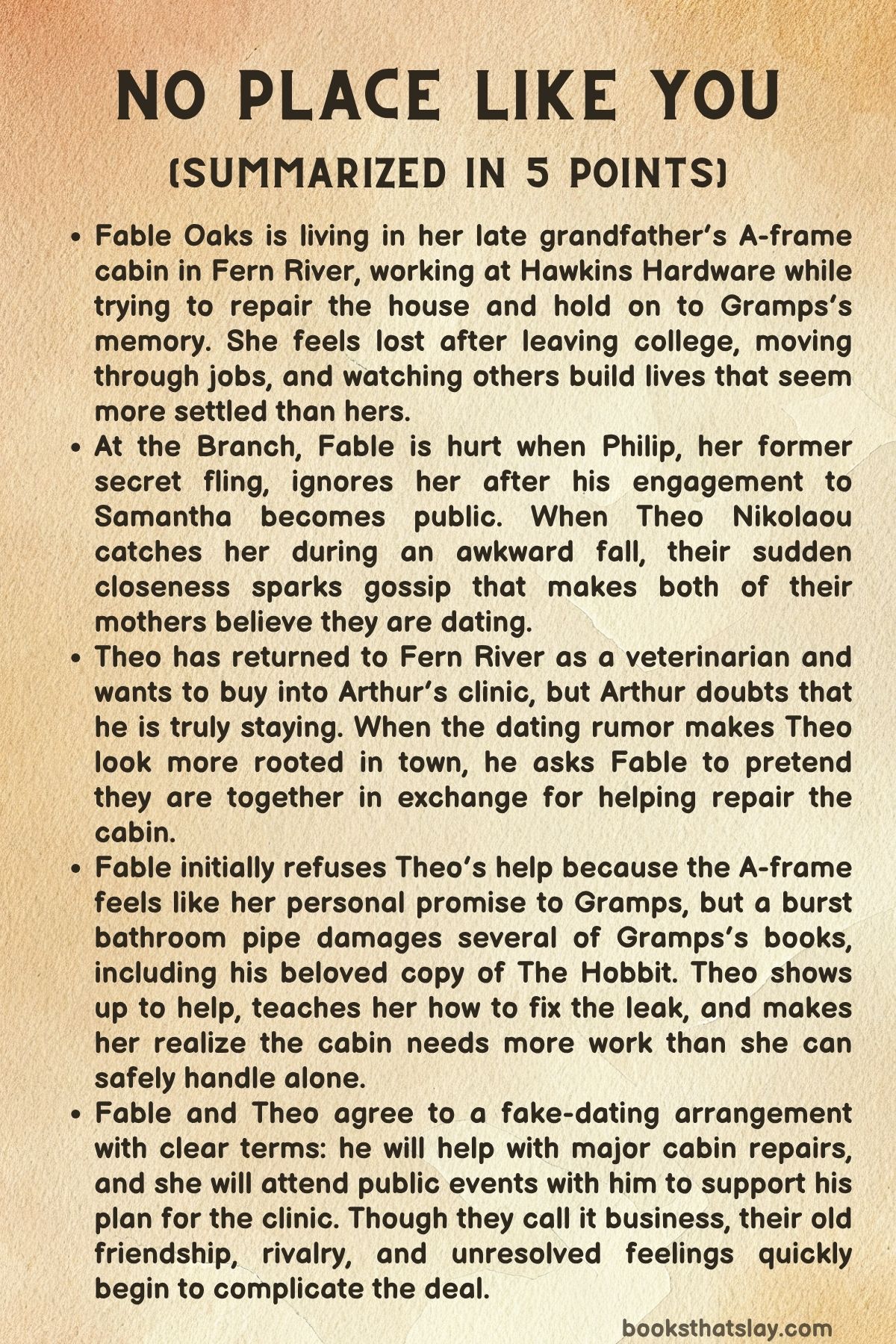
Fable Oaks is living in her late grandfather’s old A-frame cabin in Fern River, trying to rebuild both the house and the life she feels she has failed to shape properly. The cabin is more than a place to live.
It is tied to her memories of Gramps, the person whose love and presence still guide her. Restoring it feels like a way to keep him close, but the work is far bigger than she expected.
The stairs are unsafe, the smoke detectors are unreliable, the plumbing is in poor condition, and every corner seems to hold another repair she does not fully know how to handle. Still, Fable is determined to do it herself.
Her determination comes from love, but also from insecurity. She has dropped out of college, moved from job to job, and watched others make steadier progress while she feels stuck.
She works at Hawkins Hardware and drives her grandfather’s old Bronco, Baby Blue, clinging to the pieces of him she can still touch. On Gramps’s birthday, the weight of her grief feels especially heavy.
The cabin is full of memories, but also full of problems, and Fable is caught between honoring the past and fearing she is not capable of building anything lasting.
Her personal life feels just as unsettled. One evening, after seeing a photo of Philip, her former secret fling, newly engaged to Samantha, Fable goes to the Branch for coconut chicken tenders.
There, she runs into Philip and his friends. Philip ignores her completely, making her feel small and invisible.
When one of his friends shoves him, Philip crashes into Fable by accident. Before she can fall, Theo Nikolaou catches her and pulls her into his lap.
Theo was once her childhood best friend, but their closeness turned into rivalry during high school. Their history is complicated, and being held by him brings back too much at once.
Theo is angry on Fable’s behalf and protective in a way that unsettles her. Instead of staying and facing the moment, Fable panics and leaves quickly.
Theo has also returned to Fern River with something to prove. He is now a veterinarian working at the local clinic, but his future there is uncertain.
Arthur, the clinic’s owner, plans to sell the practice to Garrett rather than consider Theo as the main buyer. Arthur sees Garrett as more stable and more rooted in Fern River.
Theo, in Arthur’s eyes, is the one who left once and might leave again. Theo wants to show that he has come home for good, but Arthur doubts his commitment.
The incident at the Branch soon becomes gossip. Cathy, known for spreading town news, sends around a photo of Theo holding Fable.
Theo’s mother, Eva, and Fable’s mother, Mary, both believe Theo and Fable are dating. The rumor reaches Arthur, and when he brings it up, Theo does not correct him.
Arthur’s attitude toward Theo begins to soften. The idea that Theo is in a relationship with someone local makes him appear more settled, more connected to the town, and possibly more trustworthy as a long-term owner of the clinic.
Arthur later says he may consider a future where Theo and Garrett buy the practice together, but only if Theo proves he is truly staying and can work with Garrett. The upcoming adopt-a-thon becomes an important test.
Theo sees that the fake relationship rumor could help him, but he also knows he cannot maintain it without Fable’s agreement.
When Theo visits Fable at Hawkins Hardware, he explains what has happened and asks her to pretend they are dating. In exchange, he offers to help with repairs at the A-frame.
Fable refuses at first. She insists that the cabin is her project and that she can handle it alone.
Accepting help feels too close to admitting failure, and she is not ready to let Theo, of all people, see how overwhelmed she really is.
The next morning, the cabin proves how fragile her independence is. A bathroom pipe Fable tried to repair bursts or leaks badly enough to flood the hallway and the spare bedroom where Gramps’s belongings are stored.
Several boxes of his books get wet, including his treasured copy of The Hobbit, the book that helped Fable fall in love with stories. The damage breaks her composure.
The loss is not only about paper and pages. It feels like another part of Gramps slipping away.
Devastated, Fable calls her sisters, Tessa and Millie. Tessa acts quickly and sends help.
That help arrives in the form of Theo, carrying paper towels and a fan. Fable does not want to let him in, but the situation leaves her little choice.
Together, they begin drying the damaged books and trying to save what they can. Theo sees the condition of the cabin more clearly and understands that Fable has been carrying far too much on her own.
When he looks at the pipe, Theo does not simply take over and fix it for her. Instead, he teaches Fable how to repair it herself.
This matters because it respects her need to feel capable. He offers help without making her feel useless.
After the leak is stopped, he notices that the stairs and railing are unsafe too. Fable’s frustration rises again.
She breaks down slightly under the pressure of everything that needs to be done, but still insists the A-frame must remain her responsibility.
Theo asks her to let him help. Fable remembers overhearing him wonder whether he needed her help too, and this shifts something between them.
Rather than accept charity, she proposes a trade. Theo will help her with the cabin repairs, and she will act as his fake girlfriend so he can appear settled and committed to Fern River.
This gives both of them something they need while allowing Fable to keep her pride.
They create a practical arrangement. The repair list includes insulation, stairs, railing, drywall, painting, and other work needed to make the A-frame safer and more livable.
In return, Fable agrees to attend public events with Theo. These include the adopt-a-thon, house hunting, dinner with Maddox, and other appearances that will help convince people, especially Arthur, that Theo has planted roots in town.
They both claim the arrangement is only business, but their history makes that impossible to believe completely. The old connection between them is still present, even under years of hurt and distance.
Theo admits he does not pursue real relationships because he does not trust himself and fears hurting people. Fable recognizes that their past still stands between them, especially the parade incident that ended their friendship and changed how they saw each other.
Even so, they agree to the fake relationship. Theo writes a playful note that echoes the one he gave Fable in fifth grade when he first asked to be her best friend.
The gesture brings their shared past into the present, reminding Fable of who they once were before rivalry, pain, and misunderstanding came between them. When she checks “yes,” the agreement becomes more than a bargain about repairs and appearances.
It opens the door to facing old feelings, unfinished conversations, and the possibility that home may not only be a cabin, a town, or a memory of someone lost. It may also be found in the person who once knew you best.
Characters
Fable Oaks
Fable Oaks is the emotional center of No Place Like You, and her character is shaped by grief, insecurity, stubborn independence, and a deep need to prove that she can rebuild both her home and herself. She is living in her late grandfather’s old A-frame cabin, and the house becomes much more than a renovation project for her.
It represents her connection to Gramps, her childhood, her memories, and the version of herself that once felt more hopeful. Because she has dropped out of college, changed jobs several times, and watched others move forward, Fable carries a quiet sense of failure.
She does not simply feel stuck in practical terms; she feels emotionally stranded, as if everyone else has found a path while she is still trying to understand where she belongs.
Her determination to restore the cabin reveals both her strength and her vulnerability. Fable wants to do the repairs herself because, to her, accepting help can feel like admitting defeat.
Saving the A-frame feels like saving Gramps’s memory, so every broken stair, faulty pipe, damaged wall, and ruined box of books becomes emotionally charged. When the bathroom pipe floods the hallway and damages Gramps’s belongings, her reaction shows how fragile her control really is.
She has been trying to hold grief, responsibility, and self-doubt together through sheer willpower, but the damage to the books, especially the treasured copy of The Hobbit, exposes how deeply she fears losing the pieces of Gramps that remain.
Fable is also guarded in relationships. Her reaction to Philip’s engagement photo and his public indifference shows that she is still hurt by being treated as something hidden or disposable.
Her panic when Theo catches her at the bar suggests that her feelings for him are complicated by history, pride, and unresolved pain. She is not indifferent to Theo; in fact, her quick retreat shows that closeness with him still affects her strongly.
Fable’s agreement to fake-date him is practical on the surface, but emotionally it places her near someone who once mattered deeply and still has the power to unsettle her. Her character arc in this part of the story is about learning that independence does not have to mean isolation, and that allowing help does not erase her strength.
Theo Nikolaou
Theo Nikolaou is one of the most emotionally layered characters in the book because he combines confidence, protectiveness, guilt, ambition, and fear of attachment. As a veterinarian who has returned to Fern River, he wants to prove that he belongs there permanently, yet the town still sees him through the lens of his past departure.
Arthur’s reluctance to sell him the clinic shows that Theo is fighting against a reputation for instability. Theo wants professional recognition, but what he truly seems to want is trust: trust from Arthur, trust from the town, and perhaps most importantly, trust from himself.
His protectiveness toward Fable appears immediately when Philip ignores her and then crashes into her at the bar. Theo’s anger on her behalf reveals that his old bond with Fable has not disappeared, even if their friendship was damaged years earlier.
He notices her discomfort, reacts to her mistreatment, and later steps into her life again when the cabin disaster happens. However, Theo’s care is not controlling.
One of the most important details about him is that when he helps with the pipe, he does not simply fix it for Fable; he teaches her how to repair it herself. This shows that he understands her need for agency.
He supports her without taking the project away from her, which makes his help emotionally meaningful.
Theo’s fear of real relationships adds complexity to his character. He admits that he does not trust himself and worries about hurting people, which suggests that beneath his capable exterior is someone who carries guilt and self-doubt.
The fake-dating arrangement benefits him professionally, but it also forces him into emotional closeness with Fable. His playful note, echoing the one from fifth grade, reveals that he still remembers the innocence and warmth of their original friendship.
Theo is not merely using Fable for appearances; he is drawn back into a relationship that matters to him, even if he is afraid to name what he feels. His conflict lies between wanting to be seen as rooted and fearing the emotional responsibilities that come with truly staying.
Gramps
Gramps is physically absent, but his presence shapes the emotional world of the story. He lives on through the A-frame cabin, Baby Blue, his belongings, his books, and Fable’s memories.
For Fable, Gramps represents love, safety, continuity, and the person who helped her feel connected to stories and to herself. His treasured copy of The Hobbit is especially important because it is not just an object; it represents the beginning of Fable’s love for stories and the emotional inheritance he left her.
Gramps’s importance is also seen in the way Fable responds to the cabin. She does not view it as a simple property or a practical responsibility.
To her, the house is almost a living memory of him. Repairing it becomes a way of keeping him close, which is why every failure in the renovation feels personal.
His birthday intensifies her grief because it reminds her that she is trying to preserve someone who is no longer there. Although Gramps does not act directly in the present, he motivates Fable’s choices and reveals the depth of her loyalty.
His character functions as the emotional foundation of Fable’s journey.
Philip
Philip is important because he represents a painful part of Fable’s past and exposes her lingering feelings of rejection. His former secret fling with Fable suggests that he was willing to be close to her privately but not openly.
When Fable sees that he is newly engaged to Samantha, it wounds her not only because he has moved on, but because he seems to have given someone else the public commitment and recognition that he never gave her. His engagement becomes a symbol of how easily Fable feels left behind.
At the Branch, Philip’s decision to ignore Fable completely reveals his emotional cowardice. He does not offer kindness, closure, or even basic acknowledgment.
His behavior makes him seem careless and self-protective, someone more interested in avoiding discomfort than treating Fable with respect. The accidental collision caused by his friend’s shove is less important than the emotional collision already taking place.
Philip’s role is not to be deeply sympathetic, but to show the kind of treatment Fable has endured and why Theo’s protective response matters so much in contrast.
Samantha
Samantha is not developed through direct action in the text, but her presence is still meaningful. As Philip’s fiancée, she represents the life Philip has publicly chosen and the future from which Fable is excluded.
For Fable, Samantha is less a rival in an active sense and more a symbol of comparison. Seeing Samantha engaged to Philip forces Fable to confront the fact that someone who once kept her hidden is now openly building a life with someone else.
Because Samantha is viewed mainly through the engagement photo and Philip’s connection to her, her character functions indirectly. She sharpens Fable’s emotional discomfort and highlights Fable’s fear that she was never chosen properly.
Samantha’s importance lies in what she reveals about Fable’s inner state. Her existence makes Fable’s hurt visible, even though Samantha herself is not shown as cruel or responsible for that pain.
Arthur
Arthur is a practical and cautious figure whose decisions place pressure on Theo’s professional life. As the owner of the veterinary clinic, he holds power over Theo’s future in Fern River.
His preference for Garrett comes from his belief that Garrett is more stable and more rooted in town, while Theo is still associated with having left before. Arthur’s judgment may feel unfair to Theo, but it is not presented as random.
He is making a decision based on reliability, reputation, and the future of the practice.
Arthur also shows how small-town perception can influence real opportunities. When he hears the rumor that Theo and Fable are dating, his opinion of Theo begins to soften because the relationship makes Theo appear more settled.
This reveals that Arthur values not only professional ability but also social rootedness. His character creates the external conflict that leads to the fake-dating arrangement.
He is not simply an obstacle; he is a gatekeeper whose doubts force Theo to prove what kind of life he truly intends to build.
Garrett
Garrett functions as Theo’s professional rival and as a symbol of the stability Theo is trying to prove he has. Arthur sees Garrett as more rooted in Fern River, which immediately places him in contrast with Theo.
Even without much direct development, Garrett’s presence creates tension because he represents the safer choice in Arthur’s eyes. He is the person Theo is measured against.
Garrett’s role becomes especially important when Arthur suggests that Theo and Garrett might buy the practice together if Theo can prove himself and work with Garrett on the adopt-a-thon. This makes Garrett more than a rival; he becomes part of Theo’s test.
Theo must show not only commitment to the town but also maturity, cooperation, and professional steadiness. Garrett’s character is therefore important because he pressures Theo to demonstrate that returning to Fern River is not temporary.
Cathy
Cathy represents the power of gossip in a small town. By sending around the photo of Theo holding Fable at the bar, she turns a private and accidental moment into public speculation.
Her action sets off a chain of consequences that affects Theo, Fable, their families, and Arthur’s perception of Theo. Cathy may not be central emotionally, but she is important to the plot because her gossip creates the misunderstanding that becomes useful to Theo.
Her character also reflects the lack of privacy in Fern River. In this community, one photo can become a public story before the people involved have even decided what it means.
Cathy’s gossip is intrusive, but it also exposes how quickly appearances can shape reality. Because of her, Theo and Fable are pushed into a situation where pretending becomes easier than correcting the truth.
Eva Nikolaou
Eva Nikolaou, Theo’s mother, appears as part of the family and community response to the dating rumor. Her belief that Theo and Fable are together shows how eager people around them are to interpret the photo as romantic.
As Theo’s mother, Eva likely sees the rumor through the lens of hope, curiosity, or maternal interest. Her reaction adds pressure because Theo’s fake relationship is not only being judged by Arthur but also accepted by people close to him.
Eva’s role also helps show that Theo’s personal life is tied to his public identity in Fern River. His mother’s belief in the relationship makes the lie feel more intimate and complicated.
It is no longer only a professional strategy; it enters family space. Eva’s character therefore contributes to the emotional stakes of the fake-dating arrangement.
Mary
Mary, Fable’s mother, plays a similar role to Eva in the spread and acceptance of the dating rumor. Her belief that Fable and Theo are together shows that the fake relationship affects both families, not just Theo’s professional life.
Mary’s reaction matters because it places Fable in a difficult position. Fable is already grieving, overwhelmed by the cabin, and emotionally unsettled by Theo, and now her mother is part of the misunderstanding too.
Mary’s presence also reinforces the sense that Fable’s life is being watched and interpreted by others. Fable is trying to prove herself privately through the A-frame, but the rumor pulls her into public attention.
Mary may not be heavily developed here, but she helps create the family pressure surrounding Fable’s choices and makes the fake relationship feel harder to keep emotionally separate from reality.
Tessa
Tessa is one of Fable’s sisters, and her response to the flooded cabin shows that she is practical, protective, and quick to act. When Fable calls her sisters in distress, Tessa immediately sends help by getting Theo to come over with supplies.
This shows that Tessa understands the seriousness of the situation and does not hesitate when Fable needs support. Her action also suggests that she may know Fable well enough to recognize that Fable will not easily ask for or accept help directly.
Tessa’s character highlights the family support around Fable, even when Fable feels alone. She does not solve the emotional problem for Fable, but she creates the opening for Theo to step in.
In doing so, Tessa indirectly helps move Fable toward accepting assistance and reconnecting with Theo. Her role is brief but meaningful because she acts out of care when Fable is overwhelmed.
Millie
Millie, Fable’s other sister, is part of the family circle Fable turns to during the cabin disaster. Although Tessa takes the most direct action by sending Theo, Millie’s inclusion in the call shows that Fable’s sisters are part of her emotional support system.
Fable may be stubbornly independent, but in her most distressed moment, she still reaches for family.
Millie’s role helps reveal that Fable is not completely isolated, even if she often feels that way. The presence of both sisters suggests that Fable’s grief and struggles exist within a family network.
Millie may not be developed in detail in the book, but her presence matters because it shows that Fable has people she can turn to when the pressure becomes too much.
Maddox
Maddox is mentioned as someone connected to one of the public events in Theo and Fable’s fake-dating arrangement. Dinner with Maddox becomes part of the list of appearances Fable agrees to make as Theo’s fake girlfriend.
Although Maddox is not directly developed here, the mention of dinner suggests that he is someone whose opinion or presence matters in Theo’s social or professional world.
Maddox’s role is therefore connected to the performance aspect of Theo and Fable’s arrangement. He represents one of the situations where their fake relationship must appear believable.
Even without detailed characterization, Maddox helps expand the arrangement beyond a single rumor and shows that Theo and Fable will have to maintain the act in front of real people in their community.
Baby Blue
Baby Blue, Gramps’s beloved old Bronco, is not a human character, but it carries character-like emotional value in No Place Like You because it represents memory, inheritance, and Fable’s continued bond with her grandfather. The vehicle is part of what Gramps left behind, and Fable’s use of it shows that she is still living among the objects that connect her to him.
Like the A-frame, Baby Blue is a reminder that Fable’s present life is built around preserving pieces of the past.
Baby Blue also adds texture to Fable’s character. Driving Gramps’s old Bronco suggests that she is sentimental, loyal, and attached to history.
She does not simply discard old things because they are worn or inconvenient. Instead, she holds onto them because they carry love and meaning.
In that sense, Baby Blue reflects Fable’s larger struggle: she is trying to move forward while still protecting what remains of the person she lost.
Themes
Grief and the Burden of Memory
Fable’s grief is tied closely to the cabin, the Bronco, Gramps’s belongings, and the routines that still connect her to him. Her attempt to restore the A-frame is not just a home repair project; it becomes her way of holding on to the person who gave her comfort, identity, and a sense of belonging.
The damaged books, especially the treasured copy of The Hobbit, show how painful it is when memory feels physically threatened. Fable’s distress is not only about ruined objects, but about the fear that losing these pieces means losing Gramps all over again.
Her grief also keeps her stuck because she treats the cabin as something she must save alone, almost as if accepting help would weaken her loyalty to him. Through Fable, No Place Like You presents grief as both love and weight: it preserves what mattered, but it can also make moving forward feel like betrayal.
Independence and the Fear of Needing Others
Fable’s insistence on fixing the A-frame by herself reveals a deep need to prove that she is capable, especially after dropping out of college, changing jobs, and feeling behind everyone else. Her independence is partly admirable because it shows determination, resilience, and pride in learning how to care for the home Gramps left behind.
Yet it also becomes a wall. She refuses help even when the cabin is unsafe, the repairs are beyond her skill level, and the damage threatens things she loves.
Theo’s approach matters because he does not simply take over; he teaches her, allowing her to keep her agency while still accepting support. This changes the meaning of help from failure to partnership.
Fable’s journey suggests that strength is not proven by doing everything alone. True confidence can include learning, depending on someone trustworthy, and admitting that some burdens become lighter when shared.
Reputation, Belonging, and the Pressure to Seem Settled
Theo’s conflict with Arthur shows how much small-town life depends on reputation and public perception. Although Theo has returned to Fern River and wants to build a future there, Arthur judges him through the lens of his past departure.
Garrett appears more stable because he seems rooted, while Theo has to prove that he is not temporary. The fake-dating arrangement begins because the rumor about Fable gives Theo an image of commitment that he cannot easily create on his own.
This reveals how belonging is not only about what a person feels internally, but also about whether the community believes in their permanence. At the same time, Fable is also judged by comparison: others seem to be moving forward while she feels stalled.
Both characters are caught between who they are and who others think they are. The theme shows how public narratives can shape opportunities, relationships, and self-worth.
Unresolved History and Second Chances
Fable and Theo’s present connection is shaped by years of unfinished emotion. Their childhood friendship, later rivalry, and the painful parade incident still influence how they react to each other.
Even when they agree that the fake relationship is practical, their old closeness immediately complicates the arrangement. Theo’s protective response at the bar shows that his care for Fable has not disappeared, while Fable’s panic reveals how much the past still unsettles her.
Their playful contract and the note echoing fifth grade suggest that second chances are built through small returns to what was once meaningful. However, the story does not treat reconciliation as simple.
Theo admits that he avoids real relationships because he fears hurting people, which means their future depends on honesty, trust, and emotional courage. The theme highlights how unresolved history can hurt, but it can also become the starting point for repair when both people are willing to face it.