Nothing Tastes as Good Summary, Characters and Themes
Nothing Tastes as Good by Luke Dumas is a dark satirical horror novel about body shame, medical greed, and the dangerous promise of transformation. The story follows Emmett Truesdale, a young man who has spent most of his life being judged, mocked, and controlled because of his weight.
When he joins a clinical trial for a new weight-loss treatment, he believes he has finally found a way to become the version of himself the world will accept. But the treatment brings terrible side effects, turning his hunger into something violent and monstrous. The book uses horror to examine fatphobia, trauma, ambition, and corporate cruelty.
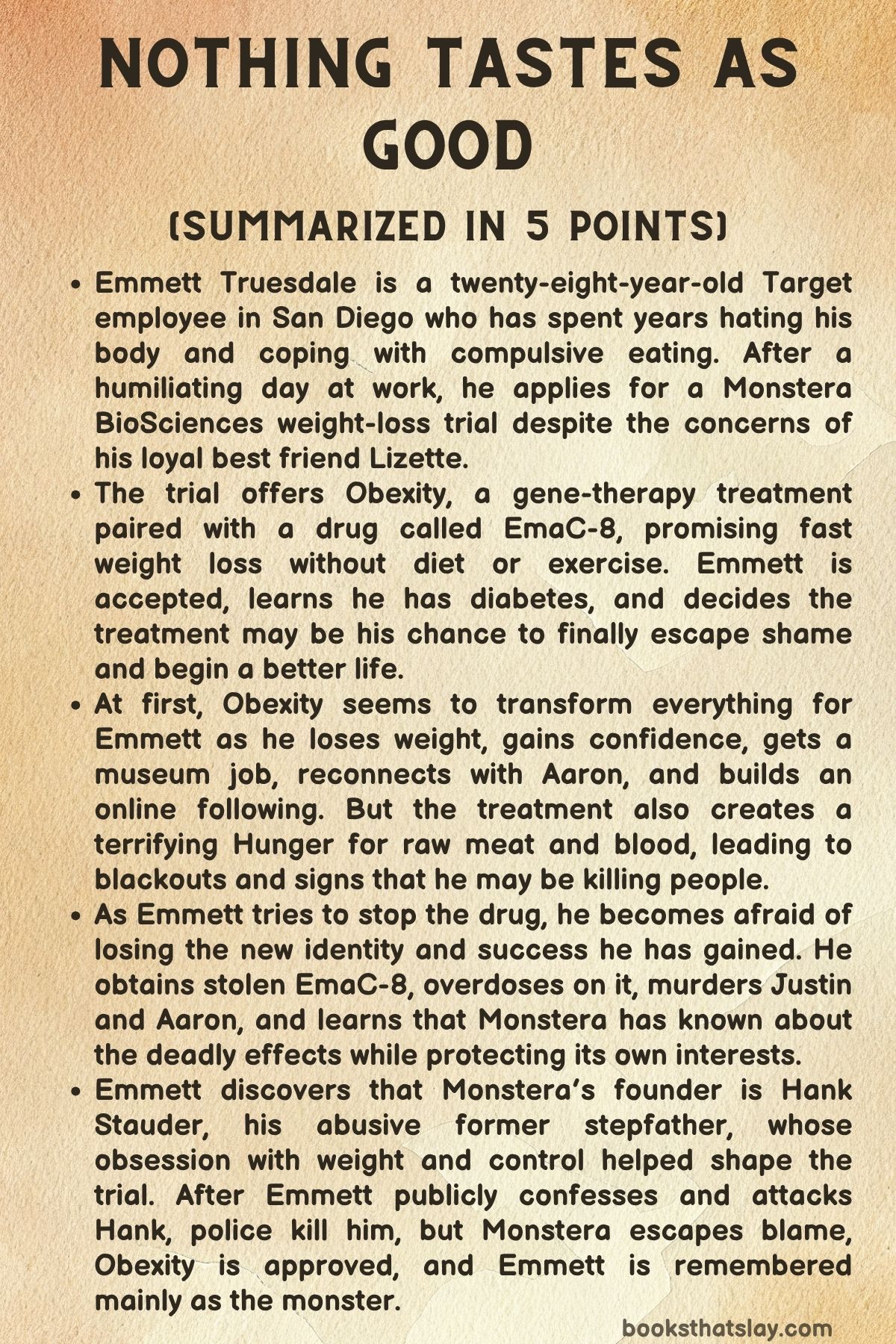
Summary
Emmett Truesdale is twenty-eight years old, living in San Diego, and working at Target. His days are marked by shame, exhaustion, and constant judgment from strangers and coworkers.
He has spent most of his life hating his body and struggling with compulsive eating, and the world around him has only deepened that self-loathing. Customers make cruel comments about his size, and his manager, Rick, treats him with contempt.
After one especially humiliating day, Rick criticizes him for sitting down and for smelling sweaty, leaving Emmett feeling trapped in a life built around embarrassment.
Emmett lives with his best friend, Lizette, a plus-size clothing designer who loves him fiercely and refuses to let others reduce him to his body. She understands the cruelty of fatphobia and tries to protect him from it, but Emmett’s pain runs deeper than reassurance can reach.
He wants change, not just comfort. He wants to stop being seen as a problem.
When he sees an Instagram advertisement for a paid clinical trial run by Monstera BioSciences, the promise feels almost impossible to ignore. The trial is for a new weight-loss treatment called Obexity, which claims to create rapid results without traditional dieting or exercise.
Lizette is suspicious from the beginning, but she goes with Emmett to the information session. There, Dr. Jennifer Saito presents the treatment in polished, confident language.
Obexity combines a gene-therapy procedure with a drug called EmaC-8. It is framed as cutting-edge medicine, a breakthrough for people whose bodies have resisted ordinary methods of weight loss.
The presentation is persuasive, and Emmett wants to believe every word. For him, the trial is not just about health or appearance.
It seems like a door into an entirely different life.
Emmett applies and is accepted. During the medical assessment at Cronus Health, he is made to feel exposed and degraded.
The process reduces him to measurements, numbers, risks, and medical warnings. He learns that he has diabetes, which makes the decision feel even more urgent.
Lizette remains uneasy, sensing that Monstera’s promises are too neat and too eager. Emmett hears her concerns, but he cannot let go of the possibility that this treatment might finally free him from the body that has been used against him for so long.
He signs the paperwork and undergoes the procedure.
At first, nothing seems to change. Then the weight begins to fall away with shocking speed.
Emmett’s body shrinks, and the world responds differently. People who once ignored or mocked him now treat him with interest, warmth, and admiration.
His confidence grows alongside the attention. He reconnects with Aaron, a man he knew from graduate school and once had feelings for.
What previously felt impossible now seems within reach. He also gets a new job at the Museum of Us, a position that makes him feel more respected and more connected to the life he wanted before shame narrowed his options.
As Emmett documents his transformation online, his follower count rises. His posts become evidence of success, and strangers praise him for his changing appearance.
He starts to see Obexity as the force that has given him access to love, work, visibility, and dignity. He begins believing that the life opening before him is the life he should always have had.
But the treatment does not only change his body. It changes his appetite.
Ordinary cravings become something more aggressive and frightening. Emmett experiences what he comes to understand as the Hunger, a violent need tied to raw meat, blood, and flesh.
He begins having blackouts. He wakes up with blood on his body and no clear memory of what happened.
Around San Diego, news reports describe horrifying discoveries: mutilated bodies, severed limbs, and violent deaths. The details force Emmett to confront a terrifying possibility.
During his blackouts, he may be killing and eating people.
Monstera refuses to give him clear answers. Its representatives remain controlled, evasive, and concerned with protecting the company rather than helping him understand what is happening.
When another trial participant is accused of killing her husband, Emmett becomes more convinced that Obexity and EmaC-8 are responsible for something terrible. He tries to stop taking the drug.
With Lizette’s help, he destroys his remaining doses and briefly regains some control over himself.
Stopping the drug brings a new terror. Emmett’s weight begins returning rapidly.
The body that had earned him praise, desire, professional opportunity, and social-media attention starts to disappear. Instead of feeling saved by quitting, he feels as if everything he gained is being taken away.
His fear of returning to his former life overpowers his fear of the Hunger. He contacts Niño, a friend of his brother, and obtains stolen EmaC-8.
Rather than using it carefully, he overdoses on it. This choice marks a turning point.
Emmett gives in more fully to the violent force inside him.
His crimes become more direct and undeniable. He contacts Justin Matthews through a hookup app and murders him.
The act confirms that the Hunger is no longer something Emmett can treat as a frightening mystery. It is part of what he has become under the influence of the drug and his own desperation to remain transformed.
Later, Aaron confronts him during the public launch of Monstera’s campaign, where Emmett is being used as the face of Obexity. The company presents him as proof of its success, turning his body into marketing.
When Aaron challenges him, Emmett kills him too.
Monstera steps in after Aaron’s death, not with shock but with control. Dr. Saito and others reveal that they know about the killings.
Their response makes clear that the company has been aware of the treatment’s dangers and has been managing the consequences from behind the scenes. Emmett learns that powerful people, including police contacts, are connected to earlier trials.
The truth is larger than one failed experiment. Monstera has built a system around secrecy, influence, and profit.
The most devastating revelation concerns Monstera’s founder, Cecil H. Smith. Emmett discovers that this man is actually Hank Stauder, his abusive former stepfather.
Hank was a cruel figure in Emmett’s childhood, someone who controlled his eating, shamed his body, and treated his weight as a moral failure. The discovery reframes the entire trial.
Emmett realizes that Hank’s obsession with obesity, discipline, and control may have shaped both the drug and the company’s larger mission. What seemed like medical progress now appears rooted in punishment and domination.
Emmett decides to make the truth public. He posts a confession accusing Monstera and Hank of creating and covering up the disaster.
The confession exposes his own crimes but also points toward the larger forces that enabled them. Soon, police corner him in the California Tower at Balboa Park.
By this point, the drug is ravaging his body. Instead of preserving his thinness, it causes him to swell grotesquely, turning his body into a visible sign of the treatment’s violence.
Hank arrives and confronts him. Even at the end, Hank sees Emmett through the same cruel lens he used in childhood.
He treats him as broken, weak, and defined by fatness. Emmett responds with rage.
He attacks Hank and begins eating him, turning years of shame and control into a final act of monstrous retaliation. Police shoot Emmett, and he falls from the tower, dragging Hank down with him.
Emmett dies on impact, his body enormously swollen from the drug.
After his death, the public narrative turns against him. Instead of focusing on Monstera’s responsibility, people fixate on Emmett as a cannibal and a monster.
The company’s hired firm, Prentice & Darrow, shapes the story to protect its client. Emmett’s crimes are explained as the result of childhood trauma and personal disorder, not as the consequence of Obexity.
His pain, his transformation, and his warnings are all used to isolate blame onto him.
In the end, Monstera survives and profits. The FDA reverses its earlier rejection and approves the drug.
Hank’s company continues, and the larger system that created the disaster remains intact. Emmett becomes the scapegoat for everything the trial unleashed.
Nothing Tastes as Good ends as a bleak criticism of a culture that punishes fatness, sells transformation as salvation, and protects powerful institutions even after they create monsters.
Characters
The characters in Nothing Tastes as Good are shaped by shame, desire, control, hunger, and the social cruelty surrounding body image. Each figure in the book helps expose a different part of Emmett Truesdale’s collapse, from the private wounds of childhood to the public machinery that turns him into a scapegoat.
Emmett Truesdale
Emmett Truesdale is the central and most tragic figure in the book. At twenty-eight, he begins as a deeply wounded man whose life has been shaped by humiliation, body hatred, and compulsive eating.
His job at Target reflects how small and degraded his world has become: customers mock him, his manager criticizes him, and even ordinary workdays become reminders that his body is constantly being judged. Emmett’s desire to lose weight is not presented as simple vanity.
It grows out of years of shame, rejection, illness, and the belief that a different body would finally allow him to become a different person. This makes his decision to join the Obexity trial emotionally understandable, even though it becomes disastrous.
As Emmett loses weight, his personality begins to change in complicated ways. He becomes more confident, socially visible, romantically hopeful, and professionally ambitious.
He gets a new job, reconnects with Aaron, gains online attention, and begins to believe that the trial has unlocked the life he was denied. However, this transformation also exposes how much of his self-worth has become attached to his shrinking body.
The more he gains approval, the more terrified he becomes of losing it. This fear is what makes him vulnerable to the drug’s deeper corruption.
His physical hunger turns into something violent and monstrous, but the book also suggests that the Hunger is connected to emotional starvation: the need to be wanted, admired, desired, and free from shame.
Emmett’s moral decline is disturbing because he is not simply a monster from the beginning. He is frightened by what is happening to him and initially tries to resist.
He destroys his doses with Lizette’s help and wants to believe he can regain control. Yet when his weight returns, his terror overwhelms his conscience.
His choice to obtain stolen EmaC-8 and overdose on it marks the point where his desire for the life Obexity gave him becomes stronger than his horror at what he is becoming. By the end, Emmett is both victim and perpetrator.
He is exploited by Monstera, damaged by Hank, abandoned by systems that should protect him, and still responsible for horrific violence. His death turns him into a public symbol of monstrosity, while the people and institutions that helped create him escape accountability.
Lizette
Lizette is Emmett’s best friend, roommate, emotional anchor, and one of the most compassionate characters in the story. As a plus-size clothing designer, she understands body shame and fatphobia in a way that allows her to see Emmett clearly.
She loves him without requiring him to become thinner, more acceptable, or more socially impressive. Her distrust of the Obexity trial is important because she recognizes from the beginning that the treatment is not only medically risky but emotionally dangerous.
She understands that Emmett is not merely seeking health; he is chasing the promise of a completely different identity.
Lizette’s role in the book is also protective. She accompanies Emmett to the information session, worries about the clinical trial, and later helps him destroy his doses when he tries to quit.
Her loyalty is not passive. She challenges him, questions the forces manipulating him, and tries to pull him back from the obsession that is consuming him.
In this sense, Lizette represents the kind of love Emmett already has but cannot fully trust because it does not come with the social validation he craves. She values him before his transformation, while the world begins valuing him only after his body changes.
Her tragedy lies in the fact that her care is not enough to save him. Lizette can see the danger, but she cannot undo the deeper wounds created by childhood abuse, social cruelty, medical exploitation, and Emmett’s own desperate choices.
She is one of the clearest moral centers in the book because she does not confuse thinness with worth. Through her, the story shows what acceptance looks like, while also showing how difficult it is for someone like Emmett to accept that acceptance when he has spent his life believing he is defective.
Dr. Jennifer Saito
Dr. Jennifer Saito is one of the most unsettling characters because she presents herself as professional, rational, and scientific while participating in something deeply unethical. As the public medical face of the Obexity trial, she explains the treatment in controlled, reassuring language.
She gives the impression that Monstera BioSciences is offering a medical breakthrough, not a dangerous experiment with horrifying consequences. Her calm authority makes the trial seem legitimate, and this legitimacy helps persuade vulnerable people like Emmett to trust the company.
Saito’s character represents the moral danger of scientific ambition detached from human responsibility. She does not need to behave like a traditional villain to be frightening.
Her power comes from her ability to hide cruelty behind procedure, consent forms, clinical language, and institutional confidence. When Emmett begins to suspect that the drug is causing violence, Monstera refuses to give clear answers, and Saito becomes part of that silence.
Her failure is not ignorance alone; it is her willingness to protect the company and the treatment even when participants are suffering and dying.
By the later parts of the story, Saito’s role becomes more openly sinister. She and others reveal that Monstera knows about the killings and that influential people are tied to earlier trials.
This shows that her professionalism has always been part of a larger structure of concealment. Saito’s character is important because she shows how monstrous outcomes can be produced by people who speak calmly, wear authority well, and convince themselves that progress justifies harm.
Lizette’s Relationship to Emmett
Lizette’s relationship with Emmett deserves separate attention because it reveals the emotional contrast at the center of the book. She sees Emmett as a whole person, while Emmett sees himself through the eyes of everyone who has shamed him.
Their friendship is built on intimacy, humor, shared vulnerability, and mutual dependence, but it is also strained by Emmett’s inability to believe that being loved as he is can be enough. When he starts losing weight and gaining attention, he moves further away from the version of himself Lizette has always accepted.
This relationship shows that Emmett’s transformation is not only physical but relational. As he becomes more invested in his new image, he risks losing the person who cared for him before that image existed.
Lizette’s concern challenges the fantasy that Obexity is purely liberating. To Emmett, the treatment feels like escape.
To Lizette, it looks like another system teaching him to hate himself. Their bond gives the story emotional weight because Lizette’s love represents a path Emmett might have followed if his shame had not been so powerful.
Aaron
Aaron is the man from Emmett’s graduate school past and represents the romantic and social life Emmett once believed was out of reach. When Emmett reconnects with him after losing weight, Aaron becomes tied to Emmett’s fantasy of transformation.
He is not merely a love interest; he is proof, in Emmett’s mind, that the new body has made a new life possible. Through Aaron, Emmett experiences desire, validation, and the feeling of being chosen in a way that seems to repair old wounds.
However, Aaron’s importance also lies in how fragile that validation is. Emmett’s connection with him depends heavily on the version of himself created by Obexity.
This makes Aaron part of the pressure Emmett feels to maintain his weight loss at any cost. When Emmett fears losing his body, he also fears losing Aaron, which shows how completely he has linked love with thinness.
Aaron becomes both a symbol of hope and a reminder of Emmett’s insecurity.
Aaron’s death is one of the darkest moments in the story because it shows that Emmett’s hunger has consumed not only strangers but also the possibility of genuine intimacy. When Aaron confronts him, Emmett kills someone who had represented acceptance, attraction, and a future.
This murder confirms that the Hunger has overtaken his remaining moral boundaries. It also deepens the tragedy because Emmett destroys one of the very things he believed weight loss would help him gain.
Hank Stauder / Cecil H. Smith
Hank Stauder, later revealed as Cecil H. Smith, is one of the most important antagonistic figures in the book. As Emmett’s abusive former stepfather, he is a source of the childhood shame that shapes Emmett’s adult relationship with food and his body.
Hank’s control over Emmett’s eating is not just ordinary cruelty; it becomes a form of psychological conditioning. He teaches Emmett to experience appetite as failure, fatness as disgrace, and his body as something that must be punished into obedience.
The revelation that Hank is connected to Monstera and Obexity gives the story a disturbing circular structure. The man who once controlled Emmett privately has helped create a system that controls bodies publicly.
Hank’s obsession with obesity, discipline, and transformation appears to have grown into a corporate project. This makes him more than a personal abuser.
He becomes the embodiment of a larger culture that treats fat bodies as problems to be corrected, exploited, and erased.
In the final confrontation, Hank still sees Emmett through the same cruel lens he used in childhood. He does not treat him as a damaged adult, a victim of corporate experimentation, or a person in agony.
He treats him as the same defective child he once shamed. Emmett’s attack on Hank is horrifying, but it also has symbolic force: he turns his monstrous hunger against the man who helped create it.
Their shared fall is a brutal ending to their relationship, suggesting that Hank’s violence and Emmett’s destruction have always been tied together.
Rick
Rick, Emmett’s manager at Target, is a smaller character but an important example of everyday cruelty. He criticizes Emmett for sitting down and smelling sweaty, reinforcing the daily humiliations that make Emmett feel trapped in his body and his job.
Rick does not need to be deeply developed to matter; his function is to show how casual workplace disrespect can become part of a larger pattern of dehumanization.
Rick represents the ordinary social forces that push Emmett toward the clinical trial. He is not responsible for Obexity, the Hunger, or the murders, but he contributes to the emotional environment in which Emmett becomes desperate for change.
His treatment of Emmett helps explain why the promise of effortless weight loss feels so powerful. Rick’s cruelty is mundane, which is exactly why it matters.
The book uses him to show that harm does not always begin with laboratories or conspiracies; sometimes it begins with repeated small acts of contempt.
Niño
Niño plays a crucial role in Emmett’s final collapse because he provides access to stolen EmaC-8 after Emmett has tried to quit. As the friend of Emmett’s brother, Niño functions as a link between Emmett’s desperation and the illegal supply of the drug.
He is not the source of Emmett’s hunger, but he enables the choice that pushes Emmett beyond recovery.
Niño’s importance comes from what he makes possible. When Emmett destroys his doses, there is still a chance, however fragile, that he might survive the trial’s effects and return to himself.
But the rapid return of his weight terrifies him, and Niño becomes the means through which fear turns into action. By obtaining the drug through him, Emmett chooses the body and life he thinks he cannot lose, even though he knows the treatment may be connected to violence.
Niño therefore represents the dangerous availability of the thing Emmett most wants and most fears.
Justin Matthews
Justin Matthews is one of Emmett’s victims and represents the moment when Emmett’s monstrous transformation becomes undeniable. Emmett contacts him through a hookup app, which makes the murder especially disturbing because it corrupts a space associated with desire, intimacy, and physical connection.
Justin is not merely a plot device; his death shows the human cost of Emmett’s surrender to the Hunger.
Through Justin, the story reveals how Emmett’s need to be desired becomes entangled with violence. The same body that now attracts attention is also the body driven by a terrifying appetite.
Justin’s murder shows that Emmett’s transformation has not freed him from shame or loneliness. Instead, it has turned his pursuit of pleasure and validation into predation.
His death also marks a point where Emmett can no longer pretend that the danger is abstract or accidental.
Emmett’s Brother
Emmett’s brother is not developed as fully as some of the central figures, but his connection to Niño matters because it gives Emmett access to the stolen drug. Through this link, the book suggests that Emmett’s crisis is not sealed off from his past or family network.
Even when he is trying to build a new identity through his body, job, relationship, and online presence, the older structures of his life remain close enough to affect his choices.
The brother’s role is indirect, but it helps move Emmett from fear into relapse. The fact that Emmett reaches the drug through someone connected to family life also reinforces how difficult it is for him to escape the patterns that shaped him.
His downfall is not caused by one relationship alone, but by a web of personal history, shame, opportunity, and desperation.
Prentice & Darrow
Prentice & Darrow functions less as a traditional character and more as the public voice of corporate damage control. The firm’s role after Emmett’s death is to reshape the meaning of what happened.
Instead of allowing the public to focus on Monstera’s responsibility, the firm frames Emmett’s crimes as the result of childhood trauma and personal disorder. This makes Emmett the convenient explanation for everything, while the company’s actions are pushed into the background.
The firm represents how institutions protect themselves through narrative. Emmett tells the truth publicly, but truth alone is not enough when a powerful company can hire professionals to manage perception.
Prentice & Darrow’s framing is chilling because it partly uses real facts about Emmett’s trauma while stripping those facts of corporate context. In doing so, the firm turns a victim of exploitation into the sole villain of the story.
This final manipulation is one of the book’s bleakest statements about power.
Themes
Body Shame and the Desire for Acceptance
In Nothing Tastes as Good, Emmett’s relationship with his body is shaped by years of humiliation, rejection, and cruelty. His weight is not treated by the people around him as only a physical fact; it becomes the reason they dismiss his dignity, intelligence, comfort, and humanity.
At work, customers and his manager treat him as if his body makes him less worthy of respect, and these daily insults deepen his belief that happiness is only possible through physical transformation. His decision to join the trial grows from this emotional exhaustion.
The treatment promises weight loss, but what Emmett truly wants is relief from shame. As he becomes thinner, he feels newly visible, employable, desirable, and socially valuable.
This shows how deeply society teaches him to connect thinness with success and love. The tragedy is that even when his body changes, the insecurity remains.
His confidence depends on approval from others, so he becomes terrified of returning to the version of himself the world rejected. The theme reveals how body shame can damage identity so completely that acceptance begins to feel conditional, fragile, and dangerous.
Corporate Greed and the Exploitation of Vulnerable People
Monstera BioSciences presents itself as a company offering hope, but its actions reveal a ruthless desire for profit and control. The clinical trial targets people who are desperate for change, especially those who have been made to feel powerless because of their weight.
Emmett is not approached as a whole person with fears, history, and emotional wounds; he is treated as data, publicity, and eventually damage to be managed. The company hides information, avoids responsibility, and continues promoting Obexity even when the effects become horrific.
Its leaders understand that public perception matters more than truth, so they use marketing, legal framing, and institutional power to protect the drug. The approval of the treatment after Emmett’s death shows that the system rewards profit even when human lives are destroyed.
This theme criticizes a world where medical language can be used to cover exploitation. Monstera does not simply create a dangerous product; it takes advantage of people’s pain, sells them transformation, and abandons them when the consequences threaten the company’s success.
Hunger, Addiction, and Loss of Control
Emmett’s Hunger begins as a frightening side effect, but it also reflects a deeper struggle with compulsion, shame, and dependency. Before the treatment, his eating is tied to comfort, distress, and self-hatred.
After the procedure, that familiar relationship with appetite becomes violent and monstrous. The Hunger is not only physical; it represents the way desire can grow stronger when it is denied, judged, or medically manipulated.
Emmett tries to resist it, destroys his doses, and briefly attempts to regain control, yet the fear of gaining weight again pushes him back toward the drug. This makes his dependency more complex than a simple craving.
He is addicted not only to EmaC-8, but also to the new life it seems to provide: attention, romance, professional opportunity, and social approval. His choices become increasingly terrible because he believes losing the drug means losing everything that made him feel valuable.
The theme shows how control can disappear when a person is trapped between bodily need, emotional fear, and a society that rewards the results of self-destruction.
Scapegoating and the Protection of Power
After Emmett’s death, the public story shifts away from Monstera’s responsibility and turns him into the sole monster. This final framing is one of the cruelest parts of the narrative because it shows how easily powerful institutions protect themselves by isolating blame onto one damaged person.
Emmett has committed horrific acts, but the company’s role in creating, concealing, and profiting from the crisis is pushed aside. Instead of confronting the drug, the trial, or Hank’s history of abuse and control, the public is encouraged to see Emmett as an individual failure caused by trauma and disorder.
This allows Monstera to survive and even succeed. The FDA approval of the drug proves that official systems can be influenced by money, image, and legal strategy rather than truth.
Emmett becomes useful to the company even after death because his monstrosity distracts from theirs. The theme suggests that society often prefers a simple villain over a difficult investigation of power, especially when the real guilt belongs to corporations, regulators, and respected public figures.