The Faraway Inn Summary, Characters and Themes
The Faraway Inn by Sarah Beth Durst is a fantasy novel about healing, belonging, and finding purpose in an unexpected place. The story follows Calisa, a teenager who runs away from her painful life in Brooklyn after her boyfriend’s betrayal and arrives at her great-aunt’s neglected inn in rural Vermont.
What first seems like an old bed-and-breakfast soon reveals itself as a magical refuge for travelers from other worlds. Through strange guests, hidden portals, and new friendships, Calisa discovers that the inn needs more than repairs. It needs someone who believes in its future.
Summary
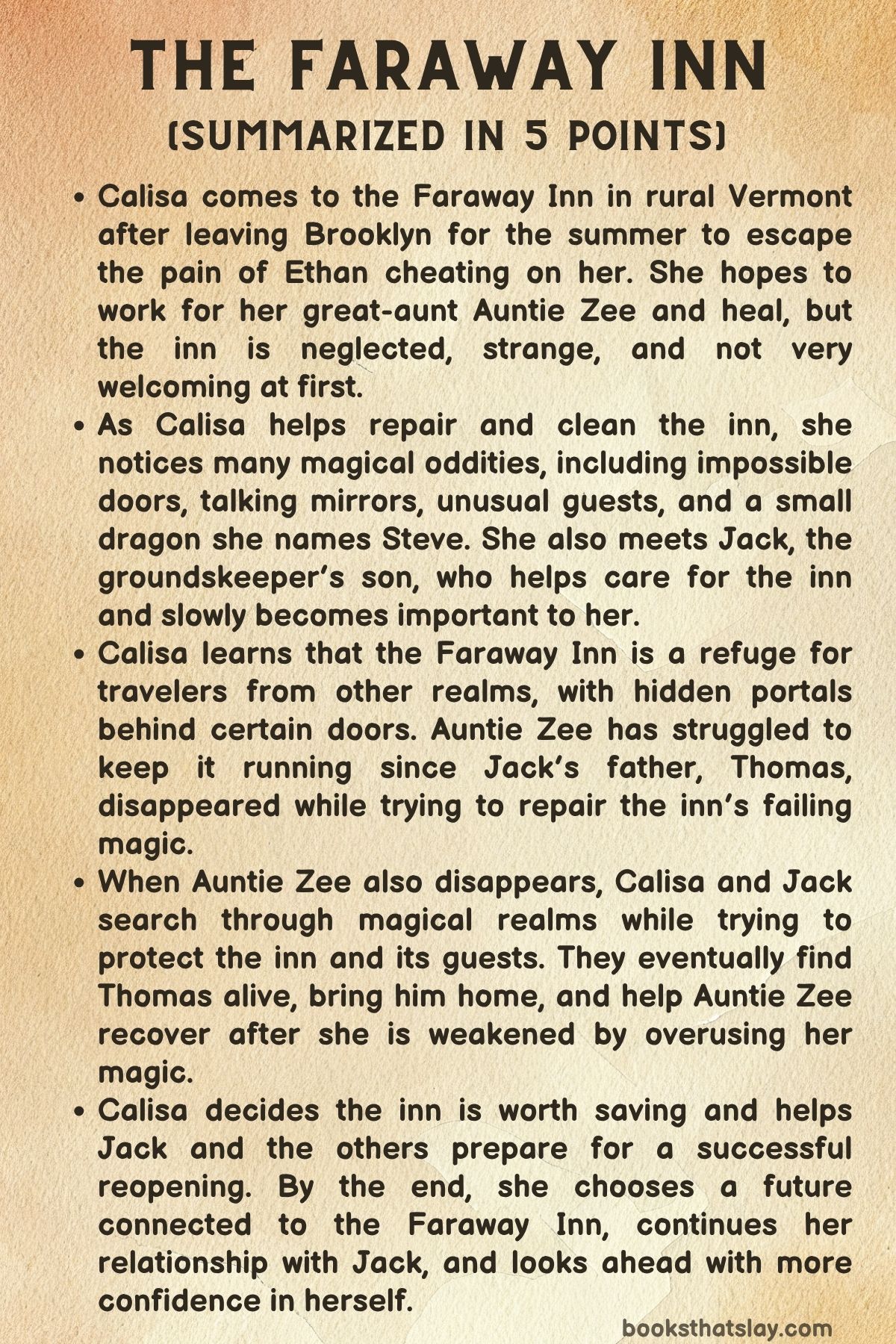
Calisa arrives in rural Vermont hoping to escape the hurt and humiliation she has left behind in Brooklyn. Her boyfriend, Ethan, cheated on her, and she no longer wants to spend the summer surrounded by reminders of him or by people who know what happened.
She decides to stay at the Faraway Inn, a bed-and-breakfast owned by her great-aunt, Auntie Zee. Calisa imagines that the inn will give her a place to work, rest, and put herself back together.
Instead, she finds an old building in serious disrepair, with sagging porches, overgrown grounds, dusty rooms, and an owner who does not seem pleased to see her.
Her first moments at the inn are far from welcoming. Calisa falls through the porch and is helped by Jack, the son of the inn’s groundskeeper.
Jack is kind, practical, and deeply tied to the place. He knows the building, the gardens, and many of its strange habits.
Auntie Zee, however, is distant and stern. Rather than offering Calisa a summer-long refuge, she tells her she can stay for only three days.
This rejection hurts Calisa, but it also pushes her to prove that she can be useful.
Calisa begins working wherever she can. She helps Jack repair the porch, cleans rooms, cooks pancakes, restores the sitting room, and tries to make herself valuable to the inn.
As she works, she notices that the Faraway Inn is not simply neglected. It is strange in ways that ordinary explanations cannot cover.
Some doors open into impossible darkness. Whispers move through empty halls.
A mirror speaks. Tea appears without anyone making it.
Fire behaves as if it has a will of its own. Even the guests seem unusual, as though they belong to lives and worlds Calisa does not understand.
Among the guests are Mulligan, a theatrical and emotional man who makes magical hot chocolate while mourning someone he loves; Kendra, a polished and intimidating woman with unusual tastes; and Melidor, a creature tied to the garden. Calisa also finds a small lizard-like creature and decides to care for it, naming it Steve.
She later discovers that Steve is not a lizard at all, but a small dragon. Each of these discoveries makes it harder for Calisa to dismiss the inn’s oddness as coincidence.
Gradually, Calisa learns the truth. The Faraway Inn is a safe house for magical travelers from other realms.
Certain doors are portals, and the inn has long served guests who need quiet, privacy, protection, or rest before continuing their journeys. Auntie Zee has spent decades managing this unusual refuge.
Her coldness is not simple cruelty; it comes from exhaustion, worry, and the burden of keeping the inn alive while its magic fails. The portals are becoming unstable, fewer guests are arriving, and the inn has lost much of the care and attention that once made it flourish.
Jack’s connection to the inn is also shaped by loss. His father, Thomas, disappeared three years earlier while trying to find a way to repair the portals.
Since then, Jack has stayed close to the inn, helping Auntie Zee maintain it and holding on to the hope that his father might still be found. For Jack, the Faraway Inn is not just a building.
It is his home, his history, and his last strong link to his father.
Calisa’s understanding grows when she discovers a portal to the Night Market, a magical marketplace filled with travelers, merchants, and beings from many realms. The Night Market expands her view of what the inn truly is.
It is part of a much larger network of magical places, people, and needs. What seemed at first like a strange old house in the woods is actually a doorway to countless lives.
Then Auntie Zee disappears. Her absence forces Calisa and Jack to take responsibility.
They must keep the inn running while also searching for her. Their search sends them through different portals and into contact with suppliers, travelers, and dangerous places.
Calisa is still new to this world, but she learns quickly because she has to. She begins to understand not only the rules of the inn, but also the emotional weight it carries for everyone connected to it.
As Calisa and Jack work together, their friendship grows into something warmer. Their bond develops through shared work, worry, and trust.
Calisa sees how much Jack has carried since his father vanished, and Jack sees Calisa as more than a girl running from a broken relationship. He sees her courage, creativity, and growing love for the inn.
Calisa, in turn, starts to realize that she does not want to define herself through Ethan’s betrayal. She wants to choose what matters to her.
Their search eventually leads them to a seaside realm, where they find Thomas alive. He has been trapped while trying to locate a remedy that could help Auntie Zee and restore the failing magic of the inn.
His return changes everything for Jack, who finally has his father back after years of uncertainty. It also gives the inn a chance at recovery.
When Thomas, Jack, and Calisa return, they discover that Auntie Zee has been forced into her cat form because she pushed herself too far. With Thomas’s knowledge and Calisa’s help, Auntie Zee is able to recover.
Once the immediate danger passes, Calisa begins thinking beyond survival. She does not want the Faraway Inn to continue fading away.
She believes it can become active and welcoming again. Rather than accepting decline, she proposes reopening it with care and intention.
She and Jack visit other realms, speak to people who might need the inn, gather supplies, repair rooms, and restore old traditions. Afternoon tea, garden picnics, guest care, and small acts of hospitality become part of rebuilding not just the business, but the spirit of the place.
The reopening becomes a test of whether the inn still has a role in the wider magical world. Guests return, though not everyone wants or understands what the inn offers.
Still, the event proves that the Faraway Inn can live again. It can continue to be a refuge for those who need shelter between worlds.
Calisa’s ideas, energy, and willingness to work help bring back a sense of possibility that had nearly disappeared.
At the same time, Calisa faces the emotional wound that sent her to Vermont in the first place. Ethan’s betrayal once made her feel unwanted and replaceable, but her time at the inn changes how she sees herself.
She no longer wants her worth to depend on whether someone like Ethan chooses her. She has found work that matters, people who value her, and a future that excites her.
Her feelings for Jack are part of that future, but they are not the only reason she chooses it. The inn itself has become important to her.
By the end of the summer, Calisa understands that the Faraway Inn is not just a temporary escape. It is part of who she wants to become.
She decides to apply to colleges with hotel management or business programs so she can learn how to help run and expand the inn properly. She returns to Brooklyn for her senior year, but she does not leave the inn behind.
Through the portals, she continues to visit, keeping her connection to Jack, Auntie Zee, Thomas, Steve, and the magical world she has discovered.
The story ends with Calisa and Jack walking together through a portal to the Night Market. Their future is open, hopeful, and full of possibility.
Calisa has not erased the pain that brought her to Vermont, but she has grown beyond it. She has found a place where her care, imagination, and hard work matter.
In The Faraway Inn, the neglected old bed-and-breakfast becomes a symbol of renewal, showing that broken places and wounded people can be repaired when someone chooses to stay, work, and believe in what they can become.
Characters
In The Faraway Inn, Sarah Beth Durst creates characters who are shaped by loss, responsibility, magic, and the search for belonging. Each character has a distinct role in the book, but together they help show how the inn becomes more than a place to stay.
It becomes a refuge, a home, and a symbol of healing.
Calisa
Calisa is the central character of the book, and her journey begins from a place of heartbreak and emotional exhaustion. After Ethan cheats on her, she comes to the inn hoping to escape the pain of betrayal and avoid facing the uncertainty of her own future.
At first, her arrival feels like an act of retreat rather than courage. She wants distance from Brooklyn, from Ethan, and from the version of herself who depended too much on being loved by someone else.
However, as the story develops, Calisa gradually becomes more active, practical, and emotionally independent. Her willingness to clean, repair, cook, welcome guests, and solve problems shows that she is not merely hiding from her past; she is learning how capable she can be when she is given real responsibility.
Calisa’s growth is also shown through her changing relationship with the inn. At first, she sees it as a temporary shelter, but later she understands that it is a sanctuary for magical beings who need safety and rest.
This realization deepens her character because she begins to think beyond her own pain. Her compassion expands to include Jack, Auntie Zee, Thomas, Steve, and the many guests who rely on the inn.
She becomes someone who restores not only rooms and routines, but also hope. By the end of the story, Calisa’s choice to study hotel management or business shows that she has found a future based on her own desires and strengths.
She no longer defines herself through Ethan’s rejection. Instead, she chooses purpose, belonging, and a life connected to wonder.
Jack
Jack is one of the most grounded and emotionally important characters in the story. As the groundskeeper’s son, he is closely connected to the inn’s physical condition and its deeper magical history.
He helps repair the porch, maintain the grounds, and support the inn even while carrying the pain of his father’s disappearance. Jack’s character is shaped by loyalty.
The inn is not just a workplace to him; it is his home and his last strong connection to Thomas. Because of this, his attachment to the place feels personal and tender rather than simply practical.
Jack also plays an important role in Calisa’s emotional development. He does not treat her as someone broken or helpless.
Instead, he works beside her, allowing their bond to grow through shared effort, trust, and discovery. His relationship with Calisa is gentle and gradual, built on mutual respect rather than dramatic romance alone.
Jack’s quiet sadness over his father gives him depth, while his continued care for the inn shows resilience. When Thomas is finally found, Jack’s emotional burden begins to lift, but his character does not lose purpose.
He remains devoted to the inn’s future and becomes part of the new life Calisa imagines. Through Jack, the book explores grief, patience, loyalty, and the healing power of shared responsibility.
Auntie Zee
Auntie Zee is a complex figure because she first appears cold, strict, and unwelcoming, yet her harshness hides years of exhaustion and sacrifice. When Calisa arrives, Auntie Zee refuses to offer warmth easily and allows her to stay only briefly.
This makes her seem distant and unsympathetic at first. However, as the story reveals the truth about the inn, Auntie Zee becomes a much more tragic and admirable character.
She has spent decades protecting a magical refuge for travelers from other realms, and the strain of that duty has worn her down.
Her character represents the burden of responsibility carried for too long without enough help. After Thomas disappears and the portals begin to fail, Auntie Zee struggles to maintain the inn alone.
Her coldness can be understood as a form of self-protection. She is afraid of losing more people, afraid of failing the guests, and perhaps afraid of letting Calisa become involved in a dangerous magical world.
Her transformation into cat form after overexerting herself reveals the physical and magical cost of everything she has been trying to hold together. Auntie Zee is not simply a stern guardian; she is a protector who has nearly destroyed herself through devotion.
By the end, her recovery allows the inn to recover as well, and her relationship with Calisa becomes part of the broader restoration of family, trust, and hope.
Ethan
Ethan does not appear as actively as some of the other characters, but his influence on Calisa is significant. He represents the painful life Calisa is trying to escape when she arrives in Vermont.
His betrayal wounds her confidence and makes her question her own worth. In this way, Ethan functions less as a romantic partner in the present action and more as the emotional shadow that follows Calisa into the story.
His cheating forces her to confront how much of her identity had been tied to being wanted and valued by someone else.
Ethan’s role is important because Calisa’s growth can be measured by how she moves beyond him. At the beginning, her decisions are shaped by the desire to avoid him and recover from what he did.
By the end, she is no longer simply reacting to his betrayal. She is choosing a future that belongs to her.
Ethan therefore represents a turning point in Calisa’s life. His actions hurt her, but they also push her toward a place where she discovers strength, independence, magic, and a deeper sense of purpose.
He is not the center of her story; he is the reason she begins searching for a life in which she can become the center of her own.
Thomas
Thomas is Jack’s missing father and one of the key figures behind the mystery of the failing inn. Even before he appears directly, his absence shapes the emotional atmosphere of the story.
For Jack, Thomas’s disappearance is a source of grief and uncertainty. For Auntie Zee, it is part of the burden that leaves her isolated and overwhelmed.
For the inn itself, his absence represents the loss of someone who understood its magic and was trying to save it. This makes Thomas important long before he is found.
When Thomas is discovered alive in a seaside realm, he becomes a symbol of hope restored. His disappearance was not abandonment but sacrifice; he had been searching for a way to fix the portals and save the magic connected to the inn.
This reveals him as brave, devoted, and willing to risk himself for the people and place he loves. His return heals Jack emotionally and helps Auntie Zee recover physically and magically.
Thomas’s character shows how love for a home can lead people into danger, but it can also bring them back. He strengthens the book’s themes of family, repair, and reunion.
Mulligan
Mulligan is a dramatic and memorable guest whose magical hot chocolate and emotional grief make him stand out. He brings both wonder and sadness into the story.
His presence helps Calisa understand that the inn’s guests are not merely strange or entertaining; many of them arrive carrying private pain. Mulligan’s grief for someone he loves gives him emotional weight and shows that magical beings are just as vulnerable to loss as ordinary humans.
As a character, Mulligan expands the emotional world of the inn. He shows that the refuge exists not only for travelers who need a bed, but for those who need comfort, privacy, and space to mourn.
His theatrical personality adds charm and humor, but beneath that drama is real sorrow. This contrast makes him more than a quirky guest.
He helps reveal the inn’s purpose as a place where wounded people and beings can pause before continuing with their lives. Through Mulligan, the story connects magic with tenderness and reminds the reader that even the most unusual guests have deeply human emotions.
Kendra
Kendra is elegant, intimidating, and mysterious. Her taste for salted tea and her commanding presence make her feel different from ordinary guests, and she helps establish the unusual nature of the inn’s visitors.
She is important because she represents the kind of guest who expects the inn to understand and respect customs beyond the human world. Through Kendra, Calisa learns that hospitality at the inn requires more than cleaning rooms and serving food.
It requires attention, flexibility, and respect for the needs of beings from other realms.
Kendra’s character also adds sophistication and tension to the story. She is not warm in an obvious way, but her presence suggests that the inn has a long reputation among magical travelers.
Her expectations show that the inn once operated with a sense of ceremony and tradition that has faded during its decline. By including Kendra, the book shows how reopening the inn is not just about repairing buildings or portals.
It is about restoring trust, dignity, and a culture of welcome. Kendra helps Calisa understand that every guest has a history, a preference, and a place in the larger magical world.
Melidor
Melidor is a creature connected to the garden, and this connection makes the character important to the atmosphere of the inn. The overgrown forest and crumbling gardens reflect the inn’s neglect, and Melidor’s presence suggests that the natural and magical worlds around the inn are still alive, even if they have been ignored.
Melidor helps show that the inn’s magic is not limited to doors and portals. It also lives in the land, the garden, and the strange beings who belong there.
Melidor’s role gives the story a sense of ancient and living magic. The character reminds Calisa that restoring the inn means paying attention to more than visible repairs.
The garden, like the rooms and traditions, needs care. Melidor also helps create the feeling that the inn exists between worlds, where nature itself may have personality, memory, and power.
Through this character, the story deepens its sense of place and shows that magical spaces survive through relationships between people, creatures, and the land itself.
Steve
Steve begins as a strange lizard-like creature cared for by Calisa, but he is eventually revealed to be a small dragon. His character brings playfulness, surprise, and affection into the story.
Calisa’s care for Steve shows her nurturing side and her ability to accept the unfamiliar without needing to fully understand it at once. She does not reject him because he is strange.
Instead, she names him, protects him, and forms a bond with him. This makes Steve an important part of Calisa’s emotional healing.
Steve also represents the wonder that enters Calisa’s life after heartbreak. At the beginning of the story, she arrives wounded and uncertain, but through Steve and the inn’s magic, she begins to experience amazement again.
His dragon identity adds charm and reinforces the idea that ordinary appearances can hide extraordinary truths. By staying with Calisa, Steve becomes a companion who connects her human life with the magical world she has discovered.
He is small, but his role is meaningful because he symbolizes trust, discovery, and the new life Calisa chooses for herself.
Themes
Healing After Betrayal
Calisa arrives at The Faraway Inn carrying the hurt of Ethan’s betrayal, and her emotional state shapes the way she first sees everything around her. She has not simply left Brooklyn for a change of scenery; she has run from humiliation, confusion, and the fear that someone else’s rejection has lowered her worth.
At first, the inn becomes a hiding place where she can avoid facing what happened. Yet as she begins repairing rooms, helping guests, and taking responsibility for small tasks, her recovery becomes active rather than passive.
The physical work of fixing broken spaces mirrors her effort to rebuild confidence. Calisa’s healing does not come from forgetting Ethan or replacing him with Jack.
It comes from realizing that she can choose where she belongs, what she values, and how she wants her future to look. By the end, she no longer defines herself through Ethan’s actions.
Her growth shows that betrayal can wound someone deeply, but it does not have to decide the direction of their life.
Finding Belonging in an Unexpected Place
Calisa reaches the inn as an outsider who expects only a temporary escape, but the strange and demanding world around her slowly becomes a place of connection. Auntie Zee’s cold welcome, the decaying building, and the confusing magical events all make Calisa feel unwanted at first.
However, her willingness to help changes her relationship with the inn and with the people who depend on it. She starts by trying to prove that she is useful, but her role soon becomes more meaningful than simple chores.
The guests, the portals, the garden, Jack, Steve, and even Auntie Zee begin to form a community around her. Belonging here is not automatic; it is earned through care, patience, and commitment.
Calisa discovers that home is not always the place where life began or where things are easiest. Sometimes home is the place where a person’s presence matters.
Her decision to connect her future to the inn shows that belonging can grow from responsibility, affection, and shared purpose.
Responsibility and the Preservation of Sanctuary
The inn functions as more than a business because it offers safety to travelers from different realms who need privacy, rest, and protection. Its decline threatens not only Auntie Zee’s livelihood but also a larger network of vulnerable guests who rely on it.
Calisa gradually understands that caring for the inn means caring for many lives beyond her own. At first, she sees the broken porch, dusty rooms, and ruined gardens as signs of neglect.
Later, she recognizes them as evidence of a sanctuary under strain. Auntie Zee has carried the burden for years, especially after Thomas disappears, and the failing portals show how fragile safe spaces can become when one person is left to protect them alone.
Calisa’s decision to help reopen the inn marks a shift from personal escape to shared responsibility. She learns that places of refuge do not survive through magic alone.
They require labor, planning, kindness, and people willing to defend their purpose when decline seems easier than renewal.
Choosing One’s Own Future
Calisa’s journey is shaped by the movement from reacting to other people’s choices to making her own. Ethan’s betrayal initially pushes her away from Brooklyn, and Auntie Zee’s strict limits make her feel as though her stay depends on someone else’s permission.
Even the inn’s mysteries first place her in a position of confusion, where she responds to events rather than directing them. Over time, Calisa becomes more confident in deciding what matters to her.
She chooses to help Jack search for his father, chooses to care for the guests, chooses to restore the inn, and finally chooses a future that includes learning how to manage and expand it. This theme is especially important because her independence is not presented as isolation.
She still values Jack, Auntie Zee, Steve, and the magical community, but she no longer needs another person to decide her worth. Her college plans show maturity because they connect wonder with practical ambition.
Calisa’s future becomes something she builds, not something she escapes into.