The Fortune Tellers of Rue Daru Summary, Characters and Themes
The Fortune Tellers of Rue Daru by Olesya Salnikova Gilmore is a historical fantasy mystery set among Russian émigrés in Paris. The novel centers on Zina Lenormand, a young woman raised in a tearoom where staged séances, old secrets, and real spirits exist side by side.
As Zina tries to understand her gift for reading auras, she is drawn into the mystery of her mother’s murder and the death of a powerful Grand Duke. The book blends family secrets, revenge, romance, spiritual danger, and questions of inheritance, truth, and female independence.
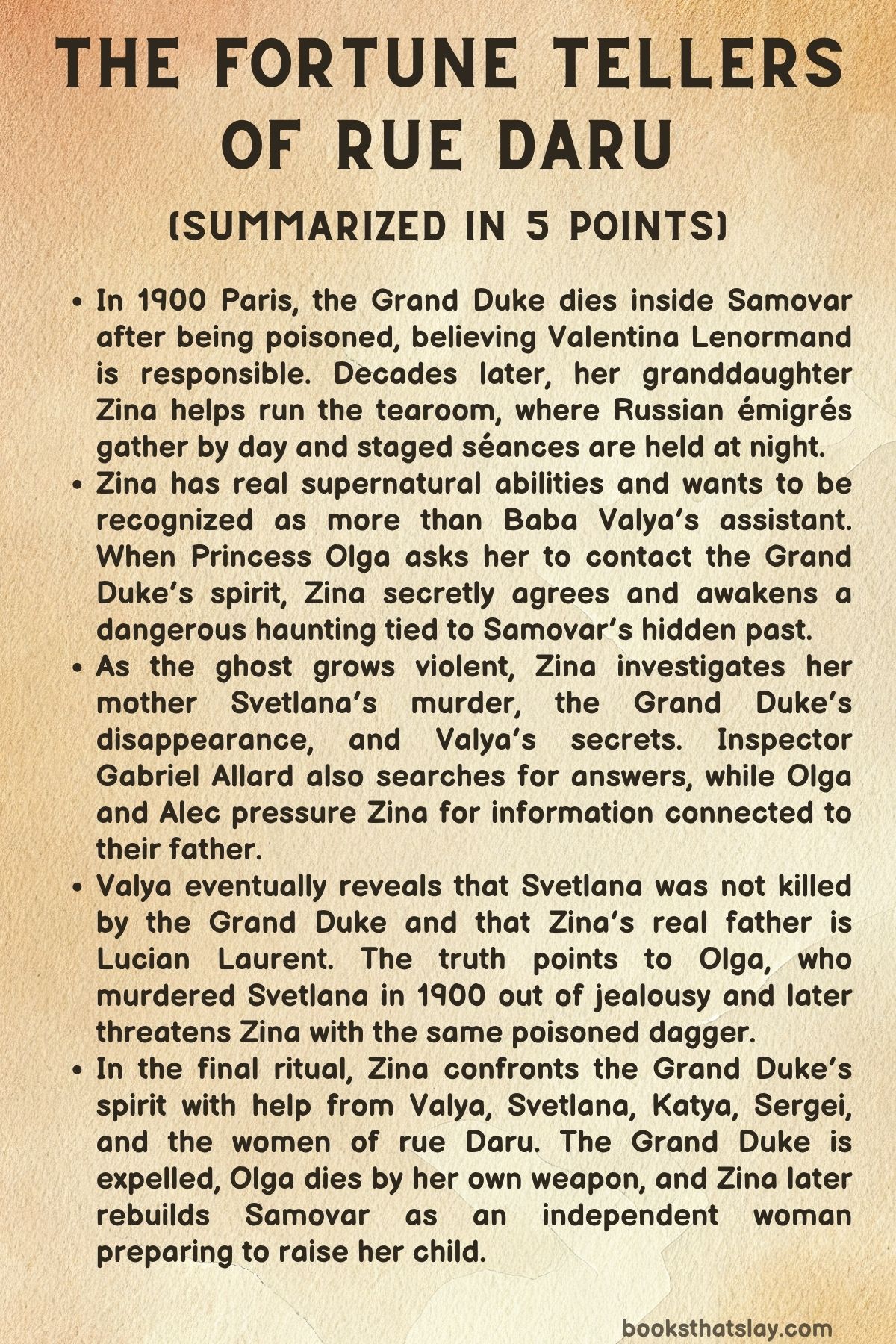
Summary
In June 1900, a poisoned Grand Duke enters Samovar, a Russian tearoom in Paris owned by Valentina Lenormand. He is weak, bleeding, and terrified, convinced that Valentina has caused his suffering.
Searching through the darkened tearoom, he looks for an antidote while his mind is clouded by hallucinations. He sees the room as both familiar and threatening, and his desperation grows as his body fails.
Before he can find what he needs, he collapses and dies inside Samovar. His death becomes one of the buried events that will shape the lives of the women connected to the tearoom for decades.
Nearly twenty-four years later, Zina Lenormand lives at Samovar with her grandmother, Valentina, whom she calls Baba Valya. The tearoom is a gathering place for Russian émigrés in Paris.
During the day, it offers food, tea, gossip, and a sense of home to people displaced by revolution and exile. At night, it becomes a place of staged séances and fortune-telling performances.
Valya has built a reputation as a powerful mystic, but much of what happens in the séance room is carefully managed illusion.
Zina assists her grandmother, but she wants more than a supporting role. She can read auras and senses that her own abilities are real, even if Valya refuses to fully acknowledge them.
Zina also carries grief and unanswered questions about her mother, Svetlana, who was murdered when Zina was young. During one séance, photographs of dead men appear to watch her, stirring her desire to reach Svetlana’s spirit and learn what really happened.
Zina’s longing for truth makes her vulnerable to danger, especially because Valya has spent years hiding the past.
The next morning, Princess Olga Romanova comes to Samovar and asks Zina for help. Olga wants to contact the spirit of her missing father, the Grand Duke.
When Zina mentions Olga to Valya, her grandmother reacts with fear and anger, warning her to stay away. Zina ignores the warning and secretly agrees to hold a séance for Olga.
At the sitting are Olga, her brother Alec, and Zina’s friend Katya. Zina expects the usual performance, but something real answers her call.
The Grand Duke’s spirit appears and claims he is trapped inside Samovar. He accuses Valya and Svetlana of stealing the building from him and calls Zina “daughter.”
After this séance, Samovar changes. Strange and violent events begin to happen.
Bloodlike visions appear, plants die, and unseen forces attack the living. The Grand Duke’s presence grows stronger, and Zina realizes that she may have opened a door she cannot easily close.
At the same time, Inspector Gabriel Allard begins looking into Svetlana’s murder and the Grand Duke’s disappearance. His investigation brings him close to Zina, and an attraction develops between them.
Yet Zina later learns that Gabriel has also been connected to Olga’s inquiries, which makes her question whether she can trust him.
Olga and Alec continue searching Samovar for something linked to their father. Their interest is not innocent, and they pressure Zina for information.
As the hauntings worsen, Zina discovers an old dagger and begins seeing visions of Svetlana and the Grand Duke. She starts to suspect that the Grand Duke may have killed her mother and may be keeping Svetlana’s spirit trapped.
These suspicions deepen her fear of him and her anger toward Valya, whose silence has left Zina without the truth for most of her life.
Zina tries to understand and strengthen her abilities. She holds more séances and seeks help from people who know more about spirits than she does.
One of them is Sergei, who teaches her how a dangerous spirit might be expelled. Through this training, Zina begins to move from assistant to practitioner.
She learns that her gift is not only a curiosity or a performance tool but a power that may allow her to protect Samovar and the people she loves.
The story also reveals Valya’s past. As a young fortune teller in Moscow, Valya loved Ivan Morozov, a printer involved in dangerous political work.
Ivan was murdered by men connected to aristocratic power, and his death marked Valya forever. She later moved through Saint Petersburg and then Paris, driven by grief, a hunger for safety, and a desire for revenge.
In Paris, her daughter Svetlana became close to the Grand Duke. The Grand Duke grew obsessed with Svetlana and with the occult, creating a dangerous bond between the Romanov family, Samovar, and Valya’s household.
As the present danger increases, Olga and Alec lure Zina away and threaten her, trying to force her to reveal what she knows. Valya is later attacked inside Samovar, making it clear that both the living and the dead are capable of violence.
At last, Valya tells Zina the truth she has hidden for years. Svetlana was not killed by the Grand Duke, although he was poisoned after her death.
Zina’s true father is Lucian Laurent, a police official who loved Svetlana and had planned to leave Paris with her. Valya buried Svetlana in Samovar’s garden and concealed the truth to protect Zina from enemies who might harm her.
The final confrontation takes place during an expulsion ritual at Samovar. Zina, Valya, Katya, Sergei, and the women of rue Daru gather to force out the Grand Duke’s spirit.
Zina enters the spirit world and faces him directly. There, Svetlana’s spirit helps reveal the truth: Olga killed Svetlana in 1900.
Her motive was jealousy and hatred, and she used the poisoned dagger connected to Valya’s earlier tragedy. The Grand Duke had not murdered Svetlana, but his obsession and power had helped create the conditions that led to her death.
In the present, Olga attacks Zina with the same dagger, trying to repeat the violence of the past. Valya’s spirit and Svetlana’s spirit intervene to protect Zina.
During the struggle, Olga dies when the dagger is driven into her own chest. The Grand Duke’s spirit is finally expelled, and the hold he has had over Samovar is broken.
Svetlana and Valya are freed, allowing the house and Zina to move beyond the secrets that have haunted them.
Months later, Zina has taken charge of Samovar. She is pregnant after her relationship with Gabriel, but she refuses his offer of marriage.
Instead, she chooses to raise her child on her own terms, without surrendering her independence or repeating the patterns of secrecy that shaped her family. She reconciles with Lucian, accepts him as her father, and keeps Katya close as part of her chosen family.
Samovar remains her home, no longer defined by lies and fear but by truth, survival, and the strength of the women who kept it alive.
Characters
Zina Lenormand
Zina Lenormand is the central figure of The Fortune Tellers of Rue Daru, and her character is shaped by inheritance, secrecy, longing, and self-discovery. At the beginning of the book, she lives under the shadow of Baba Valya’s authority, working in Samovar while yearning to be recognized as a true fortune teller rather than merely an assistant.
Her ability to read auras suggests that she possesses genuine spiritual power, but her confidence is fragile because she has been raised in an environment where performance, deception, and real supernatural ability are constantly mixed together. Zina’s desire to contact her murdered mother, Svetlana, gives her a deeply emotional motivation.
She is not simply curious about the dead; she is searching for identity, love, and truth in a life built on silence.
As the haunting of Samovar intensifies, Zina becomes braver, more independent, and more morally aware. Her early willingness to help Princess Olga comes partly from ambition and partly from compassion, but it also shows her hunger to prove herself.
Once she summons the Grand Duke’s spirit, she is forced into a dangerous world where the past is no longer hidden and the dead can manipulate the living. Zina’s growth comes through learning that truth is more complicated than accusation.
She suspects Valya, the Grand Duke, Gabriel, and even the foundations of her own family story, yet she keeps searching instead of accepting easy answers. Her journey is not only about defeating a ghost but also about learning how to trust her own judgment.
Zina’s relationship with Gabriel adds another layer to her character. She is drawn to him emotionally and physically, but she does not allow romance to become the solution to her life.
By the end of the story, her pregnancy and her rejection of Gabriel’s marriage offer show that she has become someone who chooses her own future rather than accepting a role handed to her by family, society, or a man. Her decision to raise her child on her own terms marks her final transformation.
Zina inherits Samovar, but she also changes what that inheritance means. The tearoom is no longer only a place of secrets and survival; through Zina, it becomes a place rebuilt around truth, memory, and self-possession.
Baba Valya Lenormand
Baba Valya is one of the most complex characters in the book because she is both protector and deceiver, victim and manipulator, survivor and keeper of dangerous secrets. As Zina’s grandmother, she appears strict, controlling, and often frighteningly secretive.
She runs Samovar with authority and uses fortune-telling and séances to maintain power over the fragile world she has built. Her anger when Zina mentions Princess Olga reveals that Valya’s fear is not irrational but rooted in a buried history that she has spent decades trying to contain.
She understands the danger of the Romanovs, the Grand Duke, and the past far better than Zina does, but her refusal to explain the truth creates the very mistrust that threatens to destroy their family.
Valya’s past reveals why she became so guarded. As a young fortune teller in Moscow, she loved Ivan Morozov, whose murder exposed her to the cruelty of aristocratic power and political violence.
That loss hardened her and pushed her toward revenge, survival, and control. Her later choices in Saint Petersburg and Paris show a woman trying to secure safety for herself and Svetlana in a world where women without protection could easily be ruined or killed.
Valya’s morality is complicated because many of her actions are built on love, but that love often expresses itself through concealment. She hides Svetlana’s burial, Zina’s parentage, and the truth about the Grand Duke because she believes secrecy is the only way to protect her family.
Her final role is deeply tragic and redemptive. Valya’s love for Zina and Svetlana is never in doubt, even when her choices cause pain.
She has carried guilt, grief, and fear for decades, and the haunting forces her to face what she tried to bury. In the final confrontation, Valya’s spirit helps protect Zina and free Svetlana, showing that her deepest loyalty has always been to her family.
Her death and spiritual release complete her arc. She is not presented as purely heroic or purely guilty; she is a woman shaped by trauma who made terrible compromises in the name of survival.
Her character gives the story much of its emotional weight because she represents the cost of keeping the past hidden for too long.
Svetlana Lenormand
Svetlana is physically absent for most of the book, but her presence shapes nearly every major conflict. She is Zina’s murdered mother, Valya’s beloved daughter, the Grand Duke’s obsession, Lucian Laurent’s lost love, and Olga’s victim.
Because so many characters remember, desire, mourn, or resent her, Svetlana becomes almost mythic before she is fully understood. At first, she exists mainly as a mystery for Zina: a dead mother whose spirit may be trapped and whose murder has defined the emotional emptiness in Zina’s life.
This makes Svetlana both a person and a symbol of everything Zina has been denied.
As more of the truth emerges, Svetlana becomes a more human and tragic figure. She was caught between dangerous forms of love and possession.
The Grand Duke’s fascination with her was not healthy devotion but obsession, mixed with power and occult desire. Lucian’s love offered a possible escape, suggesting that Svetlana might have had a future beyond Samovar, beyond Valya’s plans, and beyond aristocratic danger.
Her murder destroys that possibility and leaves behind a chain of lies that affects the next generation. Svetlana’s tragedy lies in the fact that she is denied the chance to choose her own life.
In the final spiritual confrontation, Svetlana becomes more than a victim. Her spirit helps reveal the truth about Olga and intervenes to protect Zina.
This gives her character agency after death and allows her to reclaim her story from those who distorted it. She is not merely the murdered woman at the center of the mystery; she is a mother whose love survives beyond death and a daughter whose fate exposes the consequences of jealousy, class power, and secrecy.
Through Svetlana, the story shows how the dead can remain present not only as ghosts but as unresolved wounds in the lives of those left behind.
The Grand Duke
The Grand Duke is one of the most threatening and morally corrupt figures in the book. His first appearance, poisoned and hallucinating inside Samovar, immediately establishes him as a figure tied to violence, fear, and accusation.
Even before the full truth is revealed, he feels dangerous because he enters the story as both victim and menace. His death does not end his power.
Instead, his spirit becomes trapped in Samovar, where he continues to manipulate, terrify, and wound the living. His haunting presence turns the tearoom into a battlefield between memory and possession.
The Grand Duke’s character is defined by entitlement. He believes that people, places, and even spirits can belong to him.
His claim that Valya and Svetlana stole Samovar from him shows how aristocratic power distorts his understanding of justice. He does not see others as independent human beings with their own desires; he sees them as extensions of his will.
His obsession with Svetlana reveals this most clearly. What he calls love is closer to ownership, and his interest in the occult deepens his desire to control even death itself.
His calling Zina “daughter” is especially disturbing because it is both manipulative and false, designed to confuse her and draw her into his version of the past.
Although he is not ultimately Svetlana’s murderer, the Grand Duke remains morally guilty in a broader sense. He helped create the world of obsession, fear, and danger in which her death occurred.
His spirit’s violence shows that death has not humbled him. He continues to attack Samovar, frighten Zina, and resist being expelled because he cannot accept losing power.
His defeat is therefore not just the removal of a ghost but the symbolic overthrow of an old, corrupt authority. He represents the lingering poison of aristocratic privilege, male possession, and the refusal to let the living move beyond the past.
Princess Olga Romanova
Princess Olga Romanova is one of the most dangerous characters in the book because she hides cruelty beneath refinement, grief, and aristocratic dignity. When she first approaches Zina, she appears to be a grieving daughter searching for her missing father’s spirit.
This makes her request seem emotionally understandable, and Zina’s decision to help her feels compassionate as well as ambitious. However, Olga’s polished surface conceals jealousy, violence, and calculation.
Her connection to the Grand Duke is not only familial; she has inherited his possessiveness and sense of entitlement.
Olga’s true nature becomes clearer as she and Alec pressure Zina and search Samovar for information. She is not simply looking for closure.
She is trying to control the truth before it destroys her. Her hatred of Svetlana is rooted in jealousy and class resentment, and her murder of Svetlana reveals the extent to which she sees others as threats to her own position and emotional security.
The poisoned dagger connects her crime to older violence in Valya’s life, making Olga part of a larger pattern of aristocratic cruelty. Her crime is personal, but it also reflects the destructive arrogance of a class that believes it can take lives without consequence.
As the final villain, Olga is chilling because she is alive, deliberate, and fully responsible for her actions. The Grand Duke may be the terrifying ghost, but Olga is the human murderer whose choices caused the central tragedy.
Her attack on Zina in the present shows that she has not changed or repented. She is willing to repeat violence to protect herself.
Her death by the same dagger she used against Svetlana is a form of poetic justice. Olga’s character demonstrates how jealousy, when combined with privilege and hatred, becomes deadly.
She is not haunted by guilt in a redemptive way; she is haunted by exposure.
Alec Romanova
Alec Romanova functions as an extension of the Romanov threat, though he is less central than Olga. As Olga’s brother, he participates in the pressure placed on Zina and becomes part of the aristocratic intrusion into Samovar.
His role shows that Olga is not acting in complete isolation; she belongs to a family structure that is used to secrecy, entitlement, and force. Alec’s presence makes the danger around Zina feel more physical and immediate because he helps lure and threaten her.
Alec’s character is important because he reflects the arrogance and desperation of a fading aristocratic world. Like Olga, he wants access to what Samovar hides, and he treats Zina less as a person than as a tool.
His behavior shows how the Romanovs continue to assume power over others even after their old status has weakened. He may not carry the same emotional jealousy that drives Olga’s murder of Svetlana, but he supports the search for answers in a way that is invasive and menacing.
Alec also helps deepen the atmosphere of suspicion surrounding the Romanov family. His actions make it harder for Zina to know whom to trust and increase the sense that the past is not dead but actively hunting her.
While Olga is the true murderer, Alec contributes to the pressure and intimidation that bring the hidden truth closer to the surface. He represents complicity: the kind of character who may not be the central villain but still enables danger through loyalty, entitlement, and silence.
Inspector Gabriel Allard
Inspector Gabriel Allard is a complicated figure because he is both investigator and romantic interest, both helper and source of mistrust. His investigation into Svetlana’s murder and the Grand Duke’s disappearance gives him an official connection to the truth Zina desperately wants to uncover.
At first, his role suggests order and reason in a story filled with ghosts, séances, and visions. He represents the possibility that the mysteries surrounding Samovar can be solved through evidence rather than fear.
Gabriel’s relationship with Zina complicates his role. Their growing closeness gives Zina emotional connection and adult intimacy, but his involvement with Olga’s inquiries makes him difficult to trust completely.
This ambiguity is important because Zina’s journey requires her to stop relying entirely on others for answers. Gabriel may care for her, but he is not the savior of the story.
His presence tests Zina’s ability to separate desire from judgment. The romance is meaningful, but it does not erase the larger problems of secrecy, power, and truth.
By the end, Gabriel’s offer of marriage could have provided a conventional resolution, especially because Zina is pregnant. Her refusal is central to both his character and hers.
Gabriel is not portrayed as evil, but he belongs to a world of institutions, expectations, and social solutions that Zina ultimately chooses not to depend on. His character helps show how far Zina has come.
She can love, desire, and accept help without surrendering her independence. Gabriel remains important, but he does not define her future.
Katya
Katya is Zina’s friend and one of the most grounding presences in the book. In a world filled with ghosts, family secrets, and dangerous aristocrats, Katya offers companionship, loyalty, and emotional steadiness.
Her friendship matters because Zina is often isolated inside Samovar, caught between Valya’s control and the mysteries surrounding her mother. Katya gives Zina a connection outside the suffocating family structure and helps her feel less alone as the haunting grows more threatening.
Katya’s presence during the séances and the final ritual shows courage and devotion. She is not simply a passive friend who listens from the sidelines; she becomes involved in the dangerous effort to confront the Grand Duke’s spirit.
Her willingness to stand beside Zina reflects the importance of chosen family in the story. Bloodlines in the book are often tangled with secrecy, violence, and inheritance, but Katya represents a bond built on trust rather than obligation.
Her character also helps balance the darker emotional tones of the story. While Zina is burdened by grief and destiny, Katya reminds the reader that friendship can be a form of protection.
She remains close to Zina even after the truth is revealed and Samovar is rebuilt. This continued presence suggests that Zina’s future will not be defined only by motherhood, loss, or independence, but also by female friendship and community.
Katya may not drive the central mystery, but she is essential to Zina’s survival.
Sergei
Sergei plays an important role as a spiritual guide and source of practical knowledge. When Zina begins facing forces beyond her control, Sergei helps her understand that real spiritual danger requires discipline, training, and courage.
His teaching about how to expel a dangerous spirit gives Zina tools she did not previously have. This is important because Zina’s powers are genuine but underdeveloped.
Sergei helps her move from instinctive ability toward purposeful action.
Sergei’s character also helps distinguish true spiritual practice from the staged performances at Samovar. The tearoom’s séances often blur fraud and faith, but Sergei’s guidance treats the supernatural as real and dangerous.
He understands that the Grand Duke’s spirit is not a theatrical effect or a harmless presence. Through him, the book gives spiritual power a structure and seriousness that Zina must learn to respect.
He helps her recognize that contact with the dead is not only about longing but also about boundaries.
In the final expulsion ritual, Sergei’s presence adds strength to the collective effort against the Grand Duke. He is not the hero who defeats the spirit alone, but he contributes knowledge and support that make Zina’s confrontation possible.
His role reinforces one of the book’s central ideas: Zina must claim her own power, but she does not have to do so in isolation. Sergei represents mentorship, spiritual discipline, and the importance of learning how to protect oneself before entering the world of the dead.
Lucian Laurent
Lucian Laurent is one of the most emotionally significant characters because he represents the truth of Zina’s parentage and the life Svetlana might have had. As a police official who loved Svetlana, Lucian stands apart from both the Romanov world of entitlement and Valya’s world of secrecy.
His love for Svetlana appears to have offered her a possible escape from danger. The revelation that he is Zina’s real father changes Zina’s understanding of herself and breaks the false connection the Grand Duke tried to impose on her.
Lucian’s importance lies partly in what he did not get to become. Because Svetlana was murdered, he was denied a life with her and a life with their daughter.
This makes him a figure of lost possibility. Unlike the Grand Duke, who seeks to possess and control, Lucian’s connection to Svetlana is presented as loving and sincere.
He is associated with protection rather than obsession, though he too is caught in the failures of the past. His absence from Zina’s upbringing is not framed as abandonment in the simple sense, but as part of the larger tragedy created by murder and concealment.
Zina’s reconciliation with Lucian near the end is quiet but meaningful. It gives her access to a living parent after years of defining herself through a dead mother and a secretive grandmother.
Lucian cannot undo the past, and he cannot replace what Zina lost, but his presence allows her family story to become more truthful. Through him, Zina gains not a savior but a fuller understanding of where she comes from.
His character helps move the ending away from pure grief and toward healing.
Ivan Morozov
Ivan Morozov is a crucial figure in Valya’s past, even though he belongs to an earlier generation of tragedy. As the printer Valya loved in Moscow, Ivan represents youth, hope, political danger, and the possibility of a different life.
His murder by men connected to aristocratic interests becomes one of the defining wounds in Valya’s life. Through Ivan, the story shows that the violence surrounding Samovar did not begin with Svetlana’s death or the Grand Duke’s haunting.
It reaches back into Valya’s younger years and into the brutal relationship between power and ordinary people.
Ivan’s death shapes Valya’s distrust of aristocrats and her later desire for revenge and security. Losing him teaches her that love can be destroyed by forces far larger than personal choice.
This helps explain why Valya becomes so protective, secretive, and hardened. She does not simply fear danger in an abstract way; she has already seen what powerful people can do.
Ivan’s murder becomes a seed of the bitterness and survival instinct that later define her.
Although Ivan is not present in the main timeline, his influence remains strong. The poisoned dagger connected to Valya’s old tragedy ties his fate to Svetlana’s murder and Olga’s final violence.
This connection makes Ivan part of the book’s larger pattern of repeated harm. His character shows how old crimes echo across generations, especially when justice is denied.
Ivan represents the first great loss that pushes Valya toward the choices that will later shape Zina’s life.
The Rue Daru Women
The rue Daru women are important as a collective character because they represent community, female solidarity, and the strength of those who survive displacement. Around Samovar, Russian émigré life is marked by memory, loss, and adaptation.
These women are part of that world, carrying their own histories while helping form the social and emotional atmosphere around the tearoom. They show that Samovar is not only a family business or a haunted building; it is also a gathering place for people who have lost homes, status, loved ones, or certainty.
Their role in the final ritual is especially meaningful. The confrontation with the Grand Duke is not handled by Zina alone, nor even by Zina and Valya alone.
The presence of the rue Daru women turns the expulsion into a communal act of resistance. This matters because the Grand Duke represents a form of power that isolates, possesses, and dominates.
The women oppose him through collective strength. Their participation suggests that healing from historical and personal violence requires witnesses, allies, and shared courage.
As a group, they also expand the story beyond one family. Zina’s struggle is deeply personal, but it takes place within a larger world of women who understand survival.
The rue Daru women help preserve the emotional texture of The Fortune Tellers of Rue Daru, giving the book a sense of cultural memory and communal resilience. They may not each receive the same individual focus as Zina or Valya, but together they embody one of the story’s strongest forces: women protecting one another against the ghosts of power, grief, and silence.
The Russian Émigrés of Samovar
The Russian émigrés who gather at Samovar form the social world in which much of the story unfolds. They are not central characters in the same way as Zina, Valya, or Olga, but they help define the atmosphere of the book.
By day, Samovar serves them as a tearoom, a place of memory and belonging in Paris. Their presence suggests exile, nostalgia, and the need to recreate fragments of a lost homeland.
Through them, Samovar becomes more than a business; it becomes a cultural refuge.
At the same time, their presence helps explain why performance and illusion matter so much in the story. The fortune-telling and fake séances offered at Samovar satisfy emotional needs.
These people are surrounded by loss, and many are willing to believe in signs, spirits, or messages from beyond because the past remains painfully alive for them. Their longing gives Valya’s work its audience, but it also reflects a broader human desire to make meaning out of grief.
The émigrés also highlight the contrast between public performance and private truth. To outsiders, Samovar may appear to be a colorful tearoom filled with mystical entertainment, but underneath it lies murder, buried bodies, spiritual imprisonment, and family trauma.
The émigré community helps create that surface world while also deepening the emotional stakes beneath it. They remind the reader that everyone around Samovar is, in some way, haunted by what has been lost.
Samovar
Although Samovar is a place rather than a person, it functions almost like a character in the book. It holds secrets, protects memories, and becomes the physical center of both family life and supernatural conflict.
For Zina, Samovar is home, workplace, inheritance, and prison all at once. For Valya, it is a fortress built out of survival and concealment.
For the Grand Duke, it is a place he believes was stolen from him. For Svetlana, it becomes both grave and spiritual prison.
These overlapping meanings make Samovar emotionally and symbolically powerful.
The haunting transforms Samovar from a familiar tearoom into a living expression of the past’s violence. Blood visions, dying plants, ghostly attacks, and disturbances show that the building itself can no longer contain the truth buried within it.
The more Zina investigates, the more Samovar seems to reveal its hidden history. It is not merely the setting for the mystery; it is the container of the mystery.
Its walls, garden, rooms, and séance space all become tied to memory and revelation.
By the end, Samovar is rebuilt around truth rather than secrecy. This change is central to Zina’s future.
She does not abandon the place, even though it has caused her pain. Instead, she transforms its meaning.
Under Valya, Samovar was a place where survival depended on concealment. Under Zina, it becomes a place where the past has finally been faced.
As a symbolic character, Samovar represents inheritance itself: dangerous when built on lies, but powerful when reclaimed with honesty.
Themes
Truth, Secrecy, and the Cost of Silence
In The Fortune Tellers of Rue Daru, silence becomes both a shield and a prison. Valya hides the truth about Svetlana’s death, Zina’s father, and the Grand Duke because she believes secrecy is the only way to protect her family.
Yet the longer the past remains buried, the more dangerous it becomes. Samovar itself reflects this hidden history: it appears to be a place of comfort, tea, stories, and performance, but underneath it lies murder, grief, stolen power, and unresolved guilt.
Zina’s search for answers shows that truth is painful, but necessary for freedom. Every false story she inherits keeps her tied to fear and confusion.
When the truth finally comes out, it destroys many of Zina’s illusions, especially about her family and her identity, but it also allows her to understand herself clearly. The novel suggests that secrets may delay suffering, but they cannot erase it.
Healing begins only when the hidden past is faced honestly.
Female Power, Survival, and Independence
The women in the story survive through intelligence, resilience, and emotional strength rather than through social protection or inherited power. Valya builds a life after violence and loss, using fortune-telling, performance, and business sense to create security for herself and her family.
Zina’s journey continues this struggle, but she moves from assisting others to claiming her own authority. Her supernatural gift is not just a strange ability; it represents her voice, intuition, and right to be believed.
The rue Daru women also show the strength of female community. Their support during the final confrontation proves that survival is not only individual but collective.
Olga offers a darker version of female power, shaped by jealousy, entitlement, and cruelty. By contrast, Zina’s final choice to run Samovar, raise her child on her own terms, and reject marriage as an obligation shows independence rooted in self-knowledge.
The story presents womanhood as complex, marked by sacrifice, anger, care, ambition, and the power to rebuild.
The Past as a Living Force
The past does not remain behind the characters; it actively shapes their present lives. Old betrayals, murders, romances, and political violence return through ghosts, visions, family secrets, and physical objects such as the dagger.
Samovar becomes a place where history refuses to stay silent. Zina is haunted not only by spirits but by questions she was never allowed to ask.
Valya’s earlier losses influence every decision she makes, especially her need to control what Zina knows. The Grand Duke’s spirit shows how power can outlive the body when guilt and violence are left unresolved.
His presence traps others emotionally and spiritually, turning memory into a form of imprisonment. At the same time, the return of the past is not only destructive.
Svetlana’s spirit helps reveal the truth, and Valya’s final intervention protects Zina. The novel shows that the past must be understood before it can release its hold.
Denial strengthens haunting, while truth weakens it.
Identity, Inheritance, and Self-Definition
Zina’s identity is built on uncertain origins, hidden parentage, and stories told by others. She begins by wanting recognition as a true fortune teller, but her deeper need is to know who she is and where she comes from.
The Grand Duke’s claim that she is his daughter threatens to reshape her entire sense of self, while the discovery of Lucian as her real father forces her to separate truth from manipulation. Bloodline matters in the story, but it does not fully define a person.
Zina inherits pain, gifts, secrets, and responsibilities, yet she also chooses what kind of life she will make from them. Her pregnancy strengthens this theme because she stands at the beginning of a new family history.
By refusing Gabriel’s marriage proposal, she rejects the idea that identity must be secured through a man or a conventional family structure. Her final position at Samovar shows self-definition through truth, chosen relationships, and personal courage.