Burn the Kingdom Down Summary, Characters and Themes
Burn the Kingdom Down by Addie Thorley is a fantasy novel about power, memory, revenge, and the heavy cost of political bargains. The story follows Indira, a princess of Tashir whose quiet life as a gifted gardener is destroyed after the reported death of her older sister, Rowenna.
Forced to marry the prince of the enemy kingdom, Indira enters Vanzador determined to uncover the truth and protect her people. What she finds is a world built on secrets, false histories, and hidden suffering. The novel explores how love and loyalty can survive betrayal, and whether broken kingdoms can choose a better future.
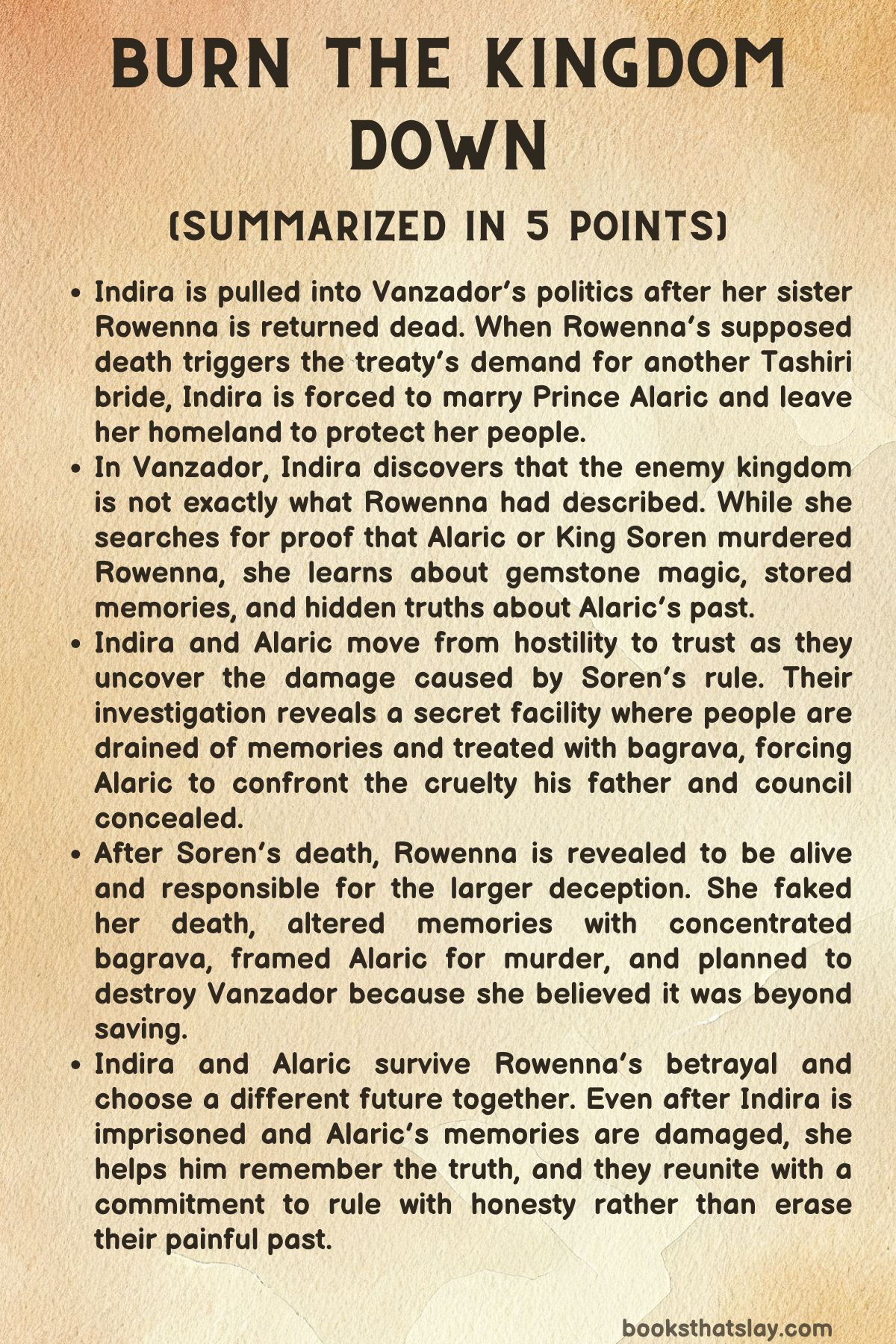
Summary
Burn the Kingdom Down begins in the kingdom of Tashir, a land protected by King Soren of Vanzador through a harsh and humiliating treaty. Years earlier, Soren used his earth-moving power to raise mountains around Tashir, supposedly shielding it from Marauders.
In exchange, Tashir must send monthly tributes of bagrava, a rare and valuable plant, along with a Tashiri bride for the Vanzadorian royal family. That bride is Rowenna, crown princess of Tashir, who is forced to marry Prince Alaric of Vanzador.
She wears a chain-mail wedding gown as a clear act of defiance, showing everyone that she is not entering the marriage willingly.
A year later, Rowenna’s younger sister, Indira, is living in Tashir and using her rare skill as a master gardener to cultivate bagrava. Her life changes when she hears her mother screaming and discovers that Vanzadorians have returned Rowenna’s body in a locked coffin.
They claim Rowenna fell from a cliff, but the condition of her body and the secrecy around her death make Indira and her family suspect murder. Haddesh, a blacksmith’s apprentice who loved Rowenna, openly accuses Soren and Alaric of killing her.
In his rage, he attacks them, and Soren kills him with his power.
Indira is devastated by Rowenna’s death and by Haddesh’s killing. She prepares Rowenna’s broken body for burial and promises herself that she will avenge her sister.
During the funeral feast, Soren delivers another cruel blow. Since Rowenna is dead, he says the treaty requires another Tashiri bride, and that bride will be Indira.
He also reveals that he knows she is a master gardener. Her ability to grow bagrava is not only useful to Tashir but valuable to Vanzador, and Soren intends to take advantage of it.
The people of Tashir panic at the thought of losing both Indira and control over their bagrava. Rather than allow Vanzador to seize everything, they begin burning their own fields.
Indira first tries to save the plants, but she soon understands that resisting Soren directly will only bring more destruction to her people. She agrees to go with him, but she bargains for Tashir’s safety before leaving.
Her choice is not surrender in spirit; it is a sacrifice made to keep her kingdom alive.
Indira is taken across the Tomb Flats and forced into marriage with Alaric in a severe Vanzadorian ceremony. She arrives at the mountain Fortress expecting a cruel, starving kingdom like the one Rowenna described in her letters.
Instead, Vanzador is prosperous, organized, and far more complex than Indira imagined. This confuses her.
The gap between Rowenna’s accounts and what Indira sees makes her question what Vanzador is hiding, though it does not lessen her belief that her sister was murdered.
At court, Indira has enemies everywhere. She clashes with Alaric, Queen Tessa, councilors, courtiers, and anyone who sees her as a foreign bride brought there for political use.
She is angry, suspicious, and determined not to be controlled. Still, she begins forming relationships that help her survive.
Her maid, Delphine, becomes a friend, and later Indira also grows close to Elodie, a courtier who proves to be more important than she first appears.
As Indira searches for proof of Rowenna’s murder, she learns more about Vanzador’s magic and its dependence on bagrava. Vanzadorian power is connected to gemstone triads embedded in people’s wrists.
She also discovers that memories can be stored in objects, altered, hidden, and used as weapons. This changes the way she understands the court around her.
In Vanzador, truth is not only concealed through lies; it can be physically removed or rewritten.
Indira’s relationship with Alaric is hostile at first. She believes he may have killed Rowenna or helped cover up her death, and he sees her as angry, reckless, and unwilling to understand his kingdom.
Yet as they spend more time together, both begin to see beyond their assumptions. Alaric is not the simple villain Indira expected.
He carries his own wounds and has been shaped by his father’s control. Indira learns that Alaric once had a brother, Besnik, who died years earlier.
More disturbingly, she discovers that Soren forced Alaric to suppress the memory of Besnik’s death.
This discovery opens a new path between Indira and Alaric. They begin working together to understand what Soren and the Vanzadorian council have been hiding.
Their alliance grows slowly, built on suspicion, argument, shared danger, and painful truth. Over time, it becomes love.
For Indira, this creates a deep conflict. She came to Vanzador to avenge Rowenna and to hate Alaric.
Instead, she finds herself caring for him while still needing answers about her sister.
Indira and Alaric uncover a secret facility where people are drained of memories and treated with bagrava. The discovery horrifies them.
It reveals that Vanzador’s prosperity and power rest on suffering that has been hidden from the public and even from Alaric. He realizes that his father and the council have concealed terrible acts from him, using memory and authority to keep him obedient.
Indira pushes him to see that both Vanzador and Tashir are trapped in a destructive system. Tashir is exploited for bagrava, while Vanzador is poisoned by secrecy, control, and the misuse of power.
When Soren attacks, Alaric finally turns against him. This is a major break from the life he has known.
He chooses Indira, truth, and the possibility of a different future over obedience to his father. Soren falls to his death, ending his reign.
Alaric becomes king, and Indira becomes queen beside him. For a brief moment, it seems they may be able to repair the damage between their kingdoms and rule with honesty instead of fear.
That hope is quickly shattered. After Soren’s funeral, Cloudia, Delphine’s injured sister, appears with a memory that seems to show Alaric murdering Rowenna.
Indira believes what she sees. Overcome by grief and betrayal, she attacks Alaric and stabs him.
The act threatens everything they have built together and appears to confirm the worst fear Indira carried from the beginning: that she has fallen in love with her sister’s killer.
Then the truth changes again. Rowenna appears alive.
She reveals that she faked her own death and manipulated the memories around it. Using concentrated bagrava, she planted false evidence against Alaric and made Indira believe he was guilty.
She also used Delphine by threatening Cloudia, forcing others into her plan. Rowenna’s goal was not simply escape or revenge against one person.
She wanted to destroy Vanzador completely because she believed it was rotten beyond saving.
Indira is stunned by Rowenna’s survival and betrayal. The sister she mourned has become someone willing to use pain, lies, and violence to achieve her aim.
Rowenna expects Indira to join her, but Indira refuses. She has seen too much suffering on both sides to accept total destruction as justice.
She understands that Vanzador has committed wrongs, but she also knows its people are not all monsters. Burning everything down would only create more victims.
Rowenna attacks Indira. Though Alaric is badly wounded from Indira’s earlier attack, he still moves to protect her.
Elodie also intervenes, striking Rowenna with a rock. During the struggle, Rowenna’s body carries Indira over the cliff, echoing the false story once told about Rowenna’s death.
Indira survives and manages to help get Alaric to healers, though the damage done between them is severe.
Afterward, Indira takes responsibility for stabbing Alaric and is imprisoned. Her guilt is real, even though she acted after being manipulated by false memories.
Meanwhile, Alaric’s own memories remain damaged, leaving him vulnerable. A councilor tries to exploit his confusion and steer him away from Indira, using his weakened state for political gain.
Indira refuses to let another person control Alaric through memory. She uses stored memories of their shared past, of Besnik, and of the truth about Rowenna to reach him.
These memories help Alaric recover enough of himself to make his own choice. He rejects the council’s manipulation and chooses Indira, not because everything is simple or forgiven, but because he remembers what is true between them.
Alaric frees Indira, and the two step forward together. They carry painful memories rather than erasing them, understanding that truth is necessary if they are to rule differently from those before them.
The story ends with Indira and Alaric prepared to face the future as rulers who know the cost of lies, exploitation, and revenge. Their kingdoms remain wounded, but they now have a chance to build something better through honesty, accountability, and shared power.
Characters
In Burn the Kingdom Down, the characters are shaped by grief, power, memory, political duty, and the difficult choice between revenge and rebuilding. Each major figure contributes to the book’s larger conflict between Tashir and Vanzador, while also showing how personal pain can either deepen compassion or become destructive.
Indira
Indira is the emotional and moral center of the book. At the beginning, she is defined by her love for Tashir, her loyalty to her family, and her gift as a master gardener.
Her ability to cultivate bagrava makes her politically valuable, but it also places her in danger because powerful people see her not as a person, but as a resource. Rowenna’s supposed death changes Indira’s life completely.
Her grief is immediate and intense, and her desire for revenge becomes one of her strongest motivations. However, Indira is not written as a simple revenge-driven heroine.
She is angry, wounded, and suspicious, but she is also observant, compassionate, and capable of changing her mind when the truth becomes more complicated than she expected.
Indira’s journey is powerful because she enters Vanzador believing it to be a place of cruelty and corruption, only to discover that its people are more complex than the stories she has been told. This does not make her forget Tashir’s suffering, but it forces her to think beyond inherited hatred.
Her relationship with Alaric reflects this growth. At first, she sees him as an enemy and a possible murderer, but as she learns more about his trauma, his manipulated memories, and his ignorance of Soren’s crimes, she begins to recognize his humanity.
Indira’s strength lies not only in surviving captivity and political pressure, but in refusing to let pain completely destroy her judgment. By the end of the book, she becomes a ruler who understands that justice cannot be built through revenge alone.
Her decision to preserve painful memories rather than erase them shows her maturity, because she accepts that healing requires truth, not denial.
Rowenna
Rowenna is one of the most tragic and morally complex figures in the book. At first, she appears to be a victim of political marriage, used as a sacrifice to preserve peace between Tashir and Vanzador.
Her chain-mail wedding gown is a striking symbol of her resistance, showing that she refuses to pretend her marriage is romantic or voluntary. Through the way others remember her, Rowenna seems brave, defiant, and deeply wronged.
Her supposed death becomes the wound that drives Indira into action, and for much of the story, Rowenna represents the cruelty of political systems that treat women as bargaining tools.
The later revelation that Rowenna is alive changes her character dramatically without erasing her suffering. She was harmed by power, but she also becomes someone willing to harm others in return.
Her decision to fake her death, manipulate memories, threaten Delphine through Cloudia, and frame Alaric shows how far her pain has twisted into obsession. Rowenna wants to destroy Vanzador because she sees it as rotten beyond repair, but her vision of justice becomes extreme and merciless.
She is not simply evil; she is a damaged person who turns her trauma into a weapon. Her tragedy lies in the fact that she understands oppression and captivity, yet chooses manipulation and violence instead of liberation.
Rowenna becomes a warning about what happens when grief is allowed to harden into vengeance without compassion.
Alaric
Alaric is introduced as a threatening figure because he is the prince Indira is forced to marry after Rowenna’s supposed death. For Indira and the people of Tashir, he represents Vanzadorian power, conquest, and possible murder.
However, as the book develops, Alaric becomes much more than the cruel prince Indira expects. He is a man shaped by manipulation, grief, political pressure, and the controlling influence of his father.
The suppressed memory of his brother Besnik’s death reveals that Alaric has been denied access to parts of his own life, which makes him both powerful and deeply vulnerable.
His growth depends on his willingness to face the truth about Vanzador and his family. Alaric has benefited from a system that hides suffering, but he is not completely loyal to that system once he understands its cruelty.
His relationship with Indira becomes important because she challenges him to see what has been concealed from him. Rather than remaining defensive, he slowly learns to question the kingdom, the council, and Soren.
His decision to turn against his father marks a major moral transformation. Alaric’s love for Indira is meaningful because it is tied to trust, memory, and shared responsibility rather than simple romance.
Even after being wounded and manipulated, he chooses Indira and rejects the council’s attempt to control him. By the end of the story, he represents the possibility that someone raised inside a harmful system can still choose accountability and change.
King Soren
King Soren is one of the central forces of oppression in the book. He presents himself as a protector of Tashir because he creates mountains to defend the kingdom from Marauders, but his protection comes at a devastating cost.
His bargain requires monthly bagrava tributes and a Tashiri bride, turning safety into a form of captivity. Soren’s power over the earth mirrors his personality: immovable, forceful, and destructive when challenged.
His killing of Haddesh shows how quickly he uses violence to silence resistance, even when that resistance comes from grief and love.
Soren’s most disturbing quality is his ability to make exploitation look like political necessity. He treats people as pieces in a larger strategy, whether they are Rowenna, Indira, Alaric, or the suffering patients connected to Vanzador’s hidden use of bagrava.
His manipulation of Alaric’s memories reveals a deeply controlling nature. He does not merely rule through fear; he controls knowledge, history, and emotional truth.
Soren’s downfall is important because it breaks the visible center of tyranny, but the book also shows that his influence does not disappear immediately after his death. The systems he helped create continue to threaten Indira and Alaric, proving that removing one ruler is not enough unless the deeper corruption is also confronted.
Queen Tessa
Queen Tessa is an important representation of Vanzadorian authority and courtly pressure. She is part of the environment that makes Indira feel watched, judged, and politically trapped.
Tessa’s role shows that power in the court is not held only by kings and princes; it is also maintained through tradition, expectation, ceremony, and social control. Her presence makes Indira’s position more difficult because Indira is not simply entering a marriage, but a world with its own rules, loyalties, and suspicions.
Tessa’s character also helps reveal the emotional coldness of the Vanzadorian court. Whether she acts out of loyalty to the kingdom, concern for stability, or commitment to hierarchy, she contributes to the pressure surrounding Indira and Alaric.
She is not described as the main villain, but she belongs to a system that has normalized political marriage and concealment. Through her, the book shows how people in positions of privilege can become guardians of harmful traditions, even when they are not the ones committing the most obvious acts of violence.
Haddesh
Haddesh is a brief but emotionally significant character in the book. As the blacksmith’s apprentice who loved Rowenna, he represents personal love in contrast to political marriage.
His grief over Rowenna’s returned coffin is raw and uncontrollable, and his accusation against Soren and Alaric gives voice to the suspicion that many others feel but are too afraid to express openly. Haddesh’s love for Rowenna makes him brave, but it also makes him reckless.
His attack on Soren comes from heartbreak, not strategy.
His death is important because it shows the brutal imbalance between ordinary people and rulers with extraordinary power. Haddesh is not killed in battle between equals; he is crushed by a king who can use earth-moving power to destroy dissent.
This moment deepens Indira’s understanding of the danger she faces. Haddesh’s fate also shows how grief spreads through the community.
Rowenna’s supposed death does not affect only her family; it wounds everyone who loved her and everyone who recognizes the injustice of her marriage. Haddesh becomes a symbol of the cost paid by powerless people when rulers make violent decisions.
Delphine
Delphine is one of the more sympathetic and quietly important characters in the book. As Indira’s maid, she begins in a position that could seem secondary, but her role becomes emotionally significant as she and Indira develop trust.
Delphine helps Indira understand Vanzador from the inside, and her presence softens Indira’s sense that everyone around her is an enemy. Through Delphine, the book shows that kindness can exist even within a dangerous court.
Her connection to Cloudia also makes her vulnerable. Rowenna’s use of Delphine by threatening her injured sister reveals how people with less power can be forced into impossible situations.
Delphine is not simply loyal or disloyal; she is someone trying to survive while protecting a person she loves. This makes her morally complicated in a very human way.
Her character shows that manipulation often works by targeting love, fear, and dependency. Delphine’s importance lies in the way she exposes the hidden emotional damage caused by larger political schemes.
Elodie
Elodie is an important ally to Indira and a valuable presence in the court. As a courtier, she belongs to the world Indira initially distrusts, but she proves that not everyone within Vanzador’s social structure is corrupt or cruel.
Her friendship with Indira helps broaden Indira’s understanding of the kingdom and gives her another source of support in an environment filled with suspicion. Elodie’s role also shows that resistance can come from unexpected places.
Her action against Rowenna near the cliff is especially important because it turns her from a supportive figure into someone who directly affects the outcome of the conflict. By striking Rowenna, Elodie helps save Indira and Alaric from Rowenna’s final attack.
This moment shows her courage and loyalty. Elodie’s character matters because she represents the possibility of chosen alliance.
She is not bound to Indira by blood or political marriage, yet she chooses to stand with her when it matters most.
Besnik
Besnik is important even though he is not present in the main action of the story. As Alaric’s dead brother, he exists largely through memory, absence, and emotional consequence.
His death is one of the hidden wounds shaping Alaric’s life, and the suppression of that memory reveals how deeply Soren has controlled his son. Besnik’s character shows that memory is not just personal in this book; it is political.
Whoever controls memory can control identity, loyalty, and grief.
Besnik’s importance lies in what he reveals about Alaric. Once Alaric begins to recover the truth of his brother’s death, he becomes more capable of understanding how much has been stolen from him.
Besnik therefore functions as a key to Alaric’s moral awakening. He represents the past that must be remembered before the future can change.
His presence in stored memories also strengthens the book’s larger idea that painful truths should not be erased, because they are necessary for justice and self-knowledge.
Cloudia
Cloudia is a small but crucial character because her suffering becomes a tool in Rowenna’s plan. As Delphine’s injured sister, she represents vulnerability and the way innocent people become trapped inside the schemes of stronger personalities.
Her appearance after Soren’s funeral seems to reveal the truth about Rowenna’s death, but the memory she presents has been manipulated. This makes Cloudia part of one of the book’s most important reversals.
Cloudia’s role shows how easily truth can be distorted when memory itself can be altered. She is not powerful in the same way as Soren, Alaric, Rowenna, or Indira, but her presence has enormous consequences because the false memory she carries drives Indira to stab Alaric.
Cloudia’s character reminds the reader that victims can be used to create more victims. Her suffering gives Rowenna leverage over Delphine and helps Rowenna turn Indira against Alaric.
Through Cloudia, the book emphasizes the danger of trusting evidence without understanding who shaped it.
Themes
Power, Exploitation, and the Cost of Rule
In Burn the Kingdom Down, power is shown as something that can protect a kingdom while also corrupting the people who hold it. Soren’s mountain-making ability first appears to be a defense against outside danger, but it soon becomes a tool for control.
His treaty with Tashir is built on fear, tribute, and forced marriage, proving that political power often demands personal sacrifice from those with the least choice. Vanzador’s leaders also hide suffering behind prosperity, using bagrava and memory treatment to benefit the kingdom while ignoring the pain of the people being harmed.
Indira’s journey exposes how rulers can justify cruelty by calling it necessity. The story suggests that leadership cannot be measured only by wealth, safety, or military strength.
True rule requires honesty, responsibility, and the courage to face what has been done in the name of survival. Alaric’s growth matters because he stops accepting inherited power blindly and begins questioning the system that raised him.
Grief, Revenge, and Moral Choice
Indira’s grief begins as a private wound but quickly becomes a force that shapes her decisions. Rowenna’s supposed death pushes her toward revenge, and her anger is understandable because she has lost her sister, her freedom, and her trust in both kingdoms.
Yet the story does not present revenge as simple justice. Indira’s pain makes her determined, but it also makes her vulnerable to manipulation, especially when false memories and planted evidence are used against her.
Her stabbing of Alaric shows how grief can cloud judgment when it is mixed with betrayal and fear. At the same time, Indira is not defined only by rage.
She keeps choosing to protect others, even when she is hurt. Her refusal to join Rowenna’s destructive plan becomes one of her strongest moral moments.
The theme shows that grief may explain violent impulses, but it does not excuse every action. Healing begins when Indira chooses truth over revenge.
Memory, Truth, and Manipulation
Memory becomes one of the most powerful forces in the story because it controls how characters understand themselves and each other. Stored memories can preserve love, guilt, and identity, but they can also be edited, suppressed, and weaponized.
Soren’s control over Alaric’s memory of Besnik shows how removing painful truth can weaken a person’s ability to make moral choices. Rowenna’s manipulation of memories is even more dangerous because she uses false evidence to turn Indira against Alaric.
This makes truth unstable, forcing characters to ask whether what they remember is real or carefully arranged by someone else. The theme is especially important because emotional truth and factual truth do not always match.
Indira’s pain is real, even when the evidence behind it is false. Alaric’s love and guilt are real, even when his mind has been damaged.
By the end, keeping painful memories becomes necessary. The story argues that honest memory, even when it hurts, is better than comfort built on lies.
Love, Trust, and Rebuilding After Betrayal
The relationship between Indira and Alaric develops in a world where trust feels almost impossible. Their marriage begins through coercion, suspicion, and political pressure, so their bond cannot rely on easy romance.
Indira sees Alaric first as an enemy connected to Rowenna’s death, while Alaric is trapped between loyalty to his father, his kingdom, and his growing awareness that something is wrong. Their love becomes meaningful because it is built through difficult choices rather than instant certainty.
They investigate hidden crimes together, challenge the beliefs they inherited, and slowly learn to see each other as people rather than symbols of enemy nations. Even after Indira wounds him, the story does not pretend trust can be repaired quickly.
Alaric’s damaged memories and Indira’s imprisonment show that love must survive consequences, not avoid them. Their final decision to rule together suggests that trust is not the absence of pain.
It is the choice to face truth, accept responsibility, and build something better after betrayal.