Burn the Sea by Mona Tewari Summary, Characters and Themes
Burn the Sea by Mona Tewari is a fantasy novel centered on Abbakka Chowta, a warrior-princess forced into power after personal tragedy and political crisis strike her coastal kingdom of Ullal.
The story mixes sea-born monsters, royal duty, betrayal, arranged marriage, and matrilineal rule into a tale of a woman learning that leadership is not only about fighting battles with weapons. Abbakka begins as a protector who expects to stand beside her sister, but loss pushes her onto the throne. Her fight against the Porcugi becomes both a war for survival and a test of how much she is willing to sacrifice for her people.
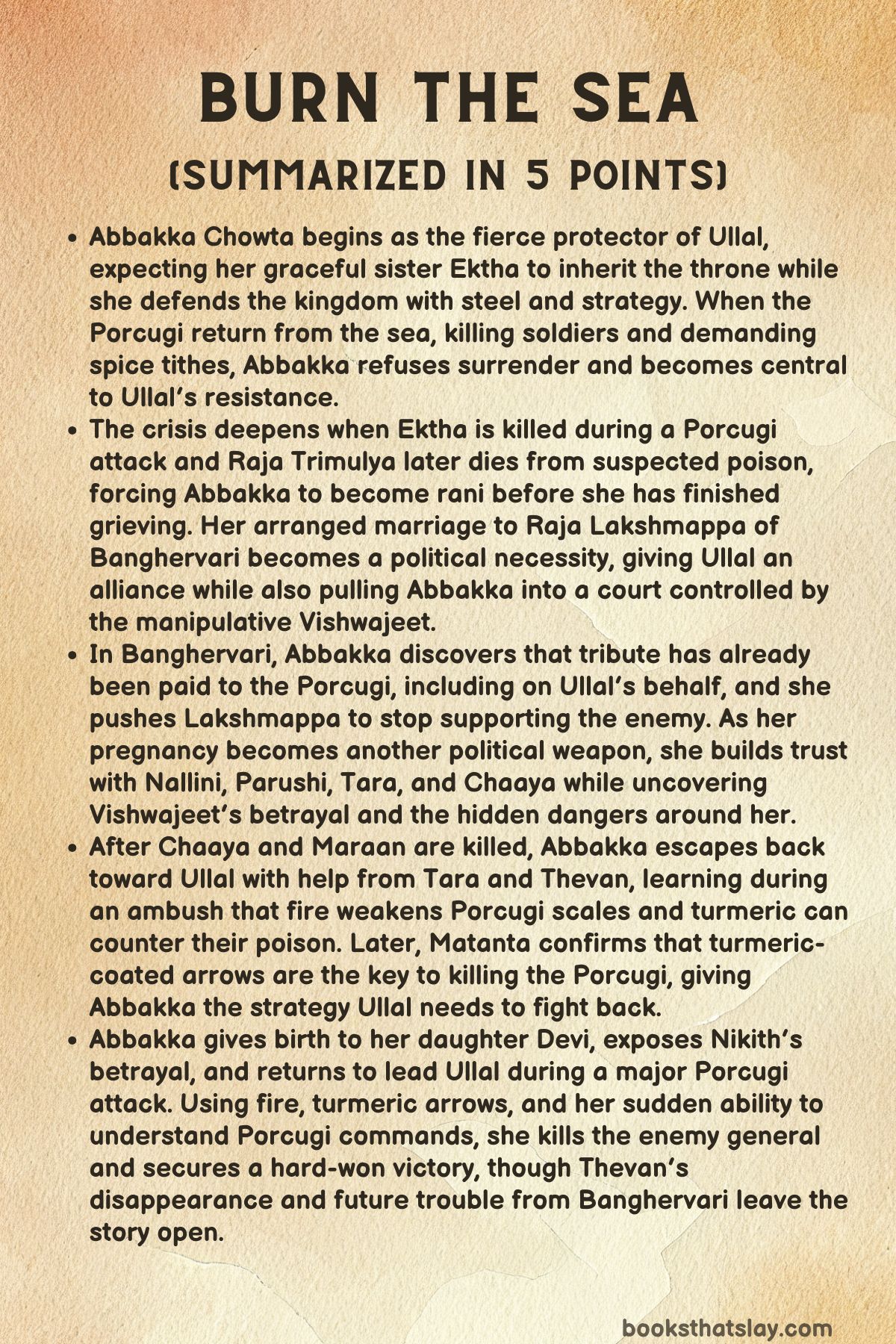
Summary
Abbakka Chowta begins the story as the fierce younger sister of Ektha, the expected future ruler of Ullal. Ektha is patient, diplomatic, and devout, while Abbakka trusts weapons, action, and direct resistance more than prayer or ceremony.
Their lives change when Thevan, a soldier from Abbakka’s past, arrives with a warning hidden inside a familiar jasmine blossom. An attack has taken place, soldiers are wounded, and the threat long treated like a distant legend has returned: the Porcugi, deadly sea creatures who once demanded tribute from the coastal kingdoms.
At the infirmary, Abbakka learns the scale of the danger. Samanth, Thevan’s older brother and Abbakka’s dear friend, has been taken and killed, along with several others who tried to save him.
The attack leaves Raja Trimulya injured and the kingdom shaken. Nikith, Ektha’s husband, urges caution, but Abbakka refuses any idea of surrender. Trimulya remembers how the Porcugi once demanded spices in exchange for so-called protection, and Ullal prepares for resistance.
Abbakka throws herself into duty to avoid grief. She helps plan defenses, manages public fear through Chetan’s gossip network, and arranges funeral rites for the dead.
Samanth’s death hits her deeply because he had been more than a friend; he was part of the emotional foundation of her childhood. At his funeral, Thevan is too broken to perform the final act, so Abbakka gives him the chance to honor his brother while she stands beside him.
As Ullal prepares for war, Trimulya sends Nikith to Banghervari to seek help. The kingdom needs allies, but the alliance comes with a price Abbakka does not expect.
Before she learns the truth, Abbakka meets Raja Lakshmappa of Banghervari by chance after his white stallion bolts through Ullal’s farms. He is charming, clumsy, generous, and clearly interested in marrying Rajkumari Abbakka, though he does not realize the woman helping him is Abbakka herself.
Soon after, the Porcugi send Kamran Khalil, a human emissary raised by them after they killed his parents. Kamran demands spice tithes in exchange for safety at sea.
Trimulya refuses. Ullal is now openly at war.
Nikith returns with news that Banghervari has agreed to ally with Ullal, but Abbakka realizes the alliance depends on her marriage to Lakshmappa. She feels betrayed by Nikith, Ektha, and Trimulya, because the people closest to her kept the plan hidden.
Trimulya explains that marriage is the strongest way to bind the kingdoms together against the Porcugi. Abbakka argues that her duty is to stay in Ullal and protect Ektha, but Trimulya makes clear that the decision is no longer hers alone.
Abbakka retreats to her hidden stepwell, where she plays her tambura and finds rare peace among the adaiman birds. Lakshmappa finds her there, having followed one of the birds, and returns her dupatta.
His sincerity unsettles her. She wants to reject the marriage completely, but he makes that harder by being kind, attentive, and genuinely admiring of who she is.
Ektha finds Abbakka collapsed in the stepwell, and the sisters begin repairing the hurt caused by the hidden marriage arrangement. Before they can fully heal the wound between them, warning horns sound.
The Porcugi attack Ullal.
The fort becomes a battlefield. Abbakka sends Ektha toward safety and joins the fight with Parushi, a skilled warrior and loyal friend.
Together, Abbakka and Parushi face one of the Porcugi up close. The creature is enormous, silver-scaled, snake-like, and nearly impossible to kill.
Through courage and teamwork, Parushi creates an opening, and Abbakka shoots the monster between the eyes. The victory proves the Porcugi can die, but the cost of fighting them remains terrifying.
Abbakka then searches for Ektha and finds her dead in the gardens. The loss destroys the future Abbakka had always imagined: Ektha as rani, Abbakka as protector.
Before Abbakka can mourn properly, Trimulya tells her that Ektha’s death has made her the future rani of Ullal. She must meet Lakshmappa not as a reluctant bride alone, but as the kingdom’s next ruler.
Lakshmappa arrives with Banghervari’s grandeur behind him. His adviser Vishwajeet presents the alliance and marriage with exaggerated ceremony, but Lakshmappa himself shows courtesy and gentleness.
Abbakka speaks with him privately, and he makes clear that he wants a marriage with affection, not just politics. For a moment, she lets herself feel the possibility of connection.
That fragile peace ends when Abbakka discovers Trimulya has died. Tara, the head healer, suspects poison because Trimulya’s wounds should not have killed him so suddenly.
Abbakka is now Rani Abbakka Chowta, surrounded by grief, war, and hidden enemies.
Tara, Parushi, Chaaya, and Chetan become part of Abbakka’s secret circle. Chaaya reveals that she is Chetan’s sister and was placed near Abbakka long ago by Abbakka’s mother to protect her.
The group begins investigating Trimulya’s death and guarding Abbakka from threats inside the court. Abbakka starts to understand that ruling requires secrecy, patience, and trust as much as swordsmanship.
After Trimulya’s funeral, Abbakka begins ruling Ullal. Thevan becomes general after his father Jagath’s death, and Nikith pledges service in Ektha’s memory.
But the war drains the kingdom. Porcugi attacks continue, ships are lost, and some citizens begin wondering if paying tribute would save lives.
Abbakka publicly refuses that path, arguing that surrender would only make Ullal permanently dependent on its enemies. When Shalini, a grieving woman from Parushi’s past, attacks her with a dagger, Abbakka orders her taken alive rather than killed.
The attack leads to another secret meeting, where Chaaya reveals Parushi is Trimulya’s daughter, born outside marriage. This makes Parushi a possible alternative heir if enemies want to create instability.
Abbakka realizes her position is more fragile than she believed. To strengthen Ullal, she agrees to consider marrying Lakshmappa, but only if her terms are accepted: Ullal must remain hers, the wedding must happen in Ullal, Banghervari must help defeat the Porcugi, and her first daughter must inherit Ullal.
Lakshmappa accepts. Abbakka and Lakshmappa marry in Ullal’s gardens, making the alliance official.
The marriage begins with tension, but also genuine warmth. Lakshmappa treats Abbakka with affection, and she slowly sees that he may become a partner, though she refuses to let marriage weaken her authority.
Abbakka travels to Banghervari and enters a court dominated by Vishwajeet. Unlike Ullal, where danger often shows itself through open conflict, Banghervari’s danger lies in performance, control, and influence.
Vishwajeet repeatedly blocks Abbakka from real power and keeps Lakshmappa focused on comfort and appearances. Abbakka studies old records on the Porcugi, pressures Lakshmappa to take the threat seriously, and uses his devotion to the Spirits to make resistance feel sacred.
When she learns Banghervari has already been paying the Porcugi tithes, including Ullal’s share, she is furious. Vishwajeet calls the payments practical, but Abbakka calls them surrender.
Lakshmappa chooses her side and orders the payments stopped.
Soon, Abbakka becomes pregnant. The pregnancy turns her body into a political battleground, because the child will affect Ullal’s future and Banghervari’s ambitions.
Vishwajeet assigns Nallini, a healer-monk, to attend Abbakka. Nallini admits she is expected to report to Vishwajeet, but Abbakka decides to use that arrangement by feeding controlled information while watching her carefully.
Over time, Nallini proves her skill and earns trust. She treats Abbakka’s injury with ants as stitches and later saves Parushi from poisoned Porcugi wounds using turmeric paste.
The discovery that turmeric can draw out Porcugi poison becomes important. Later, during an ambush on the road to Ullal, Abbakka learns that coconut-leaf fire weakens Porcugi scales, making them vulnerable.
Meanwhile, Vishwajeet’s betrayal becomes undeniable. He blocks treatment for wounded soldiers, threatens Abbakka, and reveals that Chaaya and Abbakka’s horse Maraan have been killed.
Abbakka collapses into grief, but Tara and Thevan arrive in disguise and help arrange her return to Ullal under the excuse that she needs rare blossoms for her pregnancy.
Back in Ullal, Abbakka is welcomed by her people. She reclaims her royal space, strengthens defenses, and continues refusing the tithe.
Kamran secretly appears in her stepwell, trying to persuade her to accept Porcugi rule. Abbakka realizes his presence there gives him dangerous power over her, so she kills him.
Nikith’s reaction reveals that he helped arrange the meeting and has been sending information to Vishwajeet. Before Abbakka can fully process his betrayal, she goes into early labor and gives birth to a daughter, Trimuladevi, called Devi.
Devi’s birth secures Ullal’s matrilineal future but also increases the danger around Abbakka. When Nikith later threatens Nallini and attacks Abbakka and the baby, his treason is exposed completely.
Abbakka gives him a choice between public disgrace and private death. He chooses death.
To find the final answer against the Porcugi, Abbakka travels to Matanta’s mountain. There, she asks how best to serve her people.
Matanta reveals that turmeric, delivered through arrows after fire weakens the Porcugi scales, is the true weapon. Abbakka finally understands that earlier signs were not about marriage or Lakshmappa, but war.
On the way back, Vishwajeet captures her, but Thevan escapes with the knowledge. Before parting, Abbakka and Thevan finally acknowledge their love through words and a kiss.
Vishwajeet takes Abbakka to Mangaluru, where Lakshmappa is building a seaside palace for her. Abbakka uses Lakshmappa’s affection, the pearl gajra, and careful language to weaken Vishwajeet’s lies.
Lakshmappa begins to doubt his adviser and allows Abbakka to return to Ullal.
When she reaches home, a Porcugi attack is already underway. Ullal’s soldiers are using fire and turmeric, and the strategy is working.
Abbakka discovers she can understand the Porcugi language, giving her the ability to anticipate their commands. She directs the defense and helps turn the battle.
The Porcugi general seizes Thevan and carries him toward the sea. Abbakka realizes the general wants the body of his fallen son, not her.
She kills him with a turmeric arrow shot into his mouth, denying him mercy after all he has done to Ullal.
Six moons later, Ullal’s ships return safely and richly, showing that Abbakka’s resistance has succeeded for now. Thevan is believed lost, but signs from the adaiman and Samanth’s medallion suggest he is alive somewhere.
Abbakka remains rani, mother, warrior, and protector. Her victory is real, but future danger remains, especially as word travels toward Lakshmappa’s palace.
Characters
Abbakka Chowta
Abbakka Chowta is the central force of Burn the Sea, a warrior-princess who is forced to become rani before she is emotionally ready for the throne. She begins as the sister meant to protect Ektha, not replace her, and that early self-image shapes much of her pain after Ektha’s death.
Her strength is never simple fearlessness. She is brave, but she is also angry, grieving, stubborn, and often terrified of failing the people who depend on her.
Abbakka’s growth comes from learning that ruling is not the same as fighting. She can kill a Porcugi, command soldiers, and face enemies directly, but she also has to manage gossip, marriage terms, public fear, pregnancy, court manipulation, and betrayal.
Her greatest conflict is between personal desire and public duty. She wants Ullal, freedom, Thevan, her dead family, and a life not decided by political necessity, yet the crown demands that she use every part of herself as a weapon for survival.
By the end, Abbakka becomes a ruler who understands both power and cost. She does not become softer, but she becomes wiser, more strategic, and more willing to let others help her carry the burden.
Ektha Chowta
Ektha is Abbakka’s older sister and the future that Ullal originally expected. She represents diplomacy, grace, faith, and emotional steadiness, all the qualities Abbakka believes she lacks.
Her death is one of the story’s most important turning points because it removes the life Abbakka had built her identity around. Abbakka did not dream of ruling; she dreamed of standing beside Ektha as her protector.
Ektha’s importance continues after her death. Her memory shapes Abbakka’s decisions, her grief, her anger at Nikith, and her determination to protect Devi as the next daughter of Ullal.
She is not merely a lost loved one in the book. She is the measure of what Abbakka wanted to defend and the wound that forces Abbakka into the light.
Raja Trimulya
Trimulya is Abbakka and Ektha’s uncle, guardian, and ruler of Ullal before Abbakka inherits the throne. He is a man shaped by duty rather than desire, having taken power to preserve the kingdom and protect the girls after earlier family tragedy.
His relationship with Abbakka is loving but also painful because he trains her to be strong and then uses that strength for political necessity. His decision to arrange her marriage to Lakshmappa feels like betrayal to her, but it also reflects the brutal reality of leadership during war.
Trimulya’s death by poison pushes Abbakka into full authority before she has had time to mourn Ektha. It also exposes that Ullal’s danger is not only from the sea but from hidden human enemies.
His legacy remains in Abbakka’s rule. He teaches her that power often requires decisions that wound the people one loves, and she spends much of the story learning how to carry that same burden without losing herself.
Raja Lakshmappa
Lakshmappa begins as an arranged husband Abbakka wants to dismiss. His first impression is almost comic: a handsome ruler on a stallion he cannot control, trying to impress the woman he plans to marry.
Yet he is not foolish in a flat way. He is affectionate, generous, religious, and capable of warmth, but he has been sheltered by Vishwajeet and trained to accept comfort instead of direct rule.
His relationship with Abbakka is one of the book’s most complicated political bonds. He genuinely cares for her and wants a loving marriage, but his affection often comes with possessiveness, misunderstanding, and a failure to see Ullal as her true center.
Lakshmappa’s weakness is not cruelty but dependency. He allows Vishwajeet too much control, and this makes him dangerous even when he means well.
Still, his choice to stop paying the Porcugi shows that Abbakka can reach the better part of him. He remains a mixture of ally, husband, obstacle, and future problem.
Thevan
Thevan is a soldier, Samanth’s brother, and Abbakka’s deepest emotional counterpart. His grief mirrors hers, and both of them often turn to work, discipline, and danger because they do not know how to sit with loss.
At first, Thevan’s bond with Abbakka is shaped by shared history and unspoken feeling. Samanth’s death brings them closer, but it also places pain between them because both are carrying memories of the same lost family.
As general, Thevan becomes one of Abbakka’s most important military allies. He studies defenses, supports the fire-and-turmeric strategy, protects Devi, and repeatedly places Ullal above his own safety.
His love for Abbakka is restrained by duty, rank, and timing. When they finally acknowledge it, the moment feels powerful because it has grown through years of loyalty rather than sudden passion.
Thevan’s disappearance at sea leaves the story open with longing and unfinished promise. His possible survival keeps Abbakka’s personal hope alive after the war’s terrible cost.
Parushi
Parushi is Abbakka’s closest warrior companion and one of the strongest fighters in the story. She is bold, direct, and fearless in battle, but her courage is also matched by sharp political instinct.
Her hidden identity as Trimulya’s daughter adds a new layer to her role. She is not only Abbakka’s friend and protector but also a possible royal claimant, which makes her existence dangerous in a kingdom already threatened by division.
Parushi’s horror at the idea of royal power shows her loyalty. She does not want Abbakka’s throne, and her identity only strengthens her commitment to protecting Ullal.
She often speaks truths others soften. Whether warning Abbakka, challenging suspicion, or judging court politics, Parushi gives the book a blunt moral clarity.
Her survival through poisoned wounds and repeated battles makes her a symbol of Ullal’s resilience. She is not polished like a courtier, but she is exactly the kind of person Abbakka needs near the throne.
Nikith
Nikith begins as Ektha’s husband and a trusted member of Ullal’s ruling circle. His grief after Ektha’s death appears genuine, and for a time, he seems committed to serving Abbakka in her memory.
His betrayal is devastating because it grows from familiar fears rather than open malice. He believes paying the Porcugi and cooperating with Vishwajeet may spare Ullal greater destruction, but his choices endanger the very kingdom he claims to protect.
Nikith’s treason is also personal. By giving information to Vishwajeet, helping arrange Kamran’s secret access, and threatening those close to Abbakka, he betrays Ektha’s memory as much as Abbakka’s rule.
His final confrontation reveals a man who has lost moral courage. He dresses surrender as practicality and survival, but the book presents his compromise as a failure of loyalty.
Abbakka’s decision to offer him private death instead of public disgrace shows both mercy and authority. She refuses to let his betrayal destroy the kingdom’s public spirit, but she also refuses to excuse him.
Vishwajeet
Vishwajeet is the most dangerous human antagonist in Burn the Sea because he understands power as control over access, belief, information, and fear. He does not need to fight openly when he can shape what rulers hear, what courts believe, and what servants are forced to do.
His influence over Lakshmappa is built through years of manipulation. He presents himself as loyal adviser, spiritual interpreter, and practical statesman, but he repeatedly protects his own authority over the safety of the kingdoms.
Vishwajeet’s cruelty is cold and deliberate. The deaths of Chaaya and Maraan, the pressure on Nallini, the suspected link to Trimulya’s poisoning, and his dealings with the Porcugi show a man willing to destroy anything that threatens his position.
He is especially threatened by Abbakka because she refuses to be managed. She sees through his performances, questions his policies, and pulls Lakshmappa toward direct resistance.
As a villain, Vishwajeet represents surrender disguised as wisdom. He speaks the language of order, but his order depends on obedience to monsters and silence from everyone beneath him.
Nallini
Nallini enters the story as a suspected spy placed near Abbakka by Vishwajeet. Her honesty about that position makes her more interesting than a simple infiltrator.
She is trapped by debt, fear, and institutional control, but she is not empty of conscience. Her remark that debts to people who do not respect you are dangerous reveals how clearly she understands her own situation.
Nallini’s healing skill becomes essential to the war effort. Her use of ants as stitches, her treatment of Parushi’s poisoned wound, and her knowledge of turmeric make her one of the quiet keys to defeating the Porcugi.
Her loyalty changes through action rather than speeches. She repeatedly chooses to protect Abbakka, Parushi, and the unborn child, even when doing so places her at risk.
Nallini’s character shows how people controlled by corrupt power can still reclaim agency. Abbakka’s decision to use caution without rejecting her completely allows Nallini to become an ally instead of remaining Vishwajeet’s tool.
Chaaya
Chaaya is Abbakka’s attendant, protector, and hidden connection to Abbakka’s mother’s long planning. Her revelation as Chetan’s sister shows that loyalty in Ullal runs through quiet networks as much as royal commands.
She watches food, servants, rooms, and routines, protecting Abbakka from threats that swords cannot solve. Her care is practical, intimate, and deeply rooted in years of service.
Chaaya’s death is one of the cruelest blows Vishwajeet delivers. By killing her and Maraan, he strikes not only at Abbakka’s safety but at her emotional foundation.
Her importance continues after death because her loyalty clarifies the difference between service and control. Chaaya serves because she loves and believes; Vishwajeet controls because he fears losing power.
In the story, Chaaya represents the unseen labor that keeps rulers alive. Abbakka’s public honoring of Chetan later also honors Chaaya’s hidden devotion.
Tara
Tara is the head healer of Ullal and one of Abbakka’s most reliable advisers. She is sharp, practical, and unafraid to speak plainly to royalty when health, truth, or survival is at stake.
Her suspicion that Trimulya was poisoned begins the secret investigation that exposes deeper danger within Ullal and Banghervari. She understands that healing is not only about wounds but also about reading symptoms, lies, and timing.
Tara’s strength lies in controlled authority. She can command a sickroom, manage public appearances, criticize Vishwajeet’s handling of Abbakka’s health, and create believable medical excuses when Abbakka needs to escape.
She also teaches Abbakka that presentation matters. A ruler must be seen with care because public perception can strengthen or weaken command.
Tara is not a warrior in the traditional sense, but she fights through knowledge, composure, and timing. Her presence gives Abbakka room to survive moments when force alone would fail.
Kamran Khalil
Kamran is the human emissary of the Porcugi, and his life is marked by tragedy and moral distortion. The Porcugi killed his parents, then raised him because his language skills were useful to them.
This background makes him unsettling rather than merely arrogant. He knows what the Porcugi are, yet he speaks for them and frames obedience as safety.
Kamran’s role is to tempt Ullal toward surrender. He tries to make tribute sound practical, merciful, and inevitable, but Abbakka understands that his words are another form of conquest.
His secret appearance in Abbakka’s stepwell marks a violation of one of her most private spaces. By entering that refuge, he becomes more than an emissary; he becomes a threat with personal leverage.
Abbakka’s decision to kill him is harsh but strategic. She understands that letting him leave could expose her secrets and weaken Ullal’s resistance.
Chetan
Chetan is Ullal’s florist and gossip master, a character who shows that information can be as useful as military strength. His shop is a place where flowers, rumors, grief, and politics meet.
Abbakka first uses him to shape public understanding of the Porcugi attacks. She gives him enough truth to spread courage without feeding panic.
His loyalty becomes more important after Chaaya’s identity is revealed. As her brother and as someone placed within Abbakka’s wider circle of trust, Chetan helps connect private intelligence with public mood.
He also helps point Abbakka toward Ulagan as a likely agent in Trimulya’s poisoning. His knowledge of personal debts and sudden changes in fortune makes him valuable in ways a formal council might overlook.
Chetan represents the power of ordinary people in the survival of a kingdom. He is not a soldier, but his loyalty helps defend Ullal from hidden enemies.
Matanta
Matanta is a mysterious guardian figure connected to the Spirits, adaiman, and Abbakka’s deeper destiny. His presence gives the story a mythic dimension without removing the importance of Abbakka’s choices.
In Abbakka’s youth, he tells her she is the sun, not a small star. That lesson becomes central later, when she must stop living as someone meant only to stand beside Ektha.
Matanta does not give answers easily. When Abbakka comes to him asking how to serve her people, she must ask the right question and face the danger of ancient rules.
His final guidance clarifies the meaning of turmeric and the adaiman’s signs. The answer is not marriage, surrender, or divine rescue, but a practical weapon that Abbakka must carry back into war.
Matanta’s role is less about prophecy than recognition. He helps Abbakka see what she already has the courage to become.
Samanth
Samanth is dead early in the story, but his influence remains powerful. He was Thevan’s brother, Jagath’s son, and Abbakka’s friend, someone who gave warmth and steadiness during her younger years.
His rakhi bracelet carries emotional weight because it represents chosen siblinghood, protection, and belonging. When it burns away during the funeral rites, Abbakka loses not only a friend but also a part of her childhood.
Samanth’s death helps define the cost of the Porcugi threat. The monsters are not abstract enemies; they take people with histories, families, and unfinished bonds.
His memory also shapes the bond between Abbakka and Thevan. Their shared grief for him becomes one of the emotional roots of their closeness.
Even when absent, Samanth remains tied to the story’s symbols of loyalty and protection. His medallion later becomes part of the hope that Thevan may still be alive.
Devi
Trimuladevi, called Devi, is Abbakka’s daughter and the future of Ullal. Her birth during crisis transforms the political stakes of the story.
Because she is a girl, Devi secures the matrilineal future Abbakka fought to protect in her marriage terms. She proves that Ullal’s inheritance can continue through Abbakka rather than being absorbed by Banghervari.
Lakshmappa’s distance after learning the child is a girl reveals the divide between his expectations and Ullal’s values. To Abbakka, Devi is not a disappointment; she is the next rani.
Devi’s presence also changes Abbakka’s understanding of survival. Abbakka is no longer fighting only for her people and her dead family, but for the child who will inherit the kingdom she saves.
Though Devi is an infant, her symbolic importance is enormous. She represents continuity, resistance, and the future that Abbakka refuses to surrender.
Themes
Leadership Through Loss
Abbakka’s rise to power is not presented as a clean ascent but as a succession of losses that leave her with no time to recover. Burn the Sea makes leadership feel less like glory and more like being forced to stand while grief is still fresh.
Ektha’s death destroys the role Abbakka expected to play, and Trimulya’s death removes the guardian who could have guided her. She inherits not only a throne but also a war, a poisoned court, a shaken people, and the memory of everyone who should have been beside her.
Her leadership develops because she cannot afford to remain only a warrior. She must become a speaker, negotiator, judge, mother, strategist, and symbol.
The book treats grief as something that can weaken a ruler but also deepen one. Abbakka’s sorrow teaches her what is at stake because every political decision is tied to names, bodies, families, and futures.
She does not stop grieving in order to rule. Instead, she learns to rule while carrying grief, and that makes her authority more human and more powerful.
Resistance Against Surrender
The conflict with the Porcugi is built around the question of whether survival is worth the price of obedience. The Porcugi offer “protection” in exchange for spices, but the story exposes that bargain as domination.
Abbakka understands that tribute would not end danger; it would teach the enemy that Ullal can be drained, controlled, and frightened into silence. Her refusal is not reckless pride alone, even though others often see it that way.
Nikith, Vishwajeet, and even some frightened citizens argue from the logic of immediate safety. Their fear is understandable because war costs lives, wealth, and stability.
The book does not ignore that cost. Ships are lost, soldiers die, families mourn, and Abbakka herself is nearly broken by the burden of refusing the easier path.
Still, the story argues that surrender to a violent power rarely remains limited. Once Ullal accepts the tithe, the Porcugi would decide what safety costs, how much obedience is enough, and how long the kingdom’s freedom can survive.
Abbakka’s resistance matters because it protects not only trade and territory, but the right of her people to live without kneeling to fear.
Women, Power, and Matrilineal Legacy
The story places women at the center of power in ways that go beyond titles. Abbakka, Ektha, Parushi, Tara, Chaaya, Nallini, and Devi all shape the kingdom’s survival through different forms of strength.
Ektha represents the expected future of Ullal, while Abbakka becomes the unexpected one. Devi’s birth then secures the next stage of that future, proving why Abbakka’s marriage terms mattered so much.
The matrilineal structure of Ullal is not background decoration. It is a political system that enemies can threaten, husbands can misunderstand, and allies must actively protect.
Abbakka’s pregnancy shows how a woman’s body can become a site of political pressure. Vishwajeet wants influence over the child’s future, Lakshmappa imagines a son, and Abbakka thinks first of Ullal’s inheritance.
The women around Abbakka protect that future in practical ways. Tara uses medicine and authority, Chaaya guards the hidden spaces of daily life, Parushi defends with weapons, and Nallini turns healing knowledge into resistance.
The book’s vision of power is not limited to the throne room. It lives in birth, secrecy, medicine, memory, strategy, and the bonds between women who refuse to let men define the future for them.
Love, Duty, and Political Marriage
Abbakka’s marriage to Lakshmappa begins as a bargain made for war, not romance. Her anger comes from being treated as a diplomatic bridge when she believes her true duty is to remain beside Ektha and defend Ullal.
Lakshmappa complicates that anger because he is not simply a cruel husband or empty ruler. He is kind, affectionate, and capable of listening, but he is also shaped by comfort, patriarchy, and Vishwajeet’s control.
This makes the marriage emotionally difficult. Abbakka can feel warmth toward him while also resisting the political structure that tries to use her as a wife before recognizing her as a ruler.
The story contrasts this bond with Abbakka’s love for Thevan. With Thevan, love grows from shared history, grief, loyalty, and common purpose, but duty keeps it buried for most of the book.
Neither relationship is treated as simple escape. Lakshmappa offers alliance and affection but threatens to pull Abbakka away from Ullal, while Thevan offers understanding but cannot erase her obligations.
Through these bonds, the book shows that love can comfort, restrict, empower, and endanger. Abbakka’s challenge is not choosing feeling over duty, but learning how to protect her kingdom without denying the human heart that keeps her fighting.