Captivation Creek Summary, Characters and Themes
Captivation Creek by Claire Kingsley is a small-town romantic mystery centered on friendship, loyalty, and the risky moment when familiar feelings turn into something deeper. The story follows Theo Haven, a former professional football player now working as a teacher and coach, and Penelope Fallbrook, an art teacher trying to step out of a failing relationship.
Their easy friendship becomes the emotional center of the book, while a suspicious death connected to Penelope’s former mentor draws them into danger. The novel blends romance, family bonds, humor, and suspense, creating a story about choosing love, home, and courage. It’s the 5th book of the Haven Brothers series.
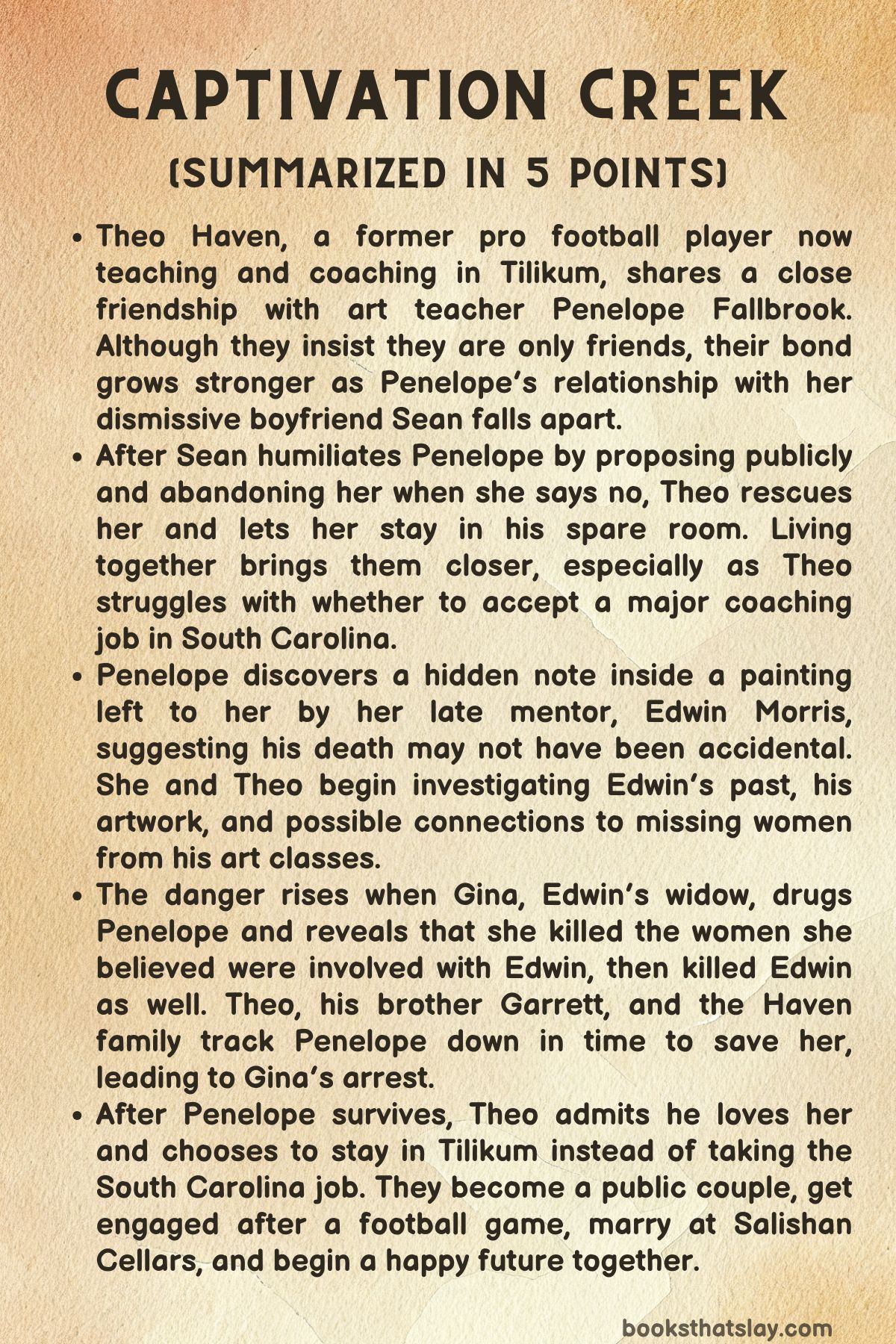
Summary
Theo Haven has built a steady life in Tilikum after leaving professional football behind. He works as a high school teacher and coaches the school football team, a role that keeps him connected to the game without the pressure and fame of his former career.
At school, one of the people he enjoys most is Penelope Fallbrook, the art teacher. Their friendship is easy, full of jokes, teasing, and quiet support.
They spend time gossiping about coworkers, watching the school’s little dramas, and acting as if their bond is completely simple. To everyone else, there is an obvious closeness between them, but both Theo and Penelope insist they are only friends.
Penelope’s personal life is much less satisfying. She lives with her boyfriend, Sean, but their relationship has become more about convenience than affection.
Sean is careless with her time, dismissive of her interests, and often treats her as if she exists to support his comfort. He changes plans without asking, brings people to their home without warning, and expects her to serve as hostess while showing little concern for what she wants or needs.
Penelope has been trying to ignore how unhappy she is, but the signs keep building until she can no longer pretend the relationship is working.
At the same time, Theo is facing a major decision of his own. The University of South Carolina has shown interest in hiring him as an offensive coordinator, a position that would be a serious step forward in his coaching career.
The opportunity is exciting, but it would also mean leaving Tilikum, his family, his team, and the life he has created. He keeps the decision mostly to himself while trying to understand whether ambition should matter more than the people and place that have become his home.
Penelope’s connection to the local art world brings her to a celebration of life for Edwin Morris, a painter who had once mentored her. She wants Sean to attend with her, but he forgets and chooses to spend time with his friends instead.
Hurt and disappointed, Penelope asks Theo to go with her, and he agrees without hesitation. At the gallery, the event feels uneasy.
There are rumors that Edwin may have had an affair, his son Michael behaves drunkenly and angrily over being financially cut off, and Edwin’s widow, Gina, seems cold and controlled. Penelope is surprised when she learns Edwin left one of his paintings for her, a gesture that feels meaningful but also strange.
Soon after, Penelope decides she has had enough of Sean. Before she can fully arrange her exit, he takes her to an expensive restaurant and proposes in front of everyone.
The public setting is meant to pressure her into saying yes, but Penelope refuses. She tells him the truth: they are not in love, and they are barely even friends anymore.
Sean reacts with anger and embarrassment, then abandons her outside the restaurant in Echo Creek. Penelope calls Theo, and he immediately comes to get her.
He takes her home and lets her stay in his spare room, giving her a safe place to begin rebuilding her life.
Living together changes the rhythm between Theo and Penelope. Their friendship becomes more intimate as they share ordinary routines, private conversations, and the comfort of being around someone who truly pays attention.
Theo also helps Penelope collect her belongings from Sean, bringing his brothers along for support. Sean is hostile and resentful, but Theo refuses to let him intimidate Penelope.
Through these moments, Penelope becomes more connected to Theo’s family and begins to see what it feels like to be surrounded by people who protect and value one another.
The painting Edwin left for Penelope soon becomes more than a gift. She finds a hidden note inside it suggesting that Edwin’s death may not have been accidental.
The discovery pulls her and Theo into an investigation neither of them expected. They begin looking at Edwin’s paintings, his students, his family, and odd details around his final days.
Their search points toward missing women who may have been connected to Edwin’s art classes. As the clues grow darker, they wonder whether Edwin himself, his unstable son Michael, or someone else around him may have been involved in the women’s deaths.
Theo and Penelope try to gather information in creative ways, even disguising themselves to visit the gallery and listen for useful details. The mystery becomes more troubling when Penelope realizes Edwin’s paintings may hold hidden messages tied to murder victims.
Theo’s brother Garrett, who works in law enforcement, eventually becomes involved, giving the investigation a more serious direction. What began as a strange note in a painting turns into evidence of a long pattern of jealousy, secrecy, and murder.
While the danger increases, Theo and Penelope’s feelings for each other become harder to deny. Theo pretends to be Penelope’s boyfriend in front of Sean and kisses her, but the kiss feels far too real to ignore.
Their attraction has been growing beneath the surface for a long time, and living together only makes it stronger. They eventually sleep together, though both try to convince themselves that they can keep the relationship casual.
Theo is still considering the South Carolina job, and neither wants to admit how much it would hurt if he left.
The truth behind Edwin’s death begins to take shape when Gina, Edwin’s widow, focuses her anger on Penelope. Gina believes Penelope had an affair with Edwin because Edwin painted her portrait, just as he had painted other women before.
In Gina’s mind, the paintings are proof of betrayal. She lures Penelope to the gallery, drugs her tea, and takes her to Curt Redfern’s house.
There, Gina injects Penelope with insulin, intending to kill her in a way that will be difficult to trace. Gina reveals that she killed the other women she believed had been involved with Edwin, and she also killed Edwin himself.
Theo realizes Penelope is missing and becomes desperate to find her. With Garrett and his brothers, he follows the clues and tracks her car to Curt.
Curt admits that Gina forced him to help, and the search leads them to Penelope, who is unconscious and in grave danger. They get her medical care in time, and she survives.
The attack forces Theo to face the truth he has been avoiding. He loves Penelope, and the life he wants is not somewhere else.
It is in Tilikum, with her.
In the hospital, Theo tells Penelope he loves her and decides not to take the South Carolina job. Gina is arrested, Curt faces legal consequences, and Michael’s own crimes and personal failures come to light as the investigation continues.
With the mystery resolved, Penelope begins to recover from the trauma and steps fully into a new life with Theo.
Theo tells his family he is staying, choosing the people he loves over the career move that once tempted him. He and Penelope become a couple openly, no longer hiding behind friendship or casual excuses.
Their relationship grows stronger through trust, humor, and the knowledge that they have already faced serious danger together. At a football game, after Theo’s team wins, he proposes to Penelope in front of the crowd.
She says yes, turning a public moment into something joyful and certain, unlike Sean’s earlier proposal.
Later, Theo and Penelope marry at Salishan Cellars and honeymoon on a beach. Their future feels open and hopeful, with the possibility of children and a life built around love, family, and the town they both call home.
Captivation Creek ends with Theo and Penelope secure in their choice of each other, having moved from friendship to love while uncovering the truth behind a deadly secret.
Characters
The characters in Captivation Creek are built around friendship, emotional honesty, romantic risk, family loyalty, and a mystery that exposes hidden cruelty beneath a close-knit community. The story uses its characters not only to develop the romance between Theo and Penelope, but also to explore how people reveal their true nature under pressure.
Some characters offer safety and devotion, while others represent neglect, jealousy, selfishness, or moral corruption.
Theo Haven
Theo Haven is one of the central characters in the book, and his role is defined by strength, loyalty, emotional restraint, and gradual self-realization. As a former professional football player who becomes a high school teacher and football coach, he carries both public confidence and private uncertainty.
He is respected in Tilikum, connected to his family, devoted to his students and team, and still capable of pursuing a larger professional future when the University of South Carolina shows interest in him. This career opportunity creates one of Theo’s main internal conflicts, because it forces him to decide whether ambition matters more than the life he has built and the woman he has come to love.
Theo’s friendship with Penelope is the emotional foundation of his character. At first, he tries to keep their relationship within the safe boundaries of friendship, joking with her, supporting her, and refusing to admit the depth of his feelings.
However, his actions reveal his love long before he says it openly. When Penelope needs someone to attend Edwin Morris’s celebration of life, Theo goes with her without hesitation.
When Sean humiliates and abandons her, Theo immediately comes to her rescue. When she needs a place to stay, he opens his home to her.
These choices show that Theo is dependable not because he wants praise, but because protecting and caring for Penelope comes naturally to him.
Theo is also important because he represents healthy love in contrast to Sean’s neglect. He listens to Penelope, respects her feelings, stands up for her, and makes space for her in his life without trying to control her.
His protectiveness is strong, especially when danger surrounds Penelope, but it is not possessive in the same way Sean’s behavior can feel selfish or dismissive. Theo’s love grows through companionship, trust, humor, and shared danger.
His decision to stay in Tilikum instead of leaving for South Carolina shows that he has finally understood what he truly values. His proposal after the football game completes his emotional arc, turning private devotion into a public, joyful commitment.
Penelope Fallbrook
Penelope Fallbrook is the emotional heart of the story, and her journey is one of awakening, courage, and choosing a better life. At the beginning of the book, she is an art teacher living with Sean, but the relationship has become hollow and one-sided.
Penelope is caring, patient, and thoughtful, yet these qualities have allowed her to tolerate too much emotional neglect. Sean changes plans without considering her, treats her like a hostess, and fails to show interest in the things that matter to her.
Her gradual realization that she and Sean are not truly in love is one of her most important moments of growth.
Penelope’s connection to art gives her character depth and also ties her directly to the central mystery. Edwin Morris was not just a painter to her; he was a mentor figure whose work and approval mattered.
When she receives one of his paintings, it feels meaningful at first, but it soon becomes the doorway into something far darker. Her discovery of the hidden note inside the painting shows her curiosity and intelligence.
Rather than dismissing the clue, she investigates, asks questions, follows patterns, and helps uncover the truth behind the missing women and Edwin’s death.
Penelope is not portrayed as helpless, even though she becomes a victim of Gina’s violence. Her strength lies in her emotional honesty, her ability to leave a bad relationship, and her willingness to face frightening truths.
Saying no to Sean’s public proposal is a defining act of self-respect. Moving into Theo’s spare room could have made her feel dependent, but instead it becomes part of her rebuilding process.
Through her friendship and romance with Theo, she learns what it means to be loved with consistency and care. By the end, Penelope has moved from uncertainty and emotional neglect into confidence, partnership, and hope for the future.
Sean
Sean functions as a contrast to Theo and as a representation of emotional carelessness. He is not the main villain of the story, but he is still harmful in Penelope’s life because he consistently fails to treat her as a valued partner.
His behavior shows selfishness in ordinary, everyday ways. He changes plans without consulting her, invites friends over without warning, expects her to accommodate him, and forgets events that matter deeply to her.
These actions reveal that he is more invested in convenience and appearances than in Penelope’s emotional well-being.
Sean’s proposal is one of the clearest examples of his misunderstanding of their relationship. Instead of recognizing that their connection is failing, he creates a public moment that pressures Penelope to accept him.
The proposal seems less like a sincere act of love and more like a performance. When Penelope says no, his reaction confirms the weakness of his character.
Rather than listening to her or acknowledging the truth, he becomes angry and leaves her stranded. This moment exposes how little real care exists beneath his claim to love her.
Sean’s role in the book is necessary because he helps Penelope recognize what love is not. His presence makes Theo’s patience, respect, and loyalty more visible.
Sean is not developed as deeply as Theo or Penelope, but his behavior has a strong effect on Penelope’s choices. He represents the kind of relationship that can appear stable from the outside while being emotionally empty on the inside.
Through him, the story shows that a person does not need to be openly cruel in every moment to still be wrong for someone.
Edwin Morris
Edwin Morris is a character whose influence remains powerful even after his death. As a local painter and former mentor to Penelope, he initially appears to be an important artistic figure whose legacy is tied to creativity, beauty, and personal inspiration.
His decision to set aside a painting for Penelope suggests that he valued her and saw something meaningful in her connection to art. However, the mystery surrounding his death complicates the way he is remembered.
Edwin’s character is surrounded by suspicion for much of the story. Rumors of an affair, the hidden messages in his paintings, his tense family situation, and his connection to women who disappeared all make him appear morally questionable.
The story uses this uncertainty to make Edwin feel both absent and present. He cannot explain himself, yet his choices and paintings continue to shape the investigation.
His art becomes a form of testimony, holding secrets that others failed to see.
By the end, Edwin is revealed less as the direct source of the killings and more as a man whose actions, relationships, and artistic choices triggered Gina’s jealousy and violence. His portrait of Penelope becomes dangerous not because Penelope did anything wrong, but because Gina interprets it through obsession and rage.
Edwin’s character therefore remains morally complicated. He is a mentor and artist, but also someone whose private life and choices created confusion, suspicion, and consequences that lasted beyond his death.
Gina Morris
Gina Morris is the true villain of the book and one of its darkest characters. At first, she appears stiff, grieving, and controlled, which makes her seem suspicious but not immediately monstrous.
Her behavior at Edwin’s celebration of life hints at hidden tension, yet the full extent of her cruelty is only revealed later. Gina’s character is built around jealousy, possessiveness, and a terrifying ability to disguise violence beneath social respectability.
Gina’s motive comes from her belief that Edwin had affairs with the women he painted. Whether her suspicions were accurate in every case matters less than the fact that she turns suspicion into murder.
She sees women not as human beings, but as threats to her pride and marriage. Her decision to kill them using insulin shows calculation and coldness.
This method makes her especially dangerous because it allows her crimes to remain hidden and appear less obvious. She is not impulsive in a simple way; she is methodical, patient, and capable of maintaining a false image.
Her attack on Penelope reveals the full horror of her character. Gina lures Penelope to the gallery, drugs her, takes her to Curt Redfern’s house, and injects her with insulin because she believes Penelope had an affair with Edwin.
This act shows that Gina is driven by delusion as much as jealousy. Penelope becomes a target not because of anything she has done, but because Gina has imposed a story onto her.
Gina’s arrest restores justice, but her presence leaves a lasting impact because she exposes how dangerous obsession can become when it is protected by secrecy and appearances.
Michael Morris
Michael Morris is Edwin’s troubled son, and his character adds disorder, resentment, and suspicion to the mystery. He first stands out because of his drunken public scene, where he complains about being cut off.
This moment paints him as angry, unstable, and possibly desperate. His behavior makes him an easy suspect because he appears to have both emotional volatility and a potential motive connected to money, inheritance, or resentment toward his father.
Michael’s role is partly to complicate the investigation. Because he behaves badly, the reader is encouraged to question whether he may be involved in Edwin’s death or the disappearances.
His personal mess and later-exposed crimes show that he is not innocent in a broader moral sense, even if he is not the central killer. He represents a different kind of corruption from Gina.
Where Gina is controlled and secretive, Michael is reckless and openly destructive.
As a character, Michael also reflects the damage inside the Morris family. His anger suggests a history of conflict, entitlement, and emotional breakdown.
He may not have Gina’s calculated cruelty, but he contributes to the atmosphere of suspicion surrounding Edwin’s death. His presence shows that the mystery is not built around one clean source of wrongdoing; instead, it exists within a network of damaged relationships, secrets, and selfish choices.
Curt Redfern
Curt Redfern is a secondary but important character because he becomes part of Gina’s crime. His house is where Penelope is taken after Gina drugs her, and his involvement makes him morally responsible even if Gina is the more dominant villain.
Curt’s character represents weakness, complicity, and the danger of allowing oneself to be used by someone more forceful.
Curt is not portrayed as the mastermind. Instead, he appears as someone who helps Gina, whether out of fear, pressure, loyalty, or poor judgment.
When Theo, Garrett, and the others track Penelope’s car to him, Curt admits that Gina forced him to help. This admission may reduce his power within the crime, but it does not erase his responsibility.
He still becomes part of a situation that nearly kills Penelope.
His function in the story is to widen the circle of guilt. Gina’s crimes do not happen in complete isolation; she depends on secrecy and assistance.
Curt’s actions show how evil can survive when others cooperate, stay silent, or fail to resist strongly enough. He is not as memorable or psychologically developed as Gina, but he matters because his weakness helps place Penelope in danger.
Garrett Haven
Garrett Haven is Theo’s brother and a law enforcement officer, and his character brings authority, competence, and family loyalty into the mystery. When the hidden clues in Edwin’s paintings become more serious, Garrett’s involvement helps move the situation from private suspicion to a real investigation.
His presence gives Theo and Penelope support from someone who understands procedure and danger.
Garrett also strengthens the sense of the Haven family as a protective unit. He is not only an officer doing his job; he is Theo’s brother, and that personal connection raises the emotional stakes when Penelope goes missing.
His help during the search shows both professional ability and family devotion. He works with Theo and the others to track Penelope, confront Curt, and uncover Gina’s role.
As a character, Garrett represents reliability. He does not overshadow Theo and Penelope’s romance, but he adds structure and credibility to the suspense plot.
His role shows that the Havens are not just background family members; they are part of the support system that helps save Penelope and bring the truth to light.
Theo’s Brothers and Family
Theo’s brothers and family are important because they show the emotional world Theo belongs to. They help define him as someone rooted in loyalty, community, and connection.
His family is one of the reasons leaving Tilikum for South Carolina is difficult. The career opportunity may be exciting, but it also threatens to pull him away from the people who shaped him and the place where he is loved.
The family’s support becomes especially clear when Theo helps Penelope retrieve her belongings from Sean. Their presence gives Penelope protection and reinforces the idea that she is no longer alone.
Instead of facing Sean’s hostility by herself, she is surrounded by people who care about Theo and, increasingly, about her. This makes her transition out of her old relationship feel safer and more complete.
Theo’s family also helps reveal the kind of love the story values. Their bond is active, loyal, and protective without being cold or distant.
Through them, Penelope gains more than a romantic partner; she gains entry into a wider circle of care. Their acceptance of her and Theo’s decision to stay deepens the ending, making the final romance feel connected not only to personal happiness but also to home, family, and belonging.
Themes
Friendship Growing into Love
Theo and Penelope’s relationship begins with comfort, humor, and trust rather than immediate romance, which makes their love feel earned. They already know how to depend on each other before either of them admits to wanting more.
Their friendship gives Penelope a safe place to land when her relationship with Sean falls apart, and it gives Theo a reason to question whether his planned career move is truly what he wants. What makes their bond meaningful is that Theo does not pressure Penelope when she is vulnerable.
He gives her shelter, support, patience, and steadiness, allowing her to rebuild her confidence on her own terms. Their attraction grows from small daily moments: sharing a home, protecting each other, joking together, and facing danger side by side.
The romance becomes powerful because it is rooted in emotional safety. By the time they become a couple, their love is not based only on passion; it is built on loyalty, respect, and the deep familiarity of two people who have already chosen each other in every practical way.
Leaving an Unhealthy Relationship
Penelope’s breakup with Sean shows the quiet damage caused by emotional neglect. Sean is not presented as simply a bad boyfriend through one dramatic action; instead, his selfishness appears through repeated small failures.
He ignores Penelope’s needs, changes plans without respect for her, treats her as someone who should serve his comfort, and shows little interest in what matters to her. This makes her decision to leave feel realistic because she is not escaping one isolated mistake but a pattern of being dismissed.
His public proposal exposes how little he understands her, since he uses a grand gesture to control the situation rather than repair the relationship. Penelope’s refusal becomes an act of self-respect.
She recognizes that staying would mean shrinking herself to fit someone else’s convenience. In Captivation Creek, her choice to walk away marks the beginning of her emotional recovery.
Moving into Theo’s home gives her physical safety, but the larger change is internal: she begins to trust her own judgment again.
Home, Belonging, and Choosing Where to Stay
Theo’s conflict over the South Carolina job reflects the difference between ambition and belonging. The offer represents success, recognition, and a major professional step, especially for someone with his football background.
Yet his hesitation shows that achievement alone cannot answer every emotional question. Tilikum is not just a place where Theo works; it is where his family, students, team, memories, and sense of purpose exist.
His growing love for Penelope sharpens this conflict because leaving would mean abandoning not only a town but also the life he has slowly built. The theme becomes less about rejecting ambition and more about understanding what kind of future will actually make him whole.
Theo’s decision to stay is not a failure of courage or drive. It is a mature choice to value connection, community, and love over status.
By choosing Tilikum, he chooses a life where his work still matters, his family remains close, and his future with Penelope can grow in a place that already feels like home.
Secrets, Jealousy, and the Danger of Possession
The mystery surrounding Edwin’s paintings reveals how secrets can survive beneath ordinary surfaces. Art, which should preserve beauty and memory, becomes a container for hidden truth, guilt, and violence.
Gina’s crimes are driven by jealousy and possession, showing how love becomes dangerous when it turns into control. Her belief that Edwin’s portraits prove betrayal exposes the destructive power of obsession.
Rather than facing insecurity or grief honestly, she turns other women into threats and removes them. This theme also contrasts sharply with Theo and Penelope’s relationship.
Their love grows through trust, choice, and care, while Gina’s version of attachment depends on suspicion and punishment. The hidden notes in the paintings suggest that truth has a way of demanding attention, even when people try to bury it.
Penelope’s curiosity and courage bring the truth into the open, but they also place her in danger because secrecy protects the guilty for only so long. The final exposure of Gina’s crimes restores justice and breaks the false image she tried to maintain.