Midnight Message Summary, Characters and Themes
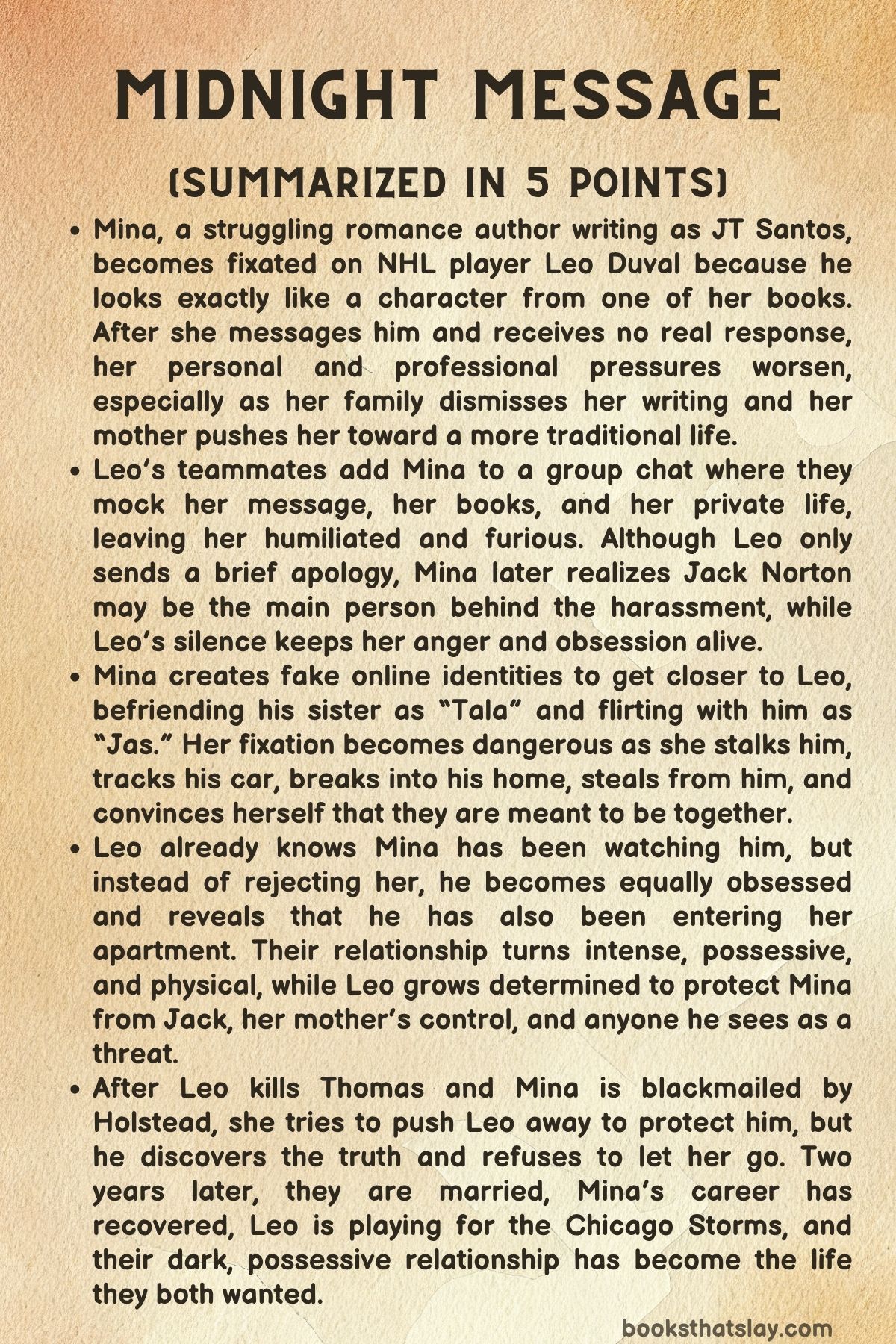
Midnight Message by Avina St. Graves is a dark romance about obsession, revenge, and two people whose worst impulses match each other too well. The story follows Mina, a struggling author whose fixation on hockey star Leo Duval begins with one awkward message and turns into stalking, deception, and a dangerous bond neither of them wants to escape.
Instead of presenting love as soft or safe, the book explores a relationship built on surveillance, possession, fear, desire, and loyalty. It is a morally dark story where romance grows in the middle of threats, violence, secrets, and emotional damage.
Summary
Mina writes romance novels under the pen name JT Santos, but her career is no longer going the way she hoped. Her latest book has failed, her confidence is slipping, and the manuscript she should be writing is stuck.
At home, things are no better. Her parents do not respect her work, and her mother constantly treats writing as if it is an embarrassing hobby instead of a real career.
She wants Mina to choose a more acceptable life, one with a proper job, church approval, and a husband who fits her mother’s idea of respectability.
During this difficult period, Mina becomes fascinated by Leo Duval, a professional hockey player in the NHL. The attraction begins because Leo looks almost exactly like Blake, a romantic lead Mina created in one of her books.
To Mina, this resemblance feels strange and personal, as if a man from her imagination has stepped into the real world. Acting on impulse, she sends Leo a message explaining the connection.
It is awkward, vulnerable, and too intense for a stranger, and Leo never replies.
That silence would have been painful enough, but the situation turns cruel when Mina is added to a group chat by several of Leo’s teammates. They have found her message and use it to humiliate her.
They mock her books, turn her writing into a joke, make sexual comments about her, dig through her private photos, and harass her online. Mina feels exposed and degraded.
Leo sends only two words: “I’m sorry.” Instead of comforting her, the message makes everything worse. She believes he may have allowed it, or at least failed to protect her.
Her hurt turns into anger, then fixation. Over time, Mina begins to suspect that Leo may not have been the person behind the attack.
His teammate Jack Norton seems especially cruel and eager to keep the harassment going. Jack continues to torment Mina through burner accounts, while Leo remains mostly silent.
The silence leaves Mina with too much room to imagine, obsess, and plan. She cannot let Leo go, even though every new detail makes the situation darker.
Determined to get closer to him, Mina begins creating false identities online. One identity is Tala, a stylish fashion influencer.
As Tala, she befriends Sabrina, Leo’s sister, and slowly builds a path into his world. Another identity is Jas, a more seductive persona created to contact Leo directly.
When Jas messages him, Leo responds. The flirtation grows quickly, and Mina becomes drawn deeper into the double life she has built.
Her obsession soon moves beyond the internet. Mina starts watching Leo in person.
She parks outside his house and the rink, tracks his routines, discovers his address, and places a tracker on his car. She breaks into his home, walks through his private rooms, takes his clothes, and lies in his bed.
Instead of seeing these actions as proof that she has crossed a dangerous line, she treats them as evidence of a connection. The more she learns about Leo, the more convinced she becomes that they are meant for each other.
What Mina does not know at first is that Leo is aware of far more than she realizes. He knows she has been watching him.
He knows she has been inside his house. He knows she has stolen from him.
Yet he is not afraid in the ordinary way. Instead, her obsession feeds something equally intense inside him.
Leo has been watching Mina too. He has broken into her apartment and observed her in secret.
Mina thinks she is the stalker in the story, but Leo has been matching her actions from the shadows.
From Leo’s perspective, the main threat is Jack Norton. Jack has spent years trying to control and isolate Leo.
He has pushed himself into Leo’s family, tried to replace him emotionally, and worked to damage anyone Leo cares about. Leo believes Jack is behind much of Mina’s harassment and sees him as a danger that must be dealt with.
His feelings for Mina become tied to anger, protection, revenge, and possession. He does not simply want her.
He wants to remove anything that has hurt her or might take her away.
Mina attends one of Leo’s games in disguise, wearing the opposing team’s jersey. Leo recognizes her anyway.
His reaction is immediate and intense. He plays with violence and focus, as if the entire game has become a message to her.
During the game, he texts her and tells her not to take her eyes off him. The moment changes their connection.
Their secret watching becomes open confrontation, and neither can pretend not to know what the other has done.
When Leo finally confronts Mina directly, they admit the truth in their own damaged language. They know they have been stalking each other.
They know the relationship is not normal. Yet neither of them wants normal.
Mina is frightened by Leo’s intensity, but she is also thrilled that he wants her with the same force she wants him. Leo gives her gifts, monitors her, pushes himself into her life, and makes it clear that he considers her his.
Their relationship becomes physical, possessive, and secret, built as much on fear and control as attraction.
At the same time, Mina’s family life continues to suffocate her. Her mother keeps belittling her and arranging encounters with Thomas, a man from church whom she considers suitable.
Thomas represents the life Mina is being pressured to accept: respectable, obedient, religiously approved, and empty of her own desires. When Leo sees Thomas touch Mina, his jealousy and rage take over.
Later, Thomas is killed. Mina learns about his death through her mother and is questioned by the police, but she and Leo are not immediately exposed.
As Mina and Leo try to hold their dangerous relationship together, a new threat appears. Mina is contacted by a blackmailer who has hacked her laptop.
This person has stolen her unpublished books, accessed her messages, learned about the tracker she placed on Leo’s car, and gathered enough information to destroy her. The blackmailer demands money and begins leaking her drafts online.
For Mina, this is devastating. Her writing is not just work; it is one of the few parts of her life that belongs to her.
Having it stolen and exposed is another violation.
The blackmailer’s control grows worse. Mina is forced to push Leo away and isolate herself from everyone who might help her.
Believing she is protecting him, she records herself breaking up with Leo. The breakup is not real in her heart, but she makes it look convincing because she fears what the blackmailer might do.
She moves back in with her parents, returning to the very place that makes her feel powerless. For Leo, the separation is unbearable.
His hockey season suffers, and his emotional state declines. He refuses to accept that Mina truly wants to leave him.
Eventually, Leo discovers the blackmail and understands why Mina pushed him away. He goes to her parents’ house and confronts the situation directly.
He refuses to let the blackmailer, her family, or fear decide their future. Mina and Leo reunite, and their bond becomes even more absolute.
The person behind the blackmail is later revealed to be Holstead, a serial home invader connected to other victims and multiple murders. The danger surrounding Mina was not only about Leo, Jack, or the team.
She had become the target of someone far more predatory.
With the threat exposed, Mina begins cutting ties with the parts of her old life that kept hurting her. She distances herself from her mother, whose control and judgment have shaped so much of Mina’s insecurity.
She also repairs her relationship with Joyce, finding some emotional ground outside the toxic family structure she has known. Leaving Detroit with Leo becomes more than an escape.
It marks the start of a life where Mina chooses herself, her writing, and the man whose darkness matches hers.
Two years later, Mina and Leo are married. Leo now plays for the Chicago Storms, and Mina’s career has recovered.
She is successful again, healthier after surgery, and mostly free from her mother’s influence. Their relationship remains possessive and intense, especially on Leo’s side, but it has settled into the kind of life both of them wanted.
They are not presented as healed in a simple or conventional way. Instead, they have built a world where their obsessions, secrets, and loyalty can exist together.
Midnight Message ends with Mina and Leo together, not because their love is safe, but because it is the one place where both of them feel fully seen. Their story moves through humiliation, stalking, violence, blackmail, family control, and revenge before arriving at a strange version of peace.
Mina begins as a woman mocked for wanting too much and ends as someone who claims her desire, her career, and her future. Leo begins as the unreachable fantasy and becomes a real, dangerous partner who is just as consumed by her as she is by him.
Characters
Mina
Mina is the emotional center of Midnight Message, and her character is built around loneliness, creative frustration, obsession, and the desperate need to be seen. At the beginning of the book, she is already vulnerable because her writing career is failing, her newest manuscript is stalled, and the people closest to her do not respect her work.
Writing under the name JT Santos gives her a second identity, but it also shows how divided she feels between who she is and who she wishes she could become. Her fascination with Leo begins because he resembles Blake, a romantic figure from her own imagination, which makes her attraction to him feel less like ordinary admiration and more like a collision between fantasy and reality.
When Leo’s teammates mock and violate her privacy, Mina’s humiliation turns into rage, shame, and fixation. She does not simply want Leo’s attention; she wants proof that she was not foolish for wanting him in the first place.
Mina is a deeply flawed character because her pain does not make her harmless. She lies, manipulates, stalks, creates fake identities, invades Leo’s private space, and convinces herself that their similarities justify her behavior.
Yet the book does not present her as a simple villain. Her actions come from emotional starvation, low self-worth, and a life where she has often been dismissed or controlled.
Her obsession with Leo becomes a twisted form of self-protection because he represents desire, recognition, danger, and escape all at once. Mina is frightening because she crosses moral lines, but she is also tragic because those lines are crossed by someone who feels powerless everywhere else.
Her relationship with Leo allows her darkest impulses to be returned rather than rejected, which makes her feel chosen in a way she has never felt before.
By the end of the story, Mina’s growth is not conventional purity or complete moral correction. Instead, her development comes through reclaiming control over her life, separating herself from her mother’s judgment, recovering her writing career, and choosing a life that accepts the strange intensity of who she is.
She becomes healthier and more secure, but she does not become ordinary. Mina remains obsessive, emotionally extreme, and drawn to danger, yet she is no longer simply spiraling alone.
Her final state suggests that she has found love, success, and freedom, but in a world shaped by the same darkness that defined her from the beginning.
Leo Duval
Leo Duval is one of the most intense and morally dangerous figures in the book. At first, he appears distant and unreachable, mainly because Mina sees him as a fantasy before she understands him as a person.
His silence after the group chat incident makes him seem cruel or cowardly, and Mina interprets that silence as betrayal. However, Leo is later revealed to be far more aware, watchful, and involved than he first appears.
He knows Mina has been stalking him, entering his house, stealing from him, and tracking him, but instead of being repulsed, he becomes fascinated by her. This reversal makes Leo a disturbing mirror for Mina.
He is not the innocent victim of her obsession; he is someone whose own obsession is just as invasive and consuming.
Leo’s character is shaped by possession, loyalty, violence, and emotional isolation. His hatred of Jack is not only about what Jack does to Mina, but also about years of Jack trying to control and replace him.
This gives Leo’s protectiveness a personal and destructive edge. When he sees Mina being touched or threatened, his response is not normal jealousy but lethal rage.
His love is never gentle in a traditional sense; it is watchful, territorial, and absolute. He monitors Mina, pushes into her life, gives her gifts, and refuses to accept separation once he believes she belongs with him.
His violence against Thomas shows that he is capable of turning desire into action without being restrained by morality or law.
At the same time, Leo is not written as emotionally empty. His fixation on Mina comes from a need to be wanted with the same intensity that he wants.
He sees her stalking not only as a violation but as proof that someone has finally chosen him completely. That is what makes his connection with Mina so dangerous and powerful: both characters interpret obsession as devotion.
By the end of Midnight Message, Leo has become Mina’s husband and has achieved a more stable public life through hockey, but his possessiveness remains central to who he is. He does not become harmless; instead, the story places him in a relationship where his darkness is accepted and answered.
Jack Norton
Jack Norton functions as one of the clearest antagonistic forces in the story. He is cruel, invasive, manipulative, and deeply invested in humiliating both Mina and Leo.
His behavior toward Mina begins with mockery and online harassment, but it becomes clear that his cruelty is not casual. He digs into her private life, sexualizes her, uses burner accounts, and continues attacking her after the first incident.
Jack represents the kind of public cruelty that turns private vulnerability into entertainment. He does not simply dislike Mina; he enjoys reducing her to an object of ridicule.
Jack’s role becomes even more important through his history with Leo. From Leo’s point of view, Jack has spent years trying to isolate him, insert himself into his family, and damage anyone Leo cares about.
This makes Jack more than a teammate who behaves badly. He becomes a parasitic presence in Leo’s life, someone who wants control, attention, and emotional dominance.
His attacks on Mina are therefore also attacks on Leo. Jack understands that hurting someone Leo wants is a way of hurting Leo himself.
As a character, Jack exposes the difference between obsession and cruelty in the story. Mina and Leo are obsessive, invasive, and morally unstable, but Jack’s actions are marked by contempt and exploitation.
He does not seek connection; he seeks power. His presence helps push Mina and Leo toward each other because he gives them a shared enemy.
In that way, Jack is both a villain in his own right and a catalyst for the central relationship’s darker escalation.
Sabrina Duval
Sabrina Duval is important because she becomes one of Mina’s pathways into Leo’s life. Mina approaches her through the fake identity “Tala,” using deception to build closeness with Leo’s sister.
Sabrina’s role shows how far Mina is willing to go to reach Leo, because Mina does not only target Leo directly; she enters the emotional and social spaces around him. Through Sabrina, Mina’s stalking becomes more elaborate and calculated.
Sabrina also represents the normal family world that Mina wants access to but cannot enter honestly. Because she is connected to Leo by blood, she has a natural place in his life that Mina envies and exploits.
Mina’s friendship with her is built on falsehood, but it still reveals Mina’s hunger for belonging. Sabrina is not merely a tool in the plot; she reflects Mina’s desire to be accepted into Leo’s world so completely that she is willing to invent a whole personality to do it.
Her presence also complicates Leo’s situation because Jack’s attempts to replace or insert himself into Leo’s family make family relationships emotionally charged. Sabrina stands near the center of that tension.
Even when she is not the darkest or most violent character, she matters because she is part of the intimate circle around Leo that both Jack and Mina try to enter in different ways.
Mina’s Mother
Mina’s mother is one of the most emotionally damaging characters in the story because her control is ordinary, domestic, and socially acceptable on the surface. She does not stalk or blackmail Mina, but she steadily weakens Mina’s confidence by belittling her writing, dismissing her career, and pushing her toward a life that fits religious and social expectations.
Her idea of success is narrow: a respectable job, a church-approved husband, and obedience to family expectations. For Mina, this becomes suffocating.
Her mother’s treatment helps explain why Mina is so vulnerable to obsession. Mina is not only craving romance; she is craving validation after years of being told that her dreams are foolish or embarrassing.
The pressure to meet Thomas and accept a life chosen for her shows how little her mother respects Mina’s autonomy. She treats Mina less like an adult with desires and more like a problem to be corrected.
This emotional control makes Mina’s relationship with Leo feel, to Mina, like rebellion and liberation.
By cutting off her mother, Mina takes one of her clearest steps toward independence. This break is important because it shows Mina refusing the life that has been forced on her.
Her mother remains significant not because she is physically dangerous like some other characters, but because she represents the emotional cage Mina has been trying to escape from the beginning.
Mina’s Father
Mina’s father is less forceful in the story than Mina’s mother, but his role still matters because he contributes to the atmosphere of dismissal surrounding Mina. He is part of the parental world that does not take her writing seriously and does not give her the emotional support she needs.
His passivity makes him different from Mina’s mother, but not innocent. By failing to truly defend Mina’s choices or understand her ambitions, he becomes part of the same pressure that leaves her isolated.
His character helps show that Mina’s home is not a place of comfort. Even if her mother is the more active source of control, her father’s lack of meaningful support deepens Mina’s sense that no one in her family really sees her.
This makes her later move back home during the blackmail especially painful, because it is not a return to safety so much as a return to confinement. Mina’s father represents the quieter side of family disappointment: not open cruelty, but emotional absence.
Thomas
Thomas represents the life Mina’s mother wants to impose on her. He is connected to the church-approved future that Mina rejects, and his presence is uncomfortable because he becomes a symbol of control rather than genuine romantic possibility.
When he touches Mina and Leo sees it, Thomas becomes part of the violent collision between Mina’s family life and Leo’s possessive obsession.
As a character, Thomas does not need to be deeply developed to be important. His function is symbolic and catalytic.
He represents the respectable, socially acceptable man who is supposed to be “right” for Mina, but the story frames that expectation as oppressive rather than romantic. His death marks a turning point because Leo’s jealousy and protectiveness become deadly.
Through Thomas, the book shows how dangerous Leo’s love can become when he sees someone as a threat to his claim over Mina.
Thomas is also important because his death pulls Mina closer to the criminal consequences surrounding her relationship with Leo. After learning he is dead and being questioned by police, Mina is forced to confront the reality that her connection with Leo exists outside normal moral boundaries.
Thomas therefore becomes a victim of both Mina’s controlled family world and Leo’s violent possessiveness.
Holstead
Holstead is the hidden predator whose actions widen the danger of the story beyond Mina and Leo’s relationship. As the blackmailer, he invades Mina’s digital life, steals her unpublished work, accesses her messages, learns about the tracker, and uses that knowledge to control her.
His power comes from exposure. He understands Mina’s secrets and uses them to isolate her from Leo and everyone else.
Holstead is frightening because he turns Mina’s own invasiveness back against her. Mina has stalked, lied, tracked, and broken into private spaces, but Holstead becomes the person who does the same kind of violation to her in a colder and more predatory way.
This does not erase Mina’s guilt, but it does make her vulnerable in a new way. She becomes trapped by someone who can destroy her career, her relationship, and her freedom.
His identity as a serial home invader tied to multiple murders makes him one of the most dangerous external threats in the story. Unlike Mina and Leo, whose darkness is bound up with desire and attachment, Holstead’s danger is exploitative and predatory.
He does not love, protect, or obsess in a romanticized way. He violates people for control.
His presence helps distinguish the central relationship’s mutual obsession from a more purely malicious form of predation.
Joyce
Joyce represents repair, reconciliation, and emotional grounding in Mina’s life. While many of Mina’s relationships are marked by secrecy, judgment, obsession, or control, Joyce offers the possibility of reconnection.
Mina’s reconciliation with her matters because it shows that Mina’s future is not only defined by Leo. Even though Leo is central to Mina’s life, Joyce reminds readers that Mina also needs relationships that are not built entirely around danger and possession.
Joyce’s importance lies in the emotional balance she brings to the later part of the story. Mina has been isolated by harassment, family pressure, blackmail, and her own choices.
Reconnecting with Joyce suggests that Mina is beginning to rebuild some part of herself outside fear and obsession. Joyce does not erase the darkness of the story, but she gives Mina a human connection that feels more restorative.
As a character, Joyce also helps show Mina’s movement away from shame. Mina’s life has been shaped by people who mock her, control her, or use her secrets against her.
Reconciliation with Joyce suggests that Mina can still be known by someone and not completely rejected. That makes Joyce a quiet but meaningful figure in Mina’s emotional recovery.
Blake
Blake is not present in the same way as the living characters, but he is still important because he is the fictional love interest who shapes Mina’s first perception of Leo. Mina notices Leo because he looks exactly like Blake, and this resemblance turns Leo into something more than a celebrity crush.
He becomes the living version of a fantasy Mina created herself. That connection blurs the line between Mina’s imagination and reality.
Blake’s role reveals how deeply Mina’s writing and emotional life are connected. Her fictional world is not separate from her desires; it influences how she sees real people.
Because Leo resembles Blake, Mina feels that there must be meaning behind the resemblance. This belief becomes one of the foundations of her obsession.
She starts treating coincidence as destiny.
Even though Blake is not an active participant in the plot, he is essential to understanding Mina. He represents the romantic ideal she invented before Leo entered her life.
Through Blake, the story shows how Mina’s loneliness, creativity, and longing can transform fiction into fixation.
Leo’s Teammates
Leo’s teammates function as a collective force of humiliation and cruelty. By adding Mina to the group chat, sharing her private message, mocking her books, sexualizing her, and digging up her private photos, they turn her vulnerability into a spectacle.
Their behavior is important because it begins the chain of rage, shame, and obsession that follows. They make Mina feel exposed and powerless, and that emotional injury pushes her further toward fixation on Leo.
As a group, they represent the uglier side of fame, masculinity, and online cruelty. They have social power because they are connected to Leo and because they can laugh at Mina together.
Their group behavior makes the harassment feel even more dehumanizing. Mina is not being rejected privately; she is being mocked in front of others.
That public humiliation becomes a wound she cannot easily move past.
The teammates also help contrast Leo with the people around him. Although Leo is dangerous in his own ways, he does not enjoy Mina’s humiliation the way they do.
Their cruelty helps position Leo as both part of the world that hurts Mina and someone separate from it. This tension is one reason Mina’s feelings toward him become so conflicted.
JT Santos
JT Santos is Mina’s pen name rather than a separate person, but this identity is still important to her character. It represents the version of Mina who can publish, desire, imagine, and speak through romance.
Under this name, Mina has built a career and a creative self, even if that career is under pressure when the story begins. The failure of her latest work is therefore not just professional disappointment; it feels like a personal collapse.
This identity also shows Mina’s split between public invisibility and private intensity. As Mina, she is judged by her parents and humiliated by strangers.
As JT Santos, she has created stories and romantic figures that express what she wants but may not know how to ask for directly. The fact that Leo resembles one of her fictional creations makes the JT Santos identity central to the beginning of her obsession.
JT Santos reveals that Mina’s imagination is powerful enough to shape her reality. Her writing is not a background detail; it is part of how she understands love, fate, desire, and self-worth.
When her career recovers later, it signals more than financial or professional success. It shows that Mina has reclaimed the creative identity that had been damaged by failure, mockery, and fear.
Themes
Obsession as a Form of Emotional Control
Obsession shapes the central relationship in Midnight Message, turning desire into surveillance, possession, and control. Mina’s fixation on Leo begins with fantasy, but it quickly becomes a need to confirm that he belongs to the world she has created in her mind.
Her fake identities, stalking, tracking, and break-ins show how emotional longing can become invasive when it is fed by loneliness, rejection, and the need to be chosen. Leo mirrors this obsession instead of rejecting it, which makes their connection disturbing but mutual.
His awareness of Mina’s actions and his own secret monitoring of her show that both characters treat privacy as something love can override. Their relationship does not grow through trust in the usual sense; it grows through exposure, danger, and possession.
The theme becomes more complex because neither character is presented as innocent. Their bond is built on behavior that would normally signal fear, yet for them it becomes proof of devotion.
Public Humiliation and Digital Vulnerability
Mina’s online harassment shows how quickly private embarrassment can become public cruelty. A single awkward message becomes material for mockery, sexual comments, and invasion when Leo’s teammates share it without care for her humanity.
The group chat scene reveals how digital spaces can turn people into entertainment, especially when the victim is already emotionally fragile. Mina is not only mocked for her message; her work, photos, and identity as a writer are also attacked, making the humiliation feel total.
Jack’s continued harassment through burner accounts shows how online abuse can follow someone beyond one platform and create constant fear. The later blackmail deepens this theme because Mina’s laptop, drafts, messages, and secrets are taken from her.
Her creative work, which should belong to her alone, becomes a weapon against her. The story uses these violations to show that digital exposure is not harmless gossip.
It can damage confidence, relationships, careers, and a person’s sense of safety.
Family Pressure and the Demand for Respectability
Mina’s conflict with her mother shows the emotional damage caused by a family that values obedience over individuality. Her writing career is dismissed because it does not fit her parents’ idea of success, and her mother’s pressure pushes her toward a life that looks respectable from the outside but feels suffocating to Mina.
The forced attention from Thomas reflects this same demand for control. He represents the kind of man her mother approves of, not someone Mina chooses for herself.
This makes Mina’s home life feel less like a source of comfort and more like another space where she has to defend her identity. Her mother’s criticism also helps explain Mina’s hunger for Leo’s attention.
Being desired by him becomes powerful because she has been made to feel foolish, unstable, and unsuccessful elsewhere. Cutting off her mother is therefore not only an act of rebellion; it is a step toward emotional survival.
Mina has to reject the life chosen for her before she can claim her own.
Revenge, Protection, and Moral Corruption
Protection in the story is often tied to violence, secrecy, and revenge, which makes the characters’ moral choices difficult to separate from their emotional wounds. Leo sees Jack as a threat not only because of what he does to Mina, but because Jack has spent years trying to control Leo’s life and relationships.
This history turns Leo’s protectiveness into something darker, where punishment feels justified because the enemy has caused lasting harm. His killing of Thomas also shows how easily jealousy and protection can become moral corruption.
Leo frames his actions through devotion, but the result is still violence. Mina’s response to danger is also morally blurred.
She lies, stalks, manipulates identities, and later pushes Leo away to protect him from blackmail. The story repeatedly places love beside harm, asking the reader to sit with characters who do terrible things for reasons that are emotionally understandable but not ethically clean.
In this world, safety is rarely peaceful. It is seized through control, secrecy, and damage.