Molka by Monika Kim Summary, Characters and Themes
Molka by Monika Kim is a dark psychological thriller about surveillance, shame, revenge, and the violence hidden inside ordinary places. Set mainly in Seoul, the book follows Junyoung, an office worker who uses hidden cameras to spy on women, and Dahye, a finance employee whose life is shaken by betrayal, public humiliation, and the ghost of her dead sister.
The story moves through corporate offices, luxury spaces, hotel rooms, and private apartments, showing how power protects predators while victims are judged and discarded. Molka is disturbing, sharp, and morally bleak, with a supernatural edge that turns grief into vengeance.
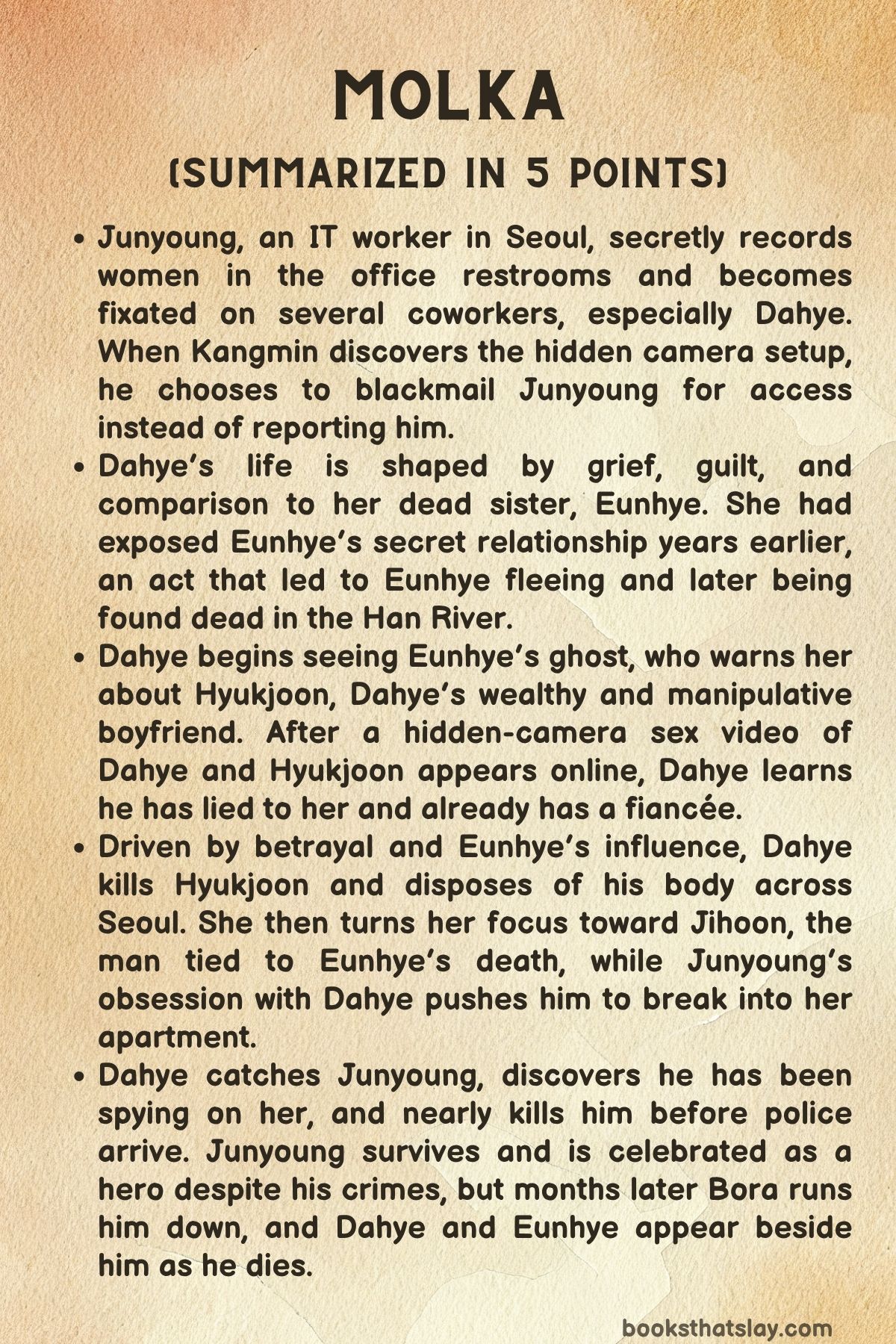
Summary
Junyoung is an IT worker in a Seoul office who hides behind the bland surface of routine work. To his coworkers, he seems ordinary and forgettable, but he has built a secret system of hidden cameras in the women’s restrooms at the office.
From his cubicle, he watches female coworkers without their knowledge, storing and replaying footage as his private source of power. He fixates on different women, including Michelle, interns, and later Dahye, a finance employee who works on another floor.
His desire is not romantic, despite how he frames it to himself. It is control, possession, and violation.
His hidden world almost collapses when one of the cameras shifts out of place. Panicked that the view will be ruined or the device will be discovered, he sneaks into the women’s restroom to fix it.
Mirae, a new employee, nearly catches him there. Junyoung escapes, but the incident reveals how risky and compulsive his behavior has become.
He is not simply watching from a distance anymore; he is entering women’s spaces, adjusting the tools of his abuse, and convincing himself that his cleverness will keep him safe.
That belief is tested when his coworker Kangmin discovers the hidden camera system. Kangmin could expose Junyoung, report him to the company, or turn him over to police.
Instead, he blackmails him. Kangmin demands access to the videos, choosing to become part of the abuse rather than stop it.
This moment shows that Junyoung’s crime is not isolated. Other men, when given the chance, may protect themselves and exploit women too.
Junyoung is terrified of being caught, but he is also relieved that Kangmin wants the material instead of justice.
Dahye, meanwhile, is living through a different kind of trap. She is dating Hyukjoon, the wealthy son of the CEO of YS Media Group.
Their relationship begins after a drunken encounter outside a karaoke bar, and Dahye is quickly drawn into his world of money, status, and access. Hyukjoon is charming when he wants to be, and his wealth makes Dahye feel chosen.
She is not secure in that feeling, though. She measures herself against her dead older sister, Eunhye, who had always seemed prettier, smarter, and more admired.
Dahye carries that comparison like a wound.
Her guilt over Eunhye’s death is even heavier. Years earlier, Dahye stole Eunhye’s diary and exposed a secret: Eunhye had been seeing an older boy named Jihoon and feared she might be pregnant.
When their father found out, Eunhye fled. Her body was later found in the Han River.
Dahye has never escaped the belief that her betrayal helped push Eunhye toward death. She loved her sister, envied her, resented her, and harmed her, all before fully understanding what she had done.
As Dahye’s relationship with Hyukjoon grows more unstable, she begins seeing signs of Eunhye. At first they are eerie fragments: wet footprints, a girl sitting on a bench, damp clothes hidden in a closet, and red eyes watching from a hotel vent.
These visions disturb Dahye’s sense of reality. They also force her to confront the past she has tried to bury.
Eunhye eventually appears to her directly, not as a comforting memory but as a drowned, ghostly figure. She tells Dahye that she has unfinished business and has been trying to warn her about Hyukjoon.
Hyukjoon’s behavior confirms that warning. He humiliates Dahye and treats her less like a partner than a thing he owns.
At a private VIP shopping salon, he pressures her sexually, then buys her an expensive red dress as if the gift can cover the damage. He takes her to Namu and surrounds her with luxury, but his attention is selfish and cruel.
Dahye wants to believe that his status means love, safety, and a future. Instead, she is slowly being reduced to another disposable woman in his life.
The damage becomes public when a hidden-camera sex video of Hyukjoon and Dahye is found online. Hyukjoon receives the news while they are at a hotel and abruptly leaves her.
The scandal spreads, and Dahye’s life shrinks under shame and fear. She hides at Bora’s apartment, trying to process what has happened, but she still clings to the idea that Hyukjoon loves her.
Her loyalty is based on desperation as much as affection. She wants the relationship to mean something, because if it does not, then she has been used and abandoned.
That illusion breaks when Dahye learns that Hyukjoon has a fiancée named Seoyeon. He has been lying to her all along.
Dahye begins following him and plants a tracker on his car, uncovering more of his deceit. Eunhye urges her forward, and Dahye’s grief, humiliation, and rage harden into a plan.
She lures Hyukjoon to her apartment and kills him. The murder is not impulsive once it begins; it becomes a deliberate act of punishment.
She mutilates his body, sends cruel messages from his phone to Seoyeon, and disposes of his remains around Seoul. She keeps one severed body part as a trophy, proof that she has taken power back in the most brutal way possible.
After Hyukjoon, Dahye turns her attention to Jihoon, the man linked to Eunhye’s downfall. Her revenge is no longer only about what Hyukjoon did to her.
It expands backward into the unresolved violence around Eunhye’s death. Eunhye’s ghost pushes Dahye to see herself not only as a victim but as someone chosen to finish what the dead cannot.
The boundary between justice, revenge, madness, and supernatural command becomes increasingly unstable.
Junyoung’s obsession with Dahye deepens when she disappears from work. Worried less about her safety than about losing access to her, he uses company records to track down her address.
When that fails to satisfy him, he follows Bora and eventually finds Dahye’s new apartment. He breaks in and steals her underwear, treating her home as another private space he has the right to invade.
Inside, he discovers evidence connecting Dahye to Hyukjoon’s death. His fantasy of watching her from a safe distance collapses when he realizes she may be far more dangerous than he imagined.
Dahye catches him. She ties him up, interrogates him, and searches his phone.
There she finds videos of herself from the office bathroom and understands that Junyoung has been spying on her. The discovery links her public humiliation to another hidden violation.
She has already been recorded and exposed by one man; now she learns that another has been watching her in secret at work. Dahye forces Junyoung to watch the recording of Hyukjoon’s murder and prepares to kill him too.
Before she can finish, two police officers arrive to question her about Hyukjoon’s disappearance. Dahye hides Junyoung in a closet, but he manages to escape.
The officers find him bound and injured. Eunhye appears again and attacks one of the officers, though the police cannot see her.
In the chaos, Dahye lunges toward Junyoung. Officer Lim shoots her.
Dahye dies laughing, a final act of defiance that leaves the living unable to fully understand what they have witnessed.
Junyoung survives and is recast by the world as a hero. Reporters praise him, coworkers celebrate him, and the police overlook the restroom videos on his phone.
His crimes disappear beneath the easier story: a brave man survived a female killer. He returns to work, receives an Employee of the Year trophy, and resumes his old habits.
The systems that should punish him instead reward him, proving that public truth often depends on who gets to tell the story.
Months later, Bora runs Junyoung down with a car. As he lies dying in the street, Dahye and Eunhye appear beside him, singing while he takes his final breath.
His punishment comes outside the law, from women he harmed directly or indirectly. Molka ends with revenge replacing justice, leaving behind a bleak picture of a society where hidden cameras, wealth, male power, and public shame destroy women long before anyone admits a crime has occurred.
Characters
In Molka, the characters are shaped by secrecy, obsession, guilt, violence, and the damage caused when people treat others as objects rather than human beings. The story presents a disturbing world where private pain and public shame collide, and each character reveals a different side of control, desire, fear, or revenge.
Through them, Molka becomes not only a story about crime and punishment, but also a dark examination of how hidden actions can destroy lives.
Junyoung
Junyoung is one of the most disturbing and morally corrupt figures in the book. At first, he appears to be an ordinary IT worker in a Seoul office, someone who blends into the workplace and hides behind the dull routine of corporate life.
However, beneath this ordinary surface, he is deeply predatory. His secret installation of cameras in the women’s restrooms shows that he has completely stripped his female coworkers of privacy, dignity, and safety.
He does not see them as full human beings, but as objects for his own private gratification. This makes his quietness and normal office presence even more frightening, because his evil is not loud or obvious; it is hidden inside everyday spaces.
His obsession with women such as Michelle, the interns, and especially Dahye reveals how detached he is from reality. He convinces himself that watching them gives him some kind of connection to them, even though his actions are invasive and cruel.
His fixation on Dahye becomes especially dangerous because it moves beyond watching. He tracks her, breaks into her private space, steals from her, and treats her life as something he has the right to enter.
Junyoung’s character shows how voyeurism can grow into stalking and how secret entitlement can become open violence.
Junyoung is also a deeply cowardly character. When Kangmin discovers his hidden camera system, Junyoung does not feel true guilt for what he has done.
Instead, he fears being exposed. His panic is centered on self-preservation rather than remorse.
Even when he is later caught by Dahye and forced to face the horror of what he has done, he remains primarily concerned with survival. This makes him morally hollow.
He is not a man who changes after being confronted with his crimes; he is a man who escapes consequences because society chooses to see him as useful in another narrative.
The most chilling part of Junyoung’s character is the way he is rewarded after Dahye’s death. He survives, becomes a national hero, receives praise, and returns to work as if his own crimes do not matter.
The police ignore the videos on his phone, and his coworkers celebrate him. This false heroism exposes the hypocrisy of the world around him.
Junyoung represents the kind of man whose crimes are overlooked when the public finds a more convenient story to believe. His eventual death at Bora’s hands feels like the book’s final answer to the injustice of his survival.
He escapes the law, but he does not escape the consequences of the harm he has caused.
Dahye
Dahye is one of the most tragic, complex, and psychologically broken characters in the book. She begins as a young woman shaped by insecurity, grief, and comparison.
Her dead older sister, Eunhye, continues to dominate her inner life even after death. Dahye sees Eunhye as prettier, smarter, more loved, and more promising, which leaves Dahye feeling like a lesser version of someone she can never surpass.
This constant comparison creates a deep emotional wound. She does not simply mourn Eunhye; she also resents her, envies her, and feels guilty for the role she played in the events that led to her death.
Dahye’s guilt over Eunhye is central to her character. As a younger sister, she stole Eunhye’s diary and exposed her secret relationship with Jihoon, as well as her fear that she might be pregnant.
This act was not a simple childish mistake. It had devastating consequences, because it led to Eunhye fleeing after their father discovered the diary.
When Eunhye’s body is later found in the Han River, Dahye is left carrying the emotional burden of believing that her betrayal helped cause her sister’s death. Her later visions of Eunhye suggest that this guilt has never truly left her.
Eunhye’s ghost is not only a supernatural presence, but also the physical shape of Dahye’s buried shame.
Her relationship with Hyukjoon reveals Dahye’s longing to be chosen and valued. Hyukjoon’s wealth, charm, and status overwhelm her because he seems to offer entry into a more glamorous and powerful world.
Dahye wants to believe that being loved by him will make her special. However, this desire blinds her to his cruelty.
He humiliates her, pressures her sexually, lies to her, and treats her as disposable. Even when the hidden-camera scandal breaks, Dahye continues clinging to the belief that Hyukjoon loves her.
This shows how deeply she wants love to rescue her from her own sense of worthlessness.
Dahye’s transformation into a killer is horrifying, but it grows out of her emotional collapse. When she learns that Hyukjoon has a fiancée and has been deceiving her, the fragile fantasy she built around him shatters.
Eunhye’s ghostly influence pushes her toward revenge, but Dahye’s own rage and humiliation are already powerful. Her murder of Hyukjoon is brutal and symbolic.
She destroys the man who objectified, used, and betrayed her, but the violence also destroys what remains of her humanity. By mutilating his body, sending cruel messages from his phone, and keeping a body part as a trophy, Dahye crosses from victimhood into monstrosity.
Even after killing Hyukjoon, Dahye does not find peace. Her attention shifts to Jihoon, showing that her revenge is not complete because her pain is not limited to one man.
She is driven by unresolved trauma, sisterly guilt, and the need to punish those connected to Eunhye’s death. Her final confrontation with Junyoung exposes another layer of horror: while she was being deceived by Hyukjoon and haunted by Eunhye, she was also being watched and violated by Junyoung.
In that moment, Dahye becomes both victim and executioner. Her death, laughing as Officer Lim shoots her, suggests a complete break from ordinary fear.
She dies as someone who has lost her place in the human world, caught between grief, madness, revenge, and supernatural influence.
Eunhye
Eunhye is one of the most important figures in the story, even though she is dead for most of the book. Her presence controls much of Dahye’s emotional life.
In memory, Eunhye appears as the ideal daughter and sister: beautiful, intelligent, admired, and full of promise. This ideal image makes Dahye feel inferior, but the truth of Eunhye’s life is far more painful.
Behind the image of perfection, Eunhye was a vulnerable young woman involved with an older boy, frightened by the possibility of pregnancy, and trapped in a situation she could not safely control.
Her death in the Han River turns her into both a personal tragedy and a haunting force. For Dahye, Eunhye is not simply a lost sister; she is the center of guilt, envy, grief, and fear.
The ghostly signs associated with her, such as wet footprints, damp clothes, and red eyes, create a constant sense that the past has not stayed buried. Eunhye’s haunting is deeply tied to water, which reflects the way she died and the way her memory keeps seeping into Dahye’s present life.
She appears as something drowned but not gone, silenced but still demanding to be heard.
As a ghost, Eunhye becomes both protector and destroyer. She warns Dahye about Hyukjoon and reveals that she has unfinished business.
This gives her a sympathetic role because she seems to be trying to save Dahye from a man who will hurt her. At the same time, Eunhye’s presence pushes Dahye toward violence.
She does not simply comfort her sister; she encourages revenge and helps deepen Dahye’s break from reality. This makes Eunhye morally ambiguous.
She may be a victim seeking justice, but she is also a force that helps turn Dahye into a murderer.
Eunhye’s character also represents the silenced suffering of women whose pain is misunderstood, hidden, or punished. Her secret relationship, possible pregnancy, and death suggest a young woman crushed by shame and fear.
The fact that her story continues after death shows that unresolved injustice does not disappear. Eunhye’s final appearance beside Dahye as Junyoung dies gives her a dark sense of closure.
She is no longer only the dead sister in Dahye’s memory; she becomes an active figure in the story’s final judgment.
Hyukjoon
Hyukjoon is a charming but cruel character whose wealth and social power allow him to manipulate others. As the son of the CEO of YS Media Group, he carries the confidence of someone who has always been protected by status.
His relationship with Dahye begins in a way that feels exciting and almost unreal to her. He appears glamorous, desirable, and superior to the ordinary world she knows.
However, his charm is a mask for selfishness and exploitation. He uses his status to impress Dahye, but he does not treat her with genuine respect.
His treatment of Dahye reveals his entitlement. He humiliates her, pressures her sexually, and acts as though expensive gifts can excuse emotional cruelty.
The red dress he buys her is not simply a romantic gesture. It becomes a symbol of control, because he dresses her according to his desires and pulls her deeper into his world of luxury and degradation.
Hyukjoon enjoys the power difference between them. Dahye is dazzled by him, while he remains detached and manipulative.
The revelation that Hyukjoon has a fiancée, Seoyeon, exposes the full depth of his deception. He has allowed Dahye to believe in a relationship that was never equal or honest.
His betrayal is especially devastating because Dahye has invested her self-worth in being loved by him. To Hyukjoon, she is replaceable; to Dahye, he has become the person who might validate her existence.
This imbalance makes his cruelty even more destructive.
Hyukjoon’s connection to the hidden-camera scandal also places him inside the larger pattern of sexual exploitation in the book. Like Junyoung, he benefits from a world where women’s bodies can be exposed, circulated, and consumed without their consent.
His panic when the video is discovered is not primarily about Dahye’s suffering, but about his own reputation. This selfishness makes his eventual murder feel like the eruption of all the humiliation and rage he has caused.
Hyukjoon is not portrayed as innocent, but his brutal death also shows that revenge does not restore justice in a clean or moral way. He is both a villain and a victim of the violence his own world helped create.
Kangmin
Kangmin is a morally weak and opportunistic character. When he discovers Junyoung’s hidden camera system, he has the chance to expose a serious crime and protect the women in the office.
Instead, he chooses blackmail. His demand for access to the videos proves that he is not horrified by Junyoung’s actions in a meaningful way.
He is interested in benefiting from the crime rather than stopping it. This makes him complicit in the violation of the women at work.
Kangmin’s role is important because he shows that evil in the book is not limited to the person who commits the original act. Junyoung installs the cameras, but Kangmin’s response allows the abuse to continue.
His silence becomes another form of harm. He represents the bystander who discovers wrongdoing but turns it into an opportunity for personal gain.
In this way, his character expands the book’s criticism from individual predators to a wider culture of complicity.
Unlike Junyoung, Kangmin does not need to be obsessed with one woman to be dangerous. His danger lies in his casual willingness to consume the suffering of others.
He treats the videos as something valuable, not as evidence of violated privacy. This makes him disturbing in a different way.
He may not be the main predator, but he shows how quickly ordinary people can become part of a system of abuse when they lack conscience.
Mirae
Mirae is a minor but significant character because she nearly exposes Junyoung when he sneaks into the women’s restroom to fix one of the cameras. As a new employee, she represents innocence and vulnerability within the workplace.
She enters an office environment without knowing that it has already been corrupted by Junyoung’s crimes. Her near discovery of him creates tension because it briefly threatens to bring the hidden abuse into the open.
Her presence also emphasizes how unsafe the women’s restroom has become. A space that should provide privacy and security has been turned into a trap.
Mirae does not need a large role to matter; her character helps show that every woman in the office is at risk, even those who barely know Junyoung. She represents the many potential victims whose lives could be harmed by a predator they may never even suspect.
Mirae’s importance also lies in what does not happen. She almost catches Junyoung, but the truth remains hidden.
This missed chance adds to the sense that the world of the book repeatedly fails to protect women at the moments when protection is most needed. Mirae becomes part of the larger pattern of almost-exposure, silence, and delayed consequences.
Michelle
Michelle is one of the women Junyoung watches and obsesses over, and her character is important because she helps reveal the pattern of his predatory behavior. Even if she is not as central as Dahye, she is still a victim of Junyoung’s hidden-camera crimes.
Through Michelle, the book shows that Junyoung’s actions are not caused by a single romantic obsession. His behavior is repeated, systematic, and rooted in his desire to control and consume women from a distance.
Michelle also represents how ordinary female coworkers are turned into objects under Junyoung’s gaze. In the workplace, she is simply a woman doing her job, but Junyoung transforms her into part of his private fantasy.
This contrast is important because it shows the gap between how women exist in their own lives and how predators choose to imagine them. Michelle’s character reminds the reader that voyeurism is not passive or harmless.
It is an act of violation, even when the victim does not immediately know it is happening.
Her role also helps establish the office as a dangerous environment disguised as a normal one. Junyoung’s cubicle, the restroom, and the workplace routines all become part of a hidden system of abuse.
Michelle’s presence in that system broadens the story beyond Dahye and shows that many women are harmed by the same secret crime.
Bora
Bora is one of the most loyal and emotionally grounded characters in the book. She gives Dahye shelter after the scandal spreads, which shows that she cares for Dahye when others might judge, abandon, or exploit her.
Her apartment becomes a temporary refuge from public shame and danger. In a story filled with betrayal and predation, Bora’s loyalty stands out because it is based on care rather than control.
However, Bora is not simply a passive friend. Her final act of running Junyoung down with a car shows that she is capable of decisive and violent action.
This moment changes the reader’s understanding of her. She is not only someone who comforts the victim; she also becomes someone who punishes the predator when official systems fail.
Since Junyoung is celebrated as a hero and allowed to return to his old habits, Bora’s action feels like a response to a world that refuses to deliver justice.
Bora’s character represents friendship, anger, and moral outrage. She sees enough of the truth to understand that Junyoung does not deserve the praise he receives.
Her violence is not presented as pure goodness, but it carries the emotional force of revenge against a man who escaped accountability. In this way, Bora becomes one of the final instruments of justice in the story, even if that justice exists outside the law.
Seoyeon
Seoyeon is Hyukjoon’s fiancée, and her role reveals the larger scale of his dishonesty. Her existence proves that Dahye was not the only woman being deceived.
Hyukjoon has built different versions of himself for different women, using lies to protect his status and pleasure. Seoyeon’s presence shatters Dahye’s belief that she has a special place in his life.
This discovery is one of the emotional triggers that pushes Dahye fully toward revenge.
Although Seoyeon is not responsible for Hyukjoon’s cruelty, she becomes entangled in the aftermath of his murder. Dahye sends cruel messages from Hyukjoon’s phone to Seoyeon, using her as another target in the revenge plot.
This shows how Dahye’s violence spreads beyond the person she directly kills. Seoyeon becomes another woman harmed by Hyukjoon’s lies and then by Dahye’s need to humiliate him through her.
Seoyeon’s character also reflects the social world Hyukjoon belongs to. As his fiancée, she is connected to respectability, status, and the future he was publicly expected to have.
Dahye, by contrast, is hidden and disposable in his life. This difference deepens Dahye’s humiliation.
Seoyeon therefore functions as both a person and a symbol of the legitimate life Hyukjoon kept separate from Dahye.
Jihoon
Jihoon is a shadowy but important character because of his connection to Eunhye’s death. As the older boy Eunhye had been secretly seeing, he represents one of the original sources of danger in Eunhye’s life.
The secrecy around their relationship, along with Eunhye’s fear that she might be pregnant, suggests that Jihoon was part of a situation that left Eunhye frightened and vulnerable. Even though he is not physically present for much of the story, his influence remains powerful.
For Dahye, Jihoon is tied to the guilt and trauma she has carried since childhood. Her theft of Eunhye’s diary exposed the relationship, but Jihoon’s role in that relationship is part of what made the secret so dangerous.
After killing Hyukjoon, Dahye turns her attention to Jihoon, which shows that her revenge is not only about her own humiliation. It is also about Eunhye and the unresolved pain surrounding her death.
Jihoon’s character functions as unfinished business. He belongs to the past, but the past continues shaping the present.
The fact that Dahye eventually focuses on him suggests that she sees him as someone who still must answer for what happened to Eunhye. Whether he is guilty in a direct legal sense or in a broader moral sense, he represents the men connected to female suffering who were never properly confronted.
Officer Lim
Officer Lim plays a crucial role near the end of the book as one of the police officers who comes to question Dahye about Hyukjoon’s disappearance. His arrival interrupts Dahye before she can kill Junyoung.
In practical terms, he becomes part of the force that stops Dahye’s immediate violence. However, his role also exposes the limits of official justice in the story.
When Eunhye appears and attacks one of the officers, the police cannot see her. This detail places Officer Lim inside a situation he cannot fully understand.
He is responding to a crime in ordinary terms, but the forces driving Dahye are psychological, supernatural, and rooted in years of guilt and trauma. His inability to see Eunhye shows the gap between legal authority and the deeper truth of what is happening.
Officer Lim’s shooting of Dahye ends her life, but it does not resolve the moral disorder of the story. Dahye is stopped, yet Junyoung survives and is later praised.
This makes Officer Lim’s action complicated. He prevents Dahye from killing Junyoung in that moment, but the system he represents fails to recognize Junyoung’s own crimes.
Officer Lim is not necessarily corrupt, but his role shows that law enforcement can stop visible violence while missing hidden violence.
Dahye and Eunhye’s Father
Dahye and Eunhye’s father is an important background figure because his reaction to Eunhye’s diary helps set the tragedy in motion. When Dahye exposes Eunhye’s secret, their father discovers that Eunhye had been seeing Jihoon and feared she might be pregnant.
His response creates the conditions that lead Eunhye to flee. Although the book does not present him as constantly present, his authority has a powerful impact on both sisters.
He represents family pressure, shame, and the danger of judgment inside the home. Eunhye’s fear after the diary is found suggests that she does not feel safe enough to explain herself or ask for help.
This makes the father part of the emotional environment that traps her. His role is not only about what he does, but about what his presence means: punishment, disappointment, and the collapse of Eunhye’s private world.
For Dahye, her father’s discovery of the diary becomes part of her lifelong guilt. She knows that her own betrayal gave him access to Eunhye’s secret.
This makes him indirectly central to Dahye’s trauma. His character shows how family authority can become destructive when it responds to vulnerability with anger or shame rather than protection.
Themes
Surveillance, Violation, and the Loss of Privacy
In Molka, hidden cameras become a symbol of how women’s bodies are watched, controlled, and turned into objects without their consent. Junyoung’s actions are not shown as a single act of curiosity or weakness, but as a repeated pattern of entitlement.
He treats the women around him as private possessions, believing he has the right to observe them in their most vulnerable moments while still appearing ordinary in public. The office setting makes this violation even more disturbing because it is supposed to be a professional space built on trust, routine, and safety.
Instead, it becomes a place where danger hides behind cubicles, coworkers, and technology. Kangmin’s blackmail also shows how easily one man’s crime becomes another man’s opportunity.
Rather than exposing the abuse, he wants access to it, proving that the problem is larger than one individual. The theme becomes even darker when Junyoung is later praised as a hero, showing how society can ignore violence against women when the offender fits a more convenient public story.
Guilt, Grief, and the Burden of the Past
Dahye’s life is shaped by a past she cannot escape. Her guilt over Eunhye’s death affects the way she sees herself, her relationships, and her sense of reality.
The stolen diary becomes more than a childhood mistake; it becomes the moment Dahye believes she destroyed her sister’s life. Because Eunhye had been seen as prettier, smarter, and more promising, Dahye’s guilt is mixed with jealousy and shame.
This makes her grief complicated, because she mourns her sister while also living under the shadow of comparison. The ghostly appearances of Eunhye suggest that the past has never truly stayed buried.
Wet footprints, visions, and direct confrontations all show Dahye’s mind and world being invaded by unresolved trauma. Eunhye’s presence may be supernatural, psychological, or both, but its meaning is clear: Dahye cannot move forward while the truth of her sister’s death remains unfinished.
Her grief gradually changes from sorrow into action, and then into violence.
Power, Class, and Emotional Manipulation
Hyukjoon’s wealth and status give him control long before his cruelty becomes obvious. Dahye is drawn to the life he represents: luxury shopping, expensive clothing, private spaces, and access to a world far above her own.
His charm works because it is supported by social power. He does not need to force his dominance openly at first; he can make Dahye feel chosen, special, and elevated.
This makes his later humiliation of her more painful because she has already tied her self-worth to his attention. The expensive red dress is not simply a gift.
It becomes a sign of ownership, pressure, and performance. Hyukjoon expects Dahye to fit the role he assigns her while hiding the truth about his fiancée and his real intentions.
His lies show how privilege can protect men from consequence while leaving women to carry shame. Dahye’s attachment to him is not foolishness but the result of emotional manipulation, class insecurity, and her hunger to be valued.
Revenge, Justice, and Moral Corruption
Dahye’s revenge begins as a response to betrayal, grief, and warning, but it quickly moves beyond justice. Killing Hyukjoon gives her a sense of control that she has lacked for years, especially after being watched, lied to, humiliated, and haunted by her sister’s death.
Yet the violence she commits is brutal and deeply disturbing, making it impossible to see her only as a victim. Her actions reveal how pain can transform into cruelty when there is no safe or fair path to justice.
The story refuses to present revenge as clean satisfaction. Dahye exposes real harm, but she also becomes capable of horror herself.
This theme is sharpened by Junyoung’s survival and public praise. The official world rewards the voyeur while condemning Dahye alone, even though both are connected to violence.
Bora’s final act suggests that when institutions fail to punish predators, revenge returns through other hands. Justice, in this world, is broken, delayed, and morally unstable.