Morsel by Carter Keane Summary, Characters and Themes
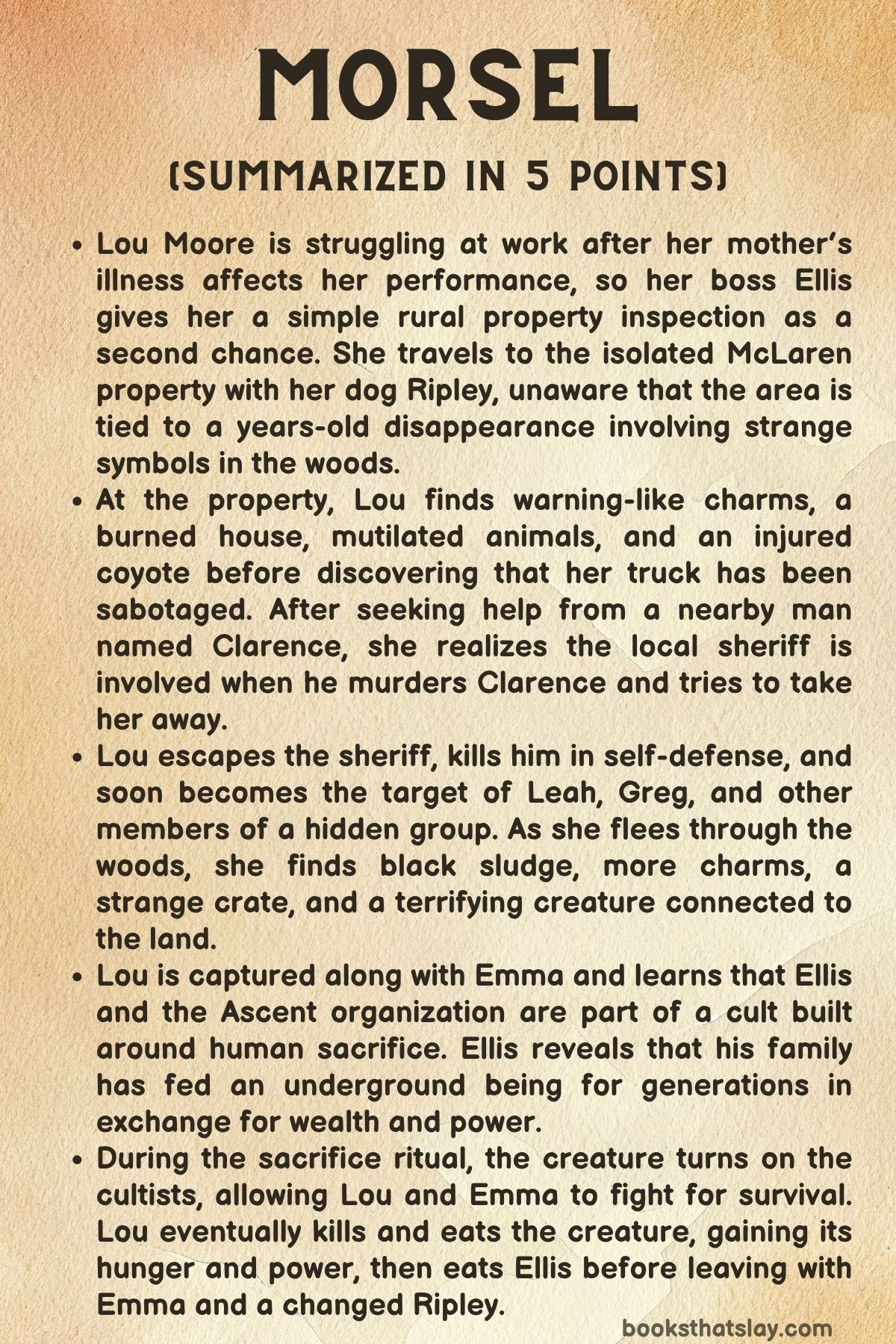
Morsel by Carter Keane is a horror novel about grief, survival, and the terrible cost of power. The story follows Lou Moore, a struggling real estate appraiser sent to inspect a remote property in rural Ohio after her work suffers during her mother’s illness.
What begins as a routine assignment turns into a fight for her life when Lou uncovers signs of ritual violence, a corrupt local network, and a starving ancient being tied to a family’s wealth. With her dog Ripley and her friend Emma caught in the danger, Lou must face not only the cult hunting her but also the loss she has tried to deny.
Summary
Lou Moore is trying to hold her life together when Morsel begins. She works for Katsaros and Curie, a real estate appraisal company in Columbus, but her recent performance has been poor.
Her mother has been seriously ill, and Lou’s attention, energy, and emotional stability have all been worn down. Her boss, Ellis Katsaros, knows she has been slipping, but instead of firing her, he offers what seems like a simple chance to prove herself.
He assigns her to inspect the McLaren property, a rural place in Lawrence County. The job is pro bono, supposedly easy, and far enough from the pressure of the office that Lou can complete it without much trouble.
Lou heads out with her dog, Ripley, despite warnings from her friend Emma. Emma is uneasy about the area, especially because of an old missing-person case linked to those same woods.
Years before, a man named Jamie Tennyson disappeared there after taking photographs of strange symbols carved or placed among the trees. The case was never properly resolved, and Emma thinks Lou should be careful.
Lou listens, but she does not take the warning seriously enough to turn back. She needs the work.
She needs to show Ellis that she can still do her job. So she drives to the property and begins the inspection.
At the gate, Lou notices odd charms hanging from the bars. They look like crosshairs, and although they seem like warnings, she chooses to ignore them.
She enters the property with Ripley and moves deeper into the woods. The place feels wrong almost from the beginning.
She photographs the remains of a burned-out house, trying to focus on the task, but the land soon reveals more disturbing signs. Lou finds mutilated animal corpses scattered in the area, suggesting either cruelty, disease, or something worse.
Then she comes across a badly injured coyote that appears sick and violent, possibly rabid. The animal chases Lou and Ripley, forcing them to run back toward the truck.
When Lou reaches her vehicle, she discovers that escape will not be simple. Her truck has been disabled.
Someone has drilled a clean hole in the gas tank, leaving her stranded in the isolated woods. Her phone will not work, and panic begins to rise as the situation shifts from strange to openly dangerous.
With no other choice, Lou and Ripley walk until they reach a nearby house owned by an elderly man named Clarence. Clarence lets them inside, gives them water, and calls the sheriff.
For a brief moment, Lou believes she has found help.
Sheriff Cory arrives, but his behavior quickly feels off. He dismisses Lou’s fears and acts as if the problem is not serious.
He offers to take Lou to the station while Clarence follows behind. Lou and Ripley are placed in the back of Cory’s cruiser, locked in and dependent on him.
Then the danger becomes unmistakable. Cory shoots Clarence in the head and drives away, revealing that he is not there to rescue Lou.
He is part of whatever is happening around the McLaren property.
Lou refuses to wait for death. She uses pepper spray through the partition of the cruiser, blinding or disorienting Cory enough to make him crash.
In the chaos that follows, she escapes with Ripley. Cory is still a threat, so Lou fights him and kills him by slamming a car door on his head.
It is a brutal act, but one born of terror and self-defense. Searching afterward, Lou finds evidence that Cory was not working alone.
The disabled truck, the strange woods, and the sheriff’s betrayal all point to a larger network.
Lou returns to Clarence’s house and manages to call Emma. She also calls 911, hoping real help will finally come.
Instead, more danger arrives first. Two people named Leah and Greg show up at the house.
Lou realizes they are connected to Cory and whoever arranged the trap. She hides, then fights them off when they threaten her.
Once again, she is forced to flee, taking Ripley back into the woods.
The forest becomes more nightmarish as Lou moves through it. She finds more of the crosshair charms, along with patches of black sludge and dead animals.
The land seems infected by something unnatural. Ripley becomes sick after the black substance gets on her, which terrifies Lou even more than the threats against herself.
She also discovers an old wooden crate, mysterious and ominous, and then sees a terrifying figure among the trees. It appears inhuman: strange, hungry, and connected to the rot and violence around her.
Lou runs while carrying the sick Ripley, desperate to get away.
Her flight is interrupted when she is struck by a car. The driver is Ellis, her boss.
At first, his arrival seems like a miracle. Lou is injured, exhausted, and frightened, and Ellis appears to be there to save her.
But as she gathers herself, she notices things that do not make sense. She sees Ascent brochures, a stone cicada, and details in Ellis’s story that do not line up.
Ascent is a self-help organization that her coworkers Arden and Jena had been pushing, and now its presence here feels suspicious rather than harmless. Lou realizes that Ellis is not an accidental rescuer.
He is involved.
Ellis takes Lou to a new house nearby, the same place she had earlier avoided. There, Leah, Greg, and others are waiting.
Lou is overpowered and chloroformed. When she wakes, she is chained in a basement and dressed in a white prairie-style dress, prepared like an offering.
To her horror, Emma has also been captured after coming to help her. Lou’s attempt to protect her friend has failed, and now both of them are trapped.
The group holding them is connected to Ascent. What once looked like a motivational or self-improvement program is revealed as a cover for something much older and darker.
Leah gives Lou and Emma drugged water and mocks Lou with personal knowledge gathered through surveillance. The cult has monitored Lou’s phone and knows intimate details of her life, including that her mother is dead.
This truth devastates Lou because she has been unable to fully face it. Her mother’s death has been sitting beneath all her fear and exhaustion, and Leah uses it as a weapon.
Lou and Emma do not surrender. They attack Leah when they get the chance.
During the struggle, something strange happens. The creature Lou saw in the woods seems to appear behind her, or to influence her, and it helps her overpower Leah.
Lou strangles Leah, and the moment suggests that the being is not simply an outside monster. It is hungry and dangerous, but it may also recognize something in Lou, or want to use her against the cult that has controlled it.
Later, Ellis prepares the true ritual. Lou is bound to an outdoor altar while Emma is restrained nearby.
Ellis explains the history behind the horror. One of his ancestors found a hungry underground being in a mine and managed to trap it.
Since then, the family has fed it human sacrifices in return for wealth and power. The ritual has been passed down for generations.
Ellis has updated the old practice through Ascent, turning sacrifice into a modern cult system. Members gather in maroon scrubs, treating murder as devotion and personal advancement.
The old crate is opened, and the creature emerges. It is pale, eyeless, starving, and monstrous.
The cult expects it to consume Lou as the chosen sacrifice, but their control over it is weaker than they believe. Instead of eating only Lou, the creature attacks the cultists.
Greg and others are slaughtered as the ritual collapses into chaos. Emma manages to free Lou, and the two women flee into the house while the creature continues killing outside.
Inside, the danger is not over. Arden attacks Lou and Emma, insisting that Lou is the proper sacrifice and trying to force the ritual back into its intended shape.
The creature breaks into the house, and the violence spreads. Ellis attempts to regain control using a whistle and a gun, but the old system he inherited is falling apart.
The being is too hungry, too angry, and too free.
Ripley, already weakened by the black substance, lies dying. For Lou, this becomes the final breaking point.
She has lost her mother, nearly lost Emma, and now seems about to lose the one constant companion who has stayed with her through the nightmare. When the creature bites Lou, she fights back with raw desperation.
She reaches into its wounded chest, pulls out its heart, and begins to eat it.
By consuming the creature, Lou changes the rules of the story. She does not remain the victim or the sacrifice.
She takes in the creature’s hunger and healing power, devouring the thing that was meant to devour her. The act transforms her.
Afterward, Ripley revives, also changed by the creature’s blood. The bond between Lou and Ripley survives, but neither of them is quite what they were before.
Lou then finds Ellis trying to escape. He has spent the story presenting himself as an employer, a leader, and a man in control, but by the end he is only another source of food.
Lou eats him too, completing her break from the world he represented. Emma arrives in a car, horrified by what Lou has become but still unwilling to abandon her.
Lou gets in with Ripley and admits that she ate Ellis. She also says she is hungry.
Emma drives away with Lou and Ripley, choosing survival and loyalty even after witnessing Lou’s transformation. The ending leaves Lou alive, powerful, and changed by the hunger she has taken into herself.
The cult has been destroyed, Ellis is dead, and the old god has been consumed, but the appetite at the center of the horror has not vanished. It now lives in Lou, turning her escape into the beginning of something new and dangerous.
Characters
Lou Moore
Lou Moore is the central character of Morsel, and her journey is built around grief, survival, denial, and transformation. At the beginning of the book, Lou is emotionally fragile because of her mother’s illness and death, even though she has not fully accepted that loss.
Her declining work performance shows that she is already under pressure before the horror of the rural property begins. Lou is not introduced as a fearless hero, but as someone exhausted, vulnerable, and trying to keep her life from falling apart.
This makes her bravery feel more human, because she is forced to act while already carrying emotional pain.
Lou’s strength becomes clearer once she enters the McLaren property. She makes mistakes, such as ignoring the charms on the gate and continuing into the woods, but these choices come from practicality and desperation rather than carelessness.
Once the danger becomes real, Lou adapts quickly. Her escape from Sheriff Cory, her killing of him in self-defense, and her repeated attempts to protect Ripley and Emma show that she has a fierce instinct to survive.
She is terrified, but she does not become helpless. Her courage is physical, emotional, and moral, because she keeps fighting even after realizing that the people around her are connected to a larger system of sacrifice and control.
Lou’s relationship with grief is one of the most important parts of her character. Leah’s taunting about Lou’s mother forces Lou to confront the truth she has been avoiding.
Her mother’s death has created a hollow space inside her, and the creature’s hunger mirrors Lou’s own emptiness. By the end of the story, Lou’s transformation is not only physical but symbolic.
When she eats the creature’s heart and later devours Ellis, she becomes something beyond an ordinary survivor. She absorbs the hunger that once threatened her, turning victimhood into power.
However, this victory is disturbing rather than purely triumphant, because Lou survives by becoming connected to the same monstrous appetite that destroyed so many others.
Ripley
Ripley is Lou’s dog and one of the most emotionally important characters in the book. She represents loyalty, innocence, and the last remaining piece of comfort in Lou’s unstable life.
Ripley’s presence makes Lou’s isolation in the woods more intense, because Lou is not only trying to save herself but also protect a creature who depends on her completely. This gives Lou’s actions an emotional urgency that would not be as strong if she were alone.
Ripley also functions as a measure of the supernatural danger. When she becomes sick after contact with the black substance, the threat becomes more personal and frightening.
The horror is no longer only in the woods, the cult, or the creature; it has touched something pure and beloved. Lou’s determination to carry Ripley, protect her, and keep her alive reveals Lou’s tenderness beneath her panic and violence.
Ripley brings out Lou’s most protective instincts.
By the end, Ripley’s revival after exposure to the god’s blood mirrors Lou’s own transformation. Like Lou, Ripley does not simply survive unchanged.
Her return suggests that the creature’s power has altered both of them. Ripley remains loyal, but she is no longer only a symbol of ordinary love and comfort.
She becomes part of the new, unsettling life Lou enters after consuming the creature. This makes Ripley both comforting and eerie, because she stays beside Lou even as Lou becomes something monstrous.
Emma
Emma is Lou’s friend and emotional anchor. From the beginning, she is shown as someone who worries about Lou and tries to protect her from danger.
Her concern about the isolated property and the missing-person case shows that she is cautious and perceptive. Emma understands that something feels wrong before Lou fully accepts the danger.
This makes her an important contrast to Lou, who initially tries to treat the assignment as a simple job.
Emma’s loyalty is one of her defining traits. She comes to help Lou even though doing so places her directly in danger.
Her capture proves that her friendship is active rather than passive; she is not just someone Lou calls for comfort, but someone willing to risk herself. In the basement, Emma’s presence gives Lou another reason to keep fighting.
Their relationship becomes a source of resistance against the cult’s attempt to reduce them to sacrifices.
At the end of the story, Emma’s reaction to Lou’s transformation is complex. She is horrified when Lou admits she ate Ellis, but she still helps her escape.
This moment shows the depth of Emma’s loyalty, but it also introduces uncertainty into their bond. Emma is no longer simply rescuing a traumatized friend; she is driving away with someone who has become dangerous and hungry.
Her decision to help Lou despite fear makes her compassionate, but it also leaves her future with Lou deeply uncertain.
Ellis Katsaros
Ellis Katsaros is one of the main human villains of the story. At first, he appears to be Lou’s boss and the person giving her a second chance at work.
This makes him seem practical, perhaps even generous, because he assigns her what appears to be an easy pro bono inspection. However, this kindness is deceptive.
Ellis uses Lou’s vulnerable position to send her into danger, showing that his authority over her is part of his manipulation.
Ellis’s evil is rooted in inheritance, privilege, and control. His family has benefited for generations from feeding human sacrifices to the trapped underground being.
Unlike someone acting out of panic or ignorance, Ellis understands the system and chooses to continue it. His decision to modernize the practice through Ascent reveals his ability to disguise brutality as self-improvement and spiritual purpose.
He turns murder into ritual and presents exploitation as enlightenment.
Ellis is especially disturbing because he believes he can control forces much older and more powerful than himself. His whistle, gun, and ritual language suggest arrogance.
He treats the creature as a tool that exists to serve his family’s wealth and influence. His downfall comes because that belief is false.
When Lou eats him, his authority is completely reversed. The man who tried to feed others to a monster becomes food himself, making his death a fitting punishment for the system he maintained.
Clarence
Clarence is a brief but important figure because he represents ordinary decency in a world filled with deception. When Lou reaches his house, he gives her shelter, water, and help.
In a story where many characters are secretly connected to violence, Clarence’s kindness stands out. He does not ask for anything from Lou or try to control her.
His role is simple but morally significant: he helps someone in need.
His death is one of the major turning points in the book. Sheriff Cory’s sudden murder of Clarence destroys Lou’s assumption that official help is available.
Clarence’s killing proves that the danger is not limited to the woods or the strange property. It has spread into the local power structure.
The shock of his death forces Lou to understand that she cannot trust appearances, titles, or authority.
Clarence also deepens the cruelty of the villains. He is elderly, harmless, and generous, which makes his murder feel especially cold.
His death shows how easily innocent people are erased by those protecting the cult’s secrets. Though he appears only briefly, Clarence leaves a strong impression because he offers Lou a glimpse of safety just before that safety is violently taken away.
Sheriff Cory
Sheriff Cory is a corrupt authority figure who turns the idea of protection into a trap. When he arrives after Clarence calls for help, Lou has reason to believe she is finally safe.
His role as sheriff should mean order, law, and rescue. Instead, he is dismissive, deceptive, and violent.
His betrayal is terrifying because he uses the trust attached to his position to gain control over Lou.
Cory’s murder of Clarence reveals his true nature with brutal clarity. He is not merely lazy or incompetent; he is actively involved in preserving the cult’s secrecy.
By locking Lou and Ripley in the cruiser, killing Clarence, and driving away, Cory becomes one of the first clear signs that the conspiracy is organized and protected. He represents the way institutions can become tools of evil when corrupt people occupy positions of power.
Lou’s killing of Cory is an important moment in her development. It is violent and shocking, but it is also self-defense.
By slamming the car door on his head, Lou crosses from ordinary fear into active survival. Cory’s death proves that Lou can fight back against people who appear stronger or more powerful than she is.
His character exists to reveal both the reach of the conspiracy and the beginning of Lou’s transformation into someone capable of extreme action.
Leah
Leah is one of the cult’s most openly cruel members. She is not hidden behind politeness in the same way Ellis is.
Instead, she taunts Lou and Emma, gives them drugged water, and uses personal knowledge as a weapon. Her cruelty is psychological as much as physical.
By revealing that the group monitored Lou’s phone and knows about her mother, Leah violates Lou’s privacy and attacks her grief directly.
Leah’s character shows how the cult dehumanizes its victims before sacrificing them. She treats Lou and Emma not as people but as objects in a ritual.
Her behavior suggests that she enjoys the power she has over them. This makes her more than a follower; she is an active participant in the system’s sadism.
She believes in the group’s right to control, drug, dress, bind, and sacrifice others.
Her death is significant because it happens while Lou is being influenced or helped by the creature. When Lou strangles Leah, the moment becomes both revenge and transformation.
Leah tried to reduce Lou to a helpless offering, but Lou becomes the force that kills her. The creature’s presence behind Lou makes the scene unsettling, because Lou’s victory is tied to something monstrous.
Leah’s death therefore marks the point where Lou’s resistance begins merging with the creature’s hunger.
Greg
Greg is one of the cult members who helps hunt and capture Lou. He represents the physical threat of the group: the people who appear when Lou is hiding, who help enforce the ritual, and who make escape nearly impossible.
While Ellis provides leadership and ideology, characters like Greg show how that ideology becomes action. He is one of the hands that carries out the violence.
Greg’s importance lies in his role as a committed participant. He is not shown as hesitant or conflicted.
He helps Leah and the others pursue Lou, which places him firmly within the cult’s machinery. His presence makes the group feel larger and more dangerous, because Lou is not fighting one deranged person but a network of people who share the same purpose.
His death during the creature’s attack demonstrates the collapse of the cult’s control. Greg and the others believe the ritual will follow familiar rules, with the chosen sacrifice being consumed while the cult survives.
Instead, the creature turns on them. Greg’s slaughter is part of the story’s reversal of power: those who fed others to the monster become victims of the monster themselves.
Arden
Arden is connected to Ascent and helps show how the cult hides behind the language of self-improvement. As Lou’s coworker, Arden belongs to the ordinary world of offices, jobs, and social pressure, but that ordinary appearance masks something far more sinister.
Arden’s connection to Ascent suggests that the cult does not only exist in rural isolation; it has entered Lou’s workplace and daily life.
Arden’s attack inside the house reveals her fanaticism. She insists that Lou is the proper sacrifice, showing that she believes in the ritual structure even after chaos has broken out.
This makes Arden different from someone who might simply be afraid of Ellis or trapped in the group. She appears committed to the belief that Lou must be offered up.
Her loyalty to the ritual continues even when the creature is killing cultists, which shows how deeply she has accepted the cult’s logic.
Arden also represents betrayal through familiarity. Because she is linked to Lou’s workplace, her involvement makes Lou’s professional life feel contaminated by the cult.
The danger was never only waiting at the McLaren property; it was already near Lou through the people around her. Arden’s character expands the horror by showing how easily predatory systems can disguise themselves as career culture, motivational language, and friendly recommendation.
Jena
Jena is another coworker associated with Ascent, and her role helps establish how the organization spreads through social influence. She may not be as directly violent in the provided events as Leah, Greg, or Arden, but her importance comes from helping normalize Ascent in Lou’s environment.
By pushing the organization along with Arden, Jena contributes to the cult’s respectable public face.
Jena’s character shows that harm does not always begin with open violence. Sometimes it begins with persuasion, workplace pressure, and the promotion of a seemingly helpful program.
Ascent appears to be a self-help organization, but beneath that surface it is tied to sacrifice and control. Jena’s involvement makes her part of that deception, whether through full knowledge or willing participation in its influence.
Through Jena, the book suggests that dangerous groups often survive because they are made to look ordinary. They enter offices, friendships, and professional networks before revealing their true nature.
Jena’s role may be quieter than the roles of the more openly violent cult members, but she is still important because she helps show how the cult recruits, spreads, and hides.
Jamie Tennyson
Jamie Tennyson is a missing man whose disappearance adds mystery and dread to the story before Lou fully understands what is happening. He vanished years earlier in the same area after photographing strange symbols in the trees.
His story functions as a warning that Lou does not fully heed. Before the direct violence begins, Jamie’s disappearance suggests that the woods already have a history of swallowing people.
Jamie is important because he connects the present danger to the past. Lou’s experience is not an isolated accident; it is part of a pattern.
The symbols he photographed are linked to the strange charms and ritual signs Lou later encounters. Through Jamie, the book creates the sense that many people may have come close to the truth and paid for it.
Although Jamie is absent from the main action, his absence itself has power. He represents the victims whose stories were buried, ignored, or turned into local rumor.
His disappearance makes the setting feel haunted by unresolved violence. He also helps prepare the reader to understand that the cult’s secrecy has been maintained over time through fear, murder, and the disappearance of inconvenient witnesses.
Themes
Grief and Emotional Avoidance
Lou’s struggle is shaped by the loss of her mother, even before she fully admits that loss to herself. Her declining performance at work, her fear of losing stability, and her refusal to face the truth about her mother’s death all show how grief can distort a person’s ability to think clearly and protect themselves.
In Morsel, Lou’s emotional avoidance makes her vulnerable because she is already weakened by guilt, exhaustion, and denial when she enters a place filled with real danger. The cult’s cruelty becomes more personal when Leah uses Lou’s mother’s death to hurt her, proving that emotional wounds can be exploited just as easily as physical weakness.
Lou’s survival depends not only on escaping the cult but also on confronting the truth she has been resisting. Her transformation near the end suggests that grief does not simply disappear; it changes form.
What begins as pain, fear, and denial becomes hunger, rage, and a new kind of power.
Power, Wealth, and Exploitation
The cult’s history reveals a brutal connection between privilege and violence. Ellis’s family has gained wealth and influence by feeding human beings to the underground creature, turning murder into a hidden system of inheritance.
This theme shows how power often depends on suffering that is kept out of sight. Ellis presents himself as professional, helpful, and respectable, but beneath that image is a man willing to sacrifice others to preserve his status.
His use of Ascent makes the exploitation even more disturbing because he disguises violence as self-improvement and community. The cult members are not random killers; they are people who believe they are entitled to benefit from another person’s death.
Lou is chosen because she seems disposable to them: isolated, grieving, and easy to control. By the end, the same system that fed on victims collapses when the creature turns against its worshippers.
Their belief that they could manage violence for personal gain proves false.
Survival and Transformation
Lou’s journey is driven by survival, but survival changes her in ways she cannot reverse. At first, she survives through quick thinking, fear, and instinct.
She escapes the sheriff, protects Ripley, fights attackers, and keeps moving even when injured and terrified. Her will to live is tied closely to her love for Ripley and Emma, which gives her a reason to resist when the cult tries to reduce her to a sacrifice.
As the danger grows, survival becomes more than escape; it becomes transformation. Lou does not defeat the creature from a safe distance.
She fights it physically, consumes its heart, and takes its hunger into herself. This act changes the meaning of survival from endurance into possession of power.
Lou is no longer only the hunted person trying to get away. She becomes something the remaining villains fear.
The ending complicates victory because Lou lives, but she carries the creature’s hunger with her.
Corruption Behind Ordinary Respectability
Much of the horror comes from the way danger hides behind ordinary faces and familiar institutions. Lou’s boss, the sheriff, coworkers, and the self-help group all appear connected to normal social structures: employment, law enforcement, professional ambition, and personal growth.
These are things people usually trust, yet each one becomes part of the trap. Cory’s betrayal is especially shocking because he represents public safety, but he murders Clarence without hesitation.
Ellis’s betrayal is equally disturbing because he uses his authority as Lou’s employer to guide her toward danger while pretending to give her a second chance. The theme suggests that evil does not always announce itself through obvious signs.
Sometimes it wears polite language, business clothing, motivational slogans, and official power. Lou’s experience shows how easily trust can become a weapon when people in authority use their roles to control information and isolate victims.
The ordinary world becomes frightening because its protections fail.